My Music Magazine
Evaluation Of My Music Magazine Conventions
Q1
In what ways does your media product work
use, develop or challenge forms and
conventions of real media products?
My Music Magazine Front Cover !
Front Cover Conventions
Masthead
Barcode
The main
image
Pull
Quote
Main
Article
Cover
Item
The Masthead
The Masthead is usually located at the
top left of the page conventionally in a
bigger text size and different font.
The Masthead is on all magazines from
R&B to Classical as it’s the Title of your
magazine. I chose this Font rather than
“Cracked” and “Chalk duster” because I
want my magazine to represent my style
which is to portray every style of rock
from Glam to Heavy Metal.
The Masthead is called “Audacious” to
suggest my magazines style to take
risks suggesting it’s unpredictably
entertaining.
The Image
The Image is the main convention on every
front cover on all magazines as it’s the
images you first see on the magazine that
attracts the reader to buy the magazine.
Also, conventionally the image would be a
middle shot of the artist most commonly
looking straight ahead rather than looking
down to really make the image stand out
to the reader.
On my Magazine I decided to choose an
different style of image, instead of an HD
quality, I chose an distorted image with a
lot of effects to really make my image and
overall look of my magazine very much
different than any other magazine.
Main Article
The Main Article is conventionally the second
biggest text size on your magazine front cover
usually just saying the band name the magazine is
focusing on.
The main article is influenced by the pull quote and
must be bold and stand out from the magazine. It’s
normally one of the first things the observer reads
even before looking at the title.
The Main article must be eye catching and give a
little context on why this particular magazine is
looking at this band. For an example I have chosen
“Saint or Sinner ?” as it is quite vague and makes
the reader really think about what this magazine will
be focusing on with this band.
Pull Quote
The Pull Quote is located conventionally near
The Main image and most likely relating to the
Main article.
The pull quote usually would be intriguing to
hook the reader as it will not be longer than a
few words cause people may not read it. Very
few magazines don’t have a pull quote but the
ones who do are effective on attracting the
reader.
I chose “Don’t listen to the Paparazzi” to
persuade the reader to read more and it links
to my main article.
Cover Item
The Cover Items would appear down the side
of the front cover in a not so dominant font
size. Some magazines like my self have used
two cover items with one being more
dominant than the over cover item.
The cover items give the reader a more
detailed idea on what this magazine is about
and to prepare them on what the reader will
be reading if they decide to carry on reading
the Magazine.
The cover item gives the reader more insight
and context on the chosen main topics in my
magazine with only a few words to persuade
the reader.
My Music Magazine Contents Page
Contents Page Conventions
Issue Number
Issue Date
Contents
Main Image
Editors Review
Page
Numbers
Headings
Images
Images
The images on the contents page are
conventionally all different from the
style to the colours and more, as not
every page in the contents is on a
musician’s new songs the images
must be seen to be different or
creative.
Also the images commonly are
highlighted with colour to match the
house colours on the magazine to
attract the readers eye and make it
look more professional rather than just
a plain white dull image.
Conventionally on the contents page
there is an main image and smaller
images around to draw the reader on.
Headings
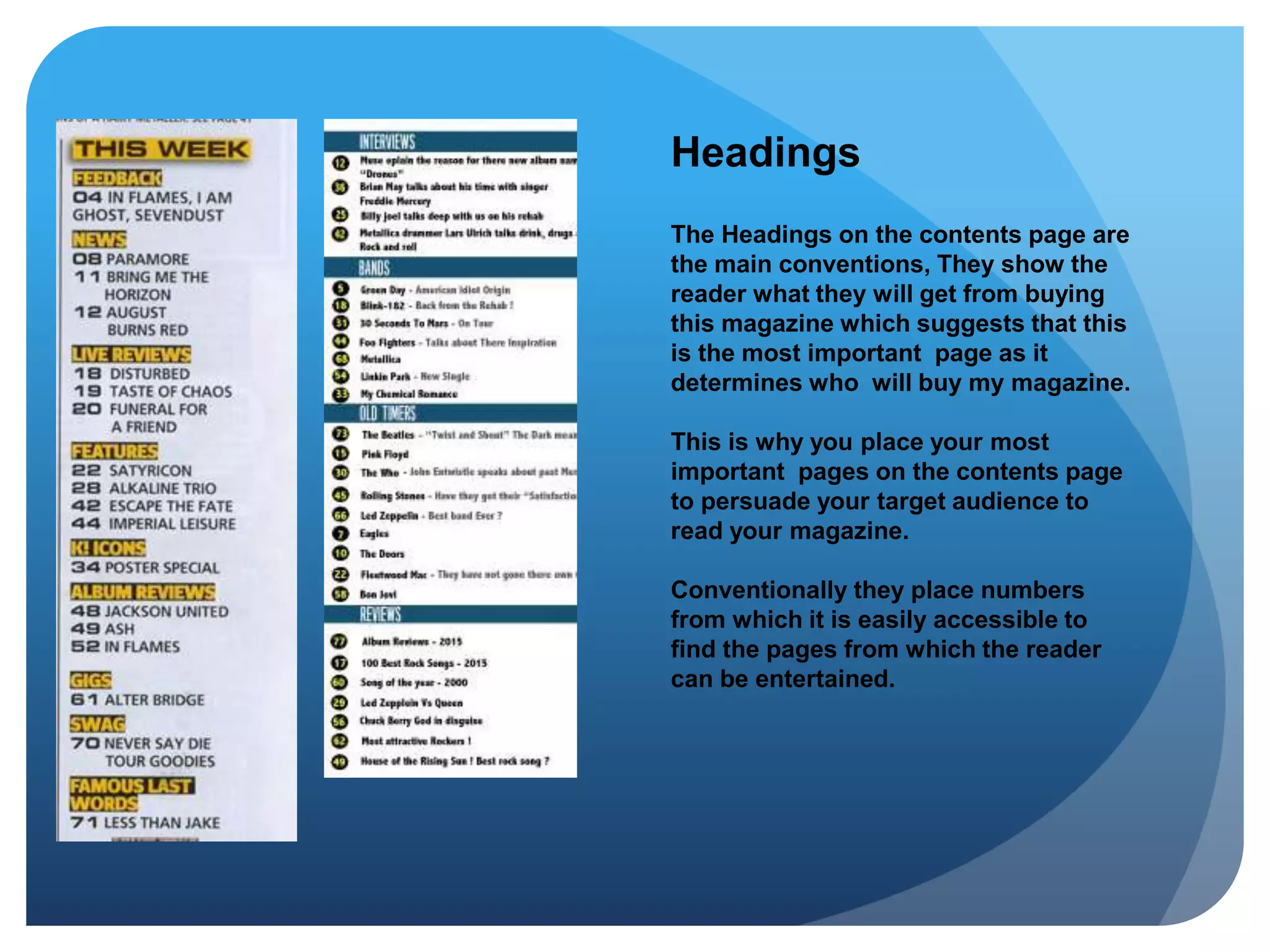
The Headings on the contents page are
the main conventions, They show the
reader what they will get from buying
this magazine which suggests that this
is the most important page as it
determines who will buy my magazine.
This is why you place your most
important pages on the contents page
to persuade your target audience to
read your magazine.
Conventionally they place numbers
from which it is easily accessible to
find the pages from which the reader
can be entertained.
My Music Magazine Article Page
Article Page Conventions
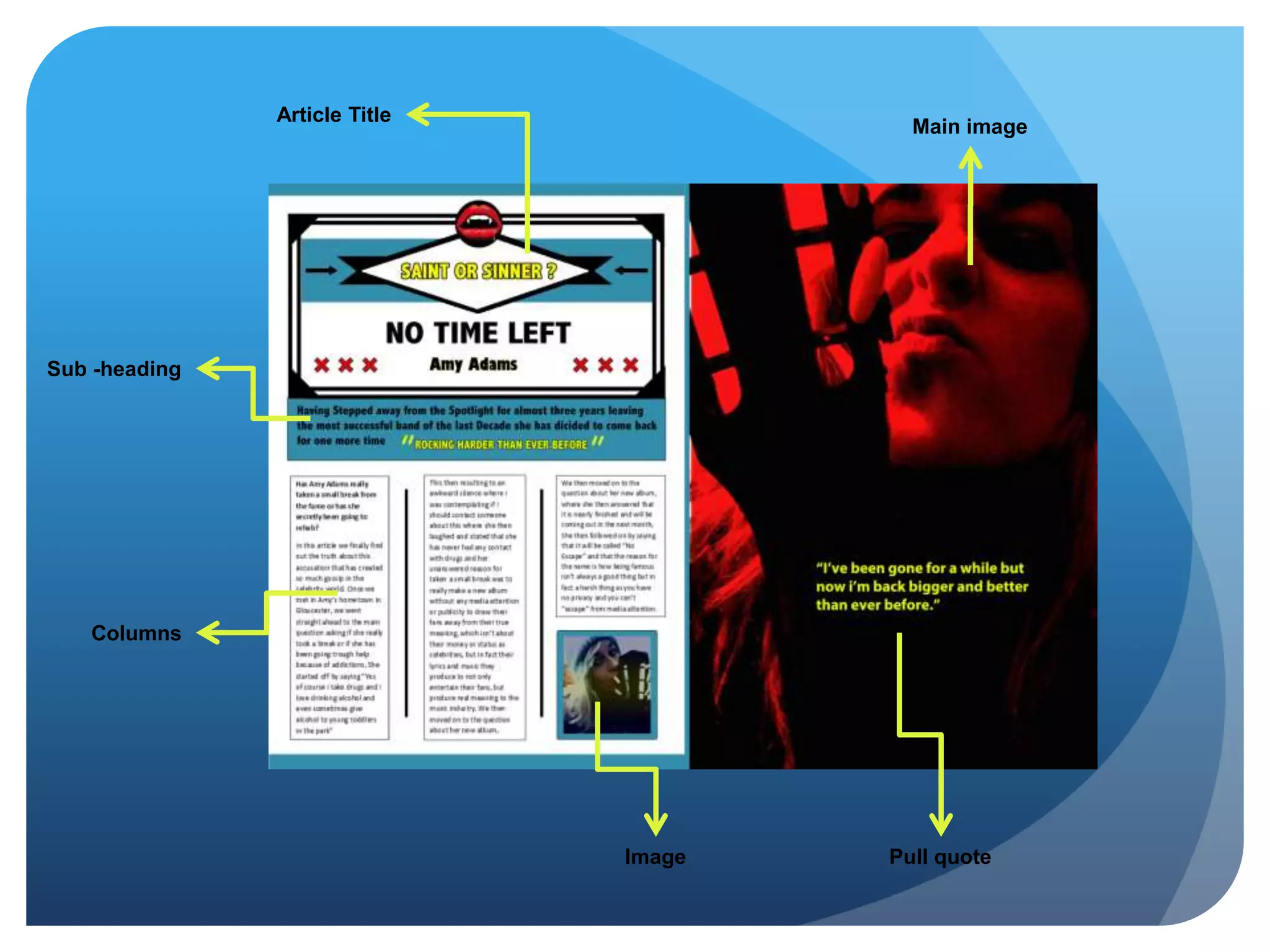
Main image
Sub -heading
Image
Columns
Article Title
Pull quote
Main Image
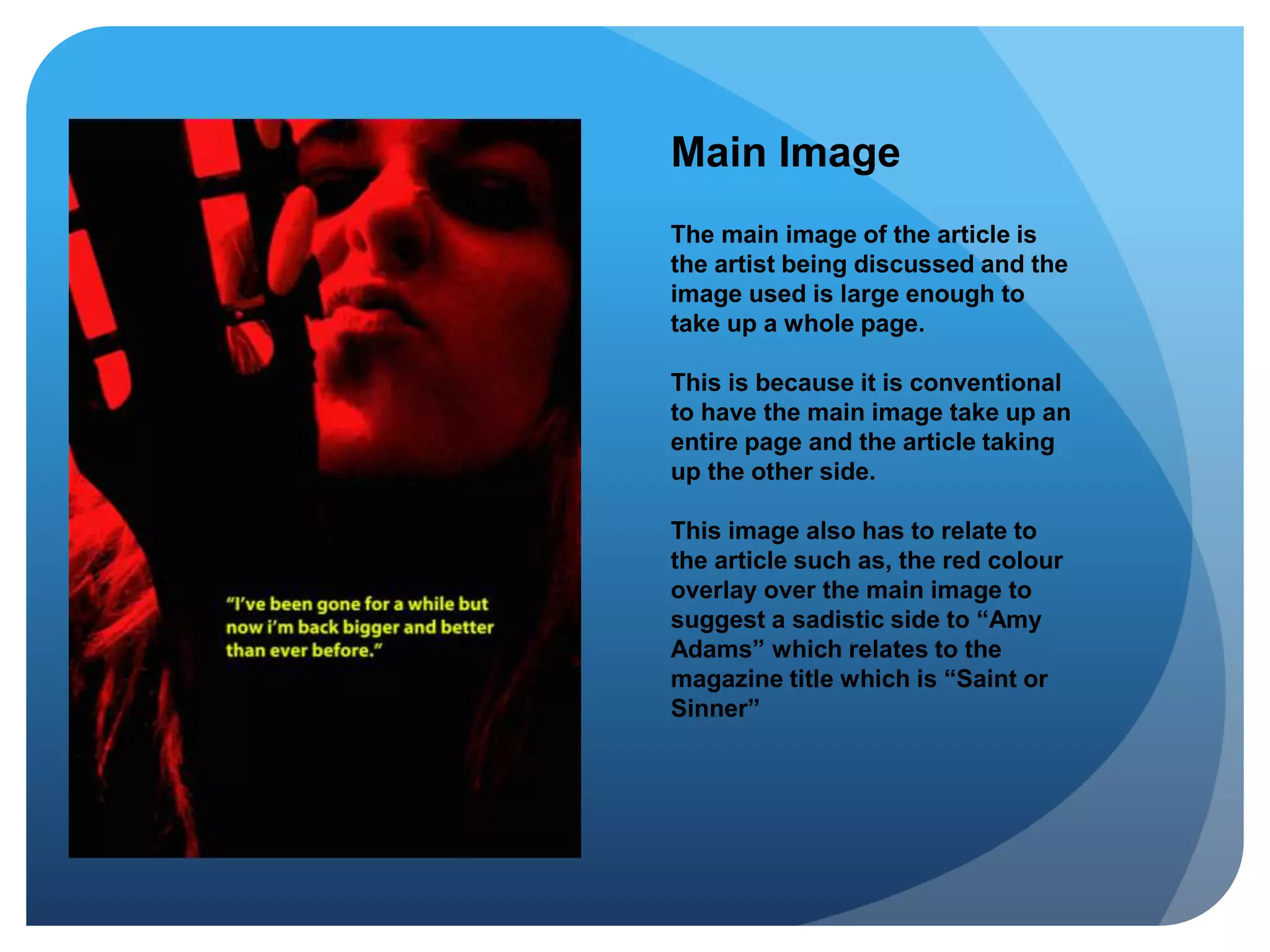
The main image of the article is
the artist being discussed and the
image used is large enough to
take up a whole page.
This is because it is conventional
to have the main image take up an
entire page and the article taking
up the other side.
This image also has to relate to
the article such as, the red colour
overlay over the main image to
suggest a sadistic side to “Amy
Adams” which relates to the
magazine title which is “Saint or
Sinner”
Column’s
The way the text in the article
is structured is extremely
conventional as it is aligned to
the left, is presented in
columns, remains on one
page rather than both and
uses a small font size. These
are all conventional methods.
Also the columns are
designed in adobe In design
where they are layed out
professionally.
Sub-Heading
A sub-heading is used underneath
the main title of the article. This is
conventional and is used to try and
give the reader a taste of the
contents of the article.
In this case the sub-heading is a
quote to drag the reader as it is
persuasive.
Conventions that have been broken?
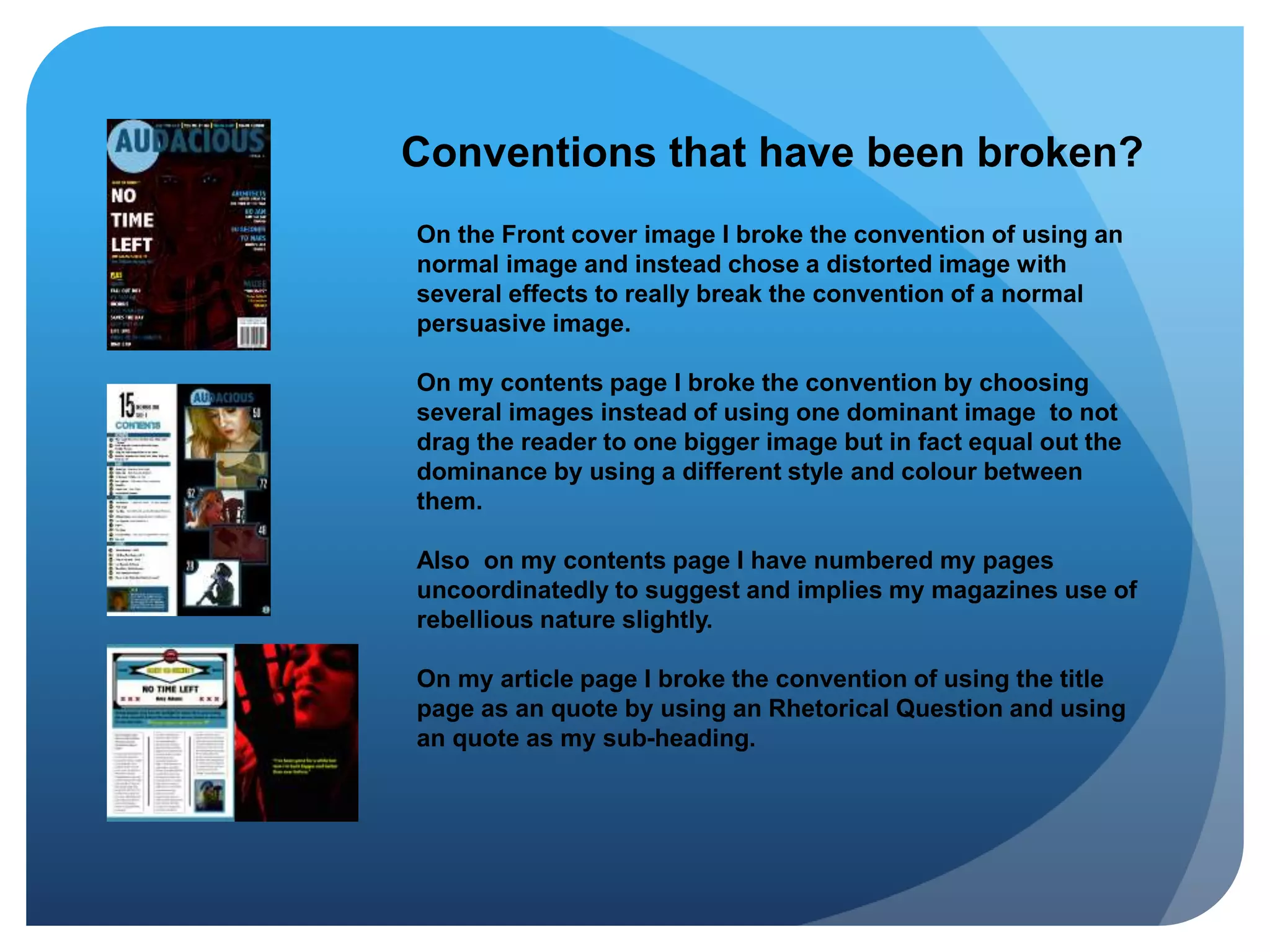
On the Front cover image I broke the convention of using an
normal image and instead chose a distorted image with
several effects to really break the convention of a normal
persuasive image.
On my contents page I broke the convention by choosing
several images instead of using one dominant image to not
drag the reader to one bigger image but in fact equal out the
dominance by using a different style and colour between
them.
Also on my contents page I have numbered my pages
uncoordinatedly to suggest and implies my magazines use of
rebellious nature slightly.
On my article page I broke the convention of using the title
page as an quote by using an Rhetorical Question and using
an quote as my sub-heading.

Presentation1

  • 1.
    My Music Magazine EvaluationOf My Music Magazine Conventions
  • 2.
    Q1 In what waysdoes your media product work use, develop or challenge forms and conventions of real media products?
  • 3.
    My Music MagazineFront Cover ! Front Cover Conventions
  • 4.
  • 5.
    The Masthead The Mastheadis usually located at the top left of the page conventionally in a bigger text size and different font. The Masthead is on all magazines from R&B to Classical as it’s the Title of your magazine. I chose this Font rather than “Cracked” and “Chalk duster” because I want my magazine to represent my style which is to portray every style of rock from Glam to Heavy Metal. The Masthead is called “Audacious” to suggest my magazines style to take risks suggesting it’s unpredictably entertaining.
  • 6.
    The Image The Imageis the main convention on every front cover on all magazines as it’s the images you first see on the magazine that attracts the reader to buy the magazine. Also, conventionally the image would be a middle shot of the artist most commonly looking straight ahead rather than looking down to really make the image stand out to the reader. On my Magazine I decided to choose an different style of image, instead of an HD quality, I chose an distorted image with a lot of effects to really make my image and overall look of my magazine very much different than any other magazine.
  • 7.
    Main Article The MainArticle is conventionally the second biggest text size on your magazine front cover usually just saying the band name the magazine is focusing on. The main article is influenced by the pull quote and must be bold and stand out from the magazine. It’s normally one of the first things the observer reads even before looking at the title. The Main article must be eye catching and give a little context on why this particular magazine is looking at this band. For an example I have chosen “Saint or Sinner ?” as it is quite vague and makes the reader really think about what this magazine will be focusing on with this band.
  • 8.
    Pull Quote The PullQuote is located conventionally near The Main image and most likely relating to the Main article. The pull quote usually would be intriguing to hook the reader as it will not be longer than a few words cause people may not read it. Very few magazines don’t have a pull quote but the ones who do are effective on attracting the reader. I chose “Don’t listen to the Paparazzi” to persuade the reader to read more and it links to my main article.
  • 9.
    Cover Item The CoverItems would appear down the side of the front cover in a not so dominant font size. Some magazines like my self have used two cover items with one being more dominant than the over cover item. The cover items give the reader a more detailed idea on what this magazine is about and to prepare them on what the reader will be reading if they decide to carry on reading the Magazine. The cover item gives the reader more insight and context on the chosen main topics in my magazine with only a few words to persuade the reader.
  • 10.
    My Music MagazineContents Page Contents Page Conventions
  • 11.
    Issue Number Issue Date Contents MainImage Editors Review Page Numbers Headings Images
  • 12.
    Images The images onthe contents page are conventionally all different from the style to the colours and more, as not every page in the contents is on a musician’s new songs the images must be seen to be different or creative. Also the images commonly are highlighted with colour to match the house colours on the magazine to attract the readers eye and make it look more professional rather than just a plain white dull image. Conventionally on the contents page there is an main image and smaller images around to draw the reader on.
  • 13.
    Headings The Headings onthe contents page are the main conventions, They show the reader what they will get from buying this magazine which suggests that this is the most important page as it determines who will buy my magazine. This is why you place your most important pages on the contents page to persuade your target audience to read your magazine. Conventionally they place numbers from which it is easily accessible to find the pages from which the reader can be entertained.
  • 14.
    My Music MagazineArticle Page Article Page Conventions
  • 15.
  • 16.
    Main Image The mainimage of the article is the artist being discussed and the image used is large enough to take up a whole page. This is because it is conventional to have the main image take up an entire page and the article taking up the other side. This image also has to relate to the article such as, the red colour overlay over the main image to suggest a sadistic side to “Amy Adams” which relates to the magazine title which is “Saint or Sinner”
  • 17.
    Column’s The way thetext in the article is structured is extremely conventional as it is aligned to the left, is presented in columns, remains on one page rather than both and uses a small font size. These are all conventional methods. Also the columns are designed in adobe In design where they are layed out professionally.
  • 18.
    Sub-Heading A sub-heading isused underneath the main title of the article. This is conventional and is used to try and give the reader a taste of the contents of the article. In this case the sub-heading is a quote to drag the reader as it is persuasive.
  • 19.
    Conventions that havebeen broken? On the Front cover image I broke the convention of using an normal image and instead chose a distorted image with several effects to really break the convention of a normal persuasive image. On my contents page I broke the convention by choosing several images instead of using one dominant image to not drag the reader to one bigger image but in fact equal out the dominance by using a different style and colour between them. Also on my contents page I have numbered my pages uncoordinatedly to suggest and implies my magazines use of rebellious nature slightly. On my article page I broke the convention of using the title page as an quote by using an Rhetorical Question and using an quote as my sub-heading.