Depressive Disorders in
Children and Adolescents
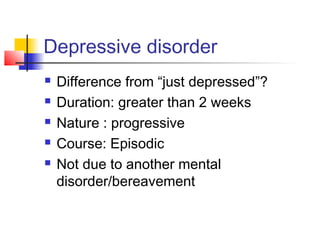
Depressive disorder
 Difference from “just depressed”?
 Duration: greater than 2 weeks
 Nature : progressive
 Course: Episodic
 Not due to another mental
disorder/bereavement
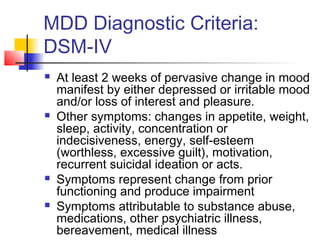
MDD Diagnostic Criteria:
DSM-IV
 At least 2 weeks of pervasive change in mood
manifest by either depressed or irritable mood
and/or loss of interest and pleasure.
 Other symptoms: changes in appetite, weight,
sleep, activity, concentration or
indecisiveness, energy, self-esteem
(worthless, excessive guilt), motivation,
recurrent suicidal ideation or acts.
 Symptoms represent change from prior
functioning and produce impairment
 Symptoms attributable to substance abuse,
medications, other psychiatric illness,
bereavement, medical illness
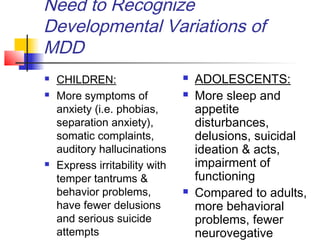
Need to Recognize
Developmental Variations of
MDD
 CHILDREN:
 More symptoms of
anxiety (i.e. phobias,
separation anxiety),
somatic complaints,
auditory hallucinations
 Express irritability with
temper tantrums &
behavior problems,
have fewer delusions
and serious suicide
attempts
 ADOLESCENTS:
 More sleep and
appetite
disturbances,
delusions, suicidal
ideation & acts,
impairment of
functioning
 Compared to adults,
more behavioral
problems, fewer
neurovegative
Problems in Reducing MDD in
Children and Adolescents
 Problems of diagnosis
 Developmental variations
 Complexity of factors associated with
clinical course
Theories
 Psychological
 Psychodynamic : e.g. anger turned inward
 Cognitive: e.g. Beck’s model: triad
Biological theory
 Genetic: heritable , clustering
 Endocrinal: cortisol, thyroid
 Neurotransmitters : serotonin
Predisposing factors
 Genetic
 Environmental factors:

Temperament and personality

Family environment
 Other factors: e.g. Chronic physical
illnesses
 Some clinical variants
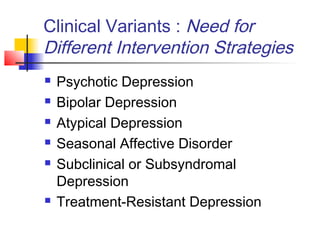
Clinical Variants : Need for
Different Intervention Strategies
 Psychotic Depression
 Bipolar Depression
 Atypical Depression
 Seasonal Affective Disorder
 Subclinical or Subsyndromal
Depression
 Treatment-Resistant Depression
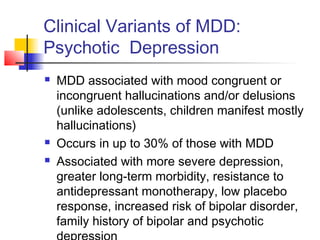
Clinical Variants of MDD:
Psychotic Depression
 MDD associated with mood congruent or
incongruent hallucinations and/or delusions
(unlike adolescents, children manifest mostly
hallucinations)
 Occurs in up to 30% of those with MDD
 Associated with more severe depression,
greater long-term morbidity, resistance to
antidepressant monotherapy, low placebo
response, increased risk of bipolar disorder,
family history of bipolar and psychotic
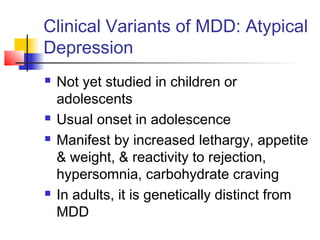
Clinical Variants of MDD: Atypical
Depression
 Not yet studied in children or
adolescents
 Usual onset in adolescence
 Manifest by increased lethargy, appetite
& weight, & reactivity to rejection,
hypersomnia, carbohydrate craving
 In adults, it is genetically distinct from
MDD
Management
 Acute episode
 Maintenance
 Prevention /prophylaxis
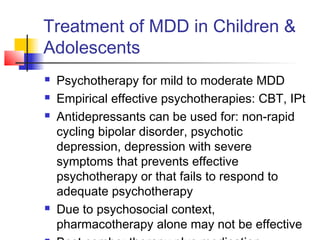
Treatment of MDD in Children &
Adolescents
 Psychotherapy for mild to moderate MDD
 Empirical effective psychotherapies: CBT, IPt
 Antidepressants can be used for: non-rapid
cycling bipolar disorder, psychotic
depression, depression with severe
symptoms that prevents effective
psychotherapy or that fails to respond to
adequate psychotherapy
 Due to psychosocial context,
pharmacotherapy alone may not be effective

Presentation1

  • 1.
  • 2.
    Depressive disorder  Differencefrom “just depressed”?  Duration: greater than 2 weeks  Nature : progressive  Course: Episodic  Not due to another mental disorder/bereavement
  • 3.
    MDD Diagnostic Criteria: DSM-IV At least 2 weeks of pervasive change in mood manifest by either depressed or irritable mood and/or loss of interest and pleasure.  Other symptoms: changes in appetite, weight, sleep, activity, concentration or indecisiveness, energy, self-esteem (worthless, excessive guilt), motivation, recurrent suicidal ideation or acts.  Symptoms represent change from prior functioning and produce impairment  Symptoms attributable to substance abuse, medications, other psychiatric illness, bereavement, medical illness
  • 4.
    Need to Recognize DevelopmentalVariations of MDD  CHILDREN:  More symptoms of anxiety (i.e. phobias, separation anxiety), somatic complaints, auditory hallucinations  Express irritability with temper tantrums & behavior problems, have fewer delusions and serious suicide attempts  ADOLESCENTS:  More sleep and appetite disturbances, delusions, suicidal ideation & acts, impairment of functioning  Compared to adults, more behavioral problems, fewer neurovegative
  • 5.
    Problems in ReducingMDD in Children and Adolescents  Problems of diagnosis  Developmental variations  Complexity of factors associated with clinical course
  • 6.
    Theories  Psychological  Psychodynamic: e.g. anger turned inward  Cognitive: e.g. Beck’s model: triad
  • 7.
    Biological theory  Genetic:heritable , clustering  Endocrinal: cortisol, thyroid  Neurotransmitters : serotonin
  • 8.
    Predisposing factors  Genetic Environmental factors:  Temperament and personality  Family environment  Other factors: e.g. Chronic physical illnesses
  • 9.
  • 10.
    Clinical Variants :Need for Different Intervention Strategies  Psychotic Depression  Bipolar Depression  Atypical Depression  Seasonal Affective Disorder  Subclinical or Subsyndromal Depression  Treatment-Resistant Depression
  • 11.
    Clinical Variants ofMDD: Psychotic Depression  MDD associated with mood congruent or incongruent hallucinations and/or delusions (unlike adolescents, children manifest mostly hallucinations)  Occurs in up to 30% of those with MDD  Associated with more severe depression, greater long-term morbidity, resistance to antidepressant monotherapy, low placebo response, increased risk of bipolar disorder, family history of bipolar and psychotic
  • 12.
    Clinical Variants ofMDD: Atypical Depression  Not yet studied in children or adolescents  Usual onset in adolescence  Manifest by increased lethargy, appetite & weight, & reactivity to rejection, hypersomnia, carbohydrate craving  In adults, it is genetically distinct from MDD
  • 13.
    Management  Acute episode Maintenance  Prevention /prophylaxis
  • 14.
    Treatment of MDDin Children & Adolescents  Psychotherapy for mild to moderate MDD  Empirical effective psychotherapies: CBT, IPt  Antidepressants can be used for: non-rapid cycling bipolar disorder, psychotic depression, depression with severe symptoms that prevents effective psychotherapy or that fails to respond to adequate psychotherapy  Due to psychosocial context, pharmacotherapy alone may not be effective