


Social Cognition and Crime
Psychology and Crime
Social Cognition of Crime
 Attribution theory
 Locus of Control
 Impulsivity
 Learned Helplessness
 Cognitive Scripts
 Communication model
Social Cognition/Attribution
Theory
Social Cognition/Attribution
Theory
 Everyone is a naïve psychologist (Heider)
 Internal/External attributions
 Fundamental Attribution Error (Ross)
 Actor/Observer Difference (Jones & Nisbett)
 Effects of Attributions (Jones, Rock et al.)
 Self-fulfilling Prophecy
Social Cognition/Attribution
Theory
 Everyone is a naïve psychologist (Heider)
 Internal/External attributions
 Fundamental Attribution Error (Ross)
 Actor/Observer Difference (Jones & Nisbett)
 Effects of Attributions (Jones, Rock et al.)
 Self-fulfilling Prophecy
Everyone is a naïve
psychologist
 Internal (dispositional) attributions
 personality characteristics
 beliefs
 External (situational) attributions
 situational pressure/influence
 Example: Student turns in papers late
 Internal:
Everyone is a naïve
psychologist
 Internal (dispositional) attributions
 personality characteristics
 beliefs
 External (situational) attributions
 situational pressure/influence
 Example: Student turns in papers late
 Internal:lazy, partying all the time
Everyone is a naïve
psychologist
 Internal (dispositional) attributions
 personality characteristics
 beliefs
 External (situational) attributions
 situational pressure/influence
 Example: Student turns in papers late
 Internal:lazy, partying all the time
 External:
Everyone is a naïve
psychologist
 Internal (dispositional) attributions
 personality characteristics
 beliefs
 External (situational) attributions
 situational pressure/influence
 Example: Student turns in papers late
 Internal:lazy, partying all the time
 External:family problems, working, girlfriend
Social Cognition/Attribution
Theory
 Everyone is a naïve psychologist (Heider)
 Internal/External attributions
 Fundamental Attribution Error (Ross)
 Actor/Observer Difference (Jones & Nisbett)
 Effects of Attributions (Jones, Rock et al.)
 Self-fulfilling Prophecy
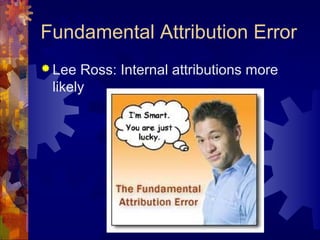
Fundamental Attribution Error
 Lee Ross: Internal attributions more
likely
Social Cognition/Attribution
Theory
 Everyone is a naïve psychologist (Heider)
 Internal/External attributions
 Fundamental Attribution Error (Ross)
 Actor/Observer Difference (Jones & Nisbett)
 Effects of Attributions (Jones, Rock et al.)
 Self-fulfilling Prophecy
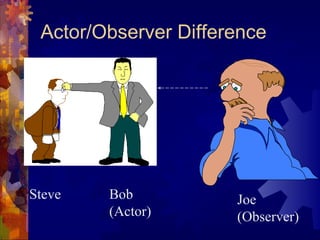
Actor/Observer Difference
Joe
(Observer)
Bob
(Actor)
Steve
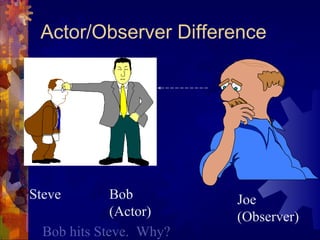
Actor/Observer Difference
Joe
(Observer)
Bob
(Actor)
Steve
Bob hits Steve. Why?
Actor/Observer Difference
 OBSERVER-->Internal attribution
 ACTOR-->External attribution
 What is salient in the perceptual field?
 For OBSERVER: The actor
 For ACTOR: Everything but the actor
(i.e., the situation)
Social Cognition/Attribution
Theory
 Everyone is a naïve psychologist (Heider)
 Internal/External attributions
 Fundamental Attribution Error (Ross)
 Actor/Observer Difference (Jones & Nisbett)
 Effects of Attributions (Jones, Rock et al.)
 Self-fulfilling Prophecy
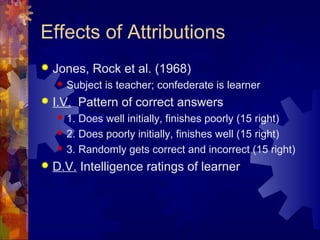
Effects of Attributions
 Jones, Rock et al. (1968)
 Subject is teacher; confederate is learner
 I.V. Pattern of correct answers
 1. Does well initially, finishes poorly (15 right)
 2. Does poorly initially, finishes well (15 right)
 3. Randomly gets correct and incorrect (15 right)
 D.V. Intelligence ratings of learner
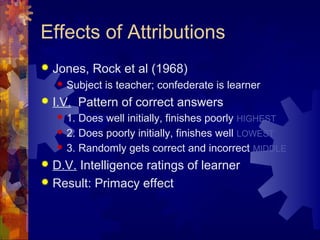
Effects of Attributions
 Jones, Rock et al (1968)
 Subject is teacher; confederate is learner
 I.V. Pattern of correct answers
 1. Does well initially, finishes poorly HIGHEST
 2. Does poorly initially, finishes well LOWEST
 3. Randomly gets correct and incorrect MIDDLE
 D.V. Intelligence ratings of learner
 Result: Primacy effect
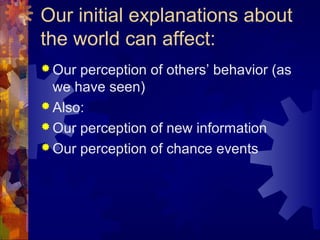
Our initial explanations about
the world can affect:
 Our perception of others’ behavior (as
we have seen)
 Also:
 Our perception of new information
 Our perception of chance events
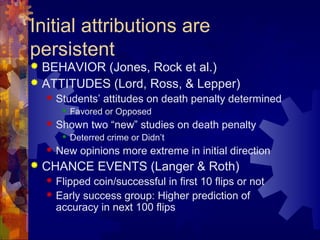
Initial attributions are
persistent
 BEHAVIOR (Jones, Rock et al.)
 ATTITUDES (Lord, Ross, & Lepper)
 Students’ attitudes on death penalty determined
 Favored or Opposed
 Shown two “new” studies on death penalty
 Deterred crime or Didn’t
 New opinions more extreme in initial direction
 CHANCE EVENTS (Langer & Roth)
 Flipped coin/successful in first 10 flips or not
 Early success group: Higher prediction of
accuracy in next 100 flips
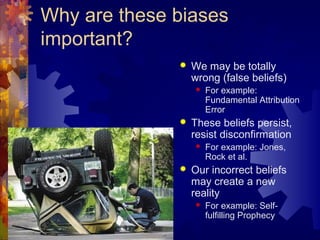
Why are these biases
important?
 We may be totally
wrong (false beliefs)
 For example:
Fundamental Attribution
Error
 These beliefs persist,
resist disconfirmation
 For example: Jones,
Rock et al.
 Our incorrect beliefs
may create a new
reality
 For example: Self-
fulfilling Prophecy
Social Cognition/Attribution
Theory
 Everyone is a naïve psychologist (Heider)
 Internal/External attributions
 Fundamental Attribution Error (Ross)
 Actor/Observer Difference (Jones & Nisbett)
 Effects of Attributions (Jones, Rock et al.)
 Self-fulfilling Prophecy
Components of Self-fulfilling
Prophecy
 False belief (Expectation)
 Actions, based on that belief
 New reality created
Palmer and Hollin (2000)
 Palmer and Hollin (2000) found that
self-reported delinquency in young
offenders was associated not only with
lower levels of moral reasoning but also
with increased tendencies to inaccurate
attributions of hostility, especially in
ambiguous situations where it may be
difficult to accurately ascertain
intentions.
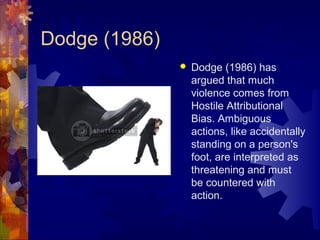
Dodge (1986)
 Dodge (1986) has
argued that much
violence comes from
Hostile Attributional
Bias. Ambiguous
actions, like accidentally
standing on a person's
foot, are interpreted as
threatening and must
be countered with
action.
Personal Control
Internal Locus of ControlInternal Locus of Control
You pretty much control your own destiny
External Locus of ControlExternal Locus of Control
Luck, fate and/or powerful others control your destiny
Methods of StudyMethods of Study
• Correlate feelings of control with behaviorCorrelate feelings of control with behavior
• Experiment by raising/lowering people’s sense ofExperiment by raising/lowering people’s sense of
control and noting effectscontrol and noting effects
Locus of Control
 A number of studies have shown that
offenders tend to external control, that is
they explain their behaviour as being
controlled by influences beyond their
personal control (Beck and Ollendick 1976;
Kumchy and Sayer 1980).
 other studies have failed to show any
difference in locus of control between
offender and non-offender samples (Drasgow
et al. 1974; Groh and Goldenberg 1976);
 Lefcourt and Ladwig (1965) found offenders
to be more internally controlled than non-
offenders.
Locus of Control
 The varied findings are probably due to two
unfounded assumptions: that locus of control
is a unitary concept, and that offenders form
a homogeneous population.
 a number of studies have shown that there
are several dimensions to locus of control,
such as belief in control over one's immediate
environment as opposed to belief in control
over political events (Mirels 1970).
Locus of Control
 locus of control within an offender
population may be a function of race
(Griffith et al. 1981); type of offence, for
example, violent offenders tend to
external control (Hollin and Wheeler
1982); or time spent in prison (Kiessel
1966).
Impulsivity
 Failure in self-control
 Unable to delay reward
 a failure to learn to stop and think;
 a failure to learn effective thinking';
 a failure to generate alternative
responses;
 a reflection of hopelessness.
Impulsivity
 Studies designed to find a link between
impulsivity and crime give mixed results
 The difference between studies may be
due to
 differing definitions and measures of
impulsivity,
 and the heterogeneity of the offender
population.
Impulsivity
 Uncontrolled episodes of anger may
result from impulsivity or a tendency to
follow impulses instinctively and without
thought for the consequences.
 It has been suggested that this is a
common characteristic of most
offending behaviour, i.e. the satisfaction
of immediate needs.
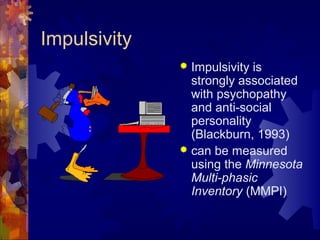
Impulsivity
 Impulsivity is
strongly associated
with psychopathy
and anti-social
personality
(Blackburn, 1993)
 can be measured
using the Minnesota
Multi-phasic
Inventory (MMPI)
Cognitive-Social Learning
 Learned Helplessness
• Seligman (1975)
• Learned helplessness
• the expectancy that one cannot escape aversive events
& the motivational & learning deficits that result from the
belief.
• Human depression
• Explanatory style
• pessimistic explanatory style
• causes of misfortune internal rather than external
• stable & global
• positive illusions
• Optimism
cognitive scripts
(Huesmann, 1988).
 A script is the details of how people should
behave in a certain situation and what will
happen if they behave that way.
 These are learnt from the environment in
direct experience and from watching others,
and from the media.
 But each script is unique to an individual, yet
resistant to change.
cognitive scripts
(Huesmann, 1988).
 They become more resistant with use
and rehearsal over time. For example, if
insulted, a man with an ‘aggressive
script' will respond violently. He will
justify this behaviour by seeing the
insult as aggression, and aggression
must be faced by aggression.
cognitive scripts
(Huesmann, 1988).
 During high levels of physiological
arousal, people resort to largely
unthinking behaviour, and thus well-
rehearsed scripts' take over.
 So to teach non-aggressive scripts' will
reduce violence in situations of high
arousal (Zillmann (1988))
McGuire (1969) – Matrix of
communication
 The source – effective from another socially
powerful offender
 The message – agreeable information
presented first. Immunisation against
persuasion – weak arguments against crime
easily countered – e.g. “Yes, you could be
caught, but the odds in your favour are 20 to
1, and only mugs get caught”.
McGuire (1969) – Matrix of
communication
 The channel – face to face, in a
pleasant context
 The receiver – recent failure – uses
cognitive rehearsal – e.g. “sleep on it”
 The destination.
Incentives
 Primary food, drink, sex
 Sensory boredom, seeking new experiences
important at the beginning of a career and for
person crimes
 Monetary important for late in career,
property crimes
 Social increase in social contacts
 Status/power built up from a series of
successful crimes
 Self-evaluative professional pride.
The target
propinquity (the targets being close to
where the criminal lives)
payoff
vulnerability ability to defend
access to law enforcement policing,
unlikely to be reported
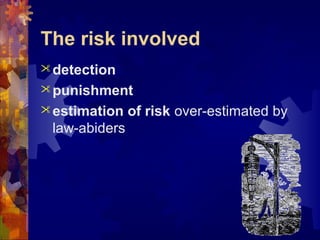
The risk involved
detection
punishment
estimation of risk over-estimated by
law-abiders
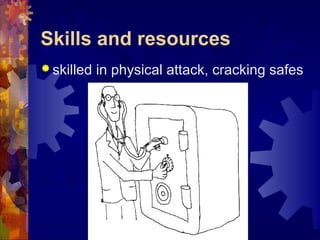
Skills and resources
 skilled in physical attack, cracking safes
Opportunity to obtain same
objective by legal means
 relevant to acquisition stage,
 those at performance stage combine
legitimate and criminal activities
Criminogenic factors
 Alcohol/drugs, possession of firearms,
factors that increased the likelihood of a
criminal act. Override rational thinking
 Drugs, need to steal to pay for drugs.
 Alcohol, this inhibits behaviour. More
confident but less capable. Higher crime but
also higher chances of being caught. Also
increases helplessness in potential victims.
Cohen et al (1956), bus drivers more
optimistic about driving buses through small
gap but were less successful.
Cognitive consequences
and distortions.
 It is central to much of social
psychology that people try to maintain
cognitive consistency between their
attitudes and their actions, and that they
experience a subjective sense of
discomfort when there is inconsistency.
It is easier to resolve this by changing
one’s cognitions than one’s behaviour
(Berkowitz 1969).
Moral justification.
 This operates on the nature of the behaviour
itself. “What is culpable can be made
honourable through cognitive restructuring...
reprehensible conduct is made personally
and socially acceptable by portraying it in the
service of moral ends” (Bandura 1986, p.
376). As an example, Bandura points to
military training: people who have been
taught to deplore killing as immoral can be
transformed rapidly into skilled combatants.
In the criminological context moral
justification is likely to be associated with
political crimes.
Attribution of blame.
 Offenders seek to exonerate themselves by
attributing the blame for their actions to the
victim.
 The most obvious example is that of rape —
a claim that in the past was frequently
accepted by the courts.
 It will be found also in other person crimes
and to some extent in property crimes.
The end

Social cognition and crime

  • 1.
    Social Cognition andCrime Psychology and Crime
  • 2.
    Social Cognition ofCrime  Attribution theory  Locus of Control  Impulsivity  Learned Helplessness  Cognitive Scripts  Communication model
  • 3.
  • 4.
    Social Cognition/Attribution Theory  Everyoneis a naïve psychologist (Heider)  Internal/External attributions  Fundamental Attribution Error (Ross)  Actor/Observer Difference (Jones & Nisbett)  Effects of Attributions (Jones, Rock et al.)  Self-fulfilling Prophecy
  • 5.
    Social Cognition/Attribution Theory  Everyoneis a naïve psychologist (Heider)  Internal/External attributions  Fundamental Attribution Error (Ross)  Actor/Observer Difference (Jones & Nisbett)  Effects of Attributions (Jones, Rock et al.)  Self-fulfilling Prophecy
  • 6.
    Everyone is anaïve psychologist  Internal (dispositional) attributions  personality characteristics  beliefs  External (situational) attributions  situational pressure/influence  Example: Student turns in papers late  Internal:
  • 7.
    Everyone is anaïve psychologist  Internal (dispositional) attributions  personality characteristics  beliefs  External (situational) attributions  situational pressure/influence  Example: Student turns in papers late  Internal:lazy, partying all the time
  • 8.
    Everyone is anaïve psychologist  Internal (dispositional) attributions  personality characteristics  beliefs  External (situational) attributions  situational pressure/influence  Example: Student turns in papers late  Internal:lazy, partying all the time  External:
  • 9.
    Everyone is anaïve psychologist  Internal (dispositional) attributions  personality characteristics  beliefs  External (situational) attributions  situational pressure/influence  Example: Student turns in papers late  Internal:lazy, partying all the time  External:family problems, working, girlfriend
  • 10.
    Social Cognition/Attribution Theory  Everyoneis a naïve psychologist (Heider)  Internal/External attributions  Fundamental Attribution Error (Ross)  Actor/Observer Difference (Jones & Nisbett)  Effects of Attributions (Jones, Rock et al.)  Self-fulfilling Prophecy
  • 11.
    Fundamental Attribution Error Lee Ross: Internal attributions more likely
  • 12.
    Social Cognition/Attribution Theory  Everyoneis a naïve psychologist (Heider)  Internal/External attributions  Fundamental Attribution Error (Ross)  Actor/Observer Difference (Jones & Nisbett)  Effects of Attributions (Jones, Rock et al.)  Self-fulfilling Prophecy
  • 13.
  • 14.
  • 15.
    Actor/Observer Difference  OBSERVER-->Internalattribution  ACTOR-->External attribution  What is salient in the perceptual field?  For OBSERVER: The actor  For ACTOR: Everything but the actor (i.e., the situation)
  • 16.
    Social Cognition/Attribution Theory  Everyoneis a naïve psychologist (Heider)  Internal/External attributions  Fundamental Attribution Error (Ross)  Actor/Observer Difference (Jones & Nisbett)  Effects of Attributions (Jones, Rock et al.)  Self-fulfilling Prophecy
  • 17.
    Effects of Attributions Jones, Rock et al. (1968)  Subject is teacher; confederate is learner  I.V. Pattern of correct answers  1. Does well initially, finishes poorly (15 right)  2. Does poorly initially, finishes well (15 right)  3. Randomly gets correct and incorrect (15 right)  D.V. Intelligence ratings of learner
  • 18.
    Effects of Attributions Jones, Rock et al (1968)  Subject is teacher; confederate is learner  I.V. Pattern of correct answers  1. Does well initially, finishes poorly HIGHEST  2. Does poorly initially, finishes well LOWEST  3. Randomly gets correct and incorrect MIDDLE  D.V. Intelligence ratings of learner  Result: Primacy effect
  • 19.
    Our initial explanationsabout the world can affect:  Our perception of others’ behavior (as we have seen)  Also:  Our perception of new information  Our perception of chance events
  • 20.
    Initial attributions are persistent BEHAVIOR (Jones, Rock et al.)  ATTITUDES (Lord, Ross, & Lepper)  Students’ attitudes on death penalty determined  Favored or Opposed  Shown two “new” studies on death penalty  Deterred crime or Didn’t  New opinions more extreme in initial direction  CHANCE EVENTS (Langer & Roth)  Flipped coin/successful in first 10 flips or not  Early success group: Higher prediction of accuracy in next 100 flips
  • 21.
    Why are thesebiases important?  We may be totally wrong (false beliefs)  For example: Fundamental Attribution Error  These beliefs persist, resist disconfirmation  For example: Jones, Rock et al.  Our incorrect beliefs may create a new reality  For example: Self- fulfilling Prophecy
  • 22.
    Social Cognition/Attribution Theory  Everyoneis a naïve psychologist (Heider)  Internal/External attributions  Fundamental Attribution Error (Ross)  Actor/Observer Difference (Jones & Nisbett)  Effects of Attributions (Jones, Rock et al.)  Self-fulfilling Prophecy
  • 23.
    Components of Self-fulfilling Prophecy False belief (Expectation)  Actions, based on that belief  New reality created
  • 24.
    Palmer and Hollin(2000)  Palmer and Hollin (2000) found that self-reported delinquency in young offenders was associated not only with lower levels of moral reasoning but also with increased tendencies to inaccurate attributions of hostility, especially in ambiguous situations where it may be difficult to accurately ascertain intentions.
  • 25.
    Dodge (1986)  Dodge(1986) has argued that much violence comes from Hostile Attributional Bias. Ambiguous actions, like accidentally standing on a person's foot, are interpreted as threatening and must be countered with action.
  • 26.
    Personal Control Internal Locusof ControlInternal Locus of Control You pretty much control your own destiny External Locus of ControlExternal Locus of Control Luck, fate and/or powerful others control your destiny Methods of StudyMethods of Study • Correlate feelings of control with behaviorCorrelate feelings of control with behavior • Experiment by raising/lowering people’s sense ofExperiment by raising/lowering people’s sense of control and noting effectscontrol and noting effects
  • 27.
    Locus of Control A number of studies have shown that offenders tend to external control, that is they explain their behaviour as being controlled by influences beyond their personal control (Beck and Ollendick 1976; Kumchy and Sayer 1980).  other studies have failed to show any difference in locus of control between offender and non-offender samples (Drasgow et al. 1974; Groh and Goldenberg 1976);  Lefcourt and Ladwig (1965) found offenders to be more internally controlled than non- offenders.
  • 28.
    Locus of Control The varied findings are probably due to two unfounded assumptions: that locus of control is a unitary concept, and that offenders form a homogeneous population.  a number of studies have shown that there are several dimensions to locus of control, such as belief in control over one's immediate environment as opposed to belief in control over political events (Mirels 1970).
  • 29.
    Locus of Control locus of control within an offender population may be a function of race (Griffith et al. 1981); type of offence, for example, violent offenders tend to external control (Hollin and Wheeler 1982); or time spent in prison (Kiessel 1966).
  • 30.
    Impulsivity  Failure inself-control  Unable to delay reward  a failure to learn to stop and think;  a failure to learn effective thinking';  a failure to generate alternative responses;  a reflection of hopelessness.
  • 31.
    Impulsivity  Studies designedto find a link between impulsivity and crime give mixed results  The difference between studies may be due to  differing definitions and measures of impulsivity,  and the heterogeneity of the offender population.
  • 32.
    Impulsivity  Uncontrolled episodesof anger may result from impulsivity or a tendency to follow impulses instinctively and without thought for the consequences.  It has been suggested that this is a common characteristic of most offending behaviour, i.e. the satisfaction of immediate needs.
  • 33.
    Impulsivity  Impulsivity is stronglyassociated with psychopathy and anti-social personality (Blackburn, 1993)  can be measured using the Minnesota Multi-phasic Inventory (MMPI)
  • 34.
    Cognitive-Social Learning  LearnedHelplessness • Seligman (1975) • Learned helplessness • the expectancy that one cannot escape aversive events & the motivational & learning deficits that result from the belief. • Human depression • Explanatory style • pessimistic explanatory style • causes of misfortune internal rather than external • stable & global • positive illusions • Optimism
  • 35.
    cognitive scripts (Huesmann, 1988). A script is the details of how people should behave in a certain situation and what will happen if they behave that way.  These are learnt from the environment in direct experience and from watching others, and from the media.  But each script is unique to an individual, yet resistant to change.
  • 36.
    cognitive scripts (Huesmann, 1988). They become more resistant with use and rehearsal over time. For example, if insulted, a man with an ‘aggressive script' will respond violently. He will justify this behaviour by seeing the insult as aggression, and aggression must be faced by aggression.
  • 37.
    cognitive scripts (Huesmann, 1988). During high levels of physiological arousal, people resort to largely unthinking behaviour, and thus well- rehearsed scripts' take over.  So to teach non-aggressive scripts' will reduce violence in situations of high arousal (Zillmann (1988))
  • 38.
    McGuire (1969) –Matrix of communication  The source – effective from another socially powerful offender  The message – agreeable information presented first. Immunisation against persuasion – weak arguments against crime easily countered – e.g. “Yes, you could be caught, but the odds in your favour are 20 to 1, and only mugs get caught”.
  • 39.
    McGuire (1969) –Matrix of communication  The channel – face to face, in a pleasant context  The receiver – recent failure – uses cognitive rehearsal – e.g. “sleep on it”  The destination.
  • 40.
    Incentives  Primary food,drink, sex  Sensory boredom, seeking new experiences important at the beginning of a career and for person crimes  Monetary important for late in career, property crimes  Social increase in social contacts  Status/power built up from a series of successful crimes  Self-evaluative professional pride.
  • 41.
    The target propinquity (thetargets being close to where the criminal lives) payoff vulnerability ability to defend access to law enforcement policing, unlikely to be reported
  • 42.
  • 43.
    Skills and resources skilled in physical attack, cracking safes
  • 44.
    Opportunity to obtainsame objective by legal means  relevant to acquisition stage,  those at performance stage combine legitimate and criminal activities
  • 45.
    Criminogenic factors  Alcohol/drugs,possession of firearms, factors that increased the likelihood of a criminal act. Override rational thinking  Drugs, need to steal to pay for drugs.  Alcohol, this inhibits behaviour. More confident but less capable. Higher crime but also higher chances of being caught. Also increases helplessness in potential victims. Cohen et al (1956), bus drivers more optimistic about driving buses through small gap but were less successful.
  • 46.
    Cognitive consequences and distortions. It is central to much of social psychology that people try to maintain cognitive consistency between their attitudes and their actions, and that they experience a subjective sense of discomfort when there is inconsistency. It is easier to resolve this by changing one’s cognitions than one’s behaviour (Berkowitz 1969).
  • 47.
    Moral justification.  Thisoperates on the nature of the behaviour itself. “What is culpable can be made honourable through cognitive restructuring... reprehensible conduct is made personally and socially acceptable by portraying it in the service of moral ends” (Bandura 1986, p. 376). As an example, Bandura points to military training: people who have been taught to deplore killing as immoral can be transformed rapidly into skilled combatants. In the criminological context moral justification is likely to be associated with political crimes.
  • 48.
    Attribution of blame. Offenders seek to exonerate themselves by attributing the blame for their actions to the victim.  The most obvious example is that of rape — a claim that in the past was frequently accepted by the courts.  It will be found also in other person crimes and to some extent in property crimes.
  • 49.