Bank Reconciliation
Statement
Contact: asand343@gmail.com
• Distinguish and explain items
appearing in the Bank Statement/Pass
Book and Cash book (Bank Column).
• Understand the need and the purpose of
preparing the Bank Reconciliation
Statement
• Prepare the Bank Reconciliation
Statement
 The business expects the ending balance appearing in the bank
statement is the same as the amount in the Cash Book (bank
column).
 Thus, the purpose of Bank Reconciliation is to do necessary
adjustments to our records in the cash book and come up with
the same ending balance as recorded by the bank.
 It is an analysis explaining the difference between a business’s
book balance of cash and its bank statement balance.
 Bank Statement is normally debited for
payments or charges, and credited for receipts by
the business.
i. Examples of payments and charges: cheques
drawn in favour of creditors or suppliers, bank
charges, direct debits and standing
order/instructions.
ii. Examples of receipts: deposits of cash or cheques,
dividend, interest on current account and bank
GIRO credits or credit transfer.
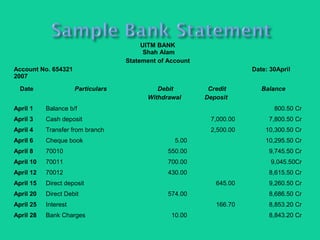
UITM BANK
Shah Alam
Statement of Account
Account No. 654321 Date: 30April
2007
Date Particulars Debit
Withdrawal
Credit
Deposit
Balance
April 1 Balance b/f 800.50 Cr
April 3 Cash deposit 7,000.00 7,800.50 Cr
April 4 Transfer from branch 2,500.00 10,300.50 Cr
April 6 Cheque book 5.00 10,295.50 Cr
April 8 70010 550.00 9,745.50 Cr
April 10 70011 700.00 9,045.50Cr
April 12 70012 430.00 8,615.50 Cr
April 15 Direct deposit 645.00 9,260.50 Cr
April 20 Direct Debit 574.00 8,686.50 Cr
April 25 Interest 166.70 8,853.20 Cr
April 28 Bank Charges 10.00 8,843.20 Cr
 Cash book or bank account is normally debited
with receipts (deposits of cash or cheques)
 credited with payments (cheques drawn in
favour of creditors or suppliers) of the
business.
a) Items recorded in the Bank account but not recorded by the
bank:
i. Deposits not yet credited. This happens when a business
deposits money or cheques but the amount does not appear
in the bank statement since the deposits has not yet been
processed by the bank; but has already been recorded by the
business.
ii. Unpresented cheques. Cheques drawn for payment to
creditors or others have not been cashed or banked, i.e.,
when cheques are drawn for payment and sent to creditors,
the record in the business books has been made, but for
some reasons the creditor is still carrying the cheque around
and have not presented it to the bank for clearance.
(b) Items recorded in the Bank Statement but not recorded by the business:
i. Direct debit. The bank debited the account of the business for payments such
as insurance premiums, rates, fees, subscriptions etc.
ii. Standing instructions order. This is quite similar to the direct debit in that
the bank will debit the account of the business for payments such as
insurance premiums, rates, subscriptions, etc.
iii. Bank service charge. This is a fee charged by the bank for operating the
account for the business andlor issuing the cheque book.
iv. Bank GIRO credit or credit transfer. The business account is credited with
amount paid by creditor or other organisation direct into the business bank
account.
v. Interest revenue on current account This interest is credited to the account of
the business and is paid by certain bank based on large enough balance of
cash in the account.
vi. Dishonoured cheques. A cheque, that the bank will not honour upon
presentation by the business for clearance. However, the business has
already accepted the cheque for the cash book settlement of a debt.
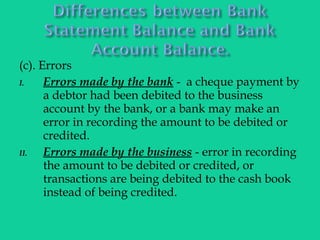
(c). Errors
I. Errors made by the bank - a cheque payment by
a debtor had been debited to the business
account by the bank, or a bank may make an
error in recording the amount to be debited or
credited.
II. Errors made by the business - error in recording
the amount to be debited or credited, or
transactions are being debited to the cash book
instead of being credited.
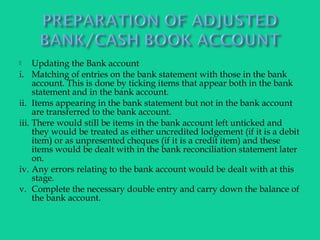
 Updating the Bank account
i. Matching of entries on the bank statement with those in the bank
account. This is done by ticking items that appear both in the bank
statement and in the bank account.
ii. Items appearing in the bank statement but not in the bank account
are transferred to the bank account.
iii. There would still be items in the bank account left unticked and
they would be treated as either uncredited lodgement (if it is a debit
item) or as unpresented cheques (if it is a credit item) and these
items would be dealt with in the bank reconciliation statement later
on.
iv. Any errors relating to the bank account would be dealt with at this
stage.
v. Complete the necessary double entry and carry down the balance of
the bank account.
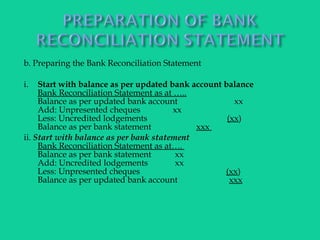
b. Preparing the Bank Reconciliation Statement
i. Start with balance as per updated bank account balance
Bank Reconciliation Statement as at …..
Balance as per updated bank account xx
Add: Unpresented cheques xx
Less: Uncredited lodgements (xx)
Balance as per bank statement xxx
ii. Start with balance as per bank statement
Bank Reconciliation Statement as at….
Balance as per bank statement xx
Add: Uncredited lodgements xx
Less: Unpresented cheques (xx)
Balance as per updated bank account xxx
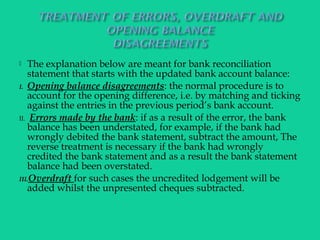
 The explanation below are meant for bank reconciliation
statement that starts with the updated bank account balance:
I. Opening balance disagreements: the normal procedure is to
account for the opening difference, i.e. by matching and ticking
against the entries in the previous period’s bank account.
II. Errors made by the bank: if as a result of the error, the bank
balance has been understated, for example, if the bank had
wrongly debited the bank statement, subtract the amount, The
reverse treatment is necessary if the bank had wrongly
credited the bank statement and as a result the bank statement
balance had been overstated.
III.Overdraft for such cases the uncredited lodgement will be
added whilst the unpresented cheques subtracted.
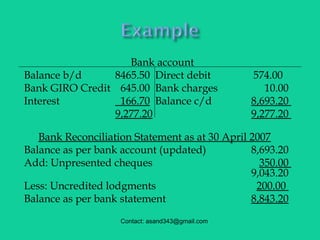
Bank account
Balance b/d 8465.50 Direct debit 574.00
Bank GIRO Credit 645.00 Bank charges 10.00
Interest 166.70 Balance c/d 8,693.20
9,277.20 9,277.20
Bank Reconciliation Statement as at 30 April 2007
Balance as per bank account (updated) 8,693.20
Add: Unpresented cheques 350.00
9,043.20
Less: Uncredited lodgments 200.00
Balance as per bank statement 8,843.20
Contact: asand343@gmail.com

Bank Reconciliation Statement

  • 1.
  • 2.
    • Distinguish andexplain items appearing in the Bank Statement/Pass Book and Cash book (Bank Column). • Understand the need and the purpose of preparing the Bank Reconciliation Statement • Prepare the Bank Reconciliation Statement
  • 3.
     The businessexpects the ending balance appearing in the bank statement is the same as the amount in the Cash Book (bank column).  Thus, the purpose of Bank Reconciliation is to do necessary adjustments to our records in the cash book and come up with the same ending balance as recorded by the bank.  It is an analysis explaining the difference between a business’s book balance of cash and its bank statement balance.
  • 4.
     Bank Statementis normally debited for payments or charges, and credited for receipts by the business. i. Examples of payments and charges: cheques drawn in favour of creditors or suppliers, bank charges, direct debits and standing order/instructions. ii. Examples of receipts: deposits of cash or cheques, dividend, interest on current account and bank GIRO credits or credit transfer.
  • 5.
    UITM BANK Shah Alam Statementof Account Account No. 654321 Date: 30April 2007 Date Particulars Debit Withdrawal Credit Deposit Balance April 1 Balance b/f 800.50 Cr April 3 Cash deposit 7,000.00 7,800.50 Cr April 4 Transfer from branch 2,500.00 10,300.50 Cr April 6 Cheque book 5.00 10,295.50 Cr April 8 70010 550.00 9,745.50 Cr April 10 70011 700.00 9,045.50Cr April 12 70012 430.00 8,615.50 Cr April 15 Direct deposit 645.00 9,260.50 Cr April 20 Direct Debit 574.00 8,686.50 Cr April 25 Interest 166.70 8,853.20 Cr April 28 Bank Charges 10.00 8,843.20 Cr
  • 6.
     Cash bookor bank account is normally debited with receipts (deposits of cash or cheques)  credited with payments (cheques drawn in favour of creditors or suppliers) of the business.
  • 7.
    a) Items recordedin the Bank account but not recorded by the bank: i. Deposits not yet credited. This happens when a business deposits money or cheques but the amount does not appear in the bank statement since the deposits has not yet been processed by the bank; but has already been recorded by the business. ii. Unpresented cheques. Cheques drawn for payment to creditors or others have not been cashed or banked, i.e., when cheques are drawn for payment and sent to creditors, the record in the business books has been made, but for some reasons the creditor is still carrying the cheque around and have not presented it to the bank for clearance.
  • 8.
    (b) Items recordedin the Bank Statement but not recorded by the business: i. Direct debit. The bank debited the account of the business for payments such as insurance premiums, rates, fees, subscriptions etc. ii. Standing instructions order. This is quite similar to the direct debit in that the bank will debit the account of the business for payments such as insurance premiums, rates, subscriptions, etc. iii. Bank service charge. This is a fee charged by the bank for operating the account for the business andlor issuing the cheque book. iv. Bank GIRO credit or credit transfer. The business account is credited with amount paid by creditor or other organisation direct into the business bank account. v. Interest revenue on current account This interest is credited to the account of the business and is paid by certain bank based on large enough balance of cash in the account. vi. Dishonoured cheques. A cheque, that the bank will not honour upon presentation by the business for clearance. However, the business has already accepted the cheque for the cash book settlement of a debt.
  • 9.
    (c). Errors I. Errorsmade by the bank - a cheque payment by a debtor had been debited to the business account by the bank, or a bank may make an error in recording the amount to be debited or credited. II. Errors made by the business - error in recording the amount to be debited or credited, or transactions are being debited to the cash book instead of being credited.
  • 10.
     Updating theBank account i. Matching of entries on the bank statement with those in the bank account. This is done by ticking items that appear both in the bank statement and in the bank account. ii. Items appearing in the bank statement but not in the bank account are transferred to the bank account. iii. There would still be items in the bank account left unticked and they would be treated as either uncredited lodgement (if it is a debit item) or as unpresented cheques (if it is a credit item) and these items would be dealt with in the bank reconciliation statement later on. iv. Any errors relating to the bank account would be dealt with at this stage. v. Complete the necessary double entry and carry down the balance of the bank account.
  • 11.
    b. Preparing theBank Reconciliation Statement i. Start with balance as per updated bank account balance Bank Reconciliation Statement as at ….. Balance as per updated bank account xx Add: Unpresented cheques xx Less: Uncredited lodgements (xx) Balance as per bank statement xxx ii. Start with balance as per bank statement Bank Reconciliation Statement as at…. Balance as per bank statement xx Add: Uncredited lodgements xx Less: Unpresented cheques (xx) Balance as per updated bank account xxx
  • 12.
     The explanationbelow are meant for bank reconciliation statement that starts with the updated bank account balance: I. Opening balance disagreements: the normal procedure is to account for the opening difference, i.e. by matching and ticking against the entries in the previous period’s bank account. II. Errors made by the bank: if as a result of the error, the bank balance has been understated, for example, if the bank had wrongly debited the bank statement, subtract the amount, The reverse treatment is necessary if the bank had wrongly credited the bank statement and as a result the bank statement balance had been overstated. III.Overdraft for such cases the uncredited lodgement will be added whilst the unpresented cheques subtracted.
  • 13.
    Bank account Balance b/d8465.50 Direct debit 574.00 Bank GIRO Credit 645.00 Bank charges 10.00 Interest 166.70 Balance c/d 8,693.20 9,277.20 9,277.20 Bank Reconciliation Statement as at 30 April 2007 Balance as per bank account (updated) 8,693.20 Add: Unpresented cheques 350.00 9,043.20 Less: Uncredited lodgments 200.00 Balance as per bank statement 8,843.20 Contact: asand343@gmail.com