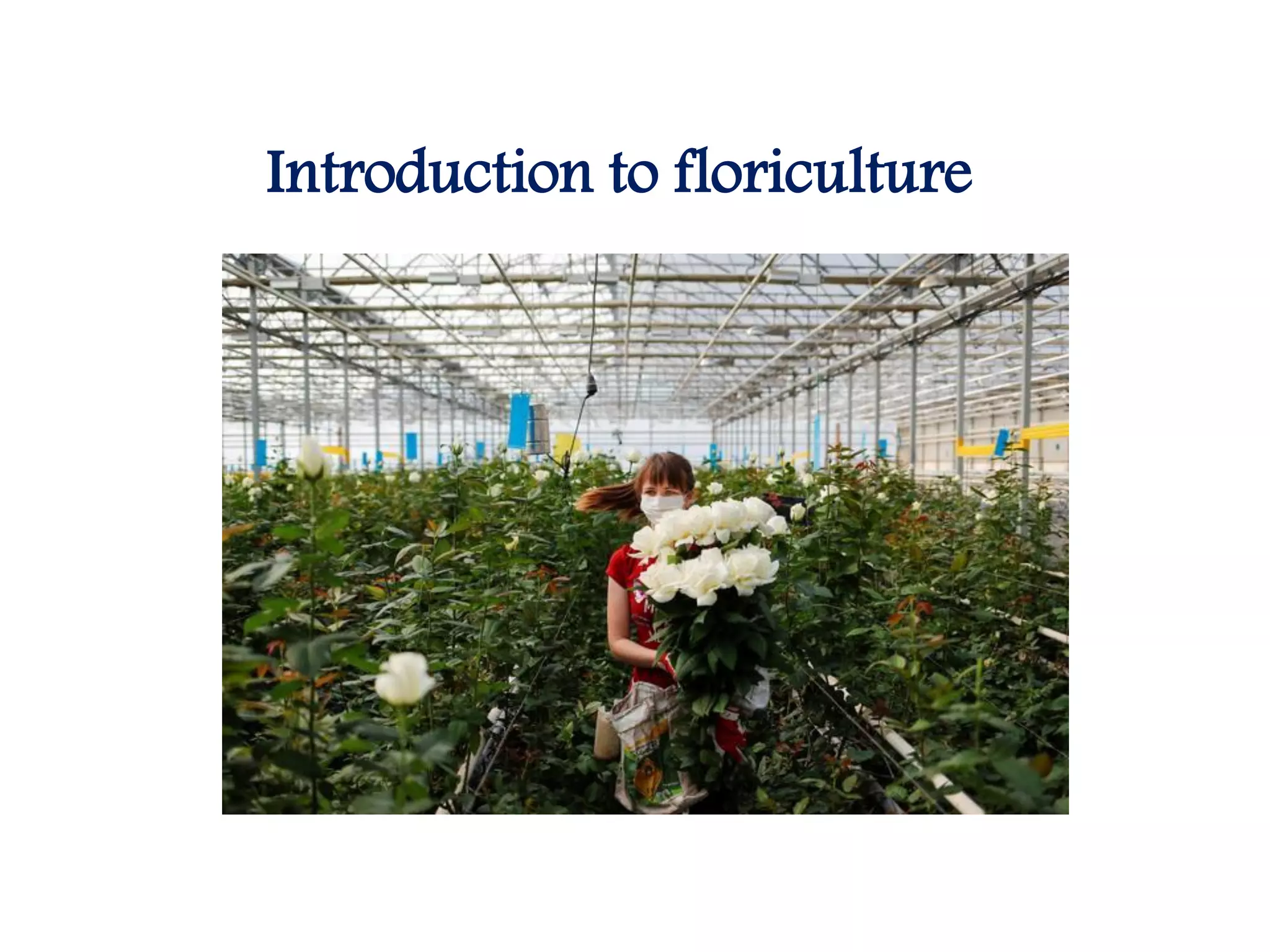
Introduction to floriculture
Floriculture...?
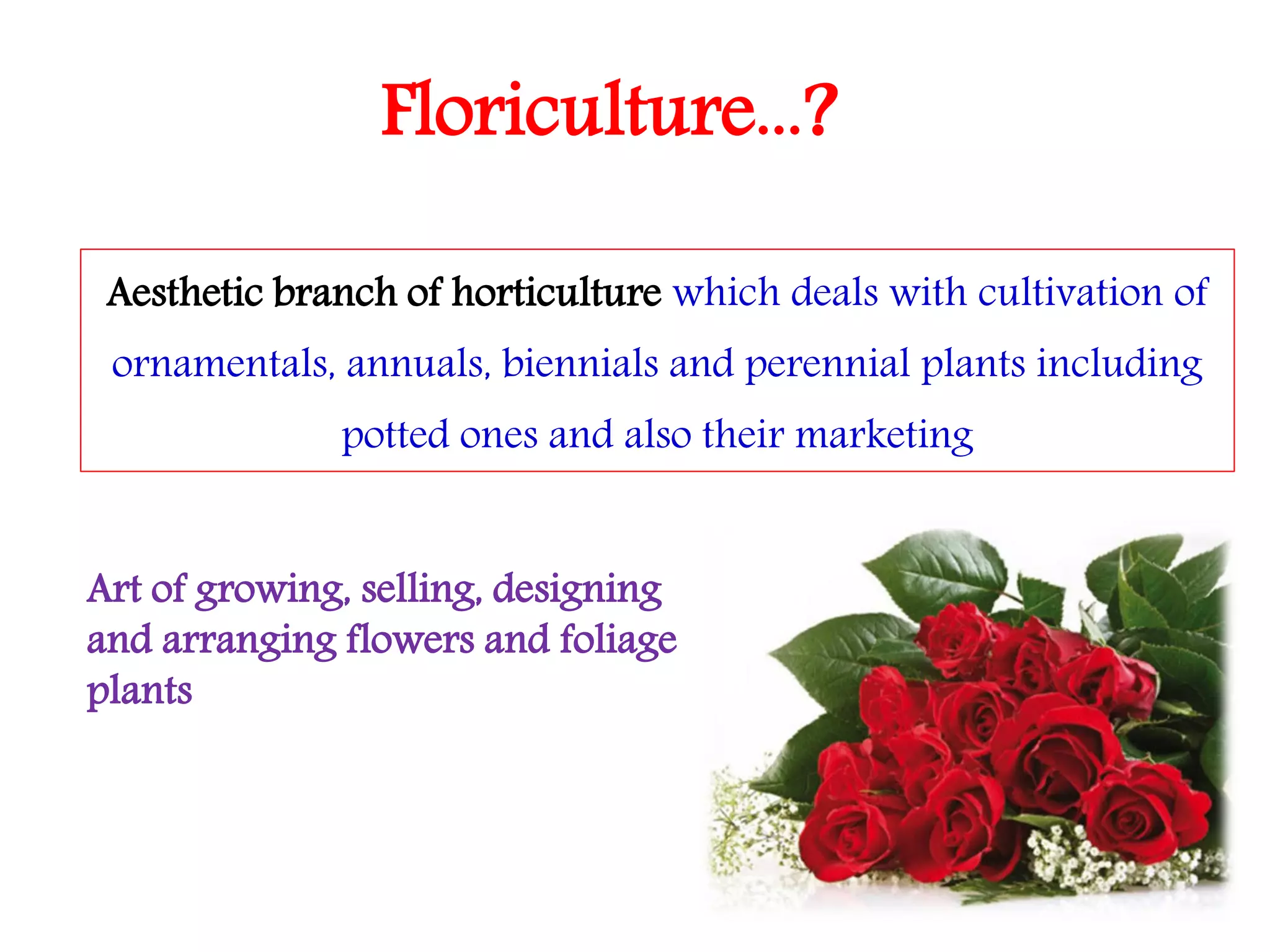
Aesthetic branch of horticulture which deals with cultivation of
ornamentals, annuals, biennials and perennial plants including
potted ones and also their marketing
Art of growing, selling, designing
and arranging flowers and foliage
plants
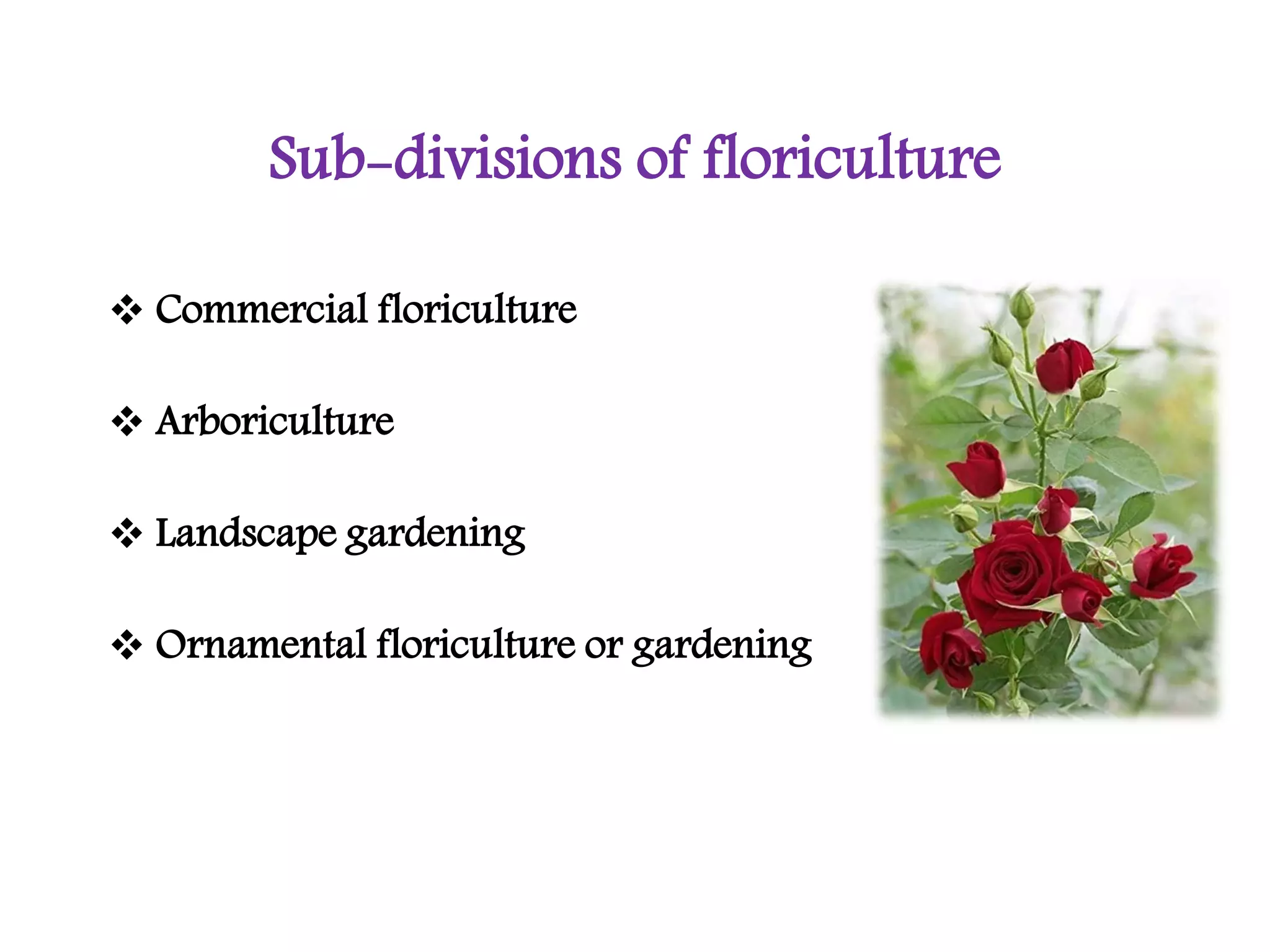
Sub-divisions of floriculture
 Commercial floriculture
 Arboriculture
 Landscape gardening
 Ornamental floriculture or gardening
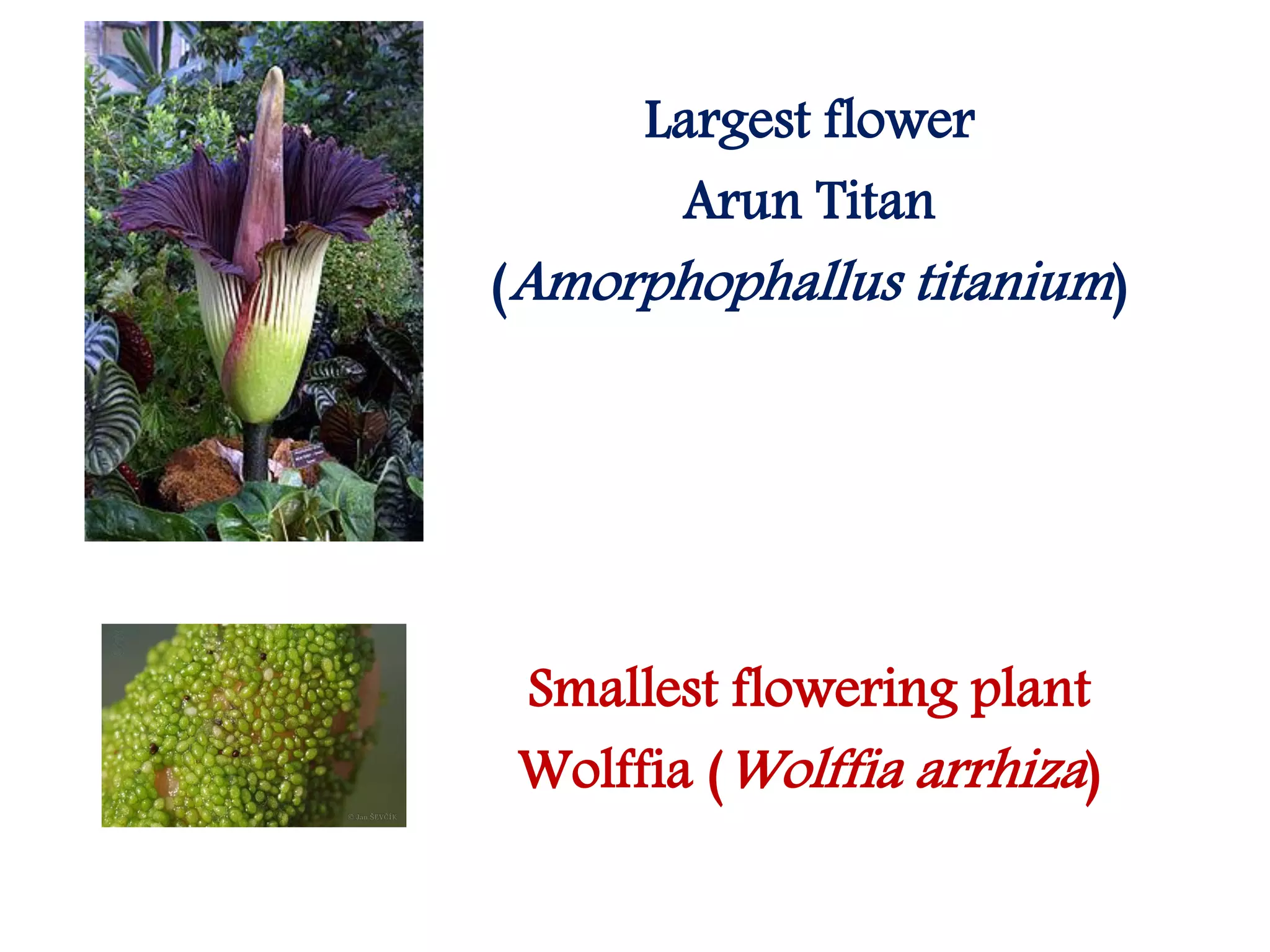
Largest flower
Arun Titan
(Amorphophallus titanium)
Smallest flowering plant
Wolffia (Wolffia arrhiza)
Directorate of Floricultural Research -
Pune, Maharashtra
• Launched on 10th December, 2009
• Initially it in IARI campus
• During 2014 February, shifted to
College of Agriculture Campus,
Shivajinagar
Dr. K. V. Prasad
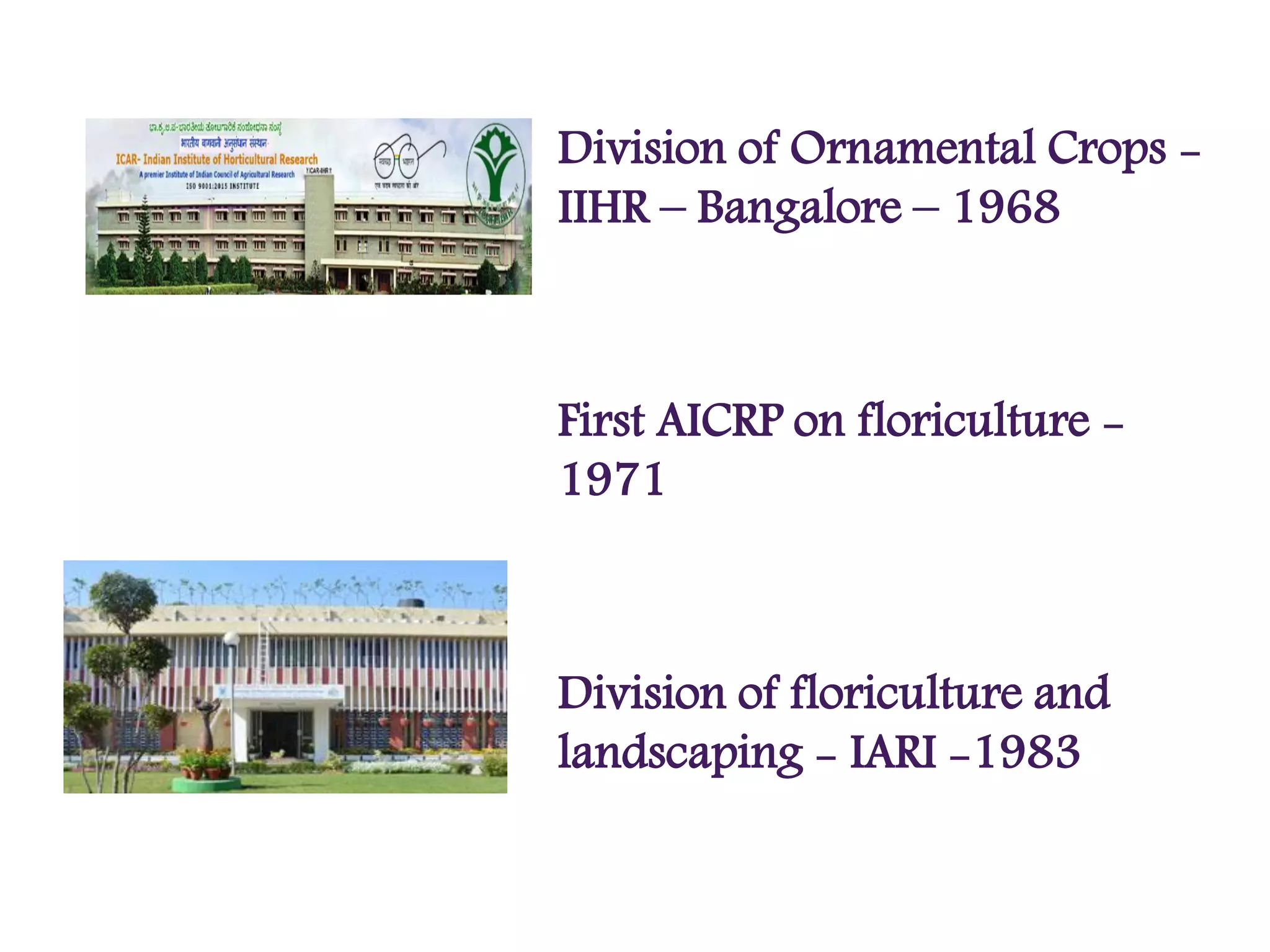
Division of Ornamental Crops -
IIHR – Bangalore – 1968
First AICRP on floriculture -
1971
Division of floriculture and
landscaping - IARI -1983
Floriculture Industry comprises ……
Cut flower
Loose flowers
Cut greens
Potted plants
Nursery industry
Perfume industry
Pigment industry
Dry flower industry
Cut flowers
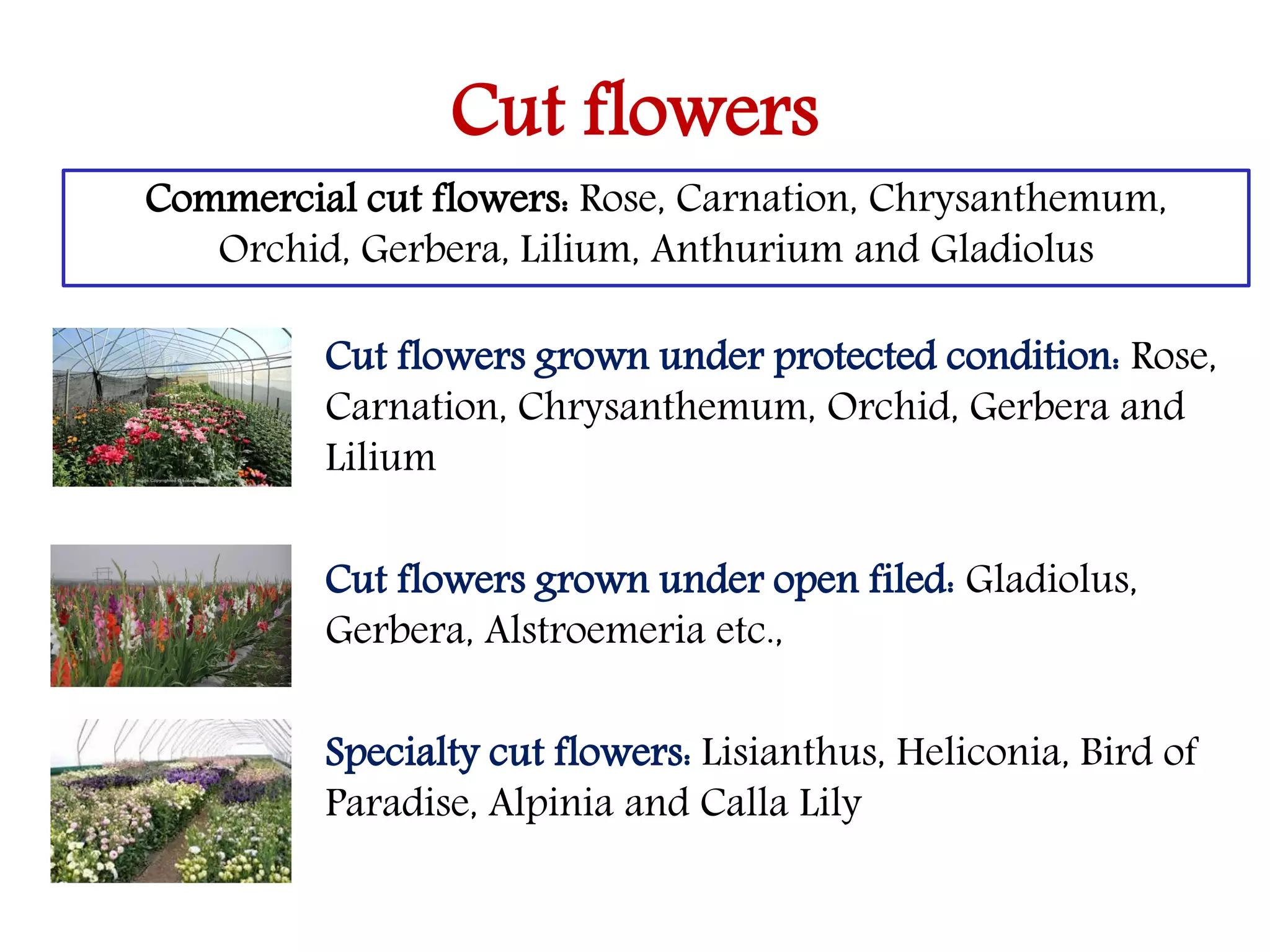
Cut flowers grown under protected condition: Rose,
Carnation, Chrysanthemum, Orchid, Gerbera and
Lilium
Cut flowers grown under open filed: Gladiolus,
Gerbera, Alstroemeria etc.,
Specialty cut flowers: Lisianthus, Heliconia, Bird of
Paradise, Alpinia and Calla Lily
Commercial cut flowers: Rose, Carnation, Chrysanthemum,
Orchid, Gerbera, Lilium, Anthurium and Gladiolus
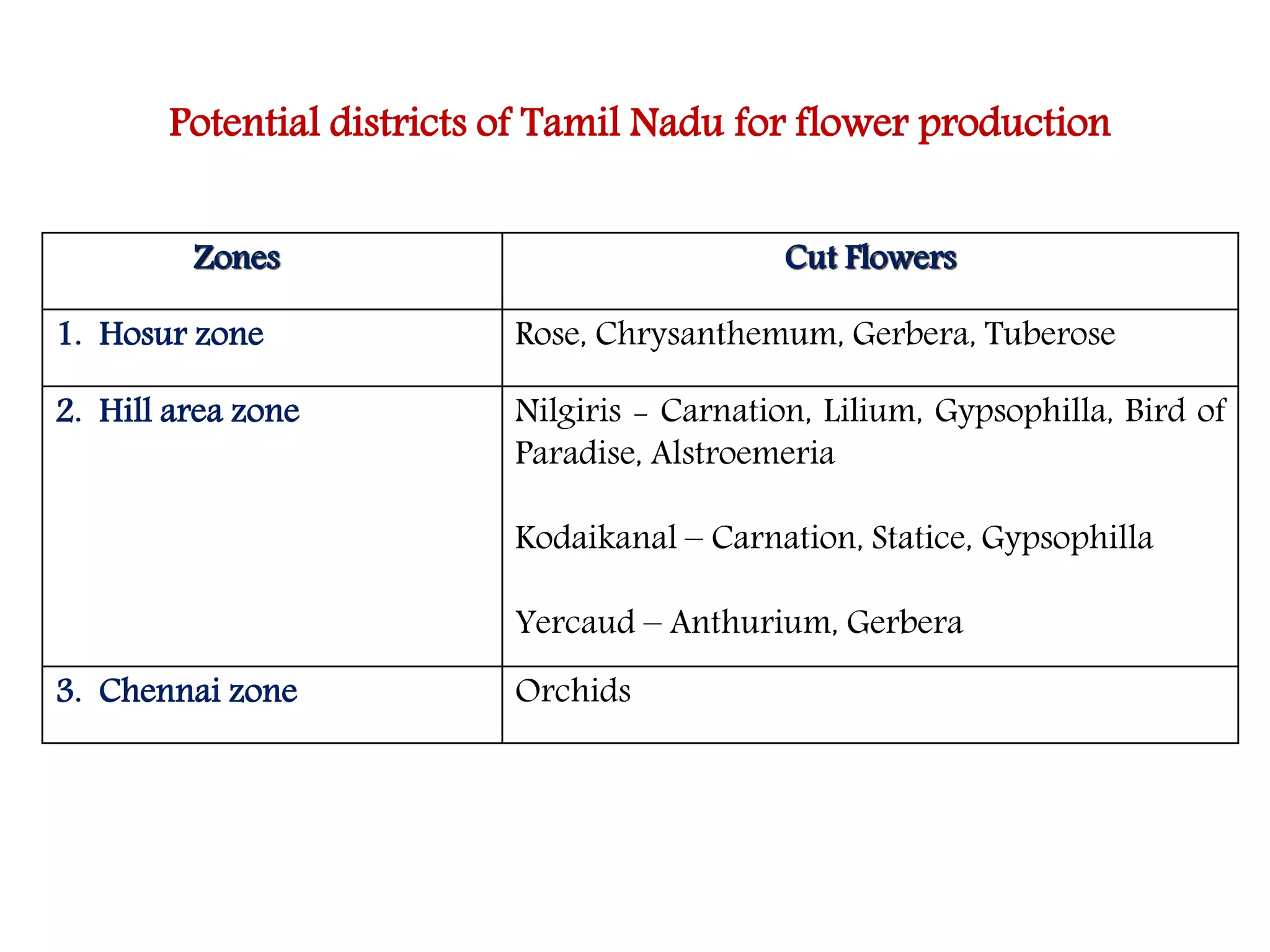
Zones Cut Flowers
1. Hosur zone Rose, Chrysanthemum, Gerbera, Tuberose
2. Hill area zone Nilgiris - Carnation, Lilium, Gypsophilla, Bird of
Paradise, Alstroemeria
Kodaikanal – Carnation, Statice, Gypsophilla
Yercaud – Anthurium, Gerbera
3. Chennai zone Orchids
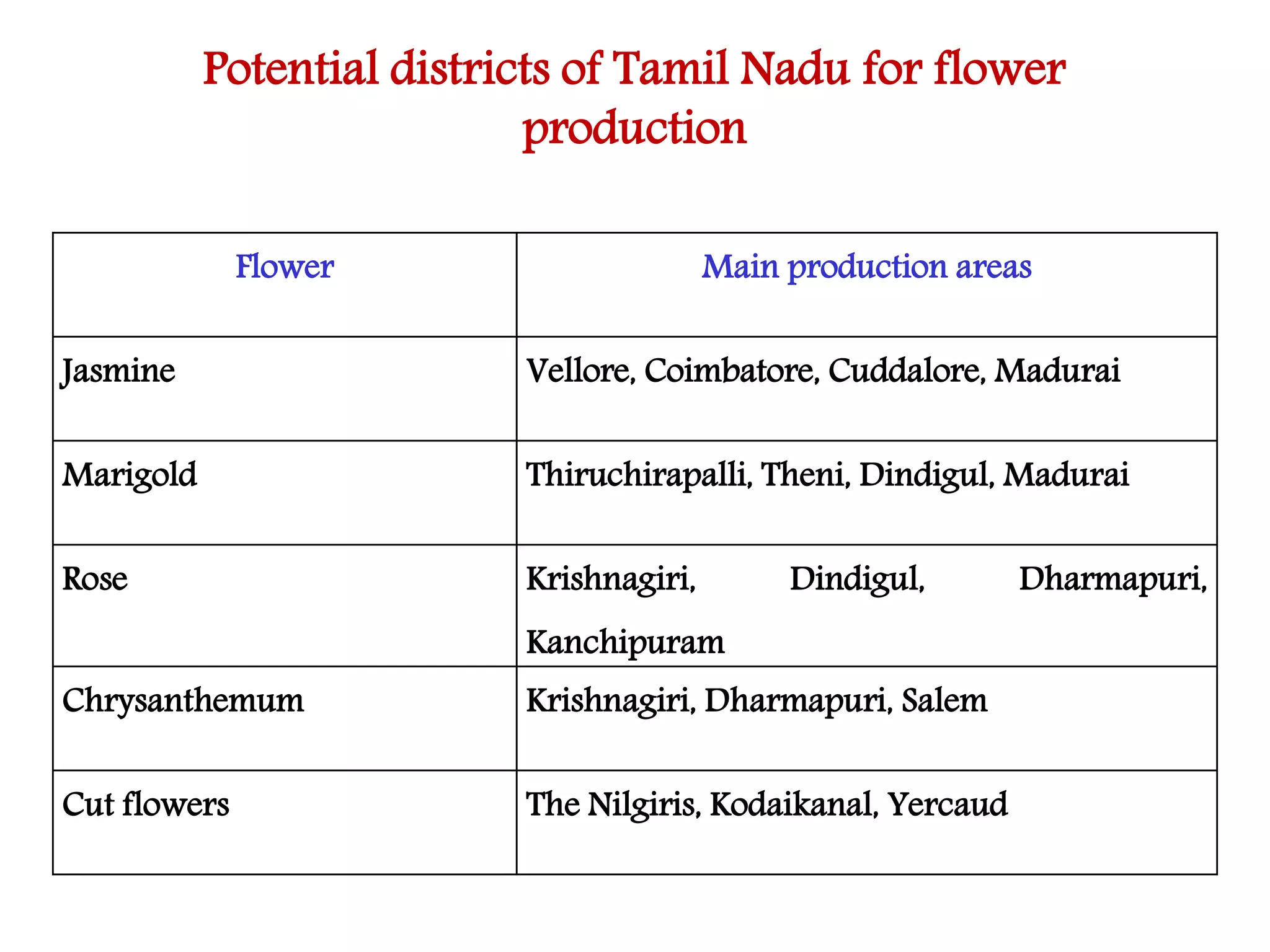
Potential districts of Tamil Nadu for flower production
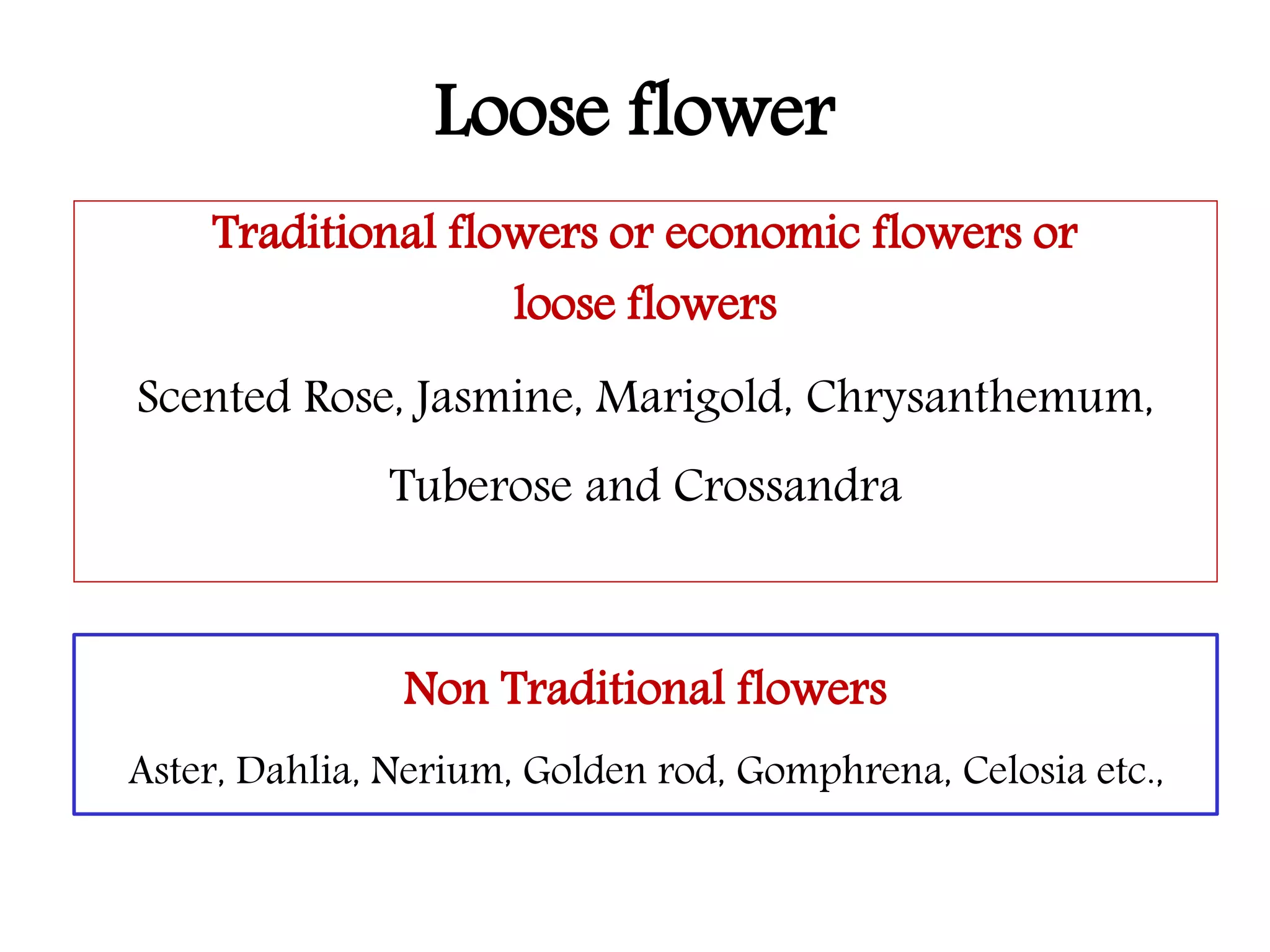
Loose flower
Traditional flowers or economic flowers or
loose flowers
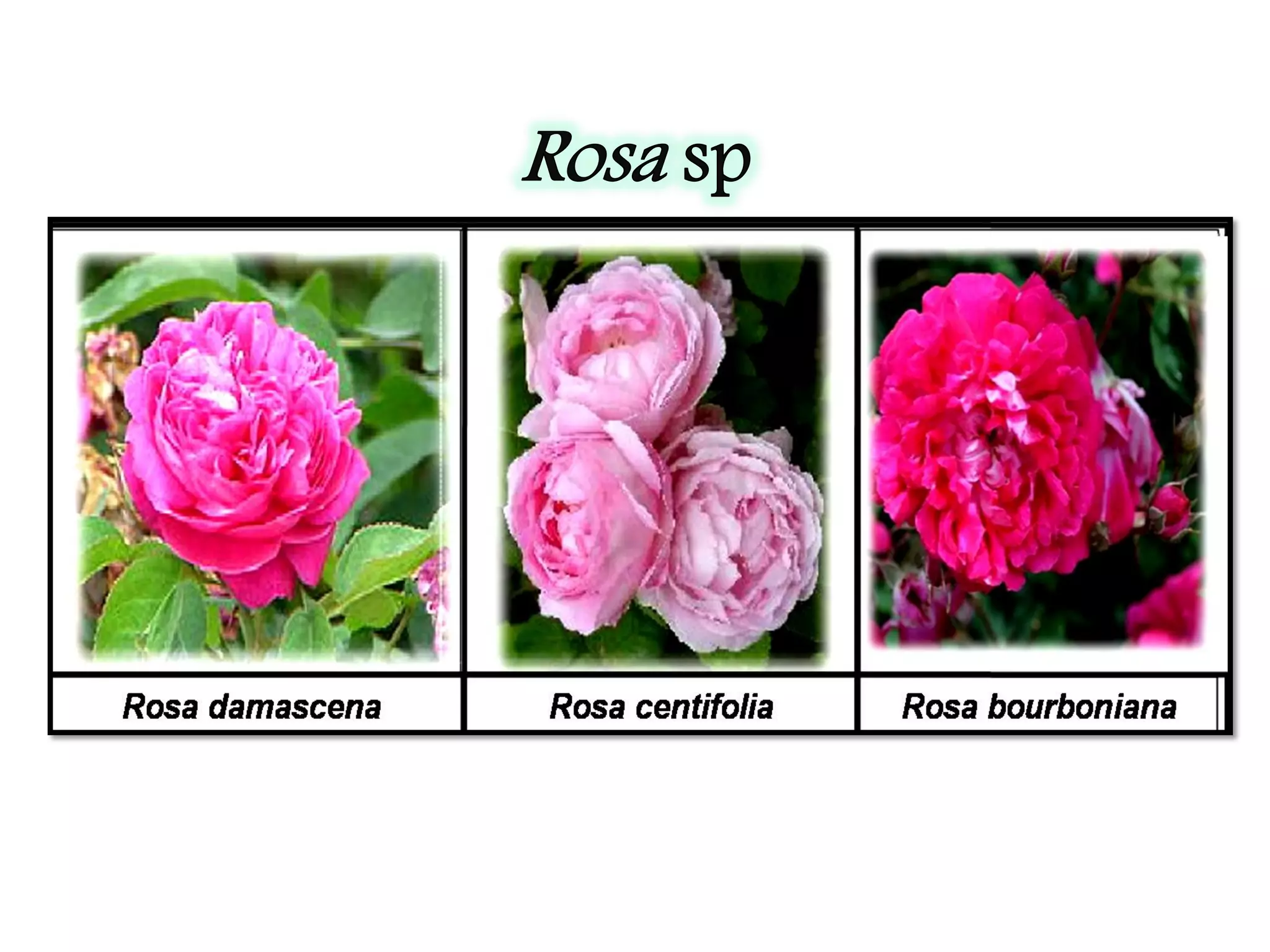
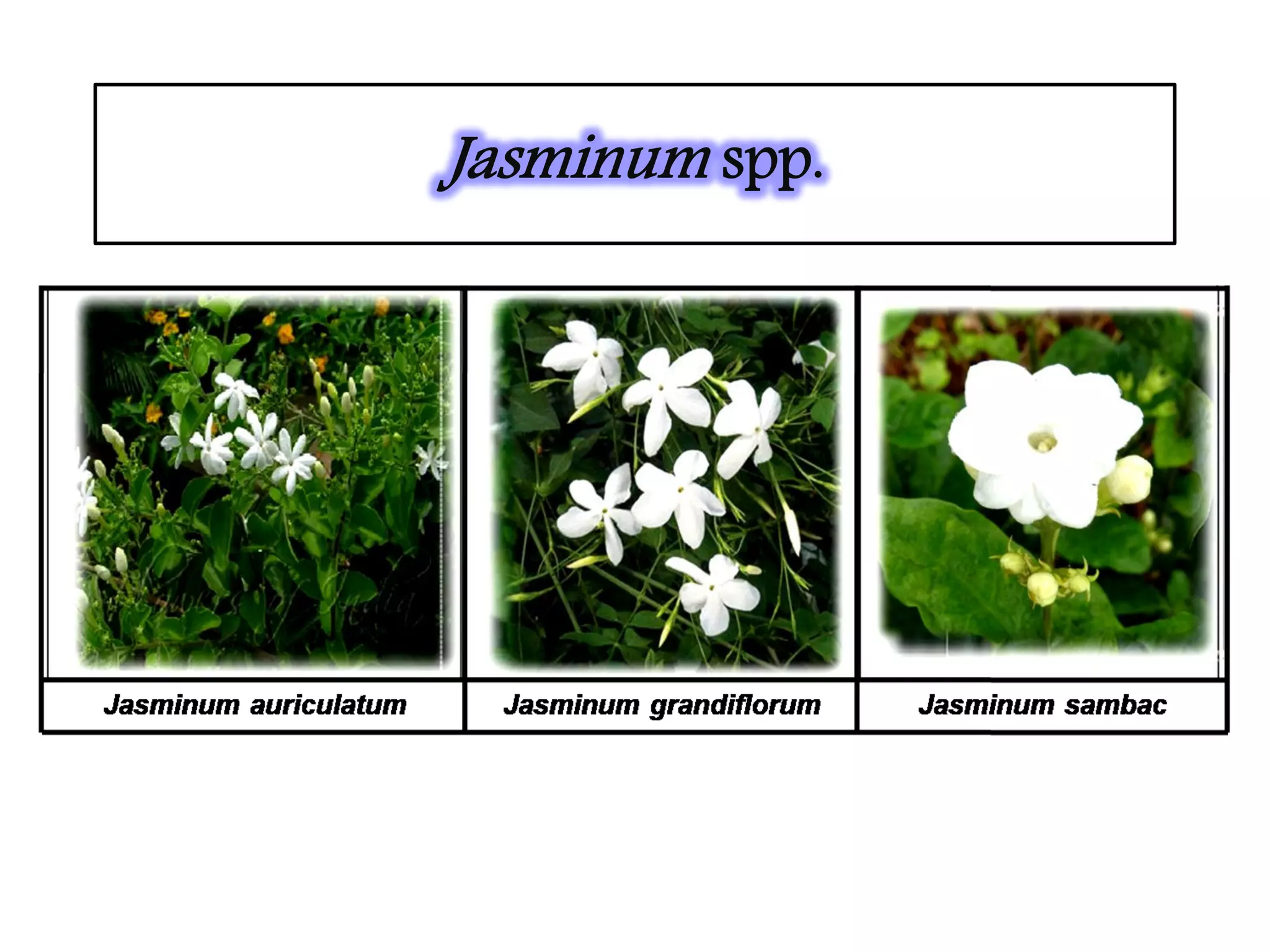
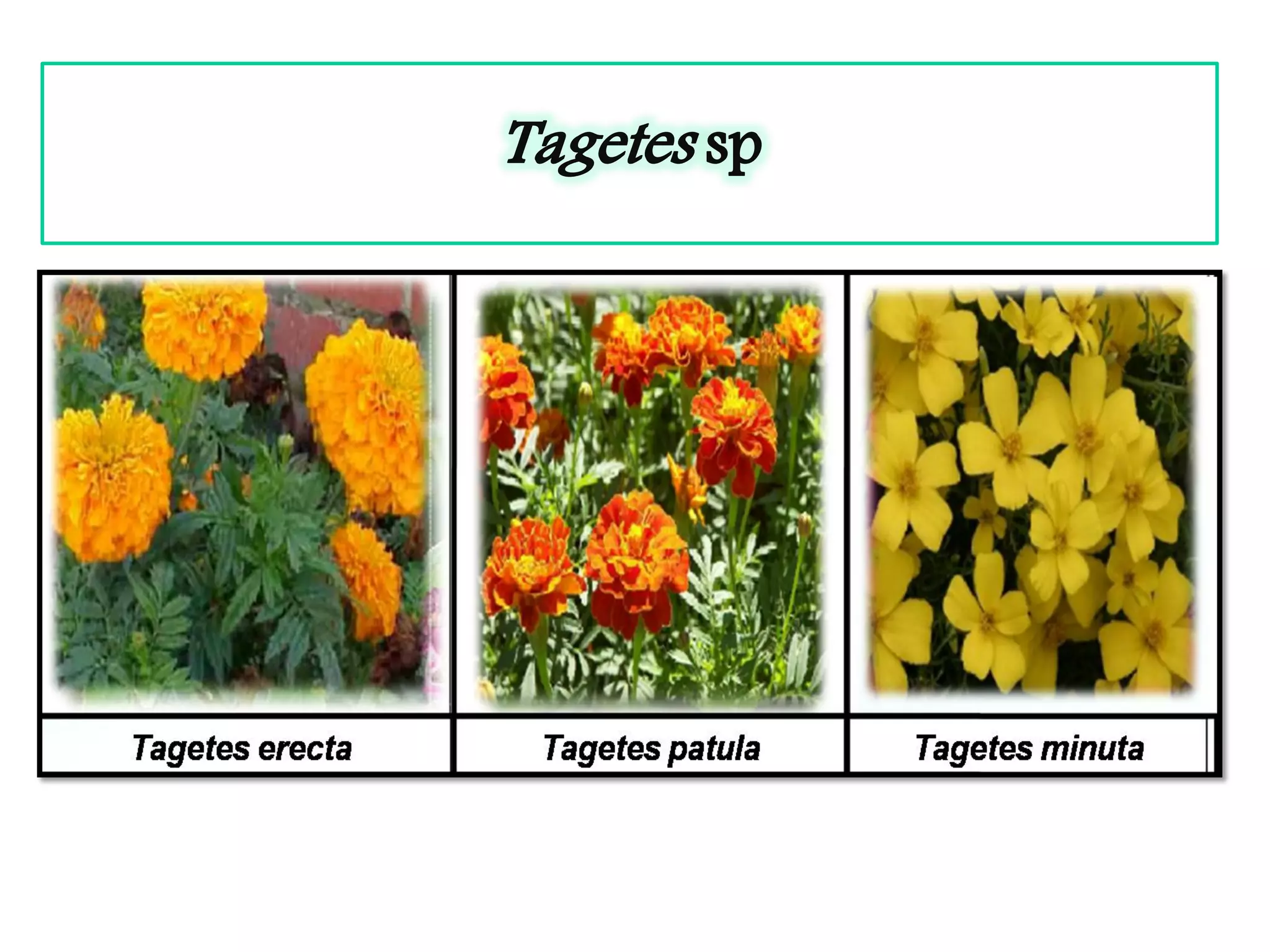
Scented Rose, Jasmine, Marigold, Chrysanthemum,
Tuberose and Crossandra
Non Traditional flowers
Aster, Dahlia, Nerium, Golden rod, Gomphrena, Celosia etc.,
Potential districts of Tamil Nadu for flower
production
Flower Main production areas
Jasmine Vellore, Coimbatore, Cuddalore, Madurai
Marigold Thiruchirapalli, Theni, Dindigul, Madurai
Rose Krishnagiri, Dindigul, Dharmapuri,
Kanchipuram
Chrysanthemum Krishnagiri, Dharmapuri, Salem
Cut flowers The Nilgiris, Kodaikanal, Yercaud
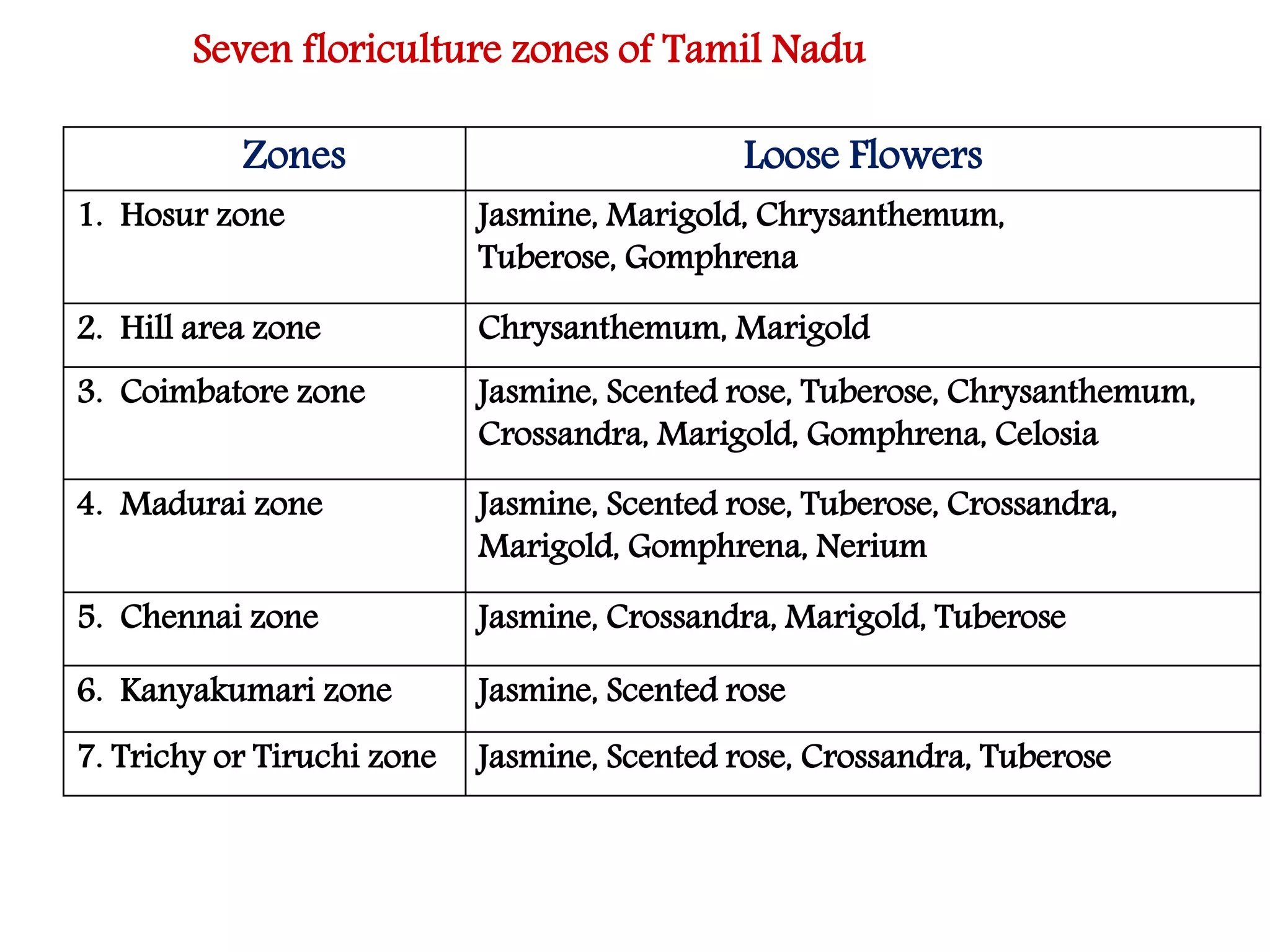
Zones Loose Flowers
1. Hosur zone Jasmine, Marigold, Chrysanthemum,
Tuberose, Gomphrena
2. Hill area zone Chrysanthemum, Marigold
3. Coimbatore zone Jasmine, Scented rose, Tuberose, Chrysanthemum,
Crossandra, Marigold, Gomphrena, Celosia
4. Madurai zone Jasmine, Scented rose, Tuberose, Crossandra,
Marigold, Gomphrena, Nerium
5. Chennai zone Jasmine, Crossandra, Marigold, Tuberose
6. Kanyakumari zone Jasmine, Scented rose
7. Trichy or Tiruchi zone Jasmine, Scented rose, Crossandra, Tuberose
Seven floriculture zones of Tamil Nadu
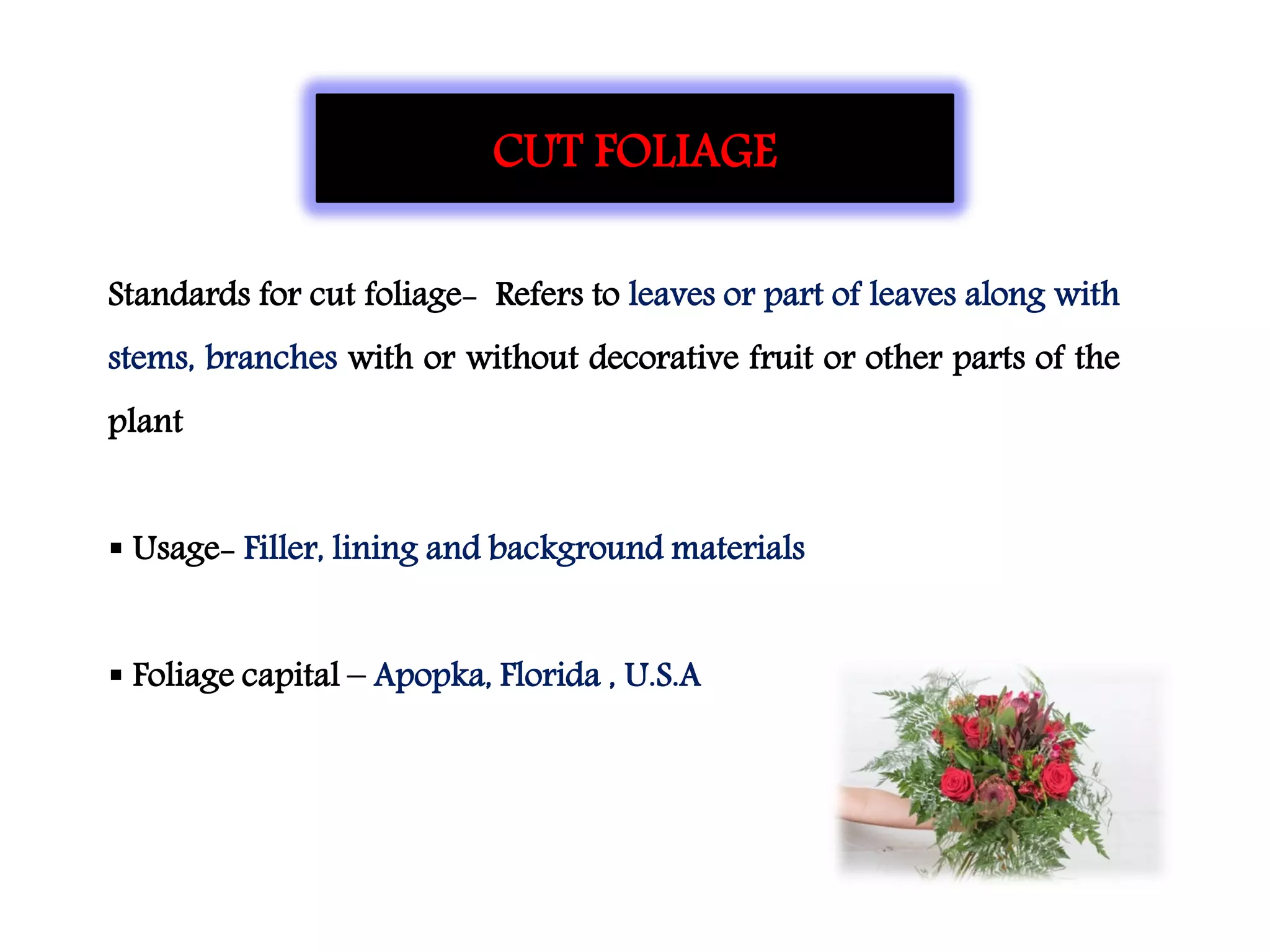
CUT FOLIAGE
Standards for cut foliage- Refers to leaves or part of leaves along with
stems, branches with or without decorative fruit or other parts of the
plant
 Usage- Filler, lining and background materials
 Foliage capital – Apopka, Florida , U.S.A
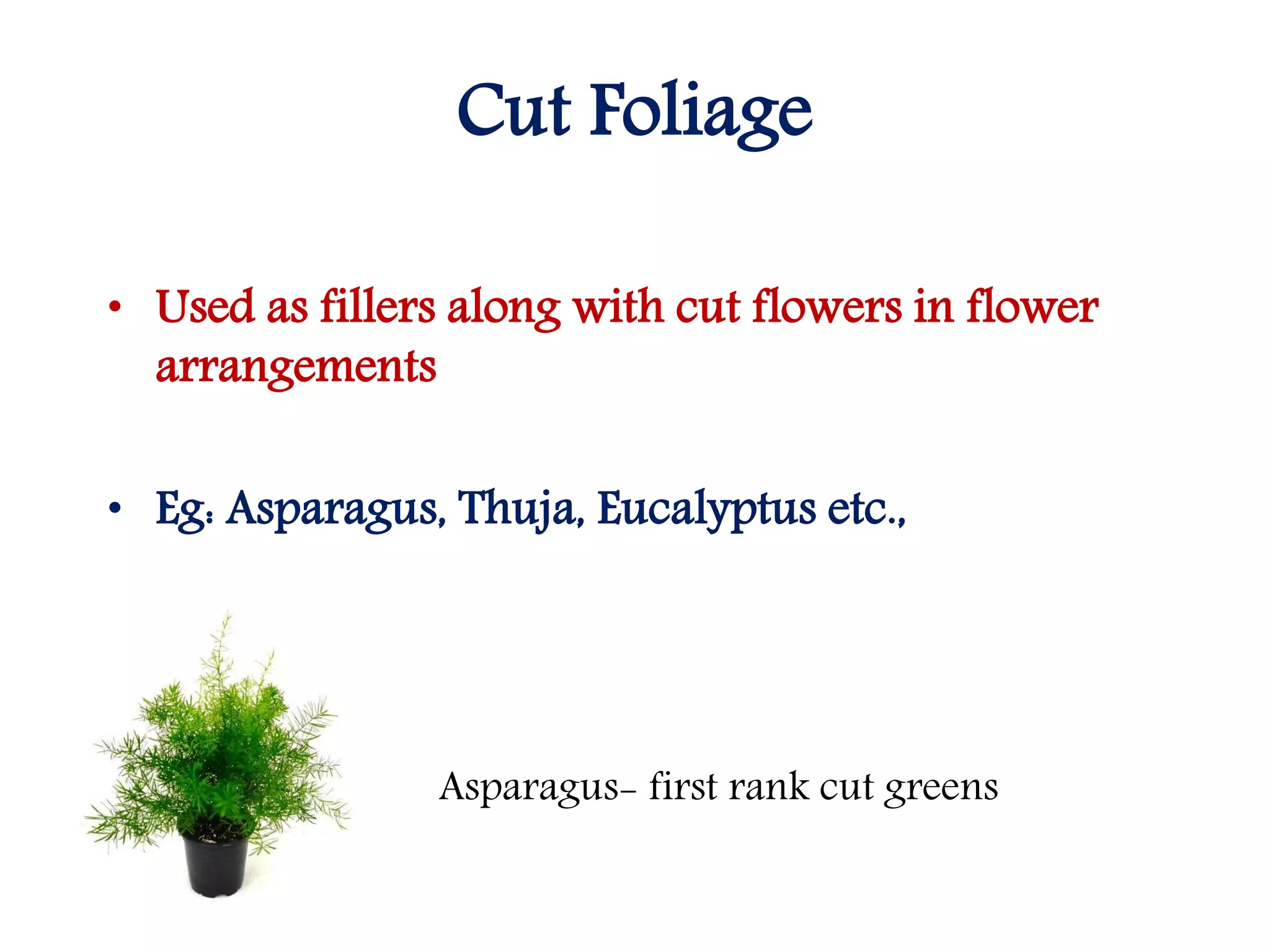
Cut Foliage
• Used as fillers along with cut flowers in flower
arrangements
• Eg: Asparagus, Thuja, Eucalyptus etc.,
Asparagus- first rank cut greens
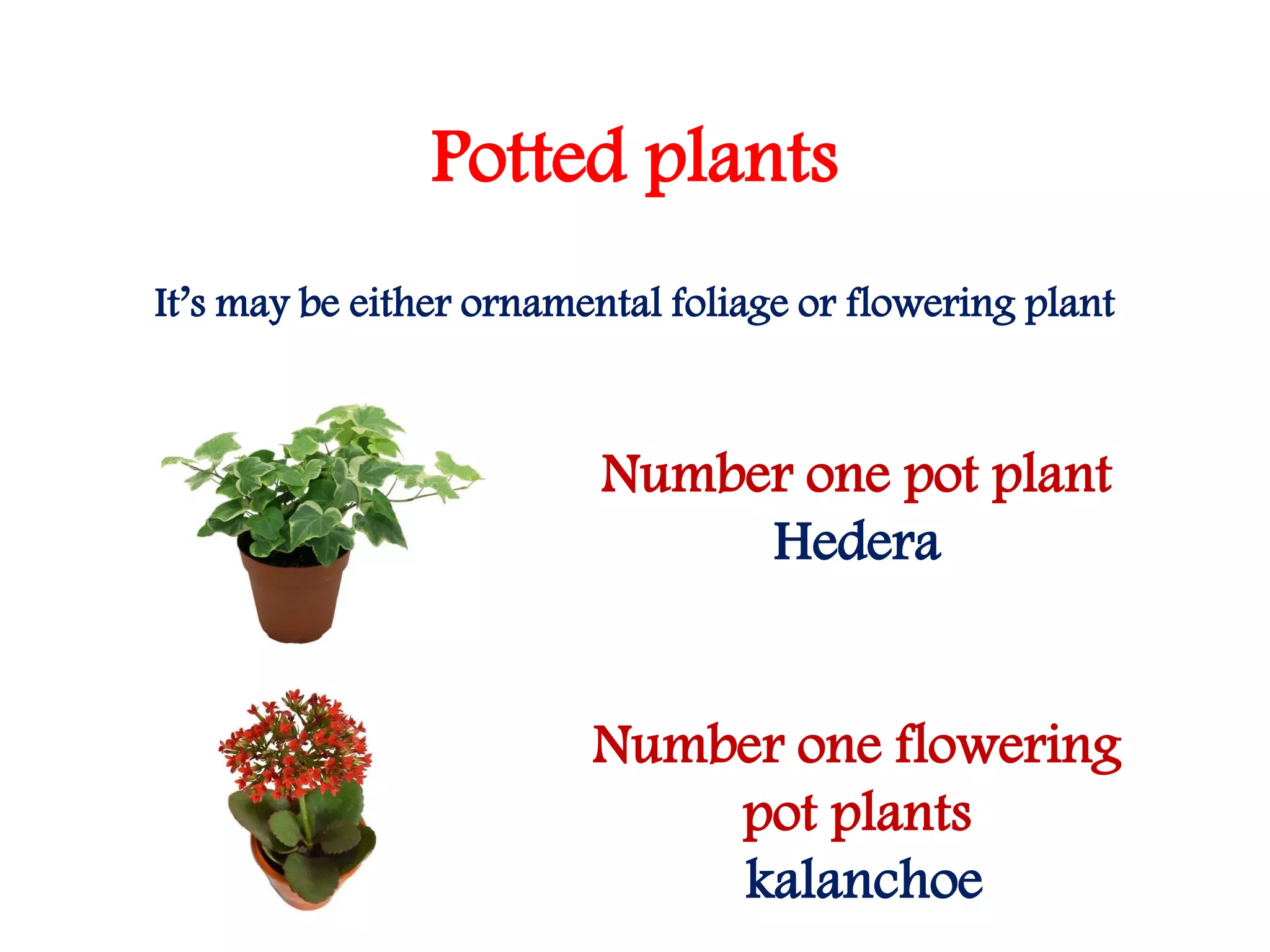
Potted plants
It’s may be either ornamental foliage or flowering plant
Number one pot plant
Hedera
Number one flowering
pot plants
kalanchoe
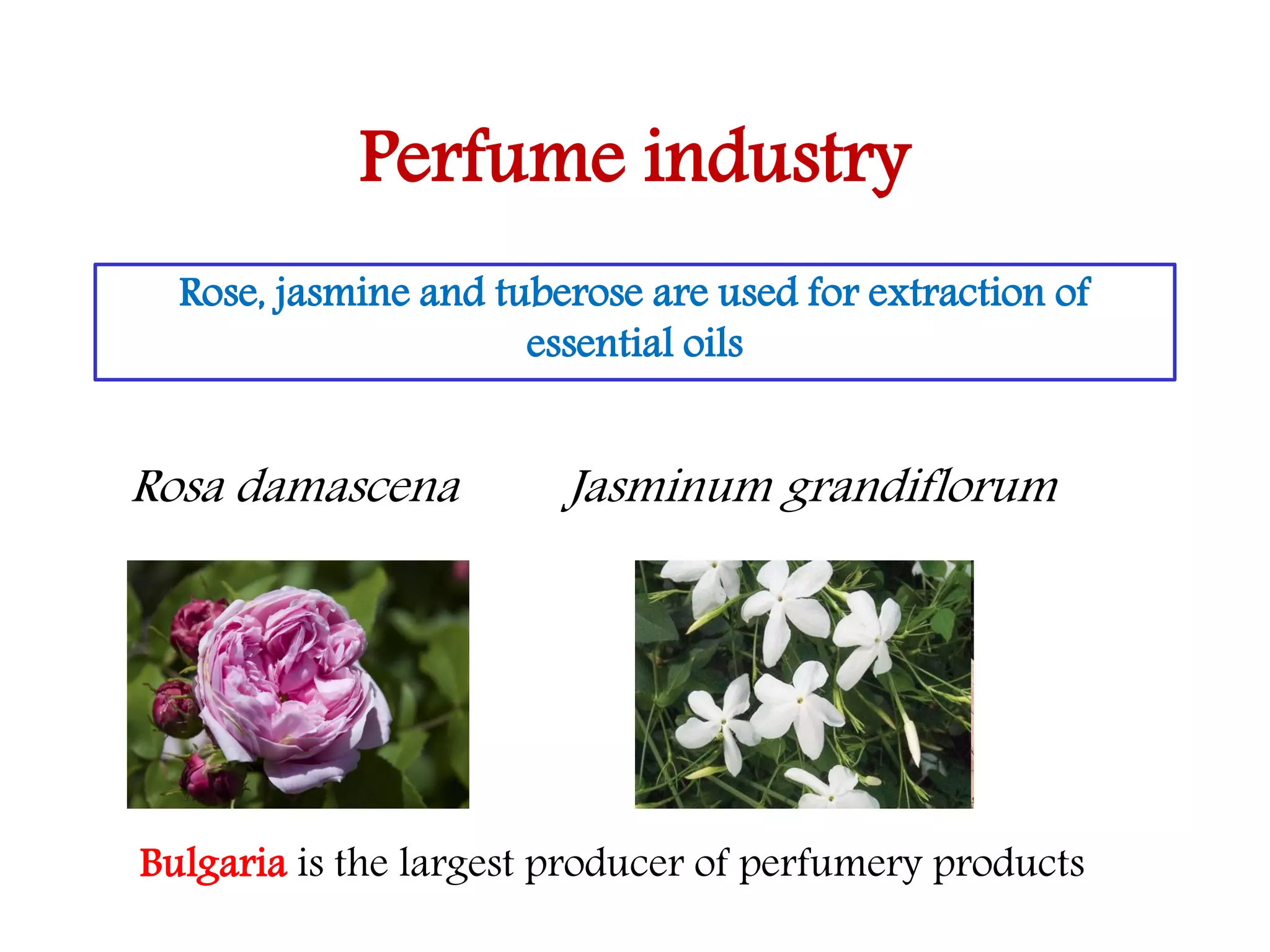
Perfume industry
Rosa damascena Jasminum grandiflorum
Rose, jasmine and tuberose are used for extraction of
essential oils
Bulgaria is the largest producer of perfumery products
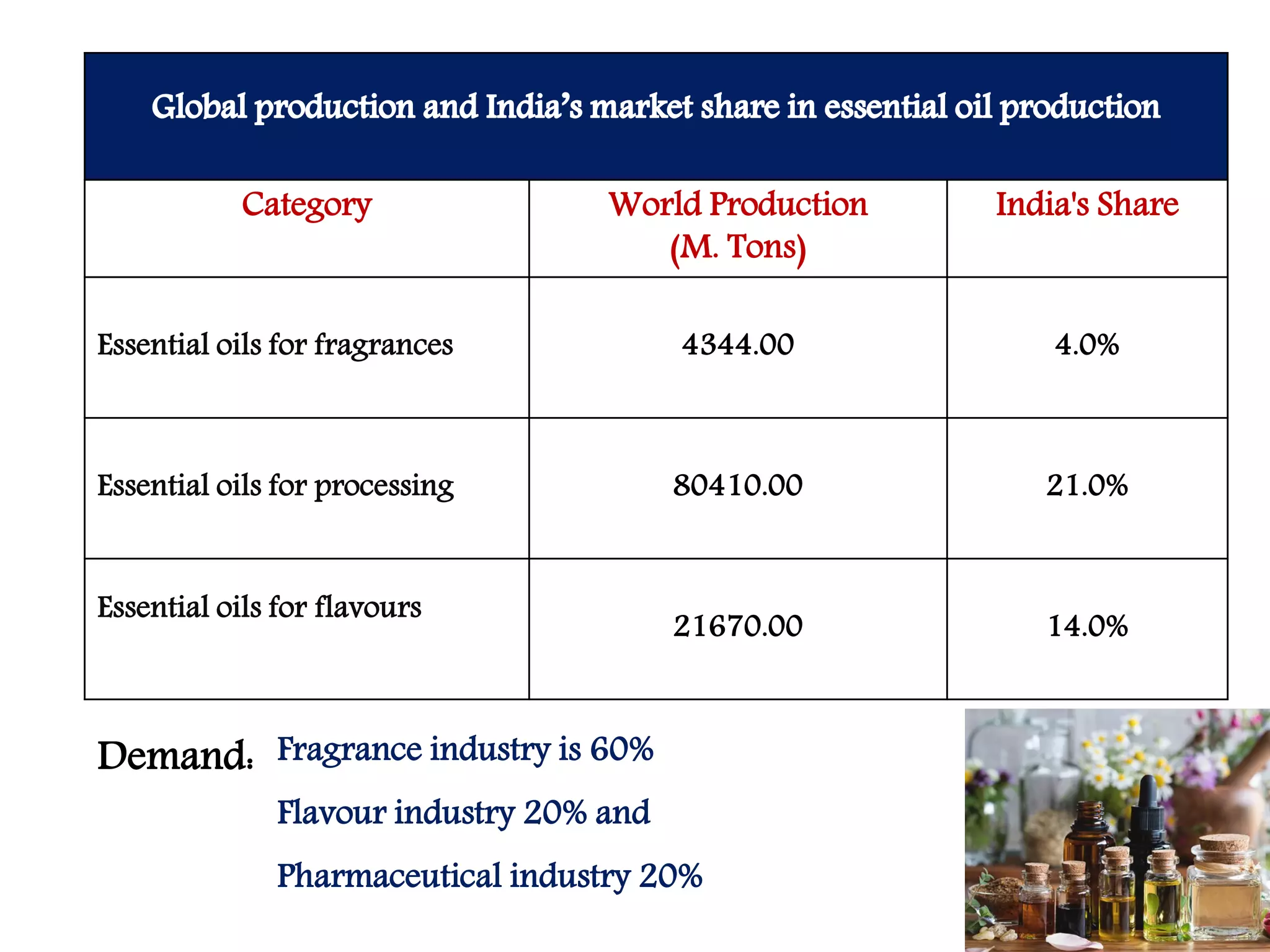
Category World Production
(M. Tons)
India's Share
Essential oils for fragrances 4344.00 4.0%
Essential oils for processing 80410.00 21.0%
Essential oils for flavours
21670.00 14.0%
Fragrance industry is 60%
Flavour industry 20% and
Pharmaceutical industry 20%
Demand:
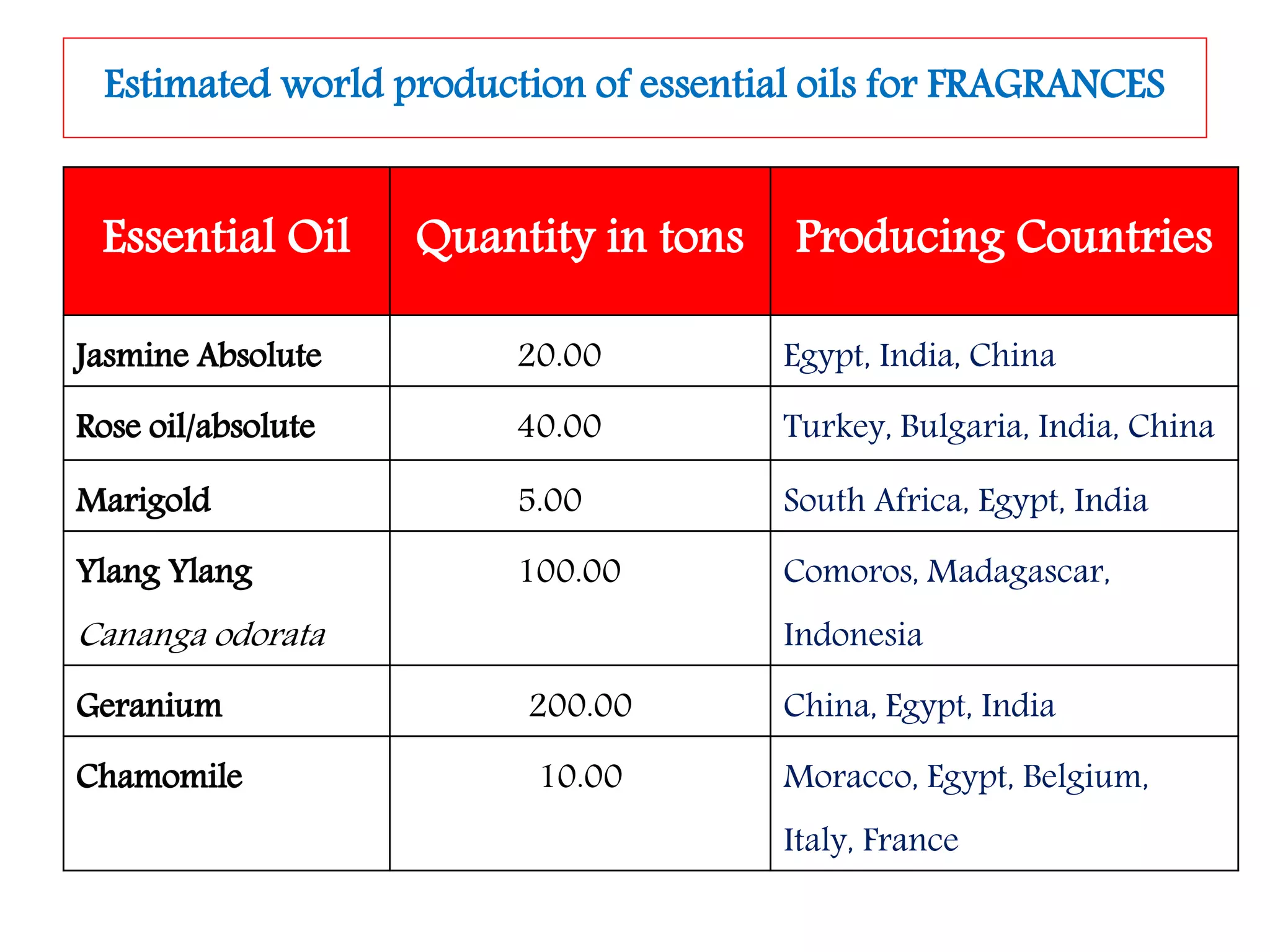
Estimated world production of essential oils for FRAGRANCES
Essential Oil Quantity in tons Producing Countries
20.00 Egypt, India, China
40.00 Turkey, Bulgaria, India, China
5.00 South Africa, Egypt, India
Cananga odorata
100.00 Comoros, Madagascar,
Indonesia
200.00 China, Egypt, India
10.00 Moracco, Egypt, Belgium,
Italy, France
Colour pigments
• Pharmaceutical, animal feed additives and food colourants
• Anthocyanin’s: red, purple and blue colors; water soluble
• Flavones: pale yellow colors; water soluble.
• Carotenes: yellow, orange and red colors; oil or fat soluble
Marigold
• Feed additive for poultry to add the yellow colour of egg yolk
• Prevent dry eye and night blindness in humans
Chrysanthemum
• Food products and cosmetics
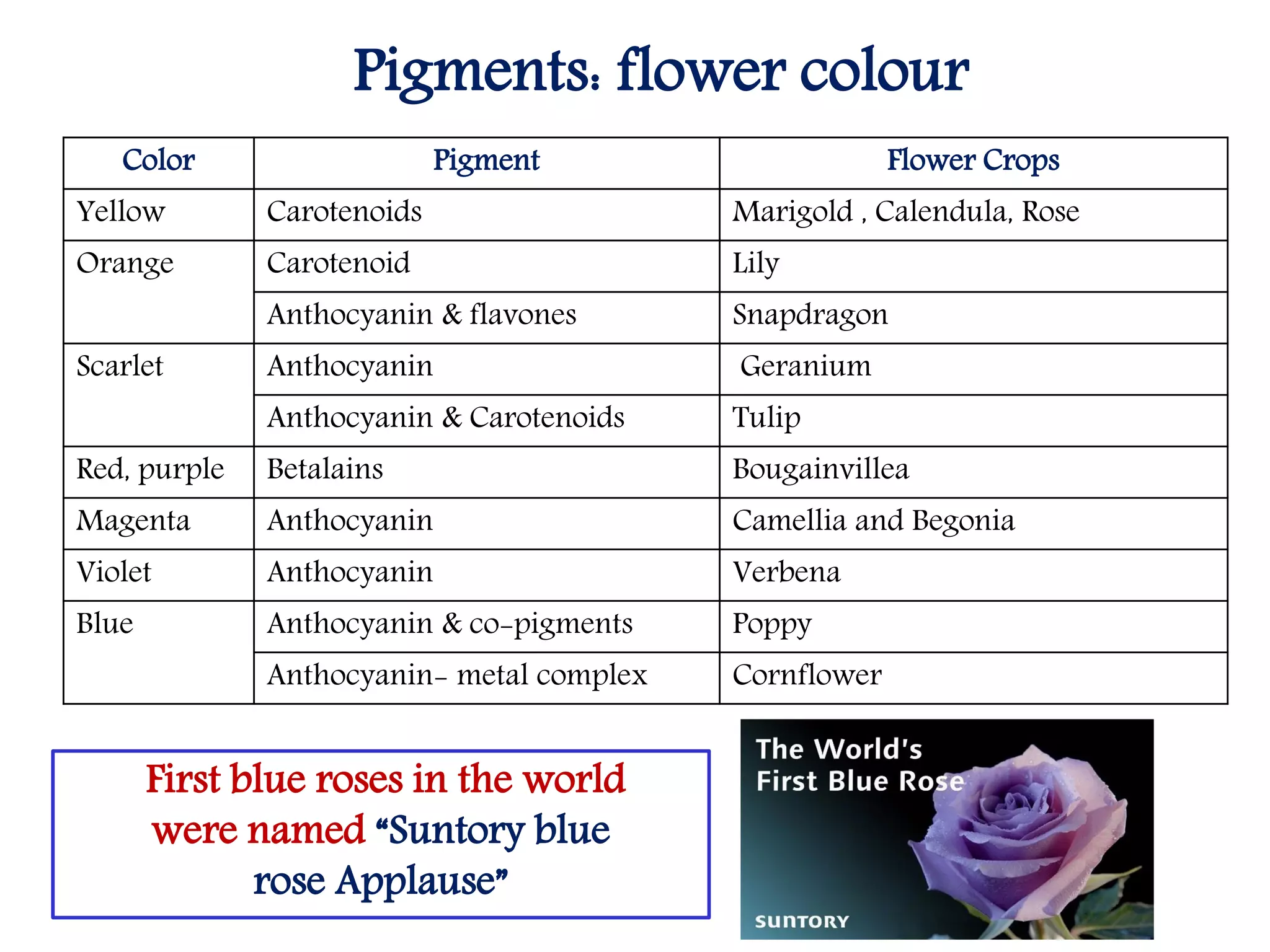
Color Pigment Flower Crops
Yellow Carotenoids Marigold , Calendula, Rose
Orange Carotenoid Lily
Anthocyanin & flavones Snapdragon
Scarlet Anthocyanin Geranium
Anthocyanin & Carotenoids Tulip
Red, purple Betalains Bougainvillea
Magenta Anthocyanin Camellia and Begonia
Violet Anthocyanin Verbena
Blue Anthocyanin & co-pigments Poppy
Anthocyanin- metal complex Cornflower
Pigments: flower colour
First blue roses in the world
were named “Suntory blue
rose Applause”
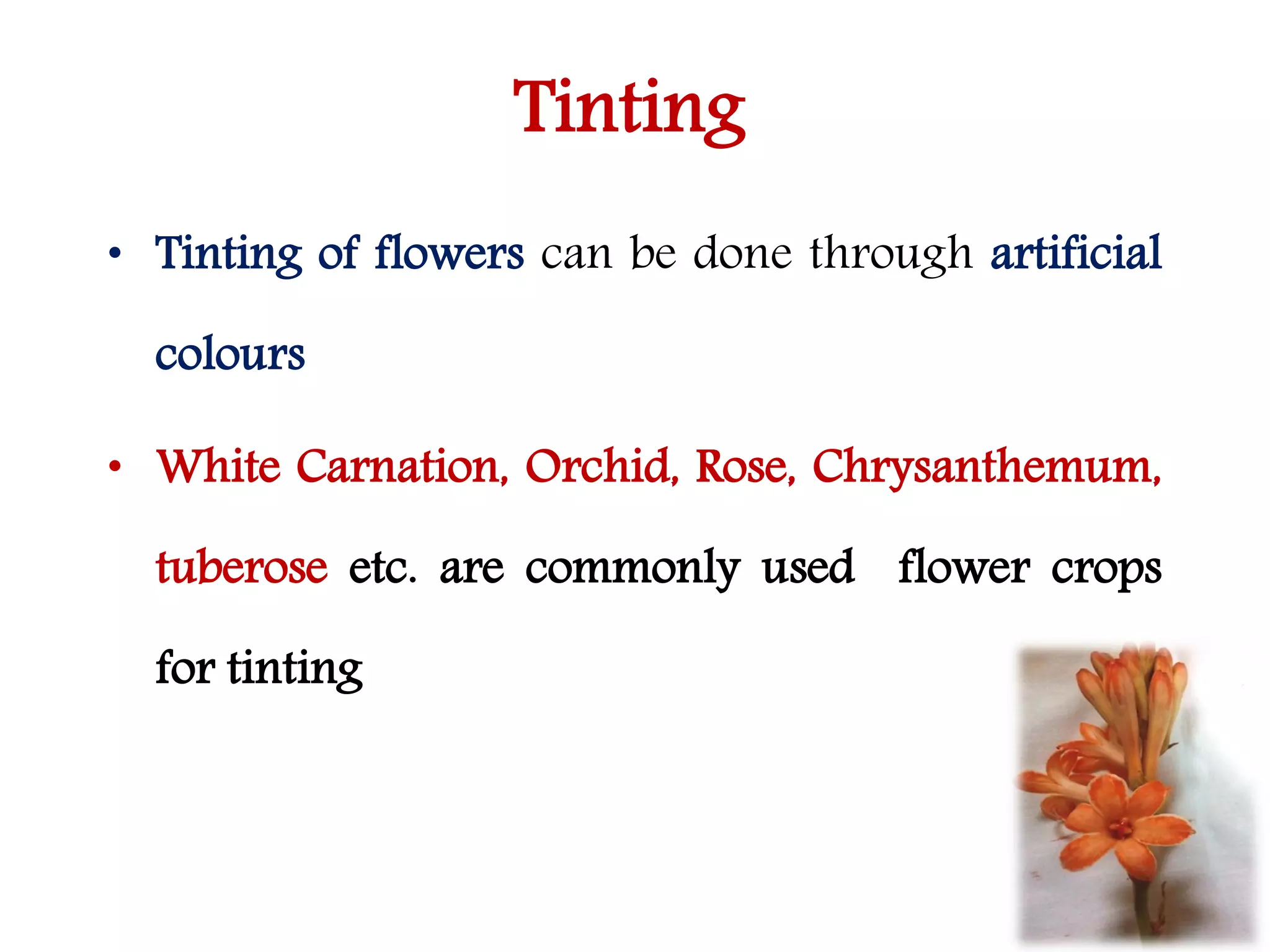
Tinting
• Tinting of flowers can be done through artificial
colours
• White Carnation, Orchid, Rose, Chrysanthemum,
tuberose etc. are commonly used flower crops
for tinting
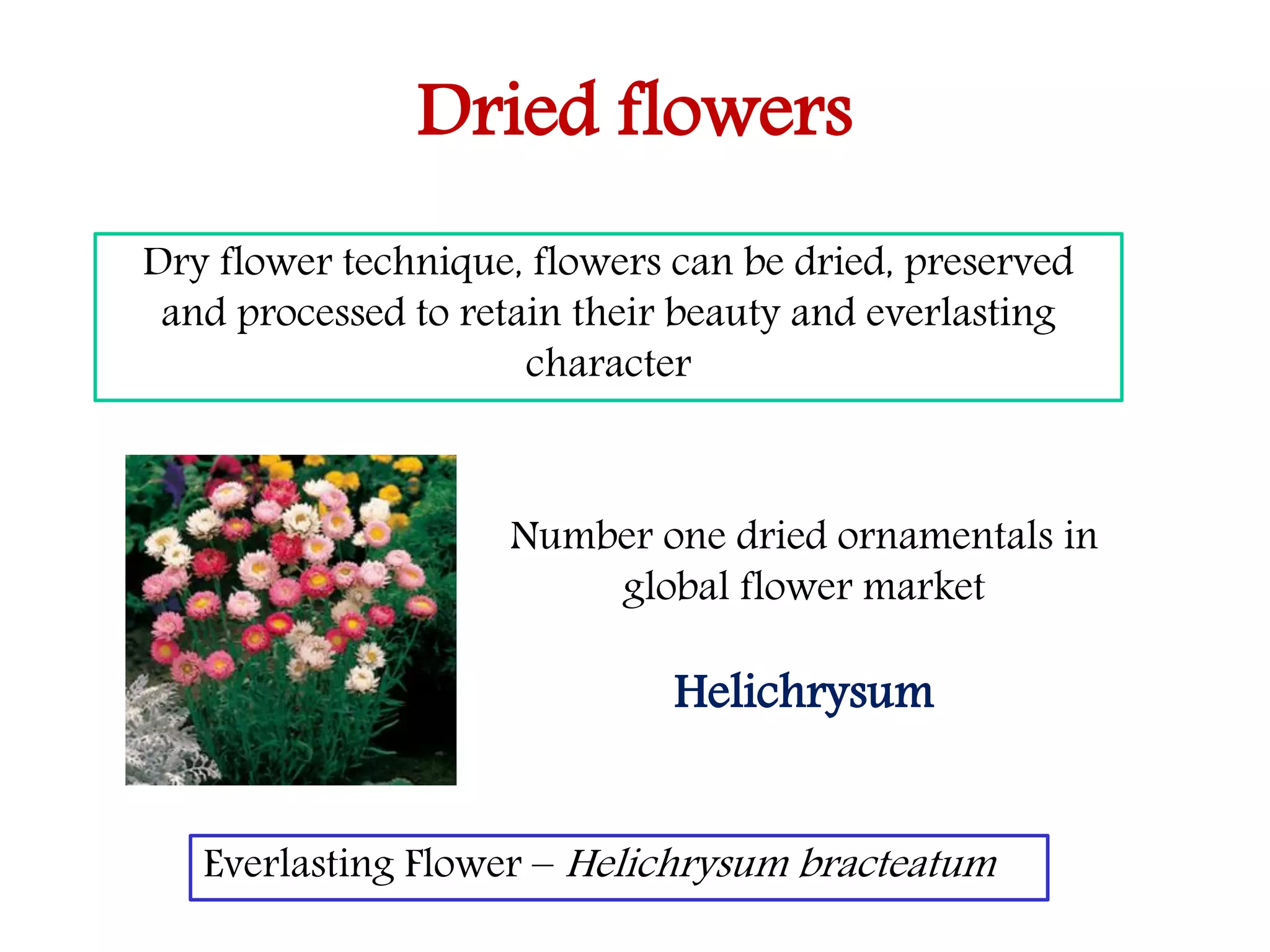
Dried flowers
Number one dried ornamentals in
global flower market
Helichrysum
Dry flower technique, flowers can be dried, preserved
and processed to retain their beauty and everlasting
character
Everlasting Flower – Helichrysum bracteatum
Dried flowers
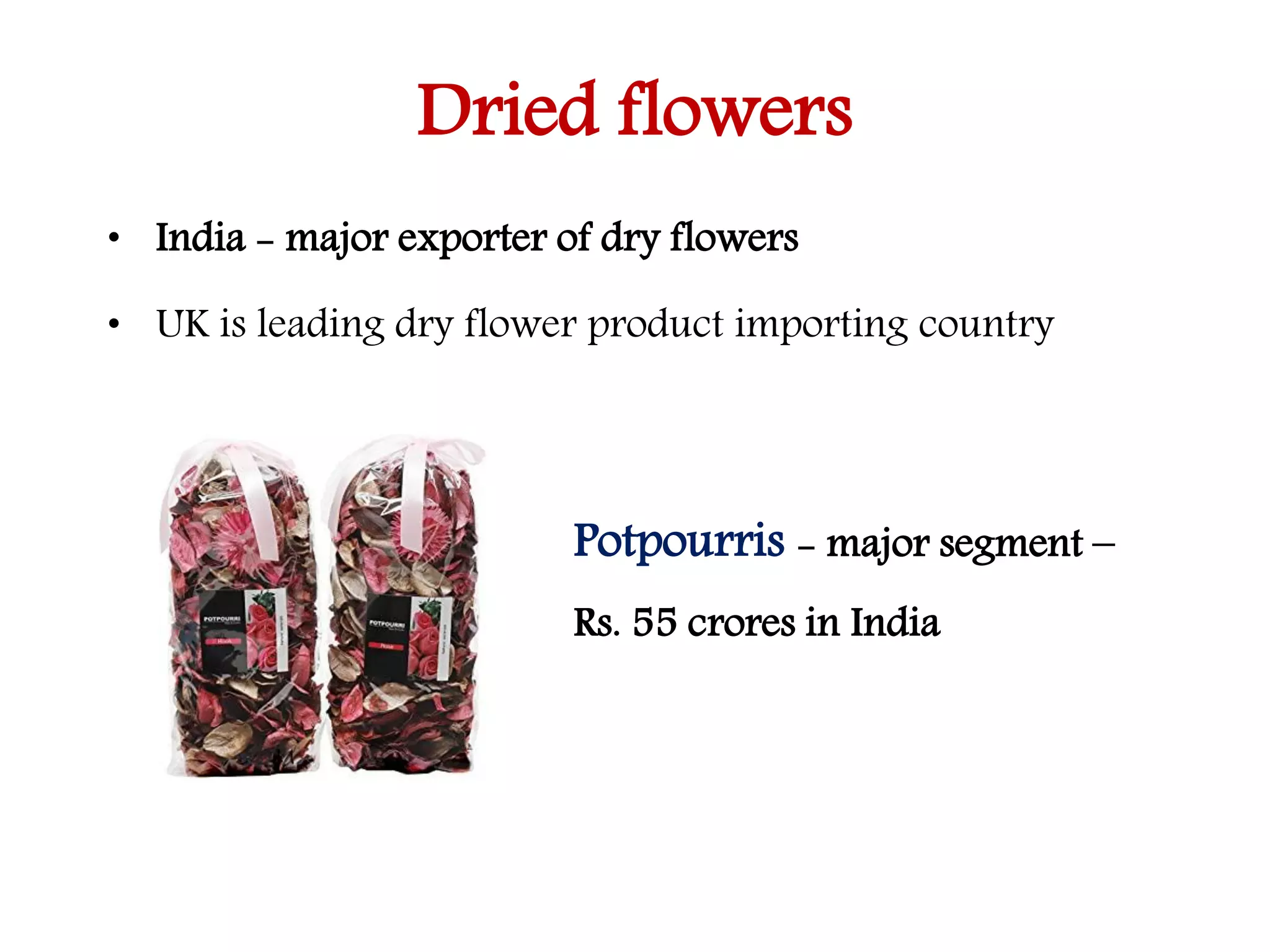
• India - major exporter of dry flowers
• UK is leading dry flower product importing country
Potpourris - major segment –
Rs. 55 crores in India
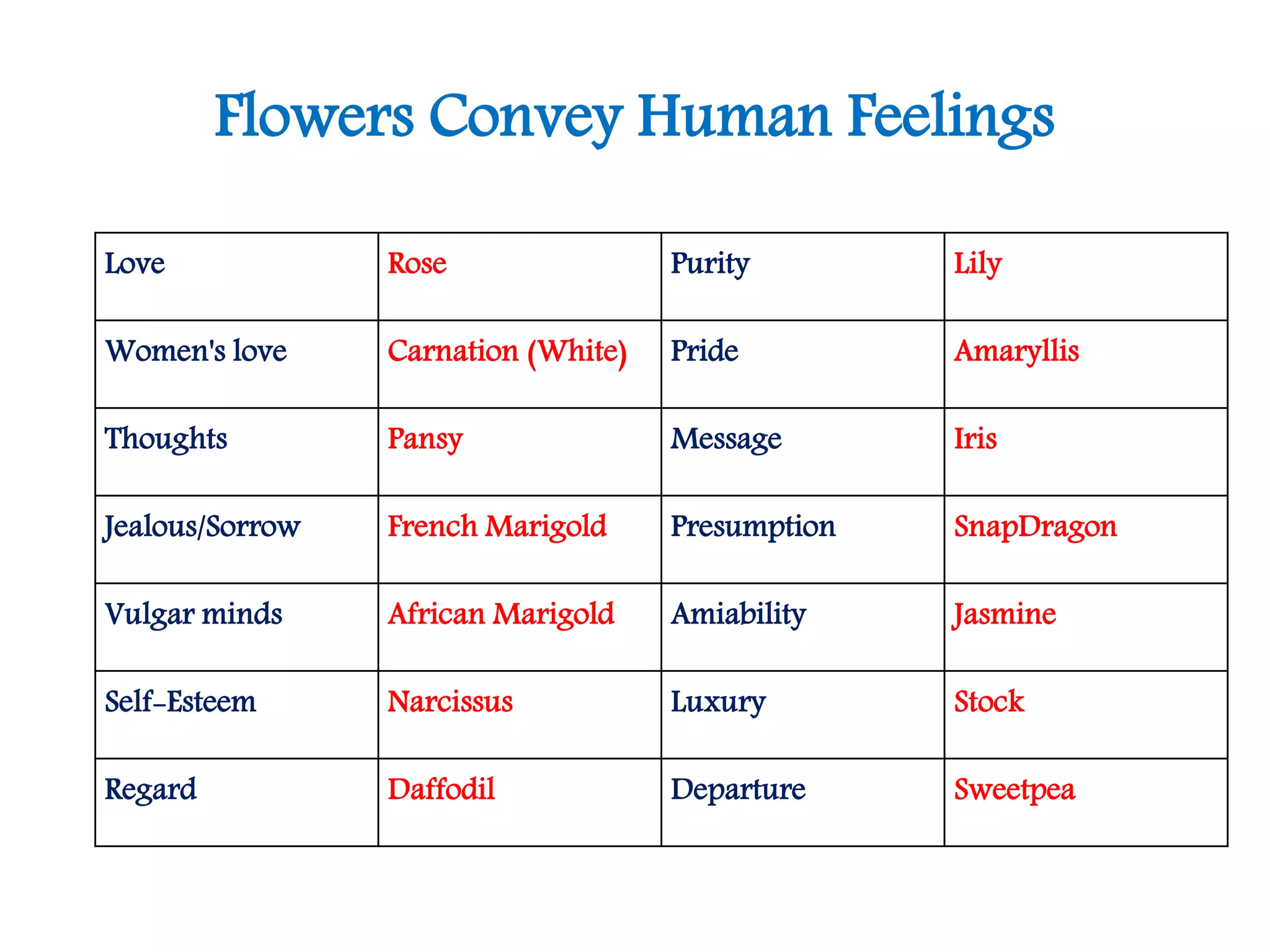
Flowers Convey Human Feelings
Love Rose Purity Lily
Women's love Carnation (White) Pride Amaryllis
Thoughts Pansy Message Iris
Jealous/Sorrow French Marigold Presumption SnapDragon
Vulgar minds African Marigold Amiability Jasmine
Self-Esteem Narcissus Luxury Stock
Regard Daffodil Departure Sweetpea
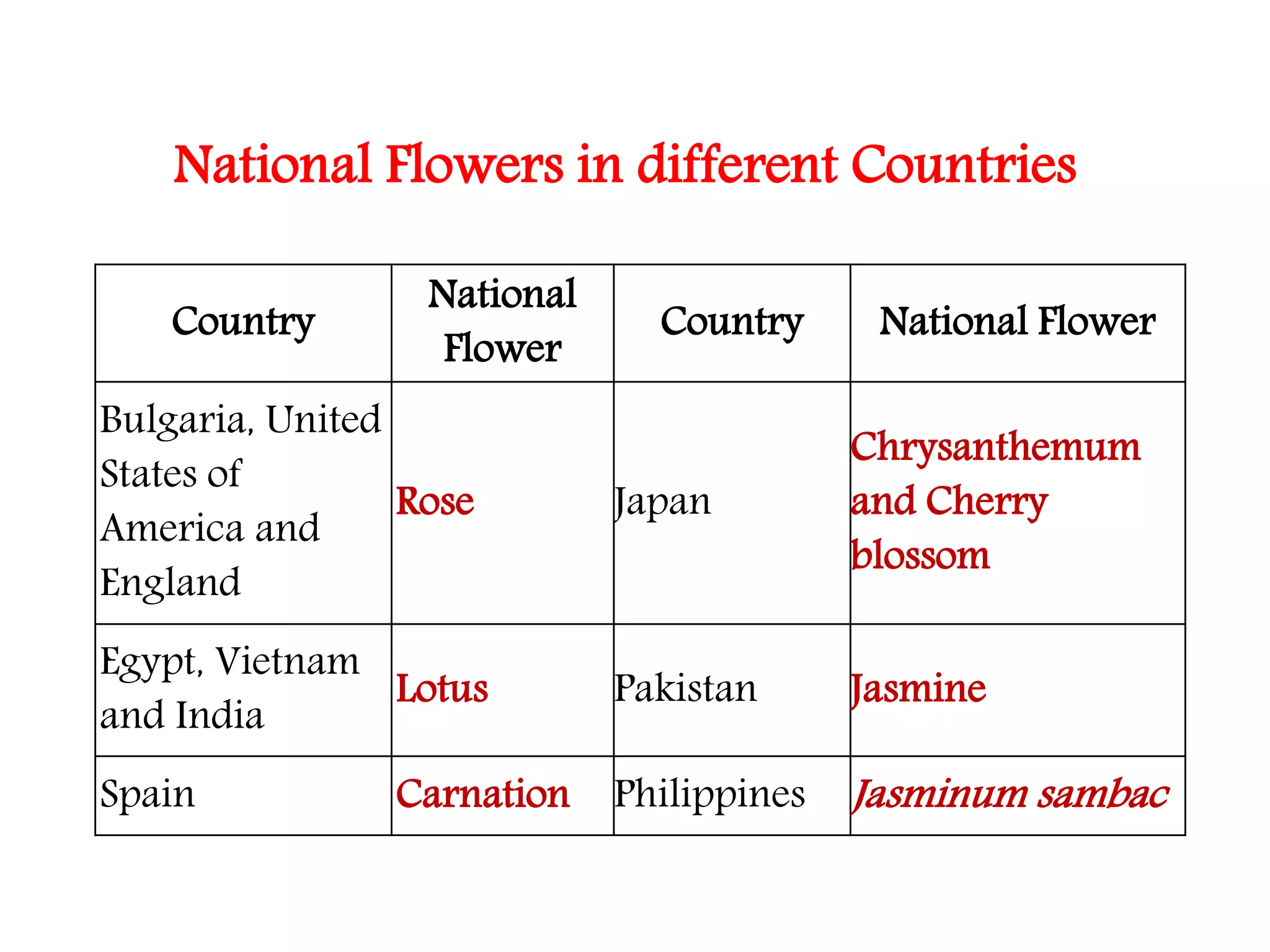
National Flowers in different Countries
Country
National
Flower
Country National Flower
Bulgaria, United
States of
America and
England
Rose Japan
Chrysanthemum
and Cherry
blossom
Egypt, Vietnam
and India
Lotus Pakistan Jasmine
Spain Carnation Philippines Jasminum sambac
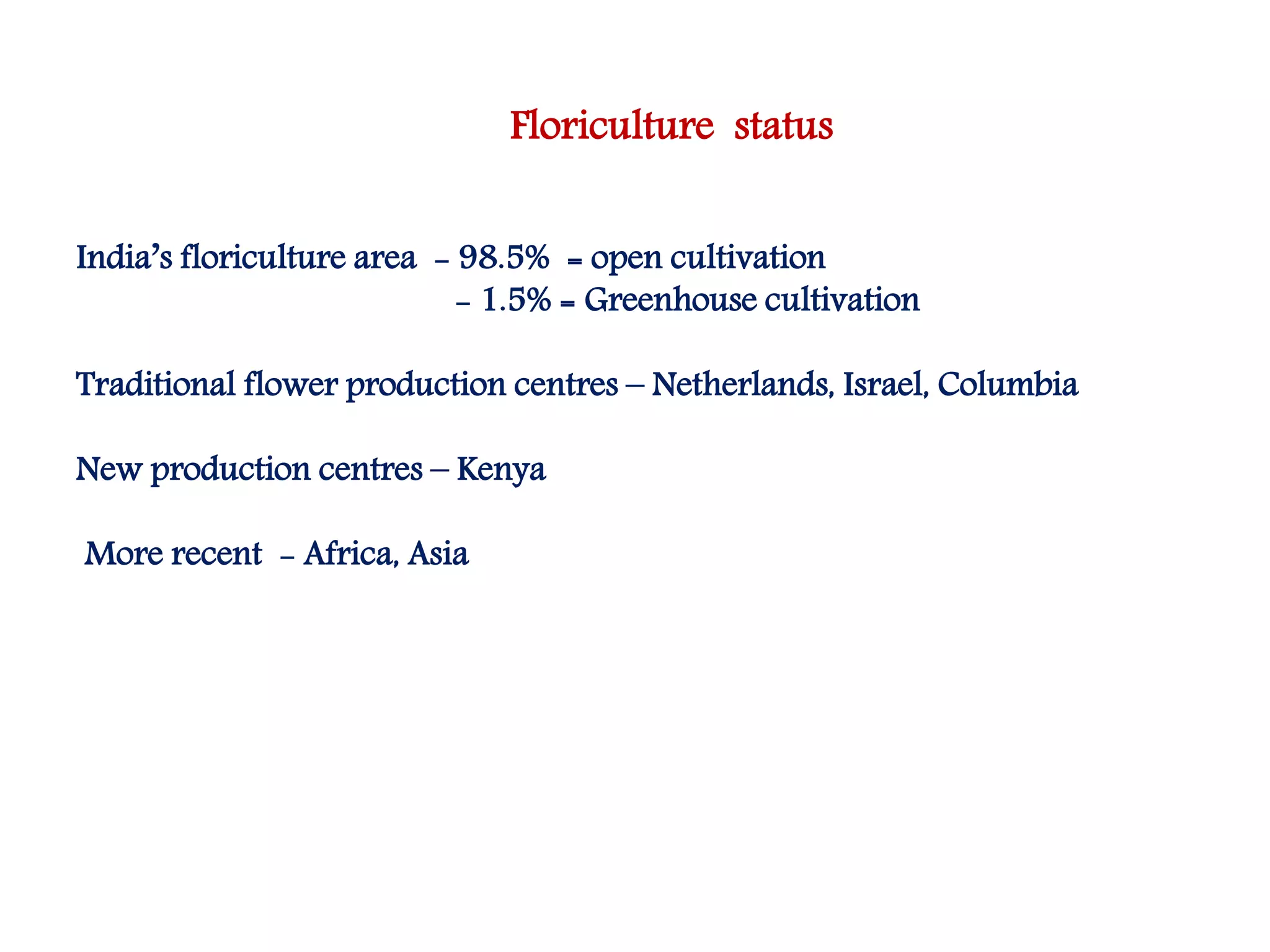
Floriculture status
India’s floriculture area - 98.5% = open cultivation
- 1.5% = Greenhouse cultivation
Traditional flower production centres – Netherlands, Israel, Columbia
New production centres – Kenya
More recent - Africa, Asia
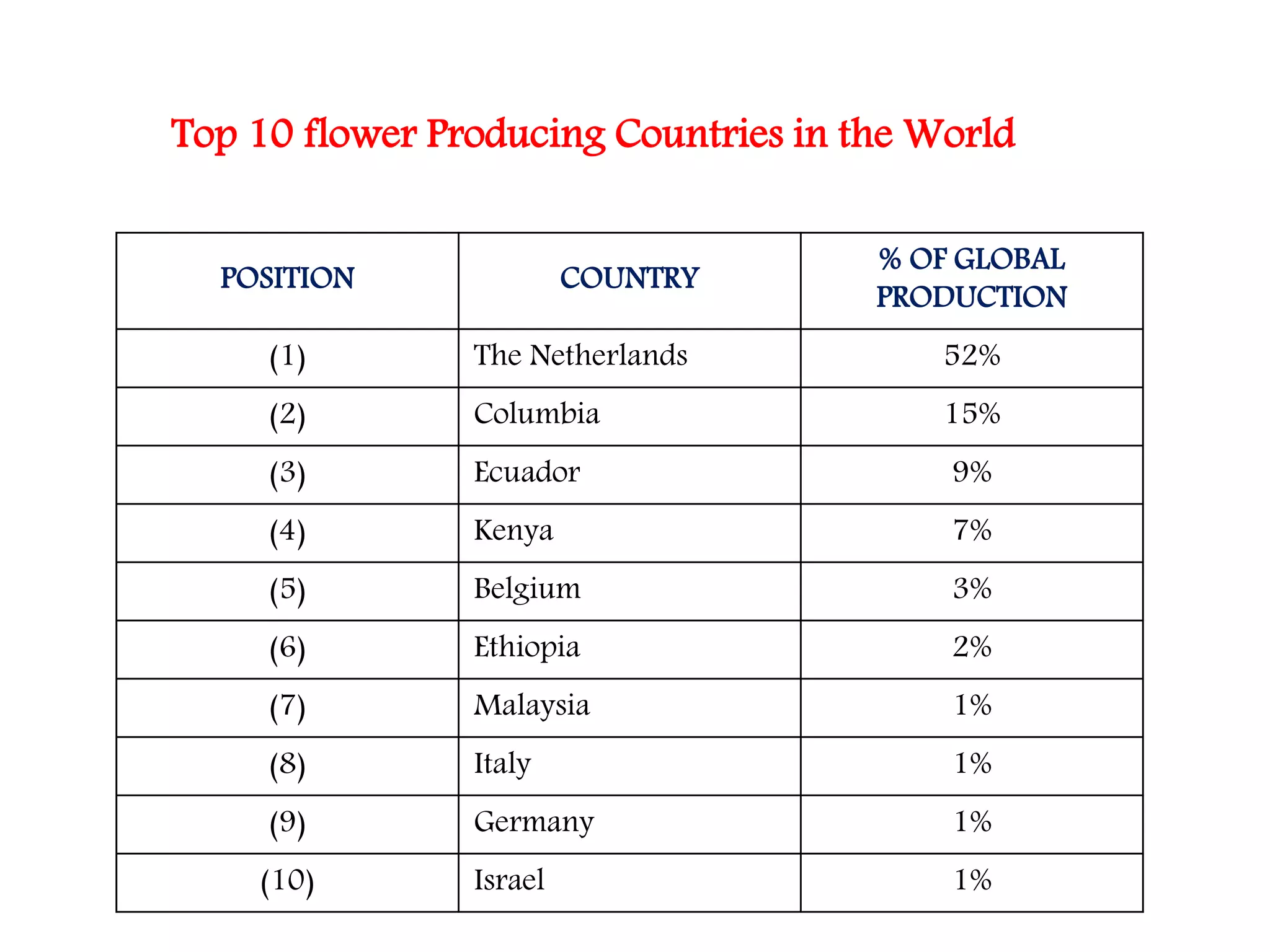
POSITION COUNTRY
% OF GLOBAL
PRODUCTION
(1) The Netherlands 52%
(2) Columbia 15%
(3) Ecuador 9%
(4) Kenya 7%
(5) Belgium 3%
(6) Ethiopia 2%
(7) Malaysia 1%
(8) Italy 1%
(9) Germany 1%
(10) Israel 1%
Top 10 flower Producing Countries in the World
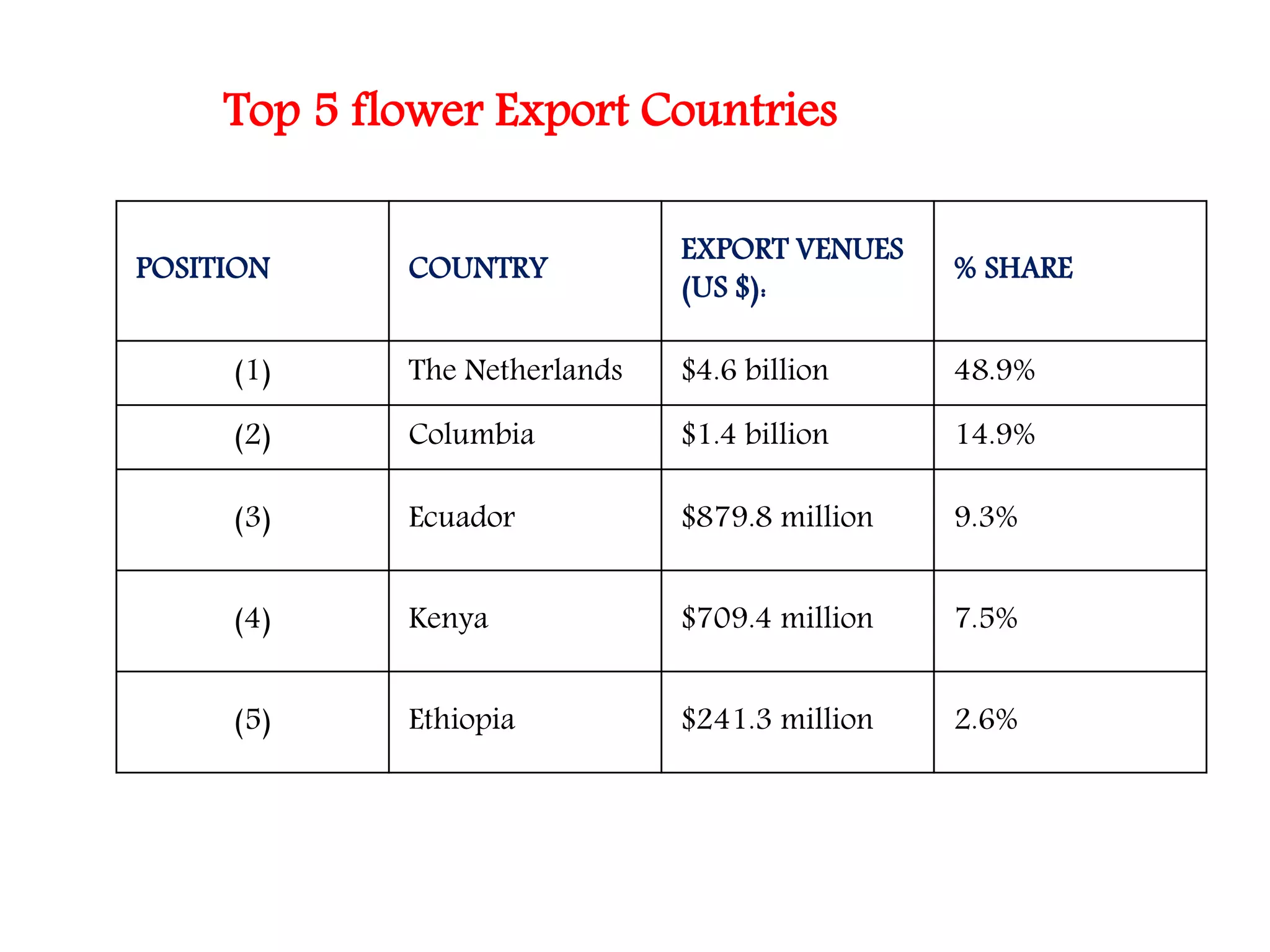
POSITION COUNTRY
EXPORT VENUES
(US $):
% SHARE
(1) The Netherlands $4.6 billion 48.9%
(2) Columbia $1.4 billion 14.9%
(3) Ecuador $879.8 million 9.3%
(4) Kenya $709.4 million 7.5%
(5) Ethiopia $241.3 million 2.6%
Top 5 flower Export Countries
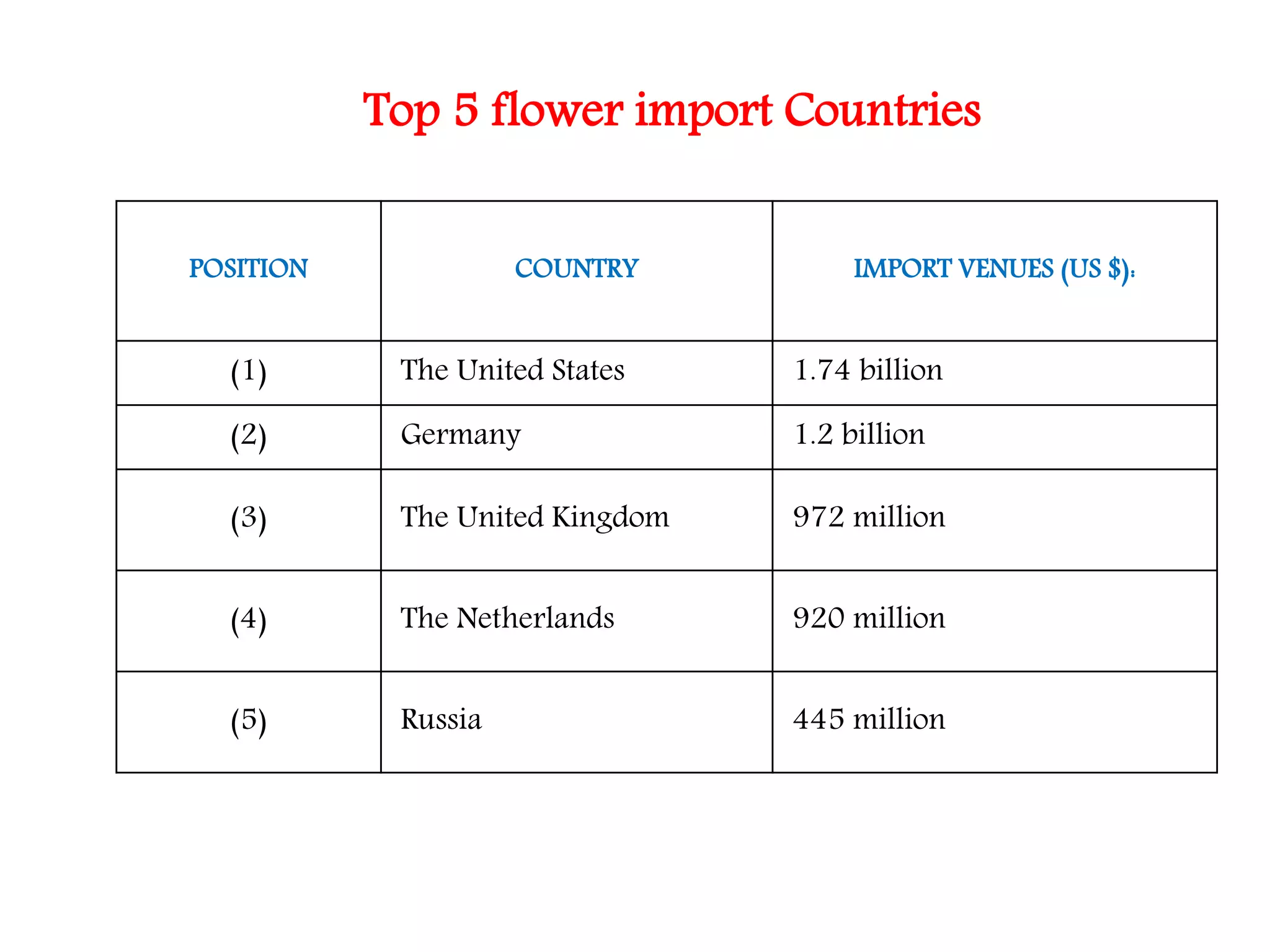
POSITION COUNTRY IMPORT VENUES (US $):
(1) The United States 1.74 billion
(2) Germany 1.2 billion
(3) The United Kingdom 972 million
(4) The Netherlands 920 million
(5) Russia 445 million
Top 5 flower import Countries
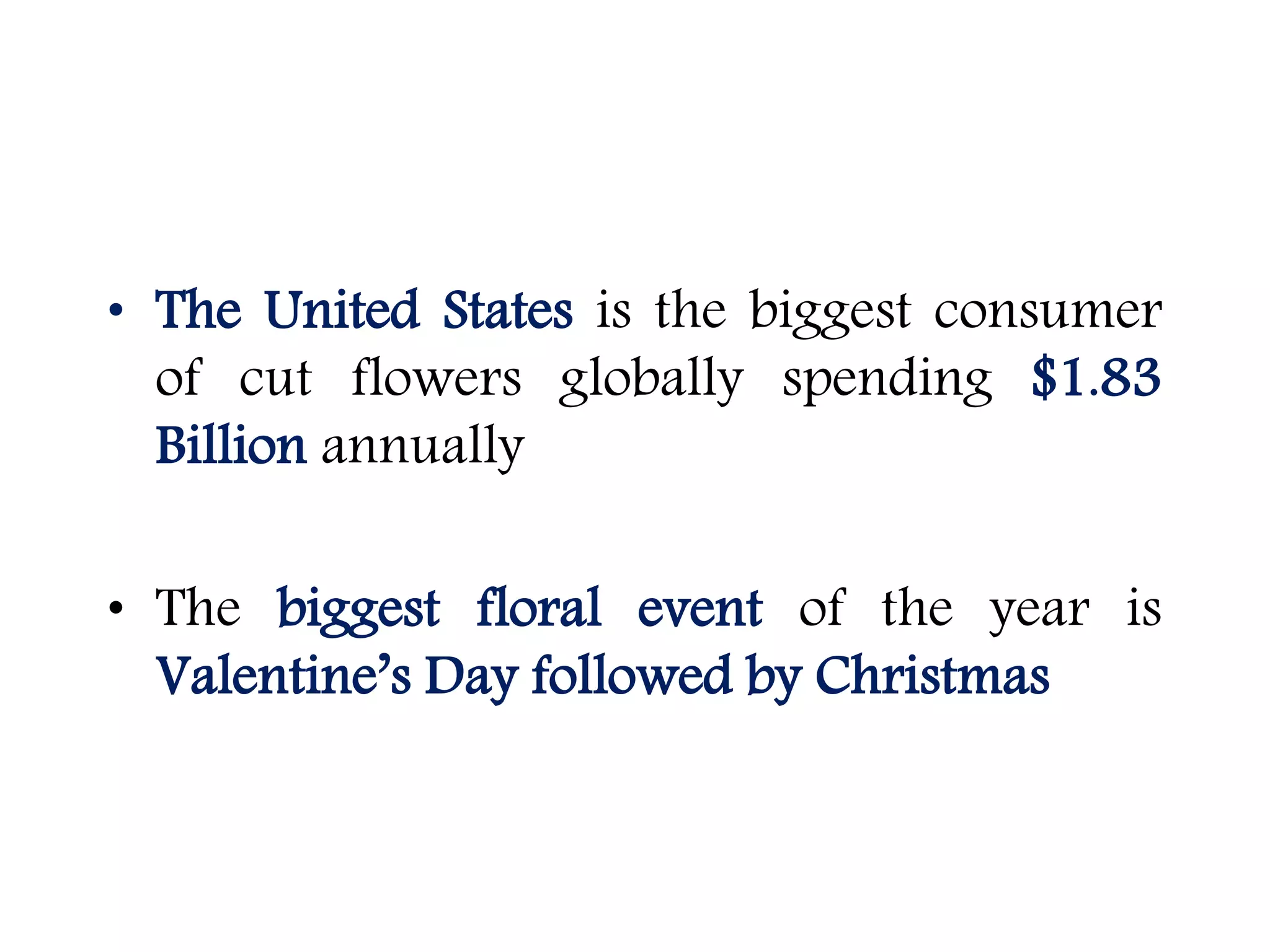
• The United States is the biggest consumer
of cut flowers globally spending $1.83
Billion annually
• The biggest floral event of the year is
Valentine’s Day followed by Christmas
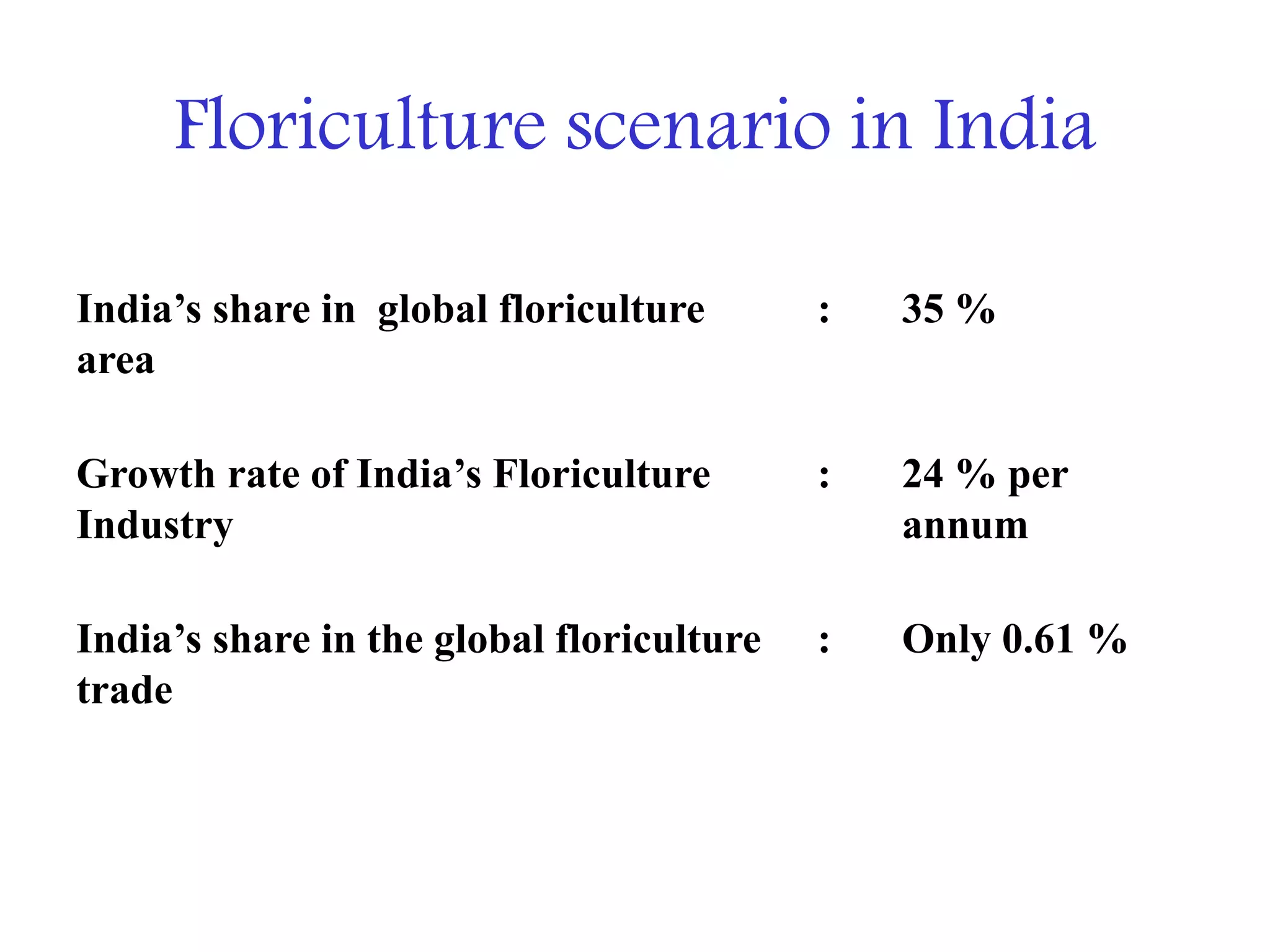
Floriculture scenario in India
India’s share in global floriculture
area
: 35 %
Growth rate of India’s Floriculture
Industry
: 24 % per
annum
India’s share in the global floriculture
trade
: Only 0.61 %
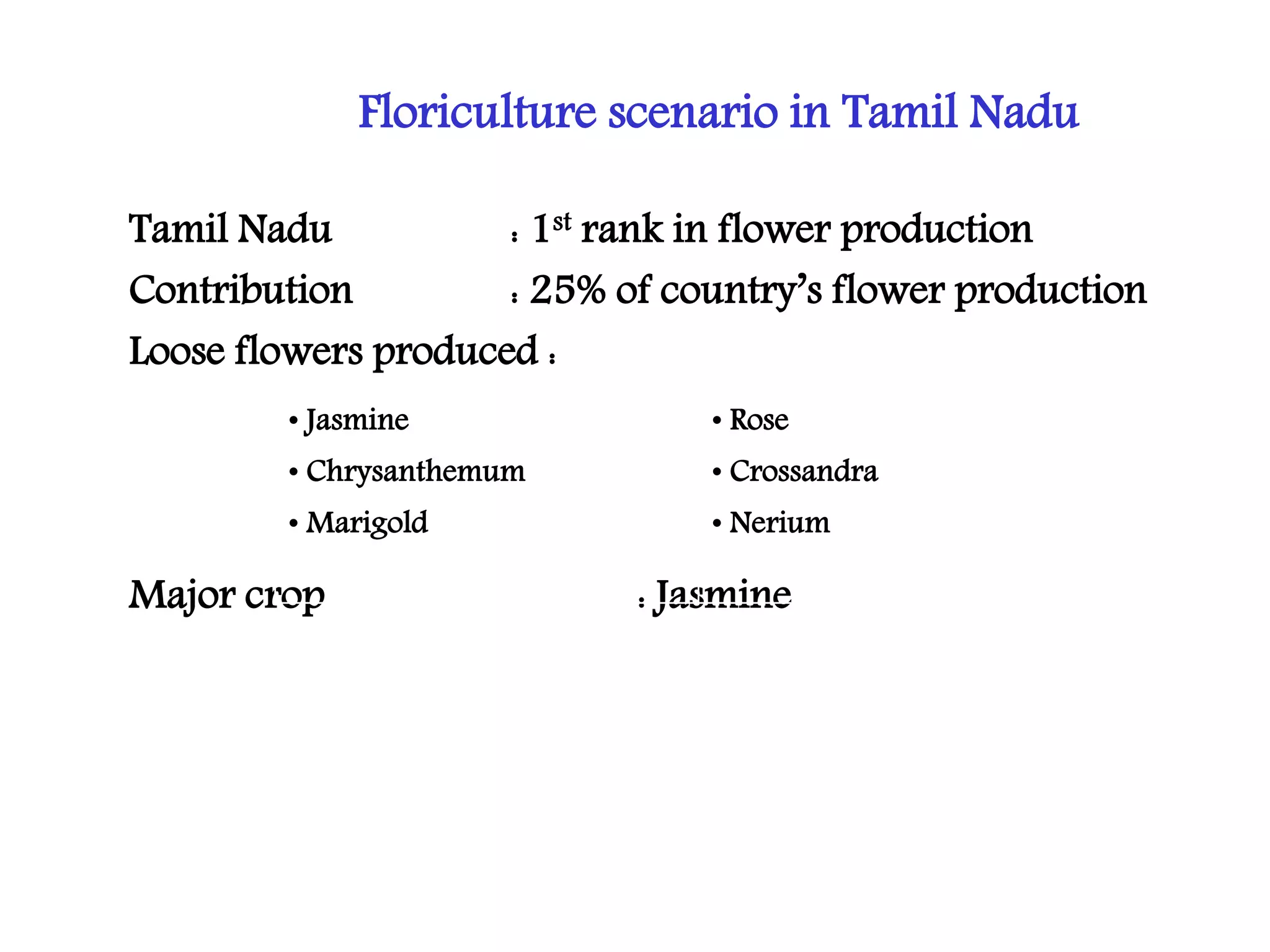
Floriculture scenario in Tamil Nadu
Tamil Nadu : 1st rank in flower production
Contribution : 25% of country’s flower production
Loose flowers produced :
Major crop : Jasmine
• Jasmine • Rose
• Chrysanthemum • Crossandra
• Marigold • Nerium

Introduction to Floriculture

  • 1.
  • 2.
    Floriculture...? Aesthetic branch ofhorticulture which deals with cultivation of ornamentals, annuals, biennials and perennial plants including potted ones and also their marketing Art of growing, selling, designing and arranging flowers and foliage plants
  • 3.
    Sub-divisions of floriculture Commercial floriculture  Arboriculture  Landscape gardening  Ornamental floriculture or gardening
  • 4.
    Largest flower Arun Titan (Amorphophallustitanium) Smallest flowering plant Wolffia (Wolffia arrhiza)
  • 5.
    Directorate of FloriculturalResearch - Pune, Maharashtra • Launched on 10th December, 2009 • Initially it in IARI campus • During 2014 February, shifted to College of Agriculture Campus, Shivajinagar Dr. K. V. Prasad
  • 6.
    Division of OrnamentalCrops - IIHR – Bangalore – 1968 First AICRP on floriculture - 1971 Division of floriculture and landscaping - IARI -1983
  • 7.
    Floriculture Industry comprises…… Cut flower Loose flowers Cut greens Potted plants Nursery industry Perfume industry Pigment industry Dry flower industry
  • 8.
    Cut flowers Cut flowersgrown under protected condition: Rose, Carnation, Chrysanthemum, Orchid, Gerbera and Lilium Cut flowers grown under open filed: Gladiolus, Gerbera, Alstroemeria etc., Specialty cut flowers: Lisianthus, Heliconia, Bird of Paradise, Alpinia and Calla Lily Commercial cut flowers: Rose, Carnation, Chrysanthemum, Orchid, Gerbera, Lilium, Anthurium and Gladiolus
  • 9.
    Zones Cut Flowers 1.Hosur zone Rose, Chrysanthemum, Gerbera, Tuberose 2. Hill area zone Nilgiris - Carnation, Lilium, Gypsophilla, Bird of Paradise, Alstroemeria Kodaikanal – Carnation, Statice, Gypsophilla Yercaud – Anthurium, Gerbera 3. Chennai zone Orchids Potential districts of Tamil Nadu for flower production
  • 10.
    Loose flower Traditional flowersor economic flowers or loose flowers Scented Rose, Jasmine, Marigold, Chrysanthemum, Tuberose and Crossandra Non Traditional flowers Aster, Dahlia, Nerium, Golden rod, Gomphrena, Celosia etc.,
  • 14.
    Potential districts ofTamil Nadu for flower production Flower Main production areas Jasmine Vellore, Coimbatore, Cuddalore, Madurai Marigold Thiruchirapalli, Theni, Dindigul, Madurai Rose Krishnagiri, Dindigul, Dharmapuri, Kanchipuram Chrysanthemum Krishnagiri, Dharmapuri, Salem Cut flowers The Nilgiris, Kodaikanal, Yercaud
  • 15.
    Zones Loose Flowers 1.Hosur zone Jasmine, Marigold, Chrysanthemum, Tuberose, Gomphrena 2. Hill area zone Chrysanthemum, Marigold 3. Coimbatore zone Jasmine, Scented rose, Tuberose, Chrysanthemum, Crossandra, Marigold, Gomphrena, Celosia 4. Madurai zone Jasmine, Scented rose, Tuberose, Crossandra, Marigold, Gomphrena, Nerium 5. Chennai zone Jasmine, Crossandra, Marigold, Tuberose 6. Kanyakumari zone Jasmine, Scented rose 7. Trichy or Tiruchi zone Jasmine, Scented rose, Crossandra, Tuberose Seven floriculture zones of Tamil Nadu
  • 16.
    CUT FOLIAGE Standards forcut foliage- Refers to leaves or part of leaves along with stems, branches with or without decorative fruit or other parts of the plant  Usage- Filler, lining and background materials  Foliage capital – Apopka, Florida , U.S.A
  • 17.
    Cut Foliage • Usedas fillers along with cut flowers in flower arrangements • Eg: Asparagus, Thuja, Eucalyptus etc., Asparagus- first rank cut greens
  • 18.
    Potted plants It’s maybe either ornamental foliage or flowering plant Number one pot plant Hedera Number one flowering pot plants kalanchoe
  • 19.
    Perfume industry Rosa damascenaJasminum grandiflorum Rose, jasmine and tuberose are used for extraction of essential oils Bulgaria is the largest producer of perfumery products
  • 20.
    Category World Production (M.Tons) India's Share Essential oils for fragrances 4344.00 4.0% Essential oils for processing 80410.00 21.0% Essential oils for flavours 21670.00 14.0% Fragrance industry is 60% Flavour industry 20% and Pharmaceutical industry 20% Demand:
  • 21.
    Estimated world productionof essential oils for FRAGRANCES Essential Oil Quantity in tons Producing Countries 20.00 Egypt, India, China 40.00 Turkey, Bulgaria, India, China 5.00 South Africa, Egypt, India Cananga odorata 100.00 Comoros, Madagascar, Indonesia 200.00 China, Egypt, India 10.00 Moracco, Egypt, Belgium, Italy, France
  • 22.
    Colour pigments • Pharmaceutical,animal feed additives and food colourants • Anthocyanin’s: red, purple and blue colors; water soluble • Flavones: pale yellow colors; water soluble. • Carotenes: yellow, orange and red colors; oil or fat soluble Marigold • Feed additive for poultry to add the yellow colour of egg yolk • Prevent dry eye and night blindness in humans Chrysanthemum • Food products and cosmetics
  • 23.
    Color Pigment FlowerCrops Yellow Carotenoids Marigold , Calendula, Rose Orange Carotenoid Lily Anthocyanin & flavones Snapdragon Scarlet Anthocyanin Geranium Anthocyanin & Carotenoids Tulip Red, purple Betalains Bougainvillea Magenta Anthocyanin Camellia and Begonia Violet Anthocyanin Verbena Blue Anthocyanin & co-pigments Poppy Anthocyanin- metal complex Cornflower Pigments: flower colour First blue roses in the world were named “Suntory blue rose Applause”
  • 24.
    Tinting • Tinting offlowers can be done through artificial colours • White Carnation, Orchid, Rose, Chrysanthemum, tuberose etc. are commonly used flower crops for tinting
  • 25.
    Dried flowers Number onedried ornamentals in global flower market Helichrysum Dry flower technique, flowers can be dried, preserved and processed to retain their beauty and everlasting character Everlasting Flower – Helichrysum bracteatum
  • 26.
    Dried flowers • India- major exporter of dry flowers • UK is leading dry flower product importing country Potpourris - major segment – Rs. 55 crores in India
  • 27.
    Flowers Convey HumanFeelings Love Rose Purity Lily Women's love Carnation (White) Pride Amaryllis Thoughts Pansy Message Iris Jealous/Sorrow French Marigold Presumption SnapDragon Vulgar minds African Marigold Amiability Jasmine Self-Esteem Narcissus Luxury Stock Regard Daffodil Departure Sweetpea
  • 28.
    National Flowers indifferent Countries Country National Flower Country National Flower Bulgaria, United States of America and England Rose Japan Chrysanthemum and Cherry blossom Egypt, Vietnam and India Lotus Pakistan Jasmine Spain Carnation Philippines Jasminum sambac
  • 29.
    Floriculture status India’s floriculturearea - 98.5% = open cultivation - 1.5% = Greenhouse cultivation Traditional flower production centres – Netherlands, Israel, Columbia New production centres – Kenya More recent - Africa, Asia
  • 30.
    POSITION COUNTRY % OFGLOBAL PRODUCTION (1) The Netherlands 52% (2) Columbia 15% (3) Ecuador 9% (4) Kenya 7% (5) Belgium 3% (6) Ethiopia 2% (7) Malaysia 1% (8) Italy 1% (9) Germany 1% (10) Israel 1% Top 10 flower Producing Countries in the World
  • 31.
    POSITION COUNTRY EXPORT VENUES (US$): % SHARE (1) The Netherlands $4.6 billion 48.9% (2) Columbia $1.4 billion 14.9% (3) Ecuador $879.8 million 9.3% (4) Kenya $709.4 million 7.5% (5) Ethiopia $241.3 million 2.6% Top 5 flower Export Countries
  • 32.
    POSITION COUNTRY IMPORTVENUES (US $): (1) The United States 1.74 billion (2) Germany 1.2 billion (3) The United Kingdom 972 million (4) The Netherlands 920 million (5) Russia 445 million Top 5 flower import Countries
  • 33.
    • The UnitedStates is the biggest consumer of cut flowers globally spending $1.83 Billion annually • The biggest floral event of the year is Valentine’s Day followed by Christmas
  • 34.
    Floriculture scenario inIndia India’s share in global floriculture area : 35 % Growth rate of India’s Floriculture Industry : 24 % per annum India’s share in the global floriculture trade : Only 0.61 %
  • 35.
    Floriculture scenario inTamil Nadu Tamil Nadu : 1st rank in flower production Contribution : 25% of country’s flower production Loose flowers produced : Major crop : Jasmine • Jasmine • Rose • Chrysanthemum • Crossandra • Marigold • Nerium