Table of Contents
Bio-aesthetic planning
Eco-tourism
Theme parks
Indoor gardening
Therapeutic gardening
Non-plant components
Water scaping
Xeriscaping
Hardscaping
Bio-aesthetic planning
• The term coined by poff. Lanceolate Hogbean
• Planning of flora and fauna with the
object of beautifying the country
What are all the places we can ………
• Public parks and squares.
• Public roads.
• Platforms of railway stations.
• Bus stands.
• Air ports.
• Compounds of courts,
hospitals, universities,
colleges, Schools.
• Government office
buildings.
History
 Babylonians, Sumerians and Egyptians (7000
years ago)
 Temple gardens of India, large formal
gardens of Italy, France and Natural English
gardens (18th century)
 Sal, Asoka, palaksa and pipal trees are
associated with Buddha
 Babar, Jahangir, Shah Jahan and Faide Khan
(formal gardens)
 M. S. Randhawa was the flag bearer of Bio-
aesthetic planning (created garden city of
Chandigarh)
What are all the Benefits……..???
 Environmental benefits
Temperature and energy use
Air quality:
Precipitation and humidity:
Noise abatement
Carbon sequestration:
Wind protection and air
movement:
Glare and reflection control
 Ecological benefits
Direct consumptive value in food, agriculture, medicine, and
industry.
Economic and social benefits
Aesthetic benefit
Ecotourism
Eco-tourism means making as little environmental impact as
possible and helping to sustain the indigenous populace, thereby
encouraging the preservation of wildlife and habitats when visiting
a place
 Ecotourism is about uniting conservation, communities, and
sustainable travel.
 Minimize impact.
 Build environmental and cultural awareness and respect.
 Provide positive experiences for both visitors and hosts.
 Provide direct financial benefits for conservation.
 Provide financial benefits and empowerment for local people.
 Raise sensitivity to host countries' political, environmental, and
social climate.
 Support international human rights and labour agreements
Principles
Do's
 Carry back all non-degradable litter such as empty bottles, tins,
plastic bags etc. These must not litter the environment or be buried.
They must be disposed in municipal dustbins only.
 Observe the sanctity of holy sites, temples and local cultures.
 Cut noise pollution. Do not blare aloud radios, tape recorders or other
electronic entertainment equipment in nature resorts, sanctuaries and
wildlife parks.
 In case temporary toilets are set-up near campsites, after defecation,
cover with mud or sand. Make sure that the spot is at least 30 meters
away from the water source.
 Respect people's privacy while taking photographs. Ask for prior
permission before taking a photograph.
Don'ts
 Should not take away flora and fauna in the forms of
cuttings, seeds or roots. It is illegal
 Should not use pollutants such as detergent, in streams or
springs while washing and bathing.
 Should not use wood as fuel to cook food at the campsite.
 Should not leave cigarettes butts or make open fires in the
forests.
 Should not consume aerated drinks, alcohol, drugs or any
other intoxicant and throw bottles in the wild.
 Should not tempt the locals, especially children by offering
them foodstuff or sweets. Respect local traditions.
The Camp BodhiSatva - Rajgarh, HP
The Camp Purple - Mukteshwar
The Himalayan Trout House - Tirthan, HP
The Camp Kyari-UP
Indian places to visit….
Hardscaping….
It’s is a term that refers to the hard elements, or non-living features of the
landscape. This can include anything from decks and walkways to edging
and ornamental features.
With Hardscaping, textural variety is important and should be
considered carefully.
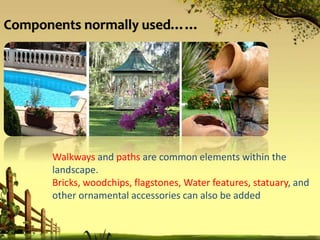
Components normally used……
Walkways and paths are common elements within the
landscape.
Bricks, woodchips, flagstones, Water features, statuary, and
other ornamental accessories can also be added
Some of the designs……..
Indoor gardening……..
Indoor gardening is concerned with the growing of
houseplants within a residence or building, in a conservatory,
or in a greenhouse.
Plants to be considered…
Orchids
Palm Spathiphyllum
Ferns
Schefflera
Dresina
Anthurium
Philodendrons
Pothos
Theme parks…
An amusement park in which the structures and settings
are based on a central theme
Which has entertainment attractions, rides, and other events
in a location for the enjoyment of large numbers of people
First started @ Copenhagen, Denmark (1583)by “Bakken”
Magic kingdom,USA
 Educational theme parks( Epcot,)
 Family-owned theme parks( Knott's
Berry Farm)
 Regional parks(Walt Disney World
Types…
Educational theme parks
Family-owned theme parks
Regional parks
Its is an outdoor garden space that has been specifically designed to meet
the physical, psychological, social and spiritual needs of the people using the
garden as well as their caregivers, family members and friends.
Therapeutic garden…
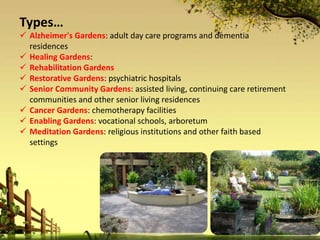
 Alzheimer's Gardens: adult day care programs and dementia
residences
 Healing Gardens:
 Rehabilitation Gardens
 Restorative Gardens: psychiatric hospitals
 Senior Community Gardens: assisted living, continuing care retirement
communities and other senior living residences
 Cancer Gardens: chemotherapy facilities
 Enabling Gardens: vocational schools, arboretum
 Meditation Gardens: religious institutions and other faith based
settings
Types…
A landscape in which an expanse of water is a dominant feature
Waterscaping…
The word xeriscape is a combination of the Greek word "xeros," which means dry,
and landscape. Put together, xeriscape means "dry landscape water from
irrigation
Xeriscaping….
Its is different from natural landscaping, because the emphasis is on
selection of plants for water conservation, not necessarily selecting native
plants.
 Lowered consumption of water:
 Makes more water available for other domestic and community uses and the
environment.
 Reduce Maintenance: less time and effort to maintain like (Occasional weeding and
mulching requires )
 Xeriscape plants in appropriate planting design, and soil grading and mulching, takes
full advantage of rainfall retention.
 Less cost to maintain: Xeriscaping requires less fertilisers and equipment,
particularly due to the reduced lawn areas.
 Reduced waste and pollution: Lawn clippings can contribute to organic waste in
landfills .
• Advantages…
Principles of ………
• Plan and design for function
• Functional turf area/irrigated separately
• Low volume drip system
• Low water plants with either shade/screening
and borders and accents
• Organic water holding soil
• Mulches to cover and cool soil
• Maintenance – necessary but less
Non-plant components………
Garden seats
Bird bath
Lantern
Sun dial
Vases..
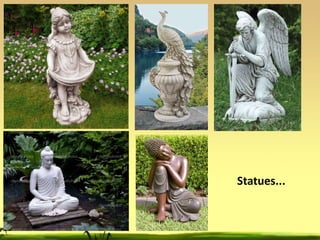
Statues...
Presentation1
Presentation1
Presentation1

Presentation1

  • 2.
    Table of Contents Bio-aestheticplanning Eco-tourism Theme parks Indoor gardening Therapeutic gardening Non-plant components Water scaping Xeriscaping Hardscaping
  • 3.
    Bio-aesthetic planning • Theterm coined by poff. Lanceolate Hogbean • Planning of flora and fauna with the object of beautifying the country
  • 4.
    What are allthe places we can ……… • Public parks and squares. • Public roads. • Platforms of railway stations. • Bus stands. • Air ports. • Compounds of courts, hospitals, universities, colleges, Schools. • Government office buildings.
  • 5.
    History  Babylonians, Sumeriansand Egyptians (7000 years ago)  Temple gardens of India, large formal gardens of Italy, France and Natural English gardens (18th century)  Sal, Asoka, palaksa and pipal trees are associated with Buddha  Babar, Jahangir, Shah Jahan and Faide Khan (formal gardens)  M. S. Randhawa was the flag bearer of Bio- aesthetic planning (created garden city of Chandigarh)
  • 6.
    What are allthe Benefits……..???  Environmental benefits Temperature and energy use Air quality: Precipitation and humidity: Noise abatement Carbon sequestration: Wind protection and air movement: Glare and reflection control  Ecological benefits Direct consumptive value in food, agriculture, medicine, and industry. Economic and social benefits Aesthetic benefit
  • 7.
    Ecotourism Eco-tourism means makingas little environmental impact as possible and helping to sustain the indigenous populace, thereby encouraging the preservation of wildlife and habitats when visiting a place
  • 8.
     Ecotourism isabout uniting conservation, communities, and sustainable travel.  Minimize impact.  Build environmental and cultural awareness and respect.  Provide positive experiences for both visitors and hosts.  Provide direct financial benefits for conservation.  Provide financial benefits and empowerment for local people.  Raise sensitivity to host countries' political, environmental, and social climate.  Support international human rights and labour agreements Principles
  • 9.
    Do's  Carry backall non-degradable litter such as empty bottles, tins, plastic bags etc. These must not litter the environment or be buried. They must be disposed in municipal dustbins only.  Observe the sanctity of holy sites, temples and local cultures.  Cut noise pollution. Do not blare aloud radios, tape recorders or other electronic entertainment equipment in nature resorts, sanctuaries and wildlife parks.  In case temporary toilets are set-up near campsites, after defecation, cover with mud or sand. Make sure that the spot is at least 30 meters away from the water source.  Respect people's privacy while taking photographs. Ask for prior permission before taking a photograph.
  • 10.
    Don'ts  Should nottake away flora and fauna in the forms of cuttings, seeds or roots. It is illegal  Should not use pollutants such as detergent, in streams or springs while washing and bathing.  Should not use wood as fuel to cook food at the campsite.  Should not leave cigarettes butts or make open fires in the forests.  Should not consume aerated drinks, alcohol, drugs or any other intoxicant and throw bottles in the wild.  Should not tempt the locals, especially children by offering them foodstuff or sweets. Respect local traditions.
  • 11.
    The Camp BodhiSatva- Rajgarh, HP The Camp Purple - Mukteshwar The Himalayan Trout House - Tirthan, HP The Camp Kyari-UP Indian places to visit….
  • 12.
    Hardscaping…. It’s is aterm that refers to the hard elements, or non-living features of the landscape. This can include anything from decks and walkways to edging and ornamental features. With Hardscaping, textural variety is important and should be considered carefully.
  • 13.
    Components normally used…… Walkwaysand paths are common elements within the landscape. Bricks, woodchips, flagstones, Water features, statuary, and other ornamental accessories can also be added
  • 14.
    Some of thedesigns……..
  • 15.
    Indoor gardening…….. Indoor gardeningis concerned with the growing of houseplants within a residence or building, in a conservatory, or in a greenhouse.
  • 17.
    Plants to beconsidered… Orchids Palm Spathiphyllum Ferns Schefflera Dresina Anthurium Philodendrons Pothos
  • 18.
    Theme parks… An amusementpark in which the structures and settings are based on a central theme Which has entertainment attractions, rides, and other events in a location for the enjoyment of large numbers of people First started @ Copenhagen, Denmark (1583)by “Bakken”
  • 19.
  • 20.
     Educational themeparks( Epcot,)  Family-owned theme parks( Knott's Berry Farm)  Regional parks(Walt Disney World Types…
  • 21.
  • 22.
  • 23.
  • 24.
    Its is anoutdoor garden space that has been specifically designed to meet the physical, psychological, social and spiritual needs of the people using the garden as well as their caregivers, family members and friends. Therapeutic garden…
  • 25.
     Alzheimer's Gardens:adult day care programs and dementia residences  Healing Gardens:  Rehabilitation Gardens  Restorative Gardens: psychiatric hospitals  Senior Community Gardens: assisted living, continuing care retirement communities and other senior living residences  Cancer Gardens: chemotherapy facilities  Enabling Gardens: vocational schools, arboretum  Meditation Gardens: religious institutions and other faith based settings Types…
  • 26.
    A landscape inwhich an expanse of water is a dominant feature Waterscaping…
  • 28.
    The word xeriscapeis a combination of the Greek word "xeros," which means dry, and landscape. Put together, xeriscape means "dry landscape water from irrigation Xeriscaping…. Its is different from natural landscaping, because the emphasis is on selection of plants for water conservation, not necessarily selecting native plants.
  • 30.
     Lowered consumptionof water:  Makes more water available for other domestic and community uses and the environment.  Reduce Maintenance: less time and effort to maintain like (Occasional weeding and mulching requires )  Xeriscape plants in appropriate planting design, and soil grading and mulching, takes full advantage of rainfall retention.  Less cost to maintain: Xeriscaping requires less fertilisers and equipment, particularly due to the reduced lawn areas.  Reduced waste and pollution: Lawn clippings can contribute to organic waste in landfills . • Advantages…
  • 31.
    Principles of ……… •Plan and design for function • Functional turf area/irrigated separately • Low volume drip system • Low water plants with either shade/screening and borders and accents • Organic water holding soil • Mulches to cover and cool soil • Maintenance – necessary but less
  • 32.
  • 33.
  • 34.
  • 35.
  • 36.
  • 37.