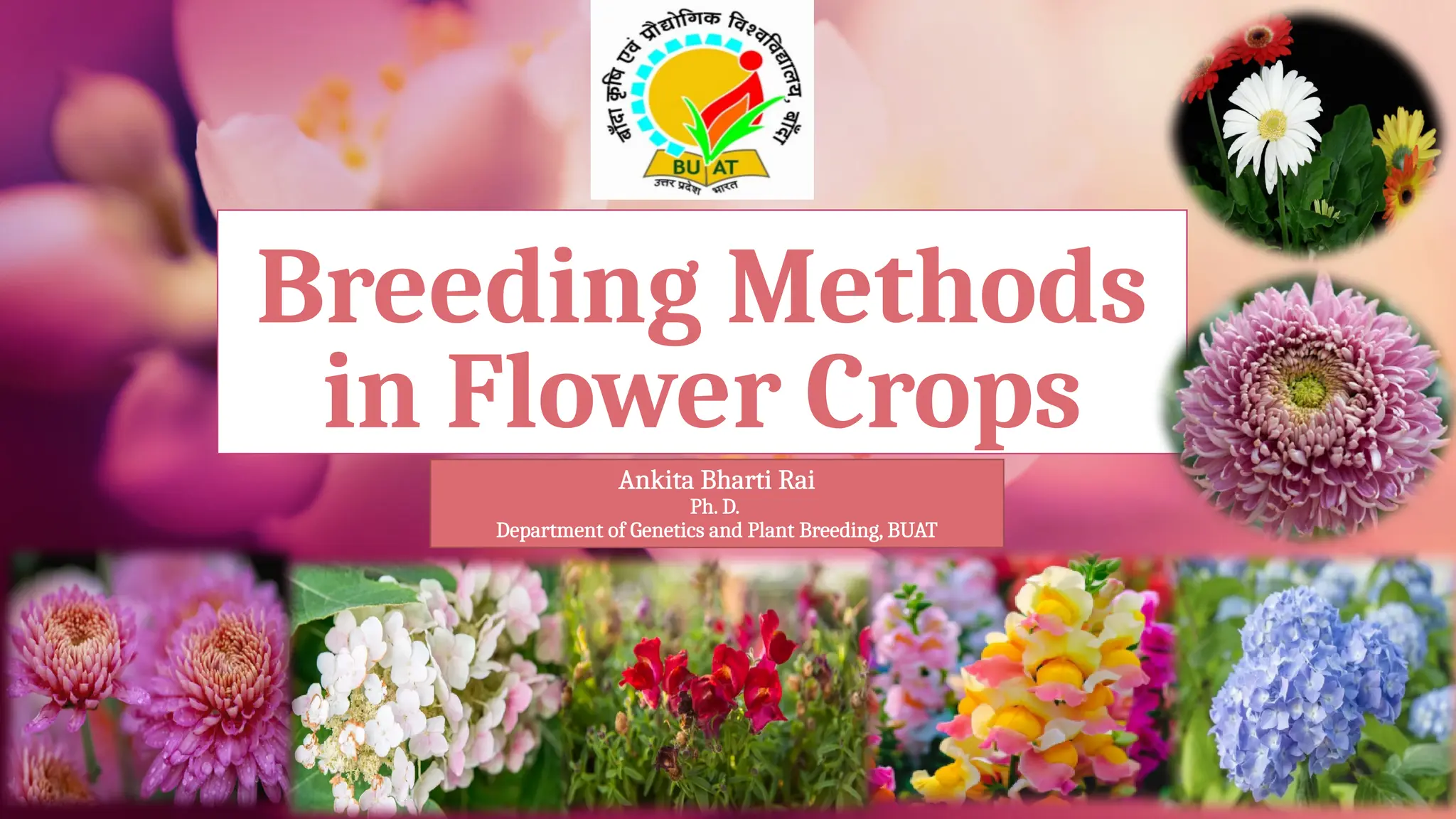
Breeding Methods
in Flower Crops
Ankita Bharti Rai
Ph. D.
Department of Genetics and Plant Breeding, BUAT
Content layout with list
• Introduction
• Limiting Factors
• Breeding Objective
• Breeding Methods
Introduction
• With the increasing demand of ornamental crops worldwide, the
commercialization of floricultural crops with wide range of variations in
terms of colours, fragrances, shelf-life etc. is being carried out at
international level.
• The floricultural industry now demands new floral varieties with ease of
transportation, increased shelf-life and easy cultivation so as to reduce
the undesirable traits and to increase the commercial uses of flower
crops.
• Thus, the breeders and cultivators are now focusing on several
Conventional and Modern Approaches to create new varieties in a
sustainable way.
Limiting
Factors
Limited natural
variability for Flower
colour, Flower Structure
and Flower Scent.
Less Shelf life due to
Ethylene Action
Reduced plasticity using
conventional methods
for plant architecture
Poor and infected
with disease planting
material.
Breeding Objective
• Breeding for Adverse
Climate and Poor Soil.
• Breeding For
Fragrance.
• Breeding For Alternate
Uses of Flower Crops.
Breeding Methods
Introduction/
Domestication
Selection
Hybridization
Mutation
Breeding
Tissue
Culture
Molecular
Markers Genetic
Modification
1. Introduction
Plant introduction refers to taking crop plants/genotypes
or group of genotypes from the place of their
origin/cultivation to such areas where they have not been
grown earlier.
It can be done within the country or from other countries
of continents.
Some plants introduction agencies of India:-
1. NBPGR (National Bureau of Plant Genetic
Resources, New Delhi)
2. FRI (Forest Research Institute ,Dehradun)
3. The Botanical Survey of India
4. Central Research Institutes for different
crops
5. NRC Orchids, Gangtok, Sikkim
Introduction is of two types:-
Primary introduction:
In this type, the introduced
crop/variety is well suited for new
environments and released as a
commercial variety without any
alteration in original genotype. In
most of commercial cut flower crops,
primary introduction is widely
adopted technique for increasing
gene pool.
Secondary Introduction:
In this, the introduced variety
may be subjected to selection,
to isolate a superior variety
or may be hybridized with a
local variety to transfer one
or more characters from the
local varieties.
Procedure of Plant Introduction
1. Introduction
Introduction consists of various Steps
Procurement
Quarantine
Cataloging
Evaluation
Acclimatization
Multiplication
Advantages of plant
Introduction:
• It provides entirely new crop plant which has not being grown earlier e.g.
Alstroemeria, bird-of paradise etc.
• It may provide superior variety directly or after selection or hybridization. Many
superior varieties of different floricultural crops roses have been introduced in the
country for direct cultivation e.g. 'Passion', 'Grand Gala' in rose.
• Introduction and export are the only feasible and fastest means of collecting
germplasm and to prevent variability from genetic erosion.
• It is quick and economical method for crop improvement particularly when
introductions are released as a variety directly or after simple selection.
• If a particular location is prone to some particular disease or insect attack, plants
may be introduced in new disease free areas directly to protect them from damage.
1. Introduction
Rose: Golden Gate, Passion, Grand Gala,
Superstar, Queen Elizabeth
Carnation: Master, Sangaria, Dover, Yellow Dot
Com, Tasman, Farida.
Alstroemeria: Alladin, Serena, Pluto, Capri,
Cindrella
Annuals: Marigold, Antirrhinum, Pansy,
Petunia, Stock, Zinnia, Calendula etc.
Trees: Bauhiniaesculenta, Cryptomeria
japonica, Cupressus species, Sepiumsebiferum
Shrubs: Different species and varieties of
Bougainvillea, Buddeleiadavidii etc.
Rose:- Golden Gate
Rose:- Passion
Rose:- Grand Gala
Rose:-Superstar
Rose:- Queen Elizabeth
Carnation:
Master
Carnation: Dover
Carnation: Dover
Carnation: Farida Carnation:
Yellow Dot Com
1. Introduction
Achievements:
2. Selection
• It refers to the process that favours survival and
further propagation of some plants having more
desirable characters than others.
• Selection is more efficient when genetic variation is
present in the base population and it utilizes the
variation already present in the population.
• Selection is the oldest method of crop improvement
and was developed as an art in the olden days.
• Selection consists of permitting the reproduction of
some desirable genotypes from a given population and
using it further for commercial cultivation.
Types of Selection:-
Natural Selection:
• Selection is a
continuous process
and in nature it is
governed by natural
environmental
conditions e.g.
temperature, soil,
weather, prevalence
of pest and disease
etc.
• In this process, the
genotypes showing
adaptability to a
given environment
leaves behind more
progeny. It can be
used for further
multiplication and
termed as natural
selection.
Artificial Selection:
• The selection, which is
carried out by man is
called as artificial
selection.
• It often permits only the
selected plants to
reproduce.
• The progeny from
remaining plants is
generally discarded.
• Artificial selection
progressively reduces the
variability and is based on
phenotype of the plants.
• The effectiveness of
selection primarily
depends on the degree to
which the phenotype
reflects the genotypes.
2. Selection
A pureline is a progeny of a single homozygous plant of a self pollinated
spp. Therefore, all the plants in a pure line will have the same genotype.
The phenotypic differences within a pure line are due to environment
and have no genetic basis. Therefore variation in a pure line is not
heritable and selection within a pureline is ineffective.
The concept of pureline was proposed by Johannsen,1903 on the basis of
his studies with beans (Phaseolus vulgaris) variety Princess.
Origin of variation in Pure Lines:-
Mechanical mixture during
harvesting:
During threshing, cleaning or
storage of seeds, other genotypes
may get mixed with a pureline.
Such contaminations are quite
common and may be removed
with careful handling.
Natural Hybridization:
In most self pollinated species, a
low amount of cross pollination
does occur. Natural hybrids can
be avoided by isolating a pure
line from other genotypes with
a couple of rows of the same
pure line.
PURELINE SELECTION
Source:- https://biologynotesonline.com/pureline-selection-procedure-applications-advantages-disadvantages/
2. Selection
In mass selection, a large number of plants of different
desirable phenotypes are selected and their seeds are
mixed together to constitute a new variety. The plants
are selected on the basis of their appearance or
phenotype. The population obtained from the selected
plants would be more uniform than the original
population.
MASS SELECTION Procedure
1st
Year
2nd
Year
3rd
to 4th
Year
7th
Year
A large number of phenotypically similar plants are
selected for their vigrous plant type, resistance and
other desirable characters. The seeds from the
selected plants are composited to raise the next
generation.
The variety may be released for cultivation, if found
suitable and recommended by the central or state
variety release committee.
The variety is evaluated in coordinated yield trials at several
locations. This is done to test the performance of the new
variety at different locations within an agro climatic zone.
The composite seed is planted in a preliminary yield
trial along with standard variety as checks.
2. Selection
Merit:
1. Since a large number of plants are selected, the
adoption of the original variety is not changed. It is
generally accepted that a mix of closely related pure
lines is more stable in performance over different
environment than a single pure line. Thus varieties
developed through mass selection are more widely
adapted than pure lines.
2. Often extensive and prolonged yield trials are not
necessary. This reduces the time and cost needed
for developing a new variety.
3. It is a less demanding method. The breeder can
devote more time to other breeding programmes.
Demerit:
1. The varieties developed through mass selection show
variation and are not as uniform as pure line varieties.
2. The improvement through mass selection is generally
less than they through pure line selection.
3. In the absence of progeny test, it is not possible to
determine if the selected plants are homozygous.
4. Due to popularity of pure line varieties, mass selection
is not commonly used in improvement of self
pollinated crops. Varieties developed by mass selection
are more difficult to identify than pure line in seed
certification programme.
MASS SELECTION
2. Selection
MASS SELECTION
• Several outstanding cultivars have been released by
selection in flower crops. Chrysanthemum cvs.
‘Apsara’, ‘Birbal Sahni’, ‘Jayanthi’, ‘Kundan’, have
been developed through selection. Similarly cvs.
‘Shubhra’, ‘Dr B.P. Pal’, ‘Parthasarthy’ and
‘Surekha’ in Bougainvillea have been developed.
• In Bougainvillea varieties, 'Sholay' and 'Usha' are the
half sib selection of cv. 'Red Glory' and 'Lady Hope'
developed at IIHR, Banglore.
• 'Kamini', 'Poornima', 'Shashank' an 'Violet
Cushion' varieties of China Aster are developed from
Pedigree selection method.
2. Selection
Source:- https://www.ijpsi.org/Papers/Vol5%288%29/C0508015018.pdf
Chrysanthemum: Birbal Sahani
China Aster
Achievements:
3. Hybridization
 It defined as the process of crossing two or more plants with distinct
genetic backgrounds, plays a pivotal role in the creation of new crop
varieties.
 Combining desired features into a single variety is an efficient way to
increase genetic diversity and to take the advantage of hybrid vigor.
 The best strategy for achieving distinctive flower shapes is to cross two
diverse types depending on the genetic makeups involved as a single gene
or a number of genes may control the genetic makeup of the many flower
forms found in ornamental crops.
 For instance, as shown by Debener in 1999, a dominant allele governs the
inheritance of the double flower shape in roses. Therefore, it is important
to cross cultivars having double-type flowers with suitable single flower
cultivars in order to produce new double-type cultivars.
3. Hybridization
Intervarietal Hybridization
(Intraspecific):
• In this method, crosses are made between plants
from two different varieties of the same species.
It is an effective method for enhancing both
cross-pollinated and self pollinated crops.
• “April Blush,” “April Dawn,” “April Rose,” and
“April Snow” are a few cultivars that were
created through intervarietal hybridization.
Interspecific Hybridization
(Intrageneric):
• In this approach, plants from two different species within
the same genus are crossed. In order to create new
cultivars of plants like verbena, petunia, orchid,
bougainvillea, lilium and amaryllis, interspecific
hybridization is used.
• Interspecific hybridization is commonly seen in species
crosses as those between the lilium, orchid, Hemerocallis,
Victoria amazonica and Bougainvillea spectabilis and
Bougainvillea glabra.
3. Hybridization
3. Hybridization
Hybridization consists of various Steps
Selection of Parents
Evaluation of Parents
Emasculation
Bagging
Tagging
Harvesting & Storage of F1Seeds
Achievements:
• Carnation
• ArkaTejas, a carnation cultivar is a interspecific hybrid
between Dianthus carophyllus × Dianthus chinensis.
• Gladiolus
• Punjab Dawn
• American Beauty
• Shan-e-Punjab
• Suchitra
• Apsara
3. Hybridization
Source:-https://iihr.res.in/hi/carnation-arka-tejas-0
Case Studies:-
CHRYSANTHEMUM
Huang et al. (2011) conducted interspecific hybridization
experiments involving Chrysanthemum morifolium
varieties ‘Hongxinju’ and ‘Xinbaiju’ as females and
Chrysanthemum indicum and Chrysanthemum
nankingense as males. Bud pollination was found to
enhance heterozygosity in these interspecific hybrids,
resulting in aneuploid chromosomes and significant
character segregation.
3. Hybridization
Case Studies:-
GERBERA
The history of gerbera breeding dates back to the late
19th century in Cambridge, England, when R.I. Lynch
crossed two South African species, G. jamesonii and G.
viridifolia, resulting in the creation of G. cantabrigiensis,
known today as G. hybrida. The descendants of these two
species are the source of the majority of commercially
grown gerbera cultivars. Gerbera cultivars come in a
wide range of sizes, colors, and shapes, including white,
yellow, orange, red, and pink.
3. Hybridization
4. Mutation Breeding
Involves sudden heritable changes that occur in an organism, deviating from
Mendelian principles of segregation and recombination.
 Mutants are those individuals that display these heritable alterations.
 De Vries first proposed the idea of mutation in the year 1900.
For instance, the moss rose originated as a mutant of Rosa centifolia and
approximately 5,819 rose cultivars have been developed through bud mutations.
Choice of Plant Material
Mutagen
Optimizing Dosage Treatment
Steps of Mutation Breeding.
• Sexually Propagated Crop- Seed Mutagenesis
For seed propagated crops, seeds are typically mutagenized
• Asexually Propagated Crop- Tissue Culture Mutagenesis
These include shoot tips, nodal cuttings, adventitious and lateral shoots, and cell and organ
cultures.
Mutagens are agents, either physical or chemical, that artificially induce
mutations.
• Physical mutagens like as alpha rays, beta rays, X-rays, gamma rays, neutrons, and UV rays can
all result in these mutations.
• Chemical mutagens encompass a range of substances such as 5- bromouracil, 5-chlorouracil,
mustard gas, sulphur mustard, nitrogen mustard, ethyl methane sulphonate (EMS) etc.
4. Mutation Breeding
Development of Mutagenized Population
• Numerous kinds of ornamental plants are heterozygous
and reproduce vegetatively, which makes it easier to find,
pick out, and preserve mutants in the M1 generation.
• Mutation induction can alter petal form.
• Additionally, mutagenic treatments have been shown to
change petal counts in both the upward and downward
direction. There have been reports of larger whorls of
ligulate florets and changes from ligulate to tubular florets
in the Compositae family as a result of mutagenic
treatments.
• Examples:-
• The 50% of rhododendron and chrysanthemum cultivars are
the result of spontaneous or artificial mutations.
• The cultivar ‘Faraday’ of tulip contained the first known
floral mutation.
4. Mutation Breeding
Advantages
• It is useful in improving certain specific
characteristics of a well adapted high
yielding variety. This is particularly
useful in floricultural crops which are
mostly clonally propagated.
• Inductions of desirable mutant alleles
which may not be present in the
normal population or germplasm or
may be present but may not be
available to the breeder due to political
or geographical reasons.
Disadvantages
• Mutation is a process that results in the
individual with desirable or non desirable
characteristics. The frequency of desirable
mutations is very low, about 0.1 per cent of the
total mutations. Therefore, large M2 and
subsequent populations have to be grown and
carefully studied. This involves considerable
time, labour and other resources.
• The breeder has to screen large population to
select desirable mutations. Therefore efficient,
quick and inexpensive selection techniques are
required to screen large populations.
4. Mutation Breeding
Achievements:
• Bougainvillea
• 'Los BanosVariegata': Gamma-ray induced mutant of
multibracted bougainvillea cultivar 'Los Banos Beauty‘
• 'Los BanosVariegata Silver Margin': Gamma-ray induced
mutant of multibracted bougainvillea cultivar 'Los Banos
Beauty'
• 'MaharaVariegata': Gamma-ray induced mutant of
multibracted bougainvillea cultivar 'Mahara'.
• Gladiolus
• 'Shobha': Induced mutant of 'Wild Rose'
• Rose
• 'Pusa Christiana': Mutant of 'Christian Dior', gamma rays
induced
• 'Abhisarika': Mutant of 'Kiss of Fire'
• 'Madhosh': Mutant of 'Gulzar', EMS (i.e. 0.025% for 8 hours)
• 'Angara': Mutant of 'Montezumma'
• 'Sharda': Mutant of 'Queen Elizabeth'
• Coreopsis
• Variety 'Pusa Tara': Spontaneous mutant of Coreopsis
4. Mutation Breeding
Source:- Kushwaha et al., 2024. DEVELOPMENT OF NEW MUTANTS USING GAMMA RADIATION IN
GLADIOLUS CV. PUNJAB DAWN. Plant Archives Vol. 24, No. 2, 2024 pp. 2031-2036.
Case Studies:- Rose
Six parent and their 12 gamma ray-induced somatic flower colour mutants
of garden rose were characterized to discriminate the mutants from their
respective parents and understanding the genetic diversity using Random
amplification of polymorphic DNA (RAPD) markers. Out of 20 primers
screened, 14 primers yielded completely identical fragments patterns. The
other 7 primers gave highly polymorphic banding patterns among the
radiomutants. All the cultivars were identified by using only 7 primers.
Moreover, individual mutants were also distinguished by unique RAPD
marker bands. Based on the presence or absence of the 48 polymorphic
bands, the genetic variations within and among the 18 cultivars were
measured. Genetic distance between all 18 cultivars varied from 0.40 to
0.91, as revealed by Jaccard’s coefficient matrix. A dendrogram was
constructed based on the similarity matrix using the Neighbor Joining
Tree method showed three main clusters. The present RAPD analysis can
be used not only for estimating genetic diversity present in gamma ray-
induced mutants but also for correct identification of mutant/new
varieties for their legal protection under plant variety rights.
4. Mutation Breeding
5. Tissue Culture
• Besides utilizing tissue culture for mass propagation, it is also used as a tool for creating
variability and screening.
• Sectorial mutants are very common in flowering crops.
• In Vitro can be used for purification and regeneration from a mutated sector.
• Subjecting the minimum unit of explant to mutagen can be achieved through induction
of mutation under in vitro conditions of tissue culture where diplontic selection
pressure is avoided and the opportunity for the mutated cell to survive gets increased.
• Carnation variety “Arka Flame” released by ICAR, is a result of in vitro mutagenesis,
approach through selection and purification from a sectorial mutant IIHRS-1.
• In Ornamentals, diversity itself is of aesthetic value and in vitro conservation approach
through tissue culture will help to save more number of species.
6. Molecular Markers
• Marker Assisted Selection is another approach gaining importance in flower crop breeding.
• Diversity studies are mainly being done based on morphological characters.
• Classification and grouping of germplasm based on molecular characterization will be having added advantage as
that will reveal genetic background of the genotype which in turn facilitates for precise classification and selecting
the right genotype for breeding program.
• In the era of breeder’s right taking the priority, it is important to be prepared with appropriate molecular markers so
that we will be able to distinguish individual genotypes based on their genetic backgrounds.
• Primers with high power of discrimination need to be identified in each species for establishing the distinctness of
varieties and supporting the claim of breeder’s right.
• In morphological testing, a single character difference is considered sufficient to assign the status of distinctness for
a genotype.
• In a similar way, there is a necessity for fixing up critical threshold value of either allele differences or measure of
coefficient for considering the uniformity criterion and to distinguish the varieties.
CASE STUDY
6. Molecular Markers
In this study, two cultivars with different colors were selected as
parents for hybridization, and the flower color parameters and
pigment content variation of the hybrid offspring were analyzed.
The correlation and genetic analysis between the flower color and
pigment content were performed. The total anthocyanins were
negatively correlated with L* and b* and positively correlated
with a*. There was a positive correlation between total carotenoids
and b* and a negative correlation between total carotenoids
and L*, but no correlation was found between total carotenoids
and a*, indicating that total anthocyanins had a greater impact on
flower color than total carotenoids.
Based on the high-density genetic map constructed in the early
stage, the QTLs of flower color traits were analyzed by interval
mapping. Through QTL analysis, three major QTLs controlling the
total anthocyanin content and two major QTLs controlling the total
carotenoid content were found, and these major sites were all
located in the LG17 and LG18 linkage groups. The conclusion of this
study lays a foundation for further selection and cloning of
candidate genes for chrysanthemum flower color, and it provides a
7. Development of Transgenics Via
Genetic Modifications
• The act of introducing a specific DNA sequence, usually a gene, into
an organism without fertilization or conventional crossbreeding is
known as genetic transformation. Transgenic plants are referred to be
plants that have undergone genetic modification.
• For successful transgenic development, it is necessary to isolate
relevant genes, establish transformation systems, optimize expression
of transgenes and obtain regulatory permission for both production
and consumption.
• The successful development of the first transgenic petunia during the
1990s was a crucial turning point for the field of genetic engineering
of ornamental plants.
• Transgenics have been produced in rose and carnation whose flowers
accumulated delphindin based anthocyanins and an altered colour.
• Through careful choice of host cultivar and optimization of the
expression of transgenes, it has been possible to obtain transgenic
plants with flowers exhibiting and attractive colour range of
blue/violet hitherto unavailable in Rose and Carnation.
CASE STUDY:-
For Rosa hybrida cv. ‘Royalty,’ the transformation procedure
comprised co-cultivating the plant material with
Agrobacterium. After that, friable embryogenic callus formed,
and the plants were then converted by embryogenesis.
Agrobacterium has also been used to genetically alter
Chrysanthemum grandiflora and indicum. The infection of
either leaves or peduncles led to the regeneration of
transformed plants through organogenesis or the formation of
transformed callus capable of generating transformed plants.
Transformed Dianthus caryophyllus (carnation) cultivars were
produced by co-cultivating leaves, petals, or stems with
Agrobacterium, followed by either direct or indirect
organogenesis.
7. Development of Transgenics Via
Genetic Modifications
• Understanding the gene sequences is of
interest not just for academic curiosity but
also for application in creating new variety.
• Next Generation Sequencing technologies
were used to discover new genes and study in
silico their expression.
• For genetic alteration in ornamental plants, a
variety of methods have been used, including:
a. RNAi or Gene Silencing
b. Chimeric Repressor Gene-Silencing
Technology (CRES-T)
c. MicroRNA
a. RNAi or Gene silencing
RNAi or Gene silencing is a powerful method for silencing
gene expression, offering a straightforward approach to
regulate gene function. Both transcriptional gene silencing
(TGS) and posttranscriptional gene silencing (PTGS),
commonly known as RNA interference (RNAi) are separate
methods by which this unique gene regulation mechanism
might lower transcript levels. When mRNA is broken down
into short RNAs, which in turn activate ribonucleases to
target homologous mRNA of a particular gene, gene
silencing occurs. The resulting phenotypes may resemble an
allelic series of mutants or genetic null mutants.
Genetic Modifications
a. RNAi or Gene silencing
Genetic Modifications
CASE STUDY
In a work by Noor et al. (2014), two C-class MADS-box genes,
pMADS3 and FBP6 were targeted by virus-induced gene
silencing (VIGS) to induce double flower development in four
cultivars of Petunia hybrida. In flowers exposed to
pMADS3/FBP6-VIGS, the results revealed a complete
conversion of stamens into petaloid tissues combined with a
considerable increase of upper limb-like tissues, giving the
flowers a decorative aspect.
b. CRISPR/Cas9 Technology
The regularly spaced, clustered short palindromic repeats,
the (CRISPR)/ CRISPR-associated protein (Cas) system has
become a potent genome-editing tool for precisely altering
DNA sequences in particular places.
• Gene knockouts have been the primary application of
CRISPR/Cas9 technology in plants. Additionally Petunia
hybrid, Chrysanthemum morifolium, Dendrobium
officinale, Torenia, Ipomoea nil, Lilium
longiflorum, Lilium pumilum and Phalaenopsis
equestris have all benefited from its successful use in
generating gene knockouts in ornamental plants to
induce genetic alterations.
Genetic Modifications
c. Micro RNA
• Micro RNA is a class of small non-coding RNA molecules,
typically about 22 nucleotides in length, that are present
in eukaryotes.
• These molecules are essential for the post-transcriptional
control of gene expression as well as RNA silencing.
• Nearly all biological and metabolic activities involve
miRNAs. There have been many miRNAs found that are
closely linked to plant architecture. For instance, miR156
has been linked to the control of plant architecture,
according to research by Jiao et al. (2010).
Genetic Modifications
REFERENCES:-
• Song X, Tian Y, Gao K, Li J, Li Y, et al. 2023. Genetic and QTL analysis of flower color and pigments in
small-flowered chrysanthemum based on high-density genetic map. Ornamental Plant
Research 3:17 doi: 10.48130/OPR-2023-0017
• Karol E.P. Robinson, Ebrahim Firoozabady, Transformation of floriculture crops, Scientia Horticulturae,
Volume 55, Issues 1–2, 1993, Pages 83-99, ISSN 0304-4238, https
://doi.org/10.1016/0304-4238(93)90026-M.
(https://www.sciencedirect.com/science/article/pii/030442389390026M)
• Guoqin Liu, Yuan Yuan, Hui Jiang, Ying Bao, Guogui Ning, Liangjun Zhao, Xiaofeng Zhou, Hougao Zhou,
Junping Gao, Nan Ma, Agrobacterium tumefaciens-mediated transformation of modern rose (Rosa
hybrida) using leaf-derived embryogenic callus, Horticultural Plant Journal, Volume 7, Issue 4, 2021,
Pages 359-366, ISSN 2468-0141, https://doi.org/10.1016/j.hpj.2021.02.001. (
https://www.sciencedirect.com/science/article/pii/S2468014121000200)
• Siti Hajar Noor, Koichiro Ushijima, Ayaka Murata, Kaori Yoshida, Miki Tanabe, Tomoki Tanigawa,
Yasutaka Kubo, Ryohei Nakano, Double flower formation induced by silencing of C-class MADS-box
genes and its variation among petunia Cultivars, Scientia Horticulturae, Volume 178, 2014, Pages 1-7.
ISSN 0304-4238, https://doi.org/10.1016/j.scienta.2014.07.029.
• Source:- Kushwaha et al., 2024.
DEVELOPMENT OF NEW MUTANTS USING GAMMA RADIATION IN GLADIOLUS CV. PUNJAB DAWN.
Plant Archives Vol. 24, No. 2, 2024 pp. 2031-2036.

Breeding Methods in Flower Crops....pptx

  • 1.
    Breeding Methods in FlowerCrops Ankita Bharti Rai Ph. D. Department of Genetics and Plant Breeding, BUAT
  • 2.
    Content layout withlist • Introduction • Limiting Factors • Breeding Objective • Breeding Methods
  • 3.
    Introduction • With theincreasing demand of ornamental crops worldwide, the commercialization of floricultural crops with wide range of variations in terms of colours, fragrances, shelf-life etc. is being carried out at international level. • The floricultural industry now demands new floral varieties with ease of transportation, increased shelf-life and easy cultivation so as to reduce the undesirable traits and to increase the commercial uses of flower crops. • Thus, the breeders and cultivators are now focusing on several Conventional and Modern Approaches to create new varieties in a sustainable way.
  • 4.
    Limiting Factors Limited natural variability forFlower colour, Flower Structure and Flower Scent. Less Shelf life due to Ethylene Action Reduced plasticity using conventional methods for plant architecture Poor and infected with disease planting material.
  • 5.
    Breeding Objective • Breedingfor Adverse Climate and Poor Soil. • Breeding For Fragrance. • Breeding For Alternate Uses of Flower Crops.
  • 6.
  • 7.
    1. Introduction Plant introductionrefers to taking crop plants/genotypes or group of genotypes from the place of their origin/cultivation to such areas where they have not been grown earlier. It can be done within the country or from other countries of continents. Some plants introduction agencies of India:- 1. NBPGR (National Bureau of Plant Genetic Resources, New Delhi) 2. FRI (Forest Research Institute ,Dehradun) 3. The Botanical Survey of India 4. Central Research Institutes for different crops 5. NRC Orchids, Gangtok, Sikkim Introduction is of two types:- Primary introduction: In this type, the introduced crop/variety is well suited for new environments and released as a commercial variety without any alteration in original genotype. In most of commercial cut flower crops, primary introduction is widely adopted technique for increasing gene pool. Secondary Introduction: In this, the introduced variety may be subjected to selection, to isolate a superior variety or may be hybridized with a local variety to transfer one or more characters from the local varieties.
  • 8.
    Procedure of PlantIntroduction 1. Introduction Introduction consists of various Steps Procurement Quarantine Cataloging Evaluation Acclimatization Multiplication
  • 9.
    Advantages of plant Introduction: •It provides entirely new crop plant which has not being grown earlier e.g. Alstroemeria, bird-of paradise etc. • It may provide superior variety directly or after selection or hybridization. Many superior varieties of different floricultural crops roses have been introduced in the country for direct cultivation e.g. 'Passion', 'Grand Gala' in rose. • Introduction and export are the only feasible and fastest means of collecting germplasm and to prevent variability from genetic erosion. • It is quick and economical method for crop improvement particularly when introductions are released as a variety directly or after simple selection. • If a particular location is prone to some particular disease or insect attack, plants may be introduced in new disease free areas directly to protect them from damage. 1. Introduction
  • 10.
    Rose: Golden Gate,Passion, Grand Gala, Superstar, Queen Elizabeth Carnation: Master, Sangaria, Dover, Yellow Dot Com, Tasman, Farida. Alstroemeria: Alladin, Serena, Pluto, Capri, Cindrella Annuals: Marigold, Antirrhinum, Pansy, Petunia, Stock, Zinnia, Calendula etc. Trees: Bauhiniaesculenta, Cryptomeria japonica, Cupressus species, Sepiumsebiferum Shrubs: Different species and varieties of Bougainvillea, Buddeleiadavidii etc. Rose:- Golden Gate Rose:- Passion Rose:- Grand Gala Rose:-Superstar Rose:- Queen Elizabeth Carnation: Master Carnation: Dover Carnation: Dover Carnation: Farida Carnation: Yellow Dot Com 1. Introduction Achievements:
  • 11.
    2. Selection • Itrefers to the process that favours survival and further propagation of some plants having more desirable characters than others. • Selection is more efficient when genetic variation is present in the base population and it utilizes the variation already present in the population. • Selection is the oldest method of crop improvement and was developed as an art in the olden days. • Selection consists of permitting the reproduction of some desirable genotypes from a given population and using it further for commercial cultivation. Types of Selection:- Natural Selection: • Selection is a continuous process and in nature it is governed by natural environmental conditions e.g. temperature, soil, weather, prevalence of pest and disease etc. • In this process, the genotypes showing adaptability to a given environment leaves behind more progeny. It can be used for further multiplication and termed as natural selection. Artificial Selection: • The selection, which is carried out by man is called as artificial selection. • It often permits only the selected plants to reproduce. • The progeny from remaining plants is generally discarded. • Artificial selection progressively reduces the variability and is based on phenotype of the plants. • The effectiveness of selection primarily depends on the degree to which the phenotype reflects the genotypes.
  • 12.
    2. Selection A purelineis a progeny of a single homozygous plant of a self pollinated spp. Therefore, all the plants in a pure line will have the same genotype. The phenotypic differences within a pure line are due to environment and have no genetic basis. Therefore variation in a pure line is not heritable and selection within a pureline is ineffective. The concept of pureline was proposed by Johannsen,1903 on the basis of his studies with beans (Phaseolus vulgaris) variety Princess. Origin of variation in Pure Lines:- Mechanical mixture during harvesting: During threshing, cleaning or storage of seeds, other genotypes may get mixed with a pureline. Such contaminations are quite common and may be removed with careful handling. Natural Hybridization: In most self pollinated species, a low amount of cross pollination does occur. Natural hybrids can be avoided by isolating a pure line from other genotypes with a couple of rows of the same pure line. PURELINE SELECTION Source:- https://biologynotesonline.com/pureline-selection-procedure-applications-advantages-disadvantages/
  • 13.
    2. Selection In massselection, a large number of plants of different desirable phenotypes are selected and their seeds are mixed together to constitute a new variety. The plants are selected on the basis of their appearance or phenotype. The population obtained from the selected plants would be more uniform than the original population. MASS SELECTION Procedure 1st Year 2nd Year 3rd to 4th Year 7th Year A large number of phenotypically similar plants are selected for their vigrous plant type, resistance and other desirable characters. The seeds from the selected plants are composited to raise the next generation. The variety may be released for cultivation, if found suitable and recommended by the central or state variety release committee. The variety is evaluated in coordinated yield trials at several locations. This is done to test the performance of the new variety at different locations within an agro climatic zone. The composite seed is planted in a preliminary yield trial along with standard variety as checks.
  • 14.
    2. Selection Merit: 1. Sincea large number of plants are selected, the adoption of the original variety is not changed. It is generally accepted that a mix of closely related pure lines is more stable in performance over different environment than a single pure line. Thus varieties developed through mass selection are more widely adapted than pure lines. 2. Often extensive and prolonged yield trials are not necessary. This reduces the time and cost needed for developing a new variety. 3. It is a less demanding method. The breeder can devote more time to other breeding programmes. Demerit: 1. The varieties developed through mass selection show variation and are not as uniform as pure line varieties. 2. The improvement through mass selection is generally less than they through pure line selection. 3. In the absence of progeny test, it is not possible to determine if the selected plants are homozygous. 4. Due to popularity of pure line varieties, mass selection is not commonly used in improvement of self pollinated crops. Varieties developed by mass selection are more difficult to identify than pure line in seed certification programme. MASS SELECTION 2. Selection MASS SELECTION
  • 15.
    • Several outstandingcultivars have been released by selection in flower crops. Chrysanthemum cvs. ‘Apsara’, ‘Birbal Sahni’, ‘Jayanthi’, ‘Kundan’, have been developed through selection. Similarly cvs. ‘Shubhra’, ‘Dr B.P. Pal’, ‘Parthasarthy’ and ‘Surekha’ in Bougainvillea have been developed. • In Bougainvillea varieties, 'Sholay' and 'Usha' are the half sib selection of cv. 'Red Glory' and 'Lady Hope' developed at IIHR, Banglore. • 'Kamini', 'Poornima', 'Shashank' an 'Violet Cushion' varieties of China Aster are developed from Pedigree selection method. 2. Selection Source:- https://www.ijpsi.org/Papers/Vol5%288%29/C0508015018.pdf Chrysanthemum: Birbal Sahani China Aster Achievements:
  • 16.
    3. Hybridization  Itdefined as the process of crossing two or more plants with distinct genetic backgrounds, plays a pivotal role in the creation of new crop varieties.  Combining desired features into a single variety is an efficient way to increase genetic diversity and to take the advantage of hybrid vigor.  The best strategy for achieving distinctive flower shapes is to cross two diverse types depending on the genetic makeups involved as a single gene or a number of genes may control the genetic makeup of the many flower forms found in ornamental crops.  For instance, as shown by Debener in 1999, a dominant allele governs the inheritance of the double flower shape in roses. Therefore, it is important to cross cultivars having double-type flowers with suitable single flower cultivars in order to produce new double-type cultivars. 3. Hybridization
  • 17.
    Intervarietal Hybridization (Intraspecific): • Inthis method, crosses are made between plants from two different varieties of the same species. It is an effective method for enhancing both cross-pollinated and self pollinated crops. • “April Blush,” “April Dawn,” “April Rose,” and “April Snow” are a few cultivars that were created through intervarietal hybridization. Interspecific Hybridization (Intrageneric): • In this approach, plants from two different species within the same genus are crossed. In order to create new cultivars of plants like verbena, petunia, orchid, bougainvillea, lilium and amaryllis, interspecific hybridization is used. • Interspecific hybridization is commonly seen in species crosses as those between the lilium, orchid, Hemerocallis, Victoria amazonica and Bougainvillea spectabilis and Bougainvillea glabra. 3. Hybridization
  • 18.
    3. Hybridization Hybridization consistsof various Steps Selection of Parents Evaluation of Parents Emasculation Bagging Tagging Harvesting & Storage of F1Seeds
  • 19.
    Achievements: • Carnation • ArkaTejas,a carnation cultivar is a interspecific hybrid between Dianthus carophyllus × Dianthus chinensis. • Gladiolus • Punjab Dawn • American Beauty • Shan-e-Punjab • Suchitra • Apsara 3. Hybridization Source:-https://iihr.res.in/hi/carnation-arka-tejas-0
  • 20.
    Case Studies:- CHRYSANTHEMUM Huang etal. (2011) conducted interspecific hybridization experiments involving Chrysanthemum morifolium varieties ‘Hongxinju’ and ‘Xinbaiju’ as females and Chrysanthemum indicum and Chrysanthemum nankingense as males. Bud pollination was found to enhance heterozygosity in these interspecific hybrids, resulting in aneuploid chromosomes and significant character segregation. 3. Hybridization
  • 21.
    Case Studies:- GERBERA The historyof gerbera breeding dates back to the late 19th century in Cambridge, England, when R.I. Lynch crossed two South African species, G. jamesonii and G. viridifolia, resulting in the creation of G. cantabrigiensis, known today as G. hybrida. The descendants of these two species are the source of the majority of commercially grown gerbera cultivars. Gerbera cultivars come in a wide range of sizes, colors, and shapes, including white, yellow, orange, red, and pink. 3. Hybridization
  • 22.
    4. Mutation Breeding Involvessudden heritable changes that occur in an organism, deviating from Mendelian principles of segregation and recombination.  Mutants are those individuals that display these heritable alterations.  De Vries first proposed the idea of mutation in the year 1900. For instance, the moss rose originated as a mutant of Rosa centifolia and approximately 5,819 rose cultivars have been developed through bud mutations.
  • 23.
    Choice of PlantMaterial Mutagen Optimizing Dosage Treatment Steps of Mutation Breeding. • Sexually Propagated Crop- Seed Mutagenesis For seed propagated crops, seeds are typically mutagenized • Asexually Propagated Crop- Tissue Culture Mutagenesis These include shoot tips, nodal cuttings, adventitious and lateral shoots, and cell and organ cultures. Mutagens are agents, either physical or chemical, that artificially induce mutations. • Physical mutagens like as alpha rays, beta rays, X-rays, gamma rays, neutrons, and UV rays can all result in these mutations. • Chemical mutagens encompass a range of substances such as 5- bromouracil, 5-chlorouracil, mustard gas, sulphur mustard, nitrogen mustard, ethyl methane sulphonate (EMS) etc. 4. Mutation Breeding
  • 24.
    Development of MutagenizedPopulation • Numerous kinds of ornamental plants are heterozygous and reproduce vegetatively, which makes it easier to find, pick out, and preserve mutants in the M1 generation. • Mutation induction can alter petal form. • Additionally, mutagenic treatments have been shown to change petal counts in both the upward and downward direction. There have been reports of larger whorls of ligulate florets and changes from ligulate to tubular florets in the Compositae family as a result of mutagenic treatments. • Examples:- • The 50% of rhododendron and chrysanthemum cultivars are the result of spontaneous or artificial mutations. • The cultivar ‘Faraday’ of tulip contained the first known floral mutation. 4. Mutation Breeding
  • 25.
    Advantages • It isuseful in improving certain specific characteristics of a well adapted high yielding variety. This is particularly useful in floricultural crops which are mostly clonally propagated. • Inductions of desirable mutant alleles which may not be present in the normal population or germplasm or may be present but may not be available to the breeder due to political or geographical reasons. Disadvantages • Mutation is a process that results in the individual with desirable or non desirable characteristics. The frequency of desirable mutations is very low, about 0.1 per cent of the total mutations. Therefore, large M2 and subsequent populations have to be grown and carefully studied. This involves considerable time, labour and other resources. • The breeder has to screen large population to select desirable mutations. Therefore efficient, quick and inexpensive selection techniques are required to screen large populations. 4. Mutation Breeding
  • 26.
    Achievements: • Bougainvillea • 'LosBanosVariegata': Gamma-ray induced mutant of multibracted bougainvillea cultivar 'Los Banos Beauty‘ • 'Los BanosVariegata Silver Margin': Gamma-ray induced mutant of multibracted bougainvillea cultivar 'Los Banos Beauty' • 'MaharaVariegata': Gamma-ray induced mutant of multibracted bougainvillea cultivar 'Mahara'. • Gladiolus • 'Shobha': Induced mutant of 'Wild Rose' • Rose • 'Pusa Christiana': Mutant of 'Christian Dior', gamma rays induced • 'Abhisarika': Mutant of 'Kiss of Fire' • 'Madhosh': Mutant of 'Gulzar', EMS (i.e. 0.025% for 8 hours) • 'Angara': Mutant of 'Montezumma' • 'Sharda': Mutant of 'Queen Elizabeth' • Coreopsis • Variety 'Pusa Tara': Spontaneous mutant of Coreopsis 4. Mutation Breeding Source:- Kushwaha et al., 2024. DEVELOPMENT OF NEW MUTANTS USING GAMMA RADIATION IN GLADIOLUS CV. PUNJAB DAWN. Plant Archives Vol. 24, No. 2, 2024 pp. 2031-2036.
  • 27.
    Case Studies:- Rose Sixparent and their 12 gamma ray-induced somatic flower colour mutants of garden rose were characterized to discriminate the mutants from their respective parents and understanding the genetic diversity using Random amplification of polymorphic DNA (RAPD) markers. Out of 20 primers screened, 14 primers yielded completely identical fragments patterns. The other 7 primers gave highly polymorphic banding patterns among the radiomutants. All the cultivars were identified by using only 7 primers. Moreover, individual mutants were also distinguished by unique RAPD marker bands. Based on the presence or absence of the 48 polymorphic bands, the genetic variations within and among the 18 cultivars were measured. Genetic distance between all 18 cultivars varied from 0.40 to 0.91, as revealed by Jaccard’s coefficient matrix. A dendrogram was constructed based on the similarity matrix using the Neighbor Joining Tree method showed three main clusters. The present RAPD analysis can be used not only for estimating genetic diversity present in gamma ray- induced mutants but also for correct identification of mutant/new varieties for their legal protection under plant variety rights. 4. Mutation Breeding
  • 28.
    5. Tissue Culture •Besides utilizing tissue culture for mass propagation, it is also used as a tool for creating variability and screening. • Sectorial mutants are very common in flowering crops. • In Vitro can be used for purification and regeneration from a mutated sector. • Subjecting the minimum unit of explant to mutagen can be achieved through induction of mutation under in vitro conditions of tissue culture where diplontic selection pressure is avoided and the opportunity for the mutated cell to survive gets increased. • Carnation variety “Arka Flame” released by ICAR, is a result of in vitro mutagenesis, approach through selection and purification from a sectorial mutant IIHRS-1. • In Ornamentals, diversity itself is of aesthetic value and in vitro conservation approach through tissue culture will help to save more number of species.
  • 29.
    6. Molecular Markers •Marker Assisted Selection is another approach gaining importance in flower crop breeding. • Diversity studies are mainly being done based on morphological characters. • Classification and grouping of germplasm based on molecular characterization will be having added advantage as that will reveal genetic background of the genotype which in turn facilitates for precise classification and selecting the right genotype for breeding program. • In the era of breeder’s right taking the priority, it is important to be prepared with appropriate molecular markers so that we will be able to distinguish individual genotypes based on their genetic backgrounds. • Primers with high power of discrimination need to be identified in each species for establishing the distinctness of varieties and supporting the claim of breeder’s right. • In morphological testing, a single character difference is considered sufficient to assign the status of distinctness for a genotype. • In a similar way, there is a necessity for fixing up critical threshold value of either allele differences or measure of coefficient for considering the uniformity criterion and to distinguish the varieties.
  • 30.
    CASE STUDY 6. MolecularMarkers In this study, two cultivars with different colors were selected as parents for hybridization, and the flower color parameters and pigment content variation of the hybrid offspring were analyzed. The correlation and genetic analysis between the flower color and pigment content were performed. The total anthocyanins were negatively correlated with L* and b* and positively correlated with a*. There was a positive correlation between total carotenoids and b* and a negative correlation between total carotenoids and L*, but no correlation was found between total carotenoids and a*, indicating that total anthocyanins had a greater impact on flower color than total carotenoids. Based on the high-density genetic map constructed in the early stage, the QTLs of flower color traits were analyzed by interval mapping. Through QTL analysis, three major QTLs controlling the total anthocyanin content and two major QTLs controlling the total carotenoid content were found, and these major sites were all located in the LG17 and LG18 linkage groups. The conclusion of this study lays a foundation for further selection and cloning of candidate genes for chrysanthemum flower color, and it provides a
  • 31.
    7. Development ofTransgenics Via Genetic Modifications • The act of introducing a specific DNA sequence, usually a gene, into an organism without fertilization or conventional crossbreeding is known as genetic transformation. Transgenic plants are referred to be plants that have undergone genetic modification. • For successful transgenic development, it is necessary to isolate relevant genes, establish transformation systems, optimize expression of transgenes and obtain regulatory permission for both production and consumption. • The successful development of the first transgenic petunia during the 1990s was a crucial turning point for the field of genetic engineering of ornamental plants. • Transgenics have been produced in rose and carnation whose flowers accumulated delphindin based anthocyanins and an altered colour. • Through careful choice of host cultivar and optimization of the expression of transgenes, it has been possible to obtain transgenic plants with flowers exhibiting and attractive colour range of blue/violet hitherto unavailable in Rose and Carnation.
  • 32.
    CASE STUDY:- For Rosahybrida cv. ‘Royalty,’ the transformation procedure comprised co-cultivating the plant material with Agrobacterium. After that, friable embryogenic callus formed, and the plants were then converted by embryogenesis. Agrobacterium has also been used to genetically alter Chrysanthemum grandiflora and indicum. The infection of either leaves or peduncles led to the regeneration of transformed plants through organogenesis or the formation of transformed callus capable of generating transformed plants. Transformed Dianthus caryophyllus (carnation) cultivars were produced by co-cultivating leaves, petals, or stems with Agrobacterium, followed by either direct or indirect organogenesis. 7. Development of Transgenics Via Genetic Modifications
  • 33.
    Genetic Modifications • Understandingthe gene sequences is of interest not just for academic curiosity but also for application in creating new variety. • Next Generation Sequencing technologies were used to discover new genes and study in silico their expression. • For genetic alteration in ornamental plants, a variety of methods have been used, including: a. RNAi or Gene Silencing b. Chimeric Repressor Gene-Silencing Technology (CRES-T) c. MicroRNA
  • 34.
    a. RNAi orGene silencing RNAi or Gene silencing is a powerful method for silencing gene expression, offering a straightforward approach to regulate gene function. Both transcriptional gene silencing (TGS) and posttranscriptional gene silencing (PTGS), commonly known as RNA interference (RNAi) are separate methods by which this unique gene regulation mechanism might lower transcript levels. When mRNA is broken down into short RNAs, which in turn activate ribonucleases to target homologous mRNA of a particular gene, gene silencing occurs. The resulting phenotypes may resemble an allelic series of mutants or genetic null mutants. Genetic Modifications
  • 35.
    a. RNAi orGene silencing Genetic Modifications CASE STUDY In a work by Noor et al. (2014), two C-class MADS-box genes, pMADS3 and FBP6 were targeted by virus-induced gene silencing (VIGS) to induce double flower development in four cultivars of Petunia hybrida. In flowers exposed to pMADS3/FBP6-VIGS, the results revealed a complete conversion of stamens into petaloid tissues combined with a considerable increase of upper limb-like tissues, giving the flowers a decorative aspect.
  • 36.
    b. CRISPR/Cas9 Technology Theregularly spaced, clustered short palindromic repeats, the (CRISPR)/ CRISPR-associated protein (Cas) system has become a potent genome-editing tool for precisely altering DNA sequences in particular places. • Gene knockouts have been the primary application of CRISPR/Cas9 technology in plants. Additionally Petunia hybrid, Chrysanthemum morifolium, Dendrobium officinale, Torenia, Ipomoea nil, Lilium longiflorum, Lilium pumilum and Phalaenopsis equestris have all benefited from its successful use in generating gene knockouts in ornamental plants to induce genetic alterations. Genetic Modifications
  • 37.
    c. Micro RNA •Micro RNA is a class of small non-coding RNA molecules, typically about 22 nucleotides in length, that are present in eukaryotes. • These molecules are essential for the post-transcriptional control of gene expression as well as RNA silencing. • Nearly all biological and metabolic activities involve miRNAs. There have been many miRNAs found that are closely linked to plant architecture. For instance, miR156 has been linked to the control of plant architecture, according to research by Jiao et al. (2010). Genetic Modifications
  • 38.
    REFERENCES:- • Song X,Tian Y, Gao K, Li J, Li Y, et al. 2023. Genetic and QTL analysis of flower color and pigments in small-flowered chrysanthemum based on high-density genetic map. Ornamental Plant Research 3:17 doi: 10.48130/OPR-2023-0017 • Karol E.P. Robinson, Ebrahim Firoozabady, Transformation of floriculture crops, Scientia Horticulturae, Volume 55, Issues 1–2, 1993, Pages 83-99, ISSN 0304-4238, https ://doi.org/10.1016/0304-4238(93)90026-M. (https://www.sciencedirect.com/science/article/pii/030442389390026M) • Guoqin Liu, Yuan Yuan, Hui Jiang, Ying Bao, Guogui Ning, Liangjun Zhao, Xiaofeng Zhou, Hougao Zhou, Junping Gao, Nan Ma, Agrobacterium tumefaciens-mediated transformation of modern rose (Rosa hybrida) using leaf-derived embryogenic callus, Horticultural Plant Journal, Volume 7, Issue 4, 2021, Pages 359-366, ISSN 2468-0141, https://doi.org/10.1016/j.hpj.2021.02.001. ( https://www.sciencedirect.com/science/article/pii/S2468014121000200) • Siti Hajar Noor, Koichiro Ushijima, Ayaka Murata, Kaori Yoshida, Miki Tanabe, Tomoki Tanigawa, Yasutaka Kubo, Ryohei Nakano, Double flower formation induced by silencing of C-class MADS-box genes and its variation among petunia Cultivars, Scientia Horticulturae, Volume 178, 2014, Pages 1-7. ISSN 0304-4238, https://doi.org/10.1016/j.scienta.2014.07.029. • Source:- Kushwaha et al., 2024. DEVELOPMENT OF NEW MUTANTS USING GAMMA RADIATION IN GLADIOLUS CV. PUNJAB DAWN. Plant Archives Vol. 24, No. 2, 2024 pp. 2031-2036.