Seminar in-charge 
Dr. T. Manjunatha Rao, Principal Scientist, IIHR, Hessaraghatta, Bengluru 
Speaker 
Ch. Girija Kumari, ID: 10468 
Ph. D. Scholar 
Dept. of Floriculture and Landscaping 
IARI-IIHR, Bengluru, Karnataka
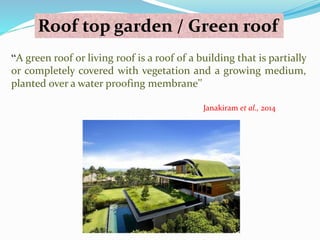
Roof top garden / Green roof 
“A green roof or living roof is a roof of a building that is partially 
or completely covered with vegetation and a growing medium, 
planted over a water proofing membrane’’ 
Janakiram et al., 2014
A BRIEF HISTORY OF ROOF GARDENS 
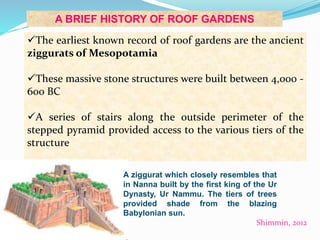
The earliest known record of roof gardens are the ancient 
ziggurats of Mesopotamia 
These massive stone structures were built between 4,000 - 
600 BC 
A series of stairs along the outside perimeter of the 
stepped pyramid provided access to the various tiers of the 
structure 
A ziggurat which closely resembles that 
in Nanna built by the first king of the Ur 
Dynasty, Ur Nammu. The tiers of trees 
provided shade from the blazing 
Babylonian sun. 
Shimmin, 2012
THE HANGING GARDENS OF BABYLON 
King Nebuchadnezzar, a famous general in his time, built the Hanging 
gardens for his wife during 8th – 6th century BC 
The ziggurat had a 400 ft2 base, with landscaped terraces eventually the 
grand roof garden at the top, 75 feet above the ground 
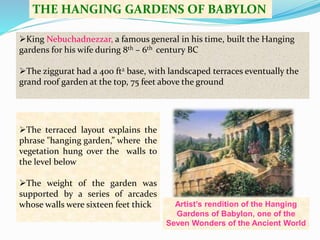
Artist’s rendition of the Hanging 
Gardens of Babylon, one of the 
Seven Wonders of the Ancient World 
The terraced layout explains the 
phrase "hanging garden,” where the 
vegetation hung over the walls to 
the level below 
The weight of the garden was 
supported by a series of arcades 
whose walls were sixteen feet thick
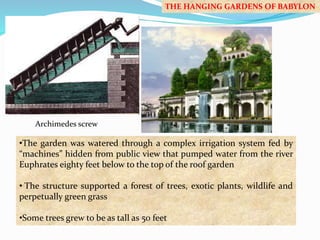
Archimedes screw 
THE HANGING GARDENS OF BABYLON 
•The garden was watered through a complex irrigation system fed by 
“machines” hidden from public view that pumped water from the river 
Euphrates eighty feet below to the top of the roof garden 
• The structure supported a forest of trees, exotic plants, wildlife and 
perpetually green grass 
•Some trees grew to be as tall as 50 feet
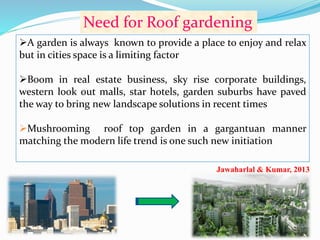
Need for Roof gardening 
A garden is always known to provide a place to enjoy and relax 
but in cities space is a limiting factor 
Boom in real estate business, sky rise corporate buildings, 
western look out malls, star hotels, garden suburbs have paved 
the way to bring new landscape solutions in recent times 
Mushrooming roof top garden in a gargantuan manner 
matching the modern life trend is one such new initiation 
Jawaharlal & Kumar, 2013
Benefits of Roof Gardening 
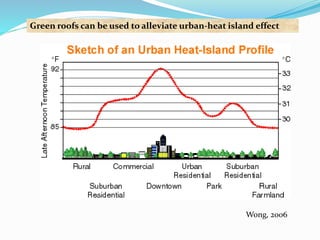
Reduce the “urban heat island effect” 
Reduce amount of greenhouse gas 
Reduce and clean storm water runoff 
Reduce energy consumption 
Increase the beauty of cities
Green roofs can be used to alleviate urban-heat island effect 
Wong, 2006
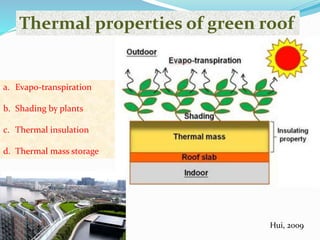
Thermal properties of green roof 
a. Evapo-transpiration 
b. Shading by plants 
c. Thermal insulation 
d. Thermal mass storage 
Hui, 2009
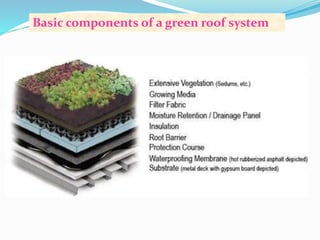
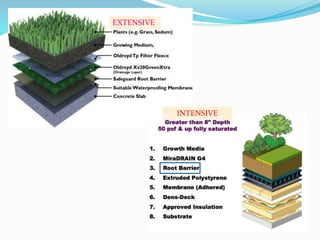
Basic components of a green roof system
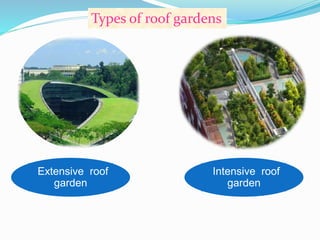
Types of roof gardens 
Extensive roof 
garden 
Intensive roof 
garden
EXTENSIVE 
INTENSIVE
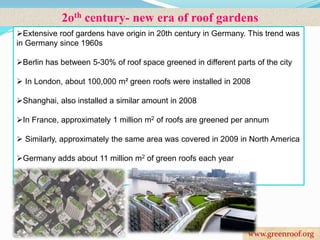
2oth century- new era of roof gardens 
Extensive roof gardens have origin in 20th century in Germany. This trend was 
in Germany since 1960s 
Berlin has between 5-30% of roof space greened in different parts of the city 
 In London, about 100,000 m² green roofs were installed in 2008 
Shanghai, also installed a similar amount in 2008 
In France, approximately 1 million m2 of roofs are greened per annum 
 Similarly, approximately the same area was covered in 2009 in North America 
Germany adds about 11 million m2 of green roofs each year 
www.greenroof.org
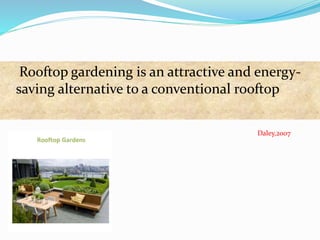
Rooftop gardening is an attractive and energy-saving 
alternative to a conventional rooftop 
Daley,2007
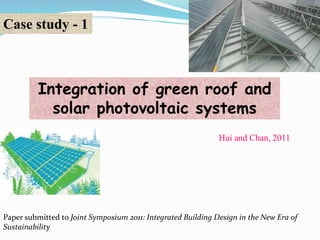
Case study - 1 
Integration of green roof and 
solar photovoltaic systems 
Hui and Chan, 2011 
Paper submitted to Joint Symposium 2011: Integrated Building Design in the New Era of 
Sustainability
Objectives of the study 
To study the benefits of integrating the green roof and 
solar photo voltaic systems 
Assessing the important factors affecting the interactions 
between the two systems 
To promote sustainable building design 
Hui and Chan , 2011
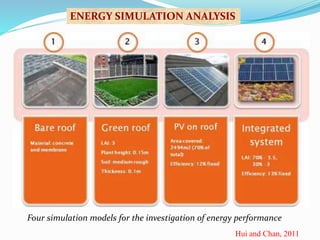
ENERGY SIMULATION ANALYSIS 
Four simulation models for the investigation of energy performance 
Hui and Chan, 2011
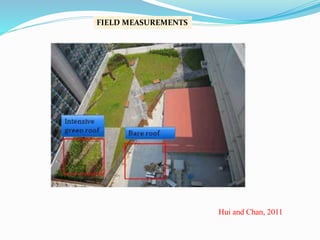
FIELD MEASUREMENTS 
Hui and Chan, 2011
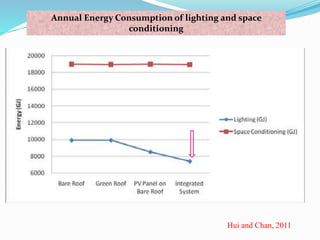
Annual Energy Consumption of lighting and space 
conditioning 
Hui and Chan, 2011
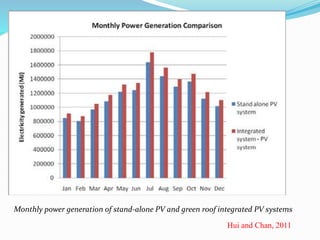
Monthly power generation of stand-alone PV and green roof integrated PV systems 
Hui and Chan, 2011
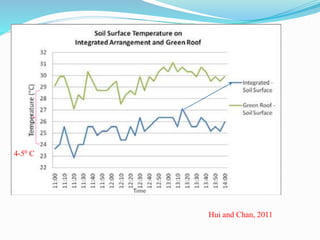
Hui and Chan, 2011 
4-50 C
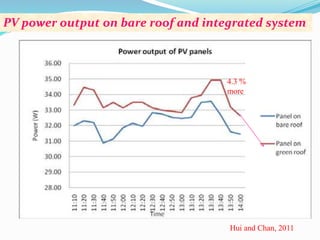
PV power output on bare roof and integrated system 
4.3 % 
more 
Hui and Chan, 2011
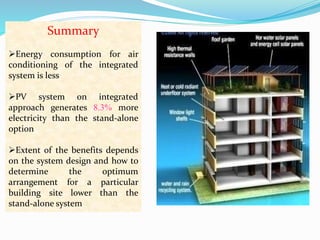
Summary 
Energy consumption for air 
conditioning of the integrated 
system is less 
PV system on integrated 
approach generates 8.3% more 
electricity than the stand-alone 
option 
Extent of the benefits depends 
on the system design and how to 
determine the optimum 
arrangement for a particular 
building site lower than the 
stand-alone system
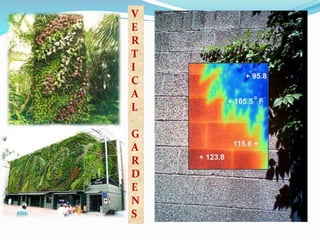
V 
E 
R 
T 
I 
C 
A 
L 
G 
A 
R 
D 
E 
N 
S
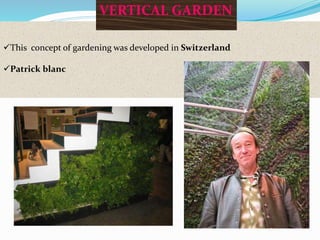
This concept of gardening was developed in Switzerland 
Patrick blanc 
VERTICAL GARDEN
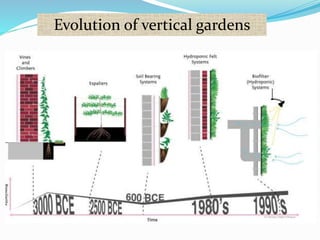
Evolution of vertical gardens
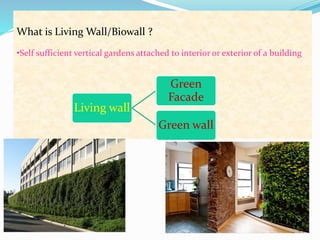
What is Living Wall/Biowall ? 
•Self sufficient vertical gardens attached to interior or exterior of a building 
Living wall 
Green 
Facade 
Green wall
Green facade 
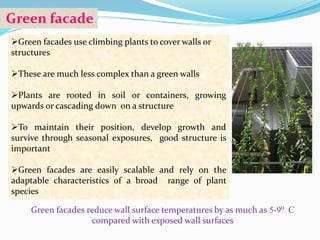
Green facades use climbing plants to cover walls or 
structures 
These are much less complex than a green walls 
Plants are rooted in soil or containers, growing 
upwards or cascading down on a structure 
To maintain their position, develop growth and 
survive through seasonal exposures, good structure is 
important 
Green facades are easily scalable and rely on the 
adaptable characteristics of a broad range of plant 
species 
Green facades reduce wall surface temperatures by as much as 5-90 C 
compared with exposed wall surfaces
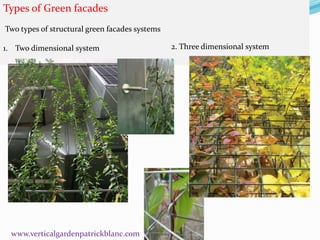
Types of Green facades 
Two types of structural green facades systems 
1. Two dimensional system 2. Three dimensional system 
www.verticalgardenpatrickblanc.com
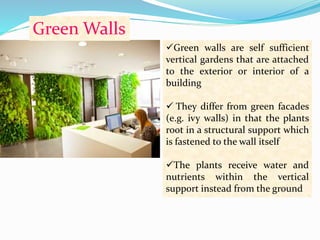
Green Walls 
Green walls are self sufficient 
vertical gardens that are attached 
to the exterior or interior of a 
building 
 They differ from green facades 
(e.g. ivy walls) in that the plants 
root in a structural support which 
is fastened to the wall itself 
The plants receive water and 
nutrients within the vertical 
support instead from the ground
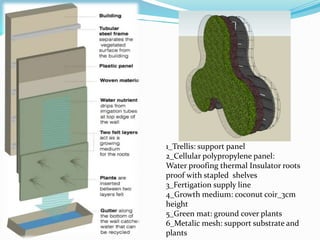
1_Trellis: support panel 
2_Cellular polypropylene panel: 
Water proofing thermal Insulator roots 
proof with stapled shelves 
3_Fertigation supply line 
4_Growth medium: coconut coir_3cm 
height 
5_Green mat: ground cover plants 
6_Metalic mesh: support substrate and 
plants
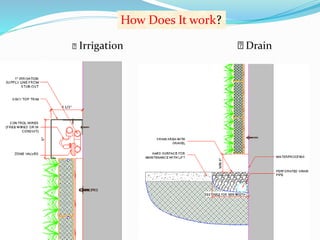
How Does It work? 
Irrigation Drain
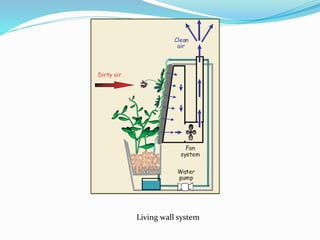
Living wall system
Problems with vertical walls 
Humidity 
The best protection against humidity was obtained with use 
elastomer materials 
The modular systems are the best solution possible for solving 
this type of problem 
Steel structures can be used also, but this type of structures is 
expensive
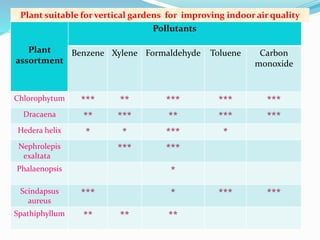
Plant suitable for vertical gardens for improving indoor air quality 
Plant 
assortment 
Pollutants 
Benzene Xylene Formaldehyde Toluene Carbon 
monoxide 
Chlorophytum *** ** *** *** *** 
Dracaena ** *** ** *** *** 
Hedera helix * * *** * 
Nephrolepis 
*** *** 
exaltata 
Phalaenopsis * 
Scindapsus 
aureus 
*** * *** *** 
Spathiphyllum ** ** **
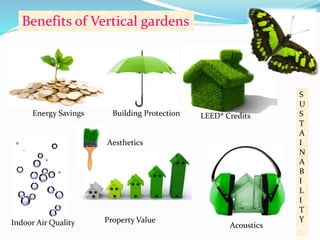
Energy Savings Building Protection LEED® Credits 
Indoor Air Quality Property Value 
Acoustics 
S 
U 
S 
T 
A 
I 
N 
A 
B 
I 
L 
I 
T 
Y 
Benefits of Vertical gardens 
Aesthetics
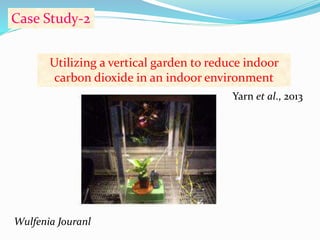
Case Study-2 
Utilizing a vertical garden to reduce indoor 
carbon dioxide in an indoor environment 
Yarn et al., 2013 
Wulfenia Jouranl
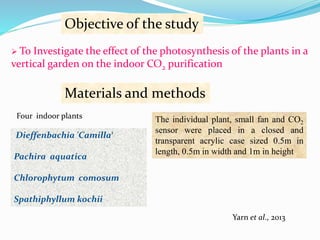
Objective of the study 
 To Investigate the effect of the photosynthesis of the plants in a 
vertical garden on the indoor CO2 purification 
Materials and methods 
Four indoor plants The individual plant, small fan and CO2 
Dieffenbachia 'Camilla‘ 
Pachira aquatica 
Chlorophytum comosum 
Spathiphyllum kochii 
sensor were placed in a closed and 
transparent acrylic case sized 0.5m in 
length, 0.5m in width and 1m in height 
Yarn et al., 2013
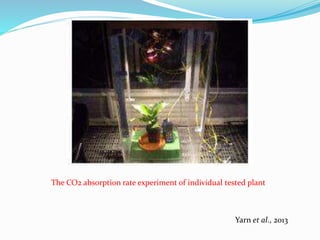
The CO2 absorption rate experiment of individual tested plant 
Yarn et al., 2013
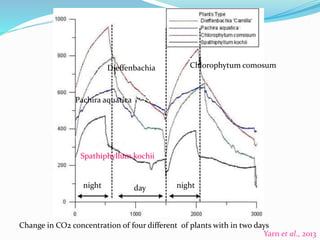
Dieffenbachia Chlorophytumcomosum 
Pachira aquatica 
Spathiphyllum kochii 
night day night 
Change in CO2 concentration of four different of plants with in two days 
Yarn et al., 2013
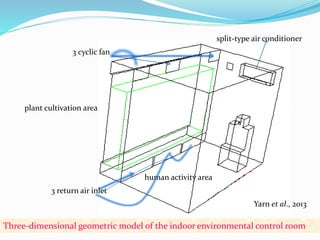
plant cultivation area 
human activity area 
3 cyclic fan 
3 return air inlet 
split-type air conditioner 
Yarn et al., 2013 
Three-dimensional geometric model of the indoor environmental control room
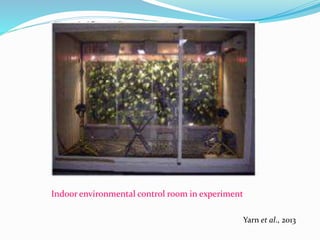
Yarn et al., 2013 
Indoor environmental control room in experiment
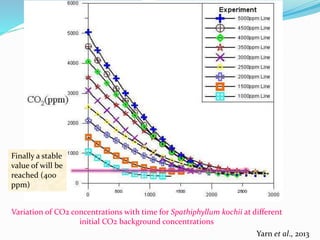
Variation of CO2 concentrations with time for Spathiphyllum kochii at different 
initial CO2 background concentrations 
Finally a stable 
value of will be 
reached (400 
ppm) 
Yarn et al., 2013
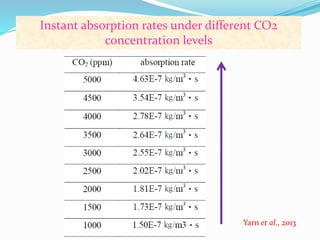
Instant absorption rates under different CO2 
concentration levels 
Yarn et al., 2013
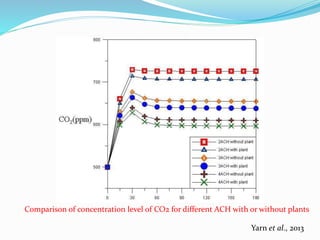
Comparison of concentration level of CO2 for different ACH with or without plants 
Yarn et al., 2013
Summary 
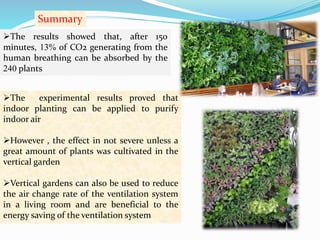
The results showed that, after 150 
minutes, 13% of CO2 generating from the 
human breathing can be absorbed by the 
240 plants 
The experimental results proved that 
indoor planting can be applied to purify 
indoor air 
However , the effect in not severe unless a 
great amount of plants was cultivated in the 
vertical garden 
Vertical gardens can also be used to reduce 
the air change rate of the ventilation system 
in a living room and are beneficial to the 
energy saving of the ventilation system
CONCLUSIONS 
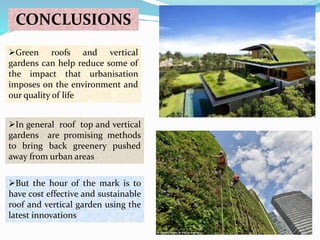
Green roofs and vertical 
gardens can help reduce some of 
the impact that urbanisation 
imposes on the environment and 
our quality of life 
In general roof top and vertical 
gardens are promising methods 
to bring back greenery pushed 
away from urban areas 
But the hour of the mark is to 
have cost effective and sustainable 
roof and vertical garden using the 
latest innovations
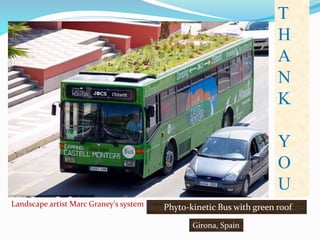
Landscape artist Marc Graney's system Phyto-kinetic Bus with green roof 
Girona, Spain 
T 
H 
A 
N 
K 
Y 
O 
U

Roof top and vertical gardening for greening the cities

  • 1.
    Seminar in-charge Dr.T. Manjunatha Rao, Principal Scientist, IIHR, Hessaraghatta, Bengluru Speaker Ch. Girija Kumari, ID: 10468 Ph. D. Scholar Dept. of Floriculture and Landscaping IARI-IIHR, Bengluru, Karnataka
  • 2.
    Roof top garden/ Green roof “A green roof or living roof is a roof of a building that is partially or completely covered with vegetation and a growing medium, planted over a water proofing membrane’’ Janakiram et al., 2014
  • 3.
    A BRIEF HISTORYOF ROOF GARDENS The earliest known record of roof gardens are the ancient ziggurats of Mesopotamia These massive stone structures were built between 4,000 - 600 BC A series of stairs along the outside perimeter of the stepped pyramid provided access to the various tiers of the structure A ziggurat which closely resembles that in Nanna built by the first king of the Ur Dynasty, Ur Nammu. The tiers of trees provided shade from the blazing Babylonian sun. Shimmin, 2012
  • 4.
    THE HANGING GARDENSOF BABYLON King Nebuchadnezzar, a famous general in his time, built the Hanging gardens for his wife during 8th – 6th century BC The ziggurat had a 400 ft2 base, with landscaped terraces eventually the grand roof garden at the top, 75 feet above the ground Artist’s rendition of the Hanging Gardens of Babylon, one of the Seven Wonders of the Ancient World The terraced layout explains the phrase "hanging garden,” where the vegetation hung over the walls to the level below The weight of the garden was supported by a series of arcades whose walls were sixteen feet thick
  • 5.
    Archimedes screw THEHANGING GARDENS OF BABYLON •The garden was watered through a complex irrigation system fed by “machines” hidden from public view that pumped water from the river Euphrates eighty feet below to the top of the roof garden • The structure supported a forest of trees, exotic plants, wildlife and perpetually green grass •Some trees grew to be as tall as 50 feet
  • 6.
    Need for Roofgardening A garden is always known to provide a place to enjoy and relax but in cities space is a limiting factor Boom in real estate business, sky rise corporate buildings, western look out malls, star hotels, garden suburbs have paved the way to bring new landscape solutions in recent times Mushrooming roof top garden in a gargantuan manner matching the modern life trend is one such new initiation Jawaharlal & Kumar, 2013
  • 7.
    Benefits of RoofGardening Reduce the “urban heat island effect” Reduce amount of greenhouse gas Reduce and clean storm water runoff Reduce energy consumption Increase the beauty of cities
  • 8.
    Green roofs canbe used to alleviate urban-heat island effect Wong, 2006
  • 9.
    Thermal properties ofgreen roof a. Evapo-transpiration b. Shading by plants c. Thermal insulation d. Thermal mass storage Hui, 2009
  • 10.
    Basic components ofa green roof system
  • 11.
    Types of roofgardens Extensive roof garden Intensive roof garden
  • 12.
  • 13.
    2oth century- newera of roof gardens Extensive roof gardens have origin in 20th century in Germany. This trend was in Germany since 1960s Berlin has between 5-30% of roof space greened in different parts of the city  In London, about 100,000 m² green roofs were installed in 2008 Shanghai, also installed a similar amount in 2008 In France, approximately 1 million m2 of roofs are greened per annum  Similarly, approximately the same area was covered in 2009 in North America Germany adds about 11 million m2 of green roofs each year www.greenroof.org
  • 14.
    Rooftop gardening isan attractive and energy-saving alternative to a conventional rooftop Daley,2007
  • 15.
    Case study -1 Integration of green roof and solar photovoltaic systems Hui and Chan, 2011 Paper submitted to Joint Symposium 2011: Integrated Building Design in the New Era of Sustainability
  • 16.
    Objectives of thestudy To study the benefits of integrating the green roof and solar photo voltaic systems Assessing the important factors affecting the interactions between the two systems To promote sustainable building design Hui and Chan , 2011
  • 17.
    ENERGY SIMULATION ANALYSIS Four simulation models for the investigation of energy performance Hui and Chan, 2011
  • 18.
    FIELD MEASUREMENTS Huiand Chan, 2011
  • 19.
    Annual Energy Consumptionof lighting and space conditioning Hui and Chan, 2011
  • 20.
    Monthly power generationof stand-alone PV and green roof integrated PV systems Hui and Chan, 2011
  • 21.
    Hui and Chan,2011 4-50 C
  • 22.
    PV power outputon bare roof and integrated system 4.3 % more Hui and Chan, 2011
  • 23.
    Summary Energy consumptionfor air conditioning of the integrated system is less PV system on integrated approach generates 8.3% more electricity than the stand-alone option Extent of the benefits depends on the system design and how to determine the optimum arrangement for a particular building site lower than the stand-alone system
  • 24.
    V E R T I C A L G A R D E N S
  • 25.
    This concept ofgardening was developed in Switzerland Patrick blanc VERTICAL GARDEN
  • 26.
  • 27.
    What is LivingWall/Biowall ? •Self sufficient vertical gardens attached to interior or exterior of a building Living wall Green Facade Green wall
  • 28.
    Green facade Greenfacades use climbing plants to cover walls or structures These are much less complex than a green walls Plants are rooted in soil or containers, growing upwards or cascading down on a structure To maintain their position, develop growth and survive through seasonal exposures, good structure is important Green facades are easily scalable and rely on the adaptable characteristics of a broad range of plant species Green facades reduce wall surface temperatures by as much as 5-90 C compared with exposed wall surfaces
  • 29.
    Types of Greenfacades Two types of structural green facades systems 1. Two dimensional system 2. Three dimensional system www.verticalgardenpatrickblanc.com
  • 30.
    Green Walls Greenwalls are self sufficient vertical gardens that are attached to the exterior or interior of a building  They differ from green facades (e.g. ivy walls) in that the plants root in a structural support which is fastened to the wall itself The plants receive water and nutrients within the vertical support instead from the ground
  • 32.
    1_Trellis: support panel 2_Cellular polypropylene panel: Water proofing thermal Insulator roots proof with stapled shelves 3_Fertigation supply line 4_Growth medium: coconut coir_3cm height 5_Green mat: ground cover plants 6_Metalic mesh: support substrate and plants
  • 33.
    How Does Itwork? Irrigation Drain
  • 34.
  • 35.
    Problems with verticalwalls Humidity The best protection against humidity was obtained with use elastomer materials The modular systems are the best solution possible for solving this type of problem Steel structures can be used also, but this type of structures is expensive
  • 36.
    Plant suitable forvertical gardens for improving indoor air quality Plant assortment Pollutants Benzene Xylene Formaldehyde Toluene Carbon monoxide Chlorophytum *** ** *** *** *** Dracaena ** *** ** *** *** Hedera helix * * *** * Nephrolepis *** *** exaltata Phalaenopsis * Scindapsus aureus *** * *** *** Spathiphyllum ** ** **
  • 37.
    Energy Savings BuildingProtection LEED® Credits Indoor Air Quality Property Value Acoustics S U S T A I N A B I L I T Y Benefits of Vertical gardens Aesthetics
  • 38.
    Case Study-2 Utilizinga vertical garden to reduce indoor carbon dioxide in an indoor environment Yarn et al., 2013 Wulfenia Jouranl
  • 39.
    Objective of thestudy  To Investigate the effect of the photosynthesis of the plants in a vertical garden on the indoor CO2 purification Materials and methods Four indoor plants The individual plant, small fan and CO2 Dieffenbachia 'Camilla‘ Pachira aquatica Chlorophytum comosum Spathiphyllum kochii sensor were placed in a closed and transparent acrylic case sized 0.5m in length, 0.5m in width and 1m in height Yarn et al., 2013
  • 40.
    The CO2 absorptionrate experiment of individual tested plant Yarn et al., 2013
  • 41.
    Dieffenbachia Chlorophytumcomosum Pachiraaquatica Spathiphyllum kochii night day night Change in CO2 concentration of four different of plants with in two days Yarn et al., 2013
  • 42.
    plant cultivation area human activity area 3 cyclic fan 3 return air inlet split-type air conditioner Yarn et al., 2013 Three-dimensional geometric model of the indoor environmental control room
  • 43.
    Yarn et al.,2013 Indoor environmental control room in experiment
  • 44.
    Variation of CO2concentrations with time for Spathiphyllum kochii at different initial CO2 background concentrations Finally a stable value of will be reached (400 ppm) Yarn et al., 2013
  • 45.
    Instant absorption ratesunder different CO2 concentration levels Yarn et al., 2013
  • 46.
    Comparison of concentrationlevel of CO2 for different ACH with or without plants Yarn et al., 2013
  • 47.
    Summary The resultsshowed that, after 150 minutes, 13% of CO2 generating from the human breathing can be absorbed by the 240 plants The experimental results proved that indoor planting can be applied to purify indoor air However , the effect in not severe unless a great amount of plants was cultivated in the vertical garden Vertical gardens can also be used to reduce the air change rate of the ventilation system in a living room and are beneficial to the energy saving of the ventilation system
  • 48.
    CONCLUSIONS Green roofsand vertical gardens can help reduce some of the impact that urbanisation imposes on the environment and our quality of life In general roof top and vertical gardens are promising methods to bring back greenery pushed away from urban areas But the hour of the mark is to have cost effective and sustainable roof and vertical garden using the latest innovations
  • 49.
    Landscape artist MarcGraney's system Phyto-kinetic Bus with green roof Girona, Spain T H A N K Y O U