What is Burlapping….
Transplanting of a grown up tree from one place to another.
Burlapping is a major operation from which trees recover slowly
Due to the wide extent and morphology of tree root system,
transplanting of trees usually involves substantial removal of roots.
Conditions of the trees to be
transplanted
•Trees should be in good health, form and structure.
•Trees with poor form/architecture, health or structure should not be
considered for transplanting
•A transplanted tree should be able to re-establish sufficient roots to
sustain itself.
•The lifespan and health of the trees after transplanting have to be
considered before transplanting to assess the cost effectiveness of the
operation.
Where to plant the burlapped
tree
oWhere retaining the trees at their existing locations are not practicable,
priority should be given to transplant the affected trees within the
project site where appropriate, so as to increase the trees’ survival rate
after transplanting and minimise the loss of greenery in the local
environment
oIf it is not practicable, transplant the affected trees to a suitable
permanent location ex-situ. Location of the receptor site should
preferably be in proximity to the project site for retention of amenity
effect in the vicinity.
Size of root ball / quality of
root system
Larger trees need bigger root ball to encompass more roots to ensure
adequate re-growth, anchorage and stability.
International practices generally recommend a range of 8:1 to 10:1 for
root ball diameter : trunk diameter.
A larger root ball is recommendable for more mature trees to enhance
better recovery after transplanting.
Species suitable for burlapping
 Invasive exotic tree species should not be considered for
transplanting.
 Trees having particular significance and high conservation value
[ie.,Native species] would be recommendable for transplanting in case
they cannot be preserved on site.
Palms are the common plants in burlapping concepts in India.
Palms like Oredoxa regia, Phoneix sylvestris and Woodeyia bifurcate
are commonly transplanted.
Beside heritage trees like Banyan, Peepal and other massive spreading
native tree are also transplanted
Native or Indigenous trees
recommended for burlapping
Neem tree
Pungam tree
Mango tree
Sacred fig tree
Java plum tree
Vilvam tree
Gum Arabic tree
Ashoka tree
Jack fruit tree
Tamarind tree
Banyan tree
Jujube tree
Sandalwood tree
Trees suitable for burlapping
Neem
Kanji
Milletia
Drumstick
Imli
Khair
Arjuna
Sissoo
Kaijelia
Peltophorum
Pipal
Silk cotton tree
Mahua
Teak
Pendula
Amla
Semal
Mango
Tamarind
gulmahor
Some exotic tree species of
India
Poplar
Eucalyptus
Prosopis juliflora
Leucaena leucocephala
Acacia tortilis
Casuarina
THESE EXOTIC TREES SHOULD NOT BE TRANSPLANTED.
Availability and suitability of a
receptor site
Before transplanting, it is pertinent that a permanent receptor site,
either within and outside the project site, should be located.
Transplanting,
Within the project site – most advisable
Outside the project site – less advisable
Trees not to be transplanted
low amenity value;
irrecoverable form after transplanting
low survival rate after transplanting;
very large size
with evidence or notable signs of over-maturity and onset of
senescence;
with poor health, structure or form (e.g. imbalanced form, leaning,
with major cavity/cracks/splits);
undesirable species (e.g. Leucaena leucocephala which is an invasive
tree).
Tools and equipments for tree
burlapping
Mechanical digging and root pruning equipment
Lifting cables, chains, straps, and/or slings
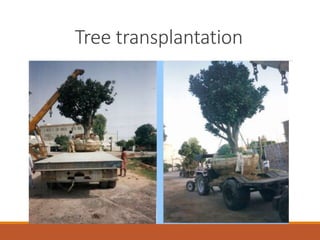
Cranes – lifting
Trolley or truck – transportation
JCB- for digging pits
Time of transplanting
Summer is not a common transplanting season as evapo-transpiration
rate is high
Early spring is generally the best time to transplant or burlap the tree.
Preparation of root ball
The root ball size varies depending on species, habit, location and
specific attributes which shall be as large as practicable to maximise the
potential of survival during and after transplanting while balancing
other logistical and cost concerns.
In general, the root ball diameter to tree diameter ranges from 8:1 to
10:1 according to international standards.
Normally the diameter of a root ball is larger than its depth which
seldom exceeds 1 metre.
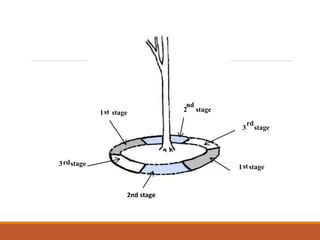
Stage wise root digging
For mature trees, root pruning is usually required to be carried out at
different stages with a minimum of 1 month allowed for root
regeneration between cuts.
It has four stages.
2nd stage
1ststage
3
rd
stage
3rdstage
2
nd
stage1st stage
The four stages of stage digging
are
1st stage – Dig a trench on the outside of the marked circumference in
only two opposing segments;
2nd stage – After a period of no less than 1 month since the 1st root
pruning, dig a trench on the outside of the marked circumference in the
adjacent two opposing segments;
3rd stage – After another period of no less than 1 month since the 2nd
root pruning, dig a trench on the outside of the marked circumference,
in the remaining two opposing segments; and
4th stage – After a further period of not less than 1 month since the 3rd
root pruning, prepare the root ball and cut the underside of the root
ball, followed by uplifting and transplanting.
Pre-lifting operations
No transplanting operations should commence until either the
receptor site or the holding nursery is fully prepared.
Tree uplifted must be transplanted and watered the same day.
Watering before lifting is recommended.
Before uplifting, the outer edge of the previously dug trenches shall be
loosened from the surrounding soil, and the root ball can be shaped
with taper on the sides, slanting inward toward the base.
The shaping and final cuts should be done by hand.
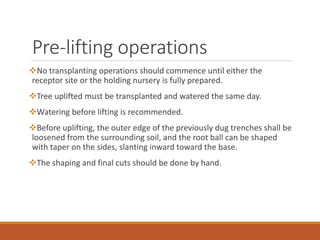
When the surrounding soil is removed, the base of the root
ball should be slanted inward to facilitate the lifting
operation
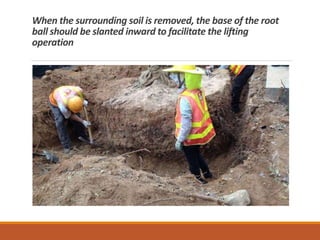
Hessian should cover the full
circumference of the root ball
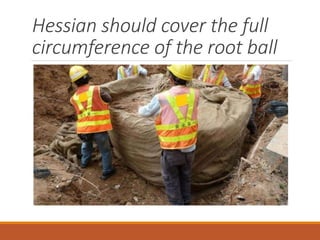
Root ball is well protected by a metal net
to facilitate transportation
Temporary support of trees
before lifting
Removal of the root system may sometimes aggravate the natural
form and balance of a tree and is prone to tree failure.
When the stability of a tree is likely to be jeopardized, a temporary
support, such as guying or simple prop is essential and important before
the tree is delivered to the transit nursery or to the new receptor site.
Lifting and handling of root-
balled trees
The root ball should be properly wrapped before lifting.
Lifting should be done by direct lift, with padded protection for the
tree, using a machine of appropriate capacity connected to the support
around the root ball, not to any other part of the tree.
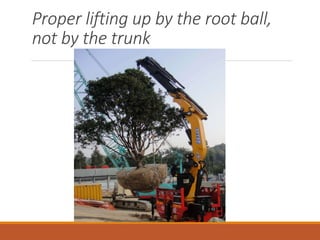
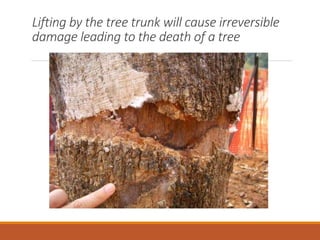
Tree should not be lifted by the trunk as this can cause serious trunk
injury but by its root ball which should be properly prepared and
wrapped.
Root balls that are not properly protected would easily collapse during
transplanting due to its own weight.
Proper lifting up by the root ball,
not by the trunk
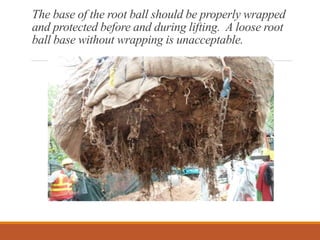
The base of the root ball should be properly wrapped
and protected before and during lifting. A loose root
ball base without wrapping is unacceptable.
Lifting by the tree trunk will cause irreversible
damage leading to the death of a tree
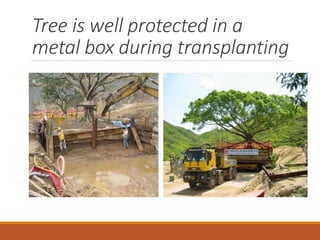
Tree is well protected in a
metal box during transplanting
Containerized root ball
Trees in containers are more resistant to root damage during
transportation.
This is a recommendable method of transplanting as the root ball is
well protected and lifting of the boxed root ball during transplanting will
give better protection during the transplanting operation
Enhance better establishment of the tree afterwards.
Preparation of receptor site
Trees will not tolerate highly compacted soil, which should be broken
up over as large an area of the site as possible.
Planting pits should be provided with drainage to allow effective
percolation of water.
The width and the final depth of a planting hole are determined by the
depth and firmness of the root ball and other characteristics of the site.
The soil directly beneath the root ball should be undistributed or
prepared to prevent settling.
The depth of the planting hole shall not exceed the depth of the root
ball and the sides of the planting hole should be scarified.
 The planting hole width should follow international practice at a
minimum of 1.5 times the diameter of the rootball to suit the location.
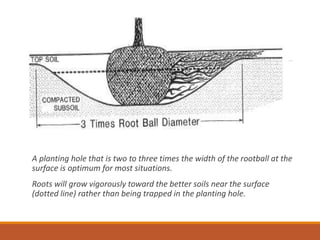
A planting hole that is two to three times the width of the rootball at the
surface is optimum for most situations.
Roots will grow vigorously toward the better soils near the surface
(dotted line) rather than being trapped in the planting hole.
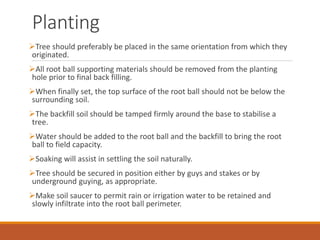
Planting
Tree should preferably be placed in the same orientation from which they
originated.
All root ball supporting materials should be removed from the planting
hole prior to final back filling.
When finally set, the top surface of the root ball should not be below the
surrounding soil.
The backfill soil should be tamped firmly around the base to stabilise a
tree.
Water should be added to the root ball and the backfill to bring the root
ball to field capacity.
Soaking will assist in settling the soil naturally.
Tree should be secured in position either by guys and stakes or by
underground guying, as appropriate.
Make soil saucer to permit rain or irrigation water to be retained and
slowly infiltrate into the root ball perimeter.
Post-planting Care
All newly planted trees are subject to stress until a normal spreading
root system has developed.
They should be well protected with robust fencing.
All newly transplanted trees should receive proper maintenance care
in order to facilitate recovery of tree from the transplanting shock.
The stress of a tree can be observed immediately after transplanting or
gradually after a period of time.
Proper care after transplanting will help to assure survival and
minimise stress and ensure a higher successful rate.
Efforts and expenses can be wasted if trees are not given proper care
after transplanting.
Cont.,
Mechanical support for trees is necessary when the tree is tall, slow to
recover & heavily foliaged.
Scaffolding is required for about one and a half month for each
transplanted tree to give it external support.
The support provided to a tree should be removed as soon as the tree
can stand alone.
It takes about 30 to 45 days in the growing period for the transplanted
tree to grow new branches & foliage.
The sooner the support will be removed, the faster the tree will
become stronger.
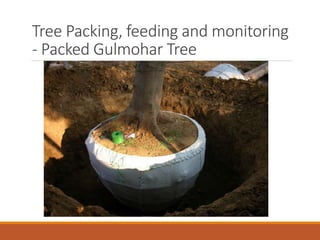
Tree Packing, feeding and monitoring
- Packed Gulmohar Tree
Tree transplantation
Mulching and watering
Mulch can be used to conserve soil moisture, to buffer soil temperature
extremes, to control weeds and other competing vegetation, and to
replenish organic matters and nutrients in the soil.
A well-established layer of mulch can hold more water than the soil
itself, without decreasing soil aeration.
Mulch should not be placed too close to the tree trunk or root collar.
Mulch layer around 5cm thick usually covers the area where roots will
grow during the first two years after planting.
The root zone and base of trees should be free from shrubs or other
planting to facilitate the proper establishment of trees.
Sufficient and appropriate watering is important for the proper root
growth.
Support above and below
ground
Staking or initial guying may help retain a tree in an upright position
until sufficient roots are developed to anchor the tree.
Guys and stakes and ties should be removed, replaced or adjusted as
necessary to ensure their effectiveness and to prevent constriction or
abrasion damage to the tree.
The supports can be removed after the tree establishment.
Supports that stay too long without proper adjustment will do more
harm than good to the trees.
Use of chemicals
Fertilisation may be unnecessary unless nutrient deficiency is
confirmed.
Moderate release of nutrients by decomposition of both mulch and
organic matter added to backfill soil may be sufficient during the initial
establishment period.
Fertiliser burn is an obvious symptom of having insufficient water in a
plant associated with an over application of fertiliser.
Cost of Transplanting
It estimated that complete operation i.e. transplanting and post
transplanting care will cost around 4000/- Rs. per tree.
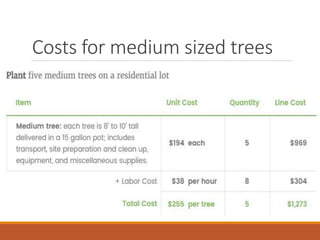
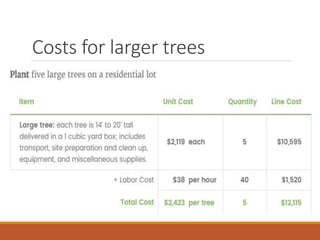
The cost to plant an average tree will vary with tree size and type, the
accessibility of its location, and labour rate.
Cost for five small tree
transplanting [cost in dollars]
Costs for medium sized trees
Costs for larger trees
Tree burlapping technology

Tree burlapping technology

  • 2.
    What is Burlapping…. Transplantingof a grown up tree from one place to another. Burlapping is a major operation from which trees recover slowly Due to the wide extent and morphology of tree root system, transplanting of trees usually involves substantial removal of roots.
  • 3.
    Conditions of thetrees to be transplanted •Trees should be in good health, form and structure. •Trees with poor form/architecture, health or structure should not be considered for transplanting •A transplanted tree should be able to re-establish sufficient roots to sustain itself. •The lifespan and health of the trees after transplanting have to be considered before transplanting to assess the cost effectiveness of the operation.
  • 4.
    Where to plantthe burlapped tree oWhere retaining the trees at their existing locations are not practicable, priority should be given to transplant the affected trees within the project site where appropriate, so as to increase the trees’ survival rate after transplanting and minimise the loss of greenery in the local environment oIf it is not practicable, transplant the affected trees to a suitable permanent location ex-situ. Location of the receptor site should preferably be in proximity to the project site for retention of amenity effect in the vicinity.
  • 5.
    Size of rootball / quality of root system Larger trees need bigger root ball to encompass more roots to ensure adequate re-growth, anchorage and stability. International practices generally recommend a range of 8:1 to 10:1 for root ball diameter : trunk diameter. A larger root ball is recommendable for more mature trees to enhance better recovery after transplanting.
  • 6.
    Species suitable forburlapping  Invasive exotic tree species should not be considered for transplanting.  Trees having particular significance and high conservation value [ie.,Native species] would be recommendable for transplanting in case they cannot be preserved on site. Palms are the common plants in burlapping concepts in India. Palms like Oredoxa regia, Phoneix sylvestris and Woodeyia bifurcate are commonly transplanted. Beside heritage trees like Banyan, Peepal and other massive spreading native tree are also transplanted
  • 7.
    Native or Indigenoustrees recommended for burlapping Neem tree Pungam tree Mango tree Sacred fig tree Java plum tree Vilvam tree Gum Arabic tree Ashoka tree Jack fruit tree Tamarind tree Banyan tree Jujube tree Sandalwood tree
  • 8.
    Trees suitable forburlapping Neem Kanji Milletia Drumstick Imli Khair Arjuna Sissoo Kaijelia Peltophorum Pipal Silk cotton tree Mahua Teak Pendula Amla Semal Mango Tamarind gulmahor
  • 9.
    Some exotic treespecies of India Poplar Eucalyptus Prosopis juliflora Leucaena leucocephala Acacia tortilis Casuarina THESE EXOTIC TREES SHOULD NOT BE TRANSPLANTED.
  • 10.
    Availability and suitabilityof a receptor site Before transplanting, it is pertinent that a permanent receptor site, either within and outside the project site, should be located. Transplanting, Within the project site – most advisable Outside the project site – less advisable
  • 11.
    Trees not tobe transplanted low amenity value; irrecoverable form after transplanting low survival rate after transplanting; very large size with evidence or notable signs of over-maturity and onset of senescence; with poor health, structure or form (e.g. imbalanced form, leaning, with major cavity/cracks/splits); undesirable species (e.g. Leucaena leucocephala which is an invasive tree).
  • 12.
    Tools and equipmentsfor tree burlapping Mechanical digging and root pruning equipment Lifting cables, chains, straps, and/or slings Cranes – lifting Trolley or truck – transportation JCB- for digging pits
  • 13.
    Time of transplanting Summeris not a common transplanting season as evapo-transpiration rate is high Early spring is generally the best time to transplant or burlap the tree.
  • 14.
    Preparation of rootball The root ball size varies depending on species, habit, location and specific attributes which shall be as large as practicable to maximise the potential of survival during and after transplanting while balancing other logistical and cost concerns. In general, the root ball diameter to tree diameter ranges from 8:1 to 10:1 according to international standards. Normally the diameter of a root ball is larger than its depth which seldom exceeds 1 metre.
  • 15.
    Stage wise rootdigging For mature trees, root pruning is usually required to be carried out at different stages with a minimum of 1 month allowed for root regeneration between cuts. It has four stages.
  • 16.
  • 17.
    The four stagesof stage digging are 1st stage – Dig a trench on the outside of the marked circumference in only two opposing segments; 2nd stage – After a period of no less than 1 month since the 1st root pruning, dig a trench on the outside of the marked circumference in the adjacent two opposing segments; 3rd stage – After another period of no less than 1 month since the 2nd root pruning, dig a trench on the outside of the marked circumference, in the remaining two opposing segments; and 4th stage – After a further period of not less than 1 month since the 3rd root pruning, prepare the root ball and cut the underside of the root ball, followed by uplifting and transplanting.
  • 18.
    Pre-lifting operations No transplantingoperations should commence until either the receptor site or the holding nursery is fully prepared. Tree uplifted must be transplanted and watered the same day. Watering before lifting is recommended. Before uplifting, the outer edge of the previously dug trenches shall be loosened from the surrounding soil, and the root ball can be shaped with taper on the sides, slanting inward toward the base. The shaping and final cuts should be done by hand.
  • 19.
    When the surroundingsoil is removed, the base of the root ball should be slanted inward to facilitate the lifting operation
  • 20.
    Hessian should coverthe full circumference of the root ball
  • 21.
    Root ball iswell protected by a metal net to facilitate transportation
  • 22.
    Temporary support oftrees before lifting Removal of the root system may sometimes aggravate the natural form and balance of a tree and is prone to tree failure. When the stability of a tree is likely to be jeopardized, a temporary support, such as guying or simple prop is essential and important before the tree is delivered to the transit nursery or to the new receptor site.
  • 23.
    Lifting and handlingof root- balled trees The root ball should be properly wrapped before lifting. Lifting should be done by direct lift, with padded protection for the tree, using a machine of appropriate capacity connected to the support around the root ball, not to any other part of the tree. Tree should not be lifted by the trunk as this can cause serious trunk injury but by its root ball which should be properly prepared and wrapped. Root balls that are not properly protected would easily collapse during transplanting due to its own weight.
  • 24.
    Proper lifting upby the root ball, not by the trunk
  • 25.
    The base ofthe root ball should be properly wrapped and protected before and during lifting. A loose root ball base without wrapping is unacceptable.
  • 26.
    Lifting by thetree trunk will cause irreversible damage leading to the death of a tree
  • 27.
    Tree is wellprotected in a metal box during transplanting
  • 28.
    Containerized root ball Treesin containers are more resistant to root damage during transportation. This is a recommendable method of transplanting as the root ball is well protected and lifting of the boxed root ball during transplanting will give better protection during the transplanting operation Enhance better establishment of the tree afterwards.
  • 29.
    Preparation of receptorsite Trees will not tolerate highly compacted soil, which should be broken up over as large an area of the site as possible. Planting pits should be provided with drainage to allow effective percolation of water. The width and the final depth of a planting hole are determined by the depth and firmness of the root ball and other characteristics of the site. The soil directly beneath the root ball should be undistributed or prepared to prevent settling. The depth of the planting hole shall not exceed the depth of the root ball and the sides of the planting hole should be scarified.  The planting hole width should follow international practice at a minimum of 1.5 times the diameter of the rootball to suit the location.
  • 30.
    A planting holethat is two to three times the width of the rootball at the surface is optimum for most situations. Roots will grow vigorously toward the better soils near the surface (dotted line) rather than being trapped in the planting hole.
  • 31.
    Planting Tree should preferablybe placed in the same orientation from which they originated. All root ball supporting materials should be removed from the planting hole prior to final back filling. When finally set, the top surface of the root ball should not be below the surrounding soil. The backfill soil should be tamped firmly around the base to stabilise a tree. Water should be added to the root ball and the backfill to bring the root ball to field capacity. Soaking will assist in settling the soil naturally. Tree should be secured in position either by guys and stakes or by underground guying, as appropriate. Make soil saucer to permit rain or irrigation water to be retained and slowly infiltrate into the root ball perimeter.
  • 32.
    Post-planting Care All newlyplanted trees are subject to stress until a normal spreading root system has developed. They should be well protected with robust fencing. All newly transplanted trees should receive proper maintenance care in order to facilitate recovery of tree from the transplanting shock. The stress of a tree can be observed immediately after transplanting or gradually after a period of time. Proper care after transplanting will help to assure survival and minimise stress and ensure a higher successful rate. Efforts and expenses can be wasted if trees are not given proper care after transplanting.
  • 33.
    Cont., Mechanical support fortrees is necessary when the tree is tall, slow to recover & heavily foliaged. Scaffolding is required for about one and a half month for each transplanted tree to give it external support. The support provided to a tree should be removed as soon as the tree can stand alone. It takes about 30 to 45 days in the growing period for the transplanted tree to grow new branches & foliage. The sooner the support will be removed, the faster the tree will become stronger.
  • 34.
    Tree Packing, feedingand monitoring - Packed Gulmohar Tree
  • 35.
  • 37.
    Mulching and watering Mulchcan be used to conserve soil moisture, to buffer soil temperature extremes, to control weeds and other competing vegetation, and to replenish organic matters and nutrients in the soil. A well-established layer of mulch can hold more water than the soil itself, without decreasing soil aeration. Mulch should not be placed too close to the tree trunk or root collar. Mulch layer around 5cm thick usually covers the area where roots will grow during the first two years after planting. The root zone and base of trees should be free from shrubs or other planting to facilitate the proper establishment of trees. Sufficient and appropriate watering is important for the proper root growth.
  • 38.
    Support above andbelow ground Staking or initial guying may help retain a tree in an upright position until sufficient roots are developed to anchor the tree. Guys and stakes and ties should be removed, replaced or adjusted as necessary to ensure their effectiveness and to prevent constriction or abrasion damage to the tree. The supports can be removed after the tree establishment. Supports that stay too long without proper adjustment will do more harm than good to the trees.
  • 39.
    Use of chemicals Fertilisationmay be unnecessary unless nutrient deficiency is confirmed. Moderate release of nutrients by decomposition of both mulch and organic matter added to backfill soil may be sufficient during the initial establishment period. Fertiliser burn is an obvious symptom of having insufficient water in a plant associated with an over application of fertiliser.
  • 40.
    Cost of Transplanting Itestimated that complete operation i.e. transplanting and post transplanting care will cost around 4000/- Rs. per tree. The cost to plant an average tree will vary with tree size and type, the accessibility of its location, and labour rate.
  • 41.
    Cost for fivesmall tree transplanting [cost in dollars]
  • 42.
    Costs for mediumsized trees
  • 43.