PRESENTATION
STRATEGY
IMPLEMENTATION
PHD THESIS
DR. ARNOUD VAN DER MAAS
STRATAEGOS CONSULTING
There is nothing more difficult to take at hand,
more perilous to conduct, or more uncertain in
its success, than to take the lead in the
introduction of a new order of things, because
the innovator has for enemies all those who have
done well under the old conditions, and
lukewarm defenders in those who may do well
under the new.
(Machiavelli, 1512)
STRATEGY IMPLEMENTATION AS
COMPETITIVE ADVANTAGE
♦ The successful implementation of strong and robust
strategies gives any organization a significant
competitive edge.
♦ In current turbulent environments, the ability to
develop and implement new strategies quickly and
effectively may well mean the difference between
success and failure for organizations.
♦ Well-formulated strategies only produce superior
performance for organizations when they are
successfully implemented.
♦ Even the best-made strategies are worthless if they
cannot be successfully implemented.
3
THE MAJORITY OF STRATEGY
IMPLEMENTATIONS FAIL
♦ For decades survey after survey reveal that most
strategy implementations fail.
♦ Fewer than 15 percent of organizations around the
world report that they are successful at strategy
implementation.
♦ Many organizations have a fundamental disconnect
between the formulation of their strategy and the
implementation of that strategy into useful action.
♦ The majority of strategies fail in the strategy
implementation phase.
4
THE STRATEGY
IMPLEMENTATION PROBLEM
♦ After a comprehensive strategy has been formulated,
significant difficulties are often encountered during
the following implementation process.
♦ The strategy implementation problem: the all too
frequent failure to create change after seemingly
viable strategic plans have been developed.
♦ Achieving successful implementation remains a
continuing challenge for managers responsible for
executing strategies.
♦ Survey after survey reveals that strategy
implementation is a top priority for executives.
5
STRATEGY IMPLEMENTATION
RESEARCH REMAINS LIMITED
♦ Strategy implementation receives limited research
attention despite its apparent importance.
♦ The field of strategic management has traditionally focused
on strategy formulation while the real challenge lies in
strategy implementation.
♦ The common view on strategy implementation is that it is a
relatively straightforward operationalization of a clearly
articulated strategic plan.
♦ Strategy formulation tends to be seen as a glamorous
intellectual and creative act and implementation as a
hands-on and action oriented activity which requires
leadership and managerial skills.
6
PERSPECTIVES ON STRATEGY
IMPLEMENTATION
♦ There is no universally accepted definition of
strategy implementation.
♦ Hard or rational versus soft or behavioral aspects of
strategy implementation.
♦ The separation of strategy formulation and strategy
implementation
♦ Planned versus emergent strategy implementation.
♦ Top-down versus bottom-up strategy formation.
♦ External versus internal implementation control.
♦ Incremental versus radical strategy implementation.
7
RESEARCH QUESTION AND
METHODOLOGY
RESEARCH QUESTION
♦ What factors influence strategy implementation
performance?
RESEARCH METHODOLOGY
♦ Qualitative survey with semi-structured interviews.
♦ 55 executives with implementation responsibilities.
♦ Selection of 44 public and private organizations.
♦ 33 strategy implementations projects investigated.
♦ A wide variety of organizations surveyed.
♦ Grounded Theory data analysis.
8
STRATEGY IMPLEMENTATION
PROCESS, CONTENT, CONTEXT
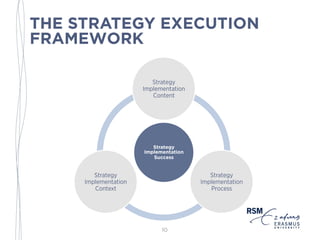
♦ Strategy implementation can only be understood
and managed by merging process, content and
context into a 3-dimensional view of strategy
implementation (Pettigrew, 1985).
♦ Process refers to the ‘how’ or manner in which the
strategy is implemented.
♦ Context refers to the ‘where’ or the circumstances
under which the strategy implementation is taking
place.
♦ Content refers to the ‘what’ or the product of the
strategy implementation.
9
THE STRATEGY EXECUTION
FRAMEWORK
Strategy
Implementation
Success
Strategy
Implementation
Content
Strategy
Implementation
Process
Strategy
Implementation
Context
10
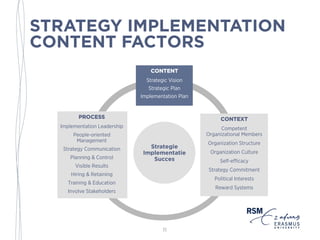
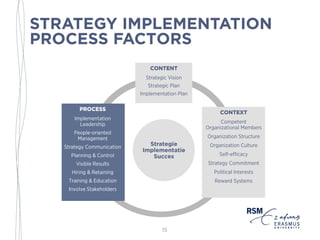
STRATEGY IMPLEMENTATION
CONTENT FACTORS
11
Strategie
Implementatie
Succes
CONTENT
Strategic Vision
Strategic Plan
Implementation Plan
CONTEXT
Competent
Organizational Members
Organization Structure
Organization Culture
Self-efficacy
Strategy Commitment
Political Interests
Reward Systems
PROCESS
Implementation Leadership
People-oriented
Management
Strategy Communication
Planning & Control
Visible Results
Hiring & Retaining
Training & Education
Involve Stakeholders
FORMULATE AN ATTRACTIVE
STRATEGIC VISION
♦ Successful strategy formulation and implementation
begins with formulating a sound and clear strategic
vision by top management.
♦ The strategic vision describes the desired future state
of the organization and helps clarify the direction in
which an organization is to move.
♦ The strategic vision needs to be attractive and easy to
communicate toward organizational members,
customers and other stakeholders.
♦ A clear and attractive strategic vision increases the
confidence of employees in a successful outcome of
the implementation effort.
12
DEVELOP A SOUND AND
CLEAR STRATEGY
♦ Develop a strategy that is able to achieve the
strategic vision.
♦ A strategy is a combination of the goals the firm is
and the means by which it seeks to achieve them.
♦ The strategy needs to be realistic, based on a sound
idea and be well thought out.
♦ No implementation can save a strategy, which is not
feasible or sound to begin with.
♦ Discuss the strategy with managers and employees
to assess whether it is sound, realistic and feasible.
♦ The strategy needs to be easy to understand for
employees and stakeholders.
13
TRANSLATE THE STRATEGY
INTO IMPLEMENTATION PLAN
♦ The implementation plan specifies the processes, activities
and operational objectives that are required to achieve the
goals of the strategy.
♦ Translate the strategic objectives into measurable
operational implementation objectives linked to
departmental and individual goals.
♦ Effective strategy implementation requires clear
implementation tasks, activities and responsibilities.
♦ By allocating clear responsibilities for the execution of the
implementation activities, progress can be measured and
controlled.
♦ Specific and ambitious but realistic goals that are accepted
by organizational members lead to the best task
performance.
14
STRATEGY IMPLEMENTATION
PROCESS FACTORS
15
Strategie
Implementatie
Succes
CONTENT
Strategic Vision
Strategic Plan
Implementation Plan
CONTEXT
Competent
Organizational Members
Organization Structure
Organization Culture
Self-efficacy
Strategy Commitment
Political Interests
Reward Systems
PROCESS
Implementation
Leadership
People-oriented
Management
Strategy Communication
Planning & Control
Visible Results
Hiring & Retaining
Training & Education
Involve Stakeholders
APPOINT A STRATEGY
IMPLEMENTATION LEADER
♦ Successful strategy implementation requires one
board member who is responsible for the outcome of
the implementation.
♦ The implementation leader is responsible for
articulating and communicating an attractive strategic
vision that guides the strategy implementation.
♦ A successful leader inspires followers through the
communication of a captivating vision designed to
motivate followers to ambitious goals.
♦ When leaders practice moral virtues such as fairness,
integrity, honesty, loyalty, determination, courage and
responsibility increases the willingness of followers to
follow the leader.
16
USE A PEOPLE-ORIENTED
MANAGEMENT STYLE
♦ Having a people-oriented management style is a key
practice for successful implementation.
♦ As individuals go to work for both instrumental and social
reasons, managers need to pay attention to both task
performance and social relationships.
♦ Better social relations increase the cooperation,
motivation, and effectiveness of organizational members.
♦ A relationship-oriented manager listens, provides support
and encouragement, coaching and counseling, develops
social relations with subordinates, celebrates social
activities and empowers organizational members during a
strategy implementation effort.
17
COMMUNICATE THE STRATEGY
♦ No less than 95 percent of organizational members do not
understand the strategy of their own organization.
♦ The objective is to make organizational members
understand what the strategy is all about and what its
goals are.
♦ The strategy needs to be clearly explained in a way that
employees understand and may become convinced that
the strategy is sound and effective.
♦ Organizational members are more willing to accept
undesirable decisions when they have received clear and
adequate explanations for those decision.
♦ It is not only important to communicate the strategy to the
people but it is also important to listen to their reactions
to the strategy.
18
MONITOR AND ADAPT
THE STRATEGY
♦ As execution plans are destined to change, implementation
teams need to regularly meet in well-structured sessions to
share information, reconfirm priorities and make
adjustments when objectives are not being met.
♦ Many organizations have accountability problems resulting
from lack of planning, absence of a functional management
information system, or cultural values which do not
encourage holding persons, especially in high positions,
accountable.
♦ When objectives are not being met the assumptions
underlying the strategy may be flawed or obsolete. When
this happens it needs to be decided whether incremental
improvements will suffice or that a new strategy is required.
19
ACHIEVE AND CELEBRATE
VISIBLE RESULTS
♦ Achieving visible improvements in performance, especially
in the beginning of the strategy implementation (quick
wins) increases the motivation and commitment of
organizational members.
♦ People are more inclined to accept new things when they
see that these things work and lead to results.
♦ During the strategy implementation it is important to
make change visible to organization. By making change
visible (such as new logo, uniforms and offices)
management van show the organization that they are
committed to the strategy and things are really changing.
♦ Achieving results is even more important when the
company is in crisis and short-term results are needed to
let employees regain confidence.
20
HIRE, RETAIN AND FIRE
ORGANIZATIONAL MEMBERS
♦ Recruitment, promotion and demotion must provide the
organizational members who have the required skills and
attitude to successfully implement the new strategy.
♦ Especially when an organization aims for radical change, new
employees and especially managers are required to achieve it.
♦ It can be necessary to demote or lay off employees who do not
have the required skills and attitude to implement the strategy.
Some organizational members may have to be removed to
show that resistance to change is not tolerated.
♦ Laying off employees needs to be done with great hesitation
and prudence as it can result in reduced work motivation and
task performance of survivors.
♦ It is crucial that layoffs are done in a way which is perceived fair
by employees. Otherwise layoffs reduce motivation and
performance of survivors.
21
TRAIN AND DEVELOP
MANAGERS AND EMPLOYEES
♦ Training and education of organizational members is a
important lever for strategy implementation. Adequately
trained staff is one of the most critical steps top
management can take to ensure successful strategy
implementation.
♦ Implementing a new strategy often requires new activities
and ways of thinking, which can be learned by training
and educating employees.
♦ Training and education improves employee knowledge
and skills, self-confidence and makes them perform better.
♦ Training and education can consist of courses, collective
classes, (on-the-job) training, and individual guidance and
coaching.
22
INVOLVE EMPLOYEES AND
STAKEHOLDERS
♦ A strategy that is developed and implemented without the
involvement of relevant employees is likely to be resisted
during implementation by the affected employees.
♦ A strategy formulated without much employee involvement
is more likely to have major flaws.
♦ Involving stakeholders such as middle managers, employees,
customers may increase their commitment to the strategy.
♦ When employees feel that they have significant input in the
strategy and see that certain ideas of their own are part of
the strategy they tend to be very committed to that strategy.
♦ Participation allows management to tap into the specialized
knowledge of lower-level employees. This can improve the
strategy and its execution.
23
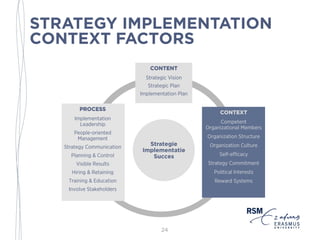
STRATEGY IMPLEMENTATION
CONTEXT FACTORS
24
Strategie
Implementatie
Succes
CONTENT
Strategic Vision
Strategic Plan
Implementation Plan
CONTEXT
Competent
Organizational Members
Organization Structure
Organization Culture
Self-efficacy
Strategy Commitment
Political Interests
Reward Systems
PROCESS
Implementation
Leadership
People-oriented
Management
Strategy Communication
Planning & Control
Visible Results
Hiring & Retaining
Training & Education
Involve Stakeholders
APPOINT COMPETENT
MANAGEMENT
♦ The presence of competent employees and especially
management is the most important success factor for
strategy implementation.
♦ Inadequate capabilities of managers are a common cause
of strategy implementation failure.
♦ When employees have little confidence in the ability of
management to execute the strategy then their
commitment to the strategy will be low.
♦ Having incompetent members within a team has a negative
influence on the performance of other team members.
♦ Successful organizational members tend to leave an
organization when they have to work for incompetent
managers and feel that their performance is not
appreciated or even worked against.
25
ALIGN STRUCTURE
TO STRATEGY
♦ Successful strategy implementation requires a clear,
decentralized and moderately formalized organization
structure that is aligned to the strategy.
♦ A decentralized structure increases commitment of
employees to decision-making, speed of decision-making,
and improves the quality of decisions using specialized
knowledge of employees at lower levels in the
organization.
♦ Individuals working in centralized organizations tend to
feel that management does not trust their skills and
abilities resulting in a sense of incompetence, reducing self-
determination and intrinsic motivation and performance.
♦ A moderately formalized structure with clear procedures,
rules and responsibilities gives employees certainty during
the implementation.
26
CREATE A SAFE
ORGANIZATION CULTURE
♦ As a new strategy may involve layoffs it can trigger intense
emotions such as anxiety and fear for job security among
organizational members.
♦ Job insecurity is related to lower job satisfaction, lower
organizational commitment, lower job involvement, increased
psychological withdrawal, greater resistance to change, greater
propensity to leave the organization, lower trust in
management and reduced work effort.
♦ Organizations with high levels of centralization, formalization
and rigid rules can create a culture characterized by fear for
making mistakes, responsibility, participation and change,
acting as major barriers to strategy implementation.
♦ Managers need to cultivate an empowering and fearless culture
in which employees dare to take initiative, voice their opinion
and not be afraid to make mistakes.
27
INCREASE SELF-EFFICACY OF
ORGANIZATIONAL MEMBERS
♦ When organizational members have high self-efficacy and
believe that they can perform the new implementation tasks
successfully, they are more likely to perform well.
♦ Another result of low self-efficacy may be that,
organizational members can become afraid to make
mistakes, take initiative, and participate in decision-making.
♦ Low self-efficacy can result from low self-confidence and
self-esteem, an authoritarian management style, and an
environment in which many things fail.
♦ Increase self-efficacy of employees through coaching and
counseling, rewarding performance, a people-oriented
management style and by creating an organizational culture
in which people are able to make mistakes and learn from
them.
28
SECURE COMMITMENT
TO THE STRATEGY
♦ Commitment to the strategy, especially by managers is
crucial to strategy implementation success.
♦ When organizational participants are committed to a
strategy and its implementation, they are more motivated
to implement the strategy and achieve its goals.
♦ Employees are likely to uncommitted to the strategy and
its execution because of the following reasons: feeling
uninformed, lack of communication and respect from
managers, negative disposition and lacking participation
in decision-making.
♦ Employee commitment can be secured by involving
employees in the strategy formulation and
implementation process and by clearly communicating
the strategy to them.
29
TAKE POLITICAL INTERESTS
INTO ACCOUNT
♦ Politics and struggles over power and leadership may
undermine an implementation effort.
♦ The existence of conflicts, and the use of individual and
group power needs to be taken into consideration
♦ Strategy formulation and implementation inevitably raise
questions of power within an organization. The very
prospect of change confronts established positions and
may lead to resistance to change.
♦ Resistance to change may lead to passivity toward the
strategy or even sabotage.
♦ Managers can overcome resistance to change by involving
potential opponents in decision-making, taking their
interests seriously and clearly communicating the new
strategy and its advantages to them.
30
REWARD PERFORMANCE AND
GIVE COMPLIMENTS
♦ Strategy implementation requires a reward system that
monitors the progress of the implementation and
demonstrates top management’s commitment to the
realization of the strategy.
♦ Reward systems are essential for motivating staff and
ensuring appropriate behavior in relation to the strategy.
♦ Rewarding implementation performance increases the
motivation and performance of organizational members.
♦ Informal rewards (pats on the back, a sense of pride,
enthusiasm) greatly increase the motivation, self-confidence
and performance of organizational members.
♦ Employees often do not get compliments when they perform
well but do get criticism when they make mistakes. This
greatly reduces the motivation, self-efficacy and
performance of organizational members.
31
CONCLUSIONS
♦ Strategy implementation success is determined by a
variety of factors related to its process, content, and
context.
♦ Successful strategy implementation requires a ‘fit’ or
‘alignment’ between its process, content and context.
♦ Every strategy implementation has an unique
constellation of factors that influence its performance.
♦ There is no ‘one best way’ to implement strategy.
♦ Soft factors such as people-oriented management are
often neglected but are crucial to implementation
success.
♦ Strategy formulation and implementation are an
integrated process.
32
THE AUTHOR
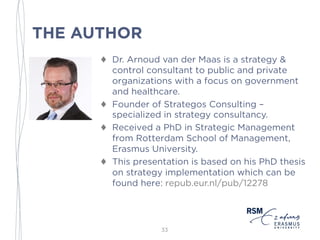
♦ Dr. Arnoud van der Maas is a strategy &
control consultant to public and private
organizations with a focus on government
and healthcare.
♦ Founder of Strataegos Consulting –
specialized in strategy consultancy.
♦ Received a PhD in Strategic Management
from Rotterdam School of Management,
Erasmus University.
♦ This presentation is based on his PhD thesis
on strategy implementation which can be
found here: repub.eur.nl/pub/12278
33

Presentation | PhD Thesis Strategy Implementation

  • 1.
  • 2.
    There is nothingmore difficult to take at hand, more perilous to conduct, or more uncertain in its success, than to take the lead in the introduction of a new order of things, because the innovator has for enemies all those who have done well under the old conditions, and lukewarm defenders in those who may do well under the new. (Machiavelli, 1512)
  • 3.
    STRATEGY IMPLEMENTATION AS COMPETITIVEADVANTAGE ♦ The successful implementation of strong and robust strategies gives any organization a significant competitive edge. ♦ In current turbulent environments, the ability to develop and implement new strategies quickly and effectively may well mean the difference between success and failure for organizations. ♦ Well-formulated strategies only produce superior performance for organizations when they are successfully implemented. ♦ Even the best-made strategies are worthless if they cannot be successfully implemented. 3
  • 4.
    THE MAJORITY OFSTRATEGY IMPLEMENTATIONS FAIL ♦ For decades survey after survey reveal that most strategy implementations fail. ♦ Fewer than 15 percent of organizations around the world report that they are successful at strategy implementation. ♦ Many organizations have a fundamental disconnect between the formulation of their strategy and the implementation of that strategy into useful action. ♦ The majority of strategies fail in the strategy implementation phase. 4
  • 5.
    THE STRATEGY IMPLEMENTATION PROBLEM ♦After a comprehensive strategy has been formulated, significant difficulties are often encountered during the following implementation process. ♦ The strategy implementation problem: the all too frequent failure to create change after seemingly viable strategic plans have been developed. ♦ Achieving successful implementation remains a continuing challenge for managers responsible for executing strategies. ♦ Survey after survey reveals that strategy implementation is a top priority for executives. 5
  • 6.
    STRATEGY IMPLEMENTATION RESEARCH REMAINSLIMITED ♦ Strategy implementation receives limited research attention despite its apparent importance. ♦ The field of strategic management has traditionally focused on strategy formulation while the real challenge lies in strategy implementation. ♦ The common view on strategy implementation is that it is a relatively straightforward operationalization of a clearly articulated strategic plan. ♦ Strategy formulation tends to be seen as a glamorous intellectual and creative act and implementation as a hands-on and action oriented activity which requires leadership and managerial skills. 6
  • 7.
    PERSPECTIVES ON STRATEGY IMPLEMENTATION ♦There is no universally accepted definition of strategy implementation. ♦ Hard or rational versus soft or behavioral aspects of strategy implementation. ♦ The separation of strategy formulation and strategy implementation ♦ Planned versus emergent strategy implementation. ♦ Top-down versus bottom-up strategy formation. ♦ External versus internal implementation control. ♦ Incremental versus radical strategy implementation. 7
  • 8.
    RESEARCH QUESTION AND METHODOLOGY RESEARCHQUESTION ♦ What factors influence strategy implementation performance? RESEARCH METHODOLOGY ♦ Qualitative survey with semi-structured interviews. ♦ 55 executives with implementation responsibilities. ♦ Selection of 44 public and private organizations. ♦ 33 strategy implementations projects investigated. ♦ A wide variety of organizations surveyed. ♦ Grounded Theory data analysis. 8
  • 9.
    STRATEGY IMPLEMENTATION PROCESS, CONTENT,CONTEXT ♦ Strategy implementation can only be understood and managed by merging process, content and context into a 3-dimensional view of strategy implementation (Pettigrew, 1985). ♦ Process refers to the ‘how’ or manner in which the strategy is implemented. ♦ Context refers to the ‘where’ or the circumstances under which the strategy implementation is taking place. ♦ Content refers to the ‘what’ or the product of the strategy implementation. 9
  • 10.
  • 11.
    STRATEGY IMPLEMENTATION CONTENT FACTORS 11 Strategie Implementatie Succes CONTENT StrategicVision Strategic Plan Implementation Plan CONTEXT Competent Organizational Members Organization Structure Organization Culture Self-efficacy Strategy Commitment Political Interests Reward Systems PROCESS Implementation Leadership People-oriented Management Strategy Communication Planning & Control Visible Results Hiring & Retaining Training & Education Involve Stakeholders
  • 12.
    FORMULATE AN ATTRACTIVE STRATEGICVISION ♦ Successful strategy formulation and implementation begins with formulating a sound and clear strategic vision by top management. ♦ The strategic vision describes the desired future state of the organization and helps clarify the direction in which an organization is to move. ♦ The strategic vision needs to be attractive and easy to communicate toward organizational members, customers and other stakeholders. ♦ A clear and attractive strategic vision increases the confidence of employees in a successful outcome of the implementation effort. 12
  • 13.
    DEVELOP A SOUNDAND CLEAR STRATEGY ♦ Develop a strategy that is able to achieve the strategic vision. ♦ A strategy is a combination of the goals the firm is and the means by which it seeks to achieve them. ♦ The strategy needs to be realistic, based on a sound idea and be well thought out. ♦ No implementation can save a strategy, which is not feasible or sound to begin with. ♦ Discuss the strategy with managers and employees to assess whether it is sound, realistic and feasible. ♦ The strategy needs to be easy to understand for employees and stakeholders. 13
  • 14.
    TRANSLATE THE STRATEGY INTOIMPLEMENTATION PLAN ♦ The implementation plan specifies the processes, activities and operational objectives that are required to achieve the goals of the strategy. ♦ Translate the strategic objectives into measurable operational implementation objectives linked to departmental and individual goals. ♦ Effective strategy implementation requires clear implementation tasks, activities and responsibilities. ♦ By allocating clear responsibilities for the execution of the implementation activities, progress can be measured and controlled. ♦ Specific and ambitious but realistic goals that are accepted by organizational members lead to the best task performance. 14
  • 15.
    STRATEGY IMPLEMENTATION PROCESS FACTORS 15 Strategie Implementatie Succes CONTENT StrategicVision Strategic Plan Implementation Plan CONTEXT Competent Organizational Members Organization Structure Organization Culture Self-efficacy Strategy Commitment Political Interests Reward Systems PROCESS Implementation Leadership People-oriented Management Strategy Communication Planning & Control Visible Results Hiring & Retaining Training & Education Involve Stakeholders
  • 16.
    APPOINT A STRATEGY IMPLEMENTATIONLEADER ♦ Successful strategy implementation requires one board member who is responsible for the outcome of the implementation. ♦ The implementation leader is responsible for articulating and communicating an attractive strategic vision that guides the strategy implementation. ♦ A successful leader inspires followers through the communication of a captivating vision designed to motivate followers to ambitious goals. ♦ When leaders practice moral virtues such as fairness, integrity, honesty, loyalty, determination, courage and responsibility increases the willingness of followers to follow the leader. 16
  • 17.
    USE A PEOPLE-ORIENTED MANAGEMENTSTYLE ♦ Having a people-oriented management style is a key practice for successful implementation. ♦ As individuals go to work for both instrumental and social reasons, managers need to pay attention to both task performance and social relationships. ♦ Better social relations increase the cooperation, motivation, and effectiveness of organizational members. ♦ A relationship-oriented manager listens, provides support and encouragement, coaching and counseling, develops social relations with subordinates, celebrates social activities and empowers organizational members during a strategy implementation effort. 17
  • 18.
    COMMUNICATE THE STRATEGY ♦No less than 95 percent of organizational members do not understand the strategy of their own organization. ♦ The objective is to make organizational members understand what the strategy is all about and what its goals are. ♦ The strategy needs to be clearly explained in a way that employees understand and may become convinced that the strategy is sound and effective. ♦ Organizational members are more willing to accept undesirable decisions when they have received clear and adequate explanations for those decision. ♦ It is not only important to communicate the strategy to the people but it is also important to listen to their reactions to the strategy. 18
  • 19.
    MONITOR AND ADAPT THESTRATEGY ♦ As execution plans are destined to change, implementation teams need to regularly meet in well-structured sessions to share information, reconfirm priorities and make adjustments when objectives are not being met. ♦ Many organizations have accountability problems resulting from lack of planning, absence of a functional management information system, or cultural values which do not encourage holding persons, especially in high positions, accountable. ♦ When objectives are not being met the assumptions underlying the strategy may be flawed or obsolete. When this happens it needs to be decided whether incremental improvements will suffice or that a new strategy is required. 19
  • 20.
    ACHIEVE AND CELEBRATE VISIBLERESULTS ♦ Achieving visible improvements in performance, especially in the beginning of the strategy implementation (quick wins) increases the motivation and commitment of organizational members. ♦ People are more inclined to accept new things when they see that these things work and lead to results. ♦ During the strategy implementation it is important to make change visible to organization. By making change visible (such as new logo, uniforms and offices) management van show the organization that they are committed to the strategy and things are really changing. ♦ Achieving results is even more important when the company is in crisis and short-term results are needed to let employees regain confidence. 20
  • 21.
    HIRE, RETAIN ANDFIRE ORGANIZATIONAL MEMBERS ♦ Recruitment, promotion and demotion must provide the organizational members who have the required skills and attitude to successfully implement the new strategy. ♦ Especially when an organization aims for radical change, new employees and especially managers are required to achieve it. ♦ It can be necessary to demote or lay off employees who do not have the required skills and attitude to implement the strategy. Some organizational members may have to be removed to show that resistance to change is not tolerated. ♦ Laying off employees needs to be done with great hesitation and prudence as it can result in reduced work motivation and task performance of survivors. ♦ It is crucial that layoffs are done in a way which is perceived fair by employees. Otherwise layoffs reduce motivation and performance of survivors. 21
  • 22.
    TRAIN AND DEVELOP MANAGERSAND EMPLOYEES ♦ Training and education of organizational members is a important lever for strategy implementation. Adequately trained staff is one of the most critical steps top management can take to ensure successful strategy implementation. ♦ Implementing a new strategy often requires new activities and ways of thinking, which can be learned by training and educating employees. ♦ Training and education improves employee knowledge and skills, self-confidence and makes them perform better. ♦ Training and education can consist of courses, collective classes, (on-the-job) training, and individual guidance and coaching. 22
  • 23.
    INVOLVE EMPLOYEES AND STAKEHOLDERS ♦A strategy that is developed and implemented without the involvement of relevant employees is likely to be resisted during implementation by the affected employees. ♦ A strategy formulated without much employee involvement is more likely to have major flaws. ♦ Involving stakeholders such as middle managers, employees, customers may increase their commitment to the strategy. ♦ When employees feel that they have significant input in the strategy and see that certain ideas of their own are part of the strategy they tend to be very committed to that strategy. ♦ Participation allows management to tap into the specialized knowledge of lower-level employees. This can improve the strategy and its execution. 23
  • 24.
    STRATEGY IMPLEMENTATION CONTEXT FACTORS 24 Strategie Implementatie Succes CONTENT StrategicVision Strategic Plan Implementation Plan CONTEXT Competent Organizational Members Organization Structure Organization Culture Self-efficacy Strategy Commitment Political Interests Reward Systems PROCESS Implementation Leadership People-oriented Management Strategy Communication Planning & Control Visible Results Hiring & Retaining Training & Education Involve Stakeholders
  • 25.
    APPOINT COMPETENT MANAGEMENT ♦ Thepresence of competent employees and especially management is the most important success factor for strategy implementation. ♦ Inadequate capabilities of managers are a common cause of strategy implementation failure. ♦ When employees have little confidence in the ability of management to execute the strategy then their commitment to the strategy will be low. ♦ Having incompetent members within a team has a negative influence on the performance of other team members. ♦ Successful organizational members tend to leave an organization when they have to work for incompetent managers and feel that their performance is not appreciated or even worked against. 25
  • 26.
    ALIGN STRUCTURE TO STRATEGY ♦Successful strategy implementation requires a clear, decentralized and moderately formalized organization structure that is aligned to the strategy. ♦ A decentralized structure increases commitment of employees to decision-making, speed of decision-making, and improves the quality of decisions using specialized knowledge of employees at lower levels in the organization. ♦ Individuals working in centralized organizations tend to feel that management does not trust their skills and abilities resulting in a sense of incompetence, reducing self- determination and intrinsic motivation and performance. ♦ A moderately formalized structure with clear procedures, rules and responsibilities gives employees certainty during the implementation. 26
  • 27.
    CREATE A SAFE ORGANIZATIONCULTURE ♦ As a new strategy may involve layoffs it can trigger intense emotions such as anxiety and fear for job security among organizational members. ♦ Job insecurity is related to lower job satisfaction, lower organizational commitment, lower job involvement, increased psychological withdrawal, greater resistance to change, greater propensity to leave the organization, lower trust in management and reduced work effort. ♦ Organizations with high levels of centralization, formalization and rigid rules can create a culture characterized by fear for making mistakes, responsibility, participation and change, acting as major barriers to strategy implementation. ♦ Managers need to cultivate an empowering and fearless culture in which employees dare to take initiative, voice their opinion and not be afraid to make mistakes. 27
  • 28.
    INCREASE SELF-EFFICACY OF ORGANIZATIONALMEMBERS ♦ When organizational members have high self-efficacy and believe that they can perform the new implementation tasks successfully, they are more likely to perform well. ♦ Another result of low self-efficacy may be that, organizational members can become afraid to make mistakes, take initiative, and participate in decision-making. ♦ Low self-efficacy can result from low self-confidence and self-esteem, an authoritarian management style, and an environment in which many things fail. ♦ Increase self-efficacy of employees through coaching and counseling, rewarding performance, a people-oriented management style and by creating an organizational culture in which people are able to make mistakes and learn from them. 28
  • 29.
    SECURE COMMITMENT TO THESTRATEGY ♦ Commitment to the strategy, especially by managers is crucial to strategy implementation success. ♦ When organizational participants are committed to a strategy and its implementation, they are more motivated to implement the strategy and achieve its goals. ♦ Employees are likely to uncommitted to the strategy and its execution because of the following reasons: feeling uninformed, lack of communication and respect from managers, negative disposition and lacking participation in decision-making. ♦ Employee commitment can be secured by involving employees in the strategy formulation and implementation process and by clearly communicating the strategy to them. 29
  • 30.
    TAKE POLITICAL INTERESTS INTOACCOUNT ♦ Politics and struggles over power and leadership may undermine an implementation effort. ♦ The existence of conflicts, and the use of individual and group power needs to be taken into consideration ♦ Strategy formulation and implementation inevitably raise questions of power within an organization. The very prospect of change confronts established positions and may lead to resistance to change. ♦ Resistance to change may lead to passivity toward the strategy or even sabotage. ♦ Managers can overcome resistance to change by involving potential opponents in decision-making, taking their interests seriously and clearly communicating the new strategy and its advantages to them. 30
  • 31.
    REWARD PERFORMANCE AND GIVECOMPLIMENTS ♦ Strategy implementation requires a reward system that monitors the progress of the implementation and demonstrates top management’s commitment to the realization of the strategy. ♦ Reward systems are essential for motivating staff and ensuring appropriate behavior in relation to the strategy. ♦ Rewarding implementation performance increases the motivation and performance of organizational members. ♦ Informal rewards (pats on the back, a sense of pride, enthusiasm) greatly increase the motivation, self-confidence and performance of organizational members. ♦ Employees often do not get compliments when they perform well but do get criticism when they make mistakes. This greatly reduces the motivation, self-efficacy and performance of organizational members. 31
  • 32.
    CONCLUSIONS ♦ Strategy implementationsuccess is determined by a variety of factors related to its process, content, and context. ♦ Successful strategy implementation requires a ‘fit’ or ‘alignment’ between its process, content and context. ♦ Every strategy implementation has an unique constellation of factors that influence its performance. ♦ There is no ‘one best way’ to implement strategy. ♦ Soft factors such as people-oriented management are often neglected but are crucial to implementation success. ♦ Strategy formulation and implementation are an integrated process. 32
  • 33.
    THE AUTHOR ♦ Dr.Arnoud van der Maas is a strategy & control consultant to public and private organizations with a focus on government and healthcare. ♦ Founder of Strataegos Consulting – specialized in strategy consultancy. ♦ Received a PhD in Strategic Management from Rotterdam School of Management, Erasmus University. ♦ This presentation is based on his PhD thesis on strategy implementation which can be found here: repub.eur.nl/pub/12278 33