Presentation by Charlene Lourdes S. Llana
Subject: MPA 210- Strategic Planning Management
Prof: Josefina B. Bitonio, DPA
• POLICY AND STRATEGY
FORMULATION
• PROGRAM/PROJECT
IMPLEMENTATION
POLICY AND
STRATEGY
FORMULATION
WHAT IS POLICY?
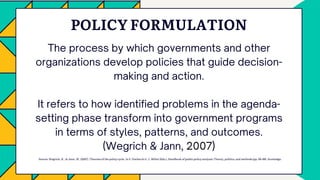
POLICY FORMULATION
Source: Wegrich, K., & Jann, W. (2007). Theories of the policy cycle. In F. Fischer & G. J. Miller (Eds.), Handbook of public policy analysis: Theory, politics, and methods (pp. 69–88). Routledge.
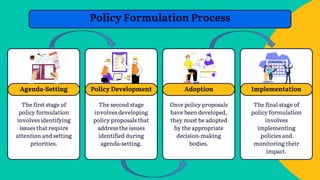
Agenda-Setting
The first stage of
policy formulation
involves identifying
issues that require
attention and setting
priorities.
Policy Formulation Process
Policy Development
The second stage
involves developing
policy proposals that
address the issues
identified during
agenda-setting.
Adoption
Once policy proposals
have been developed,
they must be adopted
by the appropriate
decision-making
bodies.
The final stage of
policy formulation
involves
implementing
policies and
monitoring their
impact.
Implementation
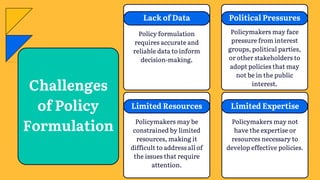
Lack of Data
Policy formulation
requires accurate and
reliable data to inform
decision-making.
Challenges
of Policy
Formulation
Policymakers may face
pressure from interest
groups, political parties,
or other stakeholders to
adopt policies that may
not be in the public
interest.
Political Pressures
Limited Resources
Policymakers may be
constrained by limited
resources, making it
difficult to address all of
the issues that require
attention.
Limited Expertise
Policymakers may not
have the expertise or
resources necessary to
develop effective policies.
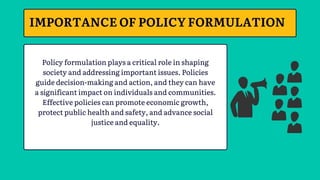
Policy formulation plays a critical role in shaping
society and addressing important issues. Policies
guide decision-making and action, and they can have
a significant impact on individuals and communities.
Effective policies can promote economic growth,
protect public health and safety, and advance social
justice and equality.
IMPORTANCE OF POLICY FORMULATION
WHAT IS STRATEGY?
The process of using available knowledge
to document the intended direction of a
business and the actionable steps to reach
its goals.
This process is used for resource
allocation, prioritization, organization-
wide alignment, and validation of
business goals.
STRATEGY
FORMULATION
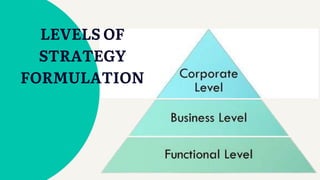
LEVELS OF
STRATEGY
FORMULATION
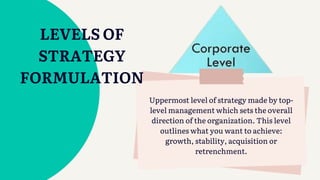
LEVELS OF
STRATEGY
FORMULATION
Uppermost level of strategy made by top-
level management which sets the overall
direction of the organization. This level
outlines what you want to achieve:
growth, stability, acquisition or
retrenchment.
LEVELS OF
STRATEGY
FORMULATION
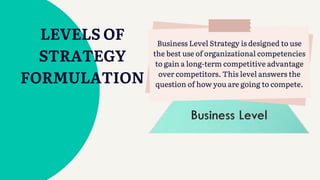
Business Level Strategy is designed to use
the best use of organizational competencies
to gain a long-term competitive advantage
over competitors. This level answers the
question of how you are going to compete.
LEVELS OF
STRATEGY
FORMULATION
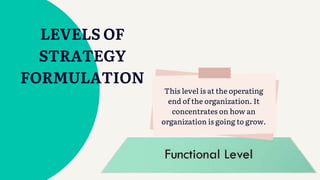
This level is at the operating
end of the organization. It
concentrates on how an
organization is going to grow.
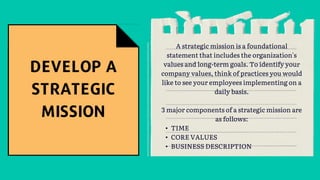
A strategic mission is a foundational
statement that includes the organization's
values and long-term goals. To identify your
company values, think of practices you would
like to see your employees implementing on a
daily basis.
3 major components of a strategic mission are
as follows:
• TIME
• CORE VALUES
• BUSINESS DESCRIPTION
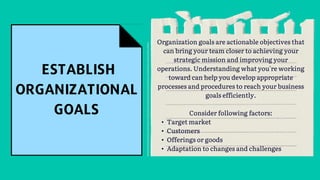
Organization goals are actionable objectives that
can bring your team closer to achieving your
strategic mission and improving your
operations. Understanding what you're working
toward can help you develop appropriate
processes and procedures to reach your business
goals efficiently.
Consider following factors:
• Target market
• Customers
• Offerings or goods
• Adaptation to changes and challenges
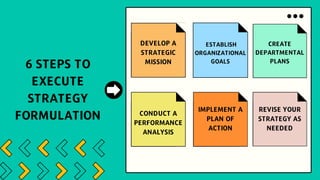
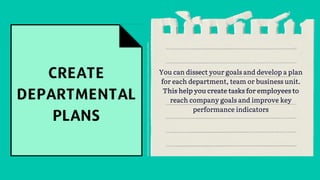
You can dissect your goals and develop a plan
for each department, team or business unit.
This help you create tasks for employees to
reach company goals and improve key
performance indicators
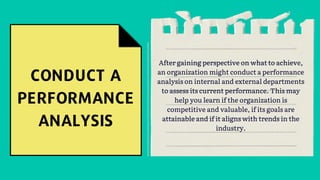
After gaining perspective on what to achieve,
an organization might conduct a performance
analysis on internal and external departments
to assess its current performance. This may
help you learn if the organization is
competitive and valuable, if its goals are
attainable and if it aligns with trends in the
industry.
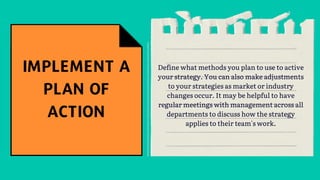
Define what methods you plan to use to active
your strategy. You can also make adjustments
to your strategies as market or industry
changes occur. It may be helpful to have
regular meetings with management across all
departments to discuss how the strategy
applies to their team's work.
As you implement a new strategy to reach
organizational goals, be sure to monitor your
progress and consistently conduct analyses to
evaluate the effectiveness of a strategy. Using
metrics to evaluate the results of your strategy
may help you make objective, data-backed
decisions.
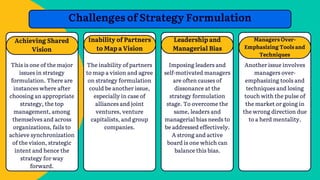
Challenges of Strategy Formulation
Inability of Partners
to Map a Vision
Leadership and
Managerial Bias
Managers Over-
Emphasizing Tools and
Techniques
The inability of partners
to map a vision and agree
on strategy formulation
could be another issue,
especially in case of
alliances and joint
ventures, venture
capitalists, and group
companies.
Imposing leaders and
self-motivated managers
are often causes of
dissonance at the
strategy formulation
stage. To overcome the
same, leaders and
managerial bias needs to
be addressed effectively.
A strong and active
board is one which can
balance this bias.
Another issue involves
managers over-
emphasizing tools and
techniques and losing
touch with the pulse of
the market or going in
the wrong direction due
to a herd mentality.
Achieving Shared
Vision
This is one of the major
issues in strategy
formulation. There are
instances where after
choosing an appropriate
strategy, the top
management, among
themselves and across
organizations, fails to
achieve synchronization
of the vision, strategic
intent and hence the
strategy for way
forward.
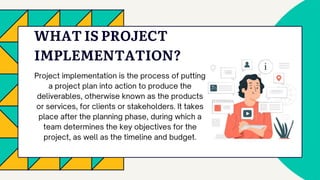
WHAT IS PROJECT
IMPLEMENTATION?
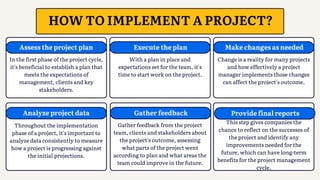
Assess the project plan
In the first phase of the project cycle,
it's beneficial to establish a plan that
meets the expectations of
management, clients and key
stakeholders.
HOW TO IMPLEMENT A PROJECT?
Execute the plan
With a plan in place and
expectations set for the team, it's
time to start work on the project.
Make changes as needed
Change is a reality for many projects
and how effectively a project
manager implements those changes
can affect the project's outcome.
Analyze project data
Throughout the implementation
phase of a project, it's important to
analyze data consistently to measure
how a project is progressing against
the initial projections.
Gather feedback
Gather feedback from the project
team, clients and stakeholders about
the project's outcome, assessing
what parts of the project went
according to plan and what areas the
team could improve in the future.
Provide final reports
This step gives companies the
chance to reflect on the successes of
the project and identify any
improvements needed for the
future, which can have long-term
benefits for the project management
cycle.
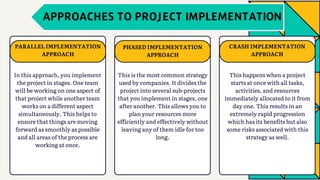
PARALLEL IMPLEMENTATION
APPROACH
In this approach, you implement
the project in stages. One team
will be working on one aspect of
that project while another team
works on a different aspect
simultaneously. This helps to
ensure that things are moving
forward as smoothly as possible
and all areas of the process are
working at once.
PHASED IMPLEMENTATION
APPROACH
This is the most common strategy
used by companies. It divides the
project into several sub-projects
that you implement in stages, one
after another. This allows you to
plan your resources more
efficiently and effectively without
leaving any of them idle for too
long.
CRASH IMPLEMENTATION
APPROACH
This happens when a project
starts at once with all tasks,
activities, and resources
immediately allocated to it from
day one. This results in an
extremely rapid progression
which has its benefits but also
some risks associated with this
strategy as well.
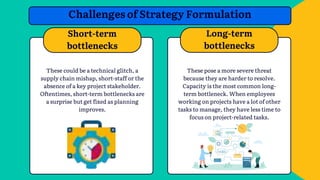
Short-term
bottlenecks
These could be a technical glitch, a
supply chain mishap, short-staff or the
absence of a key project stakeholder.
Oftentimes, short-term bottlenecks are
a surprise but get fixed as planning
improves.
Challenges of Strategy Formulation
Long-term
bottlenecks
These pose a more severe threat
because they are harder to resolve.
Capacity is the most common long-
term bottleneck. When employees
working on projects have a lot of other
tasks to manage, they have less time to
focus on project-related tasks.
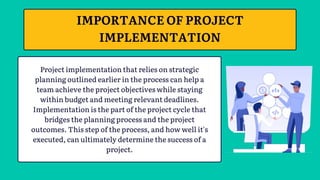
Project implementation that relies on strategic
planning outlined earlier in the process can help a
team achieve the project objectives while staying
within budget and meeting relevant deadlines.
Implementation is the part of the project cycle that
bridges the planning process and the project
outcomes. This step of the process, and how well it's
executed, can ultimately determine the success of a
project.
IMPORTANCE OF PROJECT
IMPLEMENTATION
Image Source: https://twitter.com/USTCSS/status/1445252443311251458
References:
•
•
•
•
•
•
•
•
•
•
Lec : Policy & Strategy Formulation.pptx

Lec : Policy & Strategy Formulation.pptx

  • 1.
    Presentation by CharleneLourdes S. Llana Subject: MPA 210- Strategic Planning Management Prof: Josefina B. Bitonio, DPA • POLICY AND STRATEGY FORMULATION • PROGRAM/PROJECT IMPLEMENTATION
  • 2.
  • 3.
  • 4.
    POLICY FORMULATION Source: Wegrich,K., & Jann, W. (2007). Theories of the policy cycle. In F. Fischer & G. J. Miller (Eds.), Handbook of public policy analysis: Theory, politics, and methods (pp. 69–88). Routledge.
  • 5.
    Agenda-Setting The first stageof policy formulation involves identifying issues that require attention and setting priorities. Policy Formulation Process Policy Development The second stage involves developing policy proposals that address the issues identified during agenda-setting. Adoption Once policy proposals have been developed, they must be adopted by the appropriate decision-making bodies. The final stage of policy formulation involves implementing policies and monitoring their impact. Implementation
  • 6.
    Lack of Data Policyformulation requires accurate and reliable data to inform decision-making. Challenges of Policy Formulation Policymakers may face pressure from interest groups, political parties, or other stakeholders to adopt policies that may not be in the public interest. Political Pressures Limited Resources Policymakers may be constrained by limited resources, making it difficult to address all of the issues that require attention. Limited Expertise Policymakers may not have the expertise or resources necessary to develop effective policies.
  • 7.
    Policy formulation playsa critical role in shaping society and addressing important issues. Policies guide decision-making and action, and they can have a significant impact on individuals and communities. Effective policies can promote economic growth, protect public health and safety, and advance social justice and equality. IMPORTANCE OF POLICY FORMULATION
  • 8.
  • 9.
    The process ofusing available knowledge to document the intended direction of a business and the actionable steps to reach its goals. This process is used for resource allocation, prioritization, organization- wide alignment, and validation of business goals. STRATEGY FORMULATION
  • 10.
  • 11.
    LEVELS OF STRATEGY FORMULATION Uppermost levelof strategy made by top- level management which sets the overall direction of the organization. This level outlines what you want to achieve: growth, stability, acquisition or retrenchment.
  • 12.
    LEVELS OF STRATEGY FORMULATION Business LevelStrategy is designed to use the best use of organizational competencies to gain a long-term competitive advantage over competitors. This level answers the question of how you are going to compete.
  • 13.
    LEVELS OF STRATEGY FORMULATION This levelis at the operating end of the organization. It concentrates on how an organization is going to grow.
  • 15.
    A strategic missionis a foundational statement that includes the organization's values and long-term goals. To identify your company values, think of practices you would like to see your employees implementing on a daily basis. 3 major components of a strategic mission are as follows: • TIME • CORE VALUES • BUSINESS DESCRIPTION
  • 16.
    Organization goals areactionable objectives that can bring your team closer to achieving your strategic mission and improving your operations. Understanding what you're working toward can help you develop appropriate processes and procedures to reach your business goals efficiently. Consider following factors: • Target market • Customers • Offerings or goods • Adaptation to changes and challenges
  • 17.
    You can dissectyour goals and develop a plan for each department, team or business unit. This help you create tasks for employees to reach company goals and improve key performance indicators
  • 18.
    After gaining perspectiveon what to achieve, an organization might conduct a performance analysis on internal and external departments to assess its current performance. This may help you learn if the organization is competitive and valuable, if its goals are attainable and if it aligns with trends in the industry.
  • 19.
    Define what methodsyou plan to use to active your strategy. You can also make adjustments to your strategies as market or industry changes occur. It may be helpful to have regular meetings with management across all departments to discuss how the strategy applies to their team's work.
  • 20.
    As you implementa new strategy to reach organizational goals, be sure to monitor your progress and consistently conduct analyses to evaluate the effectiveness of a strategy. Using metrics to evaluate the results of your strategy may help you make objective, data-backed decisions.
  • 21.
    Challenges of StrategyFormulation Inability of Partners to Map a Vision Leadership and Managerial Bias Managers Over- Emphasizing Tools and Techniques The inability of partners to map a vision and agree on strategy formulation could be another issue, especially in case of alliances and joint ventures, venture capitalists, and group companies. Imposing leaders and self-motivated managers are often causes of dissonance at the strategy formulation stage. To overcome the same, leaders and managerial bias needs to be addressed effectively. A strong and active board is one which can balance this bias. Another issue involves managers over- emphasizing tools and techniques and losing touch with the pulse of the market or going in the wrong direction due to a herd mentality. Achieving Shared Vision This is one of the major issues in strategy formulation. There are instances where after choosing an appropriate strategy, the top management, among themselves and across organizations, fails to achieve synchronization of the vision, strategic intent and hence the strategy for way forward.
  • 22.
  • 23.
    Assess the projectplan In the first phase of the project cycle, it's beneficial to establish a plan that meets the expectations of management, clients and key stakeholders. HOW TO IMPLEMENT A PROJECT? Execute the plan With a plan in place and expectations set for the team, it's time to start work on the project. Make changes as needed Change is a reality for many projects and how effectively a project manager implements those changes can affect the project's outcome. Analyze project data Throughout the implementation phase of a project, it's important to analyze data consistently to measure how a project is progressing against the initial projections. Gather feedback Gather feedback from the project team, clients and stakeholders about the project's outcome, assessing what parts of the project went according to plan and what areas the team could improve in the future. Provide final reports This step gives companies the chance to reflect on the successes of the project and identify any improvements needed for the future, which can have long-term benefits for the project management cycle.
  • 24.
    PARALLEL IMPLEMENTATION APPROACH In thisapproach, you implement the project in stages. One team will be working on one aspect of that project while another team works on a different aspect simultaneously. This helps to ensure that things are moving forward as smoothly as possible and all areas of the process are working at once. PHASED IMPLEMENTATION APPROACH This is the most common strategy used by companies. It divides the project into several sub-projects that you implement in stages, one after another. This allows you to plan your resources more efficiently and effectively without leaving any of them idle for too long. CRASH IMPLEMENTATION APPROACH This happens when a project starts at once with all tasks, activities, and resources immediately allocated to it from day one. This results in an extremely rapid progression which has its benefits but also some risks associated with this strategy as well.
  • 25.
    Short-term bottlenecks These could bea technical glitch, a supply chain mishap, short-staff or the absence of a key project stakeholder. Oftentimes, short-term bottlenecks are a surprise but get fixed as planning improves. Challenges of Strategy Formulation Long-term bottlenecks These pose a more severe threat because they are harder to resolve. Capacity is the most common long- term bottleneck. When employees working on projects have a lot of other tasks to manage, they have less time to focus on project-related tasks.
  • 26.
    Project implementation thatrelies on strategic planning outlined earlier in the process can help a team achieve the project objectives while staying within budget and meeting relevant deadlines. Implementation is the part of the project cycle that bridges the planning process and the project outcomes. This step of the process, and how well it's executed, can ultimately determine the success of a project. IMPORTANCE OF PROJECT IMPLEMENTATION
  • 27.
  • 28.