Strategic Management
Implementation
Strategic
Translating strategy into action
FUENTES, RODRIGUEZ
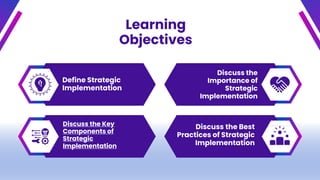
Learning
Objectives
Define Strategic
Implementation
Discuss the
Importance of
Strategic
Implementation
Discuss the Best
Practices of Strategic
Implementation
Discuss the Key
Components of
Strategic
Implementation
Strategic implementation involves translating
plans into action through a defined strategy,
necessitating meticulous planning and adept
project management abilities. It emphasizes
factors like timing, quality, quantity, and
information management.
Introduction
Definition of Strategic
Implementation
MICHAEL PORTER
Strategic implementation is the execution phase of
strategic management, where the formulated strategies
are translated into concrete actions and initiatives. It
encompasses the deployment of resources, management
of organizational capabilities, and adaptation to
changing market conditions to achieve competitive
advantage and deliver superior performance.
Definition of Strategic
Implementation
PETER DRUCKER
Strategic implementation is the process of converting
strategic objectives into action plans, allocating resources,
and guiding organizational activities to achieve the desired
outcomes. It involves aligning the organization's structure,
systems, and processes with the strategic goals to ensure
effective execution.
Definition of Strategic
Implementation
GARY HAMEL
Strategic implementation means continuously striving to
achieve strategic goals through disciplined execution and
ongoing improvement. It includes empowering staff,
promoting innovation, and establishing agile processes to
adapt to changing markets. Success hinges on robust
leadership, effective communication, and an unwavering
dedication to customer value.
Understanding Strategic Implementation
Key elements include clear communication, strong leadership, and
continuous monitoring and adaptation. Successful implementation
ensures that goals are achieved efficiently and effectively.
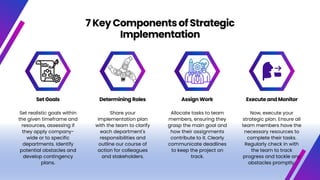
7 Key Componentsof Strategic
Implementation
Set Goals Determining Roles Assign Work Execute and Monitor
Set realistic goals within
the given timeframe and
resources, assessing if
they apply company-
wide or to specific
departments. Identify
potential obstacles and
develop contingency
plans.
Share your
implementation plan
with the team to clarify
each department's
responsibilities and
outline our course of
action for colleagues
and stakeholders.
Allocate tasks to team
members, ensuring they
grasp the main goal and
how their assignments
contribute to it. Clearly
communicate deadlines
to keep the project on
track.
Now, execute your
strategic plan. Ensure all
team members have the
necessary resources to
complete their tasks.
Regularly check in with
the team to track
progress and tackle any
obstacles promptly.
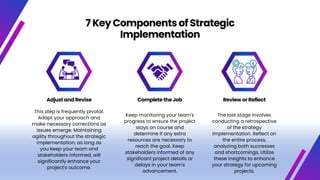
7 Key Componentsof Strategic
Implementation
Adjust and Revise Complete the Job Review or Reflect
This step is frequently pivotal.
Adapt your approach and
make necessary corrections as
issues emerge. Maintaining
agility throughout the strategic
implementation, as long as
you keep your team and
stakeholders informed, will
significantly enhance your
project's outcome.
Keep monitoring your team's
progress to ensure the project
stays on course and
determine if any extra
resources are necessary to
reach the goal. Keep
stakeholders informed of any
significant project details or
delays in your team's
advancement.
The last stage involves
conducting a retrospective
of the strategy
implementation. Reflect on
the entire process,
analyzing both successes
and shortcomings. Utilize
these insights to enhance
your strategy for upcoming
projects.
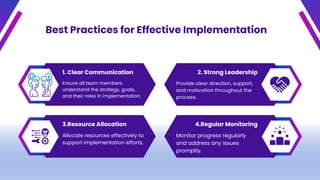
Best Practices for Effective Implementation
1. Clear Communication 2. Strong Leadership
3.Resource Allocation 4.Regular Monitoring
Ensure all team members
understand the strategy, goals,
and their roles in implementation.
Provide clear direction, support,
and motivation throughout the
process.
Allocate resources effectively to
support implementation efforts.
Monitor progress regularly
and address any issues
promptly.
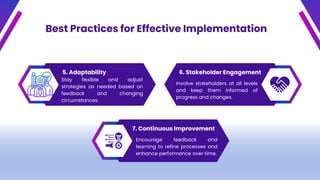
Best Practices for Effective Implementation
5. Adaptability 6. Stakeholder Engagement
7. Continuous Improvement
Stay flexible and adjust
strategies as needed based on
feedback and changing
circumstances.
Involve stakeholders at all levels
and keep them informed of
progress and changes.
Encourage feedback and
learning to refine processes and
enhance performance over time.
EXAMPLES
Launch ofthe
iPhone in 2007
Amazon’s
implementation
of Amazon Prime
Toyota’s
implementation
of the Toyota
Production
System (TPS)
EXAMPLES
McDonnald’s
Expansion and
Localized Efforts
Google’s
diversified
product
portfolio
and
innovation
Understanding strategic implementation is crucial
for effective goal achievement in organizations. It
entails translating strategies into actionable plans,
ensuring alignment across all levels, and fostering
a supportive environment. By following outlined
steps and best practices, organizations can
navigate complexities, driving sustainable growth.
With a clear understanding and commitment to
improvement, they can thrive in today's business
landscape.
Conclusion
Resources
INTERNET:
https://www.simplilearn.com/strategic-implementation-process-article
https://www.studysmarter.co.uk/explanations/business-
studies/change-management/strategic-
implementation/#:~:text=Strategic%20implementation%20is%20a%20pro
cess,defined%20plan%20of%20strategic%20implementation.
BOOKS:
“Management, Tasks, Responsibilities, Practices” by Peter Drucker
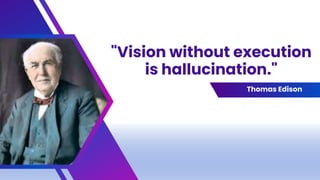
"Vision without execution
is hallucination."
Thomas Edison
F o r Y o u r A t t e n t i o n
Thank You

Strategic Management Strategic Implementation Presentation for Reporting.pptx

  • 1.
  • 2.
    Learning Objectives Define Strategic Implementation Discuss the Importanceof Strategic Implementation Discuss the Best Practices of Strategic Implementation Discuss the Key Components of Strategic Implementation
  • 3.
    Strategic implementation involvestranslating plans into action through a defined strategy, necessitating meticulous planning and adept project management abilities. It emphasizes factors like timing, quality, quantity, and information management. Introduction
  • 4.
    Definition of Strategic Implementation MICHAELPORTER Strategic implementation is the execution phase of strategic management, where the formulated strategies are translated into concrete actions and initiatives. It encompasses the deployment of resources, management of organizational capabilities, and adaptation to changing market conditions to achieve competitive advantage and deliver superior performance.
  • 5.
    Definition of Strategic Implementation PETERDRUCKER Strategic implementation is the process of converting strategic objectives into action plans, allocating resources, and guiding organizational activities to achieve the desired outcomes. It involves aligning the organization's structure, systems, and processes with the strategic goals to ensure effective execution.
  • 6.
    Definition of Strategic Implementation GARYHAMEL Strategic implementation means continuously striving to achieve strategic goals through disciplined execution and ongoing improvement. It includes empowering staff, promoting innovation, and establishing agile processes to adapt to changing markets. Success hinges on robust leadership, effective communication, and an unwavering dedication to customer value.
  • 7.
    Understanding Strategic Implementation Keyelements include clear communication, strong leadership, and continuous monitoring and adaptation. Successful implementation ensures that goals are achieved efficiently and effectively.
  • 8.
    7 Key ComponentsofStrategic Implementation Set Goals Determining Roles Assign Work Execute and Monitor Set realistic goals within the given timeframe and resources, assessing if they apply company- wide or to specific departments. Identify potential obstacles and develop contingency plans. Share your implementation plan with the team to clarify each department's responsibilities and outline our course of action for colleagues and stakeholders. Allocate tasks to team members, ensuring they grasp the main goal and how their assignments contribute to it. Clearly communicate deadlines to keep the project on track. Now, execute your strategic plan. Ensure all team members have the necessary resources to complete their tasks. Regularly check in with the team to track progress and tackle any obstacles promptly.
  • 9.
    7 Key ComponentsofStrategic Implementation Adjust and Revise Complete the Job Review or Reflect This step is frequently pivotal. Adapt your approach and make necessary corrections as issues emerge. Maintaining agility throughout the strategic implementation, as long as you keep your team and stakeholders informed, will significantly enhance your project's outcome. Keep monitoring your team's progress to ensure the project stays on course and determine if any extra resources are necessary to reach the goal. Keep stakeholders informed of any significant project details or delays in your team's advancement. The last stage involves conducting a retrospective of the strategy implementation. Reflect on the entire process, analyzing both successes and shortcomings. Utilize these insights to enhance your strategy for upcoming projects.
  • 10.
    Best Practices forEffective Implementation 1. Clear Communication 2. Strong Leadership 3.Resource Allocation 4.Regular Monitoring Ensure all team members understand the strategy, goals, and their roles in implementation. Provide clear direction, support, and motivation throughout the process. Allocate resources effectively to support implementation efforts. Monitor progress regularly and address any issues promptly.
  • 11.
    Best Practices forEffective Implementation 5. Adaptability 6. Stakeholder Engagement 7. Continuous Improvement Stay flexible and adjust strategies as needed based on feedback and changing circumstances. Involve stakeholders at all levels and keep them informed of progress and changes. Encourage feedback and learning to refine processes and enhance performance over time.
  • 12.
    EXAMPLES Launch ofthe iPhone in2007 Amazon’s implementation of Amazon Prime Toyota’s implementation of the Toyota Production System (TPS)
  • 13.
  • 14.
    Understanding strategic implementationis crucial for effective goal achievement in organizations. It entails translating strategies into actionable plans, ensuring alignment across all levels, and fostering a supportive environment. By following outlined steps and best practices, organizations can navigate complexities, driving sustainable growth. With a clear understanding and commitment to improvement, they can thrive in today's business landscape. Conclusion
  • 15.
  • 16.
    "Vision without execution ishallucination." Thomas Edison
  • 17.
    F o rY o u r A t t e n t i o n Thank You