Implementing
a Business
Strategy
Strategic Business Analysis
Lesson 13
LessonOutline
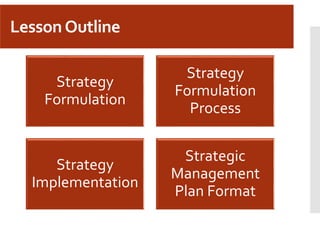
Strategy
Formulation
Strategy
Formulation
Process
Strategy
Implementation
Strategic
Management
Plan Format
Strategy Formulation
Strategy formulation involves the
selection of the most efficient and
appropriate ways to achieve the
organization’s vision and help it to
actualize its mission.
Strategy Formulation
The process of strategy
formulation is part of
strategic management that
involves the use of
analytical tools to arrive at
the best way to maximize
the use of company
resources.
Strategy Formulation
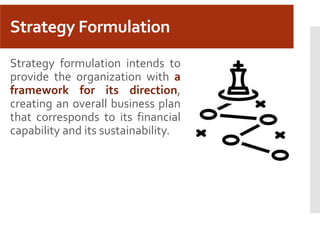
Strategy formulation intends to
provide the organization with a
framework for its direction,
creating an overall business plan
that corresponds to its financial
capability and its sustainability.
Strategy Formulation
The most utilized tool to
assess a company’s health is
the SWOT (i.e., strengths,
weaknesses, opportunities,
and threats) analysis. SWOT
analysis provides a detailed
look on company situation
and serves as a guide in
creating appropriate
strategies and its subsequent
implementation.
Strategy Formulation Process
Implementing a business strategy
follows a detailed process that starts
with the identification of the
company’s big picture. Strategy
formulation is the process of
choosing the most appropriate
course of action that a company
must take to realize its objectives and
goals and achieve its vision.
Strategy Formulation Process
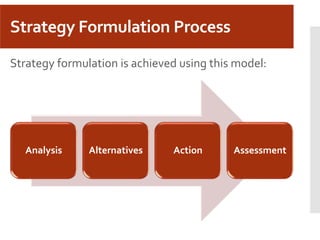
Strategy formulation is achieved using this model:
Analysis Alternatives Action Assessment
Strategy Formulation Process
• It is one of the first steps in the strategic
implementation process and generally involves
identifying the organization’s strengths,
weaknesses, opportunities, and threats. This
helps build a strong foundation of knowledge to
ensure the development of a strategic plan
remains relevant, meets the needs of the
changing client population, and makes the best
of the available resources.
Analysis
Strategy Formulation Process:Analysis
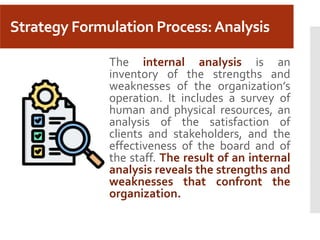
The internal analysis is an
inventory of the strengths and
weaknesses of the organization’s
operation. It includes a survey of
human and physical resources, an
analysis of the satisfaction of
clients and stakeholders, and the
effectiveness of the board and of
the staff. The result of an internal
analysis reveals the strengths and
weaknesses that confront the
organization.
Strategy Formulation Process:Analysis
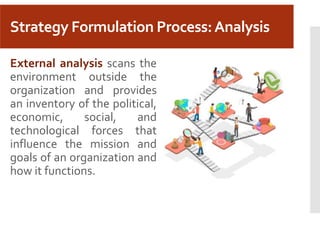
External analysis scans the
environment outside the
organization and provides
an inventory of the political,
economic, social, and
technological forces that
influence the mission and
goals of an organization and
how it functions.
Strategy Formulation Process:Analysis
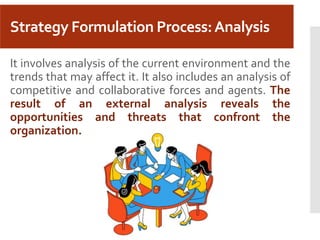
It involves analysis of the current environment and the
trends that may affect it. It also includes an analysis of
competitive and collaborative forces and agents. The
result of an external analysis reveals the
opportunities and threats that confront the
organization.
Strategy Formulation Process
• The identification of alternatives involves
the weighing of benefits and drawbacks from
any possible strategy. Alternatives are not
necessarily stand-alone courses of action but
can be a complement of an already existing
organizational strategy that needs
refinement, modification, or improvement,
Alternatives
Strategy Formulation Process
• Taking action is pursuing the best alternative
under the given circumstances and after
considering the various resources which the
organization need to implement a strategy.
Taking action must be done purposely in a
planned way and considers budgets and
allocation of resources within an outline of
tasks and programs.
Action
Strategy Formulation Process
• Assessment is done through the
creation of a review system that
creates control mechanisms and
generates data that will aid
future courses of action.
Assessment
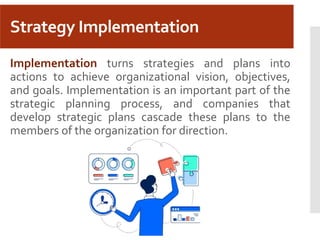
Strategy Implementation
Implementation turns strategies and plans into
actions to achieve organizational vision, objectives,
and goals. Implementation is an important part of the
strategic planning process, and companies that
develop strategic plans cascade these plans to the
members of the organization for direction.
Strategy Implementation
The process of strategy implementation may differ
based on industry or organizational culture. Strategy is
formulated at the top management level and follows a
common process of integration within departments
and functional areas of the organization.
Strategy Implementation
The value of strategy implementation is in the
expression of more detailed polices and in the
communication of these policies to the members of
the organization.
Strategy Implementation
Strategic modifications are
made in support of employees as
they deal with the nuances of
customer and supplier’s
relations. Strategic changes are
also implemented according to
the situation of company
resources that are affected by
the strategies.
Strategy Implementation
Similarly, it is important that
implemented strategies are
practical and relevant for the
members of the organization,
even at the lower level and can
realistically address issues that
may arise.
Strategy Implementation
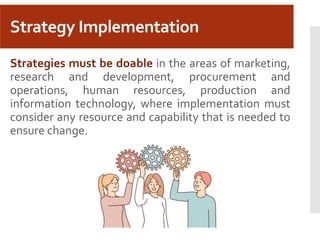
Strategies must be doable in the areas of marketing,
research and development, procurement and
operations, human resources, production and
information technology, where implementation must
consider any resource and capability that is needed to
ensure change.
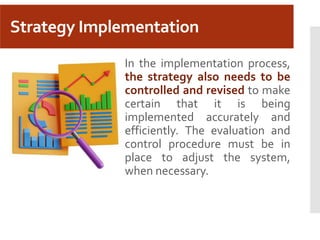
Strategy Implementation
In the implementation process,
the strategy also needs to be
controlled and revised to make
certain that it is being
implemented accurately and
efficiently. The evaluation and
control procedure must be in
place to adjust the system,
when necessary.
Strategy Implementation
The commitment of senior
management is an important
factor in the implementation
of a strategy. Senior
management’s commitment
is a definite requirement for
successful strategy
implementation. Therefore,
senior management must give
critical support and show
adherence to the
implementation process.
Strategy Implementation
Senior executives must discard the
notion that lower-level managers
have the same perceptions of the
strategy and its implementation,
its underlying rationale, and its
urgency as they have.
Strategy Implementation
Another aspect of
implementation of strategic
plan is the involvement of
middle manager’s valuable
knowledge. The success of
any implementation attempt
depends on the level of
involvement of middle
managers.
Strategy Implementation
To generate the required
acceptance for the
implementation, the affected
middle manager’s knowledge,
which is often underestimated,
must already be accounted for
in the formulation of the
strategy.
Strategy Implementation
After that, it is to make sure
that these managers are a
part of the strategy process,
their motivation toward the
project will increase and they
will see themselves as an
important part in the process.
Strategy Implementation
Effective communication should be emphasized in
the implementation process. Research show that
communication is a major success factor within
strategy implementation.
Strategy Implementation
An organization introduces a two-way
communication program that allows and solicits
questions from employees about issues regarding the
formulated strategy.
Strategy Implementation
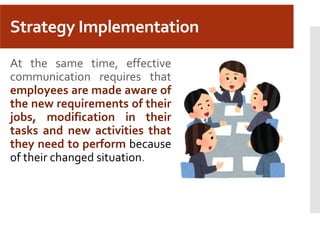
At the same time, effective
communication requires that
employees are made aware of
the new requirements of their
jobs, modification in their
tasks and new activities that
they need to perform because
of their changed situation.
Some of the steps that can help in the
transition process because of strategy
implementation are as follows:
• This is the first step in the implementation process.
It states that managers must know what the
strategic plan is. They must review it carefully and
highlight any elements of the plan that might be
especially challenging. It is necessary to identify
any part of the plan that might be unrealistic or
excessive in cost, either of time or money and
emphasize these, and be sure to keep them in
mind to begin implementing the strategic plan.
Evaluate the strategic plan.
Some of the steps that can help in the
transition process because of strategy
implementation are as follows:
• This vision might be a series of goals to be
reached, step by step, or an outline of items
that need to be completed. It is imperative
that everybody must know what the result
should be and why it is important and
establish a clear image of what the strategy
plan is intended to accomplish.
Create a vision for implementing
the strategic plan.
Some of the steps that can help in the
transition process because of strategy
implementation are as follows:
• Management must develop competent team
that supports management to implement
strategies. They must establish a team leader
who can encourage the team and field
questions or address problems as they arise.
Select the team members to help
implement the strategic plan.
Some of the steps that can help in the
transition process because of strategy
implementation are as follows:
• Organize meetings and present the list of goals or
objectives and let the strategic planning team know
what has been accomplished. Whether the
implementation is on schedule, ahead of schedule, or
behind schedule. Evaluate the current schedule
regularly to discuss any changes that need to be
made. Management must establish a rewards system
that recognizes success throughout the process of
implementation.
Schedule meetings to talk about
progress reports.
Some of the steps that can help in the
transition process because of strategy
implementation are as follows:
• It is good to inform all activities to the organization’s
executives and provide progress reports on the
implementation of the plan. Letting an
organization’s management know about the
progress of implementation makes them a part of
the process, and should problems arise, the
management will be better able to address concerns
or probable changes.
Involve the upper management where
appropriate.
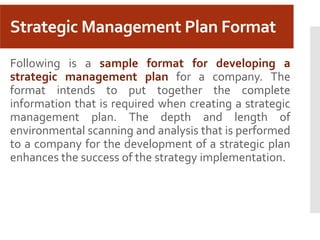
Strategic Management Plan Format
Following is a sample format for developing a
strategic management plan for a company. The
format intends to put together the complete
information that is required when creating a strategic
management plan. The depth and length of
environmental scanning and analysis that is performed
to a company for the development of a strategic plan
enhances the success of the strategy implementation.
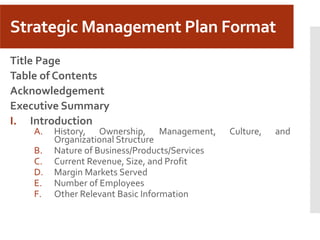
Strategic Management Plan Format
Title Page
Table of Contents
Acknowledgement
Executive Summary
I. Introduction
A. History, Ownership, Management, Culture, and
Organizational Structure
B. Nature of Business/Products/Services
C. Current Revenue, Size, and Profit
D. Margin Markets Served
E. Number of Employees
F. Other Relevant Basic Information
Strategic Management Plan Format
II. Research Design and Methodology
A. Data and Information Sources
B. Manner of Obtaining Information and Methodologies
Used
C. Major Assumptions
III. Comparing Mission andVision
A. State the Current Mission andVision
B. Comment and Evaluate Mission andVision
C. Recommend Changes if Needed
D. Recommend on How the Mission and Vision will be
Communicated to All Stakeholders
Strategic Management Plan Format
IV. External Analysis
A. General Statement
(Note: Discuss the following areas focusing only on
factors that will have significant impact on your business.)
1. Political and Governmental Focus
2. Economic Focus
3. Social, Cultural, and Demographic Focus
4. Technological Focus
5. Environmental Focus
6. Legal Focus
Strategic Management Plan Format
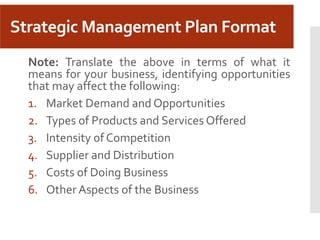
Note: Translate the above in terms of what it
means for your business, identifying opportunities
that may affect the following:
1. Market Demand and Opportunities
2. Types of Products and Services Offered
3. Intensity of Competition
4. Supplier and Distribution
5. Costs of Doing Business
6. Other Aspects of the Business
Strategic Management Plan Format
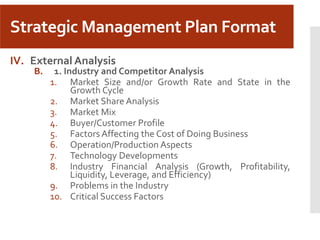
IV. External Analysis
B. 1. Industry and Competitor Analysis
1. Market Size and/or Growth Rate and State in the
Growth Cycle
2. Market Share Analysis
3. Market Mix
4. Buyer/Customer Profile
5. Factors Affecting the Cost of Doing Business
6. Operation/Production Aspects
7. Technology Developments
8. Industry Financial Analysis (Growth, Profitability,
Liquidity, Leverage, and Efficiency)
9. Problems in the Industry
10. Critical Success Factors
Strategic Management Plan Format
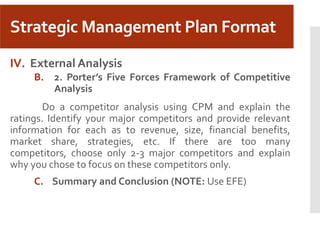
IV. External Analysis
B. 2. Porter’s Five Forces Framework of Competitive
Analysis
Do a competitor analysis using CPM and explain the
ratings. Identify your major competitors and provide relevant
information for each as to revenue, size, financial benefits,
market share, strategies, etc. If there are too many
competitors, choose only 2-3 major competitors and explain
why you chose to focus on these competitors only.
C. Summary and Conclusion (NOTE: Use EFE)
Strategic Management Plan Format
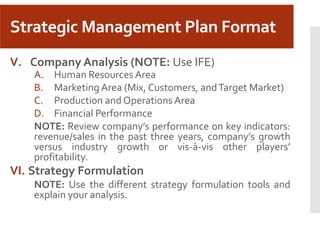
V. Company Analysis (NOTE: Use IFE)
A. Human Resources Area
B. Marketing Area (Mix, Customers, andTarget Market)
C. Production and Operations Area
D. Financial Performance
NOTE: Review company’s performance on key indicators:
revenue/sales in the past three years, company’s growth
versus industry growth or vis-à-vis other players’
profitability.
VI. Strategy Formulation
NOTE: Use the different strategy formulation tools and
explain your analysis.
Strategic Management Plan Format
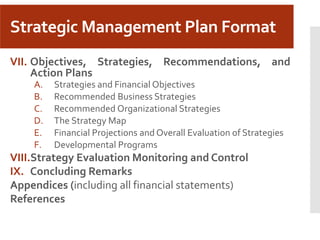
VII. Objectives, Strategies, Recommendations, and
Action Plans
A. Strategies and Financial Objectives
B. Recommended Business Strategies
C. Recommended Organizational Strategies
D. The Strategy Map
E. Financial Projections and Overall Evaluation of Strategies
F. Developmental Programs
VIII.Strategy Evaluation Monitoring and Control
IX. Concluding Remarks
Appendices (including all financial statements)
References
In summary…
Strategy implementation which starts with goal
setting matters in the overall need to grow a
business, reduce risks that goes with running an
organization, to identify the company’s strengths and
weaknesses and to increase operational productivity.
AnyQuestions?

SBA - Lesson 13 - Implementing a Business Strategy.pptx

  • 1.
  • 2.
  • 3.
    Strategy Formulation Strategy formulationinvolves the selection of the most efficient and appropriate ways to achieve the organization’s vision and help it to actualize its mission.
  • 4.
    Strategy Formulation The processof strategy formulation is part of strategic management that involves the use of analytical tools to arrive at the best way to maximize the use of company resources.
  • 5.
    Strategy Formulation Strategy formulationintends to provide the organization with a framework for its direction, creating an overall business plan that corresponds to its financial capability and its sustainability.
  • 6.
    Strategy Formulation The mostutilized tool to assess a company’s health is the SWOT (i.e., strengths, weaknesses, opportunities, and threats) analysis. SWOT analysis provides a detailed look on company situation and serves as a guide in creating appropriate strategies and its subsequent implementation.
  • 7.
    Strategy Formulation Process Implementinga business strategy follows a detailed process that starts with the identification of the company’s big picture. Strategy formulation is the process of choosing the most appropriate course of action that a company must take to realize its objectives and goals and achieve its vision.
  • 8.
    Strategy Formulation Process Strategyformulation is achieved using this model: Analysis Alternatives Action Assessment
  • 9.
    Strategy Formulation Process •It is one of the first steps in the strategic implementation process and generally involves identifying the organization’s strengths, weaknesses, opportunities, and threats. This helps build a strong foundation of knowledge to ensure the development of a strategic plan remains relevant, meets the needs of the changing client population, and makes the best of the available resources. Analysis
  • 10.
    Strategy Formulation Process:Analysis Theinternal analysis is an inventory of the strengths and weaknesses of the organization’s operation. It includes a survey of human and physical resources, an analysis of the satisfaction of clients and stakeholders, and the effectiveness of the board and of the staff. The result of an internal analysis reveals the strengths and weaknesses that confront the organization.
  • 11.
    Strategy Formulation Process:Analysis Externalanalysis scans the environment outside the organization and provides an inventory of the political, economic, social, and technological forces that influence the mission and goals of an organization and how it functions.
  • 12.
    Strategy Formulation Process:Analysis Itinvolves analysis of the current environment and the trends that may affect it. It also includes an analysis of competitive and collaborative forces and agents. The result of an external analysis reveals the opportunities and threats that confront the organization.
  • 13.
    Strategy Formulation Process •The identification of alternatives involves the weighing of benefits and drawbacks from any possible strategy. Alternatives are not necessarily stand-alone courses of action but can be a complement of an already existing organizational strategy that needs refinement, modification, or improvement, Alternatives
  • 14.
    Strategy Formulation Process •Taking action is pursuing the best alternative under the given circumstances and after considering the various resources which the organization need to implement a strategy. Taking action must be done purposely in a planned way and considers budgets and allocation of resources within an outline of tasks and programs. Action
  • 15.
    Strategy Formulation Process •Assessment is done through the creation of a review system that creates control mechanisms and generates data that will aid future courses of action. Assessment
  • 16.
    Strategy Implementation Implementation turnsstrategies and plans into actions to achieve organizational vision, objectives, and goals. Implementation is an important part of the strategic planning process, and companies that develop strategic plans cascade these plans to the members of the organization for direction.
  • 17.
    Strategy Implementation The processof strategy implementation may differ based on industry or organizational culture. Strategy is formulated at the top management level and follows a common process of integration within departments and functional areas of the organization.
  • 18.
    Strategy Implementation The valueof strategy implementation is in the expression of more detailed polices and in the communication of these policies to the members of the organization.
  • 19.
    Strategy Implementation Strategic modificationsare made in support of employees as they deal with the nuances of customer and supplier’s relations. Strategic changes are also implemented according to the situation of company resources that are affected by the strategies.
  • 20.
    Strategy Implementation Similarly, itis important that implemented strategies are practical and relevant for the members of the organization, even at the lower level and can realistically address issues that may arise.
  • 21.
    Strategy Implementation Strategies mustbe doable in the areas of marketing, research and development, procurement and operations, human resources, production and information technology, where implementation must consider any resource and capability that is needed to ensure change.
  • 22.
    Strategy Implementation In theimplementation process, the strategy also needs to be controlled and revised to make certain that it is being implemented accurately and efficiently. The evaluation and control procedure must be in place to adjust the system, when necessary.
  • 23.
    Strategy Implementation The commitmentof senior management is an important factor in the implementation of a strategy. Senior management’s commitment is a definite requirement for successful strategy implementation. Therefore, senior management must give critical support and show adherence to the implementation process.
  • 24.
    Strategy Implementation Senior executivesmust discard the notion that lower-level managers have the same perceptions of the strategy and its implementation, its underlying rationale, and its urgency as they have.
  • 25.
    Strategy Implementation Another aspectof implementation of strategic plan is the involvement of middle manager’s valuable knowledge. The success of any implementation attempt depends on the level of involvement of middle managers.
  • 26.
    Strategy Implementation To generatethe required acceptance for the implementation, the affected middle manager’s knowledge, which is often underestimated, must already be accounted for in the formulation of the strategy.
  • 27.
    Strategy Implementation After that,it is to make sure that these managers are a part of the strategy process, their motivation toward the project will increase and they will see themselves as an important part in the process.
  • 28.
    Strategy Implementation Effective communicationshould be emphasized in the implementation process. Research show that communication is a major success factor within strategy implementation.
  • 29.
    Strategy Implementation An organizationintroduces a two-way communication program that allows and solicits questions from employees about issues regarding the formulated strategy.
  • 30.
    Strategy Implementation At thesame time, effective communication requires that employees are made aware of the new requirements of their jobs, modification in their tasks and new activities that they need to perform because of their changed situation.
  • 31.
    Some of thesteps that can help in the transition process because of strategy implementation are as follows: • This is the first step in the implementation process. It states that managers must know what the strategic plan is. They must review it carefully and highlight any elements of the plan that might be especially challenging. It is necessary to identify any part of the plan that might be unrealistic or excessive in cost, either of time or money and emphasize these, and be sure to keep them in mind to begin implementing the strategic plan. Evaluate the strategic plan.
  • 32.
    Some of thesteps that can help in the transition process because of strategy implementation are as follows: • This vision might be a series of goals to be reached, step by step, or an outline of items that need to be completed. It is imperative that everybody must know what the result should be and why it is important and establish a clear image of what the strategy plan is intended to accomplish. Create a vision for implementing the strategic plan.
  • 33.
    Some of thesteps that can help in the transition process because of strategy implementation are as follows: • Management must develop competent team that supports management to implement strategies. They must establish a team leader who can encourage the team and field questions or address problems as they arise. Select the team members to help implement the strategic plan.
  • 34.
    Some of thesteps that can help in the transition process because of strategy implementation are as follows: • Organize meetings and present the list of goals or objectives and let the strategic planning team know what has been accomplished. Whether the implementation is on schedule, ahead of schedule, or behind schedule. Evaluate the current schedule regularly to discuss any changes that need to be made. Management must establish a rewards system that recognizes success throughout the process of implementation. Schedule meetings to talk about progress reports.
  • 35.
    Some of thesteps that can help in the transition process because of strategy implementation are as follows: • It is good to inform all activities to the organization’s executives and provide progress reports on the implementation of the plan. Letting an organization’s management know about the progress of implementation makes them a part of the process, and should problems arise, the management will be better able to address concerns or probable changes. Involve the upper management where appropriate.
  • 36.
    Strategic Management PlanFormat Following is a sample format for developing a strategic management plan for a company. The format intends to put together the complete information that is required when creating a strategic management plan. The depth and length of environmental scanning and analysis that is performed to a company for the development of a strategic plan enhances the success of the strategy implementation.
  • 37.
    Strategic Management PlanFormat Title Page Table of Contents Acknowledgement Executive Summary I. Introduction A. History, Ownership, Management, Culture, and Organizational Structure B. Nature of Business/Products/Services C. Current Revenue, Size, and Profit D. Margin Markets Served E. Number of Employees F. Other Relevant Basic Information
  • 38.
    Strategic Management PlanFormat II. Research Design and Methodology A. Data and Information Sources B. Manner of Obtaining Information and Methodologies Used C. Major Assumptions III. Comparing Mission andVision A. State the Current Mission andVision B. Comment and Evaluate Mission andVision C. Recommend Changes if Needed D. Recommend on How the Mission and Vision will be Communicated to All Stakeholders
  • 39.
    Strategic Management PlanFormat IV. External Analysis A. General Statement (Note: Discuss the following areas focusing only on factors that will have significant impact on your business.) 1. Political and Governmental Focus 2. Economic Focus 3. Social, Cultural, and Demographic Focus 4. Technological Focus 5. Environmental Focus 6. Legal Focus
  • 40.
    Strategic Management PlanFormat Note: Translate the above in terms of what it means for your business, identifying opportunities that may affect the following: 1. Market Demand and Opportunities 2. Types of Products and Services Offered 3. Intensity of Competition 4. Supplier and Distribution 5. Costs of Doing Business 6. Other Aspects of the Business
  • 41.
    Strategic Management PlanFormat IV. External Analysis B. 1. Industry and Competitor Analysis 1. Market Size and/or Growth Rate and State in the Growth Cycle 2. Market Share Analysis 3. Market Mix 4. Buyer/Customer Profile 5. Factors Affecting the Cost of Doing Business 6. Operation/Production Aspects 7. Technology Developments 8. Industry Financial Analysis (Growth, Profitability, Liquidity, Leverage, and Efficiency) 9. Problems in the Industry 10. Critical Success Factors
  • 42.
    Strategic Management PlanFormat IV. External Analysis B. 2. Porter’s Five Forces Framework of Competitive Analysis Do a competitor analysis using CPM and explain the ratings. Identify your major competitors and provide relevant information for each as to revenue, size, financial benefits, market share, strategies, etc. If there are too many competitors, choose only 2-3 major competitors and explain why you chose to focus on these competitors only. C. Summary and Conclusion (NOTE: Use EFE)
  • 43.
    Strategic Management PlanFormat V. Company Analysis (NOTE: Use IFE) A. Human Resources Area B. Marketing Area (Mix, Customers, andTarget Market) C. Production and Operations Area D. Financial Performance NOTE: Review company’s performance on key indicators: revenue/sales in the past three years, company’s growth versus industry growth or vis-à-vis other players’ profitability. VI. Strategy Formulation NOTE: Use the different strategy formulation tools and explain your analysis.
  • 44.
    Strategic Management PlanFormat VII. Objectives, Strategies, Recommendations, and Action Plans A. Strategies and Financial Objectives B. Recommended Business Strategies C. Recommended Organizational Strategies D. The Strategy Map E. Financial Projections and Overall Evaluation of Strategies F. Developmental Programs VIII.Strategy Evaluation Monitoring and Control IX. Concluding Remarks Appendices (including all financial statements) References
  • 45.
    In summary… Strategy implementationwhich starts with goal setting matters in the overall need to grow a business, reduce risks that goes with running an organization, to identify the company’s strengths and weaknesses and to increase operational productivity.
  • 46.