What are Methods of
Steel Structure
Design?
 There are three different methods for design of steel structure, i.e. simple
design, continuous design and semi-continuous steel design.
 Joints in structures have been assumed to behave as either pinned or rigid to
render design calculations manageable.
 In simple design the joints are idealised as perfect pins. Continuous design
assumes that joints are rigid and that no relative rotation of connected
members occurs whatever the applied moment.
 The vast majority of designs carried out today make one of these two
assumptions, but a more realistic alternative is now possible, which is known
as semi-continuous design.
Methods of Steel Structure Design
1. Simple Design of Steel Structure
2. Continuous Design of Steel Structure
3. Semi-Continuous Design of Steel Structure
Simple Design of Steel Structure
 Simple design is the most traditional approach and is still
commonly used. It is assumed that no moment is
transferred from one connected member to another, except
for the nominal moments which arise as a result of
eccentricity at joints.
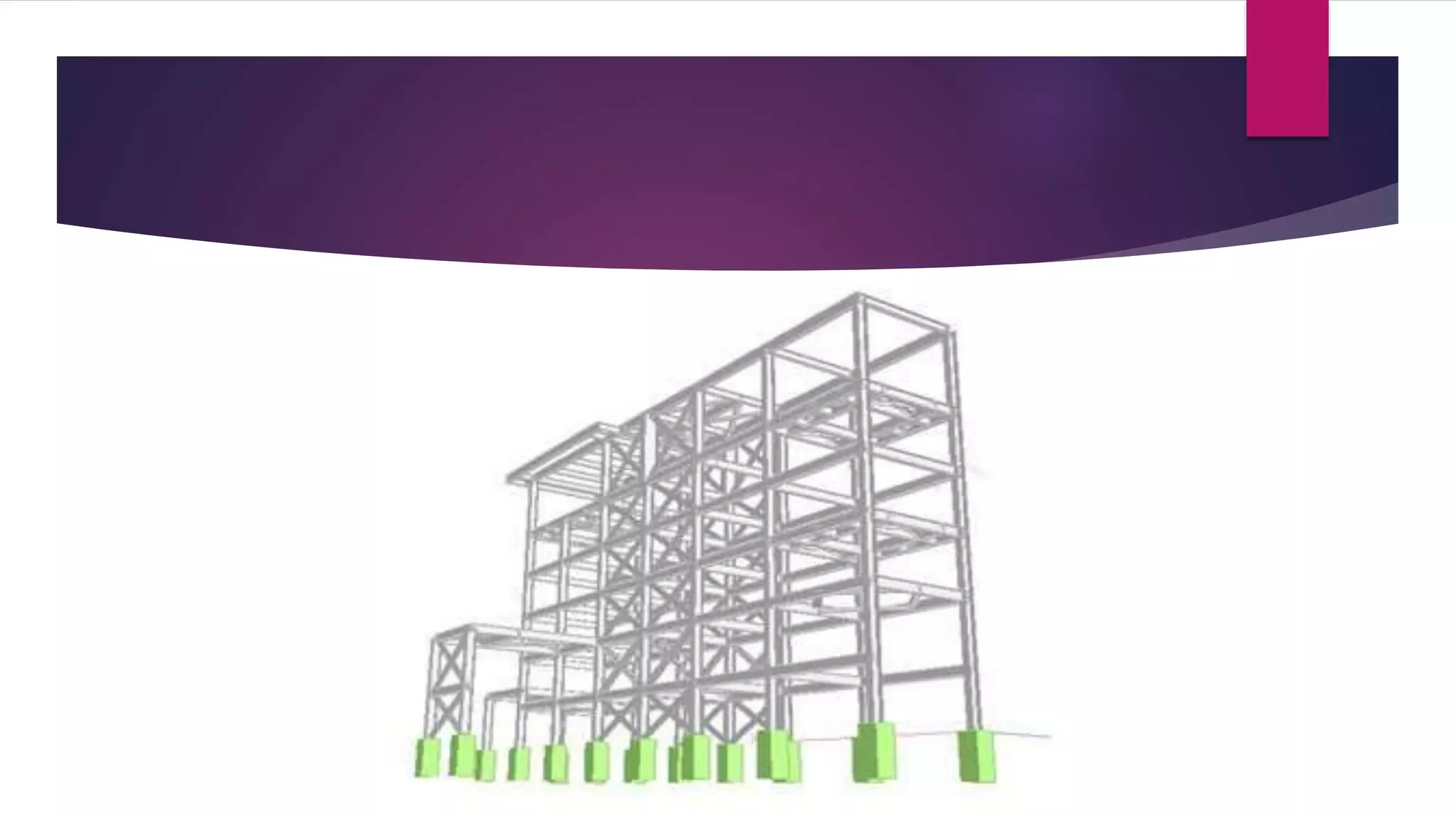
 The resistance of the structure to lateral loads and sway is
usually ensured by the provision of bracing or, in some
multi-storey buildings, by concrete cores.
 It is important that the designer recognizes the assumptions
regarding joint response and ensures that the detailing of
the connections is such that no moments develop that can
adversely affect the performance of the structure.
 Many years of experience have demonstrated the types of
details that satisfy this criterion and the designer should
refer to the standard connections on joints in simple
construction.
Continuous Design of Steel Structure
 In continuous design, it is assumed that joints are rigid and
transfer moment between members. The stability of the
frame against sway is by frame action (i.e. by bending of
beams and columns).
 Continuous design is more complex than simple design
therefore software is commonly used to analyse the frame.
Realistic combinations of pattern loading must be
considered when designing continuous frames.
 The connections between members must have different
characteristics depending on whether the design method
for the frame is elastic or plastic.
 In elastic design, the joints must possess sufficient rotational
stiffness to ensure that the distribution of forces and
moments around the frame are not significantly different to
those calculated.
 The joint must be able to carry the moments, forces and
shears arising from the frame analysis.
 In plastic design, in determining the ultimate load capacity,
the strength (not stiffness) of the joint is of prime
importance. The strength of the joint will determine whether
plastic hinges occur in the joints or in the members, and will
have a significant effect on the collapse mechanism.
 If hinges are designed to occur in the joints, the joint must
be detailed with sufficient ductility to accommodate the
resulting rotations. The stiffness of the joints will be
important when calculating beam deflections, sway
deflections and sway stability.
Semi-Continuous Design of Steel
Structure
 True semi-continuous design is more complex than either
simple or continuous design as the real joint response is
more realistically represented. Analytical routines to follow
the true connection behaviour closely are highly involved
and unsuitable for routine design, as they require the use of
sophisticated computer programs.
 However, two simplified procedures do exist for both braced
and unbraced frames; these are briefly referred to below.
Braced frames are those where the resistance to lateral
loads is provided by a bracing system or a core; in unbraced
frames this resistance is generated by bending moments in
the columns and beams.
The simplified procedures are
 (i) The wind moment method, for unbraced frames. In this procedure,
the beam/column joints are assumed to be pinned when considering
gravity loads. However, under wind loading they are assumed to be
rigid, which means that lateral loads are carried by frame action. A
fuller description of the method can be found in reference.
 (ii) Semi-continuous design of braced frames. In this procedure,
account of the real joint behaviour is taken to reduce the bending
moments applied to the beams and to reduce the deflections. Details
of the method can be found in reference.
Steel Structure Maintenance Companies
Steel House Construction Co. LLC
PO Box: 3346, SHARJAH, UAE
Telephone: (+971) 6-544 9552
Fax No: (+971) 6-544 9553
Email: info@steelhousellc.com
Web: www.steelhousellc.com

What are methods of steel structure design

  • 1.
    What are Methodsof Steel Structure Design?
  • 2.
     There arethree different methods for design of steel structure, i.e. simple design, continuous design and semi-continuous steel design.  Joints in structures have been assumed to behave as either pinned or rigid to render design calculations manageable.  In simple design the joints are idealised as perfect pins. Continuous design assumes that joints are rigid and that no relative rotation of connected members occurs whatever the applied moment.  The vast majority of designs carried out today make one of these two assumptions, but a more realistic alternative is now possible, which is known as semi-continuous design.
  • 3.
    Methods of SteelStructure Design 1. Simple Design of Steel Structure 2. Continuous Design of Steel Structure 3. Semi-Continuous Design of Steel Structure
  • 4.
    Simple Design ofSteel Structure  Simple design is the most traditional approach and is still commonly used. It is assumed that no moment is transferred from one connected member to another, except for the nominal moments which arise as a result of eccentricity at joints.  The resistance of the structure to lateral loads and sway is usually ensured by the provision of bracing or, in some multi-storey buildings, by concrete cores.
  • 5.
     It isimportant that the designer recognizes the assumptions regarding joint response and ensures that the detailing of the connections is such that no moments develop that can adversely affect the performance of the structure.  Many years of experience have demonstrated the types of details that satisfy this criterion and the designer should refer to the standard connections on joints in simple construction.
  • 7.
    Continuous Design ofSteel Structure  In continuous design, it is assumed that joints are rigid and transfer moment between members. The stability of the frame against sway is by frame action (i.e. by bending of beams and columns).  Continuous design is more complex than simple design therefore software is commonly used to analyse the frame. Realistic combinations of pattern loading must be considered when designing continuous frames.
  • 8.
     The connectionsbetween members must have different characteristics depending on whether the design method for the frame is elastic or plastic.  In elastic design, the joints must possess sufficient rotational stiffness to ensure that the distribution of forces and moments around the frame are not significantly different to those calculated.  The joint must be able to carry the moments, forces and shears arising from the frame analysis.
  • 9.
     In plasticdesign, in determining the ultimate load capacity, the strength (not stiffness) of the joint is of prime importance. The strength of the joint will determine whether plastic hinges occur in the joints or in the members, and will have a significant effect on the collapse mechanism.  If hinges are designed to occur in the joints, the joint must be detailed with sufficient ductility to accommodate the resulting rotations. The stiffness of the joints will be important when calculating beam deflections, sway deflections and sway stability.
  • 10.
    Semi-Continuous Design ofSteel Structure  True semi-continuous design is more complex than either simple or continuous design as the real joint response is more realistically represented. Analytical routines to follow the true connection behaviour closely are highly involved and unsuitable for routine design, as they require the use of sophisticated computer programs.
  • 11.
     However, twosimplified procedures do exist for both braced and unbraced frames; these are briefly referred to below. Braced frames are those where the resistance to lateral loads is provided by a bracing system or a core; in unbraced frames this resistance is generated by bending moments in the columns and beams.
  • 12.
    The simplified proceduresare  (i) The wind moment method, for unbraced frames. In this procedure, the beam/column joints are assumed to be pinned when considering gravity loads. However, under wind loading they are assumed to be rigid, which means that lateral loads are carried by frame action. A fuller description of the method can be found in reference.  (ii) Semi-continuous design of braced frames. In this procedure, account of the real joint behaviour is taken to reduce the bending moments applied to the beams and to reduce the deflections. Details of the method can be found in reference.
  • 13.
    Steel Structure MaintenanceCompanies Steel House Construction Co. LLC PO Box: 3346, SHARJAH, UAE Telephone: (+971) 6-544 9552 Fax No: (+971) 6-544 9553 Email: info@steelhousellc.com Web: www.steelhousellc.com