25 October 2011
1
Limit state design and verification
Joost Walraven
25 October 2011 2
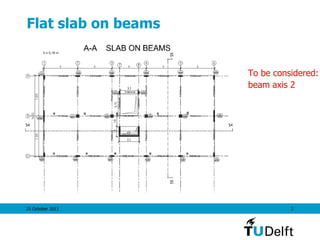
Flat slab on beams
To be considered:
beam axis 2
25 October 2011 3
b
b1 b1
b2 b2
bw
bw
beff,1
beff,2
beff
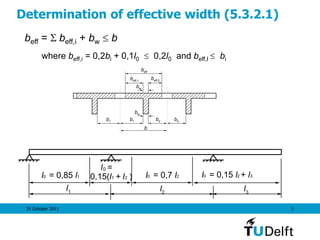
Determination of effective width (5.3.2.1)
beff = S beff,i + bw  b
where beff,i = 0,2bi + 0,1l0  0,2l0 and beff,I  bi
l3
l1 l2
0,15(l1 + l2 )
l =0
l0 = 0,7 l2 l0 = 0,15 l2 + l3l0 = 0,85 l1
25 October 2011 4
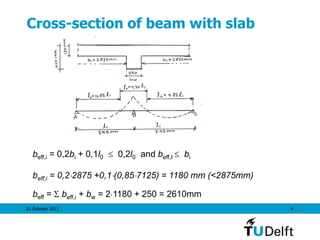
Cross-section of beam with slab
beff,i = 0,2bi + 0,1l0  0,2l0 and beff,I  bi
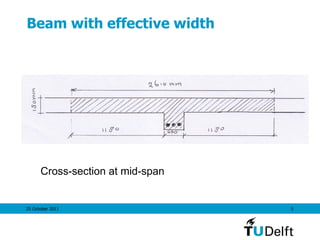
beff,i = 0,22875 +0,1(0,857125) = 1180 mm (<2875mm)
beff = S beff,i + bw = 21180 + 250 = 2610mm
25 October 2011 5
Beam with effective width
Cross-section at mid-span
25 October 2011 6
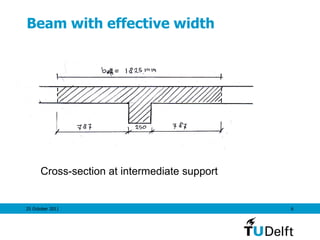
Beam with effective width
Cross-section at intermediate support
25 October 2011 7
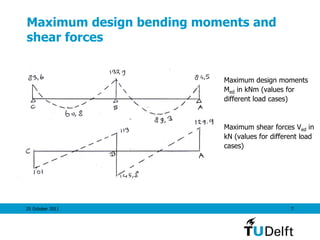
Maximum design bending moments and
shear forces
Maximum design moments
Med in kNm (values for
different load cases)
Maximum shear forces Ved in
kN (values for different load
cases)
25 October 2011 8
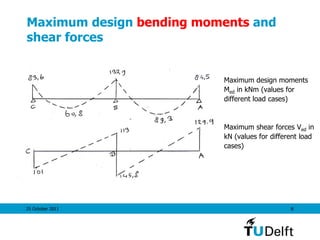
Maximum design bending moments and
shear forces
Maximum design moments
Med in kNm (values for
different load cases)
Maximum shear forces Ved in
kN (values for different load
cases)
25 October 2011 9
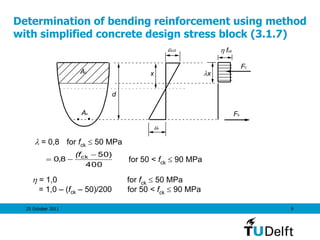
Determination of bending reinforcement using method
with simplified concrete design stress block (3.1.7)
As
d
fcd
Fs
x
s
x
cu3
Fc
Ac
400
)50
8,0 ck 

(f
for 50 < fck  90 MPa
 = 0,8 for fck  50 MPa
 = 1,0 for fck  50 MPa
= 1,0 – (fck – 50)/200 for 50 < fck  90 MPa
25 October 2011 10
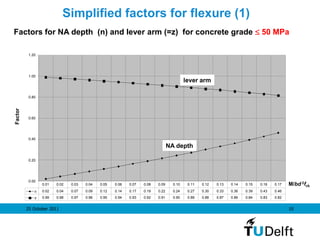
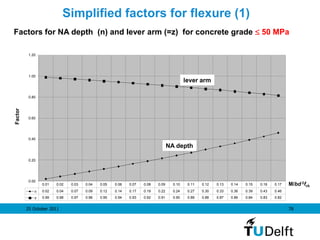
Factors for NA depth (n) and lever arm (=z) for concrete grade  50 MPa
0.00
0.20
0.40
0.60
0.80
1.00
1.20
M/bd 2fck
Factor
n 0.02 0.04 0.07 0.09 0.12 0.14 0.17 0.19 0.22 0.24 0.27 0.30 0.33 0.36 0.39 0.43 0.46
z 0.99 0.98 0.97 0.96 0.95 0.94 0.93 0.92 0.91 0.90 0.89 0.88 0.87 0.86 0.84 0.83 0.82
0.01 0.02 0.03 0.04 0.05 0.06 0.07 0.08 0.09 0.10 0.11 0.12 0.13 0.14 0.15 0.16 0.17
lever arm
NA depth
Simplified factors for flexure (1)
25 October 2011 11
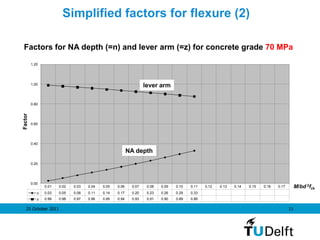
Factors for NA depth (=n) and lever arm (=z) for concrete grade 70 MPa
0.00
0.20
0.40
0.60
0.80
1.00
1.20
M/bd 2fck
Factor
n 0.03 0.05 0.08 0.11 0.14 0.17 0.20 0.23 0.26 0.29 0.33
z 0.99 0.98 0.97 0.96 0.95 0.94 0.93 0.91 0.90 0.89 0.88
0.01 0.02 0.03 0.04 0.05 0.06 0.07 0.08 0.09 0.10 0.11 0.12 0.13 0.14 0.15 0.16 0.17
Simplified factors for flexure (2)
lever arm
NA depth
25 October 2011 12
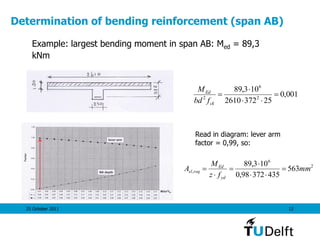
Determination of bending reinforcement (span AB)
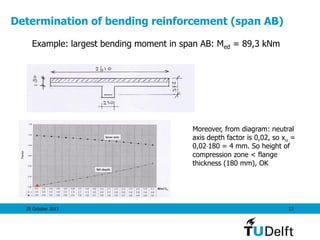
Example: largest bending moment in span AB: Med = 89,3
kNm
001,0
253722610
103,89
2
6
2




ck
Ed
fbd
M
Read in diagram: lever arm
factor = 0,99, so:
2
6
, 563
43537298,0
103,89
mm
fz
M
A
yd
Ed
reqsl 





25 October 2011 13
Determination of bending reinforcement (span AB)
Example: largest bending moment in span AB: Med = 89,3 kNm
Moreover, from diagram: neutral
axis depth factor is 0,02, so xu =
0,02180 = 4 mm. So height of
compression zone < flange
thickness (180 mm), OK
25 October 2011 14
Determination of bending reinforcement (intermediate
support B
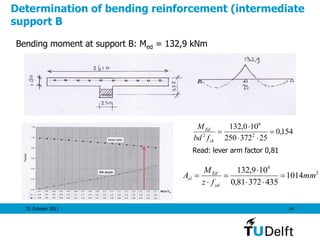
Bending moment at support B: Med = 132,9 kNm
154,0
25372250
100,132
2
6
2




ck
Ed
fbd
M
Read: lever arm factor 0,81
2
6
1014
43537281,0
109,132
mm
fz
M
A
yd
Ed
sl 





25 October 2011 15
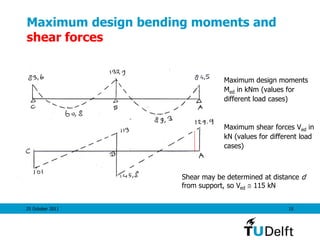
Maximum design bending moments and
shear forces
Maximum design moments
Med in kNm (values for
different load cases)
Maximum shear forces Ved in
kN (values for different load
cases)
Shear may be determined at distance d
from support, so Ved  115 kN
25 October 2011 16
Design of beams for shear (6.2.2)
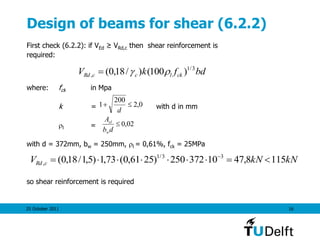
First check (6.2.2): if VEd ≥ VRd,c then shear reinforcement is
required:
where: fck in Mpa
k = with d in mm
l =
with d = 372mm, bw = 250mm, l = 0,61%, fck = 25MPa
so shear reinforcement is required
bdfkV cklccRd
3/1
, )100()/18,0( 
0,2
200
1 
d
02,0
db
A
w
sl
kNkNV cRd 1158,4710372250)2561,0(73,1)5,1/18,0( 33/1
,  
25 October 2011 17
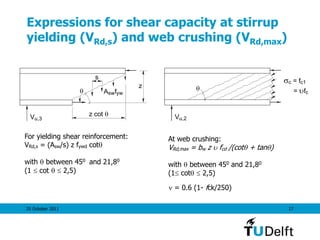
Expressions for shear capacity at stirrup
yielding (VRd,s) and web crushing (VRd,max)

Vu,2
cc1=f
=fc
Vu,3
s
z
zcot
Afswyw

Vu,2
c c1= f
= f c
Vu,3
s
z
z cot 
A fsw yw
For yielding shear reinforcement:
VRd,s = (Asw/s) z fywd cot
with  between 450 and 21,80
(1  cot   2,5)
At web crushing:
VRd,max = bw z  fcd /(cot + tan)
with  between 450 and 21,80
(1 cot  2,5)
 = 0.6 (1- fck/250)
25 October 2011 18
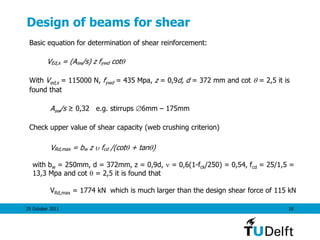
Design of beams for shear
Basic equation for determination of shear reinforcement:
VEd,s = (Asw/s) z fywd cot
With Ved,s = 115000 N, fywd = 435 Mpa, z = 0,9d, d = 372 mm and cot  = 2,5 it is
found that
Asw/s ≥ 0,32 e.g. stirrups 6mm – 175mm
Check upper value of shear capacity (web crushing criterion)
VRd,max = bw z  fcd /(cot + tan)
with bw = 250mm, d = 372mm, z = 0,9d,  = 0,6(1-fck/250) = 0,54, fcd = 25/1,5 =
13,3 Mpa and cot  = 2,5 it is found that
VRd,max = 1774 kN which is much larger than the design shear force of 115 kN
25 October 2011 19
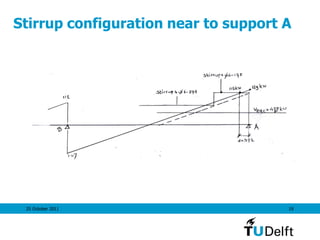
Stirrup configuration near to support A
25 October 2011 20
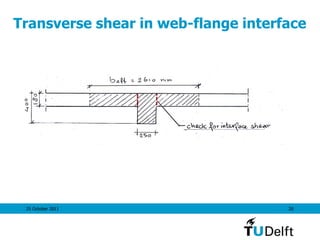
Transverse shear in web-flange interface
25 October 2011 21
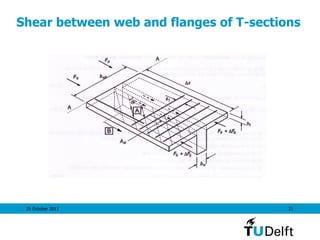
Shear between web and flanges of T-sections
25 October 2011 22
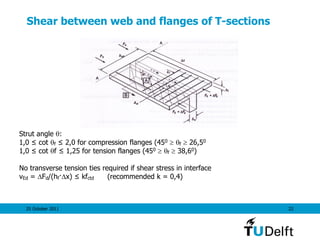
Shear between web and flanges of T-sections
Strut angle :
1,0 ≤ cot f ≤ 2,0 for compression flanges (450  f  26,50
1,0 ≤ cot f ≤ 1,25 for tension flanges (450  f  38,60)
No transverse tension ties required if shear stress in interface
vEd = Fd/(hf·x) ≤ kfctd (recommended k = 0,4)
25 October 2011 23
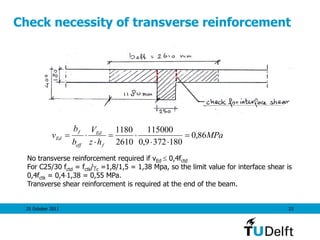
Check necessity of transverse reinforcement
MPa
hz
V
b
b
v
f
Ed
eff
f
Ed 86,0
1803729,0
115000
2610
1180





No transverse reinforcement required if vEd  0,4fctd
For C25/30 fctd = fctk/c =1,8/1,5 = 1,38 Mpa, so the limit value for interface shear is
0,4fctk = 0,41,38 = 0,55 MPa.
Transverse shear reinforcement is required at the end of the beam.
25 October 2011 24
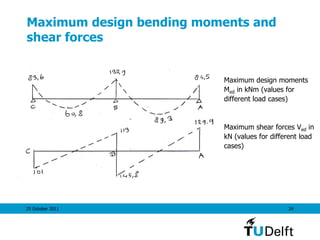
Maximum design bending moments and
shear forces
Maximum design moments
Med in kNm (values for
different load cases)
Maximum shear forces Ved in
kN (values for different load
cases)
25 October 2011 25
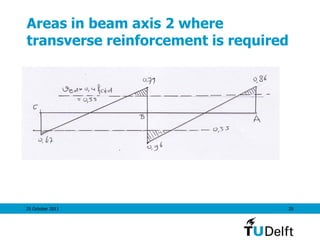
Areas in beam axis 2 where
transverse reinforcement is required
25 October 2011 26
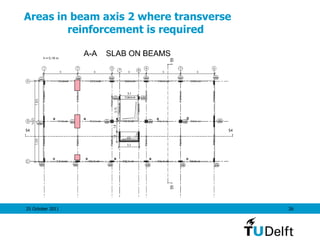
Areas in beam axis 2 where transverse
reinforcement is required
25 October 2011 27
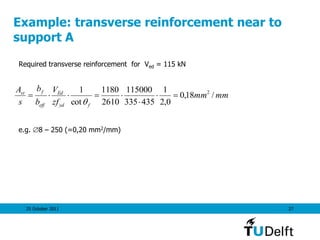
Example: transverse reinforcement near to
support A
Required transverse reinforcement for Ved = 115 kN
e.g. 8 – 250 (=0,20 mm2/mm)
mmmm
zf
V
b
b
s
A
fyd
Ed
eff
fst
/18,0
0,2
1
435335
115000
2610
1180
cot
1 2




25 October 2011 28
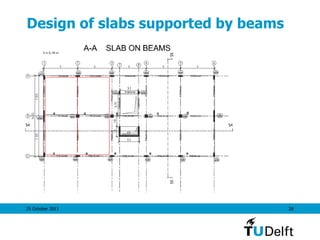
Design of slabs supported by beams
25 October 2011 29
Design of slabs supported by beams
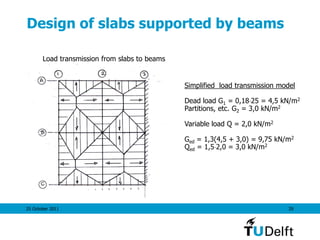
Load transmission from slabs to beams
Simplified load transmission model
Dead load G1 = 0,1825 = 4,5 kN/m2
Partitions, etc. G2 = 3,0 kN/m2
Variable load Q = 2,0 kN/m2
Ged = 1,3(4,5 + 3,0) = 9,75 kN/m2
Qed = 1,52,0 = 3,0 kN/m2
25 October 2011 30
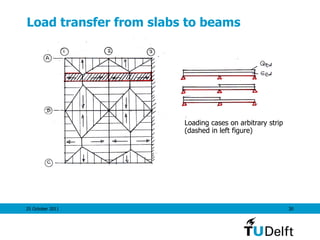
Load transfer from slabs to beams
Loading cases on arbitrary strip
(dashed in left figure)
25 October 2011 31
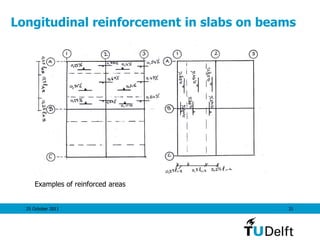
Longitudinal reinforcement in slabs on beams
Examples of reinforced areas
25 October 2011 32
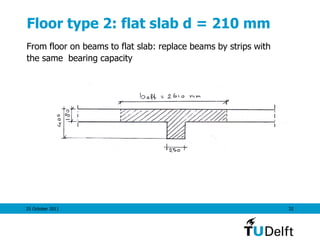
Floor type 2: flat slab d = 210 mm
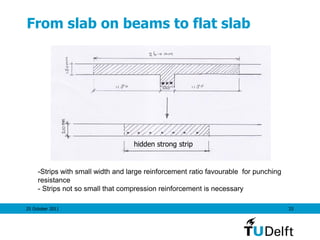
From floor on beams to flat slab: replace beams by strips with
the same bearing capacity
25 October 2011 33
From slab on beams to flat slab
hidden strong strip
-Strips with small width and large reinforcement ratio favourable for punching
resistance
- Strips not so small that compression reinforcement is necessary
25 October 2011 34
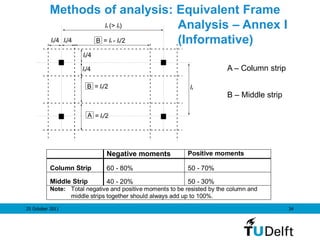
Methods of analysis: Equivalent Frame
Analysis – Annex I
(Informative)
lx (> ly)
ly
ly/4 ly/4
ly/4
ly/4
= lx - ly/2
= ly/2
= ly/2A
B
B
A – Column strip
B – Middle strip
Negative moments Positive moments
Column Strip 60 - 80% 50 - 70%
Middle Strip 40 - 20% 50 - 30%
Note: Total negative and positive moments to be resisted by the column and
middle strips together should always add up to 100%.
25 October 2011 35
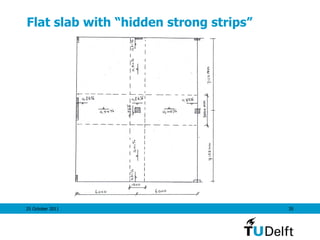
Flat slab with “hidden strong strips”
25 October 2011 36
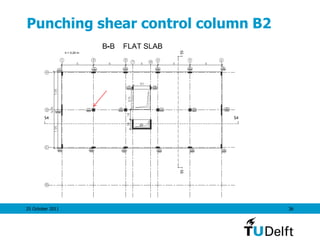
Punching shear control column B2
25 October 2011 37
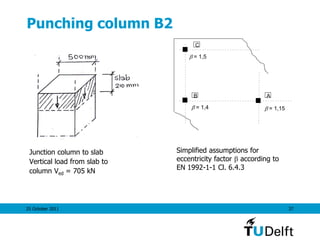
Punching column B2
Junction column to slab
Vertical load from slab to
column Ved = 705 kN
Simplified assumptions for
eccentricity factor  according to
EN 1992-1-1 Cl. 6.4.3
 = 1,4
 = 1,5
 = 1,15
C
B A
25 October 2011 38
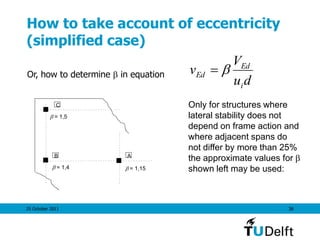
How to take account of eccentricity
(simplified case)
du
V
v
i
Ed
Ed Or, how to determine  in equation
 = 1,4
 = 1,5
 = 1,15
C
B A
Only for structures where
lateral stability does not
depend on frame action and
where adjacent spans do
not differ by more than 25%
the approximate values for 
shown left may be used:
25 October 2011 39
Upper limit value for design punching
shear stress in design
cdRd
Ed
Ed fv
du
V
v 

4,0max,
0

At the perimeter of the loaded area the maximum punching shear
stress should satisfy the following criterion:
where:
u0 = perimeter of loaded area
 = 0,6[1 – fck/250]
25 October 2011 40
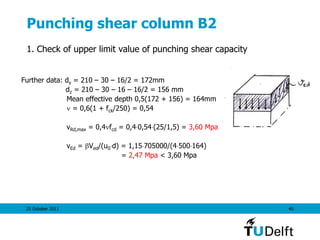
Punching shear column B2
1. Check of upper limit value of punching shear capacity
Further data: dy = 210 – 30 – 16/2 = 172mm
dz = 210 – 30 – 16 – 16/2 = 156 mm
Mean effective depth 0,5(172 + 156) = 164mm
 = 0,6(1 + fck/250) = 0,54
vRd,max = 0,4fcd = 0,40,54(25/1,5) = 3,60 Mpa
vEd = Ved/(u0d) = 1,15705000/(4500164)
= 2,47 Mpa < 3,60 Mpa
25 October 2011 41
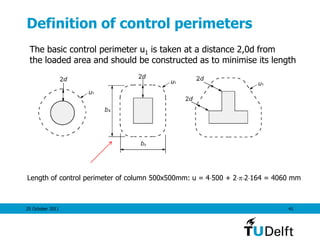
Definition of control perimeters
The basic control perimeter u1 is taken at a distance 2,0d from
the loaded area and should be constructed as to minimise its length
Length of control perimeter of column 500x500mm: u = 4500 + 22164 = 4060 mm
25 October 2011 42
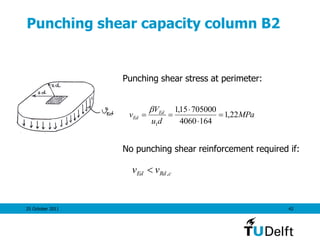
Punching shear capacity column B2
Punching shear stress at perimeter:
No punching shear reinforcement required if:
MPa
du
V
v Ed
Ed 22,1
1644060
70500015,1
1





cRdEd vv ,
25 October 2011 43
Limit values for design punching
shear stress in design
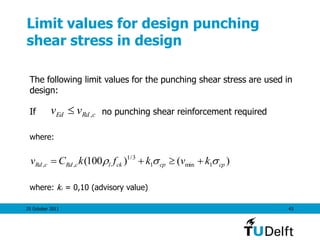
cRdEd vv ,
The following limit values for the punching shear stress are used in
design:
If no punching shear reinforcement required
)()100( 1min1
3/1
,, cpcpcklcRdcRd kvkfkCv  
where:
where: k1 = 0,10 (advisory value)
25 October 2011 44
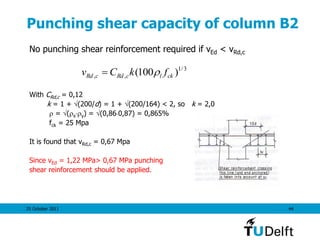
Punching shear capacity of column B2
No punching shear reinforcement required if vEd < vRd,c
With CRd,c = 0,12
k = 1 + (200/d) = 1 + (200/164) < 2, so k = 2,0
 = (xy) = (0,860,87) = 0,865%
fck = 25 Mpa
It is found that vRd,c = 0,67 Mpa
Since vEd = 1,22 MPa> 0,67 MPa punching
shear reinforcement should be applied.
3/1
,, )100( cklcRdcRd fkCv 
25 October 2011 45
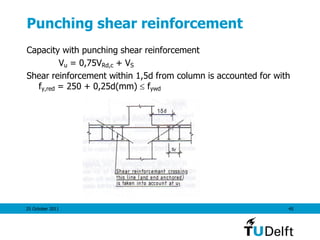
Punching shear reinforcement
Capacity with punching shear reinforcement
Vu = 0,75VRd,c + VS
Shear reinforcement within 1,5d from column is accounted for with
fy,red = 250 + 0,25d(mm)  fywd
25 October 2011 46
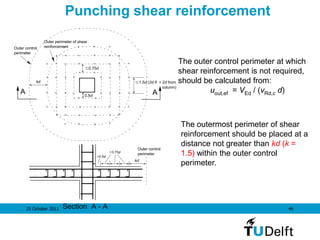
kd
Outer control
perimeter
Outer perimeter of shear
reinforcement
1.5d (2d if > 2d from
column)
0.75d
0.5d
A A
Section A - A
0.75d
0.5d
Outer control
perimeter
kd
Punching shear reinforcement
The outer control perimeter at which
shear reinforcement is not required,
should be calculated from:
uout,ef = VEd / (vRd,c d)
The outermost perimeter of shear
reinforcement should be placed at a
distance not greater than kd (k =
1.5) within the outer control
perimeter.
47
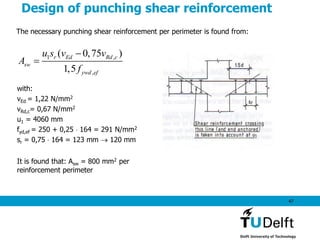
Design of punching shear reinforcement
The necessary punching shear reinforcement per perimeter is found from:
1 ,
,
( 0,75 )
1,5
r Ed Rd c
sw
ywd ef
u s v v
A
f


with:
vEd = 1,22 N/mm2
vRd,c= 0,67 N/mm2
u1 = 4060 mm
fyd,ef = 250 + 0,25  164 = 291 N/mm2
sr = 0,75  164 = 123 mm  120 mm
It is found that: Asw = 800 mm2 per
reinforcement perimeter
25 October 2011 48
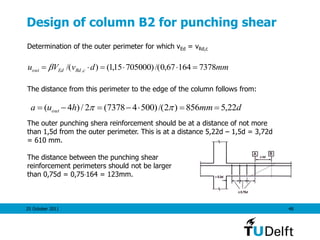
Design of column B2 for punching shear
Determination of the outer perimeter for which vEd = vRd,c
The distance from this perimeter to the edge of the column follows from:
The outer punching shera reinforcement should be at a distance of not more
than 1,5d from the outer perimeter. This is at a distance 5,22d – 1,5d = 3,72d
= 610 mm.
The distance between the punching shear
reinforcement perimeters should not be larger
than 0,75d = 0,75164 = 123mm.
mmdvVu cRdEdout 737816467,0/()70500015,1()/( ,  
dmmhua out 22,5856)2/()50047378(2/)4(  
25 October 2011 49
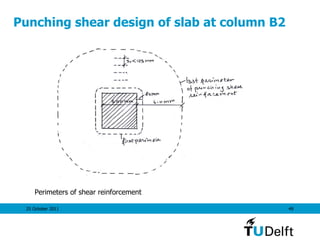
Punching shear design of slab at column B2
Perimeters of shear reinforcement
25 October 2011 50
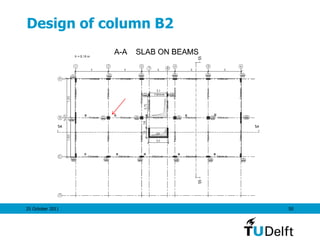
Design of column B2
25 October 2011 51
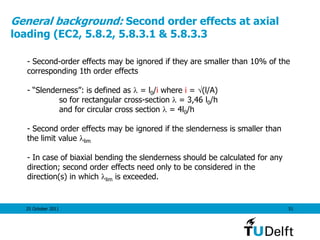
General background: Second order effects at axial
loading (EC2, 5.8.2, 5.8.3.1 & 5.8.3.3
- Second-order effects may be ignored if they are smaller than 10% of the
corresponding 1th order effects
- “Slenderness”: is defined as  = l0/i where i = (l/A)
so for rectangular cross-section  = 3,46 l0/h
and for circular cross section  = 4l0/h
- Second order effects may be ignored if the slenderness is smaller than
the limit value lim
- In case of biaxial bending the slenderness should be calculated for any
direction; second order effects need only to be considered in the
direction(s) in which lim is exceeded.
25 October 2011 52
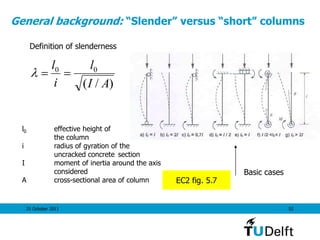
General background: “Slender” versus “short” columns
Definition of slenderness
)/(
00
AI
l
i
l

l0 effective height of
the column
i radius of gyration of the
uncracked concrete section
I moment of inertia around the axis
considered
A cross-sectional area of column
Basic cases
EC2 fig. 5.7
25 October 2011 53
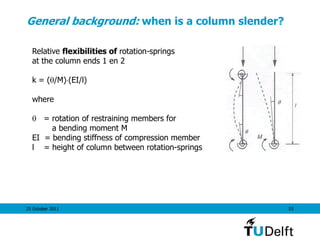
General background: when is a column slender?
Relative flexibilities of rotation-springs
at the column ends 1 en 2
k = (/M)(EI/l)
where
 = rotation of restraining members for
a bending moment M
EI = bending stiffness of compression member
l = height of column between rotation-springs
25 October 2011 54
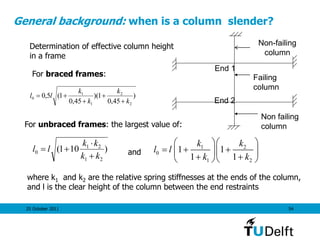
General background: when is a column slender?
)
45,0
1)(
45,0
1(5,0
2
2
1
1
0
k
k
k
k
ll




)101(
21
21
0
kk
kk
ll



Determination of effective column height
in a frame
For unbraced frames: the largest value of:
and
where k1 and k2 are the relative spring stiffnesses at the ends of the column,
and l is the clear height of the column between the end restraints
For braced frames: Failing
column
Non failing
column
End 1
End 2
Non-failing
column
1 2
0
1 2
1 1
1 1
k k
l l
k k
  
    
   
25 October 2011 55
General background: determination of effective
column length (1) (5.8, 5.8.3.2)
Failing
column
Non failing
column
End 1
End 2
Non failing
columnSimplifying assumption:
* The contribution of the adjacent “non
failing ” columns to the spring stiffness is
ignored (if this contributes in a positive
sense to the restraint)
* for beams for /M the value l/2EI may
be assumed (taking account of loss of
beam stiffness due to cracking)
Assuming that the beams are symmetric with regard to the column and that their
dimensions are the same for the two stories, the following relations are found:
k1 = k2 = [EI/l]column / [SEI/l]beams = [EI/l]column / [22EI/l]beams = 0,25 
where:  = [EI/l]column / [EI/l]beams
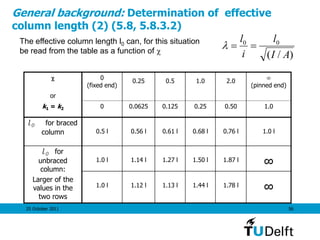
25 October 2011 56
General background: Determination of effective
column length (2) (5.8, 5.8.3.2)

or
0
(fixed end)
0.25 0.5 1.0 2.0

(pinned end)
k1 = k2 0 0.0625 0.125 0.25 0.50 1.0
l0 for braced
column 0.5 l 0.56 l 0.61 l 0.68 l 0.76 l 1.0 l
l0 for
unbraced
column:
Larger of the
values in the
two rows
1.0 l 1.14 l 1.27 l 1.50 l 1.87 l ∞
1.0 l 1.12 l 1.13 l 1.44 l 1.78 l ∞
The effective column length l0 can, for this situation
be read from the table as a function of 
)/(
00
AI
l
i
l

25 October 2011 57
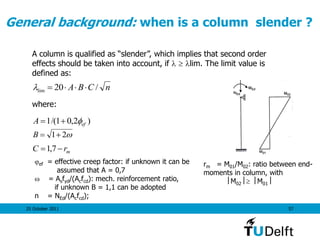
General background: when is a column slender ?
nCBA /20lim 
)2,01/(1 efA 
21B
A column is qualified as “slender”, which implies that second order
effects should be taken into account, if   lim. The limit value is
defined as:
where:
mrC  7,1
ef = effective creep factor: if unknown it can be
assumed that A = 0,7
 = Asfyd/(Acfcd): mech. reinforcement ratio,
if unknown B = 1,1 can be adopted
n = NEd/(Acfcd);
rm = M01/M02: ratio between end-
moments in column, with
M02 M01
25 October 2011 58
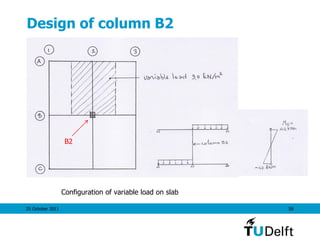
Design of column B2
Configuration of variable load on slab
B2
25 October 2011 59
Determination of columns slenderness 
First step: determination of rotational spring stiffness at end of column:
Column: EI/l = 0,043106 kNm2
Beam: EI/l = 0,052106 kNm2
K1 = [EI/l]col/[SEI]beams = 0,043/(20,052) = 0,41
If the beam would be cracked a value of 1,5 k1 would be more realistic. This would result
in l0 = 0,80l = 3,2m.
ll
k
k
k
k
ll 70,0)
02,1
41,0
1(5,0)
45,0
1)(
45,0
1(5,0 2
2
2
1
1
0 




25 October 2011 60
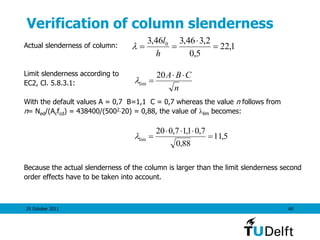
Verification of column slenderness
Actual slenderness of column:
Limit slenderness according to
EC2, Cl. 5.8.3.1:
With the default values A = 0,7 B=1,1 C = 0,7 whereas the value n follows from
n= Ned/(Acfcd) = 438400/(500220) = 0,88, the value of lim becomes:
Because the actual slenderness of the column is larger than the limit slenderness second
order effects have to be taken into account.
1,22
5,0
2,346,346,3 0



h
l

n
CBA 

20
lim
5,11
88,0
7,01,17,020
lim 


25 October 2011 61
General : Method based on nominal curvature
Mt = NEd (e0 + ei + e2)
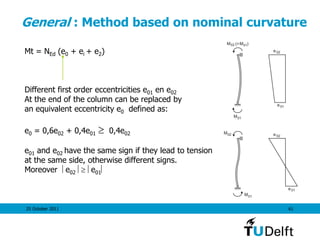
Different first order eccentricities e01 en e02
At the end of the column can be replaced by
an equivalent eccentricity e0 defined as:
e0 = 0,6e02 + 0,4e01  0,4e02
e01 and e02 have the same sign if they lead to tension
at the same side, otherwise different signs.
Moreover e02  e01
25 October 2011 62
General : Method based on the nominal curvature
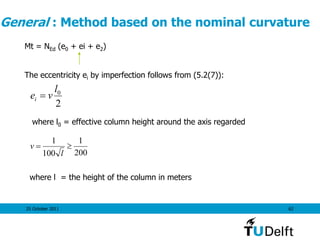
2
0l
vei 
Mt = NEd (e0 + ei + e2)
The eccentricity ei by imperfection follows from (5.2(7)):
where l0 = effective column height around the axis regarded
200
1
100
1

l
v
where l = the height of the column in meters
25 October 2011 63
General: Method based on nominal curvature
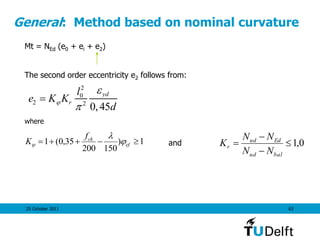
1)
150200
35,0(1  ef
ckf
K 


Mt = NEd (e0 + ei + e2)
The second order eccentricity e2 follows from:
where
0,1



balud
Edud
r
NN
NN
Kand
2
0
2 2
0,45
yd
r
l
e K K
d




25 October 2011 64
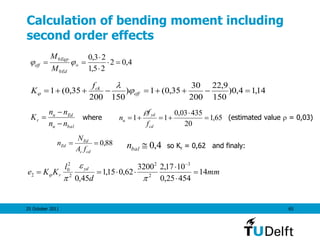
Calculation of bending moment including
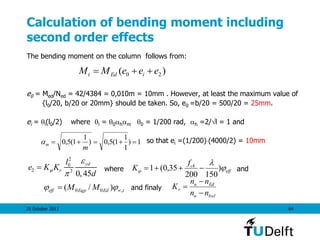
second order effects
The bending moment on the column follows from:
e0 = Med/Ned = 42/4384 = 0,010m = 10mm . However, at least the maximum value of
{l0/20, b/20 or 20mm} should be taken. So, e0 =b/20 = 500/20 = 25mm.
ei = i(l0/2) where i = 0hm 0 = 1/200 rad, h =2/l = 1 and
so that ei =(1/200)(4000/2) = 10mm
where and
and finaly
)( 20 eeeMM iEdt 
1)
1
1
1(5,0)
1
1(5,0 
m
m
2
0
2 2
0,45
yd
r
l
e K K
d



 eff
ckf
K 

 )
150200
35,0(1 
tEdEqpeff MM ,00 )/(  
balu
Edu
r
nn
nn
K



25 October 2011 65
Calculation of bending moment including
second order effects
where (estimated value  = 0,03)
so Kr = 0,62 and finaly:
4,02
25,1
23,0
0
0



 
Ed
Eqp
eff
M
M
14,14,0)
150
9,22
200
30
35,0(1)
150200
35,0(1  eff
ckf
K 


balu
Edu
r
nn
nn
K


 65,1
20
43503,0
11 


cd
yd
u
f
f
n

88,0
cdc
Ed
Ed
fA
N
n 4,0baln
mm
d
l
KKe
yd
r 14
45425,0
1017,23200
62,015,1
45,0
3
2
2
2
2
0
2 








25 October 2011 66
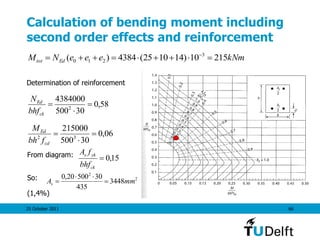
Calculation of bending moment including
second order effects and reinforcement
Determination of reinforcement
kNmeeeNM Edtot 21510)141025(4384)( 3
210  
58,0
30500
4384000
2



ck
Ed
bhf
N
06,0
30500
215000
32



cd
Ed
fbh
M
From diagram:
So:
(1,4%)
15,0
ck
yks
bhf
fA
2
2
3448
435
3050020,0
mmAs 


25 October 2011 67
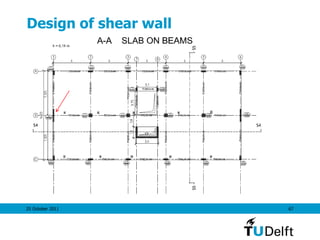
Design of shear wall
25 October 2011 68
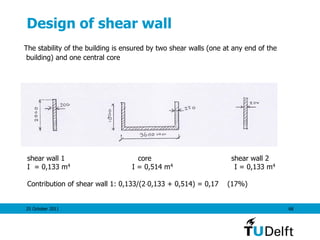
Design of shear wall
The stability of the building is ensured by two shear walls (one at any end of the
building) and one central core
shear wall 1 core shear wall 2
I = 0,133 m4 I = 0,514 m4 I = 0,133 m4
Contribution of shear wall 1: 0,133/(20,133 + 0,514) = 0,17 (17%)
25 October 2011 69
Second order effects to be regarded?
“If second order effects are smaller than 10% of the first
order moments they can be neglected”.
Moment magnification factor:
]
1/
1[0


EdB
EdEd
NN
MM

2
2
)12,1( l
EI
NB

 lqN vEd 
NB is the buckling load of the system sketched, l = height of building, qv =
uniformely distributed load in vertical direction, contributing to 2nd order
deformation.
qv
25 October 2011 70
Second order effects to be regarded?
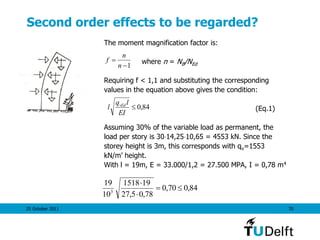
The moment magnification factor is:
where n = NB/NEd
Requiring f < 1,1 and substituting the corresponding
values in the equation above gives the condition:
(Eq.1)
Assuming 30% of the variable load as permanent, the
load per story is 3014,2510,65 = 4553 kN. Since the
storey height is 3m, this corresponds with qv=1553
kN/m’ height.
With l = 19m, E = 33.000/1,2 = 27.500 MPA, I = 0,78 m4
1

n
n
f
84,0
EI
lq
l vEd
84,070,0
78,05,27
191518
10
19
3



25 October 2011 71
Second order effects to be regarded?
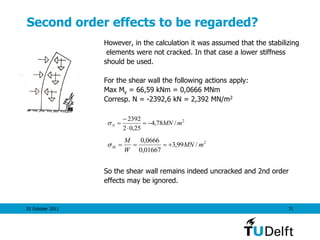
However, in the calculation it was assumed that the stabilizing
elements were not cracked. In that case a lower stiffness
should be used.
For the shear wall the following actions apply:
Max My = 66,59 kNm = 0,0666 MNm
Corresp. N = -2392,6 kN = 2,392 MN/m2
So the shear wall remains indeed uncracked and 2nd order
effects may be ignored.
2
/78,4
25,02
2392
mMNN 



2
/99,3
01667,0
0666,0
mMN
W
M
M 
25 October 2011 72
Alternative check by Eq. 5.18 in EC2
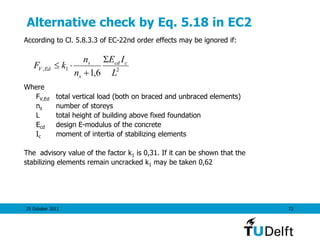
According to Cl. 5.8.3.3 of EC-22nd order effects may be ignored if:
Where
FV,Ed total vertical load (both on braced and unbraced elements)
ns number of storeys
L total height of building above fixed foundation
Ecd design E-modulus of the concrete
Ic moment of intertia of stabilizing elements
The advisory value of the factor k1 is 0,31. If it can be shown that the
stabilizing elements remain uncracked k1 may be taken 0,62
21,
6,1 L
IE
n
n
kF ccd
s
s
EdV
S


25 October 2011 73
Alternative check by Eq. 5.18 in EC2
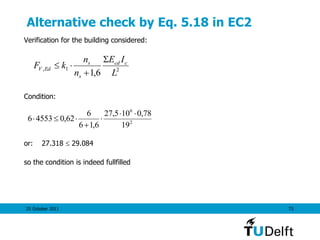
Verification for the building considered:
Condition:
or: 27.318  29.084
so the condition is indeed fullfilled
21,
6,1 L
IE
n
n
kF ccd
s
s
EdV
S


2
6
19
78,0105,27
6,16
6
62,045536




25 October 2011 74
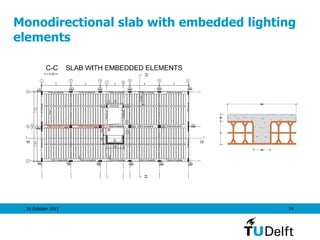
Monodirectional slab with embedded lighting
elements
25 October 2011 75
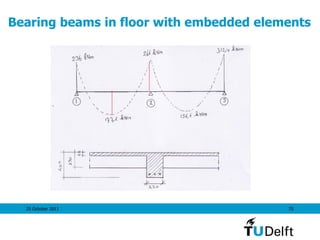
Bearing beams in floor with embedded elements
25 October 2011 76
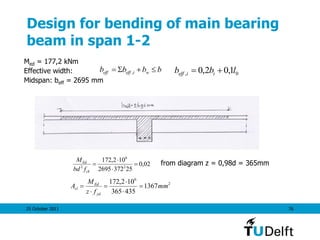
Design for bending of main bearing
beam in span 1-2
Med = 177,2 kNm
Effective width:
Midspan: beff = 2695 mm
from diagram z = 0,98d = 365mm
bbbb wieffeff S , 0, 1,02,0 lbb iieff 
02,0
253722695
102,172
2
6
2




ck
Ed
fbd
M
2
6
1367
435365
102,172
mm
fz
M
A
yd
Ed
sl 





25 October 2011 77
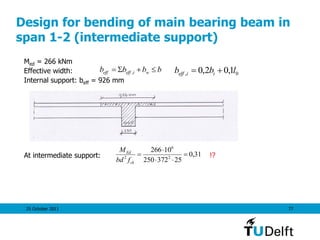
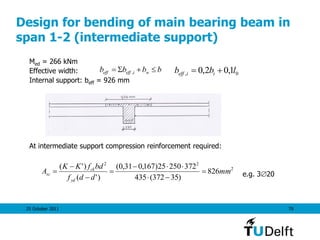
Design for bending of main bearing beam in
span 1-2 (intermediate support)
Med = 266 kNm
Effective width:
Internal support: beff = 926 mm
At intermediate support: !?
bbbb wieffeff S , 0, 1,02,0 lbb iieff 
31,0
25372250
10266
2
6
2




ck
Ed
fbd
M
25 October 2011 78
Factors for NA depth (n) and lever arm (=z) for concrete grade  50 MPa
0.00
0.20
0.40
0.60
0.80
1.00
1.20
M/bd 2fck
Factor
n 0.02 0.04 0.07 0.09 0.12 0.14 0.17 0.19 0.22 0.24 0.27 0.30 0.33 0.36 0.39 0.43 0.46
z 0.99 0.98 0.97 0.96 0.95 0.94 0.93 0.92 0.91 0.90 0.89 0.88 0.87 0.86 0.84 0.83 0.82
0.01 0.02 0.03 0.04 0.05 0.06 0.07 0.08 0.09 0.10 0.11 0.12 0.13 0.14 0.15 0.16 0.17
lever arm
NA depth
Simplified factors for flexure (1)
25 October 2011 79
Design for bending of main bearing beam in
span 1-2 (intermediate support)
Med = 266 kNm
Effective width:
Internal support: beff = 926 mm
At intermediate support compression reinforcement required:
e.g. 320
bbbb wieffeff S , 0, 1,02,0 lbb iieff 
2
22
826
)35372(435
37225025)167,031,0(
)'(
)'(
mm
ddf
bdfKK
A
yd
ck
sc 






25 October 2011 80
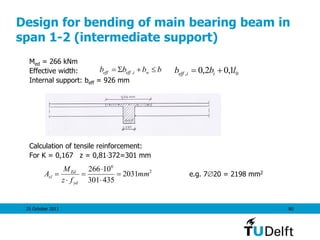
Design for bending of main bearing beam in
span 1-2 (intermediate support)
Med = 266 kNm
Effective width:
Internal support: beff = 926 mm
Calculation of tensile reinforcement:
For K = 0,167 z = 0,81372=301 mm
e.g. 720 = 2198 mm2
bbbb wieffeff S , 0, 1,02,0 lbb iieff 
2
6
2031
435301
10266
mm
fz
M
A
yd
Ed
sl 





25 October 2011 81
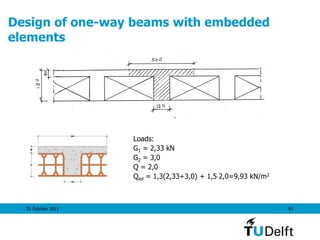
Design of one-way beams with embedded
elements
Loads:
G1 = 2,33 kN
G2 = 3,0
Q = 2,0
Qed = 1,3(2,33+3,0) + 1,52,0=9,93 kN/m2
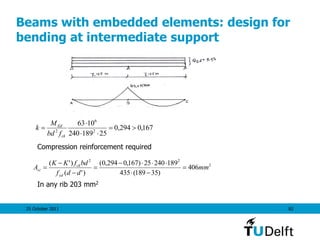
25 October 2011 82
Beams with embedded elements: design for
bending at intermediate support
Compression reinforcement required
In any rib 203 mm2
167,0294,0
25189240
1063
2
6
2




ck
Ed
fbd
M
k
2
22
406
)35189(435
18924025)167,0294,0(
)'(
)'(
mm
ddf
bdfKK
A
yd
ck
sc 






25 October 2011 83
Beams with embedded elements: design for
bending at intermediate support
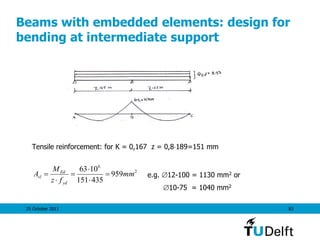
Tensile reinforcement: for K = 0,167 z = 0,8189=151 mm
e.g. 12-100 = 1130 mm2 or
2
6
959
435151
1063
mm
fz
M
A
yd
Ed
sl 





10-75 = 1040 mm2
25 October 2011 84
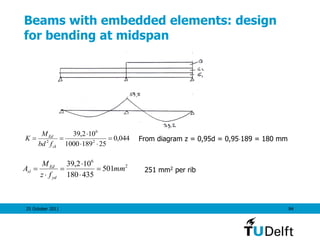
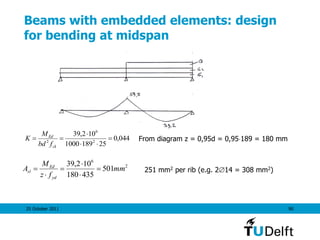
Beams with embedded elements: design
for bending at midspan
From diagram z = 0,95d = 0,95189 = 180 mm044,0
251891000
102,39
2
6
2




ck
Ed
fbd
M
K
2
6
501
435180
102,39
mm
fz
M
A
yd
Ed
sl 




 251 mm2 per rib
25 October 2011 85
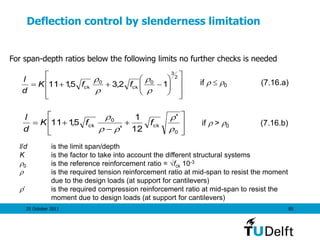
Deflection control by slenderness limitation















2
3
0
ck
0
ck 12,35,111




ffK
d
l if   0 (7.16.a)









0
ck
0
ck
'
12
1
'
5,111




ffK
d
l
if  > 0 (7.16.b)
l/d is the limit span/depth
K is the factor to take into account the different structural systems
0 is the reference reinforcement ratio = fck 10-3
 is the required tension reinforcement ratio at mid-span to resist the moment
due to the design loads (at support for cantilevers)
’ is the required compression reinforcement ratio at mid-span to resist the
moment due to design loads (at support for cantilevers)
For span-depth ratios below the following limits no further checks is needed
Deflection control by slenderness
limitation
)(
500
310
,
,
provs
reqs
yk
s
A
A
f 


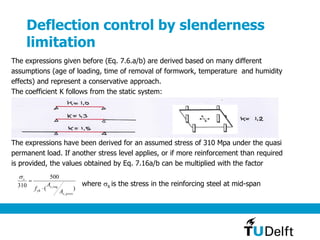
The expressions given before (Eq. 7.6.a/b) are derived based on many different
assumptions (age of loading, time of removal of formwork, temperature and humidity
effects) and represent a conservative approach.
The coefficient K follows from the static system:
The expressions have been derived for an assumed stress of 310 Mpa under the quasi
permanent load. If another stress level applies, or if more reinforcement than required
is provided, the values obtained by Eq. 7.16a/b can be multiplied with the factor
where s is the stress in the reinforcing steel at mid-span
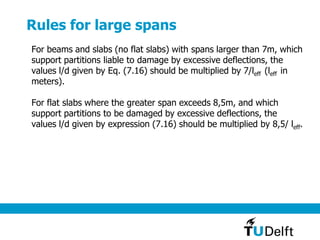
Rules for large spans
For beams and slabs (no flat slabs) with spans larger than 7m, which
support partitions liable to damage by excessive deflections, the
values l/d given by Eq. (7.16) should be multiplied by 7/leff (leff in
meters).
For flat slabs where the greater span exceeds 8,5m, and which
support partitions to be damaged by excessive deflections, the
values l/d given by expression (7.16) should be multiplied by 8,5/ leff.
25 October 2011 88
0
10
20
30
40
50
60
0 0.2 0.4 0.6 0.8 1 1.2 1.4 1.6 1.8 2
Reinforcement percentage (As/bd)
limitingspan/depthratio
fck =30 40 50 60 70 80 90
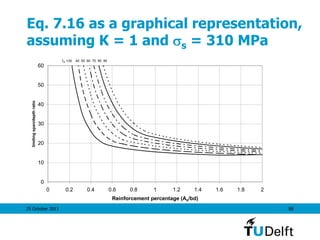
Eq. 7.16 as a graphical representation,
assuming K = 1 and s = 310 MPa
25 October 2011 89
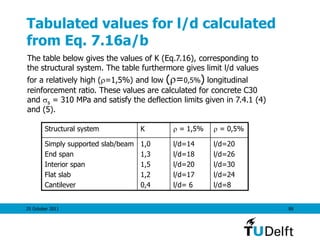
Tabulated values for l/d calculated
from Eq. 7.16a/b
The table below gives the values of K (Eq.7.16), corresponding to
the structural system. The table furthermore gives limit l/d values
for a relatively high (=1,5%) and low (=0,5%) longitudinal
reinforcement ratio. These values are calculated for concrete C30
and s = 310 MPa and satisfy the deflection limits given in 7.4.1 (4)
and (5).
Structural system K  = 1,5%  = 0,5%
Simply supported slab/beam
End span
Interior span
Flat slab
Cantilever
1,0
1,3
1,5
1,2
0,4
l/d=14
l/d=18
l/d=20
l/d=17
l/d= 6
l/d=20
l/d=26
l/d=30
l/d=24
l/d=8
25 October 2011 90
Beams with embedded elements: design
for bending at midspan
From diagram z = 0,95d = 0,95189 = 180 mm044,0
251891000
102,39
2
6
2




ck
Ed
fbd
M
K
2
6
501
435180
102,39
mm
fz
M
A
yd
Ed
sl 




 251 mm2 per rib (e.g. 214 = 308 mm2)
25 October 2011 91
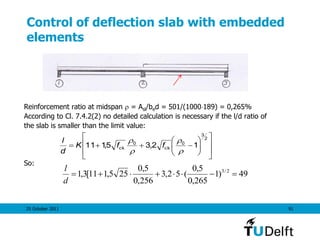
Control of deflection slab with embedded
elements
Reinforcement ratio at midspan  = Asl/bed = 501/(1000189) = 0,265%
According to Cl. 7.4.2(2) no detailed calculation is necessary if the l/d ratio of
the slab is smaller than the limit value:
So:















2
3
0
ck
0
ck 12,35,111




ffK
d
l
49)1
265,0
5,0
(52,3
256,0
5,0
255,111[3,1 2/3

d
l
25 October 2011 92
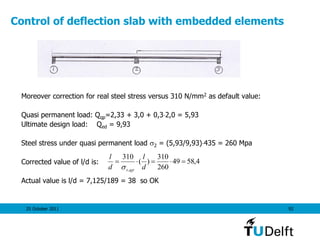
Control of deflection slab with embedded elements
Moreover correction for real steel stress versus 310 N/mm2 as default value:
Quasi permanent load: Qqp=2,33 + 3,0 + 0,32,0 = 5,93
Ultimate design load: Qed = 9,93
Steel stress under quasi permanent load 2 = (5,93/9,93)435 = 260 Mpa
Corrected value of l/d is:
Actual value is l/d = 7,125/189 = 38 so OK
4,5849
260
310
)(
310
,

d
l
d
l
qps
25 October 2011 93
Theory of crack width control
sr
se
steel stress
concrete stress
ctmf
t t
w
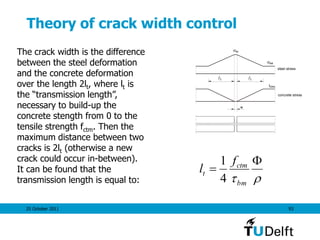
The crack width is the difference
between the steel deformation
and the concrete deformation
over the length 2lt, where lt is
the “transmission length”,
necessary to build-up the
concrete stength from 0 to the
tensile strength fctm. Then the
maximum distance between two
cracks is 2lt (otherwise a new
crack could occur in-between).
It can be found that the
transmission length is equal to: 


bm
ctm
t
f
l
4
1
25 October 2011 94
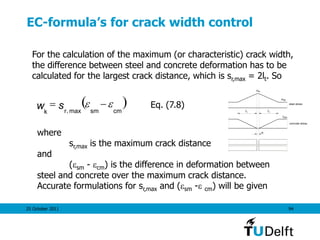
EC-formula’s for crack width control
For the calculation of the maximum (or characteristic) crack width,
the difference between steel and concrete deformation has to be
calculated for the largest crack distance, which is sr,max = 2lt. So
( )cmsmk
w r
s max,
 
where
sr,max is the maximum crack distance
and
(sm - cm) is the difference in deformation between
steel and concrete over the maximum crack distance.
Accurate formulations for sr,max and (sm - cm) will be given
sr
se
steel stress
concrete stress
ctmf
t t
w
Eq. (7.8)
25 October 2011 95
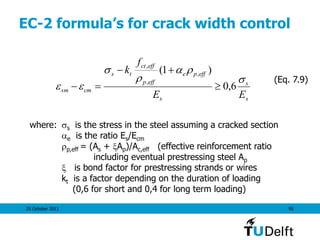
EC-2 formula’s for crack width control
where: s is the stress in the steel assuming a cracked section
e is the ratio Es/Ecm
p,eff = (As + Ap)/Ac,eff (effective reinforcement ratio
including eventual prestressing steel Ap
 is bond factor for prestressing strands or wires
kt is a factor depending on the duration of loading
(0,6 for short and 0,4 for long term loading)
(Eq. 7.9)
s
s
s
effpe
effp
effct
ts
cmsm
EE
f
k




 6,0
)1( ,
,
,



25 October 2011 96
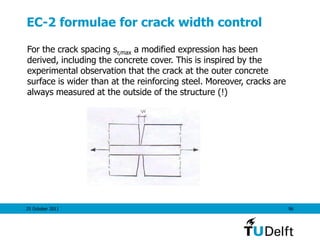
EC-2 formulae for crack width control
For the crack spacing sr,max a modified expression has been
derived, including the concrete cover. This is inspired by the
experimental observation that the crack at the outer concrete
surface is wider than at the reinforcing steel. Moreover, cracks are
always measured at the outside of the structure (!)
25 October 2011 97
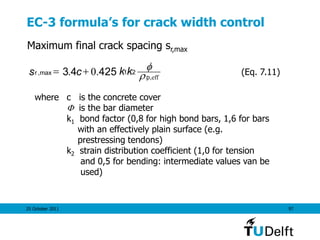
EC-3 formula’s for crack width control
Maximum final crack spacing sr,max
effp
r kkcs ,
21max, 425.04.3 
 (Eq. 7.11)
where c is the concrete cover
 is the bar diameter
k1 bond factor (0,8 for high bond bars, 1,6 for bars
with an effectively plain surface (e.g.
prestressing tendons)
k2 strain distribution coefficient (1,0 for tension
and 0,5 for bending: intermediate values van be
used)
25 October 2011 98
EC-2 formula’s for crack width control
In order to be able to apply
the crack width formulae,
basically valid for a concrete
tensile bar, to a structure
loaded in bending, a
definition of the “effective
tensile bar height” is
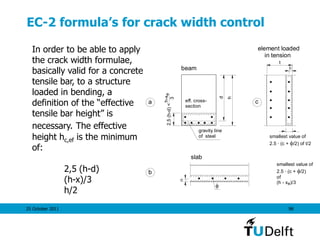
necessary. The effective
height hc,ef is the minimum
of:
2,5 (h-d)
(h-x)/3
h/2
d
h
gravity line
of steel
2.5(h-d)<
h-xe
3
eff. cross-
section
beam
slab
element loaded
in tension
c
t
smallest value of
2.5 . (c + /2) of t/2
c

smallest value of
2.5 . (c + /2)
of
(h - x )/3

e
a
b
c
25 October 2011 99
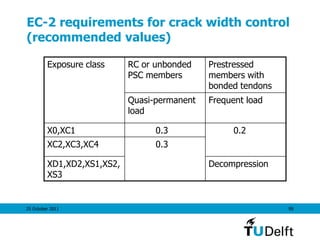
EC-2 requirements for crack width control
(recommended values)
Exposure class RC or unbonded
PSC members
Prestressed
members with
bonded tendons
Quasi-permanent
load
Frequent load
X0,XC1 0.3 0.2
XC2,XC3,XC4 0.3
XD1,XD2,XS1,XS2,
XS3
Decompression
25 October 2011 100
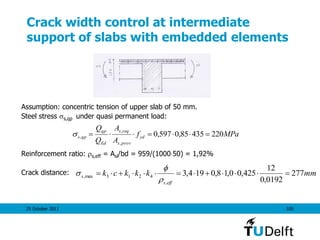
Crack width control at intermediate
support of slabs with embedded elements
Assumption: concentric tension of upper slab of 50 mm.
Steel stress s,qp under quasi permanent load:
Reinforcement ratio: s,eff = Asl/bd = 959/(100050) = 1,92%
Crack distance:
MPaf
A
A
Q
Q
yd
provs
reqs
Ed
qp
qps 22043585,0597,0
,
,
, 
mmkkkck
effs
s 277
0192,0
12
425,00,18,0194,3
,
4213max, 



25 October 2011 101
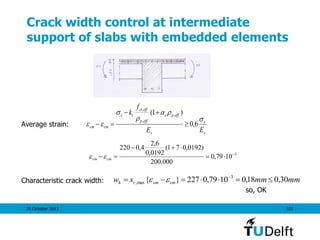
Crack width control at intermediate
support of slabs with embedded elements
Average strain:
Characteristic crack width:
so, OK
s
s
s
effpe
effp
effct
ts
cmsm
EE
f
k




 6,0
)1( ,
,
,



3
1079,0
000.200
)0192,071(
0192,0
6,2
4,0220



 cmsm 
mmmmsw cmsmrk 30,018,01079,0227}{ 3
max,  

25 October 2011 102
Crack width at mid-span beams with
embedded elements
Cross-section of
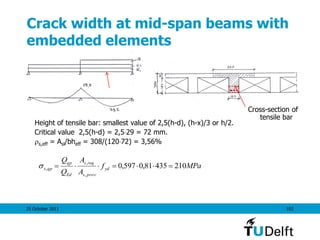
tensile bar
Height of tensile bar: smallest value of 2,5(h-d), (h-x)/3 or h/2.
Critical value 2,5(h-d) = 2,529 = 72 mm.
s,eff = Asl/bheff = 308/(12072) = 3,56%
MPaf
A
A
Q
Q
yd
provs
reqs
Ed
qp
qps 21043581,0597,0
,
,
, 
25 October 2011 103
Crack width at mid-span beams with
embedded elements
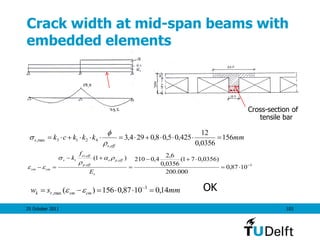
Cross-section of
tensile bar
mmkkkck
effs
s 156
0356,0
12
425,05,08,0294,3
,
4213max, 



3
,
,
,
1087,0
000.200
)0356,071(
0356,0
6,2
4,0210)1(






s
effpe
effp
effct
ts
cmsm
E
f
k 



mmsw cmsmrk 14,01087,0156)( 3
max,  
 OK
25 October 2011 104
Different cultures: different floors

04 ec2 ws_walraven_ulssls

  • 1.
    25 October 2011 1 Limitstate design and verification Joost Walraven
  • 2.
    25 October 20112 Flat slab on beams To be considered: beam axis 2
  • 3.
    25 October 20113 b b1 b1 b2 b2 bw bw beff,1 beff,2 beff Determination of effective width (5.3.2.1) beff = S beff,i + bw  b where beff,i = 0,2bi + 0,1l0  0,2l0 and beff,I  bi l3 l1 l2 0,15(l1 + l2 ) l =0 l0 = 0,7 l2 l0 = 0,15 l2 + l3l0 = 0,85 l1
  • 4.
    25 October 20114 Cross-section of beam with slab beff,i = 0,2bi + 0,1l0  0,2l0 and beff,I  bi beff,i = 0,22875 +0,1(0,857125) = 1180 mm (<2875mm) beff = S beff,i + bw = 21180 + 250 = 2610mm
  • 5.
    25 October 20115 Beam with effective width Cross-section at mid-span
  • 6.
    25 October 20116 Beam with effective width Cross-section at intermediate support
  • 7.
    25 October 20117 Maximum design bending moments and shear forces Maximum design moments Med in kNm (values for different load cases) Maximum shear forces Ved in kN (values for different load cases)
  • 8.
    25 October 20118 Maximum design bending moments and shear forces Maximum design moments Med in kNm (values for different load cases) Maximum shear forces Ved in kN (values for different load cases)
  • 9.
    25 October 20119 Determination of bending reinforcement using method with simplified concrete design stress block (3.1.7) As d fcd Fs x s x cu3 Fc Ac 400 )50 8,0 ck   (f for 50 < fck  90 MPa  = 0,8 for fck  50 MPa  = 1,0 for fck  50 MPa = 1,0 – (fck – 50)/200 for 50 < fck  90 MPa
  • 10.
    25 October 201110 Factors for NA depth (n) and lever arm (=z) for concrete grade  50 MPa 0.00 0.20 0.40 0.60 0.80 1.00 1.20 M/bd 2fck Factor n 0.02 0.04 0.07 0.09 0.12 0.14 0.17 0.19 0.22 0.24 0.27 0.30 0.33 0.36 0.39 0.43 0.46 z 0.99 0.98 0.97 0.96 0.95 0.94 0.93 0.92 0.91 0.90 0.89 0.88 0.87 0.86 0.84 0.83 0.82 0.01 0.02 0.03 0.04 0.05 0.06 0.07 0.08 0.09 0.10 0.11 0.12 0.13 0.14 0.15 0.16 0.17 lever arm NA depth Simplified factors for flexure (1)
  • 11.
    25 October 201111 Factors for NA depth (=n) and lever arm (=z) for concrete grade 70 MPa 0.00 0.20 0.40 0.60 0.80 1.00 1.20 M/bd 2fck Factor n 0.03 0.05 0.08 0.11 0.14 0.17 0.20 0.23 0.26 0.29 0.33 z 0.99 0.98 0.97 0.96 0.95 0.94 0.93 0.91 0.90 0.89 0.88 0.01 0.02 0.03 0.04 0.05 0.06 0.07 0.08 0.09 0.10 0.11 0.12 0.13 0.14 0.15 0.16 0.17 Simplified factors for flexure (2) lever arm NA depth
  • 12.
    25 October 201112 Determination of bending reinforcement (span AB) Example: largest bending moment in span AB: Med = 89,3 kNm 001,0 253722610 103,89 2 6 2     ck Ed fbd M Read in diagram: lever arm factor = 0,99, so: 2 6 , 563 43537298,0 103,89 mm fz M A yd Ed reqsl      
  • 13.
    25 October 201113 Determination of bending reinforcement (span AB) Example: largest bending moment in span AB: Med = 89,3 kNm Moreover, from diagram: neutral axis depth factor is 0,02, so xu = 0,02180 = 4 mm. So height of compression zone < flange thickness (180 mm), OK
  • 14.
    25 October 201114 Determination of bending reinforcement (intermediate support B Bending moment at support B: Med = 132,9 kNm 154,0 25372250 100,132 2 6 2     ck Ed fbd M Read: lever arm factor 0,81 2 6 1014 43537281,0 109,132 mm fz M A yd Ed sl      
  • 15.
    25 October 201115 Maximum design bending moments and shear forces Maximum design moments Med in kNm (values for different load cases) Maximum shear forces Ved in kN (values for different load cases) Shear may be determined at distance d from support, so Ved  115 kN
  • 16.
    25 October 201116 Design of beams for shear (6.2.2) First check (6.2.2): if VEd ≥ VRd,c then shear reinforcement is required: where: fck in Mpa k = with d in mm l = with d = 372mm, bw = 250mm, l = 0,61%, fck = 25MPa so shear reinforcement is required bdfkV cklccRd 3/1 , )100()/18,0(  0,2 200 1  d 02,0 db A w sl kNkNV cRd 1158,4710372250)2561,0(73,1)5,1/18,0( 33/1 ,  
  • 17.
    25 October 201117 Expressions for shear capacity at stirrup yielding (VRd,s) and web crushing (VRd,max)  Vu,2 cc1=f =fc Vu,3 s z zcot Afswyw  Vu,2 c c1= f = f c Vu,3 s z z cot  A fsw yw For yielding shear reinforcement: VRd,s = (Asw/s) z fywd cot with  between 450 and 21,80 (1  cot   2,5) At web crushing: VRd,max = bw z  fcd /(cot + tan) with  between 450 and 21,80 (1 cot  2,5)  = 0.6 (1- fck/250)
  • 18.
    25 October 201118 Design of beams for shear Basic equation for determination of shear reinforcement: VEd,s = (Asw/s) z fywd cot With Ved,s = 115000 N, fywd = 435 Mpa, z = 0,9d, d = 372 mm and cot  = 2,5 it is found that Asw/s ≥ 0,32 e.g. stirrups 6mm – 175mm Check upper value of shear capacity (web crushing criterion) VRd,max = bw z  fcd /(cot + tan) with bw = 250mm, d = 372mm, z = 0,9d,  = 0,6(1-fck/250) = 0,54, fcd = 25/1,5 = 13,3 Mpa and cot  = 2,5 it is found that VRd,max = 1774 kN which is much larger than the design shear force of 115 kN
  • 19.
    25 October 201119 Stirrup configuration near to support A
  • 20.
    25 October 201120 Transverse shear in web-flange interface
  • 21.
    25 October 201121 Shear between web and flanges of T-sections
  • 22.
    25 October 201122 Shear between web and flanges of T-sections Strut angle : 1,0 ≤ cot f ≤ 2,0 for compression flanges (450  f  26,50 1,0 ≤ cot f ≤ 1,25 for tension flanges (450  f  38,60) No transverse tension ties required if shear stress in interface vEd = Fd/(hf·x) ≤ kfctd (recommended k = 0,4)
  • 23.
    25 October 201123 Check necessity of transverse reinforcement MPa hz V b b v f Ed eff f Ed 86,0 1803729,0 115000 2610 1180      No transverse reinforcement required if vEd  0,4fctd For C25/30 fctd = fctk/c =1,8/1,5 = 1,38 Mpa, so the limit value for interface shear is 0,4fctk = 0,41,38 = 0,55 MPa. Transverse shear reinforcement is required at the end of the beam.
  • 24.
    25 October 201124 Maximum design bending moments and shear forces Maximum design moments Med in kNm (values for different load cases) Maximum shear forces Ved in kN (values for different load cases)
  • 25.
    25 October 201125 Areas in beam axis 2 where transverse reinforcement is required
  • 26.
    25 October 201126 Areas in beam axis 2 where transverse reinforcement is required
  • 27.
    25 October 201127 Example: transverse reinforcement near to support A Required transverse reinforcement for Ved = 115 kN e.g. 8 – 250 (=0,20 mm2/mm) mmmm zf V b b s A fyd Ed eff fst /18,0 0,2 1 435335 115000 2610 1180 cot 1 2    
  • 28.
    25 October 201128 Design of slabs supported by beams
  • 29.
    25 October 201129 Design of slabs supported by beams Load transmission from slabs to beams Simplified load transmission model Dead load G1 = 0,1825 = 4,5 kN/m2 Partitions, etc. G2 = 3,0 kN/m2 Variable load Q = 2,0 kN/m2 Ged = 1,3(4,5 + 3,0) = 9,75 kN/m2 Qed = 1,52,0 = 3,0 kN/m2
  • 30.
    25 October 201130 Load transfer from slabs to beams Loading cases on arbitrary strip (dashed in left figure)
  • 31.
    25 October 201131 Longitudinal reinforcement in slabs on beams Examples of reinforced areas
  • 32.
    25 October 201132 Floor type 2: flat slab d = 210 mm From floor on beams to flat slab: replace beams by strips with the same bearing capacity
  • 33.
    25 October 201133 From slab on beams to flat slab hidden strong strip -Strips with small width and large reinforcement ratio favourable for punching resistance - Strips not so small that compression reinforcement is necessary
  • 34.
    25 October 201134 Methods of analysis: Equivalent Frame Analysis – Annex I (Informative) lx (> ly) ly ly/4 ly/4 ly/4 ly/4 = lx - ly/2 = ly/2 = ly/2A B B A – Column strip B – Middle strip Negative moments Positive moments Column Strip 60 - 80% 50 - 70% Middle Strip 40 - 20% 50 - 30% Note: Total negative and positive moments to be resisted by the column and middle strips together should always add up to 100%.
  • 35.
    25 October 201135 Flat slab with “hidden strong strips”
  • 36.
    25 October 201136 Punching shear control column B2
  • 37.
    25 October 201137 Punching column B2 Junction column to slab Vertical load from slab to column Ved = 705 kN Simplified assumptions for eccentricity factor  according to EN 1992-1-1 Cl. 6.4.3  = 1,4  = 1,5  = 1,15 C B A
  • 38.
    25 October 201138 How to take account of eccentricity (simplified case) du V v i Ed Ed Or, how to determine  in equation  = 1,4  = 1,5  = 1,15 C B A Only for structures where lateral stability does not depend on frame action and where adjacent spans do not differ by more than 25% the approximate values for  shown left may be used:
  • 39.
    25 October 201139 Upper limit value for design punching shear stress in design cdRd Ed Ed fv du V v   4,0max, 0  At the perimeter of the loaded area the maximum punching shear stress should satisfy the following criterion: where: u0 = perimeter of loaded area  = 0,6[1 – fck/250]
  • 40.
    25 October 201140 Punching shear column B2 1. Check of upper limit value of punching shear capacity Further data: dy = 210 – 30 – 16/2 = 172mm dz = 210 – 30 – 16 – 16/2 = 156 mm Mean effective depth 0,5(172 + 156) = 164mm  = 0,6(1 + fck/250) = 0,54 vRd,max = 0,4fcd = 0,40,54(25/1,5) = 3,60 Mpa vEd = Ved/(u0d) = 1,15705000/(4500164) = 2,47 Mpa < 3,60 Mpa
  • 41.
    25 October 201141 Definition of control perimeters The basic control perimeter u1 is taken at a distance 2,0d from the loaded area and should be constructed as to minimise its length Length of control perimeter of column 500x500mm: u = 4500 + 22164 = 4060 mm
  • 42.
    25 October 201142 Punching shear capacity column B2 Punching shear stress at perimeter: No punching shear reinforcement required if: MPa du V v Ed Ed 22,1 1644060 70500015,1 1      cRdEd vv ,
  • 43.
    25 October 201143 Limit values for design punching shear stress in design cRdEd vv , The following limit values for the punching shear stress are used in design: If no punching shear reinforcement required )()100( 1min1 3/1 ,, cpcpcklcRdcRd kvkfkCv   where: where: k1 = 0,10 (advisory value)
  • 44.
    25 October 201144 Punching shear capacity of column B2 No punching shear reinforcement required if vEd < vRd,c With CRd,c = 0,12 k = 1 + (200/d) = 1 + (200/164) < 2, so k = 2,0  = (xy) = (0,860,87) = 0,865% fck = 25 Mpa It is found that vRd,c = 0,67 Mpa Since vEd = 1,22 MPa> 0,67 MPa punching shear reinforcement should be applied. 3/1 ,, )100( cklcRdcRd fkCv 
  • 45.
    25 October 201145 Punching shear reinforcement Capacity with punching shear reinforcement Vu = 0,75VRd,c + VS Shear reinforcement within 1,5d from column is accounted for with fy,red = 250 + 0,25d(mm)  fywd
  • 46.
    25 October 201146 kd Outer control perimeter Outer perimeter of shear reinforcement 1.5d (2d if > 2d from column) 0.75d 0.5d A A Section A - A 0.75d 0.5d Outer control perimeter kd Punching shear reinforcement The outer control perimeter at which shear reinforcement is not required, should be calculated from: uout,ef = VEd / (vRd,c d) The outermost perimeter of shear reinforcement should be placed at a distance not greater than kd (k = 1.5) within the outer control perimeter.
  • 47.
    47 Design of punchingshear reinforcement The necessary punching shear reinforcement per perimeter is found from: 1 , , ( 0,75 ) 1,5 r Ed Rd c sw ywd ef u s v v A f   with: vEd = 1,22 N/mm2 vRd,c= 0,67 N/mm2 u1 = 4060 mm fyd,ef = 250 + 0,25  164 = 291 N/mm2 sr = 0,75  164 = 123 mm  120 mm It is found that: Asw = 800 mm2 per reinforcement perimeter
  • 48.
    25 October 201148 Design of column B2 for punching shear Determination of the outer perimeter for which vEd = vRd,c The distance from this perimeter to the edge of the column follows from: The outer punching shera reinforcement should be at a distance of not more than 1,5d from the outer perimeter. This is at a distance 5,22d – 1,5d = 3,72d = 610 mm. The distance between the punching shear reinforcement perimeters should not be larger than 0,75d = 0,75164 = 123mm. mmdvVu cRdEdout 737816467,0/()70500015,1()/( ,   dmmhua out 22,5856)2/()50047378(2/)4(  
  • 49.
    25 October 201149 Punching shear design of slab at column B2 Perimeters of shear reinforcement
  • 50.
    25 October 201150 Design of column B2
  • 51.
    25 October 201151 General background: Second order effects at axial loading (EC2, 5.8.2, 5.8.3.1 & 5.8.3.3 - Second-order effects may be ignored if they are smaller than 10% of the corresponding 1th order effects - “Slenderness”: is defined as  = l0/i where i = (l/A) so for rectangular cross-section  = 3,46 l0/h and for circular cross section  = 4l0/h - Second order effects may be ignored if the slenderness is smaller than the limit value lim - In case of biaxial bending the slenderness should be calculated for any direction; second order effects need only to be considered in the direction(s) in which lim is exceeded.
  • 52.
    25 October 201152 General background: “Slender” versus “short” columns Definition of slenderness )/( 00 AI l i l  l0 effective height of the column i radius of gyration of the uncracked concrete section I moment of inertia around the axis considered A cross-sectional area of column Basic cases EC2 fig. 5.7
  • 53.
    25 October 201153 General background: when is a column slender? Relative flexibilities of rotation-springs at the column ends 1 en 2 k = (/M)(EI/l) where  = rotation of restraining members for a bending moment M EI = bending stiffness of compression member l = height of column between rotation-springs
  • 54.
    25 October 201154 General background: when is a column slender? ) 45,0 1)( 45,0 1(5,0 2 2 1 1 0 k k k k ll     )101( 21 21 0 kk kk ll    Determination of effective column height in a frame For unbraced frames: the largest value of: and where k1 and k2 are the relative spring stiffnesses at the ends of the column, and l is the clear height of the column between the end restraints For braced frames: Failing column Non failing column End 1 End 2 Non-failing column 1 2 0 1 2 1 1 1 1 k k l l k k            
  • 55.
    25 October 201155 General background: determination of effective column length (1) (5.8, 5.8.3.2) Failing column Non failing column End 1 End 2 Non failing columnSimplifying assumption: * The contribution of the adjacent “non failing ” columns to the spring stiffness is ignored (if this contributes in a positive sense to the restraint) * for beams for /M the value l/2EI may be assumed (taking account of loss of beam stiffness due to cracking) Assuming that the beams are symmetric with regard to the column and that their dimensions are the same for the two stories, the following relations are found: k1 = k2 = [EI/l]column / [SEI/l]beams = [EI/l]column / [22EI/l]beams = 0,25  where:  = [EI/l]column / [EI/l]beams
  • 56.
    25 October 201156 General background: Determination of effective column length (2) (5.8, 5.8.3.2)  or 0 (fixed end) 0.25 0.5 1.0 2.0  (pinned end) k1 = k2 0 0.0625 0.125 0.25 0.50 1.0 l0 for braced column 0.5 l 0.56 l 0.61 l 0.68 l 0.76 l 1.0 l l0 for unbraced column: Larger of the values in the two rows 1.0 l 1.14 l 1.27 l 1.50 l 1.87 l ∞ 1.0 l 1.12 l 1.13 l 1.44 l 1.78 l ∞ The effective column length l0 can, for this situation be read from the table as a function of  )/( 00 AI l i l 
  • 57.
    25 October 201157 General background: when is a column slender ? nCBA /20lim  )2,01/(1 efA  21B A column is qualified as “slender”, which implies that second order effects should be taken into account, if   lim. The limit value is defined as: where: mrC  7,1 ef = effective creep factor: if unknown it can be assumed that A = 0,7  = Asfyd/(Acfcd): mech. reinforcement ratio, if unknown B = 1,1 can be adopted n = NEd/(Acfcd); rm = M01/M02: ratio between end- moments in column, with M02 M01
  • 58.
    25 October 201158 Design of column B2 Configuration of variable load on slab B2
  • 59.
    25 October 201159 Determination of columns slenderness  First step: determination of rotational spring stiffness at end of column: Column: EI/l = 0,043106 kNm2 Beam: EI/l = 0,052106 kNm2 K1 = [EI/l]col/[SEI]beams = 0,043/(20,052) = 0,41 If the beam would be cracked a value of 1,5 k1 would be more realistic. This would result in l0 = 0,80l = 3,2m. ll k k k k ll 70,0) 02,1 41,0 1(5,0) 45,0 1)( 45,0 1(5,0 2 2 2 1 1 0     
  • 60.
    25 October 201160 Verification of column slenderness Actual slenderness of column: Limit slenderness according to EC2, Cl. 5.8.3.1: With the default values A = 0,7 B=1,1 C = 0,7 whereas the value n follows from n= Ned/(Acfcd) = 438400/(500220) = 0,88, the value of lim becomes: Because the actual slenderness of the column is larger than the limit slenderness second order effects have to be taken into account. 1,22 5,0 2,346,346,3 0    h l  n CBA   20 lim 5,11 88,0 7,01,17,020 lim   
  • 61.
    25 October 201161 General : Method based on nominal curvature Mt = NEd (e0 + ei + e2) Different first order eccentricities e01 en e02 At the end of the column can be replaced by an equivalent eccentricity e0 defined as: e0 = 0,6e02 + 0,4e01  0,4e02 e01 and e02 have the same sign if they lead to tension at the same side, otherwise different signs. Moreover e02  e01
  • 62.
    25 October 201162 General : Method based on the nominal curvature 2 0l vei  Mt = NEd (e0 + ei + e2) The eccentricity ei by imperfection follows from (5.2(7)): where l0 = effective column height around the axis regarded 200 1 100 1  l v where l = the height of the column in meters
  • 63.
    25 October 201163 General: Method based on nominal curvature 1) 150200 35,0(1  ef ckf K    Mt = NEd (e0 + ei + e2) The second order eccentricity e2 follows from: where 0,1    balud Edud r NN NN Kand 2 0 2 2 0,45 yd r l e K K d    
  • 64.
    25 October 201164 Calculation of bending moment including second order effects The bending moment on the column follows from: e0 = Med/Ned = 42/4384 = 0,010m = 10mm . However, at least the maximum value of {l0/20, b/20 or 20mm} should be taken. So, e0 =b/20 = 500/20 = 25mm. ei = i(l0/2) where i = 0hm 0 = 1/200 rad, h =2/l = 1 and so that ei =(1/200)(4000/2) = 10mm where and and finaly )( 20 eeeMM iEdt  1) 1 1 1(5,0) 1 1(5,0  m m 2 0 2 2 0,45 yd r l e K K d     eff ckf K    ) 150200 35,0(1  tEdEqpeff MM ,00 )/(   balu Edu r nn nn K   
  • 65.
    25 October 201165 Calculation of bending moment including second order effects where (estimated value  = 0,03) so Kr = 0,62 and finaly: 4,02 25,1 23,0 0 0      Ed Eqp eff M M 14,14,0) 150 9,22 200 30 35,0(1) 150200 35,0(1  eff ckf K    balu Edu r nn nn K    65,1 20 43503,0 11    cd yd u f f n  88,0 cdc Ed Ed fA N n 4,0baln mm d l KKe yd r 14 45425,0 1017,23200 62,015,1 45,0 3 2 2 2 2 0 2         
  • 66.
    25 October 201166 Calculation of bending moment including second order effects and reinforcement Determination of reinforcement kNmeeeNM Edtot 21510)141025(4384)( 3 210   58,0 30500 4384000 2    ck Ed bhf N 06,0 30500 215000 32    cd Ed fbh M From diagram: So: (1,4%) 15,0 ck yks bhf fA 2 2 3448 435 3050020,0 mmAs   
  • 67.
    25 October 201167 Design of shear wall
  • 68.
    25 October 201168 Design of shear wall The stability of the building is ensured by two shear walls (one at any end of the building) and one central core shear wall 1 core shear wall 2 I = 0,133 m4 I = 0,514 m4 I = 0,133 m4 Contribution of shear wall 1: 0,133/(20,133 + 0,514) = 0,17 (17%)
  • 69.
    25 October 201169 Second order effects to be regarded? “If second order effects are smaller than 10% of the first order moments they can be neglected”. Moment magnification factor: ] 1/ 1[0   EdB EdEd NN MM  2 2 )12,1( l EI NB   lqN vEd  NB is the buckling load of the system sketched, l = height of building, qv = uniformely distributed load in vertical direction, contributing to 2nd order deformation. qv
  • 70.
    25 October 201170 Second order effects to be regarded? The moment magnification factor is: where n = NB/NEd Requiring f < 1,1 and substituting the corresponding values in the equation above gives the condition: (Eq.1) Assuming 30% of the variable load as permanent, the load per story is 3014,2510,65 = 4553 kN. Since the storey height is 3m, this corresponds with qv=1553 kN/m’ height. With l = 19m, E = 33.000/1,2 = 27.500 MPA, I = 0,78 m4 1  n n f 84,0 EI lq l vEd 84,070,0 78,05,27 191518 10 19 3   
  • 71.
    25 October 201171 Second order effects to be regarded? However, in the calculation it was assumed that the stabilizing elements were not cracked. In that case a lower stiffness should be used. For the shear wall the following actions apply: Max My = 66,59 kNm = 0,0666 MNm Corresp. N = -2392,6 kN = 2,392 MN/m2 So the shear wall remains indeed uncracked and 2nd order effects may be ignored. 2 /78,4 25,02 2392 mMNN     2 /99,3 01667,0 0666,0 mMN W M M 
  • 72.
    25 October 201172 Alternative check by Eq. 5.18 in EC2 According to Cl. 5.8.3.3 of EC-22nd order effects may be ignored if: Where FV,Ed total vertical load (both on braced and unbraced elements) ns number of storeys L total height of building above fixed foundation Ecd design E-modulus of the concrete Ic moment of intertia of stabilizing elements The advisory value of the factor k1 is 0,31. If it can be shown that the stabilizing elements remain uncracked k1 may be taken 0,62 21, 6,1 L IE n n kF ccd s s EdV S  
  • 73.
    25 October 201173 Alternative check by Eq. 5.18 in EC2 Verification for the building considered: Condition: or: 27.318  29.084 so the condition is indeed fullfilled 21, 6,1 L IE n n kF ccd s s EdV S   2 6 19 78,0105,27 6,16 6 62,045536    
  • 74.
    25 October 201174 Monodirectional slab with embedded lighting elements
  • 75.
    25 October 201175 Bearing beams in floor with embedded elements
  • 76.
    25 October 201176 Design for bending of main bearing beam in span 1-2 Med = 177,2 kNm Effective width: Midspan: beff = 2695 mm from diagram z = 0,98d = 365mm bbbb wieffeff S , 0, 1,02,0 lbb iieff  02,0 253722695 102,172 2 6 2     ck Ed fbd M 2 6 1367 435365 102,172 mm fz M A yd Ed sl      
  • 77.
    25 October 201177 Design for bending of main bearing beam in span 1-2 (intermediate support) Med = 266 kNm Effective width: Internal support: beff = 926 mm At intermediate support: !? bbbb wieffeff S , 0, 1,02,0 lbb iieff  31,0 25372250 10266 2 6 2     ck Ed fbd M
  • 78.
    25 October 201178 Factors for NA depth (n) and lever arm (=z) for concrete grade  50 MPa 0.00 0.20 0.40 0.60 0.80 1.00 1.20 M/bd 2fck Factor n 0.02 0.04 0.07 0.09 0.12 0.14 0.17 0.19 0.22 0.24 0.27 0.30 0.33 0.36 0.39 0.43 0.46 z 0.99 0.98 0.97 0.96 0.95 0.94 0.93 0.92 0.91 0.90 0.89 0.88 0.87 0.86 0.84 0.83 0.82 0.01 0.02 0.03 0.04 0.05 0.06 0.07 0.08 0.09 0.10 0.11 0.12 0.13 0.14 0.15 0.16 0.17 lever arm NA depth Simplified factors for flexure (1)
  • 79.
    25 October 201179 Design for bending of main bearing beam in span 1-2 (intermediate support) Med = 266 kNm Effective width: Internal support: beff = 926 mm At intermediate support compression reinforcement required: e.g. 320 bbbb wieffeff S , 0, 1,02,0 lbb iieff  2 22 826 )35372(435 37225025)167,031,0( )'( )'( mm ddf bdfKK A yd ck sc       
  • 80.
    25 October 201180 Design for bending of main bearing beam in span 1-2 (intermediate support) Med = 266 kNm Effective width: Internal support: beff = 926 mm Calculation of tensile reinforcement: For K = 0,167 z = 0,81372=301 mm e.g. 720 = 2198 mm2 bbbb wieffeff S , 0, 1,02,0 lbb iieff  2 6 2031 435301 10266 mm fz M A yd Ed sl      
  • 81.
    25 October 201181 Design of one-way beams with embedded elements Loads: G1 = 2,33 kN G2 = 3,0 Q = 2,0 Qed = 1,3(2,33+3,0) + 1,52,0=9,93 kN/m2
  • 82.
    25 October 201182 Beams with embedded elements: design for bending at intermediate support Compression reinforcement required In any rib 203 mm2 167,0294,0 25189240 1063 2 6 2     ck Ed fbd M k 2 22 406 )35189(435 18924025)167,0294,0( )'( )'( mm ddf bdfKK A yd ck sc       
  • 83.
    25 October 201183 Beams with embedded elements: design for bending at intermediate support Tensile reinforcement: for K = 0,167 z = 0,8189=151 mm e.g. 12-100 = 1130 mm2 or 2 6 959 435151 1063 mm fz M A yd Ed sl       10-75 = 1040 mm2
  • 84.
    25 October 201184 Beams with embedded elements: design for bending at midspan From diagram z = 0,95d = 0,95189 = 180 mm044,0 251891000 102,39 2 6 2     ck Ed fbd M K 2 6 501 435180 102,39 mm fz M A yd Ed sl       251 mm2 per rib
  • 85.
    25 October 201185 Deflection control by slenderness limitation                2 3 0 ck 0 ck 12,35,111     ffK d l if   0 (7.16.a)          0 ck 0 ck ' 12 1 ' 5,111     ffK d l if  > 0 (7.16.b) l/d is the limit span/depth K is the factor to take into account the different structural systems 0 is the reference reinforcement ratio = fck 10-3  is the required tension reinforcement ratio at mid-span to resist the moment due to the design loads (at support for cantilevers) ’ is the required compression reinforcement ratio at mid-span to resist the moment due to design loads (at support for cantilevers) For span-depth ratios below the following limits no further checks is needed
  • 86.
    Deflection control byslenderness limitation )( 500 310 , , provs reqs yk s A A f    The expressions given before (Eq. 7.6.a/b) are derived based on many different assumptions (age of loading, time of removal of formwork, temperature and humidity effects) and represent a conservative approach. The coefficient K follows from the static system: The expressions have been derived for an assumed stress of 310 Mpa under the quasi permanent load. If another stress level applies, or if more reinforcement than required is provided, the values obtained by Eq. 7.16a/b can be multiplied with the factor where s is the stress in the reinforcing steel at mid-span
  • 87.
    Rules for largespans For beams and slabs (no flat slabs) with spans larger than 7m, which support partitions liable to damage by excessive deflections, the values l/d given by Eq. (7.16) should be multiplied by 7/leff (leff in meters). For flat slabs where the greater span exceeds 8,5m, and which support partitions to be damaged by excessive deflections, the values l/d given by expression (7.16) should be multiplied by 8,5/ leff.
  • 88.
    25 October 201188 0 10 20 30 40 50 60 0 0.2 0.4 0.6 0.8 1 1.2 1.4 1.6 1.8 2 Reinforcement percentage (As/bd) limitingspan/depthratio fck =30 40 50 60 70 80 90 Eq. 7.16 as a graphical representation, assuming K = 1 and s = 310 MPa
  • 89.
    25 October 201189 Tabulated values for l/d calculated from Eq. 7.16a/b The table below gives the values of K (Eq.7.16), corresponding to the structural system. The table furthermore gives limit l/d values for a relatively high (=1,5%) and low (=0,5%) longitudinal reinforcement ratio. These values are calculated for concrete C30 and s = 310 MPa and satisfy the deflection limits given in 7.4.1 (4) and (5). Structural system K  = 1,5%  = 0,5% Simply supported slab/beam End span Interior span Flat slab Cantilever 1,0 1,3 1,5 1,2 0,4 l/d=14 l/d=18 l/d=20 l/d=17 l/d= 6 l/d=20 l/d=26 l/d=30 l/d=24 l/d=8
  • 90.
    25 October 201190 Beams with embedded elements: design for bending at midspan From diagram z = 0,95d = 0,95189 = 180 mm044,0 251891000 102,39 2 6 2     ck Ed fbd M K 2 6 501 435180 102,39 mm fz M A yd Ed sl       251 mm2 per rib (e.g. 214 = 308 mm2)
  • 91.
    25 October 201191 Control of deflection slab with embedded elements Reinforcement ratio at midspan  = Asl/bed = 501/(1000189) = 0,265% According to Cl. 7.4.2(2) no detailed calculation is necessary if the l/d ratio of the slab is smaller than the limit value: So:                2 3 0 ck 0 ck 12,35,111     ffK d l 49)1 265,0 5,0 (52,3 256,0 5,0 255,111[3,1 2/3  d l
  • 92.
    25 October 201192 Control of deflection slab with embedded elements Moreover correction for real steel stress versus 310 N/mm2 as default value: Quasi permanent load: Qqp=2,33 + 3,0 + 0,32,0 = 5,93 Ultimate design load: Qed = 9,93 Steel stress under quasi permanent load 2 = (5,93/9,93)435 = 260 Mpa Corrected value of l/d is: Actual value is l/d = 7,125/189 = 38 so OK 4,5849 260 310 )( 310 ,  d l d l qps
  • 93.
    25 October 201193 Theory of crack width control sr se steel stress concrete stress ctmf t t w The crack width is the difference between the steel deformation and the concrete deformation over the length 2lt, where lt is the “transmission length”, necessary to build-up the concrete stength from 0 to the tensile strength fctm. Then the maximum distance between two cracks is 2lt (otherwise a new crack could occur in-between). It can be found that the transmission length is equal to:    bm ctm t f l 4 1
  • 94.
    25 October 201194 EC-formula’s for crack width control For the calculation of the maximum (or characteristic) crack width, the difference between steel and concrete deformation has to be calculated for the largest crack distance, which is sr,max = 2lt. So ( )cmsmk w r s max,   where sr,max is the maximum crack distance and (sm - cm) is the difference in deformation between steel and concrete over the maximum crack distance. Accurate formulations for sr,max and (sm - cm) will be given sr se steel stress concrete stress ctmf t t w Eq. (7.8)
  • 95.
    25 October 201195 EC-2 formula’s for crack width control where: s is the stress in the steel assuming a cracked section e is the ratio Es/Ecm p,eff = (As + Ap)/Ac,eff (effective reinforcement ratio including eventual prestressing steel Ap  is bond factor for prestressing strands or wires kt is a factor depending on the duration of loading (0,6 for short and 0,4 for long term loading) (Eq. 7.9) s s s effpe effp effct ts cmsm EE f k      6,0 )1( , , ,   
  • 96.
    25 October 201196 EC-2 formulae for crack width control For the crack spacing sr,max a modified expression has been derived, including the concrete cover. This is inspired by the experimental observation that the crack at the outer concrete surface is wider than at the reinforcing steel. Moreover, cracks are always measured at the outside of the structure (!)
  • 97.
    25 October 201197 EC-3 formula’s for crack width control Maximum final crack spacing sr,max effp r kkcs , 21max, 425.04.3   (Eq. 7.11) where c is the concrete cover  is the bar diameter k1 bond factor (0,8 for high bond bars, 1,6 for bars with an effectively plain surface (e.g. prestressing tendons) k2 strain distribution coefficient (1,0 for tension and 0,5 for bending: intermediate values van be used)
  • 98.
    25 October 201198 EC-2 formula’s for crack width control In order to be able to apply the crack width formulae, basically valid for a concrete tensile bar, to a structure loaded in bending, a definition of the “effective tensile bar height” is necessary. The effective height hc,ef is the minimum of: 2,5 (h-d) (h-x)/3 h/2 d h gravity line of steel 2.5(h-d)< h-xe 3 eff. cross- section beam slab element loaded in tension c t smallest value of 2.5 . (c + /2) of t/2 c  smallest value of 2.5 . (c + /2) of (h - x )/3  e a b c
  • 99.
    25 October 201199 EC-2 requirements for crack width control (recommended values) Exposure class RC or unbonded PSC members Prestressed members with bonded tendons Quasi-permanent load Frequent load X0,XC1 0.3 0.2 XC2,XC3,XC4 0.3 XD1,XD2,XS1,XS2, XS3 Decompression
  • 100.
    25 October 2011100 Crack width control at intermediate support of slabs with embedded elements Assumption: concentric tension of upper slab of 50 mm. Steel stress s,qp under quasi permanent load: Reinforcement ratio: s,eff = Asl/bd = 959/(100050) = 1,92% Crack distance: MPaf A A Q Q yd provs reqs Ed qp qps 22043585,0597,0 , , ,  mmkkkck effs s 277 0192,0 12 425,00,18,0194,3 , 4213max,    
  • 101.
    25 October 2011101 Crack width control at intermediate support of slabs with embedded elements Average strain: Characteristic crack width: so, OK s s s effpe effp effct ts cmsm EE f k      6,0 )1( , , ,    3 1079,0 000.200 )0192,071( 0192,0 6,2 4,0220     cmsm  mmmmsw cmsmrk 30,018,01079,0227}{ 3 max,   
  • 102.
    25 October 2011102 Crack width at mid-span beams with embedded elements Cross-section of tensile bar Height of tensile bar: smallest value of 2,5(h-d), (h-x)/3 or h/2. Critical value 2,5(h-d) = 2,529 = 72 mm. s,eff = Asl/bheff = 308/(12072) = 3,56% MPaf A A Q Q yd provs reqs Ed qp qps 21043581,0597,0 , , , 
  • 103.
    25 October 2011103 Crack width at mid-span beams with embedded elements Cross-section of tensile bar mmkkkck effs s 156 0356,0 12 425,05,08,0294,3 , 4213max,     3 , , , 1087,0 000.200 )0356,071( 0356,0 6,2 4,0210)1(       s effpe effp effct ts cmsm E f k     mmsw cmsmrk 14,01087,0156)( 3 max,    OK
  • 104.
    25 October 2011104 Different cultures: different floors