WELCOME TO THE PRESENTATION
ON
PORIFERA
PRESENTED BY
MD. SABBIR HOSSAIN
ID:17207030
MARINE SCIENCE
INSTITUTE OF MARINE SCIENCES
AND FISHERIES, UNIVERSITY OF
CHITTAGONG
What is classification?
• Classification or taxonomy is the process of
identifying, naming, categorizing living thing
based on their physical and biological
characteristics.
What is systematic and phylogeny?
• Systematic is The study and classification of
organisms with the goal of reconstructing their
evolutionary histories and relationships.
• Phylogeny is the evolutionary development and
history of a species or higher taxonomic
grouping of organisms
Write the major identifying features
of porifera?
• Poriferans are commonly called sponges.
• These are multicellular organisms which are
sessile/sedentary in nature.
• Most of them are marine while a few are fresh water
forms.
• Body is cylindrical, asymmetrical or has radial
symmetry.
• Body wall is diploblastic which consists of an outer
layer called pinacoderm and an inner layer called
choanoderm.
• The middle layer is called mesenchyme which has
various kinds of wandering amoebocytes.
Cont………
• Body wall contains numerous pores called ostia through
which water enters in the body through a canal system into
the central body cavity, called spongocoel.
• The canal system mainly comprise of incurrent and
excurrent canals which are lined with pinacocytes; and
radial canals which are lined with choanocytes (flagellated
cells).
• Body also contains one or more openings called oscula (-
um/singular) through which water passes out from the
body.
• Sponges have an exoskeleton which is made up of either
spongin fibers or calcareous/siliceous spicules or a
combination of both.
Classify Porifera up to class with two
major identifying characters and one
example of each class?
• Porifera: A group of metazoan animal whose
bodies are without any symmetry or radially
symmetrical, without mouth and nervous
system and whose bodies are provided with
many pores, canals and chonaocyte cells, are
recognized as Porifera or sponges.
Cont…………..
• Phylum porifera is classified mainly basing on
skeleton . It is divided into 3 classes.
• Class 1: Calcarea
• Class 2: Hexactinellida
• Class 3: Demospongiae
Cont………….
• Class 1: Calcarea
• Endoskeleton is composed of spicules made of
calcium carbonate.
• Choanocyte cells are large.
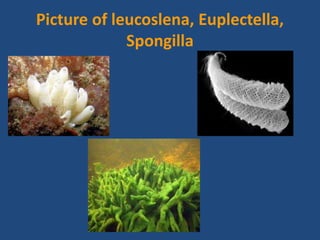
• Example: Leucoslena
• Class: Hexactinellida
• Spicules are composed of silica.
• Choanocytes are restricted to flagellated
chamber.
• Example: Euplectella
Cont……….
• Class 3: Demospongiae
• Spicules are smaller, triaxon and sixrayed.
• Spicules with pointed end.
• Example: Spongilla
Picture of leucoslena, Euplectella,
Spongilla
What is canal system?
• A system of passages connecting various
cavities of the animal body (as in corals and
sponges)
• In porifera Body of all sponges is the
perforated by large number of apertures
through which water enters Inside body and
flows through a system of criss-crossing canals
collectively forming the canal system.
How many types of canal systems are
found in porifera?
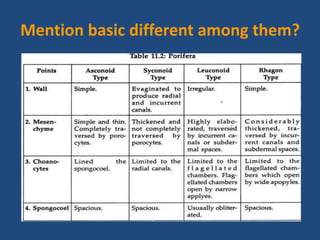
• Four types of canal systems are found in
Porifera:
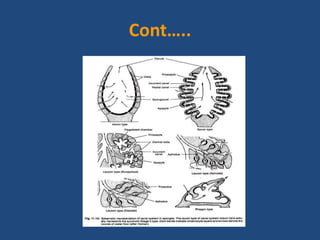
• Asconoid type
• Syconoid type
• Leuconoid type
• Rhagon type
Cont…..
Mention basic different among them?
Briefly describe the canal system of
scypha with figure?
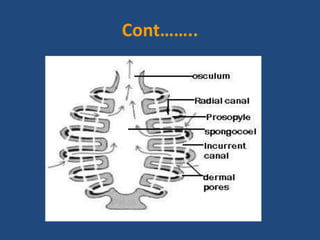
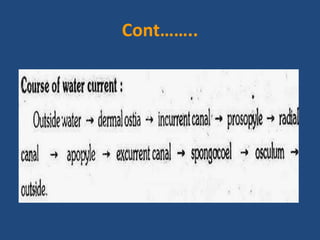
• scypha shows syconoid type of canal system
a) Dermal ostia : On the body of the scypha dermal
ostia are present. They open into incurrent canals
b) In current canals : These are narrow canals.
These are covered inside by epethelial cells. They
show some openings here and there called
prosopyles.
c) Radial canal: The body wall is folded. In these
foldings radial canals are present at regular
intervals. Prosopyles open into these Radial
canals.
Cont……..
Cont……..
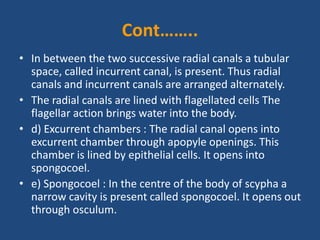
• In between the two successive radial canals a tubular
space, called incurrent canal, is present. Thus radial
canals and incurrent canals are arranged alternately.
• The radial canals are lined with flagellated cells The
flagellar action brings water into the body.
• d) Excurrent chambers : The radial canal opens into
excurrent chamber through apopyle openings. This
chamber is lined by epithelial cells. It opens into
spongocoel.
• e) Spongocoel : In the centre of the body of scypha a
narrow cavity is present called spongocoel. It opens out
through osculum.
Cont……..

Presentation on porifera

  • 1.
    WELCOME TO THEPRESENTATION ON PORIFERA PRESENTED BY MD. SABBIR HOSSAIN ID:17207030 MARINE SCIENCE INSTITUTE OF MARINE SCIENCES AND FISHERIES, UNIVERSITY OF CHITTAGONG
  • 2.
    What is classification? •Classification or taxonomy is the process of identifying, naming, categorizing living thing based on their physical and biological characteristics.
  • 3.
    What is systematicand phylogeny? • Systematic is The study and classification of organisms with the goal of reconstructing their evolutionary histories and relationships. • Phylogeny is the evolutionary development and history of a species or higher taxonomic grouping of organisms
  • 4.
    Write the majoridentifying features of porifera? • Poriferans are commonly called sponges. • These are multicellular organisms which are sessile/sedentary in nature. • Most of them are marine while a few are fresh water forms. • Body is cylindrical, asymmetrical or has radial symmetry. • Body wall is diploblastic which consists of an outer layer called pinacoderm and an inner layer called choanoderm. • The middle layer is called mesenchyme which has various kinds of wandering amoebocytes.
  • 5.
    Cont……… • Body wallcontains numerous pores called ostia through which water enters in the body through a canal system into the central body cavity, called spongocoel. • The canal system mainly comprise of incurrent and excurrent canals which are lined with pinacocytes; and radial canals which are lined with choanocytes (flagellated cells). • Body also contains one or more openings called oscula (- um/singular) through which water passes out from the body. • Sponges have an exoskeleton which is made up of either spongin fibers or calcareous/siliceous spicules or a combination of both.
  • 6.
    Classify Porifera upto class with two major identifying characters and one example of each class? • Porifera: A group of metazoan animal whose bodies are without any symmetry or radially symmetrical, without mouth and nervous system and whose bodies are provided with many pores, canals and chonaocyte cells, are recognized as Porifera or sponges.
  • 7.
    Cont………….. • Phylum poriferais classified mainly basing on skeleton . It is divided into 3 classes. • Class 1: Calcarea • Class 2: Hexactinellida • Class 3: Demospongiae
  • 8.
    Cont…………. • Class 1:Calcarea • Endoskeleton is composed of spicules made of calcium carbonate. • Choanocyte cells are large. • Example: Leucoslena • Class: Hexactinellida • Spicules are composed of silica. • Choanocytes are restricted to flagellated chamber. • Example: Euplectella
  • 9.
    Cont………. • Class 3:Demospongiae • Spicules are smaller, triaxon and sixrayed. • Spicules with pointed end. • Example: Spongilla
  • 10.
    Picture of leucoslena,Euplectella, Spongilla
  • 11.
    What is canalsystem? • A system of passages connecting various cavities of the animal body (as in corals and sponges) • In porifera Body of all sponges is the perforated by large number of apertures through which water enters Inside body and flows through a system of criss-crossing canals collectively forming the canal system.
  • 12.
    How many typesof canal systems are found in porifera? • Four types of canal systems are found in Porifera: • Asconoid type • Syconoid type • Leuconoid type • Rhagon type
  • 13.
  • 14.
  • 15.
    Briefly describe thecanal system of scypha with figure? • scypha shows syconoid type of canal system a) Dermal ostia : On the body of the scypha dermal ostia are present. They open into incurrent canals b) In current canals : These are narrow canals. These are covered inside by epethelial cells. They show some openings here and there called prosopyles. c) Radial canal: The body wall is folded. In these foldings radial canals are present at regular intervals. Prosopyles open into these Radial canals.
  • 16.
  • 17.
    Cont…….. • In betweenthe two successive radial canals a tubular space, called incurrent canal, is present. Thus radial canals and incurrent canals are arranged alternately. • The radial canals are lined with flagellated cells The flagellar action brings water into the body. • d) Excurrent chambers : The radial canal opens into excurrent chamber through apopyle openings. This chamber is lined by epithelial cells. It opens into spongocoel. • e) Spongocoel : In the centre of the body of scypha a narrow cavity is present called spongocoel. It opens out through osculum.
  • 18.