• Agricultural irrigation is the largest(80%) user of
fresh water sources
• With increasing freshwater demand, it is
important to make optimal use of water
resources with improved agricultural productivity
through objective and accurate information
provided by remote sensing
• Microwave remote sensing can be used to
estimate soil moisture on the basis of large
contrast that exists between the dielectric
constant values for dry and wet soils.
• Temporal monitoring of water availability at soil root zone
during growth periods of crop could prevent water stress
and improve the productivity
• At field scales, the high resolution soil moisture data can
be better used for irrigation scheduling through precision
agriculture.
• At larger scales, low resolution soil moisture data as
alternative to vegetation index can be used to monitor
and predict crop yield.
• Because microwaves penetrate cloud, microwave
remote sensing could be a good alternative to VIS/IR
hyperspectral data for monitoring vegetation distribution,
health and water needs for agricultural applications.
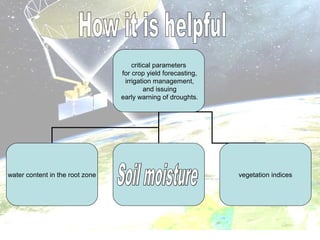
critical parameters
for crop yield forecasting,
irrigation management,
and issuing
early warning of droughts.
water content in the root zone vegetation indices
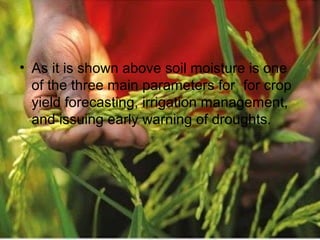
• As it is shown above soil moisture is one
of the three main parameters for for crop
yield forecasting, irrigation management,
and issuing early warning of droughts.
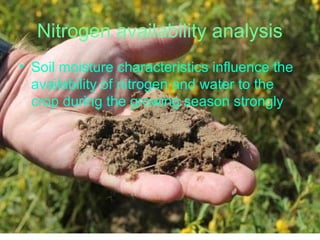
Nitrogen availability analysis
• Soil moisture characteristics influence the
availability of nitrogen and water to the
crop during the growing season strongly
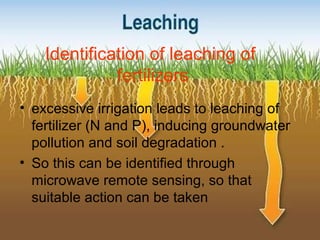
Identification of leaching of
fertilizers
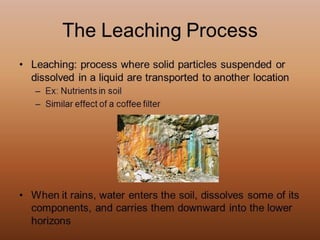
• excessive irrigation leads to leaching of
fertilizer (N and P), inducing groundwater
pollution and soil degradation .
• So this can be identified through
microwave remote sensing, so that
suitable action can be taken
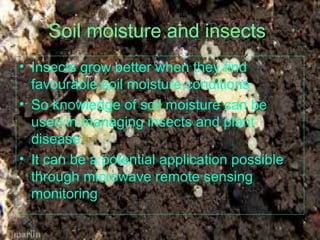
Soil moisture and insects
• Insects grow better when they find
favourable soil moisture conditions
• So knowledge of soil moisture can be
used in managing insects and plant
disease
• It can be a potential application possible
through microwave remote sensing
monitoring
i
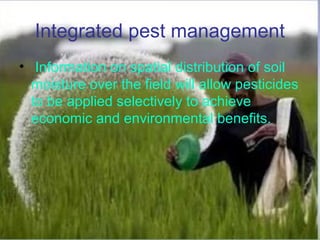
Integrated pest management
• Information on spatial distribution of soil
moisture over the field will allow pesticides
to be applied selectively to achieve
economic and environmental benefits.
• International Journal of Terraspace
Science and Engineering [2(1)2009 81-91]
on Applications of microwave remote
sensing of soil moisture for agricultural
applications
(submitted by) Lakhankar, Nir Krakauer,
Reza <Khanbilvardi (NOAA-CREST), City
University of New York, NY US>

Presentation on microwave remote sensing

  • 2.
    • Agricultural irrigationis the largest(80%) user of fresh water sources • With increasing freshwater demand, it is important to make optimal use of water resources with improved agricultural productivity through objective and accurate information provided by remote sensing • Microwave remote sensing can be used to estimate soil moisture on the basis of large contrast that exists between the dielectric constant values for dry and wet soils.
  • 3.
    • Temporal monitoringof water availability at soil root zone during growth periods of crop could prevent water stress and improve the productivity • At field scales, the high resolution soil moisture data can be better used for irrigation scheduling through precision agriculture. • At larger scales, low resolution soil moisture data as alternative to vegetation index can be used to monitor and predict crop yield. • Because microwaves penetrate cloud, microwave remote sensing could be a good alternative to VIS/IR hyperspectral data for monitoring vegetation distribution, health and water needs for agricultural applications.
  • 4.
    critical parameters for cropyield forecasting, irrigation management, and issuing early warning of droughts. water content in the root zone vegetation indices
  • 5.
    • As itis shown above soil moisture is one of the three main parameters for for crop yield forecasting, irrigation management, and issuing early warning of droughts.
  • 6.
    Nitrogen availability analysis •Soil moisture characteristics influence the availability of nitrogen and water to the crop during the growing season strongly
  • 7.
    Identification of leachingof fertilizers • excessive irrigation leads to leaching of fertilizer (N and P), inducing groundwater pollution and soil degradation . • So this can be identified through microwave remote sensing, so that suitable action can be taken
  • 9.
    Soil moisture andinsects • Insects grow better when they find favourable soil moisture conditions • So knowledge of soil moisture can be used in managing insects and plant disease • It can be a potential application possible through microwave remote sensing monitoring i
  • 10.
    Integrated pest management •Information on spatial distribution of soil moisture over the field will allow pesticides to be applied selectively to achieve economic and environmental benefits.
  • 11.
    • International Journalof Terraspace Science and Engineering [2(1)2009 81-91] on Applications of microwave remote sensing of soil moisture for agricultural applications (submitted by) Lakhankar, Nir Krakauer, Reza <Khanbilvardi (NOAA-CREST), City University of New York, NY US>