Presented By
Saddam Hussain
Presentation on Controlled access
protocol: Polling
Contents
 What is polling?
 Functions of polling: Select and Poll
 Advantage and Drawbacks of polling
 References
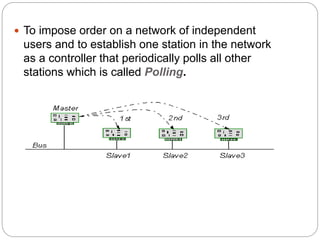
 To impose order on a network of independent
users and to establish one station in the network
as a controller that periodically polls all other
stations which is called Polling.
 It works with topologies in which one device is
designated as a Primary Station and the other
devices are Secondary Stations.
 The Primary device controls the link, where as
the secondary follows it’s instructions.
 Exchange of data must be made through the
primary device even though the final destination
is secondary.
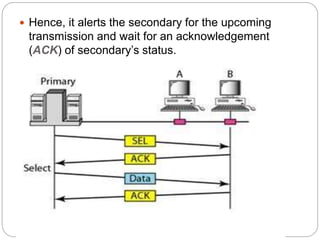
SELECT FUNCTION:
 Primary station controls the link and knows
medium is idle.
 But does not know whether receiver is ready or
not.
 Alerts the receiver, gets ack, sends the data and
get ack.
 Hence, it alerts the secondary for the upcoming
transmission and wait for an acknowledgement
(ACK) of secondary’s status.
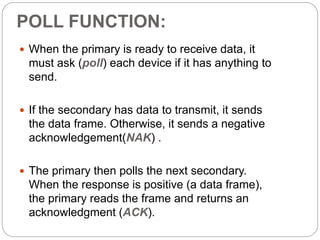
POLL FUNCTION:
 When the primary is ready to receive data, it
must ask (poll) each device if it has anything to
send.
 If the secondary has data to transmit, it sends
the data frame. Otherwise, it sends a negative
acknowledgement(NAK) .
 The primary then polls the next secondary.
When the response is positive (a data frame),
the primary reads the frame and returns an
acknowledgment (ACK).
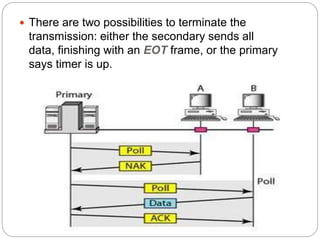
 There are two possibilities to terminate the
transmission: either the secondary sends all
data, finishing with an EOT frame, or the primary
says timer is up.
Advantages:
 Priorities can be assigned to ensure faster
access from some secondary .
 Maximum and minimum access times and data
rates on the channel are predictable and fixed.
Drawbacks:
 High dependence on the reliability of the
controller.
 Increase in turn around time reduces the
channel data rate under low loads and it’s
throughput.
Reference
 www.wikipedia.com/polling
 www.slideshare.net/search?=polling
 Data communications and networking by A.
Forouzan

Presentation on control access protocol

  • 1.
    Presented By Saddam Hussain Presentationon Controlled access protocol: Polling
  • 2.
    Contents  What ispolling?  Functions of polling: Select and Poll  Advantage and Drawbacks of polling  References
  • 3.
     To imposeorder on a network of independent users and to establish one station in the network as a controller that periodically polls all other stations which is called Polling.
  • 4.
     It workswith topologies in which one device is designated as a Primary Station and the other devices are Secondary Stations.  The Primary device controls the link, where as the secondary follows it’s instructions.  Exchange of data must be made through the primary device even though the final destination is secondary.
  • 5.
    SELECT FUNCTION:  Primarystation controls the link and knows medium is idle.  But does not know whether receiver is ready or not.  Alerts the receiver, gets ack, sends the data and get ack.
  • 6.
     Hence, italerts the secondary for the upcoming transmission and wait for an acknowledgement (ACK) of secondary’s status.
  • 7.
    POLL FUNCTION:  Whenthe primary is ready to receive data, it must ask (poll) each device if it has anything to send.  If the secondary has data to transmit, it sends the data frame. Otherwise, it sends a negative acknowledgement(NAK) .  The primary then polls the next secondary. When the response is positive (a data frame), the primary reads the frame and returns an acknowledgment (ACK).
  • 8.
     There aretwo possibilities to terminate the transmission: either the secondary sends all data, finishing with an EOT frame, or the primary says timer is up.
  • 9.
    Advantages:  Priorities canbe assigned to ensure faster access from some secondary .  Maximum and minimum access times and data rates on the channel are predictable and fixed. Drawbacks:  High dependence on the reliability of the controller.  Increase in turn around time reduces the channel data rate under low loads and it’s throughput.
  • 10.