BLOOD TRANSFUSION: PROCEDURE AND
COMPLICATIONS
Submitted by :
Shraddha M. Madghe
DCLT
Guided by:
Dr. C. S. Ukesh Ma’am
CONTENTS
 Blood
 Blood transfusion
 History of blood transfusion
 Types of blood transfusion
 Procedure of blood transfusion
 Complications in blood transfusion
 Blood is a connective tissue in liquid form.
 It is considered to be the fluid of life as it supplies oxygen to various parts of the body.
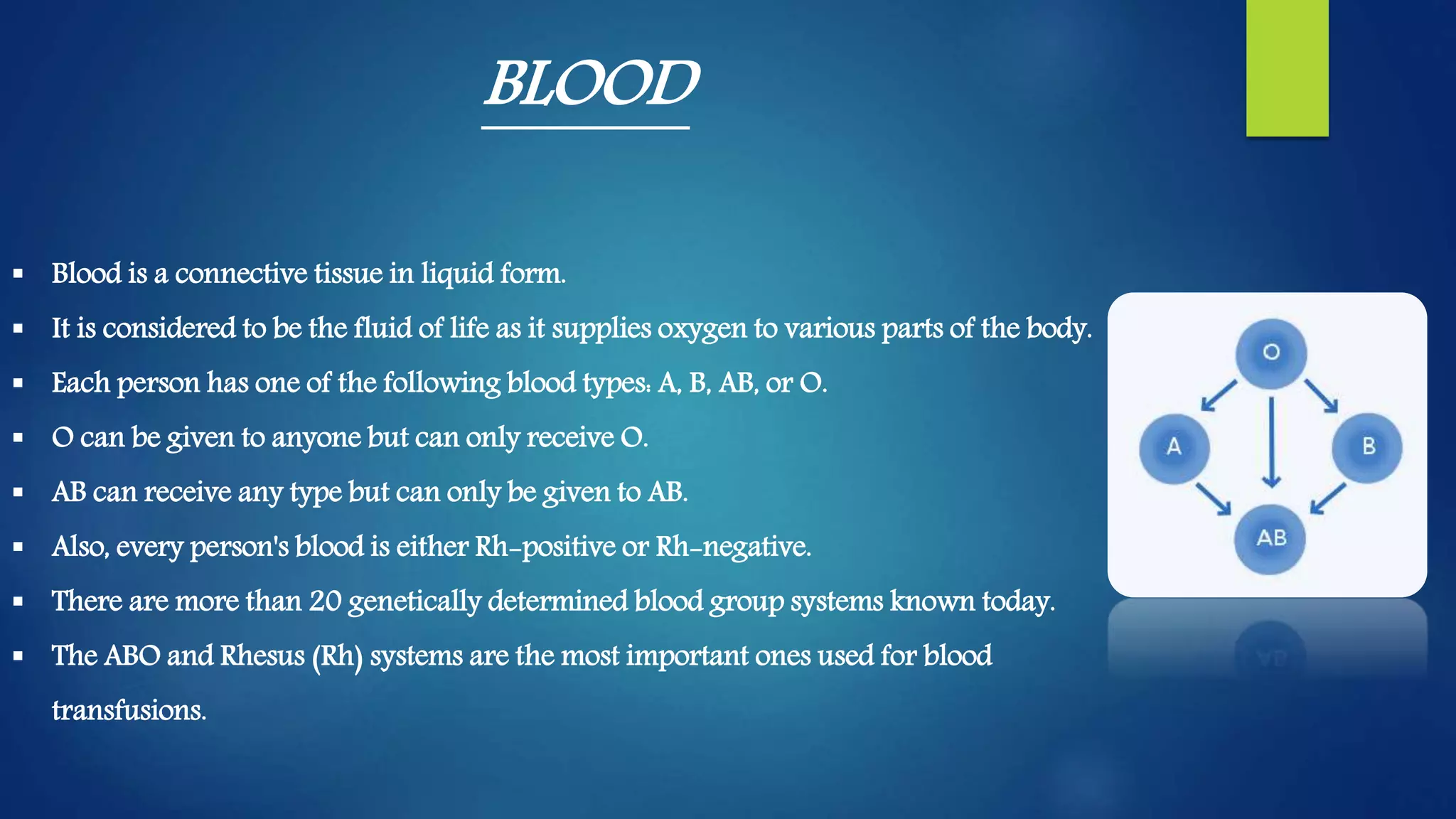
 Each person has one of the following blood types: A, B, AB, or O.
 O can be given to anyone but can only receive O.
 AB can receive any type but can only be given to AB.
 Also, every person's blood is either Rh-positive or Rh-negative.
 There are more than 20 genetically determined blood group systems known today.
 The ABO and Rhesus (Rh) systems are the most important ones used for blood
transfusions.
BLOOD
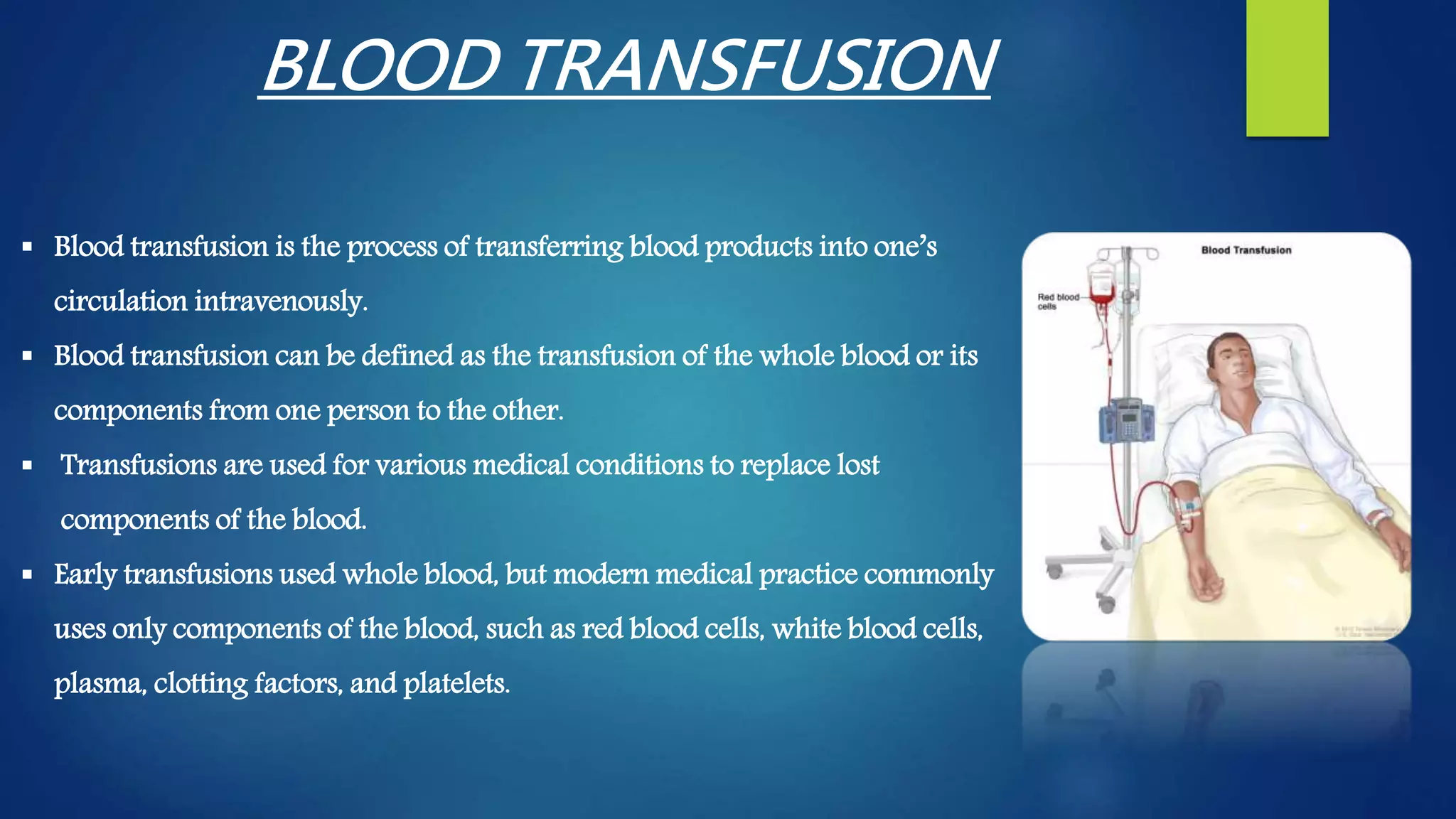
 Blood transfusion is the process of transferring blood products into one’s
circulation intravenously.
 Blood transfusion can be defined as the transfusion of the whole blood or its
components from one person to the other.
 Transfusions are used for various medical conditions to replace lost
components of the blood.
 Early transfusions used whole blood, but modern medical practice commonly
uses only components of the blood, such as red blood cells, white blood cells,
plasma, clotting factors, and platelets.
BLOOD TRANSFUSION
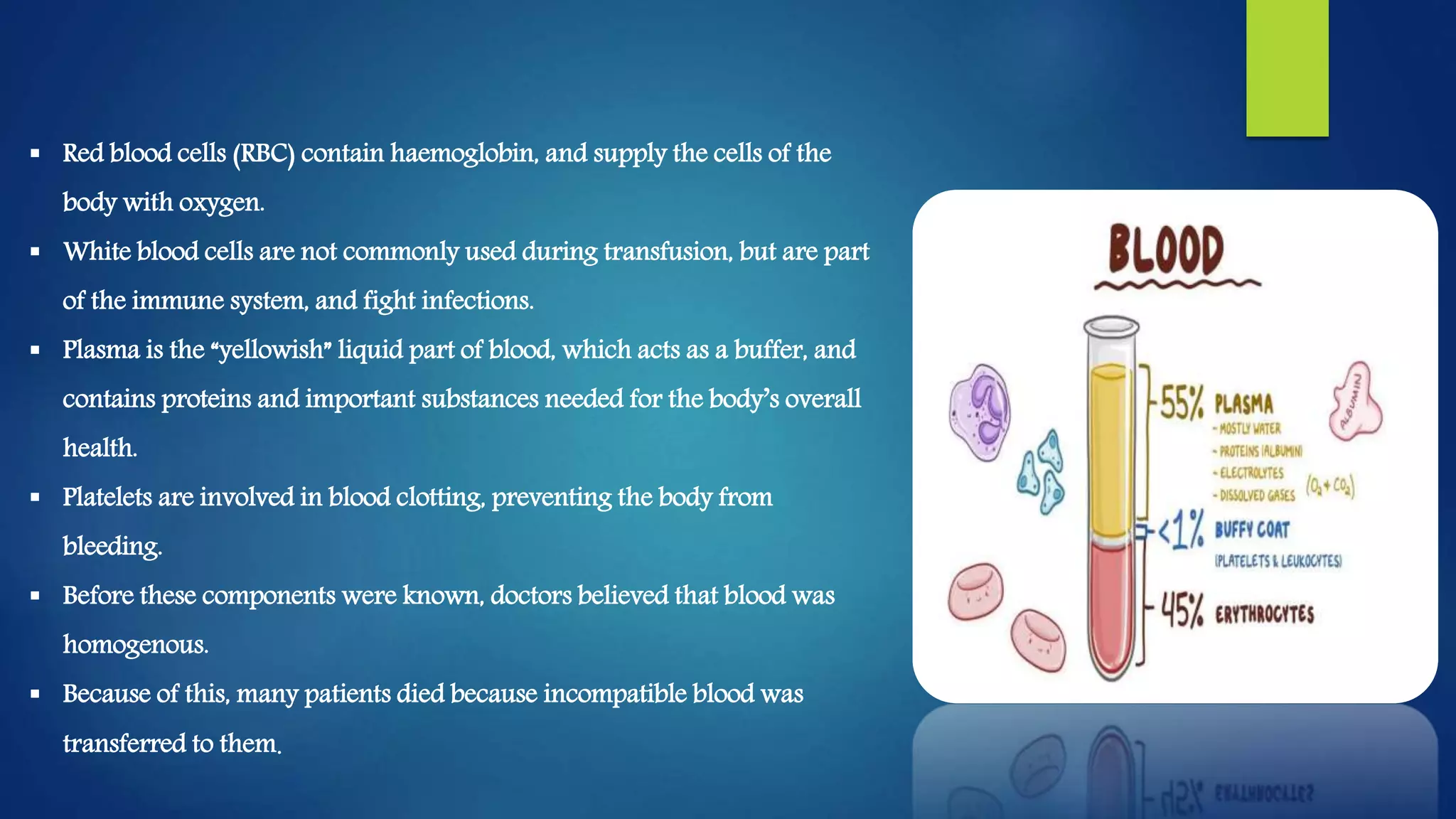
 Red blood cells (RBC) contain haemoglobin, and supply the cells of the
body with oxygen.
 White blood cells are not commonly used during transfusion, but are part
of the immune system, and fight infections.
 Plasma is the “yellowish” liquid part of blood, which acts as a buffer, and
contains proteins and important substances needed for the body’s overall
health.
 Platelets are involved in blood clotting, preventing the body from
bleeding.
 Before these components were known, doctors believed that blood was
homogenous.
 Because of this, many patients died because incompatible blood was
transferred to them.
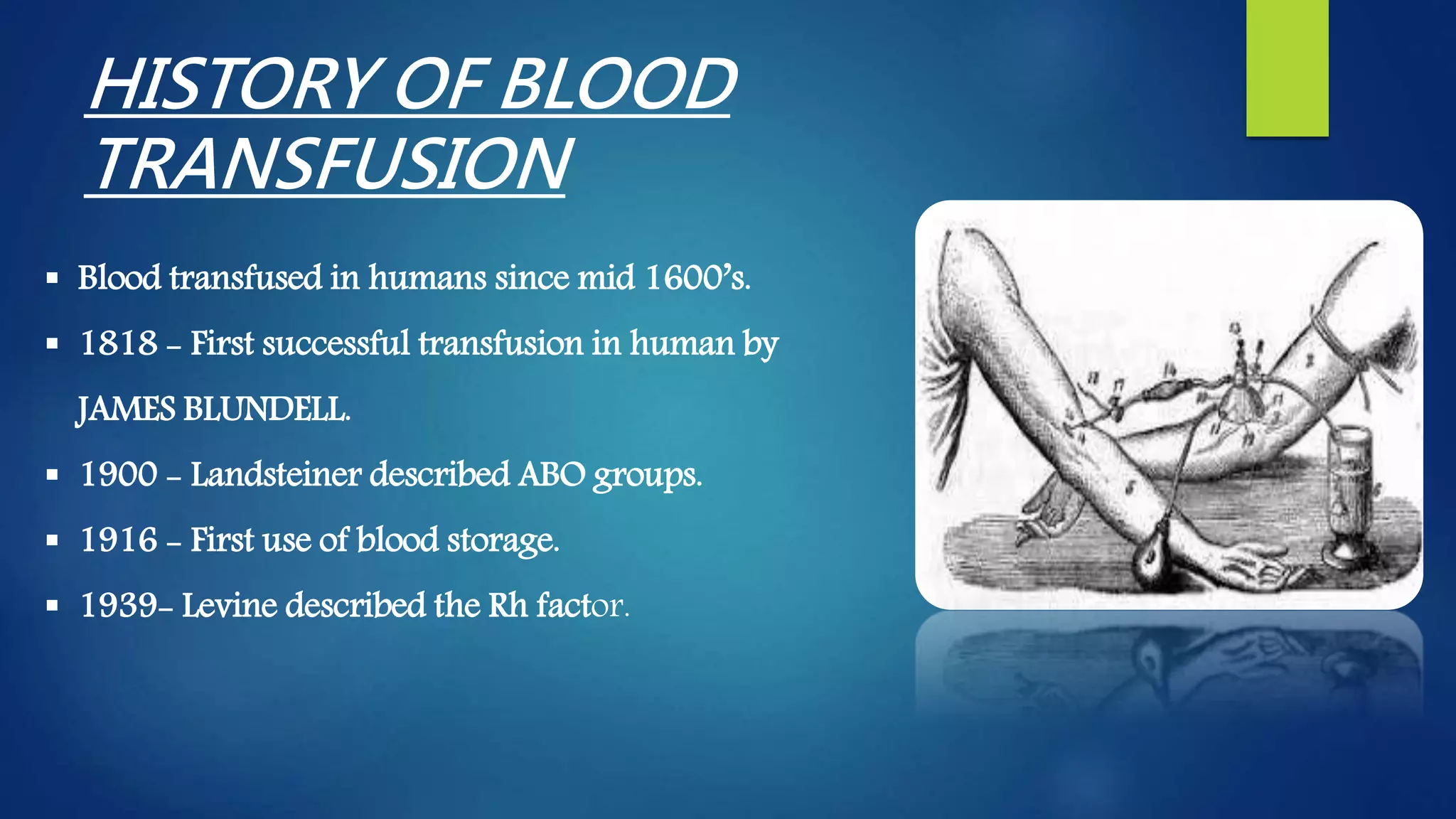
 Blood transfused in humans since mid 1600’s.
 1818 - First successful transfusion in human by
JAMES BLUNDELL.
 1900 - Landsteiner described ABO groups.
 1916 - First use of blood storage.
 1939- Levine described the Rh factor.
HISTORY OF BLOOD
TRANSFUSION
1. Allogeneic Blood Transfusion: Allogenic transfusion occurs when a donor and a recipient are not the
same person.
2. Autogenic Blood Transfusion : Reinfusion of patients own blood or blood components
3. Exchange Blood Transfusion : It is the procedure which involves removal of patients blood
completely and replacement with fresh blood or plasma of the donor
TYPES OF BLOOD TRANSFUSION
Reference from : ESSENTIALS OF MEDICAL PHYSIOLOGY by K.Sembulingam, Prema Sembulingam
PROCEDURE OF BLOOD
TRANSFUSION
 Before the transfusion :
1. Find Current Type And Crossmatch
2. Obtain Informed Consent And Health History
3. Obtain Large Bore IV Access
4. Assemble Supplies
5. Obtain Baseline Vital Signals
6. Obtain Blood From Blood Bank
BLOOD TRANSFUSION STEPS :
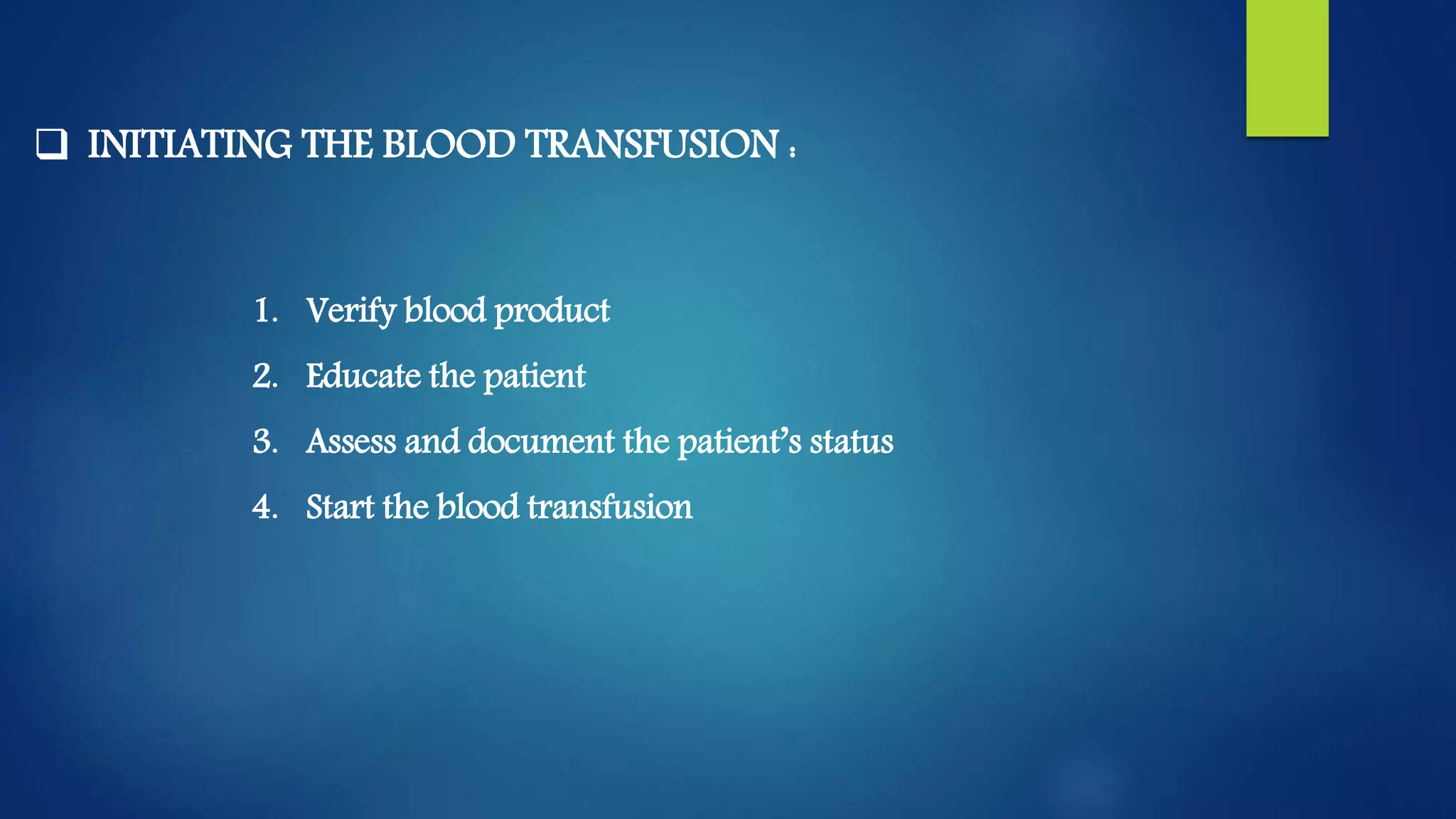
 INITIATING THE BLOOD TRANSFUSION :
1. Verify blood product
2. Educate the patient
3. Assess and document the patient’s status
4. Start the blood transfusion
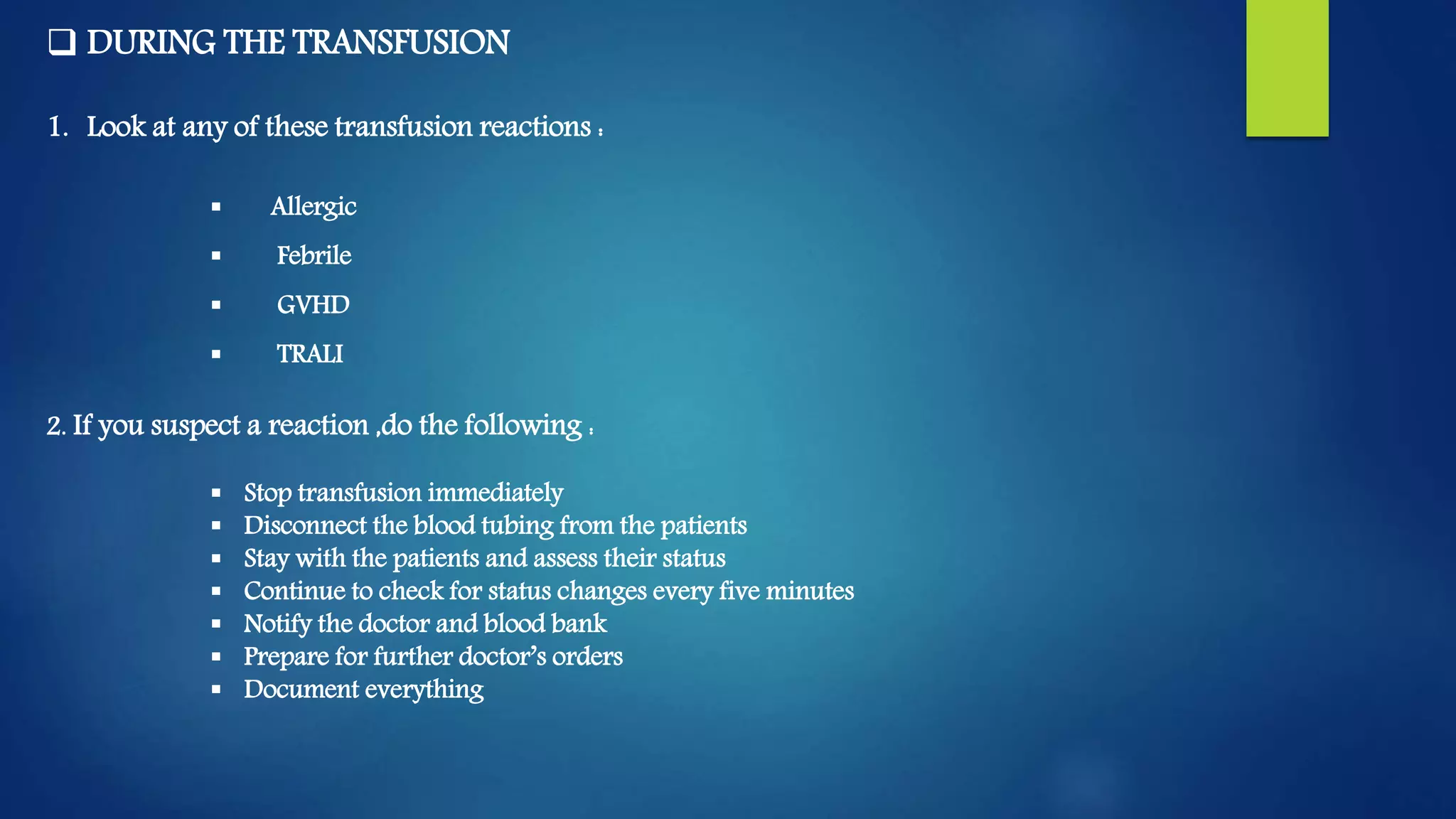
 DURING THE TRANSFUSION
1. Look at any of these transfusion reactions :
 Allergic
 Febrile
 GVHD
 TRALI
2. If you suspect a reaction ,do the following :
 Stop transfusion immediately
 Disconnect the blood tubing from the patients
 Stay with the patients and assess their status
 Continue to check for status changes every five minutes
 Notify the doctor and blood bank
 Prepare for further doctor’s orders
 Document everything
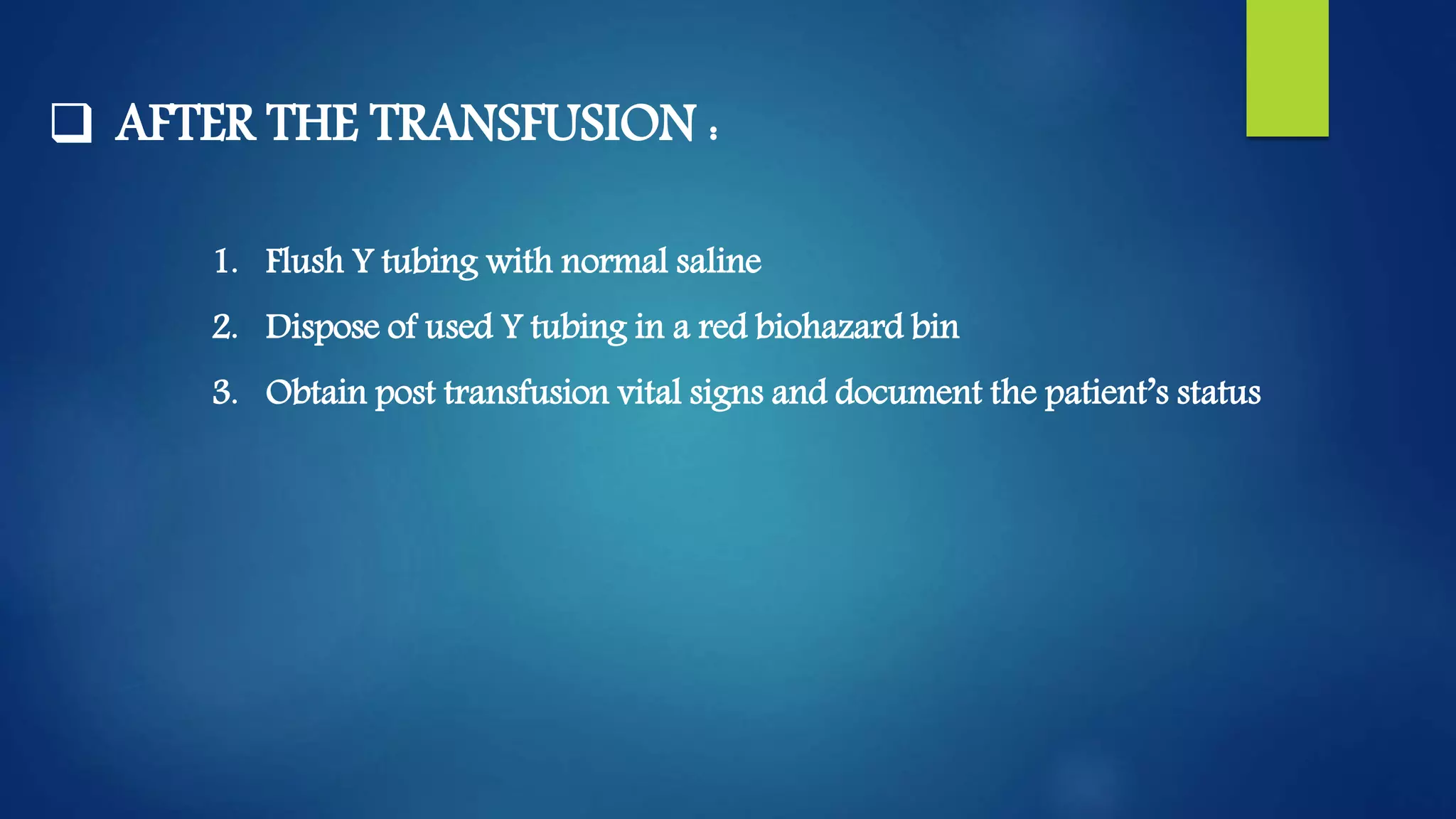
 AFTER THE TRANSFUSION :
1. Flush Y tubing with normal saline
2. Dispose of used Y tubing in a red biohazard bin
3. Obtain post transfusion vital signs and document the patient’s status
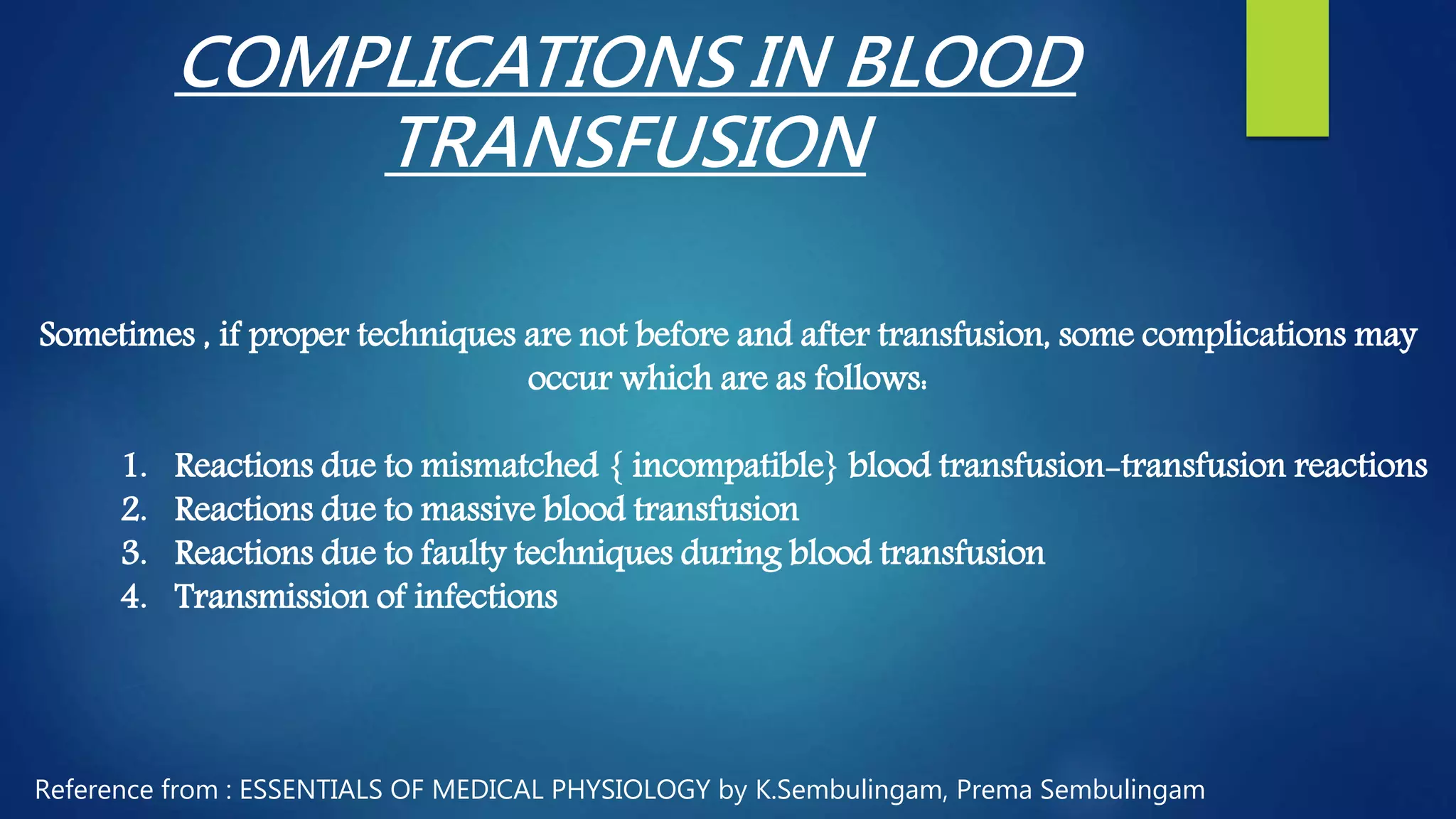
COMPLICATIONS IN BLOOD
TRANSFUSION
Sometimes , if proper techniques are not before and after transfusion, some complications may
occur which are as follows:
1. Reactions due to mismatched { incompatible} blood transfusion-transfusion reactions
2. Reactions due to massive blood transfusion
3. Reactions due to faulty techniques during blood transfusion
4. Transmission of infections
Reference from : ESSENTIALS OF MEDICAL PHYSIOLOGY by K.Sembulingam, Prema Sembulingam
REACTIONS DUE TO MISMATCHED {
INCOMPATIBLE} BLOOD TRANSFUSION-
TRANSFUSION REACTIONS
A. ABO INCOMPATIBILITY
1. .JAUNDICE : Normally ,hemoglobin release from destroyed RBC is degraded and bilirubin is formed from it. When the
serum bilirubin level increases about 2 mg/dl, jaundice occurs.
2. CARDIAC SHOCK : Simultaneously, hemoglobin released into the plasma increases and the viscosity of blood this
increases the workload in the heart leading to the heart feel you are more or toxic substances released from fuel cells
produce the arterial blood pressure and develop circulatory shock.
3. RENAL SHUTDOWN: Dysfunction of kidneys is called as renal shut down, rate of reabsorption from the renal tubules all
the substances precipitate and obstruct renal tubule.
B. Rh INCOMPATIBILITY
1. ERYTHROBLASTOSIS FETALIS : It is a hemolytic anemia in the fetus caused by transplacental transmission of maternal
antibodies to fetal red blood cells. The disorder usually results from incompatibility between maternal and fetal blood
groups, often Rho{D} antigens.
REACTIONS DUE TO MASSIVE BLOOD
TRANSFUSION
 Massive transfusion is the transfusion of blood equivalent or more than the patient's own blood volume.
It leads to :
i. Circulatory shock, particularly in patients suffering from chronic anemia, cardiac diseases or renal diseases
ii. Hyperkalemia due to increased potassium concentration in stored blood
iii. Hypocalcemia leading to tetany due to massive transfusion of citrated blood
iv. Hemosiderosis (increased deposition of ion in the form of hemosiderin, in organs such as endocrine glands,
heart and liver) due to iron overload after repeated transfusions
Reference from : ESSENTIALS OF MEDICAL PHYSIOLOGY by K.Sembulingam, Prema Sembulingam
REACTIONS DUE TO FAULTY TECHNIQUES
DURING BLOOD TRANSFUSION
Faulty techniques adapted during blood transfusion leads to:
i. Thrombophlebitis (inflammation of vein, associated with formation of thrombus).
ii. Air embolism (obstruction of blood vessel due to entrance of air into the bloodstream).
Reference from : ESSENTIALS OF MEDICAL PHYSIOLOGY by K.Sembulingam, Prema Sembulingam
TRANSMISSION OF INFECTIONS
Blood transfusion without precaution leads to trans- mission of blood-borne infections such as:
i. HIV
ii. Hepatitis B and A
iii. Glandular fever or infectious mononucleosis (acute infectious disease caused by Epstein Barr virus and
characterized by fever, swollen lymph nodes, sore throat and abnormal lymphocytes)
iv. Herpes (viral disease with eruption of small blister-like vesicles on skin or membranes)
v. Bacterial infections.
Reference from : ESSENTIALS OF MEDICAL PHYSIOLOGY by K.Sembulingam, Prema Sembulingam
THANK YOU !

Blood Transfusion: Procedure and Complications

  • 1.
    BLOOD TRANSFUSION: PROCEDUREAND COMPLICATIONS Submitted by : Shraddha M. Madghe DCLT Guided by: Dr. C. S. Ukesh Ma’am
  • 2.
    CONTENTS  Blood  Bloodtransfusion  History of blood transfusion  Types of blood transfusion  Procedure of blood transfusion  Complications in blood transfusion
  • 3.
     Blood isa connective tissue in liquid form.  It is considered to be the fluid of life as it supplies oxygen to various parts of the body.  Each person has one of the following blood types: A, B, AB, or O.  O can be given to anyone but can only receive O.  AB can receive any type but can only be given to AB.  Also, every person's blood is either Rh-positive or Rh-negative.  There are more than 20 genetically determined blood group systems known today.  The ABO and Rhesus (Rh) systems are the most important ones used for blood transfusions. BLOOD
  • 4.
     Blood transfusionis the process of transferring blood products into one’s circulation intravenously.  Blood transfusion can be defined as the transfusion of the whole blood or its components from one person to the other.  Transfusions are used for various medical conditions to replace lost components of the blood.  Early transfusions used whole blood, but modern medical practice commonly uses only components of the blood, such as red blood cells, white blood cells, plasma, clotting factors, and platelets. BLOOD TRANSFUSION
  • 5.
     Red bloodcells (RBC) contain haemoglobin, and supply the cells of the body with oxygen.  White blood cells are not commonly used during transfusion, but are part of the immune system, and fight infections.  Plasma is the “yellowish” liquid part of blood, which acts as a buffer, and contains proteins and important substances needed for the body’s overall health.  Platelets are involved in blood clotting, preventing the body from bleeding.  Before these components were known, doctors believed that blood was homogenous.  Because of this, many patients died because incompatible blood was transferred to them.
  • 6.
     Blood transfusedin humans since mid 1600’s.  1818 - First successful transfusion in human by JAMES BLUNDELL.  1900 - Landsteiner described ABO groups.  1916 - First use of blood storage.  1939- Levine described the Rh factor. HISTORY OF BLOOD TRANSFUSION
  • 7.
    1. Allogeneic BloodTransfusion: Allogenic transfusion occurs when a donor and a recipient are not the same person. 2. Autogenic Blood Transfusion : Reinfusion of patients own blood or blood components 3. Exchange Blood Transfusion : It is the procedure which involves removal of patients blood completely and replacement with fresh blood or plasma of the donor TYPES OF BLOOD TRANSFUSION Reference from : ESSENTIALS OF MEDICAL PHYSIOLOGY by K.Sembulingam, Prema Sembulingam
  • 8.
    PROCEDURE OF BLOOD TRANSFUSION Before the transfusion : 1. Find Current Type And Crossmatch 2. Obtain Informed Consent And Health History 3. Obtain Large Bore IV Access 4. Assemble Supplies 5. Obtain Baseline Vital Signals 6. Obtain Blood From Blood Bank BLOOD TRANSFUSION STEPS :
  • 9.
     INITIATING THEBLOOD TRANSFUSION : 1. Verify blood product 2. Educate the patient 3. Assess and document the patient’s status 4. Start the blood transfusion
  • 10.
     DURING THETRANSFUSION 1. Look at any of these transfusion reactions :  Allergic  Febrile  GVHD  TRALI 2. If you suspect a reaction ,do the following :  Stop transfusion immediately  Disconnect the blood tubing from the patients  Stay with the patients and assess their status  Continue to check for status changes every five minutes  Notify the doctor and blood bank  Prepare for further doctor’s orders  Document everything
  • 11.
     AFTER THETRANSFUSION : 1. Flush Y tubing with normal saline 2. Dispose of used Y tubing in a red biohazard bin 3. Obtain post transfusion vital signs and document the patient’s status
  • 12.
    COMPLICATIONS IN BLOOD TRANSFUSION Sometimes, if proper techniques are not before and after transfusion, some complications may occur which are as follows: 1. Reactions due to mismatched { incompatible} blood transfusion-transfusion reactions 2. Reactions due to massive blood transfusion 3. Reactions due to faulty techniques during blood transfusion 4. Transmission of infections Reference from : ESSENTIALS OF MEDICAL PHYSIOLOGY by K.Sembulingam, Prema Sembulingam
  • 13.
    REACTIONS DUE TOMISMATCHED { INCOMPATIBLE} BLOOD TRANSFUSION- TRANSFUSION REACTIONS A. ABO INCOMPATIBILITY 1. .JAUNDICE : Normally ,hemoglobin release from destroyed RBC is degraded and bilirubin is formed from it. When the serum bilirubin level increases about 2 mg/dl, jaundice occurs. 2. CARDIAC SHOCK : Simultaneously, hemoglobin released into the plasma increases and the viscosity of blood this increases the workload in the heart leading to the heart feel you are more or toxic substances released from fuel cells produce the arterial blood pressure and develop circulatory shock. 3. RENAL SHUTDOWN: Dysfunction of kidneys is called as renal shut down, rate of reabsorption from the renal tubules all the substances precipitate and obstruct renal tubule. B. Rh INCOMPATIBILITY 1. ERYTHROBLASTOSIS FETALIS : It is a hemolytic anemia in the fetus caused by transplacental transmission of maternal antibodies to fetal red blood cells. The disorder usually results from incompatibility between maternal and fetal blood groups, often Rho{D} antigens.
  • 14.
    REACTIONS DUE TOMASSIVE BLOOD TRANSFUSION  Massive transfusion is the transfusion of blood equivalent or more than the patient's own blood volume. It leads to : i. Circulatory shock, particularly in patients suffering from chronic anemia, cardiac diseases or renal diseases ii. Hyperkalemia due to increased potassium concentration in stored blood iii. Hypocalcemia leading to tetany due to massive transfusion of citrated blood iv. Hemosiderosis (increased deposition of ion in the form of hemosiderin, in organs such as endocrine glands, heart and liver) due to iron overload after repeated transfusions Reference from : ESSENTIALS OF MEDICAL PHYSIOLOGY by K.Sembulingam, Prema Sembulingam
  • 15.
    REACTIONS DUE TOFAULTY TECHNIQUES DURING BLOOD TRANSFUSION Faulty techniques adapted during blood transfusion leads to: i. Thrombophlebitis (inflammation of vein, associated with formation of thrombus). ii. Air embolism (obstruction of blood vessel due to entrance of air into the bloodstream). Reference from : ESSENTIALS OF MEDICAL PHYSIOLOGY by K.Sembulingam, Prema Sembulingam
  • 16.
    TRANSMISSION OF INFECTIONS Bloodtransfusion without precaution leads to trans- mission of blood-borne infections such as: i. HIV ii. Hepatitis B and A iii. Glandular fever or infectious mononucleosis (acute infectious disease caused by Epstein Barr virus and characterized by fever, swollen lymph nodes, sore throat and abnormal lymphocytes) iv. Herpes (viral disease with eruption of small blister-like vesicles on skin or membranes) v. Bacterial infections. Reference from : ESSENTIALS OF MEDICAL PHYSIOLOGY by K.Sembulingam, Prema Sembulingam
  • 17.