AMNIOINFUSION
PRANATI PATRA
DEFINITION
An amnioinfusion is a technique of instilling an
isotonic fluid {such as a normal saline or
lactated ringer’s solution} into the amniotic
cavity during labor to relieve umbilical cord
compression and alleviate fetal distress from
severe prolonged variable decelerations in the
presence of oligohydramnios.
INDICATIONS
• Fetal heart rate abnormalities
• APGAR scores for those with low scores
• Asphyxia during time of birth
• Decreasing the rates of cesarean birth related
with FHR problem
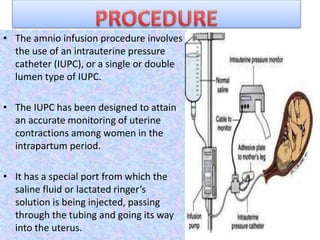
• The amnio infusion procedure involves
the use of an intrauterine pressure
catheter (IUPC), or a single or double
lumen type of IUPC.
• The IUPC has been designed to attain
an accurate monitoring of uterine
contractions among women in the
intrapartum period.
• It has a special port from which the
saline fluid or lactated ringer’s
solution is being injected, passing
through the tubing and going its way
into the uterus.
• An IUPC is inserted through
standard technique once the
membranes ruptures, and then it
is attached to intravenous
extension tubing. If IUPC is not
available, a pediatric nasogastric
tube can be used instead.
• Lactated ringer’s solution without
dextrose is infused into the
amniotic cavity; normal saline can
be an acceptable fluid alternative.
Assisting Physician with Amnioinfusion
1. Explain the procedure to the patient.
2. Assist in dorsal recumbent position. Assist
with draping and exposing vaginal area.
3. Connect IUPC tubing to IV fluid, flush
4. Connect the catheter to the monitor cable
5. Assist physician with insertion of double
lumen IUPC and connect IV tubing to the
amnioport to begin amnioinfusion.
Nursing Responsibilities
 Monitor fetal heart tones and contraction patterns
continuously.
 Discontinue amnioinfusion if any of the following occur and
notify physician:
• Decelerations have not been relieved after 500 cc infused.
Place patient in trendelenburg if leakage is excessive and/or
decelerations have not terminated after 500 cc infusion.
• Increasing uterine resting tone
• Signs of fetal compromise
• Bleeding
• Uterine tenderness
Amnioinfusion

Amnioinfusion

  • 1.
  • 3.
    DEFINITION An amnioinfusion isa technique of instilling an isotonic fluid {such as a normal saline or lactated ringer’s solution} into the amniotic cavity during labor to relieve umbilical cord compression and alleviate fetal distress from severe prolonged variable decelerations in the presence of oligohydramnios.
  • 5.
    INDICATIONS • Fetal heartrate abnormalities • APGAR scores for those with low scores • Asphyxia during time of birth • Decreasing the rates of cesarean birth related with FHR problem
  • 6.
    • The amnioinfusion procedure involves the use of an intrauterine pressure catheter (IUPC), or a single or double lumen type of IUPC. • The IUPC has been designed to attain an accurate monitoring of uterine contractions among women in the intrapartum period. • It has a special port from which the saline fluid or lactated ringer’s solution is being injected, passing through the tubing and going its way into the uterus.
  • 7.
    • An IUPCis inserted through standard technique once the membranes ruptures, and then it is attached to intravenous extension tubing. If IUPC is not available, a pediatric nasogastric tube can be used instead. • Lactated ringer’s solution without dextrose is infused into the amniotic cavity; normal saline can be an acceptable fluid alternative.
  • 8.
    Assisting Physician withAmnioinfusion 1. Explain the procedure to the patient. 2. Assist in dorsal recumbent position. Assist with draping and exposing vaginal area. 3. Connect IUPC tubing to IV fluid, flush 4. Connect the catheter to the monitor cable 5. Assist physician with insertion of double lumen IUPC and connect IV tubing to the amnioport to begin amnioinfusion.
  • 10.
    Nursing Responsibilities  Monitorfetal heart tones and contraction patterns continuously.  Discontinue amnioinfusion if any of the following occur and notify physician: • Decelerations have not been relieved after 500 cc infused. Place patient in trendelenburg if leakage is excessive and/or decelerations have not terminated after 500 cc infusion. • Increasing uterine resting tone • Signs of fetal compromise • Bleeding • Uterine tenderness