LACTATION
AND ITS
MANAGEMENT
LACTATION
• For the first 2 days following delivery, no
further anatomic changes in the breasts occur.
The secretion from the breasts called
colostrum, which starts during pregnancy.
COMPOSITION OF THE COLOSTRUM
• It is deep yellow serous fluid, alkaline in
reaction. It has got a higher specific gravity; a
high protein, vitamin A, sodium and chloride
content but has got lower carbohydrate, fat
and potassium than the breast milk
Physiology of Lactation
Lactation can be divided into 4 stages:
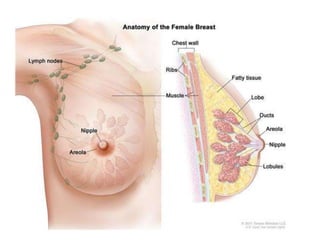
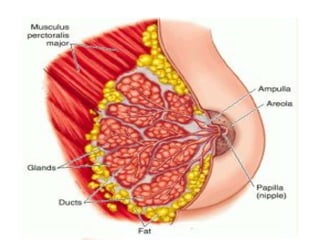
1. Mammogenesis-Development of breasts to a
functional state
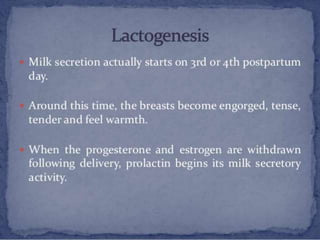
2. Lactogenesis-Synthesis and secretion of milk
from the breast alveoli
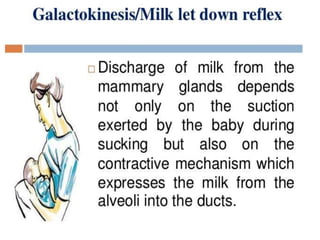
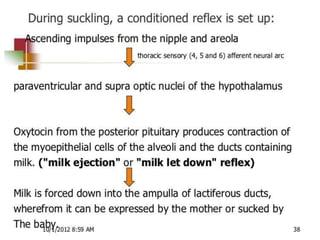
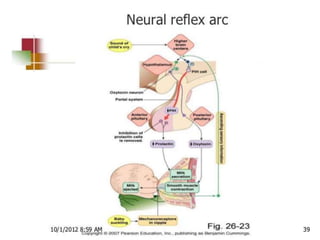
3. Galactokinesis-Ejection of milk outside the
breast
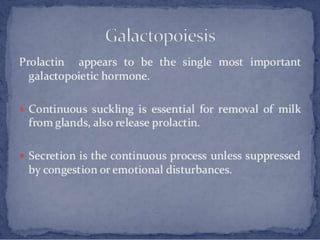
4. Galactopoiesis-Maintenance of lactation
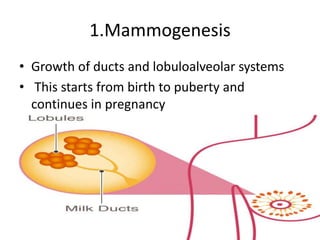
1.Mammogenesis
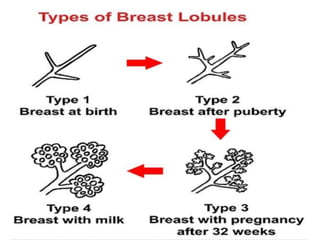
• Growth of ducts and lobuloalveolar systems
• This starts from birth to puberty and
continues in pregnancy
During pregnancy
• In early pregnancy a marked increase in ductular and
lobular formation.
• Progesterone:causes increased growth of alveoli size
and lobes,
• Estrogen:Stimulates milk duct system to grow and
differentiate, deposition of fat.
• Prolactin:contributes to increased growth and
differentiation of the alveoli and ductal structures.
CONT..
• The secretary activity is enhanced growth
hormone, thyroxine, glucocorticoids and
insulin.
Lactation and its management

Lactation and its management

  • 1.
  • 2.
    LACTATION • For thefirst 2 days following delivery, no further anatomic changes in the breasts occur. The secretion from the breasts called colostrum, which starts during pregnancy.
  • 3.
    COMPOSITION OF THECOLOSTRUM • It is deep yellow serous fluid, alkaline in reaction. It has got a higher specific gravity; a high protein, vitamin A, sodium and chloride content but has got lower carbohydrate, fat and potassium than the breast milk
  • 4.
    Physiology of Lactation Lactationcan be divided into 4 stages: 1. Mammogenesis-Development of breasts to a functional state 2. Lactogenesis-Synthesis and secretion of milk from the breast alveoli 3. Galactokinesis-Ejection of milk outside the breast 4. Galactopoiesis-Maintenance of lactation
  • 5.
    1.Mammogenesis • Growth ofducts and lobuloalveolar systems • This starts from birth to puberty and continues in pregnancy
  • 8.
    During pregnancy • Inearly pregnancy a marked increase in ductular and lobular formation. • Progesterone:causes increased growth of alveoli size and lobes, • Estrogen:Stimulates milk duct system to grow and differentiate, deposition of fat. • Prolactin:contributes to increased growth and differentiation of the alveoli and ductal structures.
  • 11.
    CONT.. • The secretaryactivity is enhanced growth hormone, thyroxine, glucocorticoids and insulin.