
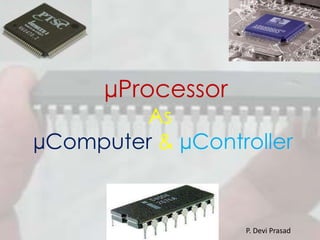


µProcessor
As
µComputer & µController
P. Devi Prasad
What is µProcessor?
The microprocessor is a multipurpose,
programmable device that accepts digital data
as input, processes it according to instructions
stored in its memory, and provides results as
output.
• The first microprocessor was the Intel 4004,
introduced in 1971.
• 8-bit microprocessor 8008 in 1972.
• Intel released the 8086, a 16-bit
microprocessor, in 1978
• it was primarily used to perform simple
mathematical operations in a calculator called
“Busicom.”
Manufacturing:-
The manufacturing of a CPU(µProcessor) is a
highly complex and demanding process
involving multiple hundreds of steps in “clean
rooms.” Cleanrooms or manufacturing plants,
contain air which is 1,000 times cleaner than a
hospital’s operation theater.
CHARACTERISTICS
• Instruction set: The set of instructions that the
microprocessor can execute.
• bandwidth: The number of bits processed in a single instruction.
• clock speed : Given in megahertz (MHz), the clock speed
determines how many instructions per second the processor can
execute.
In both cases, the higher the value, the more powerful the CPU. For
example, a 32-bit microprocessor that runs at 50MHz is more
powerful than a 16-bit microprocessor that runs at 25MHz.
In addition to bandwidth and clock speed,
microprocessors are classified as
RISC(reduced instruction set computer) or
CISC (complex instruction set computer).
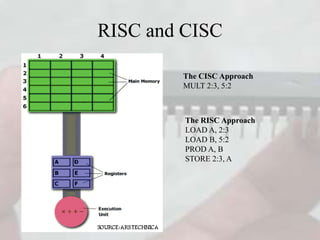
RISC and CISC
The CISC Approach
MULT 2:3, 5:2
The RISC Approach
LOAD A, 2:3
LOAD B, 5:2
PROD A, B
STORE 2:3, A
Inside a Microprocessor
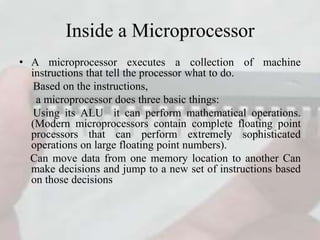
• A microprocessor executes a collection of machine
instructions that tell the processor what to do.
Based on the instructions,
a microprocessor does three basic things:
Using its ALU it can perform mathematical operations.
(Modern microprocessors contain complete floating point
processors that can perform extremely sophisticated
operations on large floating point numbers).
Can move data from one memory location to another Can
make decisions and jump to a new set of instructions based
on those decisions
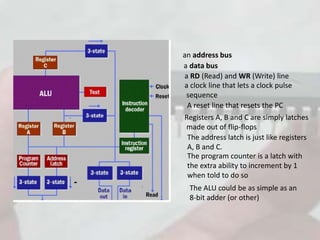
an address bus
a data bus
a RD (Read) and WR (Write) line
a clock line that lets a clock pulse
sequence
A reset line that resets the PC
Registers A, B and C are simply latches
made out of flip-flops
The address latch is just like registers
A, B and C.
The program counter is a latch with
the extra ability to increment by 1
when told to do so
The ALU could be as simple as an
8-bit adder (or other)
These buses and lines connect either to RAM
or ROM - generally both.
microprocessor have an 8 bits wide address
bus and a 8 bits wide data bus. can address 28
= 256 bytes of memory, and it can read or
write 8 bits of the memory at a time
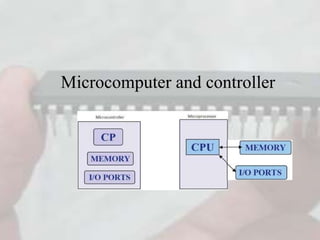
Microcomputer and controller
A microcomputer is a computer that uses a
microprocessor and its own memory/storage
space to perform applications
Your PC is an example of a microcomputer.
a microprocessor generally does not have a
RAM, ROM or IO pins and generally uses its
pins as a bus to interface to peripherals such as
RAM, ROM, serial ports, digital and analog
IO. Read
A microcontroller is a small and low-cost
computer built for the purpose of dealing with
specific tasks.
or
Microcontroller a single-chip microcomputer
with on-board program ROM and I/O that can be
programmed for various control functions.
Displaying information in a microwave LED or receiving information from a
television’s remote control.
Almost all microcontrollers have at least two
different kinds of memory,
a non-volatile memory for storing firmware
a read-write memory for temporary data.
Micro Controller - Benefits
Cost advantage:
Lesser power usage
All-in-one
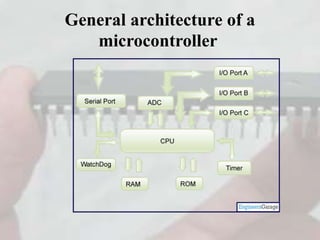
General architecture of a
microcontroller
Architecture:-
A typical microcontroller consists of the following elements:
• A central processor unit (CPU)
That contains registers, ALU, and a sequence controller to
control all activities of the microcontroller.
• Read only memory (ROM)
To hold a program and any constant data.
Modern microcontrollers have flash memory(EEPROM).
• Random access memory (RAM)
To store variable data.
• An input/output (I/O) interface
to connect the microcontroller to the real world.
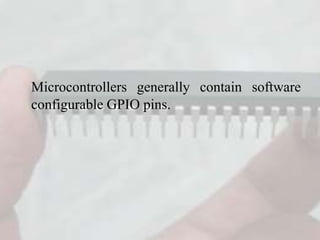
Microcontrollers generally contain software
configurable GPIO pins.
Uses:-
automatically controlled products and
devices:-
Automobile Engine Control Systems, Implantable
Medical Devices,
Remote Controls,
Office Machines,
Appliances,
Power Tools,
Toys and Other Embedded Systems,
Digital signal processor(DSP).
Micro controller
Micro controller

Micro controller

  • 2.
  • 3.
    What is µProcessor? Themicroprocessor is a multipurpose, programmable device that accepts digital data as input, processes it according to instructions stored in its memory, and provides results as output.
  • 4.
    • The firstmicroprocessor was the Intel 4004, introduced in 1971. • 8-bit microprocessor 8008 in 1972. • Intel released the 8086, a 16-bit microprocessor, in 1978 • it was primarily used to perform simple mathematical operations in a calculator called “Busicom.”
  • 5.
    Manufacturing:- The manufacturing ofa CPU(µProcessor) is a highly complex and demanding process involving multiple hundreds of steps in “clean rooms.” Cleanrooms or manufacturing plants, contain air which is 1,000 times cleaner than a hospital’s operation theater.
  • 6.
    CHARACTERISTICS • Instruction set:The set of instructions that the microprocessor can execute. • bandwidth: The number of bits processed in a single instruction. • clock speed : Given in megahertz (MHz), the clock speed determines how many instructions per second the processor can execute. In both cases, the higher the value, the more powerful the CPU. For example, a 32-bit microprocessor that runs at 50MHz is more powerful than a 16-bit microprocessor that runs at 25MHz.
  • 7.
    In addition tobandwidth and clock speed, microprocessors are classified as RISC(reduced instruction set computer) or CISC (complex instruction set computer).
  • 8.
    RISC and CISC TheCISC Approach MULT 2:3, 5:2 The RISC Approach LOAD A, 2:3 LOAD B, 5:2 PROD A, B STORE 2:3, A
  • 9.
    Inside a Microprocessor •A microprocessor executes a collection of machine instructions that tell the processor what to do. Based on the instructions, a microprocessor does three basic things: Using its ALU it can perform mathematical operations. (Modern microprocessors contain complete floating point processors that can perform extremely sophisticated operations on large floating point numbers). Can move data from one memory location to another Can make decisions and jump to a new set of instructions based on those decisions
  • 10.
    an address bus adata bus a RD (Read) and WR (Write) line a clock line that lets a clock pulse sequence A reset line that resets the PC Registers A, B and C are simply latches made out of flip-flops The address latch is just like registers A, B and C. The program counter is a latch with the extra ability to increment by 1 when told to do so The ALU could be as simple as an 8-bit adder (or other)
  • 11.
    These buses andlines connect either to RAM or ROM - generally both. microprocessor have an 8 bits wide address bus and a 8 bits wide data bus. can address 28 = 256 bytes of memory, and it can read or write 8 bits of the memory at a time
  • 12.
  • 13.
    Microcomputer and controller Amicrocomputer is a computer that uses a microprocessor and its own memory/storage space to perform applications Your PC is an example of a microcomputer.
  • 14.
    a microprocessor generallydoes not have a RAM, ROM or IO pins and generally uses its pins as a bus to interface to peripherals such as RAM, ROM, serial ports, digital and analog IO. Read
  • 15.
    A microcontroller isa small and low-cost computer built for the purpose of dealing with specific tasks. or Microcontroller a single-chip microcomputer with on-board program ROM and I/O that can be programmed for various control functions. Displaying information in a microwave LED or receiving information from a television’s remote control.
  • 16.
    Almost all microcontrollershave at least two different kinds of memory, a non-volatile memory for storing firmware a read-write memory for temporary data.
  • 17.
    Micro Controller -Benefits Cost advantage: Lesser power usage All-in-one
  • 18.
    General architecture ofa microcontroller
  • 19.
    Architecture:- A typical microcontrollerconsists of the following elements: • A central processor unit (CPU) That contains registers, ALU, and a sequence controller to control all activities of the microcontroller. • Read only memory (ROM) To hold a program and any constant data. Modern microcontrollers have flash memory(EEPROM). • Random access memory (RAM) To store variable data. • An input/output (I/O) interface to connect the microcontroller to the real world.
  • 20.
    Microcontrollers generally containsoftware configurable GPIO pins.
  • 21.
    Uses:- automatically controlled productsand devices:- Automobile Engine Control Systems, Implantable Medical Devices, Remote Controls, Office Machines, Appliances, Power Tools, Toys and Other Embedded Systems, Digital signal processor(DSP).