OBSERVING CORRECT
GRAMMAR IN MAKING
DEFINITIONS
ME LC: O bserve correct grammar
in making definitions IIa
LEARNING TARGETS
1.identify parts of a definition;
2.determine sentence patterns used in writing definitions;
3.provide the appropriate relative pronoun for each
sentence;
4.spot incorrect grammar in definitions; and
5. value the importance of correct grammar in writing a
research paper.
REVIEW
QUESTION
What is the goal of
making or writing
expanded definitions?
Other than knowing your audience,
knowing how to be thorough in
providing description and details will
help you make useful definitions.
Knowing the parts of a definition and
correct usage of words will help you
write descriptions for your
definitions easily.
This lesson will establish an understanding of the usage of correct
grammar when writing definitions by citing many examples. This lesson
also show the importance of correct grammar in making definitions, such
as clarity, precision, consistency, credibility, and accessibility. It helps to
convey the intended meaning accurately, facilitates understanding, and
contributes to effective communication within the field or subject area.
PURPOSE
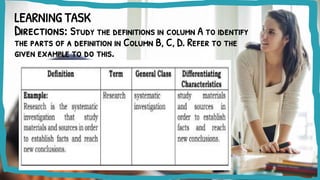
LEARNING TASK
Directions: Study the definitions in column A to identify
the parts of a definition in Column B, C, D. Refer to the
given example to do this.
PARTS OF A
DEFINITION
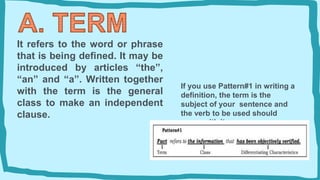
If you use Pattern#1 in writing a
definition, the term is the
subject of your sentence and
the verb to be used should
agree with it.
It refers to the word or phrase
that is being defined. It may be
introduced by articles “the”,
“an” and “a”. Written together
with the term is the general
class to make an independent
clause.
You can use Pattern #2 in writing your definitions.
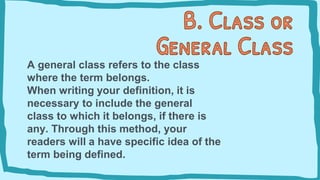
A general class refers to the class
where the term belongs.
When writing your definition, it is
necessary to include the general
class to which it belongs, if there is
any. Through this method, your
readers will a have specific idea of the
term being defined.
To introduce your
differentiating
characteristics, you
should use relative
pronouns and a dependent
clause.
When writing your definitions, make
sure that the verb you will use agrees
with the subject of your statement.
Remember, a singular subject should
take a singular verb. A plural subject
should take a plural verb.
Read the following examples:
1. An abstract is a brief statement of essential
information (Art.) (Term) (Verb) contained
within a document or presentation.
2. Research questions are questions that you
include in (Term) (Verb) the
body of your work.
3. An in-text citation refers to a brief form of
reference (Art.) (Term) (Verb) that you
include in in the body of your work.
SUBJECT-VERB-AGREEMENT
And when a phrase comes between the subject and the verb, remember
that the verb still agrees with the subject, not the noun in the phrase
following the subject of the sentence.
SUBJECT-VERB-AGREEMENT
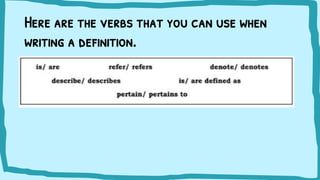
Here are the verbs that you can use when
writing a definition.
Examples!
1. A web browser is a special communications program that
reads and interprets htlmdocuments.
2. A uniform resource locator (url) is an address that you
feed Web browsers.
3.The oxford text archive is a database which contains
electronic books in many different languages around
the world.
4.Links are highlighted text pointing to additional
information.
5.A web server is a computer program that responds to
requests from web browsers.
LANGUAGE FOCUS:
DEFINING RELATIVE
PRONOUN
relative pronouns: pronouns used to introduce a relative clause—a
clause that gives further information about the noun or noun phrase (e.g., “the
ball that I threw”).
The most commonly used relative pronouns in English are which, that, who, and
whom.
In writing your distinguishing
characteristics, it is important to use
defining relative pronouns. These relative
pronouns will help you in the transition
from the independent clause (term and
class) to the subordinate clause/ defining
relative clause (distinguishing
characteristics).
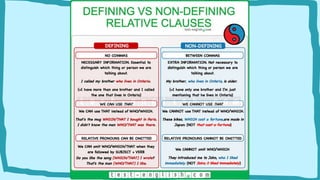
defining relative pronoun
 Defining relative clauses give
essential information about
someone or something –
information that we need in
order to understand what or
who is being referred to.
 A defining relative clause
usually comes immediately
after the noun it describes.
ACTIVITIES
Activity A: Read the given sentences and use the right relative pronouns.
We always like people __ speak the truth.
Can you tell ___ pen this is?
This is Natasha ___ I was praising.
The boy ___ I met in Delhi stays near our house.
This is the house in ___ John Keats lived.
These are the saplings ___ my mother and I planted together.
The teacher punished the students ___ were shouting.
I don’t think there’s anyone ___ doesn’t like chocolates.
Are these the people about ___ you were talking?
The car ___ my uncle brought is quite expensive.
Activity B
Directions: Arrange the following words inside the boxes to form a
grammatically correct definition for the term inside the circle.
WRITE YOUR ANSWERS ON THE BOARD.
Activity B
Directions: Arrange the following words inside the boxes to form a
grammatically correct definition for the term inside the circle.
WRITE YOUR ANSWERS ON THE BOARD.
Why is there a need to observe correct grammar in
writing research?
In research, correct grammar is crucial in research as it enhances
the clarity and credibility of your work. Remember, it's always a
good idea to proofread your work multiple times and consider
seeking feedback from colleagues or supervisors to catch any
grammar mistakes or inconsistencies.
WHAT ARE YOUR
TAKEAWAYS FROM
THIS WEEK’S LESSON?
1. Covid 19 is an acute respiratory illness in humans caused by a corona virus, capable of
producing severe symptoms and in some cases, death.
2. A virus is a submicroscopic infectious agent that replicates only inside the living cells of
an organism.
3. An organism is a living entity consisting of one cell e.g., bacteria, or several cells e.g.,
animals, plants, and fungi.
4. A procedure is called intubation that is used when you can't breathe on your own.
5. Vaccine, a substance containing a virus or bacterium in a form that is not harmful, given
to a person or animal to prevent them from getting the disease that the virus or bacterium
causes.
Directions: Tell whether the sentence has correct or
incorrect grammar. Is the statement
grammatically correct or incorrect?
CRE DITS : This presentation template was created by
S lidesgo, including icons by F laticon, infographics & images by
F reepik
Thanks!
Do you have any
questions?
P lease keep this slide for attribution

Observing-Correct-Grammar-in-Making-Definitions.pptx

  • 1.
    OBSERVING CORRECT GRAMMAR INMAKING DEFINITIONS ME LC: O bserve correct grammar in making definitions IIa
  • 2.
    LEARNING TARGETS 1.identify partsof a definition; 2.determine sentence patterns used in writing definitions; 3.provide the appropriate relative pronoun for each sentence; 4.spot incorrect grammar in definitions; and 5. value the importance of correct grammar in writing a research paper.
  • 3.
    REVIEW QUESTION What is thegoal of making or writing expanded definitions?
  • 4.
    Other than knowingyour audience, knowing how to be thorough in providing description and details will help you make useful definitions. Knowing the parts of a definition and correct usage of words will help you write descriptions for your definitions easily.
  • 5.
    This lesson willestablish an understanding of the usage of correct grammar when writing definitions by citing many examples. This lesson also show the importance of correct grammar in making definitions, such as clarity, precision, consistency, credibility, and accessibility. It helps to convey the intended meaning accurately, facilitates understanding, and contributes to effective communication within the field or subject area. PURPOSE
  • 6.
    LEARNING TASK Directions: Studythe definitions in column A to identify the parts of a definition in Column B, C, D. Refer to the given example to do this.
  • 8.
  • 9.
    If you usePattern#1 in writing a definition, the term is the subject of your sentence and the verb to be used should agree with it. It refers to the word or phrase that is being defined. It may be introduced by articles “the”, “an” and “a”. Written together with the term is the general class to make an independent clause.
  • 10.
    You can usePattern #2 in writing your definitions.
  • 11.
    A general classrefers to the class where the term belongs. When writing your definition, it is necessary to include the general class to which it belongs, if there is any. Through this method, your readers will a have specific idea of the term being defined.
  • 13.
    To introduce your differentiating characteristics,you should use relative pronouns and a dependent clause.
  • 14.
    When writing yourdefinitions, make sure that the verb you will use agrees with the subject of your statement. Remember, a singular subject should take a singular verb. A plural subject should take a plural verb. Read the following examples: 1. An abstract is a brief statement of essential information (Art.) (Term) (Verb) contained within a document or presentation. 2. Research questions are questions that you include in (Term) (Verb) the body of your work. 3. An in-text citation refers to a brief form of reference (Art.) (Term) (Verb) that you include in in the body of your work. SUBJECT-VERB-AGREEMENT
  • 16.
    And when aphrase comes between the subject and the verb, remember that the verb still agrees with the subject, not the noun in the phrase following the subject of the sentence. SUBJECT-VERB-AGREEMENT
  • 17.
    Here are theverbs that you can use when writing a definition.
  • 18.
  • 19.
    1. A webbrowser is a special communications program that reads and interprets htlmdocuments. 2. A uniform resource locator (url) is an address that you feed Web browsers. 3.The oxford text archive is a database which contains electronic books in many different languages around the world. 4.Links are highlighted text pointing to additional information. 5.A web server is a computer program that responds to requests from web browsers.
  • 20.
  • 21.
    relative pronouns: pronounsused to introduce a relative clause—a clause that gives further information about the noun or noun phrase (e.g., “the ball that I threw”). The most commonly used relative pronouns in English are which, that, who, and whom. In writing your distinguishing characteristics, it is important to use defining relative pronouns. These relative pronouns will help you in the transition from the independent clause (term and class) to the subordinate clause/ defining relative clause (distinguishing characteristics).
  • 22.
    defining relative pronoun Defining relative clauses give essential information about someone or something – information that we need in order to understand what or who is being referred to.  A defining relative clause usually comes immediately after the noun it describes.
  • 25.
    ACTIVITIES Activity A: Readthe given sentences and use the right relative pronouns. We always like people __ speak the truth. Can you tell ___ pen this is? This is Natasha ___ I was praising. The boy ___ I met in Delhi stays near our house. This is the house in ___ John Keats lived. These are the saplings ___ my mother and I planted together. The teacher punished the students ___ were shouting. I don’t think there’s anyone ___ doesn’t like chocolates. Are these the people about ___ you were talking? The car ___ my uncle brought is quite expensive.
  • 26.
    Activity B Directions: Arrangethe following words inside the boxes to form a grammatically correct definition for the term inside the circle. WRITE YOUR ANSWERS ON THE BOARD.
  • 27.
    Activity B Directions: Arrangethe following words inside the boxes to form a grammatically correct definition for the term inside the circle. WRITE YOUR ANSWERS ON THE BOARD.
  • 28.
    Why is therea need to observe correct grammar in writing research? In research, correct grammar is crucial in research as it enhances the clarity and credibility of your work. Remember, it's always a good idea to proofread your work multiple times and consider seeking feedback from colleagues or supervisors to catch any grammar mistakes or inconsistencies.
  • 29.
    WHAT ARE YOUR TAKEAWAYSFROM THIS WEEK’S LESSON?
  • 30.
    1. Covid 19is an acute respiratory illness in humans caused by a corona virus, capable of producing severe symptoms and in some cases, death. 2. A virus is a submicroscopic infectious agent that replicates only inside the living cells of an organism. 3. An organism is a living entity consisting of one cell e.g., bacteria, or several cells e.g., animals, plants, and fungi. 4. A procedure is called intubation that is used when you can't breathe on your own. 5. Vaccine, a substance containing a virus or bacterium in a form that is not harmful, given to a person or animal to prevent them from getting the disease that the virus or bacterium causes. Directions: Tell whether the sentence has correct or incorrect grammar. Is the statement grammatically correct or incorrect?
  • 31.
    CRE DITS :This presentation template was created by S lidesgo, including icons by F laticon, infographics & images by F reepik Thanks! Do you have any questions? P lease keep this slide for attribution