Project OnProject On
Historical Background &Historical Background &
Generations of Computers…Generations of Computers…
While working with this Project, weWhile working with this Project, we
have classified the whole projecthave classified the whole project
into two segments…into two segments…
History of Computing.History of Computing.
Generation of Computers.Generation of Computers.
Case Study 01Case Study 01
History of Computing…History of Computing…
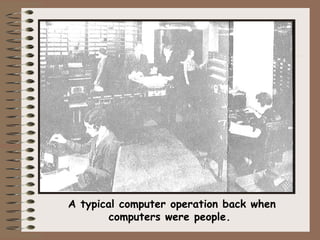
A typical computer operation back when
computers were people.
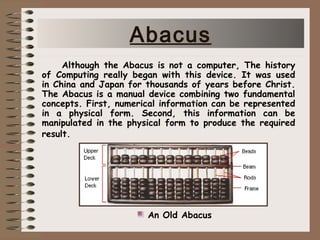
Although the Abacus is not a computer, The history
of Computing really began with this device. It was used
in China and Japan for thousands of years before Christ.
The Abacus is a manual device combining two fundamental
concepts. First, numerical information can be represented
in a physical form. Second, this information can be
manipulated in the physical form to produce the required
result.
An Old Abacus
Abacus
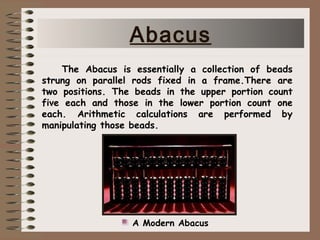
The Abacus is essentially a collection of beads
strung on parallel rods fixed in a frame.There are
two positions. The beads in the upper portion count
five each and those in the lower portion count one
each. Arithmetic calculations are performed by
manipulating those beads.
A Modern Abacus
Abacus
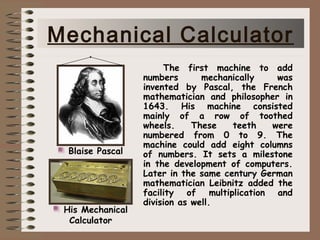
The first machine to add
numbers mechanically was
invented by Pascal, the French
mathematician and philosopher in
1643. His machine consisted
mainly of a row of toothed
wheels. These teeth were
numbered from 0 to 9. The
machine could add eight columns
of numbers. It sets a milestone
in the development of computers.
Later in the same century German
mathematician Leibnitz added the
facility of multiplication and
division as well.
Blaise Pascal
His Mechanical
Calculator
Mechanical Calculator
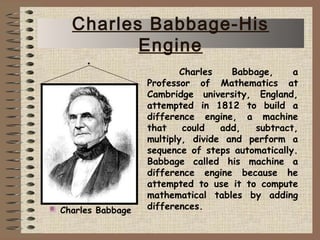
Charles Babbage, a
Professor of Mathematics at
Cambridge university, England,
attempted in 1812 to build a
difference engine, a machine
that could add, subtract,
multiply, divide and perform a
sequence of steps automatically.
Babbage called his machine a
difference engine because he
attempted to use it to compute
mathematical tables by adding
differences.Charles Babbage
Charles Babbage-His
Engine
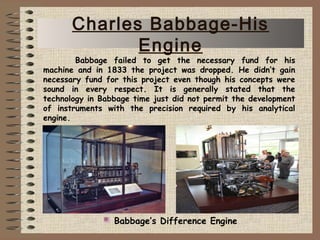
Babbage failed to get the necessary fund for his
machine and in 1833 the project was dropped. He didn’t gain
necessary fund for this project even though his concepts were
sound in every respect. It is generally stated that the
technology in Babbage time just did not permit the development
of instruments with the precision required by his analytical
engine.
Babbage’s Difference Engine
Charles Babbage-His
Engine
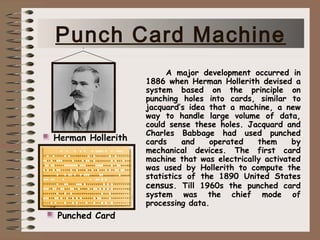
A major development occurred in
1886 when Herman Hollerith devised a
system based on the principle on
punching holes into cards, similar to
jacquard’s idea that a machine, a new
way to handle large volume of data,
could sense these holes. Jacquard and
Charles Babbage had used punched
cards and operated them by
mechanical devices. The first card
machine that was electrically activated
was used by Hollerith to compute the
statistics of the 1890 United States
census. Till 1960s the punched card
system was the chief mode of
processing data.
Punched Card
Herman Hollerith
Punch Card Machine
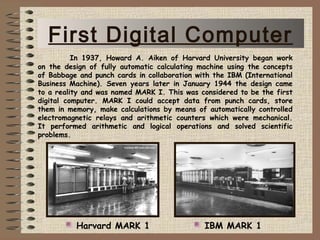
In 1937, Howard A. Aiken of Harvard University began work
on the design of fully automatic calculating machine using the concepts
of Babbage and punch cards in collaboration with the IBM (International
Business Machine). Seven years later in January 1944 the design came
to a reality and was named MARK I. This was considered to be the first
digital computer. MARK I could accept data from punch cards, store
them in memory, make calculations by means of automatically controlled
electromagnetic relays and arithmetic counters which were mechanical.
It performed arithmetic and logical operations and solved scientific
problems.
Harvard MARK 1 IBM MARK 1
First Digital Computer
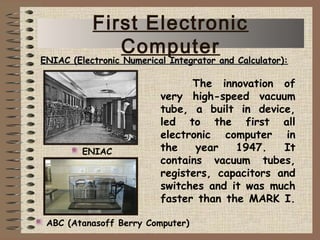
The innovation of
very high-speed vacuum
tube, a built in device,
led to the first all
electronic computer in
the year 1947. It
contains vacuum tubes,
registers, capacitors and
switches and it was much
faster than the MARK I.
ENIAC
ENIAC (Electronic Numerical Integrator and Calculator):ENIAC (Electronic Numerical Integrator and Calculator):
ABC (Atanasoff Berry Computer)
First Electronic
Computer
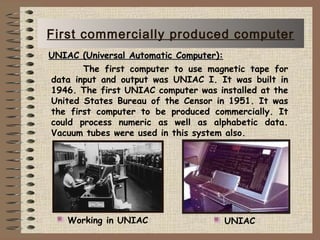
   The first computer to use magnetic tape for
data input and output was UNIAC I. It was built in
1946. The first UNIAC computer was installed at the
United States Bureau of the Censor in 1951. It was
the first computer to be produced commercially. It
could process numeric as well as alphabetic data.
Vacuum tubes were used in this system also.
UNIACWorking in UNIAC
UNIAC (Universal Automatic Computer):UNIAC (Universal Automatic Computer):
First commercially produced computer
Case Study 02Case Study 02
Computer Generations…Computer Generations…
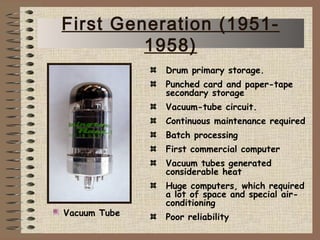
Drum primary storage.
Punched card and paper-tape
secondary storage
Vacuum-tube circuit.
Continuous maintenance required
Batch processing
First commercial computer
Vacuum tubes generated
considerable heat
Huge computers, which required
a lot of space and special air-
conditioning
Poor reliabilityVacuum Tube
First Generation (1951-
1958)
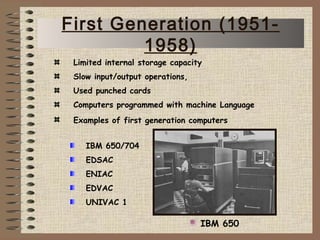
IBM 650/704
EDSAC
ENIAC
EDVAC
UNIVAC 1
IBM 650
Limited internal storage capacity
Slow input/output operations,
Used punched cards
Computers programmed with machine Language
Examples of first generation computers
First Generation (1951-
1958)
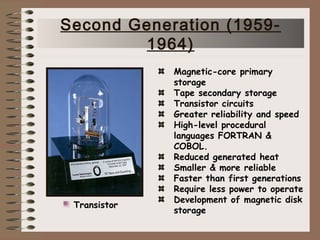
Magnetic-core primary
storage
Tape secondary storage
Transistor circuits
Greater reliability and speed
High-level procedural
languages FORTRAN &
COBOL.
Reduced generated heat
Smaller & more reliable
Faster than first generations
Require less power to operate
Development of magnetic disk
storage
Transistor
Second Generation (1959-
1964)
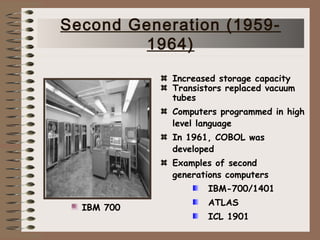
Increased storage capacity
Transistors replaced vacuum
tubes
Computers programmed in high
level language
In 1961, COBOL was
developed
Examples of second
generations computers
IBM-700/1401
ATLAS
ICL 1901
IBM 700
Second Generation (1959-
1964)
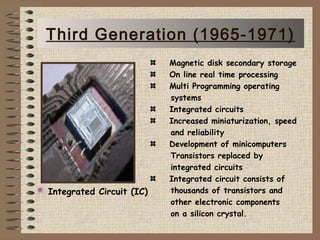
Magnetic disk secondary storage
On line real time processing
Multi Programming operating
systems
Integrated circuits
Increased miniaturization, speed
and reliability
Development of minicomputers
Transistors replaced by
integrated circuits
Integrated circuit consists of
thousands of transistors and
other electronic components
on a silicon crystal.
Integrated Circuit (IC)
Third Generation (1965-1971)
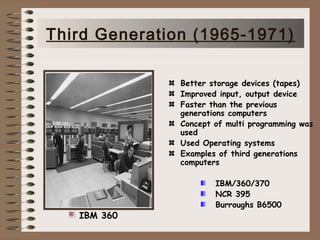
Better storage devices (tapes)
Improved input, output device
Faster than the previous
generations computers
Concept of multi programming was
used
Used Operating systems
Examples of third generations
computers
IBM/360/370
NCR 395
Burroughs B6500
IBM 360
Third Generation (1965-1971)
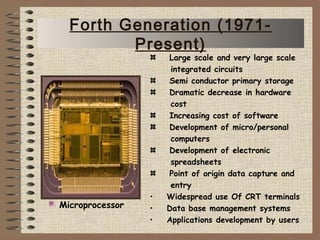
Large scale and very large scale
integrated circuits
Semi conductor primary storage
Dramatic decrease in hardware
cost
Increasing cost of software
Development of micro/personal
computers
Development of electronic
spreadsheets
Point of origin data capture and
entry
• Widespread use Of CRT terminals
• Data base management systems
• Applications development by users
Microprocessor
Forth Generation (1971-
Present)
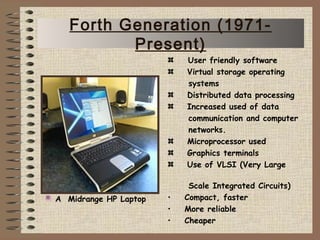
User friendly software
Virtual storage operating
systems
Distributed data processing
Increased used of data
communication and computer
networks.
Microprocessor used
Graphics terminals
Use of VLSI (Very Large
Scale Integrated Circuits)
• Compact, faster
• More reliable
• Cheaper
A Midrange HP Laptop
Forth Generation (1971-
Present)
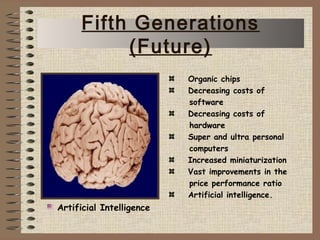
Organic chips
Decreasing costs of
software
Decreasing costs of
hardware
Super and ultra personal
computers
Increased miniaturization
Vast improvements in the
price performance ratio
Artificial intelligence.
Artificial Intelligence
Fifth Generations
(Future)
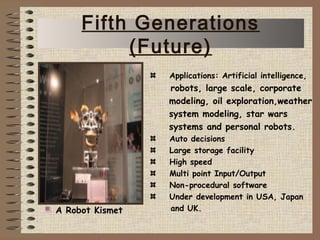
Applications: Artificial intelligence,
robots, large scale, corporate
modeling, oil exploration,weather
system modeling, star wars
systems and personal robots.
Auto decisions
Large storage facility
High speed
Multi point Input/Output
Non-procedural software
Under development in USA, Japan
and UK.A Robot Kismet
Fifth Generations
(Future)
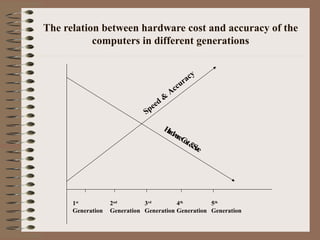
The relation between hardware cost and accuracy of the
computers in different generations
HardwareCost&Size
Speed
&
Accuracy
1st
Generation
2nd
Generation
3rd
Generation
4th
Generation
5th
Generation
Thanks a millionThanks a million
Submitted By…Submitted By…
  Mehnaj Binte ZiaMehnaj Binte Zia
Roll No: 1002052Roll No: 1002052
Sunriz IslamSunriz Islam
Roll No: 1102048.Roll No: 1102048.
Level 1, Semester 1Level 1, Semester 1
Telecommunication & Electronic Engineering.Telecommunication & Electronic Engineering.

presentation by sunriz n sarani

  • 1.
    Project OnProject On HistoricalBackground &Historical Background & Generations of Computers…Generations of Computers…
  • 2.
    While working withthis Project, weWhile working with this Project, we have classified the whole projecthave classified the whole project into two segments…into two segments… History of Computing.History of Computing. Generation of Computers.Generation of Computers.
  • 3.
    Case Study 01CaseStudy 01 History of Computing…History of Computing…
  • 4.
    A typical computeroperation back when computers were people.
  • 5.
    Although the Abacusis not a computer, The history of Computing really began with this device. It was used in China and Japan for thousands of years before Christ. The Abacus is a manual device combining two fundamental concepts. First, numerical information can be represented in a physical form. Second, this information can be manipulated in the physical form to produce the required result. An Old Abacus Abacus
  • 6.
    The Abacus isessentially a collection of beads strung on parallel rods fixed in a frame.There are two positions. The beads in the upper portion count five each and those in the lower portion count one each. Arithmetic calculations are performed by manipulating those beads. A Modern Abacus Abacus
  • 7.
    The first machineto add numbers mechanically was invented by Pascal, the French mathematician and philosopher in 1643. His machine consisted mainly of a row of toothed wheels. These teeth were numbered from 0 to 9. The machine could add eight columns of numbers. It sets a milestone in the development of computers. Later in the same century German mathematician Leibnitz added the facility of multiplication and division as well. Blaise Pascal His Mechanical Calculator Mechanical Calculator
  • 8.
    Charles Babbage, a Professorof Mathematics at Cambridge university, England, attempted in 1812 to build a difference engine, a machine that could add, subtract, multiply, divide and perform a sequence of steps automatically. Babbage called his machine a difference engine because he attempted to use it to compute mathematical tables by adding differences.Charles Babbage Charles Babbage-His Engine
  • 9.
    Babbage failed toget the necessary fund for his machine and in 1833 the project was dropped. He didn’t gain necessary fund for this project even though his concepts were sound in every respect. It is generally stated that the technology in Babbage time just did not permit the development of instruments with the precision required by his analytical engine. Babbage’s Difference Engine Charles Babbage-His Engine
  • 10.
    A major developmentoccurred in 1886 when Herman Hollerith devised a system based on the principle on punching holes into cards, similar to jacquard’s idea that a machine, a new way to handle large volume of data, could sense these holes. Jacquard and Charles Babbage had used punched cards and operated them by mechanical devices. The first card machine that was electrically activated was used by Hollerith to compute the statistics of the 1890 United States census. Till 1960s the punched card system was the chief mode of processing data. Punched Card Herman Hollerith Punch Card Machine
  • 11.
    In 1937, HowardA. Aiken of Harvard University began work on the design of fully automatic calculating machine using the concepts of Babbage and punch cards in collaboration with the IBM (International Business Machine). Seven years later in January 1944 the design came to a reality and was named MARK I. This was considered to be the first digital computer. MARK I could accept data from punch cards, store them in memory, make calculations by means of automatically controlled electromagnetic relays and arithmetic counters which were mechanical. It performed arithmetic and logical operations and solved scientific problems. Harvard MARK 1 IBM MARK 1 First Digital Computer
  • 12.
    The innovation of veryhigh-speed vacuum tube, a built in device, led to the first all electronic computer in the year 1947. It contains vacuum tubes, registers, capacitors and switches and it was much faster than the MARK I. ENIAC ENIAC (Electronic Numerical Integrator and Calculator):ENIAC (Electronic Numerical Integrator and Calculator): ABC (Atanasoff Berry Computer) First Electronic Computer
  • 13.
       The firstcomputer to use magnetic tape for data input and output was UNIAC I. It was built in 1946. The first UNIAC computer was installed at the United States Bureau of the Censor in 1951. It was the first computer to be produced commercially. It could process numeric as well as alphabetic data. Vacuum tubes were used in this system also. UNIACWorking in UNIAC UNIAC (Universal Automatic Computer):UNIAC (Universal Automatic Computer): First commercially produced computer
  • 14.
    Case Study 02CaseStudy 02 Computer Generations…Computer Generations…
  • 15.
    Drum primary storage. Punchedcard and paper-tape secondary storage Vacuum-tube circuit. Continuous maintenance required Batch processing First commercial computer Vacuum tubes generated considerable heat Huge computers, which required a lot of space and special air- conditioning Poor reliabilityVacuum Tube First Generation (1951- 1958)
  • 16.
    IBM 650/704 EDSAC ENIAC EDVAC UNIVAC 1 IBM650 Limited internal storage capacity Slow input/output operations, Used punched cards Computers programmed with machine Language Examples of first generation computers First Generation (1951- 1958)
  • 17.
    Magnetic-core primary storage Tape secondarystorage Transistor circuits Greater reliability and speed High-level procedural languages FORTRAN & COBOL. Reduced generated heat Smaller & more reliable Faster than first generations Require less power to operate Development of magnetic disk storage Transistor Second Generation (1959- 1964)
  • 18.
    Increased storage capacity Transistorsreplaced vacuum tubes Computers programmed in high level language In 1961, COBOL was developed Examples of second generations computers IBM-700/1401 ATLAS ICL 1901 IBM 700 Second Generation (1959- 1964)
  • 19.
    Magnetic disk secondarystorage On line real time processing Multi Programming operating systems Integrated circuits Increased miniaturization, speed and reliability Development of minicomputers Transistors replaced by integrated circuits Integrated circuit consists of thousands of transistors and other electronic components on a silicon crystal. Integrated Circuit (IC) Third Generation (1965-1971)
  • 20.
    Better storage devices(tapes) Improved input, output device Faster than the previous generations computers Concept of multi programming was used Used Operating systems Examples of third generations computers IBM/360/370 NCR 395 Burroughs B6500 IBM 360 Third Generation (1965-1971)
  • 21.
    Large scale andvery large scale integrated circuits Semi conductor primary storage Dramatic decrease in hardware cost Increasing cost of software Development of micro/personal computers Development of electronic spreadsheets Point of origin data capture and entry • Widespread use Of CRT terminals • Data base management systems • Applications development by users Microprocessor Forth Generation (1971- Present)
  • 22.
    User friendly software Virtualstorage operating systems Distributed data processing Increased used of data communication and computer networks. Microprocessor used Graphics terminals Use of VLSI (Very Large Scale Integrated Circuits) • Compact, faster • More reliable • Cheaper A Midrange HP Laptop Forth Generation (1971- Present)
  • 23.
    Organic chips Decreasing costsof software Decreasing costs of hardware Super and ultra personal computers Increased miniaturization Vast improvements in the price performance ratio Artificial intelligence. Artificial Intelligence Fifth Generations (Future)
  • 24.
    Applications: Artificial intelligence, robots,large scale, corporate modeling, oil exploration,weather system modeling, star wars systems and personal robots. Auto decisions Large storage facility High speed Multi point Input/Output Non-procedural software Under development in USA, Japan and UK.A Robot Kismet Fifth Generations (Future)
  • 25.
    The relation betweenhardware cost and accuracy of the computers in different generations HardwareCost&Size Speed & Accuracy 1st Generation 2nd Generation 3rd Generation 4th Generation 5th Generation
  • 26.
    Thanks a millionThanksa million Submitted By…Submitted By…   Mehnaj Binte ZiaMehnaj Binte Zia Roll No: 1002052Roll No: 1002052 Sunriz IslamSunriz Islam Roll No: 1102048.Roll No: 1102048. Level 1, Semester 1Level 1, Semester 1 Telecommunication & Electronic Engineering.Telecommunication & Electronic Engineering.