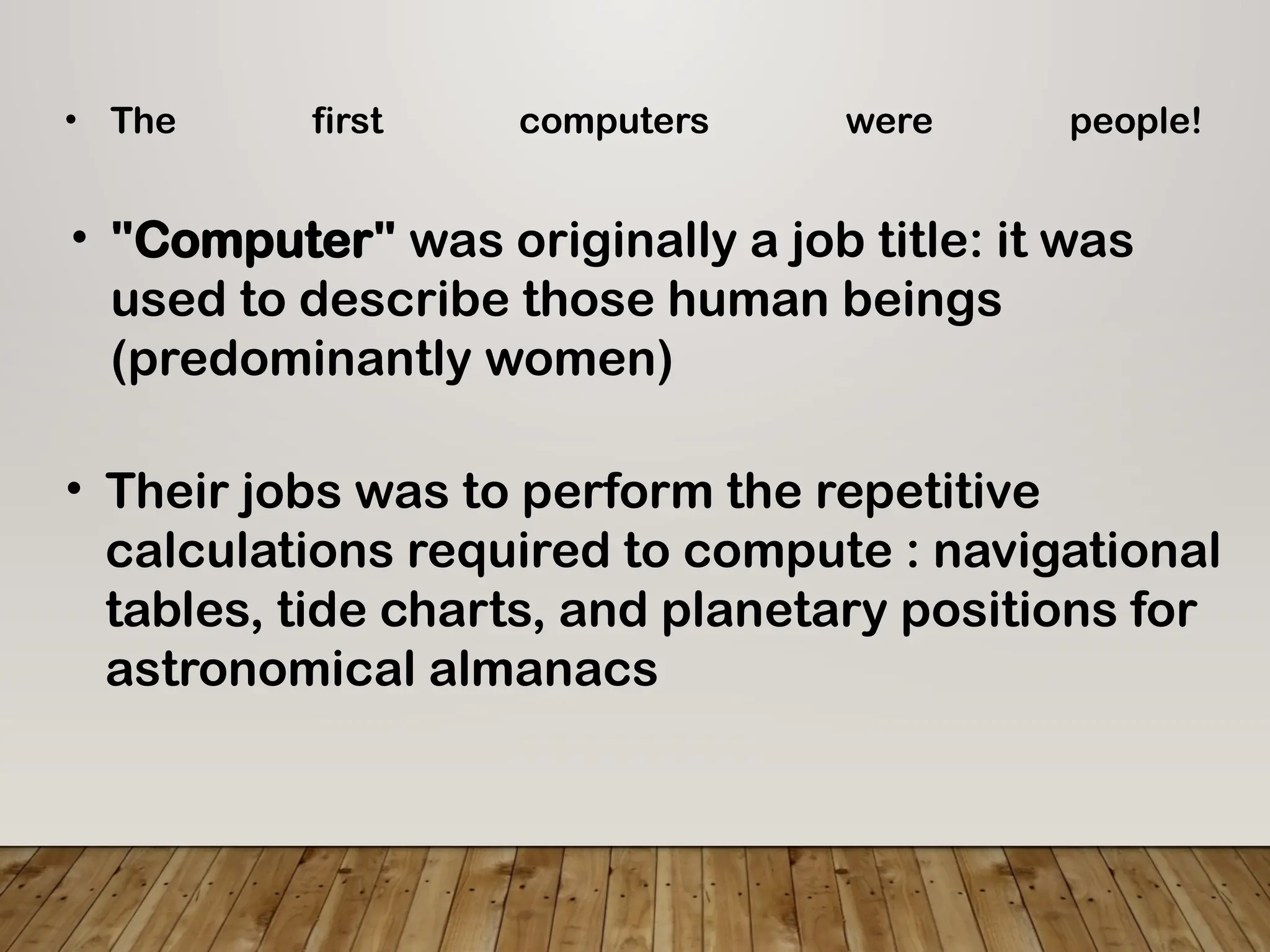
• The firstcomputers were people!
• "Computer" was originally a job title: it was
used to describe those human beings
(predominantly women)
• Their jobs was to perform the repetitive
calculations required to compute : navigational
tables, tide charts, and planetary positions for
astronomical almanacs
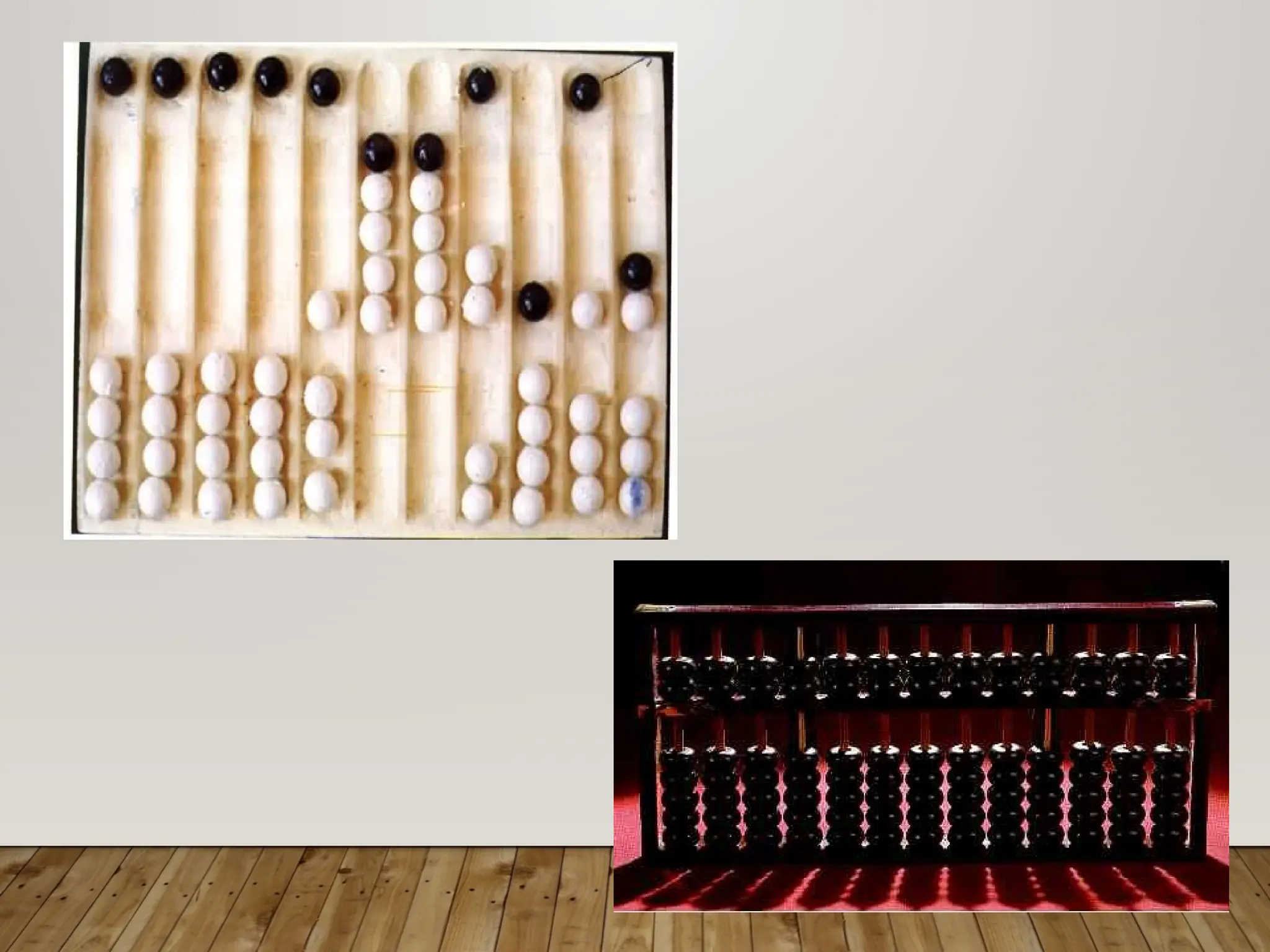
Abacus - wasan early aid for
mathematical computations. It is the
first counting device. Its only value is
that it aids the memory of the human
performing the calculation.
6.
1600’S
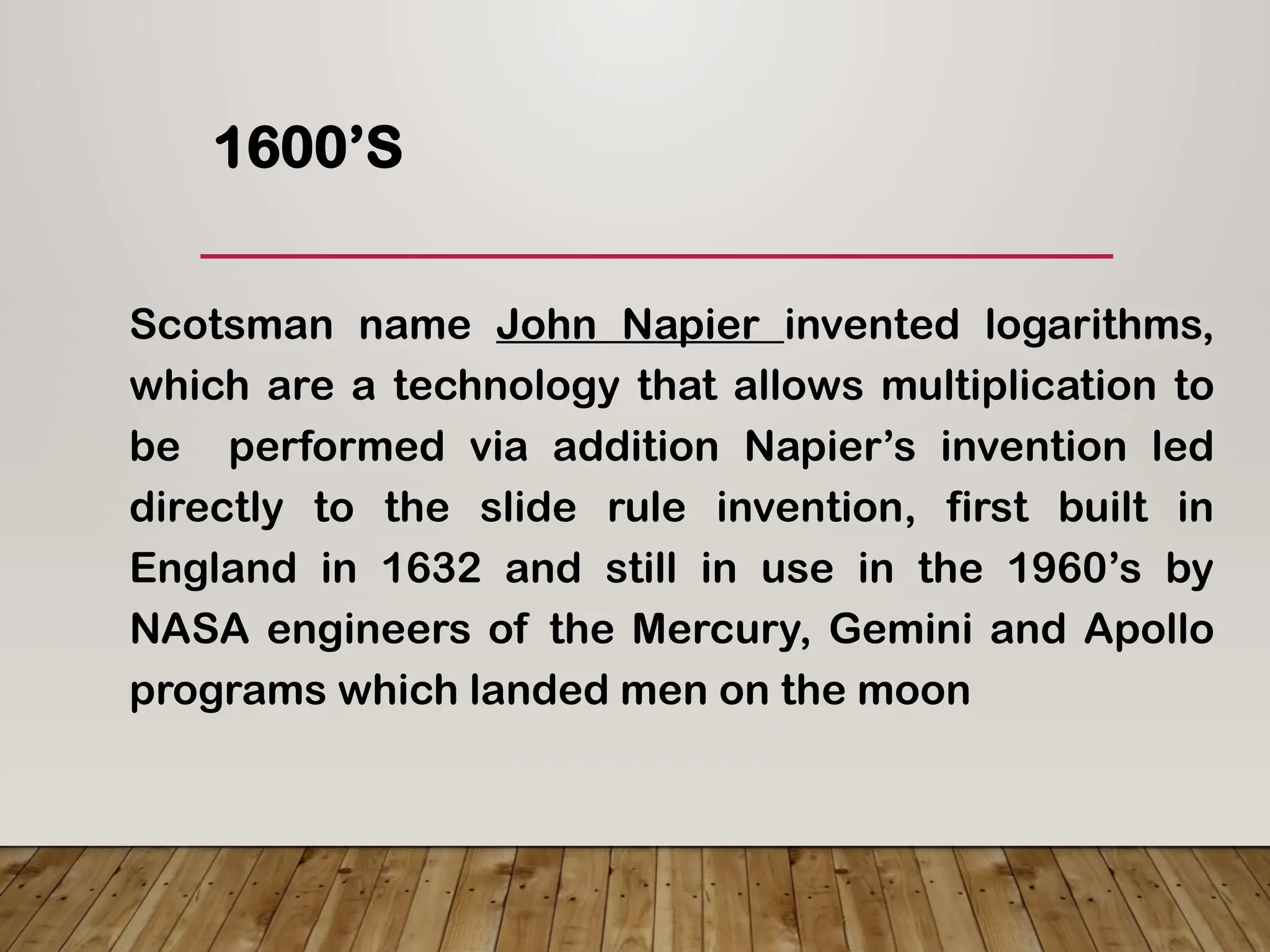
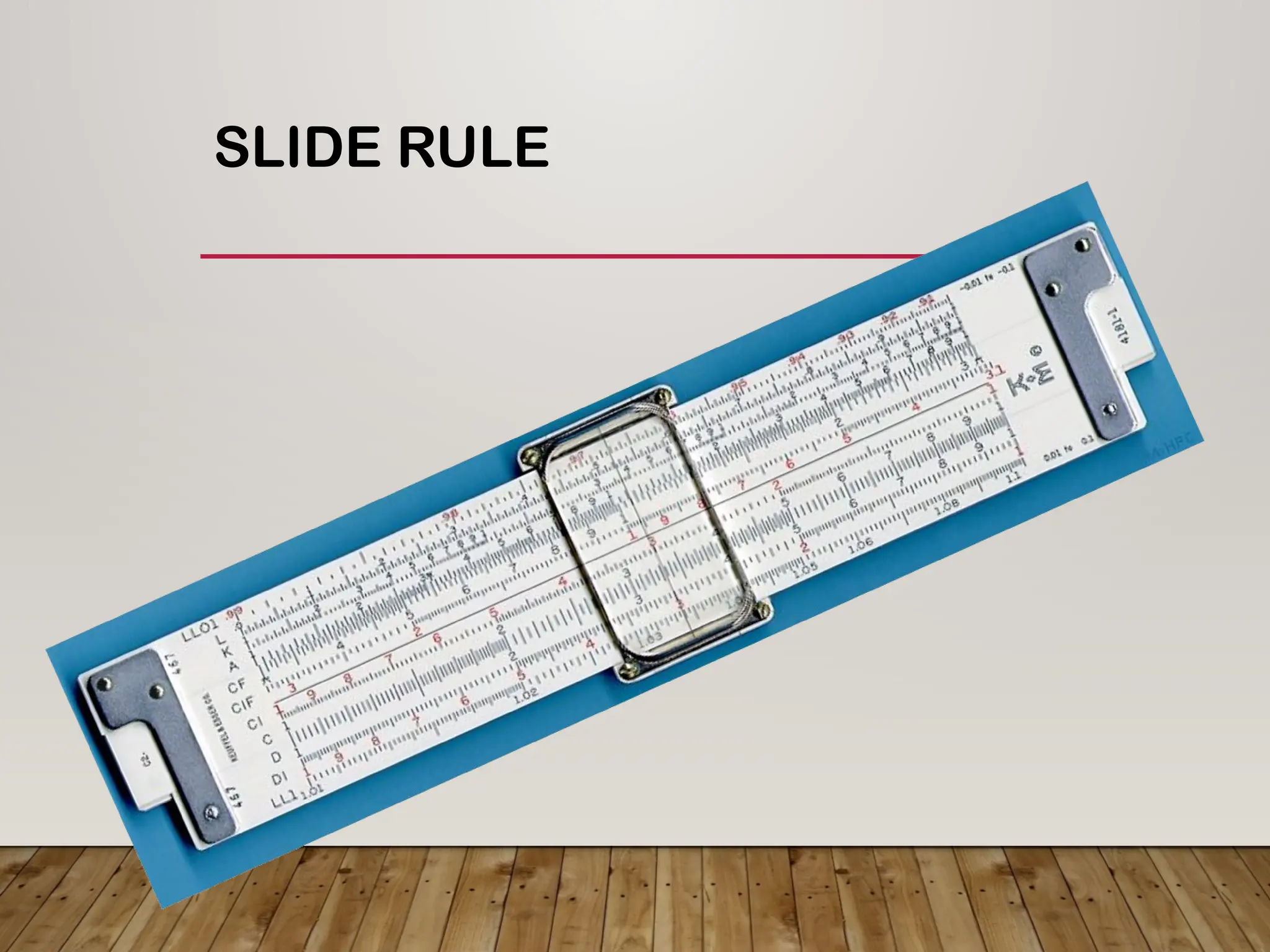
Scotsman name JohnNapier invented logarithms,
which are a technology that allows multiplication to
be performed via addition Napier’s invention led
directly to the slide rule invention, first built in
England in 1632 and still in use in the 1960’s by
NASA engineers of the Mercury, Gemini and Apollo
programs which landed men on the moon
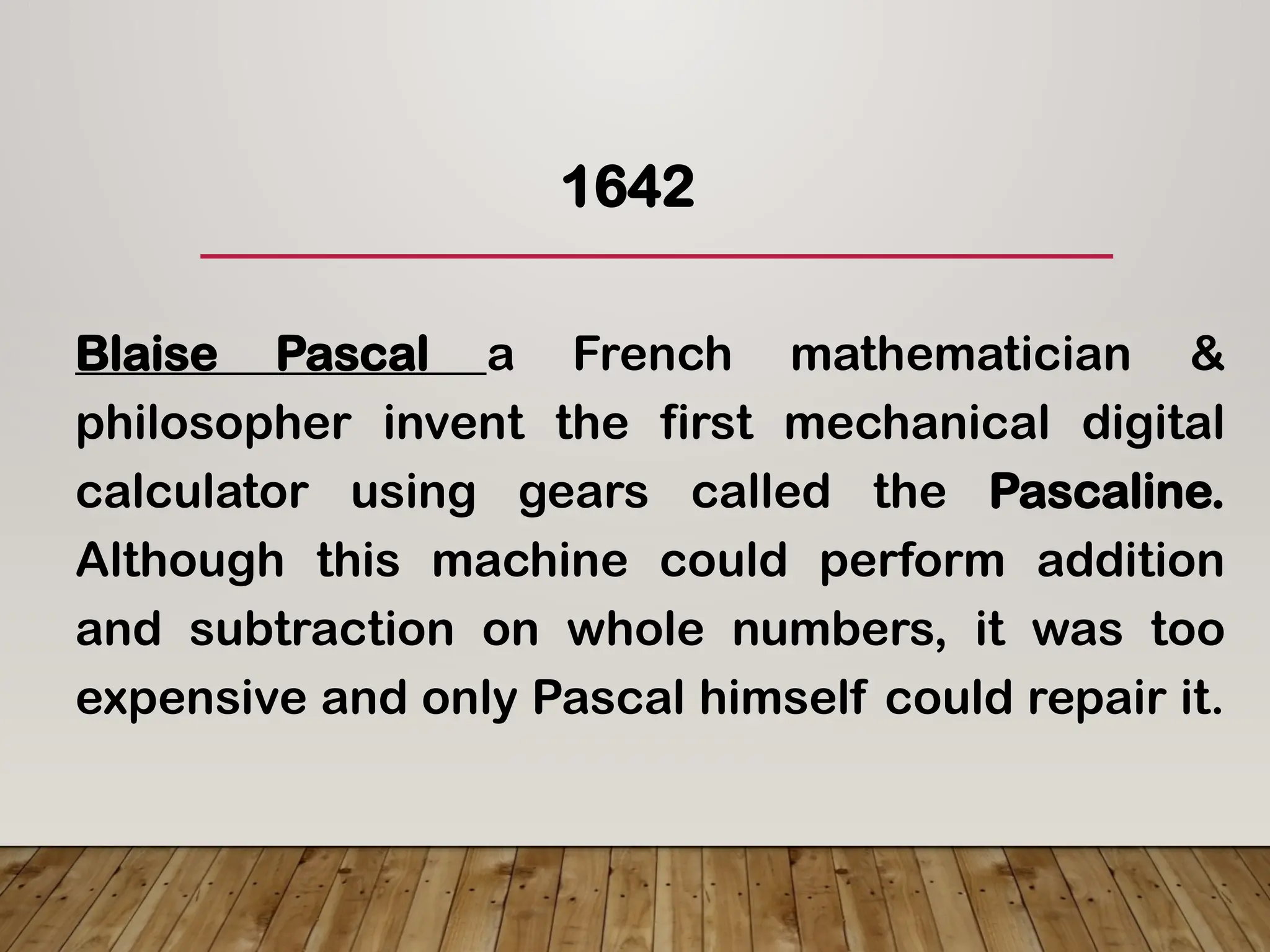
1642
Blaise Pascal aFrench mathematician &
philosopher invent the first mechanical digital
calculator using gears called the Pascaline.
Although this machine could perform addition
and subtraction on whole numbers, it was too
expensive and only Pascal himself could repair it.
1812
• Charles P.Babbage, the “father of
the computer” discovered a steam
driven calculating machine the size of
a room which he called the
DIFFERENCE ENGINE. Ten years later
the device was still near complete and
the funding dried up.
1812
• Charles P.Babbage was not deterred
and by then was on to his next
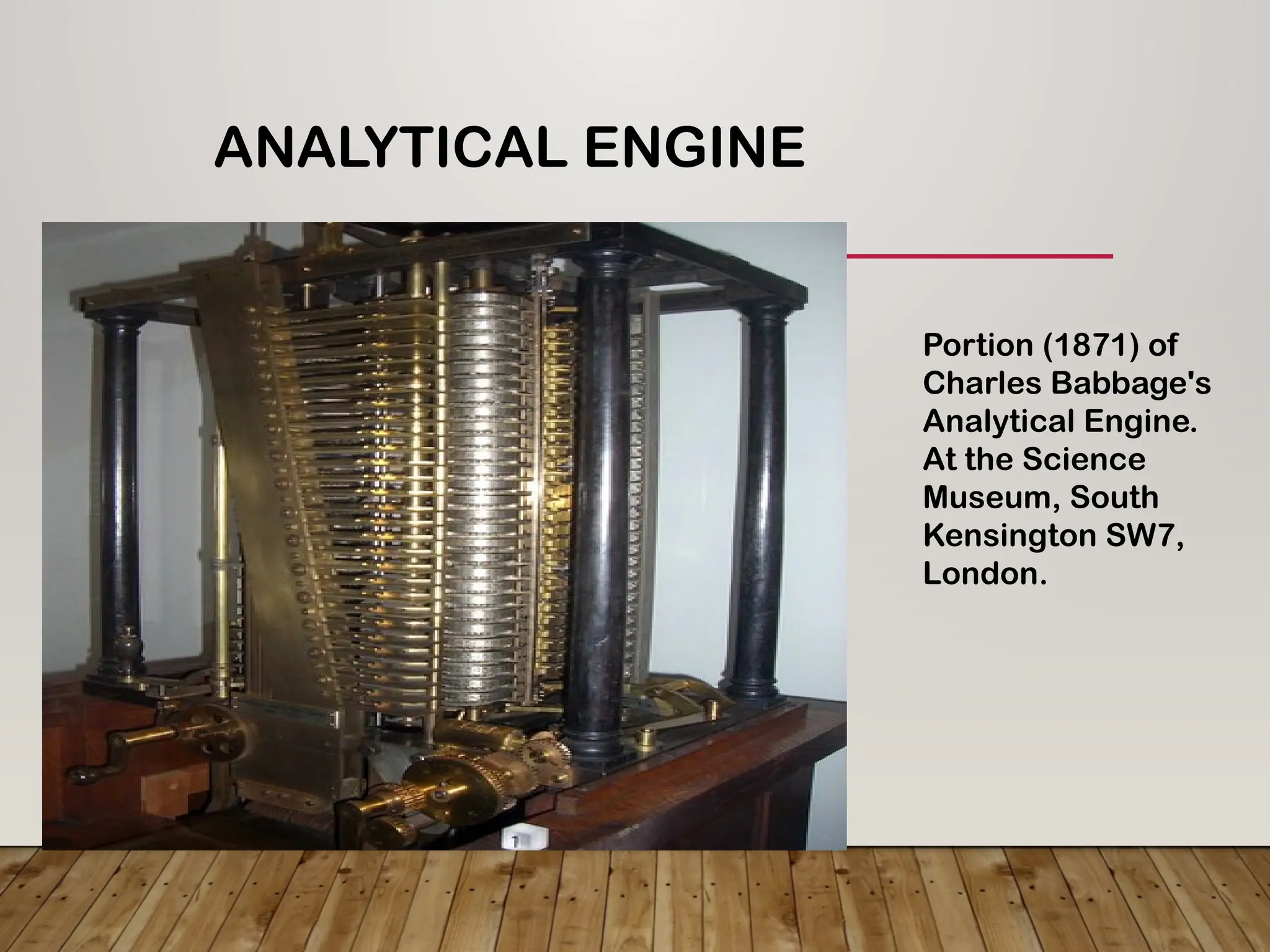
brainstorm which he called the
ANALYTICAL ENGINE . This device large
as a house and powered by 6 steam
engines, would be more general purpose
in nature because it would be
programmable, thanks to the punched
card technology of Jacquard.
1840
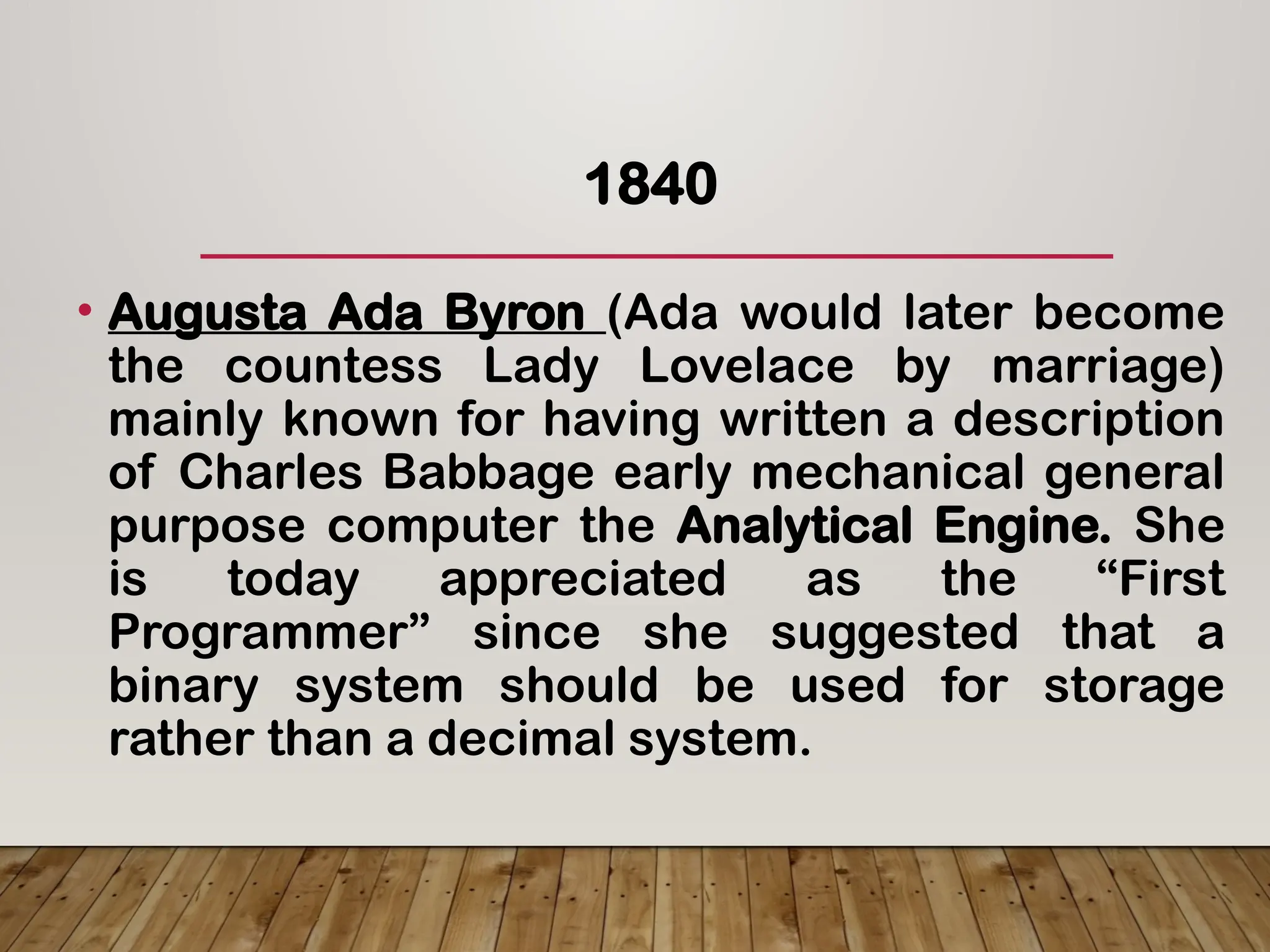
• Augusta AdaByron (Ada would later become
the countess Lady Lovelace by marriage)
mainly known for having written a description
of Charles Babbage early mechanical general
purpose computer the Analytical Engine. She
is today appreciated as the “First
Programmer” since she suggested that a
binary system should be used for storage
rather than a decimal system.
17.
1850
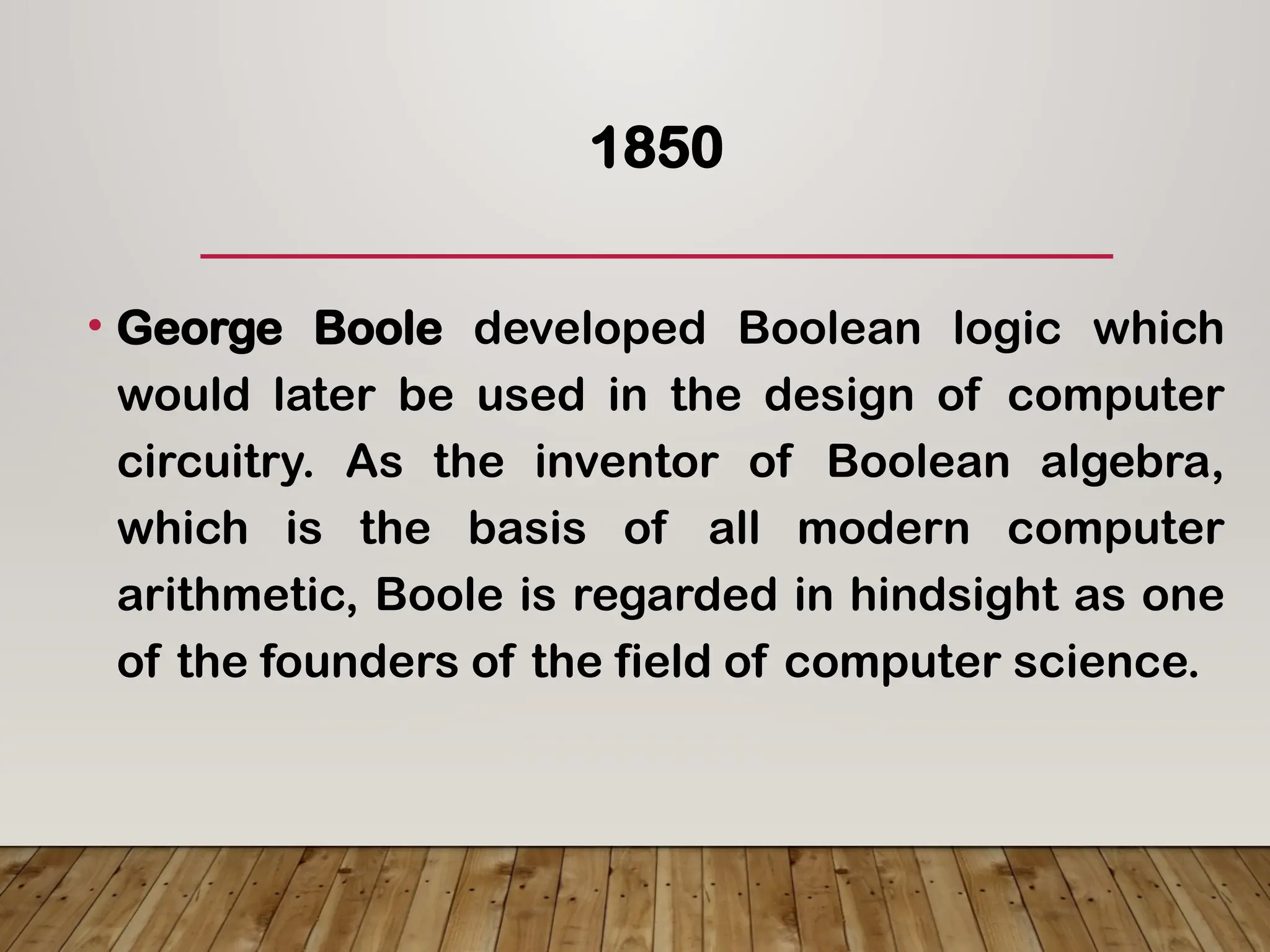
• George Booledeveloped Boolean logic which
would later be used in the design of computer
circuitry. As the inventor of Boolean algebra,
which is the basis of all modern computer
arithmetic, Boole is regarded in hindsight as one
of the founders of the field of computer science.
18.
1890
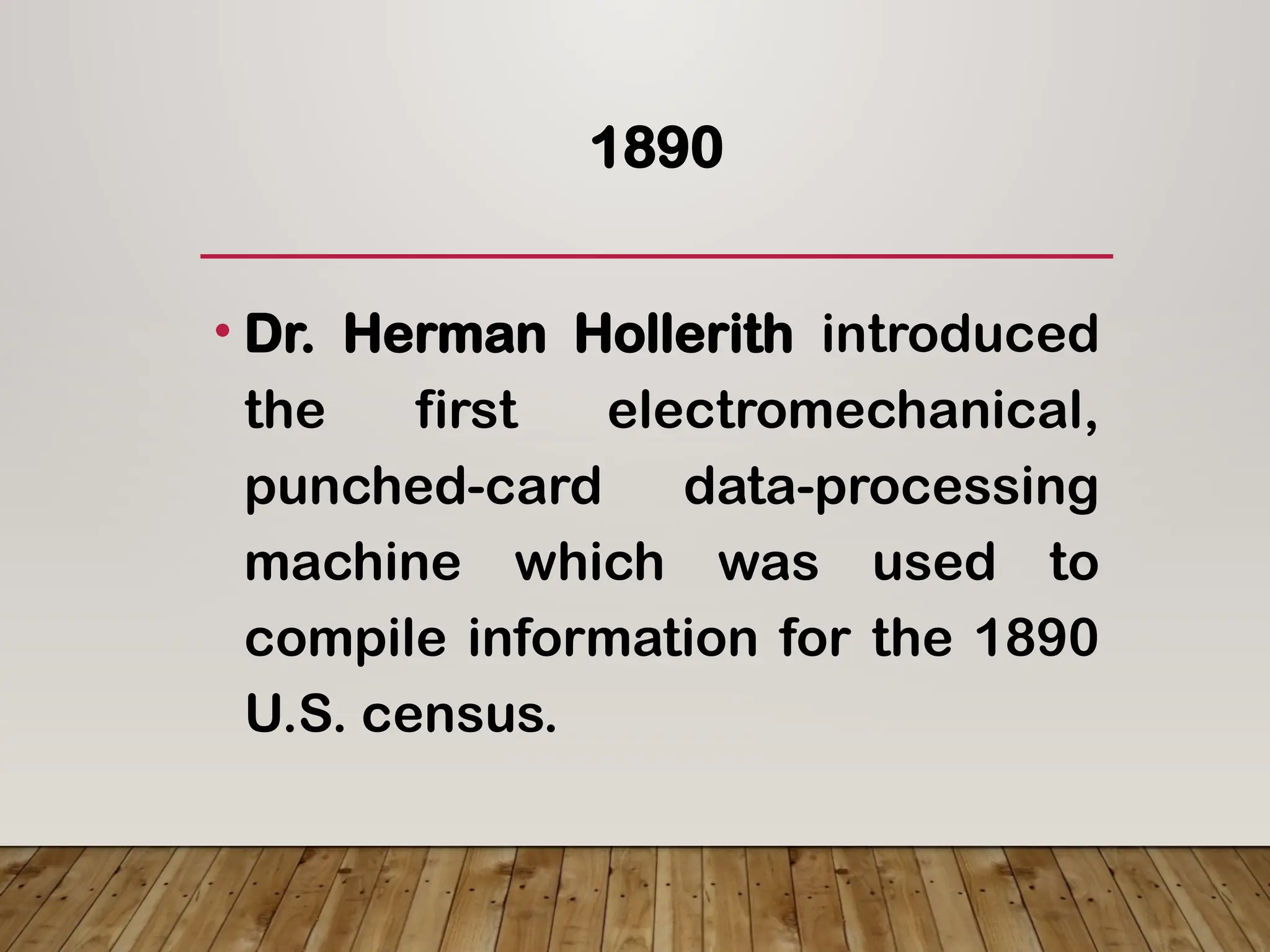
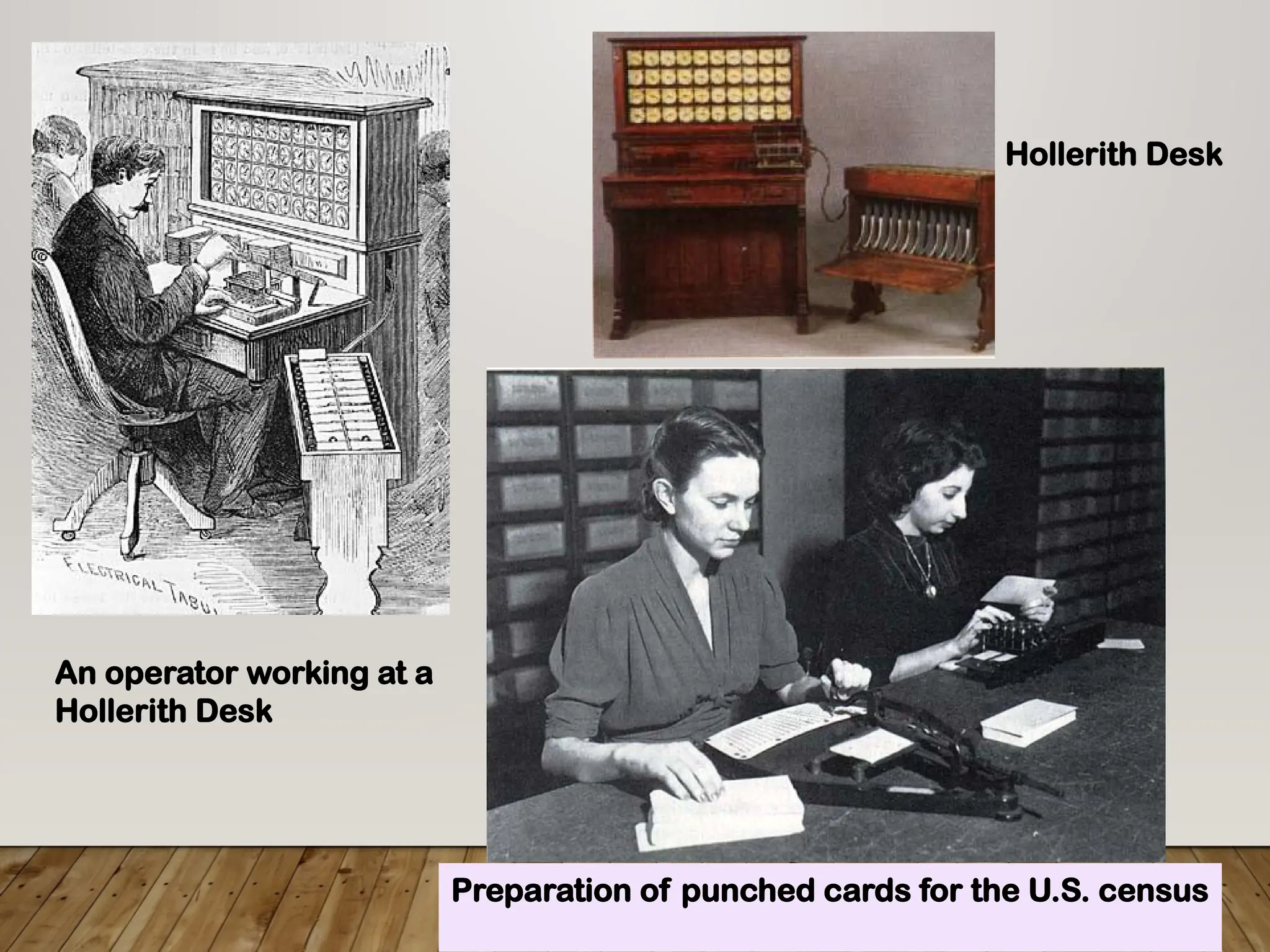
• Dr. HermanHollerith introduced
the first electromechanical,
punched-card data-processing
machine which was used to
compile information for the 1890
U.S. census.
19.
An operator workingat a
Hollerith Desk
Hollerith Desk
Preparation of punched cards for the U.S. census
20.
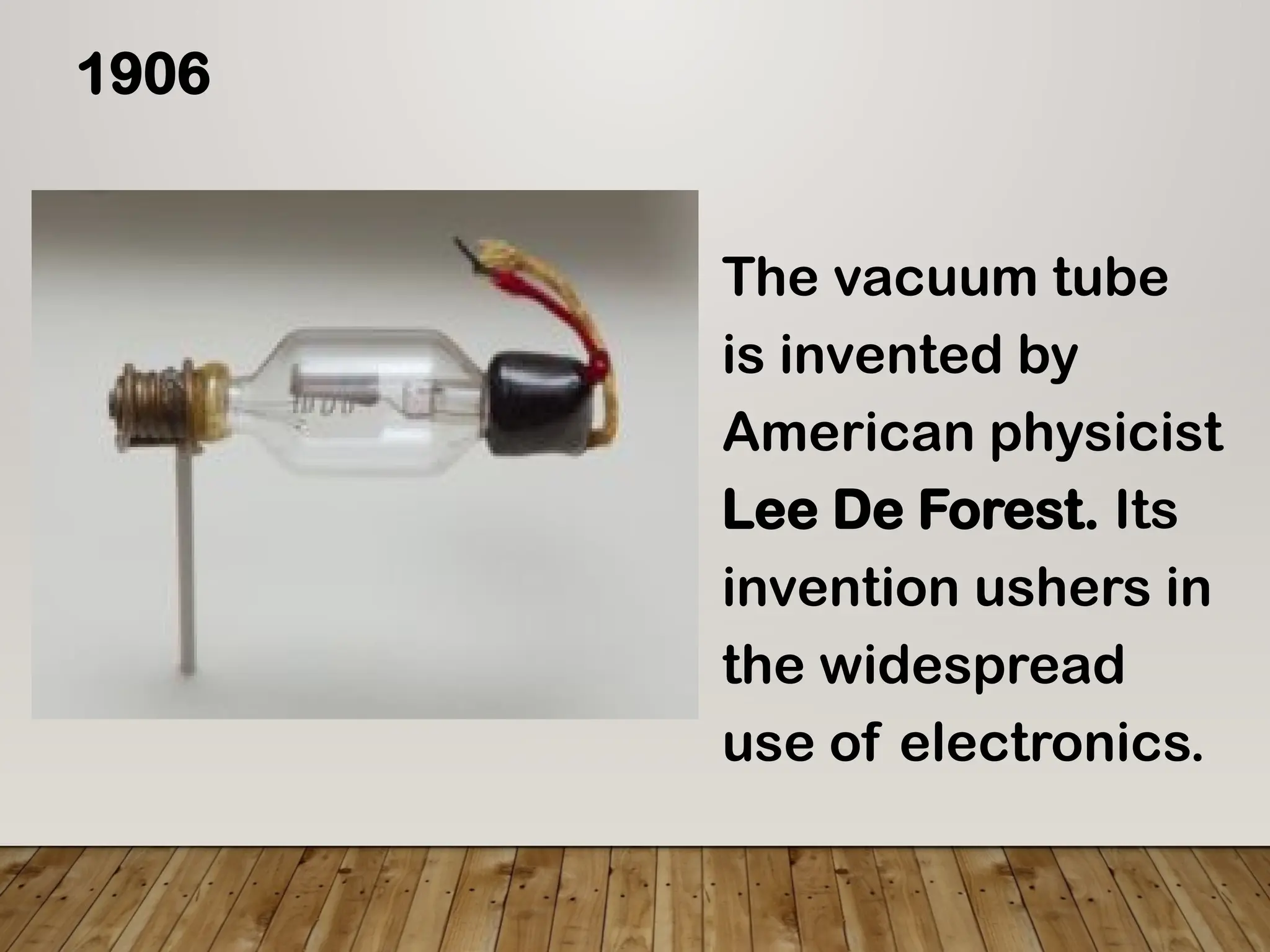
1906
The vacuum tube
isinvented by
American physicist
Lee De Forest. Its
invention ushers in
the widespread
use of electronics.
21.
1939
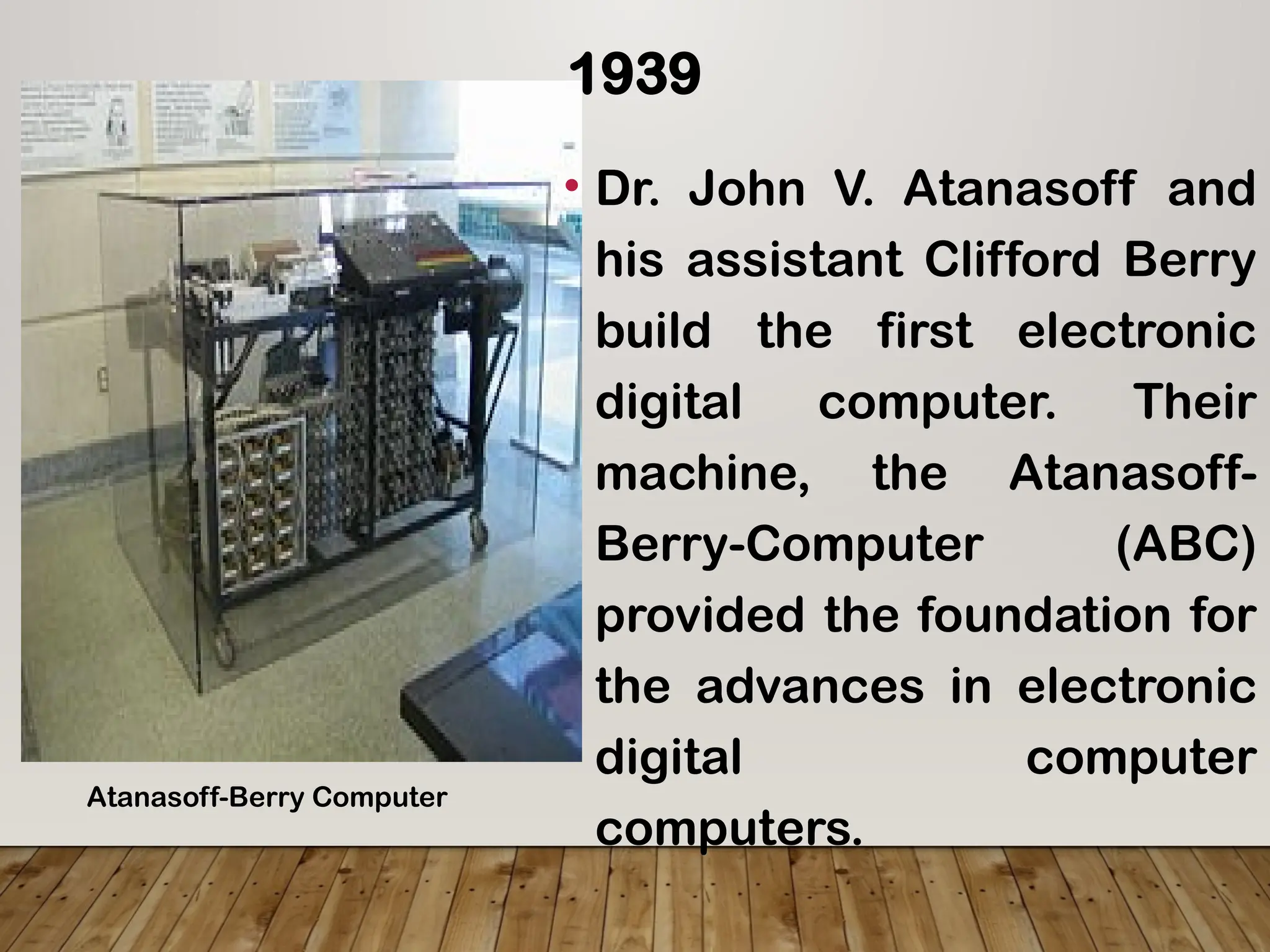
• Dr. JohnV. Atanasoff and
his assistant Clifford Berry
build the first electronic
digital computer. Their
machine, the Atanasoff-
Berry-Computer (ABC)
provided the foundation for
the advances in electronic
digital computer
computers.
Atanasoff-Berry Computer
22.
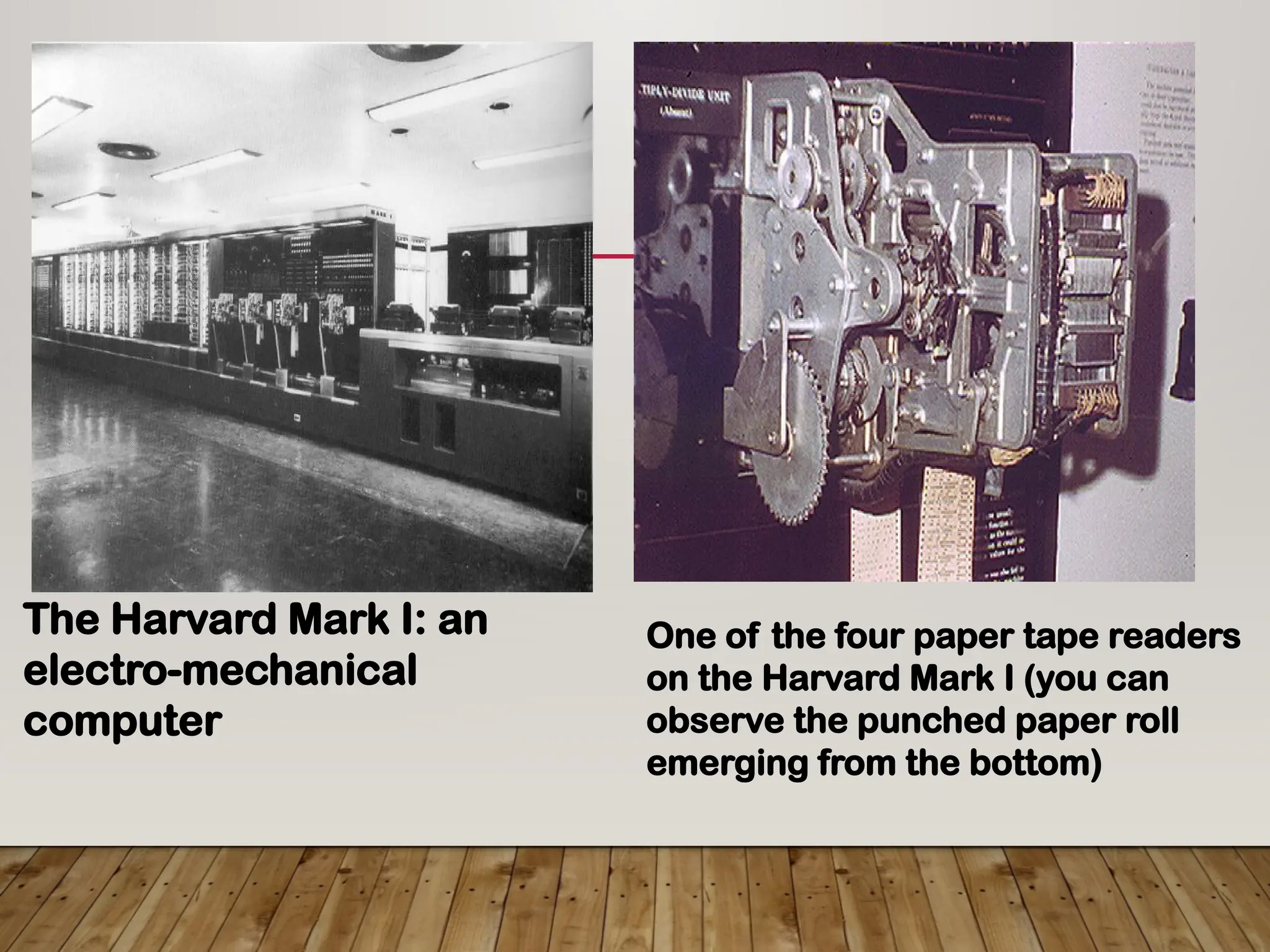
1944
Howard Aiken, incollaboration with engineers
from IBM, constructed a large automatic digital
sequence-controlled computer called the
Harvard Mark I. This computer could handle all
four arithmetic operations, and had special built-
in programs for logarithms and trigonometric
functions.
23.
The Harvard MarkI: an
electro-mechanical
computer
One of the four paper tape readers
on the Harvard Mark I (you can
observe the punched paper roll
emerging from the bottom)
24.
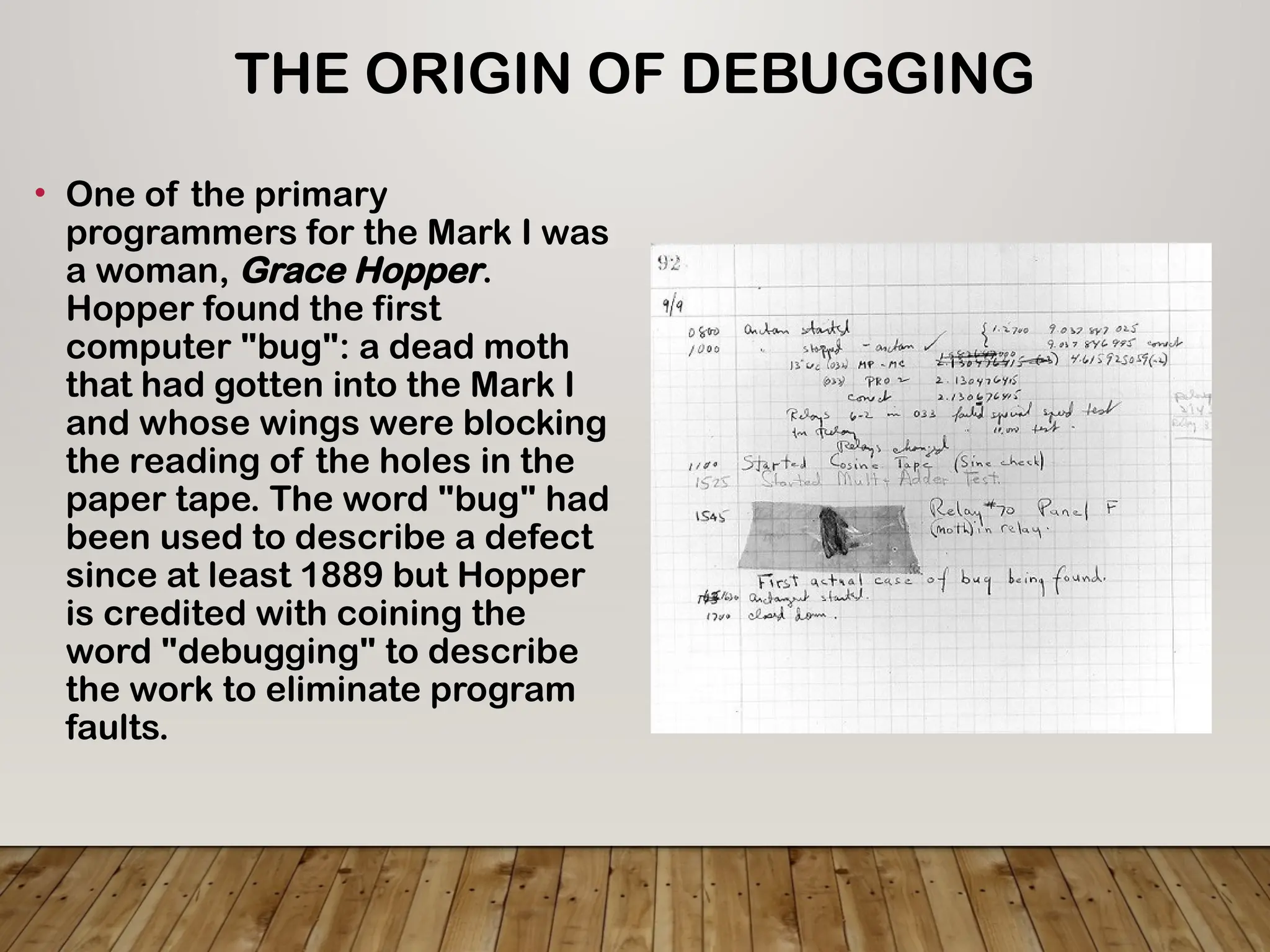
THE ORIGIN OFDEBUGGING
• One of the primary
programmers for the Mark I was
a woman, Grace Hopper.
Hopper found the first
computer "bug": a dead moth
that had gotten into the Mark I
and whose wings were blocking
the reading of the holes in the
paper tape. The word "bug" had
been used to describe a defect
since at least 1889 but Hopper
is credited with coining the
word "debugging" to describe
the work to eliminate program
faults.
25.
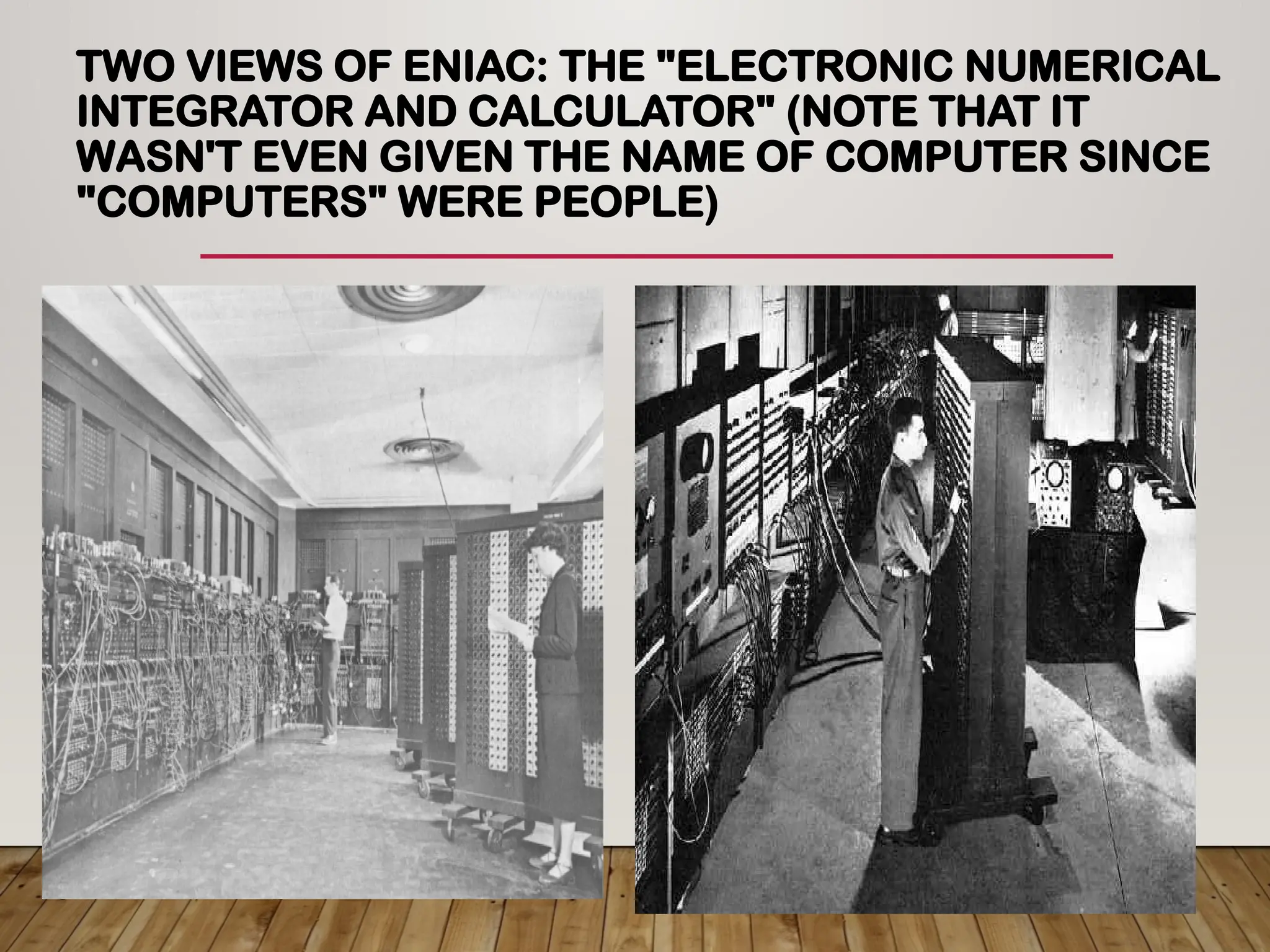
1947
• The giantENIAC (Electrical Numerical Integrator
and Calculator) machine was developed by John W.
Mauchly and J. Presper Eckert, Jr. at the University
of Pennsylvania. It used 18, 000 vacuums, punch-
card input, weighed thirty tons and occupied a
thirty-by-fifty-foot space. It wasn't programmable but
was productive from 1946 to 1955 and was used to
compute artillery firing tables. (That same year, the
transistor was invented by William Shockley, John
Bardeen and Walter Brattain of Bell Labs. It would
rid computers of vacuum tubes and radios.
26.
TWO VIEWS OFENIAC: THE "ELECTRONIC NUMERICAL
INTEGRATOR AND CALCULATOR" (NOTE THAT IT
WASN'T EVEN GIVEN THE NAME OF COMPUTER SINCE
"COMPUTERS" WERE PEOPLE)
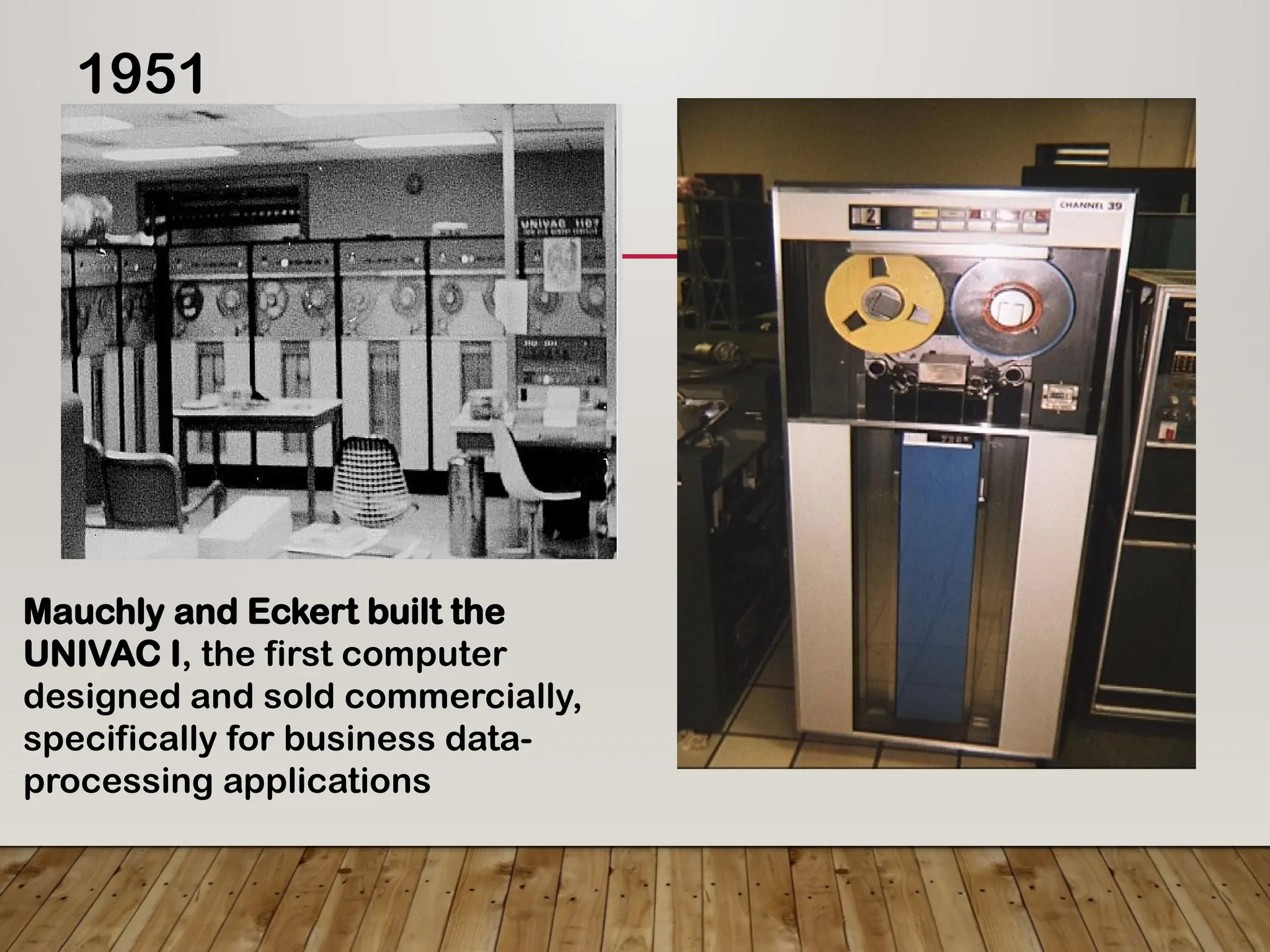
1951
Mauchly and Eckertbuilt the
UNIVAC I, the first computer
designed and sold commercially,
specifically for business data-
processing applications
29.
•1950s: Dr. GraceMurray Hopper
developed the UNIVAC I
compiler.
•1957: The programming language
FORTRAN (FORmula TRANslator)
was designed by John Backus, an
IBM engineer.
30.
•1959: Jack St.Clair Kilby and Robert
Noyce of Texas Instruments
manufactured the first integrated
circuit, or chip, which is a collection
of tiny little transistors
•1960s: Gene Amdahldesigned the
IBM System/360 series of mainframe
(G) computers, the first general-
purpose digital computers to use
integrated circuits.
•1961: Dr. Hopper was instrumental in
developing the COBOL (Common
Business Oriented Language)
programming language.
33.
•1963: Ken Olsen,founder of
DEC, produced the PDP-I,
the first minicomputer (G).
•1965: BASIC (Beginners All-
purpose Symbolic
Instruction Code)
programming language
developed by Dr. Thomas
Kurtz and Dr. John Kemeny.
•1969: The Internetis started.
•1970: Dr. Ted Hoff developed
the famous Intel 4004
microprocessor (G) chip.
36.
• 1971: Intelreleased the first
microprocessor, a specialized
integrated circuit which was to process
four bits of data at a time. It also
included its own arithmetic logic unit.
• PASCAL, a structured programming
language, was developed by Niklaus
Wirth.
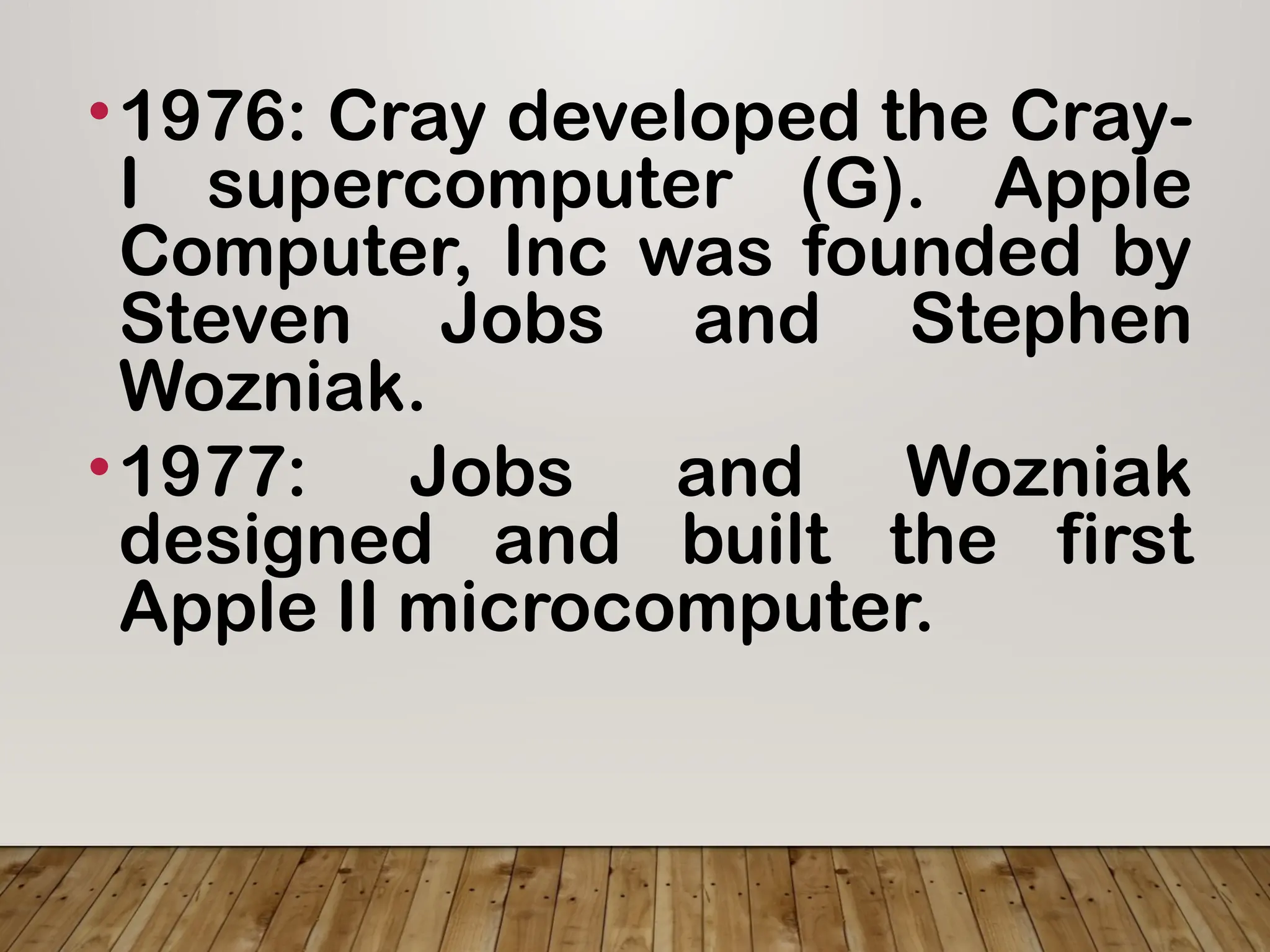
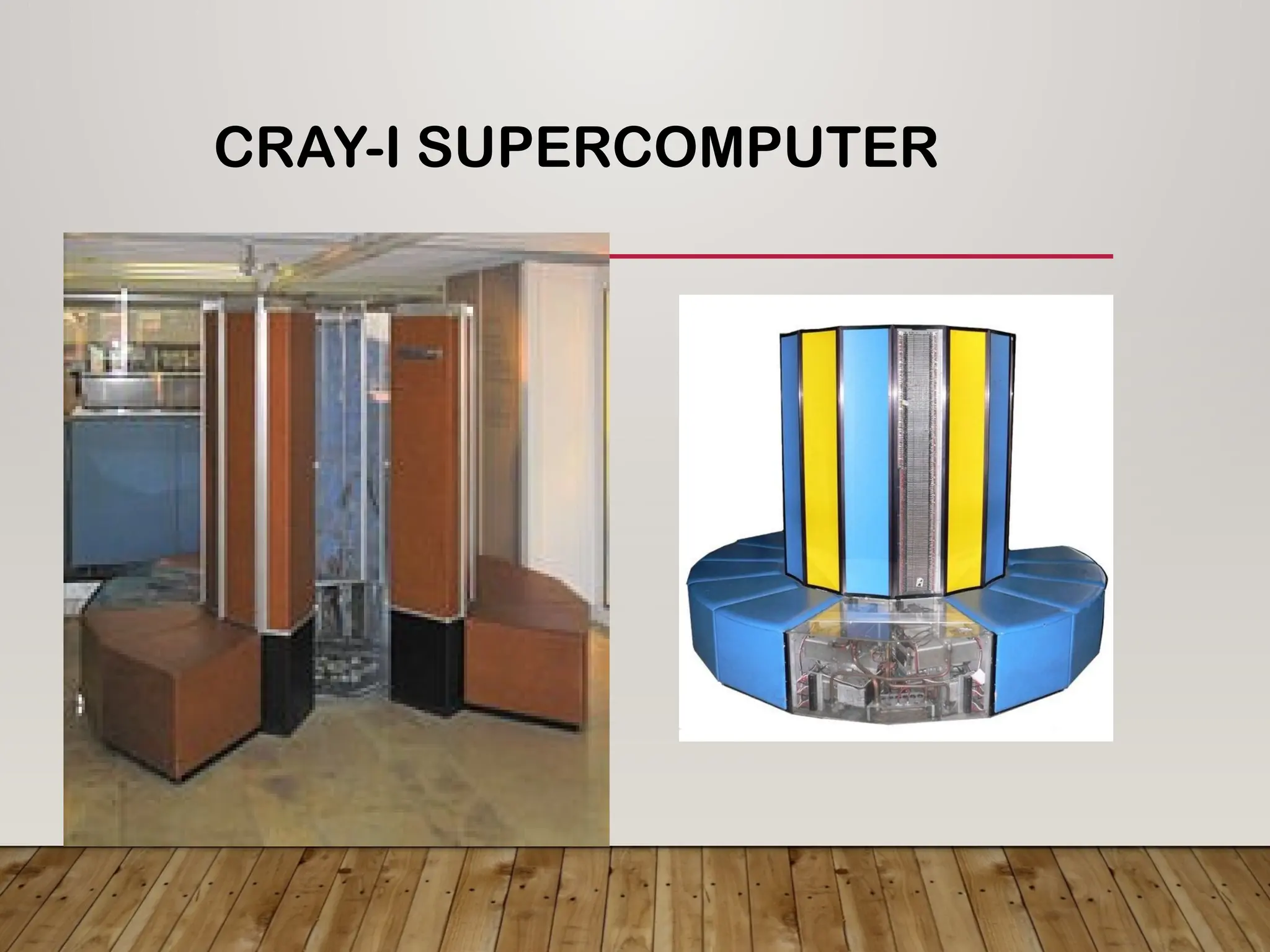
•1976: Cray developedthe Cray-
I supercomputer (G). Apple
Computer, Inc was founded by
Steven Jobs and Stephen
Wozniak.
•1977: Jobs and Wozniak
designed and built the first
Apple II microcomputer.
![Pascal's Pascaline [photo © 2002
IEEE]
A 6 digit model for those who
couldn't afford the 8 digit
model
A Pascaline opened up
so you can observe the
gears and cylinders
which rotated to display
the numerical result](https://image.slidesharecdn.com/historyofcomputers-250624194714-80ce8a2d/75/EVOLUATION-OF-COMPUTERS-HISTORY-OF-COMPUTERS-pptx-9-2048.jpg)
![A small section of
the type of
mechanism
employed in
Babbage's
Difference Engine
[photo © 2002 IEEE]](https://image.slidesharecdn.com/historyofcomputers-250624194714-80ce8a2d/75/EVOLUATION-OF-COMPUTERS-HISTORY-OF-COMPUTERS-pptx-13-2048.jpg)


![Coded Agents – with UiPath SDK + LangGraph [Virtual Hands-on Workshop]](https://cdn.slidesharecdn.com/ss_thumbnails/codedagentsdeck-251215155422-5497c599-thumbnail.jpg?width=640&height=640&fit=bounds)


