History of Computers
IRIS D. OLASO
What is Computer?
A computer is a programmable electronic device
that accepts raw data as input and processes it
with a set of instructions (a program) to produce
the result as output.
It renders output just after performing
mathematical and logical operations and can save
the output for future use.
It can process numerical as well as non-numerical
calculations. The term "computer" is derived from
the Latin word "computare" which means to
calculate.
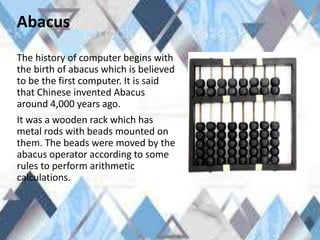
Abacus
The history of computer begins with
the birth of abacus which is believed
to be the first computer. It is said
that Chinese invented Abacus
around 4,000 years ago.
It was a wooden rack which has
metal rods with beads mounted on
them. The beads were moved by the
abacus operator according to some
rules to perform arithmetic
calculations.
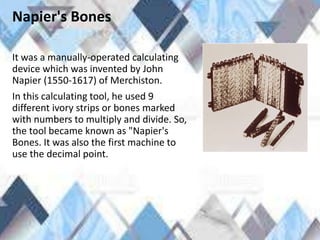
Napier's Bones
It was a manually-operated calculating
device which was invented by John
Napier (1550-1617) of Merchiston.
In this calculating tool, he used 9
different ivory strips or bones marked
with numbers to multiply and divide. So,
the tool became known as "Napier's
Bones. It was also the first machine to
use the decimal point.
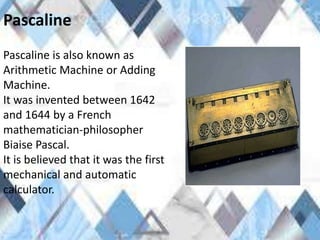
Pascaline
Pascaline is also known as
Arithmetic Machine or Adding
Machine.
It was invented between 1642
and 1644 by a French
mathematician-philosopher
Biaise Pascal.
It is believed that it was the first
mechanical and automatic
calculator.
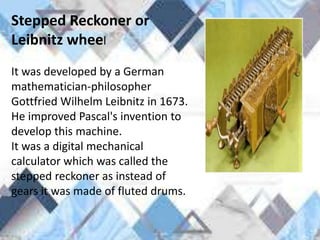
Stepped Reckoner or
Leibnitz wheel
It was developed by a German
mathematician-philosopher
Gottfried Wilhelm Leibnitz in 1673.
He improved Pascal's invention to
develop this machine.
It was a digital mechanical
calculator which was called the
stepped reckoner as instead of
gears it was made of fluted drums.
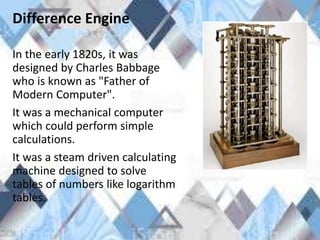
Difference Engine
In the early 1820s, it was
designed by Charles Babbage
who is known as "Father of
Modern Computer".
It was a mechanical computer
which could perform simple
calculations.
It was a steam driven calculating
machine designed to solve
tables of numbers like logarithm
tables.
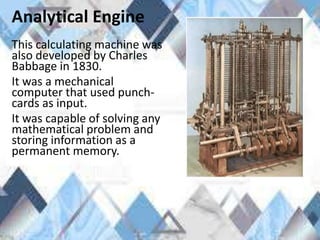
Analytical Engine
This calculating machine was
also developed by Charles
Babbage in 1830.
It was a mechanical
computer that used punch-
cards as input.
It was capable of solving any
mathematical problem and
storing information as a
permanent memory.
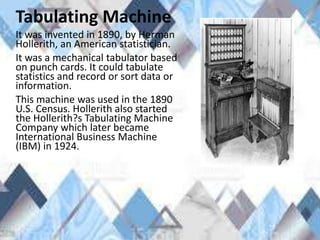
Tabulating Machine
It was invented in 1890, by Herman
Hollerith, an American statistician.
It was a mechanical tabulator based
on punch cards. It could tabulate
statistics and record or sort data or
information.
This machine was used in the 1890
U.S. Census. Hollerith also started
the Hollerith?s Tabulating Machine
Company which later became
International Business Machine
(IBM) in 1924.
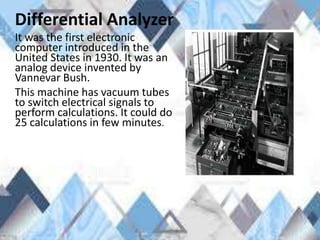
Differential Analyzer
It was the first electronic
computer introduced in the
United States in 1930. It was an
analog device invented by
Vannevar Bush.
This machine has vacuum tubes
to switch electrical signals to
perform calculations. It could do
25 calculations in few minutes.
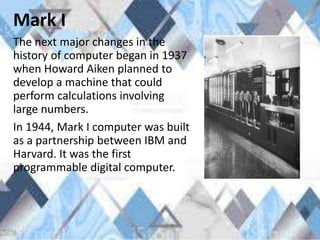
Mark I
The next major changes in the
history of computer began in 1937
when Howard Aiken planned to
develop a machine that could
perform calculations involving
large numbers.
In 1944, Mark I computer was built
as a partnership between IBM and
Harvard. It was the first
programmable digital computer.
Generation of Computers
A generation of computers refers to the specific improvements in
computer technology with time. In 1946, electronic pathways
called circuits were developed to perform the counting. It
replaced the gears and other mechanical parts used for counting
in previous computing machines.
In each new generation, the circuits became smaller and more
advanced than the previous generation circuits. The
miniaturization helped increase the speed, memory and power of
computers.
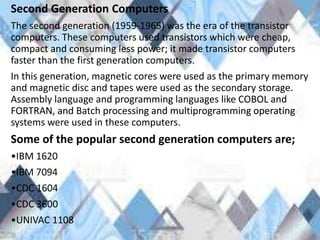
Second Generation Computers
The second generation (1959-1965) was the era of the transistor
computers. These computers used transistors which were cheap,
compact and consuming less power; it made transistor computers
faster than the first generation computers.
In this generation, magnetic cores were used as the primary memory
and magnetic disc and tapes were used as the secondary storage.
Assembly language and programming languages like COBOL and
FORTRAN, and Batch processing and multiprogramming operating
systems were used in these computers.
Some of the popular second generation computers are;
•IBM 1620
•IBM 7094
•CDC 1604
•CDC 3600
•UNIVAC 1108
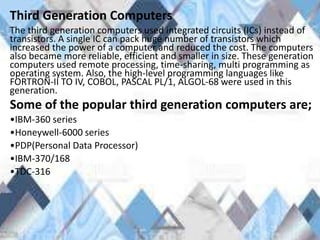
Third Generation Computers
The third generation computers used integrated circuits (ICs) instead of
transistors. A single IC can pack huge number of transistors which
increased the power of a computer and reduced the cost. The computers
also became more reliable, efficient and smaller in size. These generation
computers used remote processing, time-sharing, multi programming as
operating system. Also, the high-level programming languages like
FORTRON-II TO IV, COBOL, PASCAL PL/1, ALGOL-68 were used in this
generation.
Some of the popular third generation computers are;
•IBM-360 series
•Honeywell-6000 series
•PDP(Personal Data Processor)
•IBM-370/168
•TDC-316
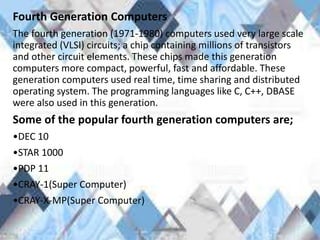
Fourth Generation Computers
The fourth generation (1971-1980) computers used very large scale
integrated (VLSI) circuits; a chip containing millions of transistors
and other circuit elements. These chips made this generation
computers more compact, powerful, fast and affordable. These
generation computers used real time, time sharing and distributed
operating system. The programming languages like C, C++, DBASE
were also used in this generation.
Some of the popular fourth generation computers are;
•DEC 10
•STAR 1000
•PDP 11
•CRAY-1(Super Computer)
•CRAY-X-MP(Super Computer)
Fifth Generation Computers
In fifth generation (1980-till date) computers, the VLSI technology
was replaced with ULSI (Ultra Large Scale Integration). It made
possible the production of microprocessor chips with ten million
electronic components. This generation computers used parallel
processing hardware and AI (Artificial Intelligence) software. The
programming languages used in this generation were C, C++, Java,
.Net, etc.
Some of the popular fifth generation computers are;
•Desktop
•Laptop
•NoteBook
•UltraBook
•ChromeBook

History of Computer-.pptx

  • 1.
  • 2.
    What is Computer? Acomputer is a programmable electronic device that accepts raw data as input and processes it with a set of instructions (a program) to produce the result as output. It renders output just after performing mathematical and logical operations and can save the output for future use. It can process numerical as well as non-numerical calculations. The term "computer" is derived from the Latin word "computare" which means to calculate.
  • 3.
    Abacus The history ofcomputer begins with the birth of abacus which is believed to be the first computer. It is said that Chinese invented Abacus around 4,000 years ago. It was a wooden rack which has metal rods with beads mounted on them. The beads were moved by the abacus operator according to some rules to perform arithmetic calculations.
  • 4.
    Napier's Bones It wasa manually-operated calculating device which was invented by John Napier (1550-1617) of Merchiston. In this calculating tool, he used 9 different ivory strips or bones marked with numbers to multiply and divide. So, the tool became known as "Napier's Bones. It was also the first machine to use the decimal point.
  • 5.
    Pascaline Pascaline is alsoknown as Arithmetic Machine or Adding Machine. It was invented between 1642 and 1644 by a French mathematician-philosopher Biaise Pascal. It is believed that it was the first mechanical and automatic calculator.
  • 6.
    Stepped Reckoner or Leibnitzwheel It was developed by a German mathematician-philosopher Gottfried Wilhelm Leibnitz in 1673. He improved Pascal's invention to develop this machine. It was a digital mechanical calculator which was called the stepped reckoner as instead of gears it was made of fluted drums.
  • 7.
    Difference Engine In theearly 1820s, it was designed by Charles Babbage who is known as "Father of Modern Computer". It was a mechanical computer which could perform simple calculations. It was a steam driven calculating machine designed to solve tables of numbers like logarithm tables.
  • 8.
    Analytical Engine This calculatingmachine was also developed by Charles Babbage in 1830. It was a mechanical computer that used punch- cards as input. It was capable of solving any mathematical problem and storing information as a permanent memory.
  • 9.
    Tabulating Machine It wasinvented in 1890, by Herman Hollerith, an American statistician. It was a mechanical tabulator based on punch cards. It could tabulate statistics and record or sort data or information. This machine was used in the 1890 U.S. Census. Hollerith also started the Hollerith?s Tabulating Machine Company which later became International Business Machine (IBM) in 1924.
  • 10.
    Differential Analyzer It wasthe first electronic computer introduced in the United States in 1930. It was an analog device invented by Vannevar Bush. This machine has vacuum tubes to switch electrical signals to perform calculations. It could do 25 calculations in few minutes.
  • 11.
    Mark I The nextmajor changes in the history of computer began in 1937 when Howard Aiken planned to develop a machine that could perform calculations involving large numbers. In 1944, Mark I computer was built as a partnership between IBM and Harvard. It was the first programmable digital computer.
  • 12.
    Generation of Computers Ageneration of computers refers to the specific improvements in computer technology with time. In 1946, electronic pathways called circuits were developed to perform the counting. It replaced the gears and other mechanical parts used for counting in previous computing machines. In each new generation, the circuits became smaller and more advanced than the previous generation circuits. The miniaturization helped increase the speed, memory and power of computers.
  • 14.
    Second Generation Computers Thesecond generation (1959-1965) was the era of the transistor computers. These computers used transistors which were cheap, compact and consuming less power; it made transistor computers faster than the first generation computers. In this generation, magnetic cores were used as the primary memory and magnetic disc and tapes were used as the secondary storage. Assembly language and programming languages like COBOL and FORTRAN, and Batch processing and multiprogramming operating systems were used in these computers. Some of the popular second generation computers are; •IBM 1620 •IBM 7094 •CDC 1604 •CDC 3600 •UNIVAC 1108
  • 15.
    Third Generation Computers Thethird generation computers used integrated circuits (ICs) instead of transistors. A single IC can pack huge number of transistors which increased the power of a computer and reduced the cost. The computers also became more reliable, efficient and smaller in size. These generation computers used remote processing, time-sharing, multi programming as operating system. Also, the high-level programming languages like FORTRON-II TO IV, COBOL, PASCAL PL/1, ALGOL-68 were used in this generation. Some of the popular third generation computers are; •IBM-360 series •Honeywell-6000 series •PDP(Personal Data Processor) •IBM-370/168 •TDC-316
  • 16.
    Fourth Generation Computers Thefourth generation (1971-1980) computers used very large scale integrated (VLSI) circuits; a chip containing millions of transistors and other circuit elements. These chips made this generation computers more compact, powerful, fast and affordable. These generation computers used real time, time sharing and distributed operating system. The programming languages like C, C++, DBASE were also used in this generation. Some of the popular fourth generation computers are; •DEC 10 •STAR 1000 •PDP 11 •CRAY-1(Super Computer) •CRAY-X-MP(Super Computer)
  • 17.
    Fifth Generation Computers Infifth generation (1980-till date) computers, the VLSI technology was replaced with ULSI (Ultra Large Scale Integration). It made possible the production of microprocessor chips with ten million electronic components. This generation computers used parallel processing hardware and AI (Artificial Intelligence) software. The programming languages used in this generation were C, C++, Java, .Net, etc. Some of the popular fifth generation computers are; •Desktop •Laptop •NoteBook •UltraBook •ChromeBook