Mantra for Process Excellence 
Shubham Vyas 
Engineer services 
Alstom T&D India
PMI NATIONAL CONFERENCE 2014 - HYDERABAD 
CAUSES OF DELAY IN ERECTION OF POWER TRANSFORMERS 
Theme - Mantra for Process Excellence 
Abstract - Electricity is the backbone of every growing economy, Lack of electricity is one of the major 
barriers of developing countries. Supplying electricity 24 hrs to each and every town & village is one of the 
major targets of all political parties to attract voters. Transformer can be defined as heart of any 
switchyard which regulates flow of electricity in entire sub-station and geographical area as blood. As we 
all know time is money and quality, the critical factors need to be identify which causes such delay. These 
delay causes decreases of customer’s faith & increasing stress of overall manufacturing team. 
Keywords – Delay, Delay elements, Erection, Power transformer. 
Introduction – As per report from Central Electricity Authority, the annual Load Generation Balance 
Report (LGBR) [1] for year 2013 -14. In the financial year 2012-13, the total energy availability increased 
by 6.2 % over the previous year and the peak met increased by 6.1%, the shortage conditions prevailed 
in the Country both in terms of energy and peaking availability as given in table 1. (MU-million unit) 
Energy (MU) Peak (MU) 
Requirement 998114 135453 
Availability 911209 123294 
Shortage 86905 12159 
(%) 8.7 9 
Table 1 Energy availability & shortage. 
The energy requirement registered a growth of 6.5% during the year against the projected growth of 5.1% 
and Peak demand registered a growth of 4.2% against the projected growth of 7.7%. The studies carried 
out for anticipated power supply position for the year. 2013-14, indicate that there would be energy 
shortage of 6.7 % and peak shortage of 2.3 %. It means that erection & commissioning of a power 
transformer at scheduled time is very important to full fill needs. 
Chan and Kumaraswamy [5] (1997) Similarly a research was conducted to find delay causes in Hong 
Kong construction projects and he found five major factors: delay – (a) poor risk of management and 
supervision (b) Unfocused site condition. (c) Slow decision making. (d) Client - initiated variation. (e) 
Work variance. 
Ogunlana [4] in 1996 at Thailand, Bangkok, and His analysis that there are three major categories of 
delay in project construction (a) Problems of shortages or inadequacies in the industry infrastructure. (b) 
Problems caused by clients and consultants. (c) Problems caused by contractor 
incompetence/inadequacy.
S. Sen & R K Tyagi [2] (2102) - As per report from Power Grid Corporation of India (PGCIL), maximum 
2.36 % transformers are failed of 220 KV rating & 1.86 % transformers are failed of 400 KV rating, Table 
2. These failures itself give a brief idea about delay in supply of electricity. 
Voltage 765KV 400KV 220KV 132KV 
population 100 305 34 12 
Failure 1 52 5 3 
Rate 0.30% 1.86% 2.36% 1.80% 
Table 2- Rate of failure of power transformer 
A per standard CBIP transformer manual total 24 days required for erection, testing & commission of 
400KV transformer. 
Fig -1 Peak Demand v/s Availability Fig -2 Energy required v/s Availability 
Need of this research - The main aim of this study is to find out, what are the causes of delay in 
erection and how to avoid this? As we all know cost, time & scope is interlinked, increasing erection time
leads to increasing overhead cost, production loss, loosing customer faith, etc. from our calculation we 
found that approx. Rs 500KINR get waste due to delay. 
Research methodology - After approval of L2 scheduled & FQP (field quality plan) by customer we 
depute our engineer for starting erection activity at site and now the practice activity starts. Our engineer 
submits daily progress report (DPR) from site and using this DPR we monitor progress of work and 
calculate whether we are working as per schedule or not. 
Calculation – Three Point estimating methods was adopted for analysis. 
Average estimation time to complete = 19 days 
Variance = 5 days 
As per formula work must complete in = 19 + 5 
1 SD = 24 days, 2 SD = 29 days, 3 SD = 34 days 
As per collected data 60 % of sites got delayed due to various regions, average over head charges for 
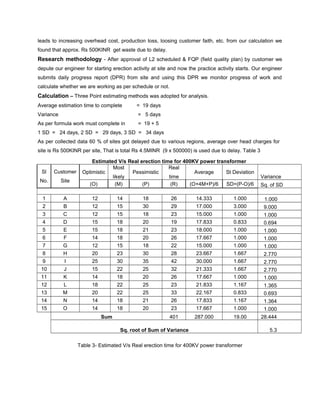
site is Rs 500KINR per site, That is total Rs 4.5MINR (9 x 500000) is used due to delay. Table 3 
Estimated V/s Real erection time for 400KV power transformer 
Sl 
No. 
Customer 
Site 
Optimistic 
Most 
likely 
Pessimistic 
Real 
time 
Average St Deviation 
Variance 
(O) (M) (P) (R) (O+4M+P)/6 SD=(P-O)/6 Sq. of SD 
1 A 12 14 18 26 14.333 1.000 1.000 
2 B 12 15 30 29 17.000 3.000 9.000 
3 C 12 15 18 23 15.000 1.000 1.000 
4 D 15 18 20 19 17.833 0.833 0.694 
5 E 15 18 21 23 18.000 1.000 1.000 
6 F 14 18 20 26 17.667 1.000 1.000 
7 G 12 15 18 22 15.000 1.000 1.000 
8 H 20 23 30 28 23.667 1.667 2.770 
9 I 25 30 35 42 30.000 1.667 2.770 
10 J 15 22 25 32 21.333 1.667 2.770 
11 K 14 18 20 26 17.667 1.000 1.000 
12 L 18 22 25 23 21.833 1.167 1.365 
13 M 20 22 25 33 22.167 0.833 0.693 
14 N 14 18 21 26 17.833 1.167 1.364 
15 O 14 18 20 23 17.667 1.000 1.000 
Sum 401 287.000 19.00 28.444 
Sq. root of Sum of Variance 5.3 
Table 3- Estimated V/s Real erection time for 400KV power transformer
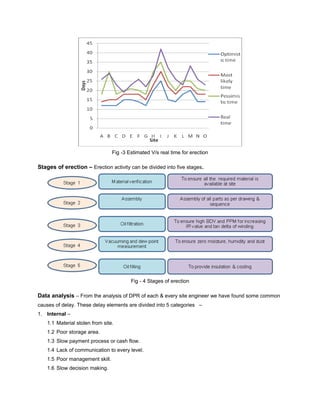
Fig -3 Estimated V/s real time for erection 
Stages of erection – Erection activity can be divided into five stages. 
Fig - 4 Stages of erection 
Data analysis – From the analysis of DPR of each & every site engineer we have found some common 
causes of delay. These delay elements are divided into 5 categories – 
1. Internal – 
1.1 Material stolen from site. 
1.2 Poor storage area. 
1.3 Slow payment process or cash flow. 
1.4 Lack of communication to every level. 
1.5 Poor management skill. 
1.6 Slow decision making.
1.7 Safety. 
2. External – 
2.1 Site condition. 
2.2 External causes (stick, accident, natural causes etc). 
3. Planning – 
3.1 Too short estimated time. 
3.2 Lack of recourses. 
3.3 Rescheduling 
4. Contractor or vendor – 
4.1 Rework. 
4.2 Scope of work not defined completely or disputes or customer interfere . 
4.3 Lack of skilled manpower. 
4.4 Poor management skill. 
4.5 Daily target. 
5. Transportation & Packaging - 
5.1 Transit damage 
Some Examples are given which defined causes of delay, photographs taken at customer’s site. 
Fig 5. Transit damage Fig 6. Poor storage area [3]
Fig 7. Poor site condition [3] Fig 8. External causes 
Impact of delay – It can be categories into two parts. 
Fig - 9 Impact of delay 
Some common impacts are – 
a) Overall project cost increases. 
b) Delay in ROI. 
c) Increasing man-hours at site (decreasing safety of individuals). 
d) Delay in production. 
e) Decreasing customer’s faith & trust. 
f) Decreasing customer satisfaction level. 
g) Increases stress to overall team. 
h) Increasing market competition. 
i) Overrun of every thing (vehicle, machine, per day expanses etc.) 
j) Decreasing brand image or decreasing reputation of org. 
Benefits to avoid delay – 
a) Enhancing customers trust. 
b) Saving time & money.
c) Can provide training to customer for maintenance of product. 
d) Implementation of new techniques & technology in saved time. 
e) Vendor can purchase new tools & tackles for site. 
f) Increasing safety awareness among site engineer’s for implementing at site to avoid accident, 
near miss, fall from height, excavation, LOTO and first aid training etc. 
g) Planning for future projects. 
Result and Conclusion – The study was aimed to find the causes of delay, total eighteen delay 
elements are identified. These delay elements are further categorized into five groups. If we can provide 
proper storage area to avoid damage of material, avoiding rework activities at site and one more thing 
proper security at site to avoid material stolen. If we can control these three delay elements at site, then 
we must say we can save around 40% of delay time and around 200 KINR per site. 
From the study we have concluded that erection of power transformer at scheduled time is very important 
for the benefit of both customer & vendor. We recommend to all site engineers to set a daily target and 
review it at the end of the day, we also advice to all site engineers to prepare lesson learned document at 
end of every phase of erection. 
We recommend to all customers, to provide a separate concrete building for material storage and provide 
at least four workers and one supervisor for monitoring incoming & outgoing materials, we recommend to 
vendors to take full time to complete per day given task to avoid re work activity. We also recommend to 
adapt a new technique called PCDCA (PLAN CHECK DO CHECK ACT) Fig 10 it’s a cyclic process, 
Checking at each & every step gives independency to do work without error and delay. 
Fig -10 PCDCA cycle 
Reference – 
[1] Load Generation Balance Report 2013-14 Report published by Central Electricity Authority (ministry of 
energygovt. of India)
[2] S.Sen, R K Tyagi & Gunjan Agrawal, failure analysis of power transformers- few case studies, CBIP 
5th International Conference Delhi, (2102), S6/8. 
[3] S. Vyas Causes of delay in project construction In developing countries, IJCMS, Volume IV Issue 2(1), 
May 2013. 
[4] Ogunlana,S O K. Promkuntong, V. Jearkjirm, Construction delays in a fast growing economy, 
Comparing Thailand with other economies. International journal of project Management Vol. 14-1 (1996), 
P. 37-45 
[5] Chan DW, Kumaraswamy MM. A comparative study of causes of time overruns in Hong Kong 
construction projects. Int J Project Manage 1997;15(1):55–63
[2] S.Sen, R K Tyagi & Gunjan Agrawal, failure analysis of power transformers- few case studies, CBIP 
5th International Conference Delhi, (2102), S6/8. 
[3] S. Vyas Causes of delay in project construction In developing countries, IJCMS, Volume IV Issue 2(1), 
May 2013. 
[4] Ogunlana,S O K. Promkuntong, V. Jearkjirm, Construction delays in a fast growing economy, 
Comparing Thailand with other economies. International journal of project Management Vol. 14-1 (1996), 
P. 37-45 
[5] Chan DW, Kumaraswamy MM. A comparative study of causes of time overruns in Hong Kong 
construction projects. Int J Project Manage 1997;15(1):55–63

Presentation by shubham vyas

  • 1.
    Mantra for ProcessExcellence Shubham Vyas Engineer services Alstom T&D India
  • 2.
    PMI NATIONAL CONFERENCE2014 - HYDERABAD CAUSES OF DELAY IN ERECTION OF POWER TRANSFORMERS Theme - Mantra for Process Excellence Abstract - Electricity is the backbone of every growing economy, Lack of electricity is one of the major barriers of developing countries. Supplying electricity 24 hrs to each and every town & village is one of the major targets of all political parties to attract voters. Transformer can be defined as heart of any switchyard which regulates flow of electricity in entire sub-station and geographical area as blood. As we all know time is money and quality, the critical factors need to be identify which causes such delay. These delay causes decreases of customer’s faith & increasing stress of overall manufacturing team. Keywords – Delay, Delay elements, Erection, Power transformer. Introduction – As per report from Central Electricity Authority, the annual Load Generation Balance Report (LGBR) [1] for year 2013 -14. In the financial year 2012-13, the total energy availability increased by 6.2 % over the previous year and the peak met increased by 6.1%, the shortage conditions prevailed in the Country both in terms of energy and peaking availability as given in table 1. (MU-million unit) Energy (MU) Peak (MU) Requirement 998114 135453 Availability 911209 123294 Shortage 86905 12159 (%) 8.7 9 Table 1 Energy availability & shortage. The energy requirement registered a growth of 6.5% during the year against the projected growth of 5.1% and Peak demand registered a growth of 4.2% against the projected growth of 7.7%. The studies carried out for anticipated power supply position for the year. 2013-14, indicate that there would be energy shortage of 6.7 % and peak shortage of 2.3 %. It means that erection & commissioning of a power transformer at scheduled time is very important to full fill needs. Chan and Kumaraswamy [5] (1997) Similarly a research was conducted to find delay causes in Hong Kong construction projects and he found five major factors: delay – (a) poor risk of management and supervision (b) Unfocused site condition. (c) Slow decision making. (d) Client - initiated variation. (e) Work variance. Ogunlana [4] in 1996 at Thailand, Bangkok, and His analysis that there are three major categories of delay in project construction (a) Problems of shortages or inadequacies in the industry infrastructure. (b) Problems caused by clients and consultants. (c) Problems caused by contractor incompetence/inadequacy.
  • 3.
    S. Sen &R K Tyagi [2] (2102) - As per report from Power Grid Corporation of India (PGCIL), maximum 2.36 % transformers are failed of 220 KV rating & 1.86 % transformers are failed of 400 KV rating, Table 2. These failures itself give a brief idea about delay in supply of electricity. Voltage 765KV 400KV 220KV 132KV population 100 305 34 12 Failure 1 52 5 3 Rate 0.30% 1.86% 2.36% 1.80% Table 2- Rate of failure of power transformer A per standard CBIP transformer manual total 24 days required for erection, testing & commission of 400KV transformer. Fig -1 Peak Demand v/s Availability Fig -2 Energy required v/s Availability Need of this research - The main aim of this study is to find out, what are the causes of delay in erection and how to avoid this? As we all know cost, time & scope is interlinked, increasing erection time
  • 4.
    leads to increasingoverhead cost, production loss, loosing customer faith, etc. from our calculation we found that approx. Rs 500KINR get waste due to delay. Research methodology - After approval of L2 scheduled & FQP (field quality plan) by customer we depute our engineer for starting erection activity at site and now the practice activity starts. Our engineer submits daily progress report (DPR) from site and using this DPR we monitor progress of work and calculate whether we are working as per schedule or not. Calculation – Three Point estimating methods was adopted for analysis. Average estimation time to complete = 19 days Variance = 5 days As per formula work must complete in = 19 + 5 1 SD = 24 days, 2 SD = 29 days, 3 SD = 34 days As per collected data 60 % of sites got delayed due to various regions, average over head charges for site is Rs 500KINR per site, That is total Rs 4.5MINR (9 x 500000) is used due to delay. Table 3 Estimated V/s Real erection time for 400KV power transformer Sl No. Customer Site Optimistic Most likely Pessimistic Real time Average St Deviation Variance (O) (M) (P) (R) (O+4M+P)/6 SD=(P-O)/6 Sq. of SD 1 A 12 14 18 26 14.333 1.000 1.000 2 B 12 15 30 29 17.000 3.000 9.000 3 C 12 15 18 23 15.000 1.000 1.000 4 D 15 18 20 19 17.833 0.833 0.694 5 E 15 18 21 23 18.000 1.000 1.000 6 F 14 18 20 26 17.667 1.000 1.000 7 G 12 15 18 22 15.000 1.000 1.000 8 H 20 23 30 28 23.667 1.667 2.770 9 I 25 30 35 42 30.000 1.667 2.770 10 J 15 22 25 32 21.333 1.667 2.770 11 K 14 18 20 26 17.667 1.000 1.000 12 L 18 22 25 23 21.833 1.167 1.365 13 M 20 22 25 33 22.167 0.833 0.693 14 N 14 18 21 26 17.833 1.167 1.364 15 O 14 18 20 23 17.667 1.000 1.000 Sum 401 287.000 19.00 28.444 Sq. root of Sum of Variance 5.3 Table 3- Estimated V/s Real erection time for 400KV power transformer
  • 5.
    Fig -3 EstimatedV/s real time for erection Stages of erection – Erection activity can be divided into five stages. Fig - 4 Stages of erection Data analysis – From the analysis of DPR of each & every site engineer we have found some common causes of delay. These delay elements are divided into 5 categories – 1. Internal – 1.1 Material stolen from site. 1.2 Poor storage area. 1.3 Slow payment process or cash flow. 1.4 Lack of communication to every level. 1.5 Poor management skill. 1.6 Slow decision making.
  • 6.
    1.7 Safety. 2.External – 2.1 Site condition. 2.2 External causes (stick, accident, natural causes etc). 3. Planning – 3.1 Too short estimated time. 3.2 Lack of recourses. 3.3 Rescheduling 4. Contractor or vendor – 4.1 Rework. 4.2 Scope of work not defined completely or disputes or customer interfere . 4.3 Lack of skilled manpower. 4.4 Poor management skill. 4.5 Daily target. 5. Transportation & Packaging - 5.1 Transit damage Some Examples are given which defined causes of delay, photographs taken at customer’s site. Fig 5. Transit damage Fig 6. Poor storage area [3]
  • 7.
    Fig 7. Poorsite condition [3] Fig 8. External causes Impact of delay – It can be categories into two parts. Fig - 9 Impact of delay Some common impacts are – a) Overall project cost increases. b) Delay in ROI. c) Increasing man-hours at site (decreasing safety of individuals). d) Delay in production. e) Decreasing customer’s faith & trust. f) Decreasing customer satisfaction level. g) Increases stress to overall team. h) Increasing market competition. i) Overrun of every thing (vehicle, machine, per day expanses etc.) j) Decreasing brand image or decreasing reputation of org. Benefits to avoid delay – a) Enhancing customers trust. b) Saving time & money.
  • 8.
    c) Can providetraining to customer for maintenance of product. d) Implementation of new techniques & technology in saved time. e) Vendor can purchase new tools & tackles for site. f) Increasing safety awareness among site engineer’s for implementing at site to avoid accident, near miss, fall from height, excavation, LOTO and first aid training etc. g) Planning for future projects. Result and Conclusion – The study was aimed to find the causes of delay, total eighteen delay elements are identified. These delay elements are further categorized into five groups. If we can provide proper storage area to avoid damage of material, avoiding rework activities at site and one more thing proper security at site to avoid material stolen. If we can control these three delay elements at site, then we must say we can save around 40% of delay time and around 200 KINR per site. From the study we have concluded that erection of power transformer at scheduled time is very important for the benefit of both customer & vendor. We recommend to all site engineers to set a daily target and review it at the end of the day, we also advice to all site engineers to prepare lesson learned document at end of every phase of erection. We recommend to all customers, to provide a separate concrete building for material storage and provide at least four workers and one supervisor for monitoring incoming & outgoing materials, we recommend to vendors to take full time to complete per day given task to avoid re work activity. We also recommend to adapt a new technique called PCDCA (PLAN CHECK DO CHECK ACT) Fig 10 it’s a cyclic process, Checking at each & every step gives independency to do work without error and delay. Fig -10 PCDCA cycle Reference – [1] Load Generation Balance Report 2013-14 Report published by Central Electricity Authority (ministry of energygovt. of India)
  • 9.
    [2] S.Sen, RK Tyagi & Gunjan Agrawal, failure analysis of power transformers- few case studies, CBIP 5th International Conference Delhi, (2102), S6/8. [3] S. Vyas Causes of delay in project construction In developing countries, IJCMS, Volume IV Issue 2(1), May 2013. [4] Ogunlana,S O K. Promkuntong, V. Jearkjirm, Construction delays in a fast growing economy, Comparing Thailand with other economies. International journal of project Management Vol. 14-1 (1996), P. 37-45 [5] Chan DW, Kumaraswamy MM. A comparative study of causes of time overruns in Hong Kong construction projects. Int J Project Manage 1997;15(1):55–63
  • 10.
    [2] S.Sen, RK Tyagi & Gunjan Agrawal, failure analysis of power transformers- few case studies, CBIP 5th International Conference Delhi, (2102), S6/8. [3] S. Vyas Causes of delay in project construction In developing countries, IJCMS, Volume IV Issue 2(1), May 2013. [4] Ogunlana,S O K. Promkuntong, V. Jearkjirm, Construction delays in a fast growing economy, Comparing Thailand with other economies. International journal of project Management Vol. 14-1 (1996), P. 37-45 [5] Chan DW, Kumaraswamy MM. A comparative study of causes of time overruns in Hong Kong construction projects. Int J Project Manage 1997;15(1):55–63