Mantra for Innovative Project Management 
Anipriya P 
Delivery Project Executive 
IBM
Re-shaping Project Management for survival in a changing marketplace 
Theme: Mantra for Innovative Project Management 
Keywords:Consulting, Client Experience Management, Talent Management, Consulting, Project 
Management. 
Abstract: In a hyper-connected and fast-paced technology driven environment, projects are becoming 
increasingly complex day by day. Service Providers have so far relied on traditional Project Management 
Principles, CMMI and Delivery Models as proven means of delivering customer needs. While this has 
worked well in the past, emerging trends like Social Networking, Mobility, Analytics, Cloud and Diversity 
pose new opportunities as well as threats. The Client’s objectives of projects are being driven by the 
challenges they face in the market place. Across industries, end-customers are seeking high digital 
experience, faster Time to Market, improved Productivity, higher quality, lower costs and personalization 
of services. These expectations bring in new dimensions of challenges to Service Providers. Hence it is 
imperative for service providers to find creative ways of distinguishing themselves as a means of survival. 
This paper explores ways of augmenting traditional methods with Consulting, new HR competencies and 
Client Experiences. The benefits of such an approach include greater agility, higher customer stickiness, 
higher success rates of projects and higher people satisfaction.
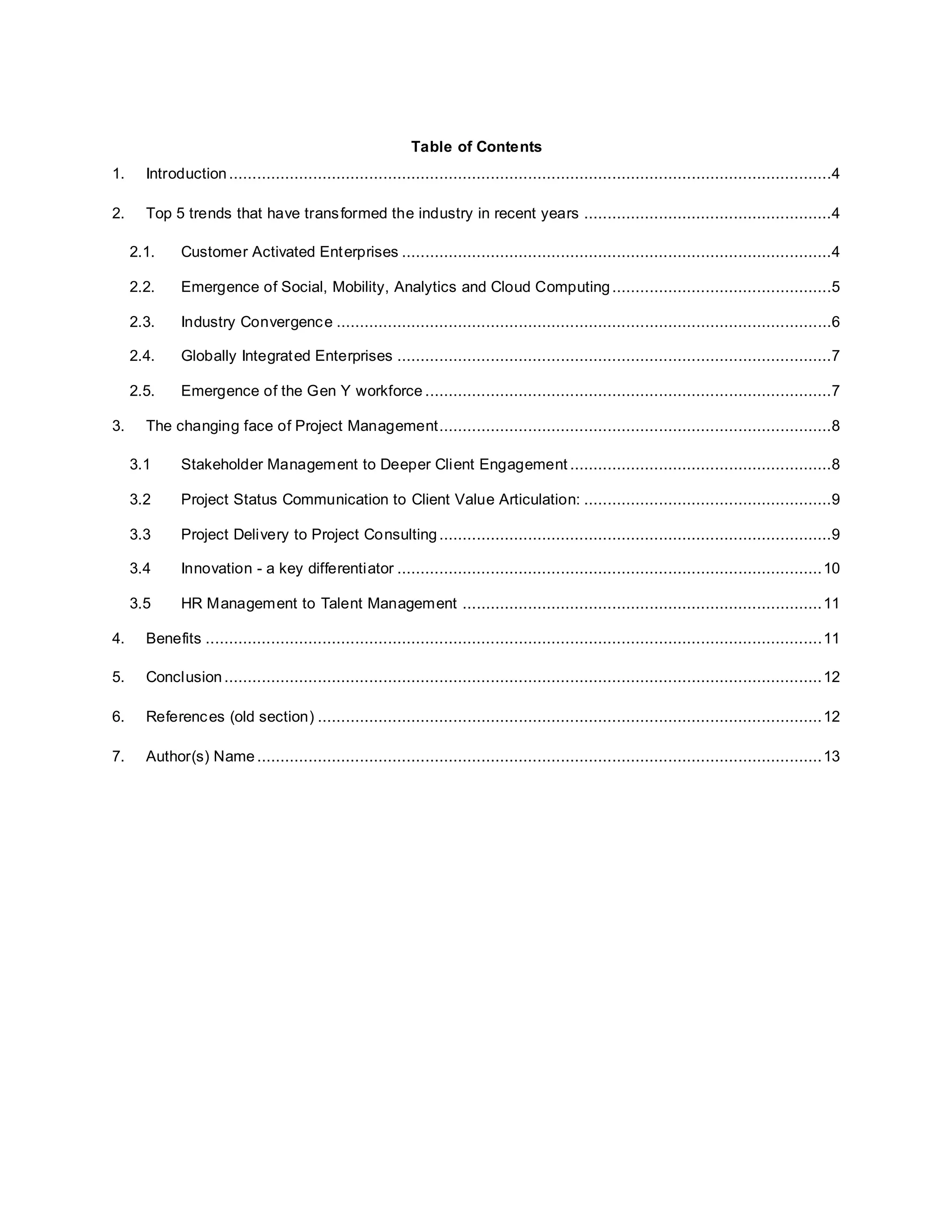
Table of Contents 
1. Introduction .................................................................................................................................4 
2. Top 5 trends that have transformed the industry in recent years .....................................................4 
2.1. Customer Activated Enterprises ............................................................................................4 
2.2. Emergence of Social, Mobility, Analytics and Cloud Computing ...............................................5 
2.3. Industry Convergence ..........................................................................................................6 
2.4. Globally Integrated Enterprises .............................................................................................7 
2.5. Emergence of the Gen Y workforce .......................................................................................7 
3. The changing face of Project Management ....................................................................................8 
3.1 Stakeholder Management to Deeper Client Engagement ........................................................8 
3.2 Project Status Communication to Client Value Articulation: .....................................................9 
3.3 Project Delivery to Project Consulting ....................................................................................9 
3.4 Innovation - a key differentiator ........................................................................................... 10 
3.5 HR Management to Talent Management ............................................................................. 11 
4. Benefits .................................................................................................................................... 11 
5. Conclusion ................................................................................................................................ 12 
6. References (old section) ............................................................................................................ 12 
7. Author(s) Name ......................................................................................................................... 13
1. Introduction 
To survive competition, organizations are constantly inventing newer products and services at a fast 
pace.If the 1980's were about quality and the 1990's were all about globalization, the present era is about 
Customer experience. In the coming years, customers will play an increasing role in influencing and 
shaping business strategy. Emerging technologies in Social, Mobile, Analytics and Cloud create new and 
unique digital experiences for the customers day by day. Convergence of industries has made 
businesses to appear seamless. Every business is trying their best to engage and retain their customers. 
The problem? Traditional project management follows a disciplined, planning and control approach to 
deliver the product/service while managing the project Triple Constraints. Across industries, the 
objectives of projects are being driven by the trends and challenges faced in the market place. Recent 
industry trends like customer activated enterprise, industry convergence, emergence of SMAC, global ly 
integrated enterprises and emergence of the GenY have transformed customer expectations. Today’s 
Project Management has to go beyond the traditional methods to find creative ways of addressing the 
changed expectations to ensure success. 
This whitepaper: 
 examines the top trends that have transformed the industry in recent years 
 explores the nature of influence of the trends in this environment 
 Introducesconsulting, new HR competencies and Client Experiencesto augment traditional 
Project Management skills. 
In the context of this paper, 
• Client refers to Project Sponsor or Sponsoring Organization who has on-going relationship with 
Service Provider 
• Service Provider refers to the Organization that delivers the Product/service 
• Customer refers to those who purchase/consume the Products/Services from the Client 
2. Top 5trends that have transformed the industry in recent years 
2.1. CustomerActivated Enterprises 
Customer experience is the new strategic differentiator in the marketplace.Recent research has shown 
that empowered customers are playing a growing role in re-defining their experience with companies.
A recent study by IBM’s Institute for Business Value, entitled “The Customer-activated Enterprise,” is 
based on findings from face-to-face conversations with more than 4,000 CEOs, CMOs, CFOs, CIOs and 
other C-suite leaders from 70 countries and 20 industries worldwide. The study reveals that 60 percent of 
CEOs plan to directly engage their customers and proactively apply what they learn to set their business 
agendas in the next three to five years.[11] The study uncovered three emerging themes that help to 
shape an organization’s future: 
• Open up to customer influence 
• Pioneer digital-physical innovation 
• Craft engaging customer experiences 
These findings suggest clearly that taking actionto make customers’ perspectives the core of the 
organization’s strategy is crucial for growth and for standing apart fromcompetitors. 
2.2. Emergence of Social, Mobility, Analytics and Cloud Computing 
Emergence of Social, Mobility, Analytics and Cloud (SMAC) has led to the world becoming hyper-connected. 
SMAC has transformed the way customers connect with Enterprises across all industries. [1] 
Social - Social media allows people to collaborate while leaving a trail of data on preferences and 
relationships with other people. When used with a clear purpose, social platforms and networks can 
enrich external and internal communications of an organization. Due to the popularity of social media, 
organizations are rethinking how social tools could be used to achieve business outcomes. 
Mobility – Mobility allows people to perform their work on – the- go. It is no longer required to be present 
in traditional office. Mobile devices and applications have replaced personal computers to access work 
related systems. Machine to Machine communication (M2M) and the Internet of things (IOT) provides 
means for instant access to applications and data from anywhere. Bring Your own device (BYOD) is 
gaining popularity. 
Cloud–Cloud computing is the latest business model for delivering IT services over the internet in a pay - 
per-use model. Through Cloud services can be delivered from anywhere without the initial capital 
expenditure on traditional IT systems. Even though Infrastructure as a Service (IaaS) , Platform as a 
Service (Paas) and Software as a Service (SaaS) are the broad categories of Cloud delivery models 
combinations of services is emerging as new business models example, Network as a Service (NaaS), 
Solutions as a Service (SLaaS). Advances in Security and Privacy are helping businesses to shed initial 
inhibitions and to exploit the power of cloud in coming years.
Analytics- Analytics is the discovery and communication of meaningful patterns in data.Predictive 
analytics allow organizations to go beyond descriptive analytics (associated with Business Intelligence) by 
providing more optimization, and answers to ‘What if ‘questions and guiding the next best action (NBA). 
Another trend in this field is the emergence of Big Data Analytics.Big data' is a blanket term for any 
collection of data sets so large and complex that it becomes difficult to process using on-hand database 
management tools or traditional data processing applications. 
A new generation of cognitive systems--a category of technologies that uses natural language 
processing and machine learning to enable people and machines to interact more naturally to extend 
and magnify human expertise and cognition. 
Service Providers play an important role as partners to manage risk of the rapidly evolving SMAC 
technology environment. Service Providers must educate their employees to prepare them for becoming 
SMAC savvy formanaging these SMAC projects. 
2.3. Industry Convergence 
Industry convergence is generally defined as the converging/merging of two or more separate and distinct 
industries. Industry convergence can occur in such a way that two or more companies that offer different 
products merge together. It can also happen that other companies can absorb the organization's core 
business to fulfill their own industry convergence objectives. [5] 
The basic drivers of industry convergence are technological convergence and customer’s needs.With the 
convergence of industries customers are able to satisfy their different needs in a limited number of 
transactionsfrom a single supplier. 
Industry convergence represents the most fundamental growth opportunity for organizations and will 
redefine industry boundaries by shifting the focus from individual products to cross-industry value 
experiences, based on digital business principles. For those industries involved in the area of 
convergence, it does offer a great deal of advantages like reduce labor, administrative as well as material 
costs. 
Service Providers have to be cognizant of these shifts in industries and the threats and opportunities that 
result out of it. This knowledge will help them to play an important role in shaping their Client’s business 
strategy and enable them in being essential.
2.4. Globally Integrated Enterprises 
The Globally Integrated Enterprise (GIE) is a term coined in 2006 by Sam Palmisano, the then CEO of 
IBM Corp, used to denote "a company that fashions its strategy, its management, and its operations in 
pursuit of a new goal: the integration of production and value delivery worldwide“ [13]. The globally 
integrated enterprise can locate functions anywhere in the world, based on the right cost, skills and 
environment. With a hyper connected world, work can move to the place where it is performed cheapest. 
This approach is made possible due to the rise of globalization, and coming down of many of the barriers 
that haltered cross-border commerce.New kinds of managerial skills are also needed to lead, to influence, 
and to quickly get credibility and respect in a diverse and multicultural workforce. 
The consideration driving most business decisions to adopt GIE are: 
 securing a supply of high-value skills 
 sensible regulation of intellectual property worldwide 
 Maintaininga company's standards of governance, transparency, privacy, security, and quality 
when its products and operations are handled by a distributed business models in as many 
countries. 
Moving toward the globally integrated enterprise will require long-term vision and continuous investment 
from business leaders. Service Providers as well as their clients alike must invest in better basic 
educational and training programs to develop high value skills next generation leadership skills and 
stringent governance for cost optimization and strict performance standards. 
2.5. Emergence of the GenY workforce 
Today’s workforce is a multi-generational one each generation has its own set of expectations, needs, 
values and working styles.Organizations are dividing their workforces into three generational groupings: 
Baby Boomers (born between 1943 and 1964), Generation X (born between 1965 and 1980) and 
Generation Y (born between 1981 and 2001). Generation Y is seen to be embracing social technology 
and diversity. Managing generational differences has become an increasingly growing area. In today’s 
diverse and ever changing business environment, it is imperative to the areas of recruitment, retention 
and engagement for organizations to successfully communicate across generational boundaries. [6] 
Gen Y is much less likely to respond to the traditional command-and-control type of management still 
popular in much of today's workforce. They are willing and not afraid to challenge the status quo and an 
environment where creativity and independent thinking are looked upon as a positive is appealing to Gen 
Y. 
Organizations with Gen Y employees must provide clear statements of goals, but allow them reasonable 
latitude on how to achieve those goals. To get the best performance out of Gen Y, Project Managers
must build on their interest in gaining new skills and knowledge by providing opportunities to grow on the 
job. 
3. The changing face of Project Management 
In the wake of emerging trends, Project Managers need to exhibit significant thought leadership in re-shaping 
current processes in Project Management. The existing processes of Stakeholder Management, 
Communication Management and Human resources Management need to undergo a total 
transformation. In addition, Project Management should also take into account avenues for Project 
Consulting, Innovation Management as additional process areas within the umbrella of Project 
Management. The following sections detail out the transformational and novel aspects of Project 
Management for survival in the changed marketplace. 
3.1 Stakeholder Management to Deeper Client Engagement 
Client engagement refers to usage of deep customer engagement to drive insight and continuously 
deliver value by personalizing engagement, versus transactional experiences. Fast paced Organizations 
have realized that next wave of business drivers will be around customers and engaging them in 
meaningful ongoing dialogues. Client relationships should be built on a strong foundation of open, honest 
interactions over time—interactions that create positive experiences and outcomes for your customers. 
Customers have so many choices to research, compare, and purchase products and services. Customer 
expectations have been increasing while budgets are being tightened. The high cost of acquiring new 
customers has become a major challenge for profitability.Customer engagement has increasingly become 
an important determining factor in determining loyalty, acquiring new customers and sustaining the 
business. 
In today's competitive environment, the success of Service Providers depends on quick identification of 
customer pain points by understanding both explicit and implicit customer.The rise of social networks and 
mobile have fundamentally changed the way businesses engage with their customers. This is necessary 
for establishing long-term relationships with the customer.Customers demand high quality service 
wherever, whenever and however they connect with your business. Project Managers must have the 
know-how to seamlessly link client strategy, technology, people and processes. Service providers have to 
initiate, grow and sustain profitable customer relationships and focus on outcome and the value to be 
delivered to clients.
The rise of Social media has transformed the way businesses of all sizes engage with their customers. 
Project Managers can also leverage social technologies to form meaningful, ongoing professional 
relationshipsto build their expertise and to network with clients as well as Subject Matter Experts. 
3.2 Project Status Communication to Client Value Articulation: 
A value proposition is a statement of the unique benefits your product or service delivers to the target 
customer. A good value proposition is the keystone for developing other marketing tools, such as an 
elevator pitch or a presentation to investors. 
Client value is the real business value you deliver to your clients. This is a question you are asked silently 
every time you communicate with a client or prospect.Clients are constantly looking for validation that you 
are the rightchoice, especially when their portfolios are down because of a 
Market turn. Prospects are trying to figure out how to tell one adviserfrom another when they all seem to 
look the same. As the industrymoves away from transactional fees, what the client gets from youis less 
tangible, making the need to “justify yourself” all the moreimportant . 
Project Managers should practice articulating the business value delivered as part of their on-going 
communication with their Clients. The Technical and Industry expertise of a Project Manager forms a key 
enabler in Client Value Articulation. The ability to communicate in the client’s business language is 
emerging as a critical skill valued by Clients as well as Service Providers. 
3.3 Project Delivery to ProjectConsulting 
Organizations must seek more effective ways to interact with customers, to develop the appropriate 
relationships, and to establish a program for long-term, sustainable profitability and benefit to the 
organization as well as the customer. In order to do this, organizations must advance their analytical 
capabilities around knowing their customers, how to market and interact with them, and what will 
generate beneficial relationships.PMs should develop consulting skills to analyze business challenges 
and jointly create solutions that integrate next-generation mobile, social, analytics and cloud 
technologies.Co-creation with clients includes an innovation model called Innovation JAM Workshops, 
which generate ideas, roadmaps, prototypes and solutions that draw on assets.Social Network Analytics 
Deep customer insight can deliver sustained competitive advantage through revenue growth and reduced 
expense. 
Project Managers need to build the range of proven experience, insights, expertise and tools to harness 
the growing velocity in volume, variety and granularity of information created today to help clients reach
better, faster decisions, take optimal actions for more predictable outcomes – creating real business 
value. Project entrepreneurship means project managers must develop an "entrepreneurial" mindset. This 
enables project managers to take on risks, foster innovation and focus on business value rather just 
looking at the traditional triple constraints. 
3.4 Innovation - a key differentiator 
Innovation is the core business basic in the current scenario. Innovation can be the act of introducing 
something new (e.g. a new idea, method or device). But it also can evolve from the process of making 
improvements of existing things, processes or services. A third approach is the combination of existing 
things, processes or services into something new.Today organizations are investing in Innovation Hubs 
which are communities of business leaders, innovators and innovation catalysts who are passionate 
about improving our business together. These communities use Social collaboration tools to coordinate 
their efforts, work on challenges, encourage and discuss ideas and share best practices in Innovation. 
Being creative drives business. It adds real value to a business. Value to its people, value to its 
customers, and value to its bottom line. 
In order to improve Innovation score and to distinguish from competition, Service Providers must 
 Promote innovation as a core skill – in all staff and especially in Project managers. Thinking 
innovatively is a skill that can be acquired. 
 Provide platform for ideation – using the collaborative tools and repositories ideas can be 
tracked, expanded andimplemented 
 Recognize people for sharing ideas &expertise–Focus on innovation can be improved through 
good management and a reward system that recognizes group effort and sharing ideas rather 
than just the individual. 
 Celebrate successes – Celebrating success can serve as motivational factor. It is essential 
for positive reinforcement of good practice. 
Project Managers must play a significant role in driving innovation as a lifeblood in the project team. 
Harvesting assets and innovations developed or practiced in the project and showcasing them should 
become important part of Project closing functions. Innovations must be stored for future reference in 
organization Knowledge Management Systems.
3.5 HR Management to Talent Management 
Corporate HR has grown up over the last 4 decades. In the 1970s and 1980s the business function which 
was responsible for people was called "The Personnel Department." This group focused on hiring people, 
paying them, and making sure they had the necessary benefits. In the 1980s and 1990s organizations 
realized that the HR function was in fact more important - and the concepts of "Strategic HR" emerged. 
HR Function was responsible recruiting the right people, training them, helping the business design job 
roles and organization structures , develop "total compensation" packages which include benefits, stock 
options and bonuses, and serving as a central point of communication for employee health and 
happiness.We are now entering a new era: the emergence of "Talent Management. [2] 
Talent Management is focused on developing a leadership pipeline, identifying and closing competency 
gaps, driving accountability, managing performance across the organization. There are many skill that are 
to be developed as mentioned in the various sections above and it need a focused approach from Talent 
Management. Talent Management function has also recognized managing Gen Y among the top HR 
Challenges.[10] 
Project Managers need to imbibe the paradigm shift in the thinking, deployment and implementation of 
the Talent Management methodology.Recognizing and understanding generational differences can help 
everyone learn to work together more effectively and transform the workplace from a generation war zone 
to an age-diverse and productive team. Employee engagement practices that will cater to the needs of 
both Gen X and Gen Y need to be designed and executed. As a result of organizations becoming 
Globally Integrated Enterprises the project teams will increasingly become multinational and multicultural. 
Exploring social collaboration tools, knowledge Management Systems and incorporating culture 
sensitivity are important for building a high performing cohesive project team. 
4. Benefits 
The approaches highlighted in this paper are oriented towards elevating Project Management for 
converting business strategy into business results. The benefits of such an approach include: 
 Higher Customer Satisfaction –WOW Experience 
 Higher Customer Intimacy 
 Reduce costs and improve operational efficiency 
 Increase revenue and customer retention and loyalty 
 Increase flexibility to support existing and new business strategies 
 Meet compliance requirements and reduce risk exposure 
 Cultivating Domain Depth
 Increased Opportunity for IP based solutions 
 Better Control on the Outcome 
 Highly Motivated Workforce 
5. Conclusion 
The driving forces of today’s marketplace and key Project Management challenges have been explored. 
Top 5 trends that are driving changes in the marketplace and key Project Management challenges have 
been examined. It can thereby be concluded that, there are many changes we need to implement in the 
Project Management practices in the coming days. Project Management Process need Transformational 
changes as well as introductionof novel practices for survival as well as for ensuring better Customer 
experience which is the key market driver.Augmenting traditional methods with Consulting, new HR 
competencies and Client Experiences has benefits. 
6. References 
1. Cloud Computing and SMAC , http://joostvanlier.wordpress.com/2013/05/24/essay -cloud-computing- 
and-smac-defining-the-trends-benefits-and-threats/ 
2. Deloitte Forecasts the Global Shift in Talent Management, 
http://www2.deloitte.com/global/en/pages/about-deloitte/articles/forecasts-global-shi ft-in-talent-management. 
html 
3. Executive Guide to Project Management – PMI Publication 
4. Forbes - 10 Tech Trends That Will Transform Your Industry, 
http://www.forbes.com/sites/oracle/2014/04/03/10-tech-trends-that-will-t ransform-your-industry/ 
5. Gartner - Industry Convergence — The Digital Industrial Revolution , 
https://www.gartner.com/doc/2684516/industry-convergence--digital-industrial 
6. Generation Y: The powerhouse of the global economy; http://www.deloitte.com/assets/Dcom- 
UnitedStates/Local%20Assets/Documents/us_consulting_hc_GenerationY_Snapshot_041509.pd 
f 
7. Pulse of the Profession 2014 – PMI Publication. 
8. SMAC and the Transformation of Innovation, http://www.project -management-podcast. 
com/index.php/podcast-episodes/episode-details/531-episode-259-smac-and-the-transformation- 
of-innovation 
9. Social Media Case Studies, http://business.linkedin.com/marketing-solutions/social-media-case-studies. 
html 
10. Talent Management, What is it? Why now?, May, 2006,Josh Bersin , Principal 
11. The Customer Activated Enterprise, http://www.ibm.com/midmarket/us/en/csuite2013.html 
12. The Evolution of Project Management, By SandroAzzopardi
13. The Globally Integrated enterprise, http://www.cfr.org/corporate-governance/globally-integrated-enterprise/ 
p10468 
14. The Millennial Survey 2014, Big demands and high expectations; 
http://www2.deloitte.com/global/en/pages/about -deloitte/articles/2014-millennial -survey-positive-impact. 
html 
7. Author(s) Name

Presentation by anipriya p

  • 1.
    Mantra for InnovativeProject Management Anipriya P Delivery Project Executive IBM
  • 2.
    Re-shaping Project Managementfor survival in a changing marketplace Theme: Mantra for Innovative Project Management Keywords:Consulting, Client Experience Management, Talent Management, Consulting, Project Management. Abstract: In a hyper-connected and fast-paced technology driven environment, projects are becoming increasingly complex day by day. Service Providers have so far relied on traditional Project Management Principles, CMMI and Delivery Models as proven means of delivering customer needs. While this has worked well in the past, emerging trends like Social Networking, Mobility, Analytics, Cloud and Diversity pose new opportunities as well as threats. The Client’s objectives of projects are being driven by the challenges they face in the market place. Across industries, end-customers are seeking high digital experience, faster Time to Market, improved Productivity, higher quality, lower costs and personalization of services. These expectations bring in new dimensions of challenges to Service Providers. Hence it is imperative for service providers to find creative ways of distinguishing themselves as a means of survival. This paper explores ways of augmenting traditional methods with Consulting, new HR competencies and Client Experiences. The benefits of such an approach include greater agility, higher customer stickiness, higher success rates of projects and higher people satisfaction.
  • 3.
    Table of Contents 1. Introduction .................................................................................................................................4 2. Top 5 trends that have transformed the industry in recent years .....................................................4 2.1. Customer Activated Enterprises ............................................................................................4 2.2. Emergence of Social, Mobility, Analytics and Cloud Computing ...............................................5 2.3. Industry Convergence ..........................................................................................................6 2.4. Globally Integrated Enterprises .............................................................................................7 2.5. Emergence of the Gen Y workforce .......................................................................................7 3. The changing face of Project Management ....................................................................................8 3.1 Stakeholder Management to Deeper Client Engagement ........................................................8 3.2 Project Status Communication to Client Value Articulation: .....................................................9 3.3 Project Delivery to Project Consulting ....................................................................................9 3.4 Innovation - a key differentiator ........................................................................................... 10 3.5 HR Management to Talent Management ............................................................................. 11 4. Benefits .................................................................................................................................... 11 5. Conclusion ................................................................................................................................ 12 6. References (old section) ............................................................................................................ 12 7. Author(s) Name ......................................................................................................................... 13
  • 4.
    1. Introduction Tosurvive competition, organizations are constantly inventing newer products and services at a fast pace.If the 1980's were about quality and the 1990's were all about globalization, the present era is about Customer experience. In the coming years, customers will play an increasing role in influencing and shaping business strategy. Emerging technologies in Social, Mobile, Analytics and Cloud create new and unique digital experiences for the customers day by day. Convergence of industries has made businesses to appear seamless. Every business is trying their best to engage and retain their customers. The problem? Traditional project management follows a disciplined, planning and control approach to deliver the product/service while managing the project Triple Constraints. Across industries, the objectives of projects are being driven by the trends and challenges faced in the market place. Recent industry trends like customer activated enterprise, industry convergence, emergence of SMAC, global ly integrated enterprises and emergence of the GenY have transformed customer expectations. Today’s Project Management has to go beyond the traditional methods to find creative ways of addressing the changed expectations to ensure success. This whitepaper:  examines the top trends that have transformed the industry in recent years  explores the nature of influence of the trends in this environment  Introducesconsulting, new HR competencies and Client Experiencesto augment traditional Project Management skills. In the context of this paper, • Client refers to Project Sponsor or Sponsoring Organization who has on-going relationship with Service Provider • Service Provider refers to the Organization that delivers the Product/service • Customer refers to those who purchase/consume the Products/Services from the Client 2. Top 5trends that have transformed the industry in recent years 2.1. CustomerActivated Enterprises Customer experience is the new strategic differentiator in the marketplace.Recent research has shown that empowered customers are playing a growing role in re-defining their experience with companies.
  • 5.
    A recent studyby IBM’s Institute for Business Value, entitled “The Customer-activated Enterprise,” is based on findings from face-to-face conversations with more than 4,000 CEOs, CMOs, CFOs, CIOs and other C-suite leaders from 70 countries and 20 industries worldwide. The study reveals that 60 percent of CEOs plan to directly engage their customers and proactively apply what they learn to set their business agendas in the next three to five years.[11] The study uncovered three emerging themes that help to shape an organization’s future: • Open up to customer influence • Pioneer digital-physical innovation • Craft engaging customer experiences These findings suggest clearly that taking actionto make customers’ perspectives the core of the organization’s strategy is crucial for growth and for standing apart fromcompetitors. 2.2. Emergence of Social, Mobility, Analytics and Cloud Computing Emergence of Social, Mobility, Analytics and Cloud (SMAC) has led to the world becoming hyper-connected. SMAC has transformed the way customers connect with Enterprises across all industries. [1] Social - Social media allows people to collaborate while leaving a trail of data on preferences and relationships with other people. When used with a clear purpose, social platforms and networks can enrich external and internal communications of an organization. Due to the popularity of social media, organizations are rethinking how social tools could be used to achieve business outcomes. Mobility – Mobility allows people to perform their work on – the- go. It is no longer required to be present in traditional office. Mobile devices and applications have replaced personal computers to access work related systems. Machine to Machine communication (M2M) and the Internet of things (IOT) provides means for instant access to applications and data from anywhere. Bring Your own device (BYOD) is gaining popularity. Cloud–Cloud computing is the latest business model for delivering IT services over the internet in a pay - per-use model. Through Cloud services can be delivered from anywhere without the initial capital expenditure on traditional IT systems. Even though Infrastructure as a Service (IaaS) , Platform as a Service (Paas) and Software as a Service (SaaS) are the broad categories of Cloud delivery models combinations of services is emerging as new business models example, Network as a Service (NaaS), Solutions as a Service (SLaaS). Advances in Security and Privacy are helping businesses to shed initial inhibitions and to exploit the power of cloud in coming years.
  • 6.
    Analytics- Analytics isthe discovery and communication of meaningful patterns in data.Predictive analytics allow organizations to go beyond descriptive analytics (associated with Business Intelligence) by providing more optimization, and answers to ‘What if ‘questions and guiding the next best action (NBA). Another trend in this field is the emergence of Big Data Analytics.Big data' is a blanket term for any collection of data sets so large and complex that it becomes difficult to process using on-hand database management tools or traditional data processing applications. A new generation of cognitive systems--a category of technologies that uses natural language processing and machine learning to enable people and machines to interact more naturally to extend and magnify human expertise and cognition. Service Providers play an important role as partners to manage risk of the rapidly evolving SMAC technology environment. Service Providers must educate their employees to prepare them for becoming SMAC savvy formanaging these SMAC projects. 2.3. Industry Convergence Industry convergence is generally defined as the converging/merging of two or more separate and distinct industries. Industry convergence can occur in such a way that two or more companies that offer different products merge together. It can also happen that other companies can absorb the organization's core business to fulfill their own industry convergence objectives. [5] The basic drivers of industry convergence are technological convergence and customer’s needs.With the convergence of industries customers are able to satisfy their different needs in a limited number of transactionsfrom a single supplier. Industry convergence represents the most fundamental growth opportunity for organizations and will redefine industry boundaries by shifting the focus from individual products to cross-industry value experiences, based on digital business principles. For those industries involved in the area of convergence, it does offer a great deal of advantages like reduce labor, administrative as well as material costs. Service Providers have to be cognizant of these shifts in industries and the threats and opportunities that result out of it. This knowledge will help them to play an important role in shaping their Client’s business strategy and enable them in being essential.
  • 7.
    2.4. Globally IntegratedEnterprises The Globally Integrated Enterprise (GIE) is a term coined in 2006 by Sam Palmisano, the then CEO of IBM Corp, used to denote "a company that fashions its strategy, its management, and its operations in pursuit of a new goal: the integration of production and value delivery worldwide“ [13]. The globally integrated enterprise can locate functions anywhere in the world, based on the right cost, skills and environment. With a hyper connected world, work can move to the place where it is performed cheapest. This approach is made possible due to the rise of globalization, and coming down of many of the barriers that haltered cross-border commerce.New kinds of managerial skills are also needed to lead, to influence, and to quickly get credibility and respect in a diverse and multicultural workforce. The consideration driving most business decisions to adopt GIE are:  securing a supply of high-value skills  sensible regulation of intellectual property worldwide  Maintaininga company's standards of governance, transparency, privacy, security, and quality when its products and operations are handled by a distributed business models in as many countries. Moving toward the globally integrated enterprise will require long-term vision and continuous investment from business leaders. Service Providers as well as their clients alike must invest in better basic educational and training programs to develop high value skills next generation leadership skills and stringent governance for cost optimization and strict performance standards. 2.5. Emergence of the GenY workforce Today’s workforce is a multi-generational one each generation has its own set of expectations, needs, values and working styles.Organizations are dividing their workforces into three generational groupings: Baby Boomers (born between 1943 and 1964), Generation X (born between 1965 and 1980) and Generation Y (born between 1981 and 2001). Generation Y is seen to be embracing social technology and diversity. Managing generational differences has become an increasingly growing area. In today’s diverse and ever changing business environment, it is imperative to the areas of recruitment, retention and engagement for organizations to successfully communicate across generational boundaries. [6] Gen Y is much less likely to respond to the traditional command-and-control type of management still popular in much of today's workforce. They are willing and not afraid to challenge the status quo and an environment where creativity and independent thinking are looked upon as a positive is appealing to Gen Y. Organizations with Gen Y employees must provide clear statements of goals, but allow them reasonable latitude on how to achieve those goals. To get the best performance out of Gen Y, Project Managers
  • 8.
    must build ontheir interest in gaining new skills and knowledge by providing opportunities to grow on the job. 3. The changing face of Project Management In the wake of emerging trends, Project Managers need to exhibit significant thought leadership in re-shaping current processes in Project Management. The existing processes of Stakeholder Management, Communication Management and Human resources Management need to undergo a total transformation. In addition, Project Management should also take into account avenues for Project Consulting, Innovation Management as additional process areas within the umbrella of Project Management. The following sections detail out the transformational and novel aspects of Project Management for survival in the changed marketplace. 3.1 Stakeholder Management to Deeper Client Engagement Client engagement refers to usage of deep customer engagement to drive insight and continuously deliver value by personalizing engagement, versus transactional experiences. Fast paced Organizations have realized that next wave of business drivers will be around customers and engaging them in meaningful ongoing dialogues. Client relationships should be built on a strong foundation of open, honest interactions over time—interactions that create positive experiences and outcomes for your customers. Customers have so many choices to research, compare, and purchase products and services. Customer expectations have been increasing while budgets are being tightened. The high cost of acquiring new customers has become a major challenge for profitability.Customer engagement has increasingly become an important determining factor in determining loyalty, acquiring new customers and sustaining the business. In today's competitive environment, the success of Service Providers depends on quick identification of customer pain points by understanding both explicit and implicit customer.The rise of social networks and mobile have fundamentally changed the way businesses engage with their customers. This is necessary for establishing long-term relationships with the customer.Customers demand high quality service wherever, whenever and however they connect with your business. Project Managers must have the know-how to seamlessly link client strategy, technology, people and processes. Service providers have to initiate, grow and sustain profitable customer relationships and focus on outcome and the value to be delivered to clients.
  • 9.
    The rise ofSocial media has transformed the way businesses of all sizes engage with their customers. Project Managers can also leverage social technologies to form meaningful, ongoing professional relationshipsto build their expertise and to network with clients as well as Subject Matter Experts. 3.2 Project Status Communication to Client Value Articulation: A value proposition is a statement of the unique benefits your product or service delivers to the target customer. A good value proposition is the keystone for developing other marketing tools, such as an elevator pitch or a presentation to investors. Client value is the real business value you deliver to your clients. This is a question you are asked silently every time you communicate with a client or prospect.Clients are constantly looking for validation that you are the rightchoice, especially when their portfolios are down because of a Market turn. Prospects are trying to figure out how to tell one adviserfrom another when they all seem to look the same. As the industrymoves away from transactional fees, what the client gets from youis less tangible, making the need to “justify yourself” all the moreimportant . Project Managers should practice articulating the business value delivered as part of their on-going communication with their Clients. The Technical and Industry expertise of a Project Manager forms a key enabler in Client Value Articulation. The ability to communicate in the client’s business language is emerging as a critical skill valued by Clients as well as Service Providers. 3.3 Project Delivery to ProjectConsulting Organizations must seek more effective ways to interact with customers, to develop the appropriate relationships, and to establish a program for long-term, sustainable profitability and benefit to the organization as well as the customer. In order to do this, organizations must advance their analytical capabilities around knowing their customers, how to market and interact with them, and what will generate beneficial relationships.PMs should develop consulting skills to analyze business challenges and jointly create solutions that integrate next-generation mobile, social, analytics and cloud technologies.Co-creation with clients includes an innovation model called Innovation JAM Workshops, which generate ideas, roadmaps, prototypes and solutions that draw on assets.Social Network Analytics Deep customer insight can deliver sustained competitive advantage through revenue growth and reduced expense. Project Managers need to build the range of proven experience, insights, expertise and tools to harness the growing velocity in volume, variety and granularity of information created today to help clients reach
  • 10.
    better, faster decisions,take optimal actions for more predictable outcomes – creating real business value. Project entrepreneurship means project managers must develop an "entrepreneurial" mindset. This enables project managers to take on risks, foster innovation and focus on business value rather just looking at the traditional triple constraints. 3.4 Innovation - a key differentiator Innovation is the core business basic in the current scenario. Innovation can be the act of introducing something new (e.g. a new idea, method or device). But it also can evolve from the process of making improvements of existing things, processes or services. A third approach is the combination of existing things, processes or services into something new.Today organizations are investing in Innovation Hubs which are communities of business leaders, innovators and innovation catalysts who are passionate about improving our business together. These communities use Social collaboration tools to coordinate their efforts, work on challenges, encourage and discuss ideas and share best practices in Innovation. Being creative drives business. It adds real value to a business. Value to its people, value to its customers, and value to its bottom line. In order to improve Innovation score and to distinguish from competition, Service Providers must  Promote innovation as a core skill – in all staff and especially in Project managers. Thinking innovatively is a skill that can be acquired.  Provide platform for ideation – using the collaborative tools and repositories ideas can be tracked, expanded andimplemented  Recognize people for sharing ideas &expertise–Focus on innovation can be improved through good management and a reward system that recognizes group effort and sharing ideas rather than just the individual.  Celebrate successes – Celebrating success can serve as motivational factor. It is essential for positive reinforcement of good practice. Project Managers must play a significant role in driving innovation as a lifeblood in the project team. Harvesting assets and innovations developed or practiced in the project and showcasing them should become important part of Project closing functions. Innovations must be stored for future reference in organization Knowledge Management Systems.
  • 11.
    3.5 HR Managementto Talent Management Corporate HR has grown up over the last 4 decades. In the 1970s and 1980s the business function which was responsible for people was called "The Personnel Department." This group focused on hiring people, paying them, and making sure they had the necessary benefits. In the 1980s and 1990s organizations realized that the HR function was in fact more important - and the concepts of "Strategic HR" emerged. HR Function was responsible recruiting the right people, training them, helping the business design job roles and organization structures , develop "total compensation" packages which include benefits, stock options and bonuses, and serving as a central point of communication for employee health and happiness.We are now entering a new era: the emergence of "Talent Management. [2] Talent Management is focused on developing a leadership pipeline, identifying and closing competency gaps, driving accountability, managing performance across the organization. There are many skill that are to be developed as mentioned in the various sections above and it need a focused approach from Talent Management. Talent Management function has also recognized managing Gen Y among the top HR Challenges.[10] Project Managers need to imbibe the paradigm shift in the thinking, deployment and implementation of the Talent Management methodology.Recognizing and understanding generational differences can help everyone learn to work together more effectively and transform the workplace from a generation war zone to an age-diverse and productive team. Employee engagement practices that will cater to the needs of both Gen X and Gen Y need to be designed and executed. As a result of organizations becoming Globally Integrated Enterprises the project teams will increasingly become multinational and multicultural. Exploring social collaboration tools, knowledge Management Systems and incorporating culture sensitivity are important for building a high performing cohesive project team. 4. Benefits The approaches highlighted in this paper are oriented towards elevating Project Management for converting business strategy into business results. The benefits of such an approach include:  Higher Customer Satisfaction –WOW Experience  Higher Customer Intimacy  Reduce costs and improve operational efficiency  Increase revenue and customer retention and loyalty  Increase flexibility to support existing and new business strategies  Meet compliance requirements and reduce risk exposure  Cultivating Domain Depth
  • 12.
     Increased Opportunityfor IP based solutions  Better Control on the Outcome  Highly Motivated Workforce 5. Conclusion The driving forces of today’s marketplace and key Project Management challenges have been explored. Top 5 trends that are driving changes in the marketplace and key Project Management challenges have been examined. It can thereby be concluded that, there are many changes we need to implement in the Project Management practices in the coming days. Project Management Process need Transformational changes as well as introductionof novel practices for survival as well as for ensuring better Customer experience which is the key market driver.Augmenting traditional methods with Consulting, new HR competencies and Client Experiences has benefits. 6. References 1. Cloud Computing and SMAC , http://joostvanlier.wordpress.com/2013/05/24/essay -cloud-computing- and-smac-defining-the-trends-benefits-and-threats/ 2. Deloitte Forecasts the Global Shift in Talent Management, http://www2.deloitte.com/global/en/pages/about-deloitte/articles/forecasts-global-shi ft-in-talent-management. html 3. Executive Guide to Project Management – PMI Publication 4. Forbes - 10 Tech Trends That Will Transform Your Industry, http://www.forbes.com/sites/oracle/2014/04/03/10-tech-trends-that-will-t ransform-your-industry/ 5. Gartner - Industry Convergence — The Digital Industrial Revolution , https://www.gartner.com/doc/2684516/industry-convergence--digital-industrial 6. Generation Y: The powerhouse of the global economy; http://www.deloitte.com/assets/Dcom- UnitedStates/Local%20Assets/Documents/us_consulting_hc_GenerationY_Snapshot_041509.pd f 7. Pulse of the Profession 2014 – PMI Publication. 8. SMAC and the Transformation of Innovation, http://www.project -management-podcast. com/index.php/podcast-episodes/episode-details/531-episode-259-smac-and-the-transformation- of-innovation 9. Social Media Case Studies, http://business.linkedin.com/marketing-solutions/social-media-case-studies. html 10. Talent Management, What is it? Why now?, May, 2006,Josh Bersin , Principal 11. The Customer Activated Enterprise, http://www.ibm.com/midmarket/us/en/csuite2013.html 12. The Evolution of Project Management, By SandroAzzopardi
  • 13.
    13. The GloballyIntegrated enterprise, http://www.cfr.org/corporate-governance/globally-integrated-enterprise/ p10468 14. The Millennial Survey 2014, Big demands and high expectations; http://www2.deloitte.com/global/en/pages/about -deloitte/articles/2014-millennial -survey-positive-impact. html 7. Author(s) Name