Encouraging Academic Integrity: But, If Necessary, Detecting and Dealing With Academic Dishonesty Bill Hill, PhD Professor Emeritus of Psychology & Retired Executive Director of the Center for Excellence in Teaching & Learning Kennesaw State University Presented to the Xavier University Faculty January 14, 2011
Workshop Goals Defining Academic Integrity & Dishonesty Your Role in Encouraging Academic Integrity Overview of Research Data Being Proactive:  Understanding Students’ Perceptions and Reasons for Academic Dishonesty Prevention Being Aware: Detecting It Being Reactive: Dealing with Instances
Caveats I don’t have a lot of original ideas. However, I am pretty good at knowing, using, summarizing, and adapting resources.
What Do You Know About Academic Dishonesty? A Quiz………
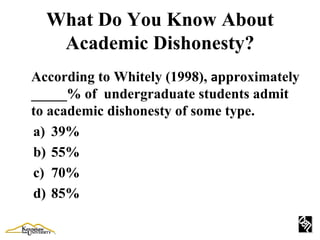
What Do You Know About Academic Dishonesty? According to Whitely (1998),  a pproximately _____% of  undergraduate students admit to academic dishonesty of some type. 39% 55% 70% 85%
What Do You Know About Academic Dishonesty? According to Whitely (1998), approximately _____% of  undergraduate students admit to cheating on a test. 25% 43% 64% 77%
What Do You Know About Academic Dishonesty? According to Whitely (1998),  a pproximately _____% of  undergraduate students admit to plagiarism. 29% 47% 66% 83%
What Do You Know About Academic Dishonesty? According to McCabe (2005), the most common form of cheating on tests and exams reported by undergraduates is: using crib notes learning what is on a test from someone who has already taken it copying from another student without their knowledge helping someone else cheat
What Do You Know About Academic Dishonesty? According to McCabe (2005), the most common form of cheating on written assignments reported by undergraduates is: working with others when asked to do individual work turning in work done by another fabricating/falsifying a bibliography paraphrasing/copying few sentences from the Internet without citation
What Do You Know About Academic Dishonesty? Faculty have generally accurate knowledge of student attitudes about academic dishonesty (see Whitley & Keith-Spiegel, 2002).  True False
What Do You Know About Academic Dishonesty? Student attitudes about academic dishonesty are relatively stable throughout their college careers (i.e., from freshman to senior) (Sims, 1995; cited in Whitley & Keith-Spiegel, 2002). True False
What Do You Know About Academic Dishonesty? Which of the following characteristics is MOST strongly related to students who admit to academic dishonesty? (see Whitley, 1998) Missing class often Frequent partying Sex of the student Strong grade orientation
What Do You Know About Academic Dishonesty? Strong threats of punishment have been shown to be an effective deterrent for academic dishonesty. (see Whitley & Keith-Spiegel, 2002) True False
Defining Academic Integrity “ The Center for Academic Integrity (CAI) defines academic integrity as a commitment, even in the face of adversity, to five fundamental values: honesty, trust, fairness, respect, and responsibility.” (see  http://www.academicintegrity.org )
Defining Academic Integrity AAUP policy statements on Professional Ethics Freedom and Responsibility Plagiarism (See AAUP, 2006)
Defining Academic Integrity Some relevant AAUP quotes: “ an obligation to … defend intellectual honesty” “ primary responsibility to their subject is to seek and to state the truth as they see it.” demonstrate “the best scholarly and ethical standards of their discipline” to students. “ make every reasonable effort to foster honest academic conduct and to ensure that their evaluations of students reflect each students’ true merit.”
Defining Academic Integrity Some other definitional sources to consider: Disciplinary ethical guidelines Institutional definitions and policies Other organizations Center for Academic Integrity Association for Student Conduct Administration (previously Association for Student Judicial Affairs)
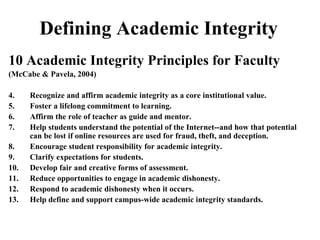
Defining Academic Integrity 10 Academic Integrity Principles for Faculty (McCabe & Pavela, 2004)  Recognize and affirm academic integrity as a core institutional value.  Foster a lifelong commitment to learning.  Affirm the role of teacher as guide and mentor.  Help students understand the potential of the Internet--and how that potential can be lost if online resources are used for fraud, theft, and deception.  Encourage student responsibility for academic integrity.  Clarify expectations for students.  Develop fair and creative forms of assessment.  Reduce opportunities to engage in academic dishonesty.  Respond to academic dishonesty when it occurs. Help define and support campus-wide academic integrity standards.
Shifting Focus a Bit From Integrity to Dishonesty
Pavela’s (1978) Typology of Academic Dishonesty Cheating “ intentionally using or attempting to use unauthorized materials, information, or study aids in any academic exercise” (p. 78) Fabrication “ intentional and unauthorized fabrication or invention of any information or citation in an academic exercise” (p. 78)
Pavela’s (1978) Typology of Academic Dishonesty Plagiarism “ deliberate adoption or reproduction of ideas or words or statements of another person as one’s own without acknowledgement” (p. 78) Facilitating Academic Dishonesty “ intentionally or knowingly helping or attempting to help another” (p. 78)
What is a recurring theme across Pavela’s typology that presents a particular challenge in determining whether or not academic dishonesty occurred? Academic dishonesty is intentional behavior
Frequency of Occurrence Most cited survey of self-reported incidents of academic dishonest among undergraduate students is McCabe and Trevino (1993).  Sample was 6,096 students from 31 colleges and universities. Other studies of frequency report similar results.
Frequency of Occurrence McCabe and Trevino’s sample (1993) self-reported on 12 behaviors Using crib notes Copying another student’s test answers Getting prior knowledge of test content Copying tests answers without other student’s knowledge Assisting another student in cheating on a test Test cheating in any other way Copying someone else’s work and submitting as own Fabricating/falsifying bibliography Turning in another’s work Receiving substantial, unpermitted help for an assignment Collaborating when individual work was specified Copying sentences without citation/footnoting
Frequency of Occurrence (McCabe & Trevino, 1993) Table adapted from Whitley & Keith-Spiegel, 2002, p. 9 Variable All Institutions Honor Code Institutions Other Institutions Committed any of 12 behaviors 78.3% 57.8% 81.8% Test Cheating 52.2% 30.9% 60.4% Copied Homework 41.6% 25.3% 49.8% Plagiarism 48.4% 31.0% 57.1%
Frequency of Occurrence (Whitley, 1998) NOTE: Number in parentheses is total studies reviewed. Variable Range Average Total  Cheating (19) 9-95% 70.4% Tests (36) 4-82% 43.1% Homework (12) 3-83% 40.9% Plagiarism (9) 3-98% 47.0%
Student & Faculty Perceptions Lots of agreement on what is academically dishonest, but several areas of disagreement.  In general, students hold more lenient attitudes than faculty (Whitley & Keith-Spiegel, 2002)
Student & Faculty Perceptions Some Faculty-Student Belief Disconnects  (Whitley & Keith-Spiegel, 2002) Behavior % Faculty Rating as Dishonest % Students Rating as Dishonest Intentionally looking at another student’s test answer and keeping yours if same >90% 50-74% Studying old tests without permission >90% 50-74% Getting external help on graded aspects of paper (e.g., spelling, grammar) 50-74% <25% Using information from another student’s paper without citation >90% 50-74% Using a term paper in multiple classes without instructor permission 75-89% 25-49%
Student & Faculty Perceptions More Faculty-Student Belief Disconnects  (Whitley & Keith-Spiegel, 2002) Behavior % Faculty Rating as Dishonest % Students Rating as Dishonest Leaving out sources in bibliography 75-89% 25-49% Changing lab report data >90% 50-74% Submitting lab report when research not done >90% 50-74% False excuses >90% 50-74% Reading condensed versions of assignments 50-74% <25% Unauthorized collaboration on assignments 75-89% 25-49% Allowing someone to copy your homework 75-89% 25-49%
Strong Indicators for Dishonesty Moderate or high expectations of success Favorable attitudes about dishonesty Social norms perceived as favoring dishonesty Expectation of rewards for high grades Past academic dishonesty Frequent partying (Whitley, 1998; Whitley & Keith-Spiegel, 2002)
Why Students Do It Based on a review of 14 studies, Whitley and Keith-Spiegel (2002) identified three categories of factors contributing to academic dishonesty   Motivational Justifications Situational
Why Students Do It I would suggest adding one more reason based on the previous data  Lack of knowledge or unclearly stated expectations
Computers & the Internet Internet behavior may contribute to moral disengagement.  Research reported by the Business Software Alliance (2003, cited in Stephens, Young, & Calabrese, 2007)  found: 69% of students download music….75% of whom never pay 26% of students download movies….84% of whom never pay 75% state that it is okay to pirate music and movies
Computers & the Internet Survey data collected by Stephens, Young, & Calabrese (2007) suggested that digital methods of academic dishonesty have not replaced conventional methods like collaboration on homework or test copying. Types that are replacing conventional methods are: Digital plagiarism (“cut and paste”) Digital crib notes
Prevention: Tests Restate your expectations prior to each test Implement test security measures, before and after Create a testing situation that discourages cheating  Use posttest measures
Prevention:  Homework & Lab Reports Monitor lab attendance Tell them you keep copies of student homework Vary assignments across classes and semesters Avoid using assignments for which answers are available online or otherwise Be explicit about collaboration Warn about unintended sharing possibilities (“trash-diving”; shared computers)
Prevention: Term Papers Tell students you keep past papers Tell them you use e-resources to check (Google, TurnItIn) Require periodic submission of “steps” of paper  Require submission of related materials with final paper Assess knowledge of paper through other means Warn about unintended sharing possibilities (“trash-diving”; shared computers) Be clear about using the same paper across classes
Detection: Tests Be vigilant during the test Watch for inappropriate behaviors Give discreet warnings when necessary Note similarities in error patterns Copy and compare answer sheets
Detection:  Homework & Lab Reports Keep copies of student work Watch for variations in answer quality Grade all in one sitting Lab reports turned in by absent students
Detection: Term Papers Keep copies of student papers  Watch for signs of plagiarism Paper “too good” Unusual content Variations in writing style (within paper; with other assignments) Use Google or TurnItIn
Dealing with Suspected Instances McCabe (2005) reported that 33% of faculty reported being aware of cheating but doing nothing.
Dealing with Suspected Instances Factors contributing to faculty avoidance (Whitley & Keith-Spiegel, 2002): Beliefs: “ Doesn’t happen in my classes” “ I don’t want to know” “ They are only hurting themselves”
Dealing with Suspected Instances Factors contributing to faculty avoidance (Whitley & Keith-Spiegel, 2002): Barriers: Difficulty in proving it Time consuming Fear of negative impressions of themselves Fear of litigation Perceived lack of support Student retaliation
Dealing with Suspected Instances Some Final Advice: Take action Follow institutional policy Do your research---gather evidence Don’t always assume guilt Pay attention to due process Maintain confidentiality Notify your department chair Consider having a witness when discussing with student (e.g., department chair)
Recommendations for Facilitating Academic Integrity Develop an Institutional and Departmental Culture of Academic Integrity Honor codes Clear shared policies and expectations (i.e., a faculty commitment and shared understanding) Administrative support and encouragement
Recommendations for Facilitating Academic Integrity Develop a Class Climate of Academic Integrity Focus on positives (importance of integrity), not negatives (punishing academic dishonesty) Establish culture of fairness Syllabus content that provides your explicit, clear expectations Classroom discussion on integrity, focusing on areas were there are disconnects between faculty and students Create a supportive learning environment that reduces student anxiety
Recommendations for Facilitating Academic Integrity Be Proactive by Developing Teaching Modules and Experiences that Reinforce Academic Integrity Build in a discussion of shared expectations of academic integrity; maybe though a quiz on what is or is not academic dishonesty Incorporate teaching modules on proper citation in papers (for example, see  http://www.indiana.edu/~istd/plagiarism_test.html ) Show them how you can use the Internet to check papers
Recommendations for Facilitating Academic Integrity Incorporate Procedures that Might Discourage Academic Dishonesty…and Reinforce the Shared Prohibition of It
Bottom Line Dealing with academic dishonesty is difficult and unpleasant. But, it is our ethical responsibility. We are responsible for setting and maintaining a culture of academic integrity.
Primary presentation sources: Academic Dishonesty: An Educator’s Guide  (Whitley & Keith-Spiegel, 2002) Factors Associated with Cheating Among College Students (Whitley, 1998) Cheating Among College and University Students: A North American Perspective (McCabe, 2005) The Center for Academic Integrity (www.academicintegrity.org)

Encouraging Academic Integrity

  • 1.
    Encouraging Academic Integrity:But, If Necessary, Detecting and Dealing With Academic Dishonesty Bill Hill, PhD Professor Emeritus of Psychology & Retired Executive Director of the Center for Excellence in Teaching & Learning Kennesaw State University Presented to the Xavier University Faculty January 14, 2011
  • 2.
    Workshop Goals DefiningAcademic Integrity & Dishonesty Your Role in Encouraging Academic Integrity Overview of Research Data Being Proactive: Understanding Students’ Perceptions and Reasons for Academic Dishonesty Prevention Being Aware: Detecting It Being Reactive: Dealing with Instances
  • 3.
    Caveats I don’thave a lot of original ideas. However, I am pretty good at knowing, using, summarizing, and adapting resources.
  • 4.
    What Do YouKnow About Academic Dishonesty? A Quiz………
  • 5.
    What Do YouKnow About Academic Dishonesty? According to Whitely (1998), a pproximately _____% of undergraduate students admit to academic dishonesty of some type. 39% 55% 70% 85%
  • 6.
    What Do YouKnow About Academic Dishonesty? According to Whitely (1998), approximately _____% of undergraduate students admit to cheating on a test. 25% 43% 64% 77%
  • 7.
    What Do YouKnow About Academic Dishonesty? According to Whitely (1998), a pproximately _____% of undergraduate students admit to plagiarism. 29% 47% 66% 83%
  • 8.
    What Do YouKnow About Academic Dishonesty? According to McCabe (2005), the most common form of cheating on tests and exams reported by undergraduates is: using crib notes learning what is on a test from someone who has already taken it copying from another student without their knowledge helping someone else cheat
  • 9.
    What Do YouKnow About Academic Dishonesty? According to McCabe (2005), the most common form of cheating on written assignments reported by undergraduates is: working with others when asked to do individual work turning in work done by another fabricating/falsifying a bibliography paraphrasing/copying few sentences from the Internet without citation
  • 10.
    What Do YouKnow About Academic Dishonesty? Faculty have generally accurate knowledge of student attitudes about academic dishonesty (see Whitley & Keith-Spiegel, 2002). True False
  • 11.
    What Do YouKnow About Academic Dishonesty? Student attitudes about academic dishonesty are relatively stable throughout their college careers (i.e., from freshman to senior) (Sims, 1995; cited in Whitley & Keith-Spiegel, 2002). True False
  • 12.
    What Do YouKnow About Academic Dishonesty? Which of the following characteristics is MOST strongly related to students who admit to academic dishonesty? (see Whitley, 1998) Missing class often Frequent partying Sex of the student Strong grade orientation
  • 13.
    What Do YouKnow About Academic Dishonesty? Strong threats of punishment have been shown to be an effective deterrent for academic dishonesty. (see Whitley & Keith-Spiegel, 2002) True False
  • 14.
    Defining Academic Integrity“ The Center for Academic Integrity (CAI) defines academic integrity as a commitment, even in the face of adversity, to five fundamental values: honesty, trust, fairness, respect, and responsibility.” (see http://www.academicintegrity.org )
  • 15.
    Defining Academic IntegrityAAUP policy statements on Professional Ethics Freedom and Responsibility Plagiarism (See AAUP, 2006)
  • 16.
    Defining Academic IntegritySome relevant AAUP quotes: “ an obligation to … defend intellectual honesty” “ primary responsibility to their subject is to seek and to state the truth as they see it.” demonstrate “the best scholarly and ethical standards of their discipline” to students. “ make every reasonable effort to foster honest academic conduct and to ensure that their evaluations of students reflect each students’ true merit.”
  • 17.
    Defining Academic IntegritySome other definitional sources to consider: Disciplinary ethical guidelines Institutional definitions and policies Other organizations Center for Academic Integrity Association for Student Conduct Administration (previously Association for Student Judicial Affairs)
  • 18.
    Defining Academic Integrity10 Academic Integrity Principles for Faculty (McCabe & Pavela, 2004) Recognize and affirm academic integrity as a core institutional value. Foster a lifelong commitment to learning. Affirm the role of teacher as guide and mentor. Help students understand the potential of the Internet--and how that potential can be lost if online resources are used for fraud, theft, and deception. Encourage student responsibility for academic integrity. Clarify expectations for students. Develop fair and creative forms of assessment. Reduce opportunities to engage in academic dishonesty. Respond to academic dishonesty when it occurs. Help define and support campus-wide academic integrity standards.
  • 19.
    Shifting Focus aBit From Integrity to Dishonesty
  • 20.
    Pavela’s (1978) Typologyof Academic Dishonesty Cheating “ intentionally using or attempting to use unauthorized materials, information, or study aids in any academic exercise” (p. 78) Fabrication “ intentional and unauthorized fabrication or invention of any information or citation in an academic exercise” (p. 78)
  • 21.
    Pavela’s (1978) Typologyof Academic Dishonesty Plagiarism “ deliberate adoption or reproduction of ideas or words or statements of another person as one’s own without acknowledgement” (p. 78) Facilitating Academic Dishonesty “ intentionally or knowingly helping or attempting to help another” (p. 78)
  • 22.
    What is arecurring theme across Pavela’s typology that presents a particular challenge in determining whether or not academic dishonesty occurred? Academic dishonesty is intentional behavior
  • 23.
    Frequency of OccurrenceMost cited survey of self-reported incidents of academic dishonest among undergraduate students is McCabe and Trevino (1993). Sample was 6,096 students from 31 colleges and universities. Other studies of frequency report similar results.
  • 24.
    Frequency of OccurrenceMcCabe and Trevino’s sample (1993) self-reported on 12 behaviors Using crib notes Copying another student’s test answers Getting prior knowledge of test content Copying tests answers without other student’s knowledge Assisting another student in cheating on a test Test cheating in any other way Copying someone else’s work and submitting as own Fabricating/falsifying bibliography Turning in another’s work Receiving substantial, unpermitted help for an assignment Collaborating when individual work was specified Copying sentences without citation/footnoting
  • 25.
    Frequency of Occurrence(McCabe & Trevino, 1993) Table adapted from Whitley & Keith-Spiegel, 2002, p. 9 Variable All Institutions Honor Code Institutions Other Institutions Committed any of 12 behaviors 78.3% 57.8% 81.8% Test Cheating 52.2% 30.9% 60.4% Copied Homework 41.6% 25.3% 49.8% Plagiarism 48.4% 31.0% 57.1%
  • 26.
    Frequency of Occurrence(Whitley, 1998) NOTE: Number in parentheses is total studies reviewed. Variable Range Average Total Cheating (19) 9-95% 70.4% Tests (36) 4-82% 43.1% Homework (12) 3-83% 40.9% Plagiarism (9) 3-98% 47.0%
  • 27.
    Student & FacultyPerceptions Lots of agreement on what is academically dishonest, but several areas of disagreement. In general, students hold more lenient attitudes than faculty (Whitley & Keith-Spiegel, 2002)
  • 28.
    Student & FacultyPerceptions Some Faculty-Student Belief Disconnects (Whitley & Keith-Spiegel, 2002) Behavior % Faculty Rating as Dishonest % Students Rating as Dishonest Intentionally looking at another student’s test answer and keeping yours if same >90% 50-74% Studying old tests without permission >90% 50-74% Getting external help on graded aspects of paper (e.g., spelling, grammar) 50-74% <25% Using information from another student’s paper without citation >90% 50-74% Using a term paper in multiple classes without instructor permission 75-89% 25-49%
  • 29.
    Student & FacultyPerceptions More Faculty-Student Belief Disconnects (Whitley & Keith-Spiegel, 2002) Behavior % Faculty Rating as Dishonest % Students Rating as Dishonest Leaving out sources in bibliography 75-89% 25-49% Changing lab report data >90% 50-74% Submitting lab report when research not done >90% 50-74% False excuses >90% 50-74% Reading condensed versions of assignments 50-74% <25% Unauthorized collaboration on assignments 75-89% 25-49% Allowing someone to copy your homework 75-89% 25-49%
  • 30.
    Strong Indicators forDishonesty Moderate or high expectations of success Favorable attitudes about dishonesty Social norms perceived as favoring dishonesty Expectation of rewards for high grades Past academic dishonesty Frequent partying (Whitley, 1998; Whitley & Keith-Spiegel, 2002)
  • 31.
    Why Students DoIt Based on a review of 14 studies, Whitley and Keith-Spiegel (2002) identified three categories of factors contributing to academic dishonesty Motivational Justifications Situational
  • 32.
    Why Students DoIt I would suggest adding one more reason based on the previous data Lack of knowledge or unclearly stated expectations
  • 33.
    Computers & theInternet Internet behavior may contribute to moral disengagement. Research reported by the Business Software Alliance (2003, cited in Stephens, Young, & Calabrese, 2007) found: 69% of students download music….75% of whom never pay 26% of students download movies….84% of whom never pay 75% state that it is okay to pirate music and movies
  • 34.
    Computers & theInternet Survey data collected by Stephens, Young, & Calabrese (2007) suggested that digital methods of academic dishonesty have not replaced conventional methods like collaboration on homework or test copying. Types that are replacing conventional methods are: Digital plagiarism (“cut and paste”) Digital crib notes
  • 35.
    Prevention: Tests Restateyour expectations prior to each test Implement test security measures, before and after Create a testing situation that discourages cheating Use posttest measures
  • 36.
    Prevention: Homework& Lab Reports Monitor lab attendance Tell them you keep copies of student homework Vary assignments across classes and semesters Avoid using assignments for which answers are available online or otherwise Be explicit about collaboration Warn about unintended sharing possibilities (“trash-diving”; shared computers)
  • 37.
    Prevention: Term PapersTell students you keep past papers Tell them you use e-resources to check (Google, TurnItIn) Require periodic submission of “steps” of paper Require submission of related materials with final paper Assess knowledge of paper through other means Warn about unintended sharing possibilities (“trash-diving”; shared computers) Be clear about using the same paper across classes
  • 38.
    Detection: Tests Bevigilant during the test Watch for inappropriate behaviors Give discreet warnings when necessary Note similarities in error patterns Copy and compare answer sheets
  • 39.
    Detection: Homework& Lab Reports Keep copies of student work Watch for variations in answer quality Grade all in one sitting Lab reports turned in by absent students
  • 40.
    Detection: Term PapersKeep copies of student papers Watch for signs of plagiarism Paper “too good” Unusual content Variations in writing style (within paper; with other assignments) Use Google or TurnItIn
  • 41.
    Dealing with SuspectedInstances McCabe (2005) reported that 33% of faculty reported being aware of cheating but doing nothing.
  • 42.
    Dealing with SuspectedInstances Factors contributing to faculty avoidance (Whitley & Keith-Spiegel, 2002): Beliefs: “ Doesn’t happen in my classes” “ I don’t want to know” “ They are only hurting themselves”
  • 43.
    Dealing with SuspectedInstances Factors contributing to faculty avoidance (Whitley & Keith-Spiegel, 2002): Barriers: Difficulty in proving it Time consuming Fear of negative impressions of themselves Fear of litigation Perceived lack of support Student retaliation
  • 44.
    Dealing with SuspectedInstances Some Final Advice: Take action Follow institutional policy Do your research---gather evidence Don’t always assume guilt Pay attention to due process Maintain confidentiality Notify your department chair Consider having a witness when discussing with student (e.g., department chair)
  • 45.
    Recommendations for FacilitatingAcademic Integrity Develop an Institutional and Departmental Culture of Academic Integrity Honor codes Clear shared policies and expectations (i.e., a faculty commitment and shared understanding) Administrative support and encouragement
  • 46.
    Recommendations for FacilitatingAcademic Integrity Develop a Class Climate of Academic Integrity Focus on positives (importance of integrity), not negatives (punishing academic dishonesty) Establish culture of fairness Syllabus content that provides your explicit, clear expectations Classroom discussion on integrity, focusing on areas were there are disconnects between faculty and students Create a supportive learning environment that reduces student anxiety
  • 47.
    Recommendations for FacilitatingAcademic Integrity Be Proactive by Developing Teaching Modules and Experiences that Reinforce Academic Integrity Build in a discussion of shared expectations of academic integrity; maybe though a quiz on what is or is not academic dishonesty Incorporate teaching modules on proper citation in papers (for example, see http://www.indiana.edu/~istd/plagiarism_test.html ) Show them how you can use the Internet to check papers
  • 48.
    Recommendations for FacilitatingAcademic Integrity Incorporate Procedures that Might Discourage Academic Dishonesty…and Reinforce the Shared Prohibition of It
  • 49.
    Bottom Line Dealingwith academic dishonesty is difficult and unpleasant. But, it is our ethical responsibility. We are responsible for setting and maintaining a culture of academic integrity.
  • 50.
    Primary presentation sources:Academic Dishonesty: An Educator’s Guide (Whitley & Keith-Spiegel, 2002) Factors Associated with Cheating Among College Students (Whitley, 1998) Cheating Among College and University Students: A North American Perspective (McCabe, 2005) The Center for Academic Integrity (www.academicintegrity.org)