Academic Integrity for
     Online Students
     Polly Nelson, Assistant Professor of Spanish
                Lord Fairfax Community College
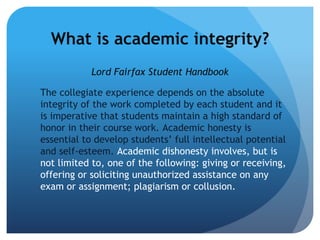
What is academic integrity?
            Lord Fairfax Student Handbook

The collegiate experience depends on the absolute
integrity of the work completed by each student and it
is imperative that students maintain a high standard of
honor in their course work. Academic honesty is
essential to develop students’ full intellectual potential
and self-esteem. Academic dishonesty involves, but is
not limited to, one of the following: giving or receiving,
offering or soliciting unauthorized assistance on any
exam or assignment; plagiarism or collusion.
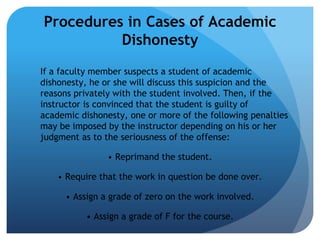
Procedures in Cases of Academic
          Dishonesty
If a faculty member suspects a student of academic
dishonesty, he or she will discuss this suspicion and the
reasons privately with the student involved. Then, if the
instructor is convinced that the student is guilty of
academic dishonesty, one or more of the following penalties
may be imposed by the instructor depending on his or her
judgment as to the seriousness of the offense:

                • Reprimand the student.

    • Require that the work in question be done over.

      • Assign a grade of zero on the work involved.

           • Assign a grade of F for the course.
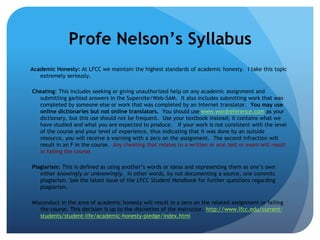
Profe Nelson’s Syllabus
Academic Honesty: At LFCC we maintain the highest standards of academic honesty. I take this topic
   extremely seriously.

Cheating: This includes seeking or giving unauthorized help on any academic assignment and
  submitting garbled answers in the Supersite/Web-SAM. It also includes submitting work that was
  completed by someone else or work that was completed by an Internet translator. You may use
  online dictionaries but not online translators. You should use www.wordreference.com as your
  dictionary, but this use should not be frequent. Use your textbook instead; it contains what we
  have studied and what you are expected to produce. If your work is not consistent with the level
  of the course and your level of experience, thus indicating that it was done by an outside
  resource, you will receive a warning with a zero on the assignment. The second infraction will
  result in an F in the course. Any cheating that relates to a written or oral test or exam will result
  in failing the course.

Plagiarism: This is defined as using another’s words or ideas and representing them as one’s own
   either knowingly or unknowingly. In other words, by not documenting a source, one commits
   plagiarism. See the latest issue of the LFCC Student Handbook for further questions regarding
   plagiarism.

Misconduct in the area of academic honesty will result in a zero on the related assignment or failing
   the course. This decision is up to the discretion of the instructor. http://www.lfcc.edu/current-
   students/student-life/academic-honesty-pledge/index.html
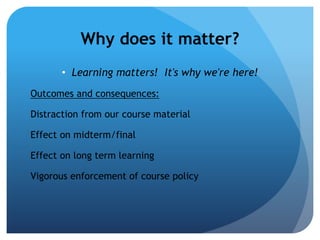
Why does it matter?
       • Learning matters! It's why we're here!
Outcomes and consequences:

Distraction from our course material

Effect on midterm/final

Effect on long term learning

Vigorous enforcement of course policy
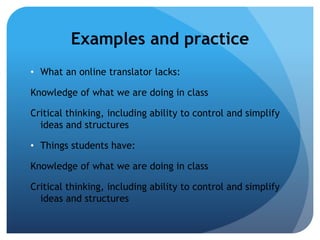
Examples and practice
• What an online translator lacks:

Knowledge of what we are doing in class

Critical thinking, including ability to control and simplify
  ideas and structures

• Things students have:

Knowledge of what we are doing in class

Critical thinking, including ability to control and simplify
  ideas and structures
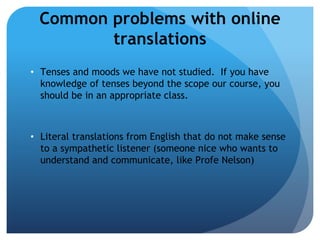
Common problems with online
         translations
• Tenses and moods we have not studied. If you have
  knowledge of tenses beyond the scope our course, you
  should be in an appropriate class.


• Literal translations from English that do not make sense
  to a sympathetic listener (someone nice who wants to
  understand and communicate, like Profe Nelson)
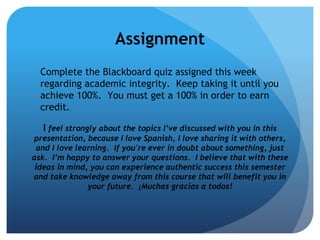
Assignment
  Complete the Blackboard quiz assigned this week
  regarding academic integrity. Keep taking it until you
  achieve 100%. You must get a 100% in order to earn
  credit.

   I feel strongly about the topics I’ve discussed with you in this
presentation, because I love Spanish, I love sharing it with others,
 and I love learning. If you're ever in doubt about something, just
ask. I’m happy to answer your questions. I believe that with these
 ideas in mind, you can experience authentic success this semester
and take knowledge away from this course that will benefit you in
               your future. ¡Muchas gracias a todos!

Academic Integrity

  • 1.
    Academic Integrity for Online Students Polly Nelson, Assistant Professor of Spanish Lord Fairfax Community College
  • 2.
    What is academicintegrity? Lord Fairfax Student Handbook The collegiate experience depends on the absolute integrity of the work completed by each student and it is imperative that students maintain a high standard of honor in their course work. Academic honesty is essential to develop students’ full intellectual potential and self-esteem. Academic dishonesty involves, but is not limited to, one of the following: giving or receiving, offering or soliciting unauthorized assistance on any exam or assignment; plagiarism or collusion.
  • 3.
    Procedures in Casesof Academic Dishonesty If a faculty member suspects a student of academic dishonesty, he or she will discuss this suspicion and the reasons privately with the student involved. Then, if the instructor is convinced that the student is guilty of academic dishonesty, one or more of the following penalties may be imposed by the instructor depending on his or her judgment as to the seriousness of the offense: • Reprimand the student. • Require that the work in question be done over. • Assign a grade of zero on the work involved. • Assign a grade of F for the course.
  • 4.
    Profe Nelson’s Syllabus AcademicHonesty: At LFCC we maintain the highest standards of academic honesty. I take this topic extremely seriously. Cheating: This includes seeking or giving unauthorized help on any academic assignment and submitting garbled answers in the Supersite/Web-SAM. It also includes submitting work that was completed by someone else or work that was completed by an Internet translator. You may use online dictionaries but not online translators. You should use www.wordreference.com as your dictionary, but this use should not be frequent. Use your textbook instead; it contains what we have studied and what you are expected to produce. If your work is not consistent with the level of the course and your level of experience, thus indicating that it was done by an outside resource, you will receive a warning with a zero on the assignment. The second infraction will result in an F in the course. Any cheating that relates to a written or oral test or exam will result in failing the course. Plagiarism: This is defined as using another’s words or ideas and representing them as one’s own either knowingly or unknowingly. In other words, by not documenting a source, one commits plagiarism. See the latest issue of the LFCC Student Handbook for further questions regarding plagiarism. Misconduct in the area of academic honesty will result in a zero on the related assignment or failing the course. This decision is up to the discretion of the instructor. http://www.lfcc.edu/current- students/student-life/academic-honesty-pledge/index.html
  • 5.
    Why does itmatter? • Learning matters! It's why we're here! Outcomes and consequences: Distraction from our course material Effect on midterm/final Effect on long term learning Vigorous enforcement of course policy
  • 6.
    Examples and practice •What an online translator lacks: Knowledge of what we are doing in class Critical thinking, including ability to control and simplify ideas and structures • Things students have: Knowledge of what we are doing in class Critical thinking, including ability to control and simplify ideas and structures
  • 7.
    Common problems withonline translations • Tenses and moods we have not studied. If you have knowledge of tenses beyond the scope our course, you should be in an appropriate class. • Literal translations from English that do not make sense to a sympathetic listener (someone nice who wants to understand and communicate, like Profe Nelson)
  • 8.
    Assignment Completethe Blackboard quiz assigned this week regarding academic integrity. Keep taking it until you achieve 100%. You must get a 100% in order to earn credit. I feel strongly about the topics I’ve discussed with you in this presentation, because I love Spanish, I love sharing it with others, and I love learning. If you're ever in doubt about something, just ask. I’m happy to answer your questions. I believe that with these ideas in mind, you can experience authentic success this semester and take knowledge away from this course that will benefit you in your future. ¡Muchas gracias a todos!