


AAlluummiinnuumm –– GGrraapphhiittee 
TThheerrmmoo--eelleeccttrriicc GGeenneerraattoorrss 
Charith S Suriyakula 
Faculty of Applied Sciences 
Rajarata University of Sri Lanka
Simple theory 
Simple technology 
Low cost 
Robust
FFoorr wwhhaatt..........?? 
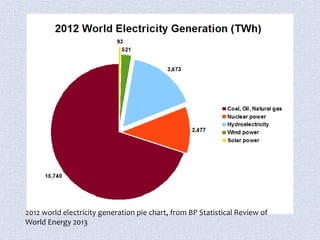
• Fossil fuel is a limited resource of Earth. Fossil fuels are non-renewable 
and is a finite resource. 
• To meet the power demand of the world, people have to 
discover renewable energy sources. 
• Using fossil fuel is damaging the environment and also it is 
expensive
2012 world electricity generation pie chart, from BP Statistical Review of 
World Energy 2013
RReenneewwaabbllee eenneerrggyy ssoouurrcceess 
• Main source is sunlight. Also known as Solar energy 
o Can directly use to light, heat homes and other buildings. 
o Can be used to generate electricity 
o Hot water heating 
• Wind energy is captured by wind turbines to generate 
electricity 
• Hydro power is used to rotate turbines and generate 
electricity 
• Some alternative energy generation method 
o Geo-thermal energy 
o Thermo-electricity
WWhhaatt wwee nneeeedd…………?? 
HHeeaatt eenneerrggyy ffrroomm aannyy ssoouurrccee……………… 
• Mechanical engines, computers 
• Stoves, lamps 
• Sun light 
• Radio active elements…….
HHeeaatt  EElleeccttrriicciittyy ?? 
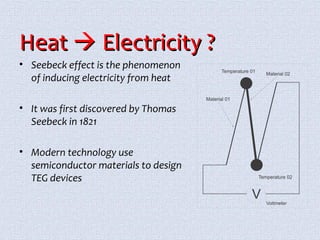
• Seebeck effect is the phenomenon 
of inducing electricity from heat 
• It was first discovered by Thomas 
Seebeck in 1821 
• Modern technology use 
semiconductor materials to design 
TEG devices
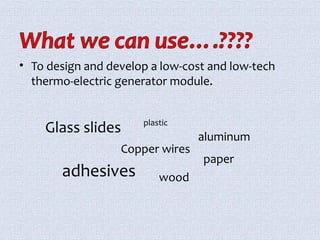
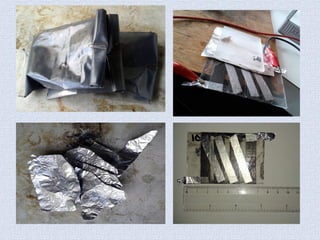
• To design and develop a low-cost and low-tech 
thermo-electric generator module. 
Glass slides 
plastic 
Copper wires 
wood 
aluminum 
adhesives 
paper
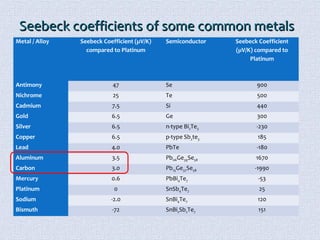
Seebeck coefficients ooff ssoommee ccoommmmoonn mmeettaallss 
Metal / Alloy Seebeck Coefficient (μV/K) 
compared to Platinum 
Semiconductor Seebeck Coefficient 
(μV/K) compared to 
Platinum 
Antimony 47 Se 900 
Nichrome 25 Te 500 
Cadmium 7.5 Si 440 
Gold 6.5 Ge 300 
Silver 6.5 n-type Bi2Te3 -230 
Copper 6.5 p-type Sb2te3 185 
Lead 4.0 PbTe -180 
Aluminum 3.5 Pb06Ge39Se58 1670 
Carbon 3.0 Pb15Ge37Se58 -1990 
Mercury 0.6 PbBi4Te7 -53 
Platinum 0 SnSb4Te7 25 
Sodium -2.0 SnBi4Te7 120 
Bismuth -72 SnBi2Sb2Te7 151
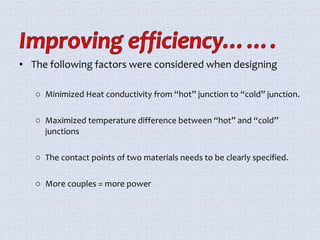
• The following factors were considered when designing 
o Minimized Heat conductivity from “hot” junction to “cold” junction. 
o Maximized temperature difference between “hot” and “cold” 
junctions 
o The contact points of two materials needs to be clearly specified. 
o More couples = more power
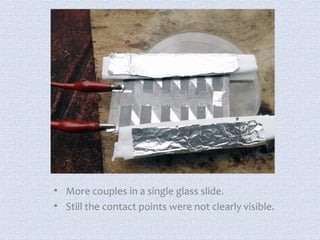
• More couples in a single glass slide. 
• Still the contact points were not clearly visible.
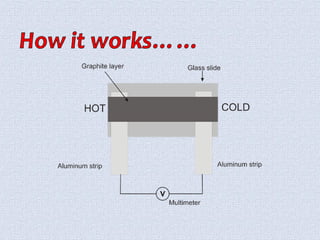
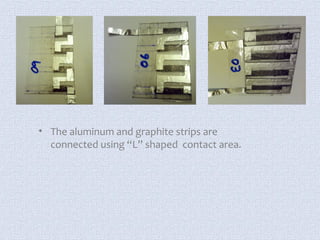
• The aluminum and graphite strips are 
connected using “L” shaped contact area.
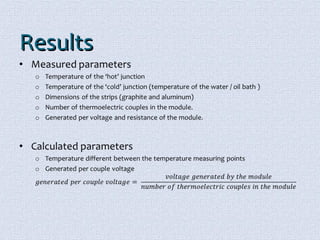
RReessuullttss
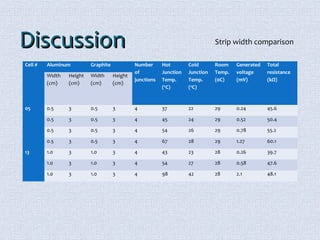
DDiissccuussssiioonn Strip width comparison 
Cell # Aluminum Graphite Number 
of 
junctions 
Hot 
Junction 
Temp. 
(0C) 
Cold 
Junction 
Temp. 
(0C) 
Room 
Temp. 
(0C) 
Generated 
voltage 
(mV) 
Total 
resistance 
(kΩ) 
Width 
(cm) 
Height 
(cm) 
Width 
(cm) 
Height 
(cm) 
05 0.5 3 0.5 3 4 37 22 29 0.24 45.6 
0.5 3 0.5 3 4 45 24 29 0.52 50.4 
0.5 3 0.5 3 4 54 26 29 0.78 55.2 
0.5 3 0.5 3 4 67 28 29 1.27 60.1 
13 1.0 3 1.0 3 4 43 23 28 0.26 39.7 
1.0 3 1.0 3 4 54 27 28 0.58 47.6 
1.0 3 1.0 3 4 98 42 28 2.1 48.1
Cell # Aluminum Graphite Number 
of 
junctions 
Hot 
Junction 
Temp. 
(0C) 
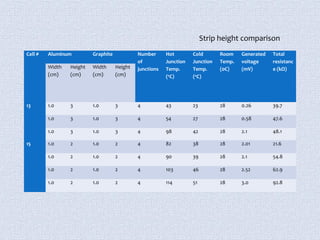
Strip height comparison 
Cold 
Junction 
Temp. 
(0C) 
Room 
Temp. 
(0C) 
Generated 
voltage 
(mV) 
Total 
resistanc 
Width Height 
Width 
Height 
e (kΩ) 
(cm) 
(cm) 
(cm) 
(cm) 
13 1.0 3 1.0 3 4 43 23 28 0.26 39.7 
1.0 3 1.0 3 4 54 27 28 0.58 47.6 
1.0 3 1.0 3 4 98 42 28 2.1 48.1 
15 1.0 2 1.0 2 4 82 38 28 2.01 21.6 
1.0 2 1.0 2 4 90 39 28 2.1 54.8 
1.0 2 1.0 2 4 103 46 28 2.52 62.9 
1.0 2 1.0 2 4 114 51 28 3.0 92.8
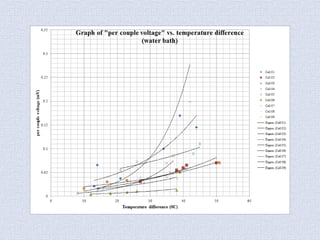
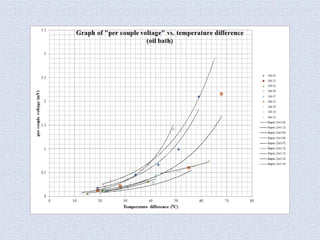
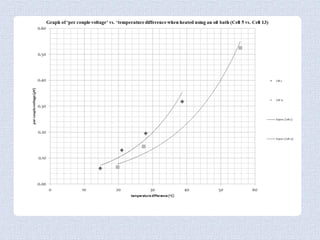
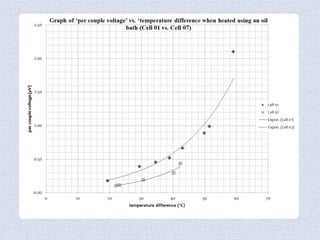
• Generated per couple voltage increases with the 
temperature difference between two junctions. 
• Theoretically this is a linear relationship. 
• Some reasons for the variation with the practical graph 
o Unevenly distributed graphite powder 
o Contact between the tow materials 
• Temperature difference between the ‘hot’ and ‘cold’ 
junctions play an important role in generating a higher 
voltage.
FFuuttuurree ddeevveellooppmmeennttss 
• Introducing a proper cooling mechanism for the ‘cold’ 
junction. 
• Experimenting on different materials to make the design 
more portable and to minimize the heat conductivity 
between the two junctions. 
• Making the module more durable.
AAcckknnoowwlleeddggeemmeenntt 
• Dr. Deepal Subasinghe of Institute of Fundamental Studies, 
Kandy for the opportunity given to conduct the project. 
• Senior colleagues of Department of Earth Sciences, 
Institute of Fundamental Studies, Kandy for the continuous 
support and guidance given throughout the project. 
• Dr. T. M. W. J. Bandara of Faculty of Applied Sciences, 
Rajarata University of Sri Lanka for the constant advice 
given to make this project a success.
RReeffeerreenncceess 
• 1. Van Herwaarden, A. W., & Sarro, P. M. (1986). Thermal sensors based on the Seebeck 
effect. Sensors and Actuators, 10(3), 321-346. 
• 2. Harman, T. C., Cahn, J. H., & Logan, M. J. (1959). Measurement of thermal conductivity 
by utilization of the Peltier effect. Journal of Applied Physics, 30(9), 1351-1359. 
• 3. Iue.tuwien.ac.at. 2013. 3.5.12 Seebeck Coefficient. [online] Available at: 
http://www.iue.tuwien.ac.at/phd/mwagner/node47.html [Accessed: 20 Sep 2013]. 
• 4. Douglas-self.com. 2013. Thermo-Electric Generators. [online] Available at: 
http://www.douglas-self.com/MUSEUM/POWER/thermoelectric/thermoelectric.htm 
[Accessed: 20 Sep 2013]. 
• 5. Thermoelectrics.caltech.edu. 2013. History of Thermoelectrics. [online] Available at: 
http://www.thermoelectrics.caltech.edu/thermoelectrics/history.html [Accessed: 20 Sep 
2013]. 
• 6. Kasap, S. (2001). Thermoelectric effects in metals: thermocouples. Canada: Department 
of Electrical Engineering University of Saskatchewan.
Generating Thermo-electricity using Graphit and Aluminum module

Generating Thermo-electricity using Graphit and Aluminum module

  • 1.
    AAlluummiinnuumm –– GGrraapphhiittee TThheerrmmoo--eelleeccttrriicc GGeenneerraattoorrss Charith S Suriyakula Faculty of Applied Sciences Rajarata University of Sri Lanka
  • 2.
    Simple theory Simpletechnology Low cost Robust
  • 3.
    FFoorr wwhhaatt..........?? •Fossil fuel is a limited resource of Earth. Fossil fuels are non-renewable and is a finite resource. • To meet the power demand of the world, people have to discover renewable energy sources. • Using fossil fuel is damaging the environment and also it is expensive
  • 4.
    2012 world electricitygeneration pie chart, from BP Statistical Review of World Energy 2013
  • 5.
    RReenneewwaabbllee eenneerrggyy ssoouurrcceess • Main source is sunlight. Also known as Solar energy o Can directly use to light, heat homes and other buildings. o Can be used to generate electricity o Hot water heating • Wind energy is captured by wind turbines to generate electricity • Hydro power is used to rotate turbines and generate electricity • Some alternative energy generation method o Geo-thermal energy o Thermo-electricity
  • 6.
    WWhhaatt wwee nneeeedd…………?? HHeeaatt eenneerrggyy ffrroomm aannyy ssoouurrccee……………… • Mechanical engines, computers • Stoves, lamps • Sun light • Radio active elements…….
  • 7.
    HHeeaatt  EElleeccttrriicciittyy?? • Seebeck effect is the phenomenon of inducing electricity from heat • It was first discovered by Thomas Seebeck in 1821 • Modern technology use semiconductor materials to design TEG devices
  • 8.
    • To designand develop a low-cost and low-tech thermo-electric generator module. Glass slides plastic Copper wires wood aluminum adhesives paper
  • 9.
    Seebeck coefficients ooffssoommee ccoommmmoonn mmeettaallss Metal / Alloy Seebeck Coefficient (μV/K) compared to Platinum Semiconductor Seebeck Coefficient (μV/K) compared to Platinum Antimony 47 Se 900 Nichrome 25 Te 500 Cadmium 7.5 Si 440 Gold 6.5 Ge 300 Silver 6.5 n-type Bi2Te3 -230 Copper 6.5 p-type Sb2te3 185 Lead 4.0 PbTe -180 Aluminum 3.5 Pb06Ge39Se58 1670 Carbon 3.0 Pb15Ge37Se58 -1990 Mercury 0.6 PbBi4Te7 -53 Platinum 0 SnSb4Te7 25 Sodium -2.0 SnBi4Te7 120 Bismuth -72 SnBi2Sb2Te7 151
  • 12.
    • The followingfactors were considered when designing o Minimized Heat conductivity from “hot” junction to “cold” junction. o Maximized temperature difference between “hot” and “cold” junctions o The contact points of two materials needs to be clearly specified. o More couples = more power
  • 13.
    • More couplesin a single glass slide. • Still the contact points were not clearly visible.
  • 14.
    • The aluminumand graphite strips are connected using “L” shaped contact area.
  • 17.
  • 20.
    DDiissccuussssiioonn Strip widthcomparison Cell # Aluminum Graphite Number of junctions Hot Junction Temp. (0C) Cold Junction Temp. (0C) Room Temp. (0C) Generated voltage (mV) Total resistance (kΩ) Width (cm) Height (cm) Width (cm) Height (cm) 05 0.5 3 0.5 3 4 37 22 29 0.24 45.6 0.5 3 0.5 3 4 45 24 29 0.52 50.4 0.5 3 0.5 3 4 54 26 29 0.78 55.2 0.5 3 0.5 3 4 67 28 29 1.27 60.1 13 1.0 3 1.0 3 4 43 23 28 0.26 39.7 1.0 3 1.0 3 4 54 27 28 0.58 47.6 1.0 3 1.0 3 4 98 42 28 2.1 48.1
  • 22.
    Cell # AluminumGraphite Number of junctions Hot Junction Temp. (0C) Strip height comparison Cold Junction Temp. (0C) Room Temp. (0C) Generated voltage (mV) Total resistanc Width Height Width Height e (kΩ) (cm) (cm) (cm) (cm) 13 1.0 3 1.0 3 4 43 23 28 0.26 39.7 1.0 3 1.0 3 4 54 27 28 0.58 47.6 1.0 3 1.0 3 4 98 42 28 2.1 48.1 15 1.0 2 1.0 2 4 82 38 28 2.01 21.6 1.0 2 1.0 2 4 90 39 28 2.1 54.8 1.0 2 1.0 2 4 103 46 28 2.52 62.9 1.0 2 1.0 2 4 114 51 28 3.0 92.8
  • 24.
    • Generated percouple voltage increases with the temperature difference between two junctions. • Theoretically this is a linear relationship. • Some reasons for the variation with the practical graph o Unevenly distributed graphite powder o Contact between the tow materials • Temperature difference between the ‘hot’ and ‘cold’ junctions play an important role in generating a higher voltage.
  • 25.
    FFuuttuurree ddeevveellooppmmeennttss •Introducing a proper cooling mechanism for the ‘cold’ junction. • Experimenting on different materials to make the design more portable and to minimize the heat conductivity between the two junctions. • Making the module more durable.
  • 26.
    AAcckknnoowwlleeddggeemmeenntt • Dr.Deepal Subasinghe of Institute of Fundamental Studies, Kandy for the opportunity given to conduct the project. • Senior colleagues of Department of Earth Sciences, Institute of Fundamental Studies, Kandy for the continuous support and guidance given throughout the project. • Dr. T. M. W. J. Bandara of Faculty of Applied Sciences, Rajarata University of Sri Lanka for the constant advice given to make this project a success.
  • 27.
    RReeffeerreenncceess • 1.Van Herwaarden, A. W., & Sarro, P. M. (1986). Thermal sensors based on the Seebeck effect. Sensors and Actuators, 10(3), 321-346. • 2. Harman, T. C., Cahn, J. H., & Logan, M. J. (1959). Measurement of thermal conductivity by utilization of the Peltier effect. Journal of Applied Physics, 30(9), 1351-1359. • 3. Iue.tuwien.ac.at. 2013. 3.5.12 Seebeck Coefficient. [online] Available at: http://www.iue.tuwien.ac.at/phd/mwagner/node47.html [Accessed: 20 Sep 2013]. • 4. Douglas-self.com. 2013. Thermo-Electric Generators. [online] Available at: http://www.douglas-self.com/MUSEUM/POWER/thermoelectric/thermoelectric.htm [Accessed: 20 Sep 2013]. • 5. Thermoelectrics.caltech.edu. 2013. History of Thermoelectrics. [online] Available at: http://www.thermoelectrics.caltech.edu/thermoelectrics/history.html [Accessed: 20 Sep 2013]. • 6. Kasap, S. (2001). Thermoelectric effects in metals: thermocouples. Canada: Department of Electrical Engineering University of Saskatchewan.

Editor's Notes