Aluminum – Graphite
Thermo-electric module
Charith S Suriyakula
AS/07/08/077
Index # 2001
Objective
• To design and develop a low-cost and low-tech
thermo-electric generator module.
The problem…
• Fossil fuel is a limited resource of Earth. Fossil fuels are non-
renewable and is a finite resource.
• To meet the power demand of the world, people have to
discover renewable energy sources.
• This is a solution for the expensive and environmentally
damaging fossil fuels.
Renewable energy sources
• Main source is sunlight. Also known as Solar energy
o Can directly use to light, heat homes and other buildings.
o Can be used to generate electricity
o Hot water heating
• Wind energy is captured by wind turbines to generate
electricity
• Hydro power is used to rotate turbines and generate
electricity
Waste Heat
• In many cases, the efficiency of a process is limited due to
the energy loss as heat.
• We have to design the process to minimize the heat loss or
to make use of the heat loss.
• Mechanical engines, computers generate heat which is
wasted to air.
• The challenge is to convert the waste heat into a applicable
energy form
Heat  Electricity ?
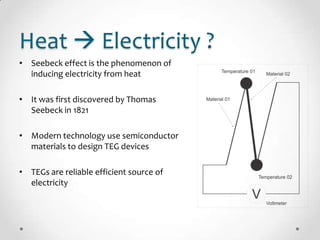
• Seebeck effect is the phenomenon of
inducing electricity from heat
• It was first discovered by Thomas
Seebeck in 1821
• Modern technology use semiconductor
materials to design TEG devices
• TEGs are reliable efficient source of
electricity
Objective
• To design and develop a low-cost and low-tech
thermo-electric generator module.
Glass slides
Copper wires
plastic
wood
aluminum
adhesives
paper
Basic design
Improvements
• The following cases were considered when designing the
TEG module
o Heat conductivity from “hot” junction to “cold” junction needs to
be minimized.
o The temperature difference between “hot” and “cold” junctions
needs to be maximized to induce higher energy from the module
o The contact points of two materials needs to be clearly specified.
o More couples = more power
• More couples in a single glass slide.
• Still the contact points were not clearly visible.
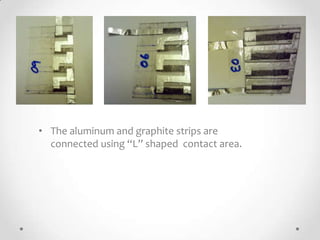
• The aluminum and graphite strips are
connected using “L” shaped contact area.
Results
Discussion
0.00
0.10
0.20
0.30
0.40
0.50
0.60
0 10 20 30 40 50 60
percouplevoltage(µV)
temperature difference (0C)
Graph of ‘per couple voltage’ vs. ‘temperature difference when heated using an oil bath (Cell 5 vs. Cell 13)
Cell 5
Cell 13
Expon. (Cell 5)
Expon. (Cell 13)
Strip width comparison
0.00
0.50
1.00
1.50
2.00
2.50
0 10 20 30 40 50 60 70
percouplevoltage(µV)
temperature difference (0C)
Graph of ‘per couple voltage’ vs. ‘temperature difference when heated using an oil bath (Cell 01 vs. Cell 07)
Cell 01
Cell 07
Expon. (Cell 01)
Expon. (Cell 07)
Strip height comparison
Final year presentation of fourth year research

Final year presentation of fourth year research

  • 1.
    Aluminum – Graphite Thermo-electricmodule Charith S Suriyakula AS/07/08/077 Index # 2001
  • 2.
    Objective • To designand develop a low-cost and low-tech thermo-electric generator module.
  • 3.
    The problem… • Fossilfuel is a limited resource of Earth. Fossil fuels are non- renewable and is a finite resource. • To meet the power demand of the world, people have to discover renewable energy sources. • This is a solution for the expensive and environmentally damaging fossil fuels.
  • 4.
    Renewable energy sources •Main source is sunlight. Also known as Solar energy o Can directly use to light, heat homes and other buildings. o Can be used to generate electricity o Hot water heating • Wind energy is captured by wind turbines to generate electricity • Hydro power is used to rotate turbines and generate electricity
  • 5.
    Waste Heat • Inmany cases, the efficiency of a process is limited due to the energy loss as heat. • We have to design the process to minimize the heat loss or to make use of the heat loss. • Mechanical engines, computers generate heat which is wasted to air. • The challenge is to convert the waste heat into a applicable energy form
  • 6.
    Heat  Electricity? • Seebeck effect is the phenomenon of inducing electricity from heat • It was first discovered by Thomas Seebeck in 1821 • Modern technology use semiconductor materials to design TEG devices • TEGs are reliable efficient source of electricity
  • 7.
    Objective • To designand develop a low-cost and low-tech thermo-electric generator module. Glass slides Copper wires plastic wood aluminum adhesives paper
  • 8.
  • 10.
    Improvements • The followingcases were considered when designing the TEG module o Heat conductivity from “hot” junction to “cold” junction needs to be minimized. o The temperature difference between “hot” and “cold” junctions needs to be maximized to induce higher energy from the module o The contact points of two materials needs to be clearly specified. o More couples = more power
  • 11.
    • More couplesin a single glass slide. • Still the contact points were not clearly visible.
  • 12.
    • The aluminumand graphite strips are connected using “L” shaped contact area.
  • 15.
  • 18.
    Discussion 0.00 0.10 0.20 0.30 0.40 0.50 0.60 0 10 2030 40 50 60 percouplevoltage(µV) temperature difference (0C) Graph of ‘per couple voltage’ vs. ‘temperature difference when heated using an oil bath (Cell 5 vs. Cell 13) Cell 5 Cell 13 Expon. (Cell 5) Expon. (Cell 13) Strip width comparison
  • 19.
    0.00 0.50 1.00 1.50 2.00 2.50 0 10 2030 40 50 60 70 percouplevoltage(µV) temperature difference (0C) Graph of ‘per couple voltage’ vs. ‘temperature difference when heated using an oil bath (Cell 01 vs. Cell 07) Cell 01 Cell 07 Expon. (Cell 01) Expon. (Cell 07) Strip height comparison