Concentrating   Solar   Power

            Technologies


                                Presentation By –
                                Swapnil Gore
                                MS Student 5/16/2011
                   1
                                Stony Brook University, NY
                                swapnil.energy9@gmail.com
Overview
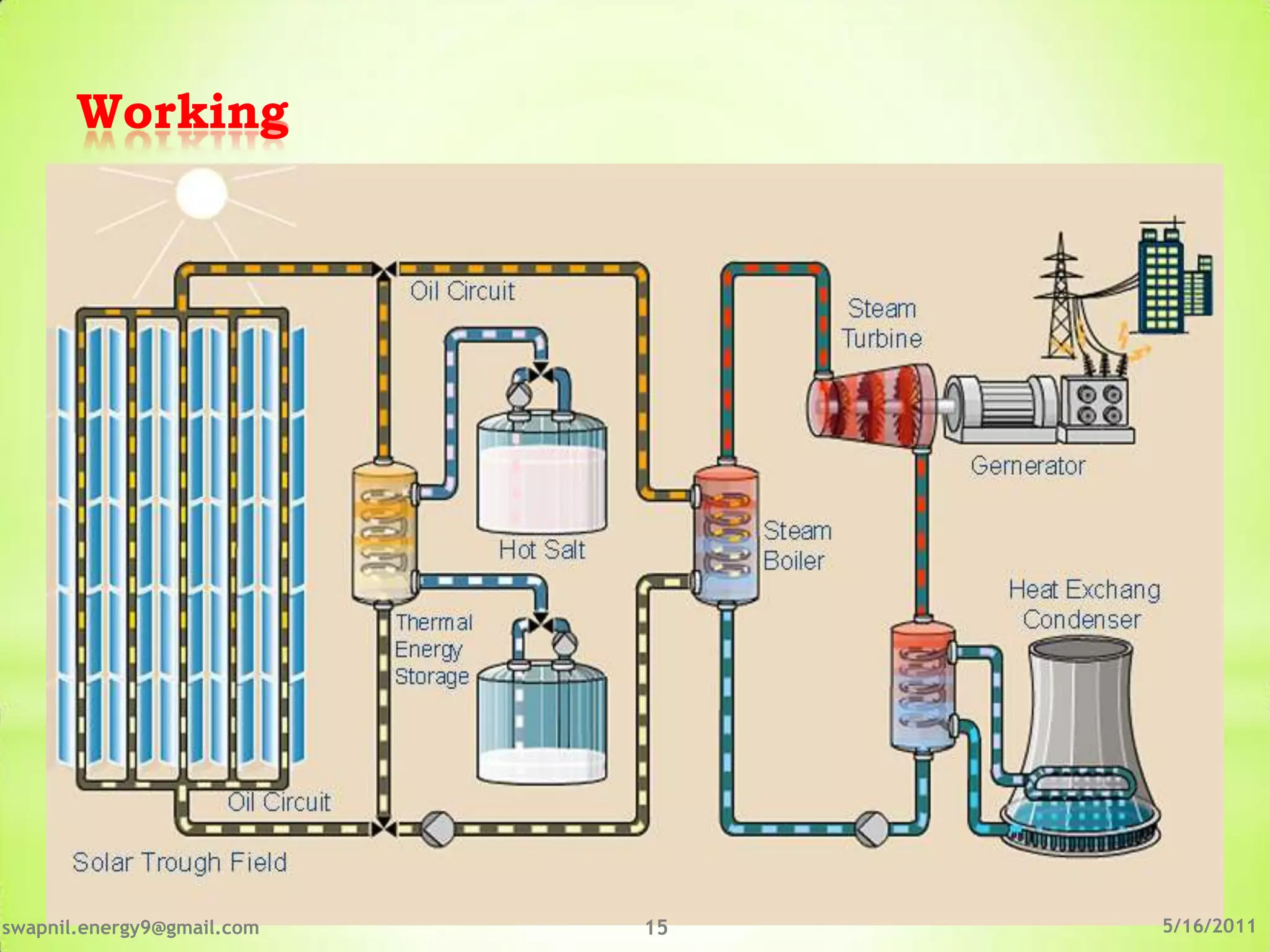
    Principle: Sunlight – Heat – Electricity
        Sunlight is concentrated, using mirrors or

   directly, on to receivers heating the circulating

   fluid      which         further   generates   steam   &/or

   electricity.

    Solar Radiation Components:
               Direct, Diffuse & Global

    CSP uses- Direct Normal Irradiance (DNI)
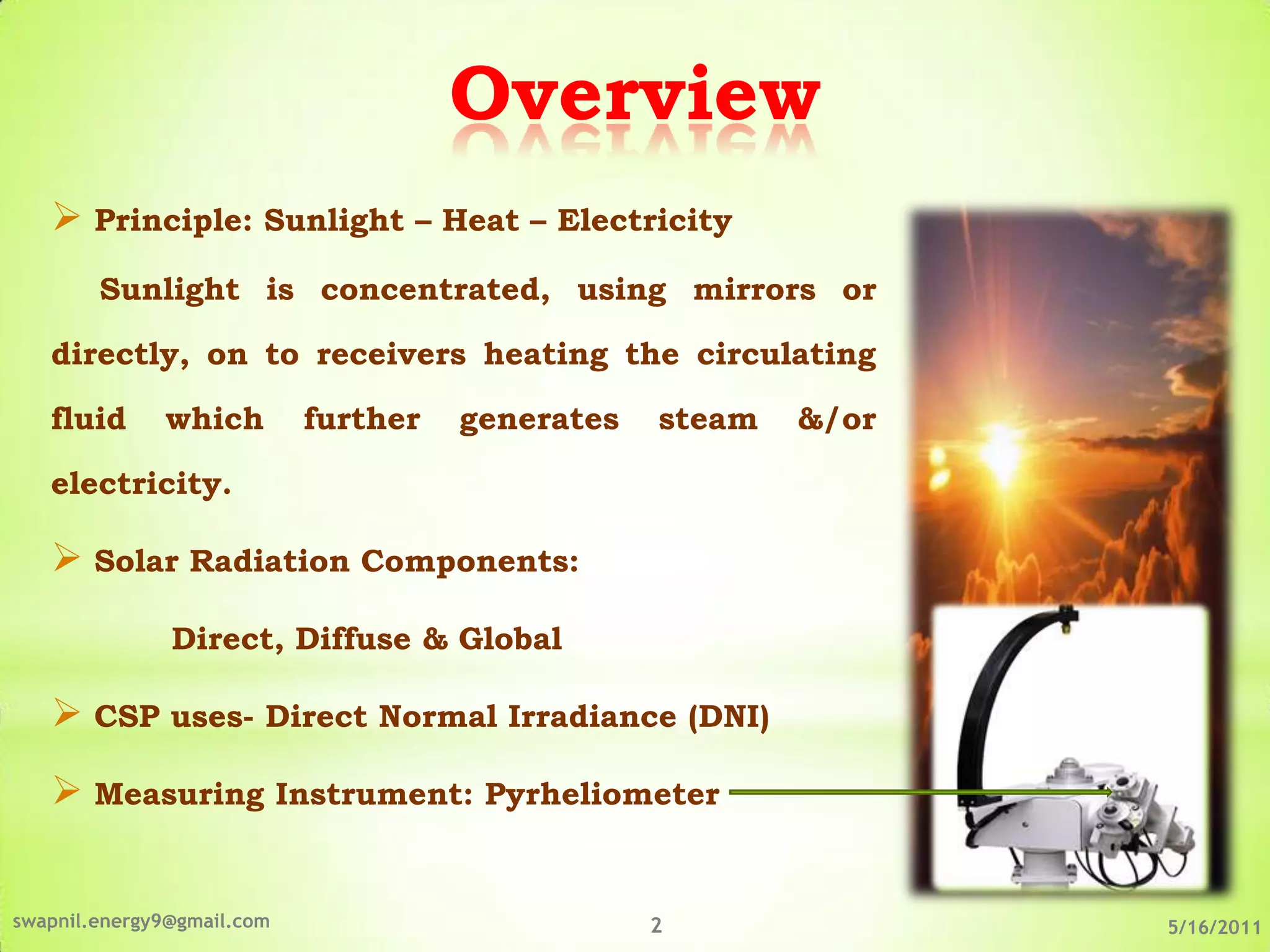
    Measuring Instrument: Pyrheliometer

swapnil.energy9@gmail.com                         2              5/16/2011
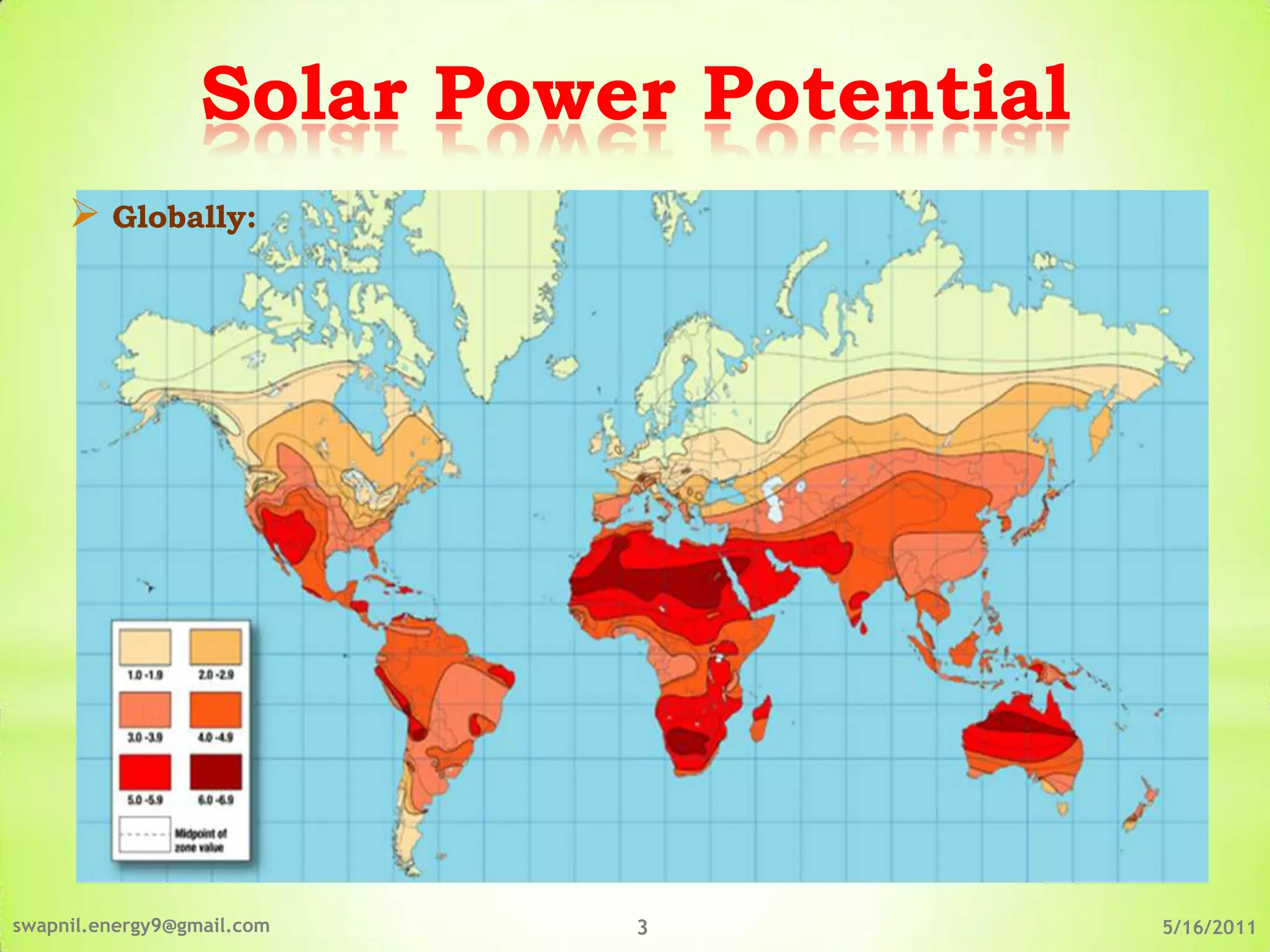
Solar Power Potential
      Globally:


swapnil.energy9@gmail.com   3             5/16/2011
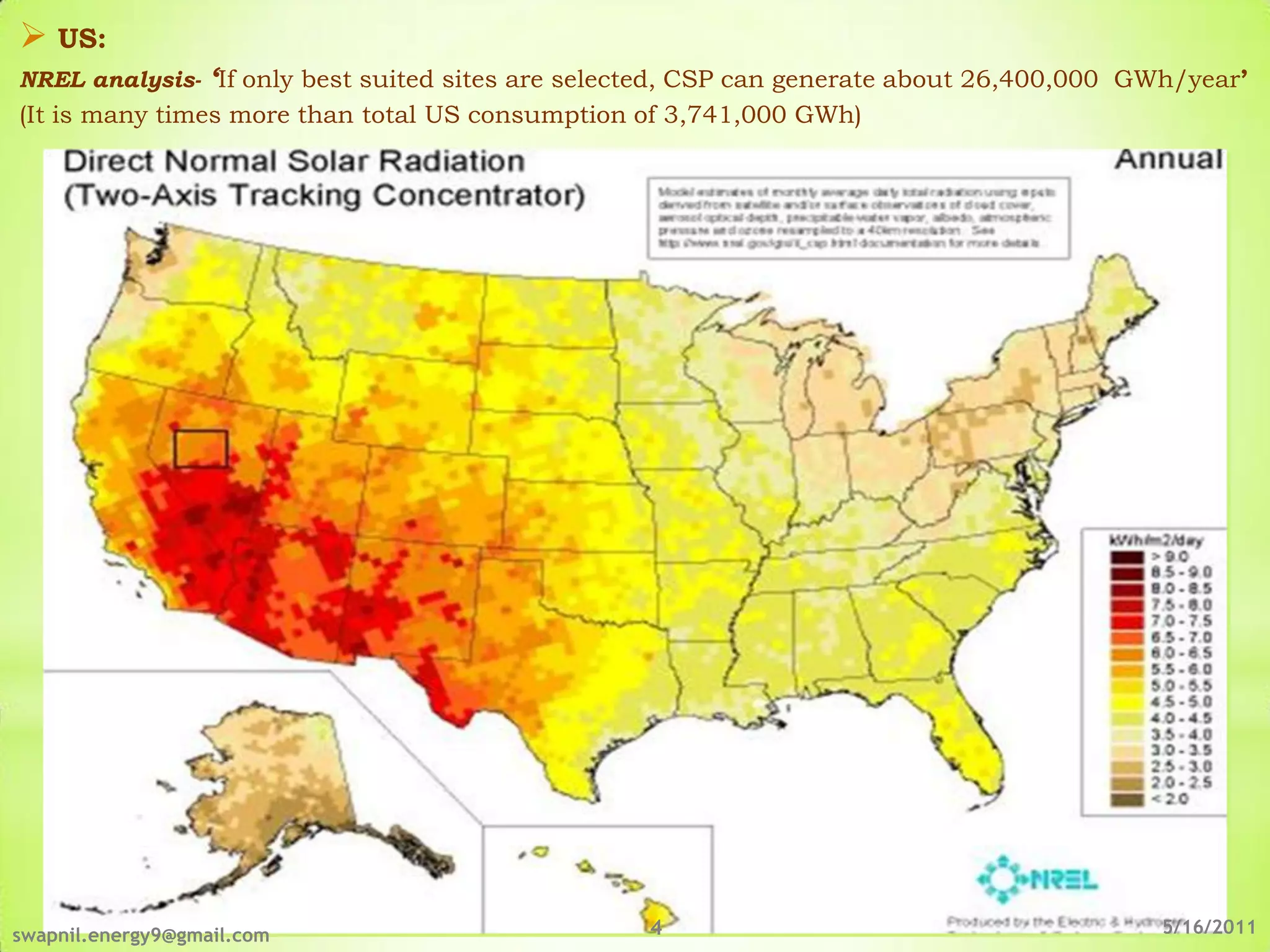
 US:
NREL analysis- ‘If only best suited sites are selected, CSP can generate about 26,400,000 GWh/year’
(It is many times more than total US consumption of 3,741,000 GWh)


swapnil.energy9@gmail.com                         4                                         5/16/2011
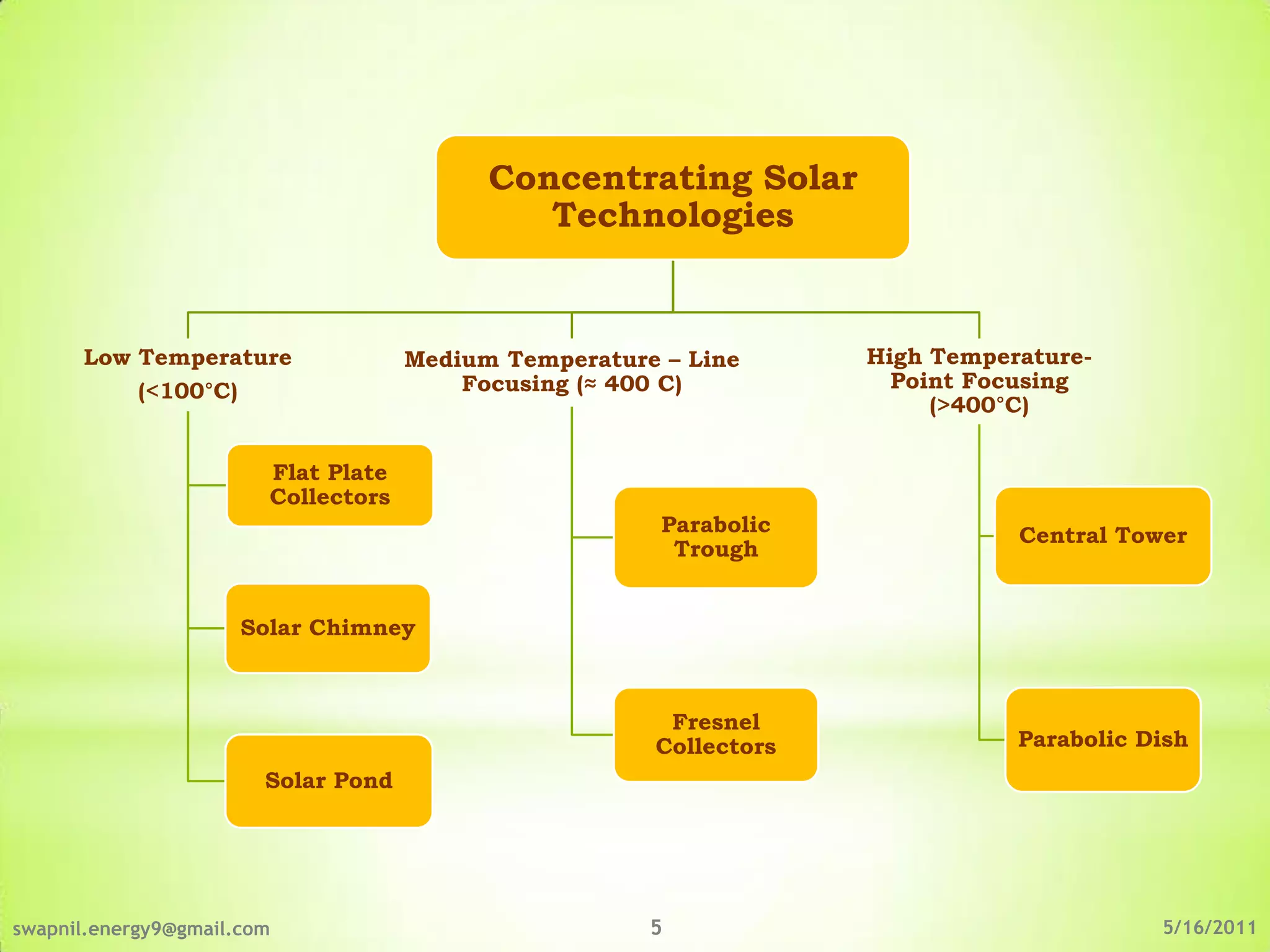
Concentrating Solar
                                              Technologies


      Low Temperature                Medium Temperature – Line      High Temperature-
          (<100°C)                       Focusing (≈ 400 C)           Point Focusing
                                                                         (>400°C)

                        Flat Plate
                        Collectors
                                                        Parabolic              Central Tower
                                                         Trough


                      Solar Chimney


                                                        Fresnel
                                                       Collectors              Parabolic Dish
                        Solar Pond


swapnil.energy9@gmail.com                              5                                  5/16/2011
Commercial CSP


   Parabolic                     Central             Dish Stirling    Fresnel
    Trough                       Tower                               Collector


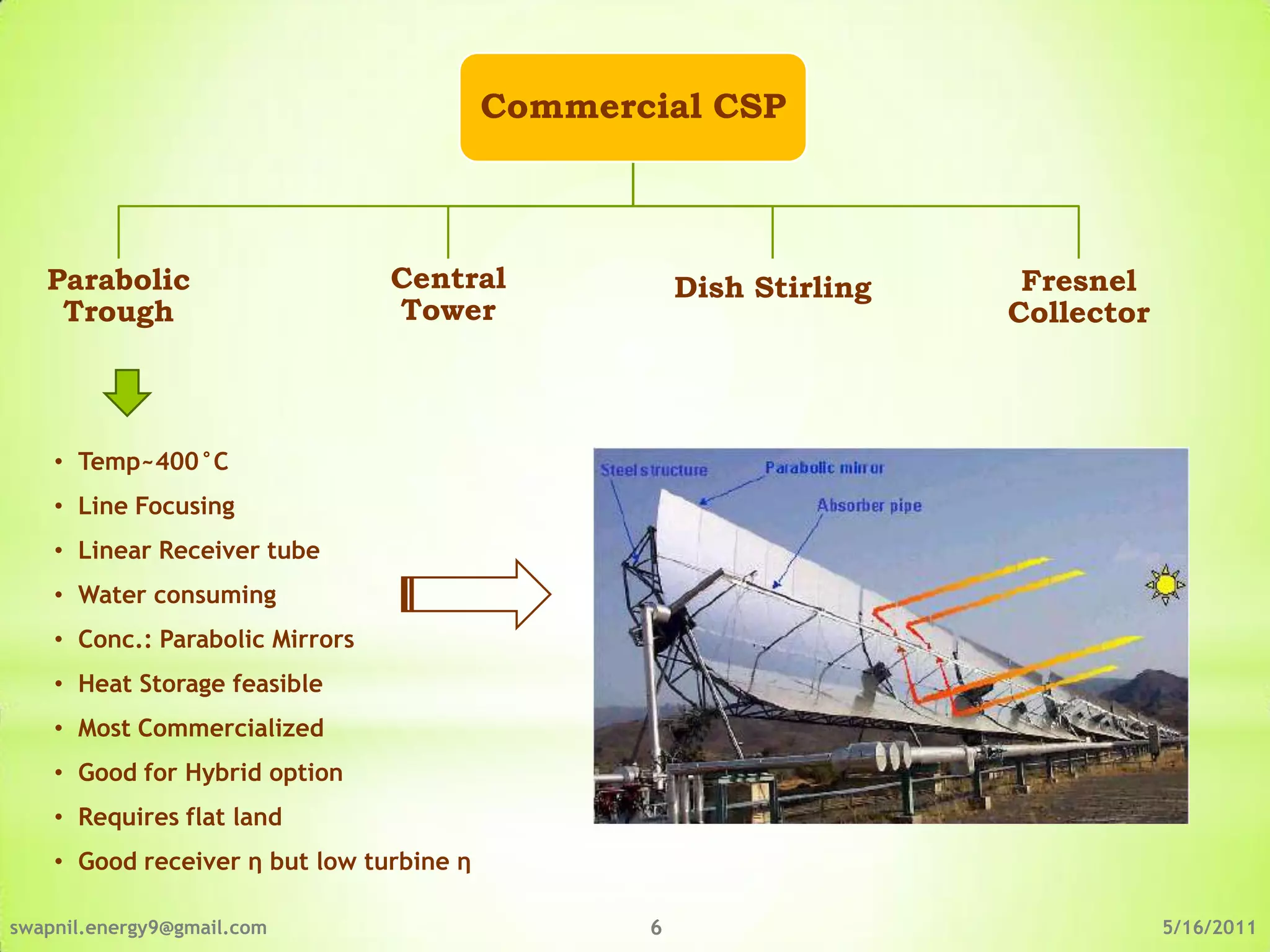
    • Temp~400°C
    • Line Focusing
    • Linear Receiver tube
    • Water consuming
    • Conc.: Parabolic Mirrors
    • Heat Storage feasible
    • Most Commercialized
    • Good for Hybrid option
    • Requires flat land
    • Good receiver η but low turbine η

swapnil.energy9@gmail.com                        6                               5/16/2011
Commercial CSP


   Parabolic                      Central                      Dish Stirling    Fresnel
    Trough                        Tower                                        Collector


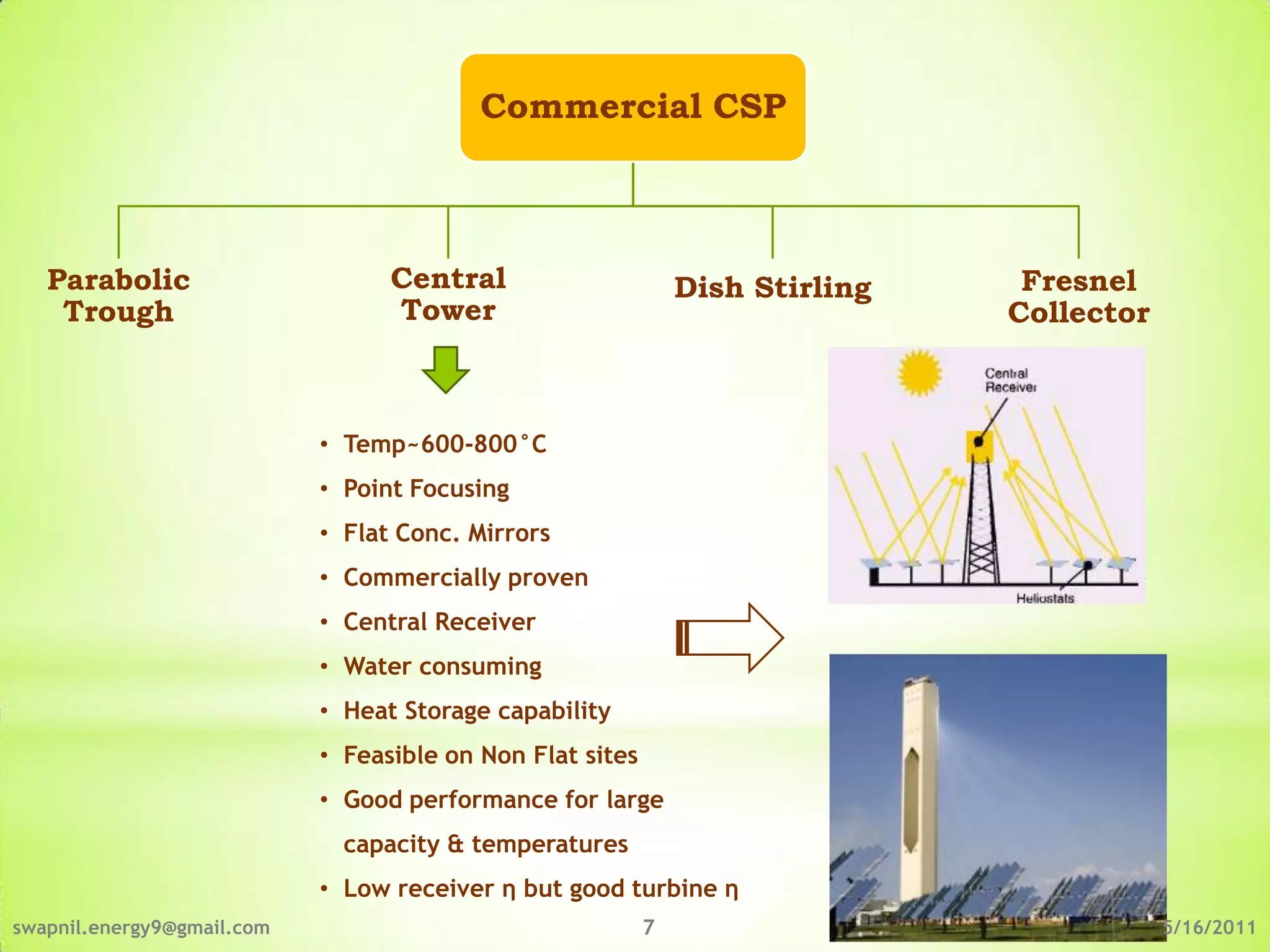
                            • Temp~600-800°C
                            • Point Focusing
                            • Flat Conc. Mirrors
                            • Commercially proven
                            • Central Receiver
                            • Water consuming
                            • Heat Storage capability
                            • Feasible on Non Flat sites
                            • Good performance for large
                              capacity & temperatures
                            • Low receiver η but good turbine η
swapnil.energy9@gmail.com                                  7                               5/16/2011
Commercial CSP


   Parabolic                Central         Dish Stirling               Fresnel
    Trough                  Tower                                      Collector


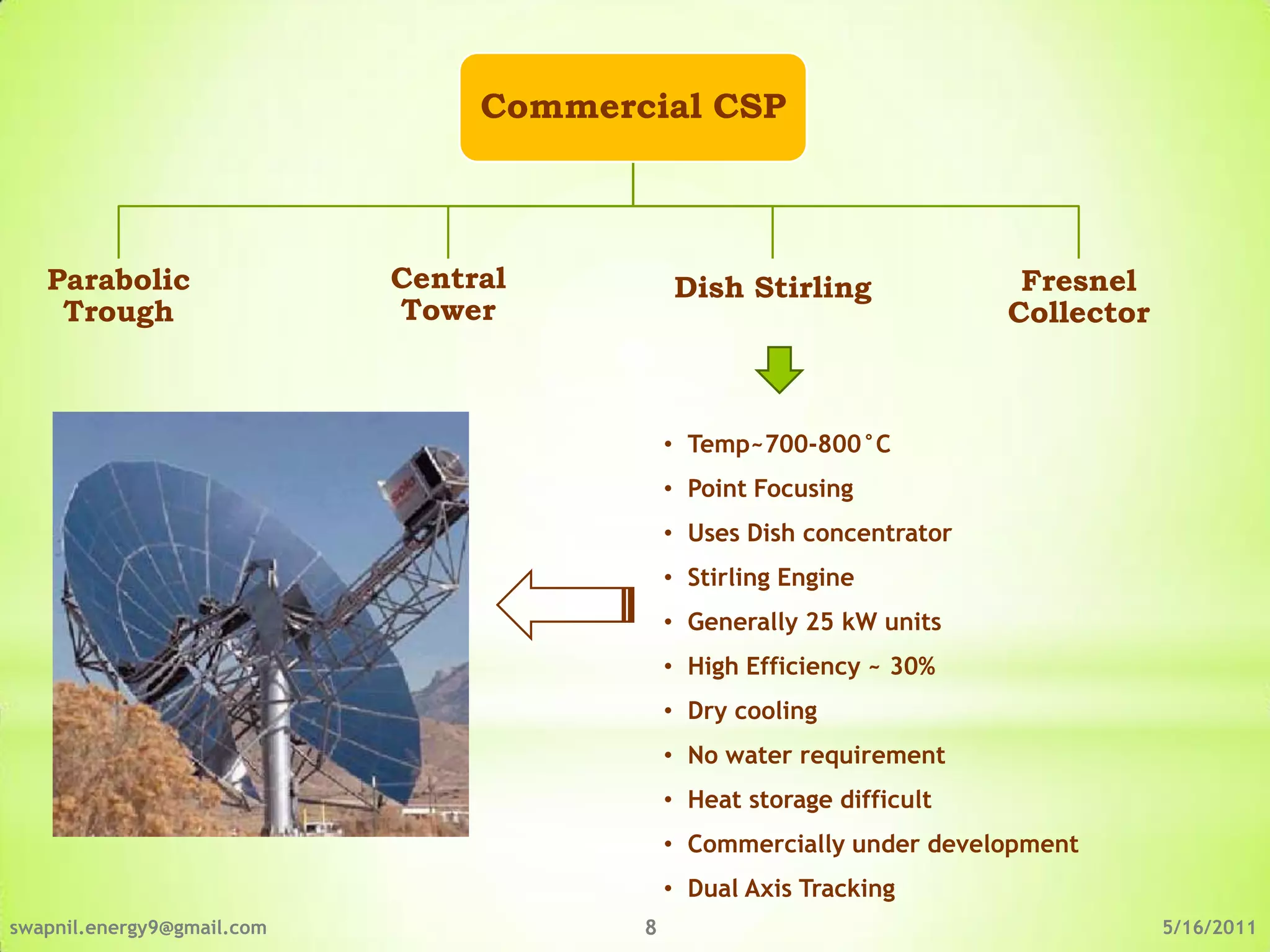
                                            • Temp~700-800°C
                                            • Point Focusing
                                            • Uses Dish concentrator
                                            • Stirling Engine
                                            • Generally 25 kW units
                                            • High Efficiency ~ 30%
                                            • Dry cooling
                                            • No water requirement
                                            • Heat storage difficult
                                            • Commercially under development
                                            • Dual Axis Tracking
swapnil.energy9@gmail.com               8                                          5/16/2011
Commercial CSP


Parabolic                    Central         Dish Stirling             Fresnel
 Trough                      Tower                                    Collector


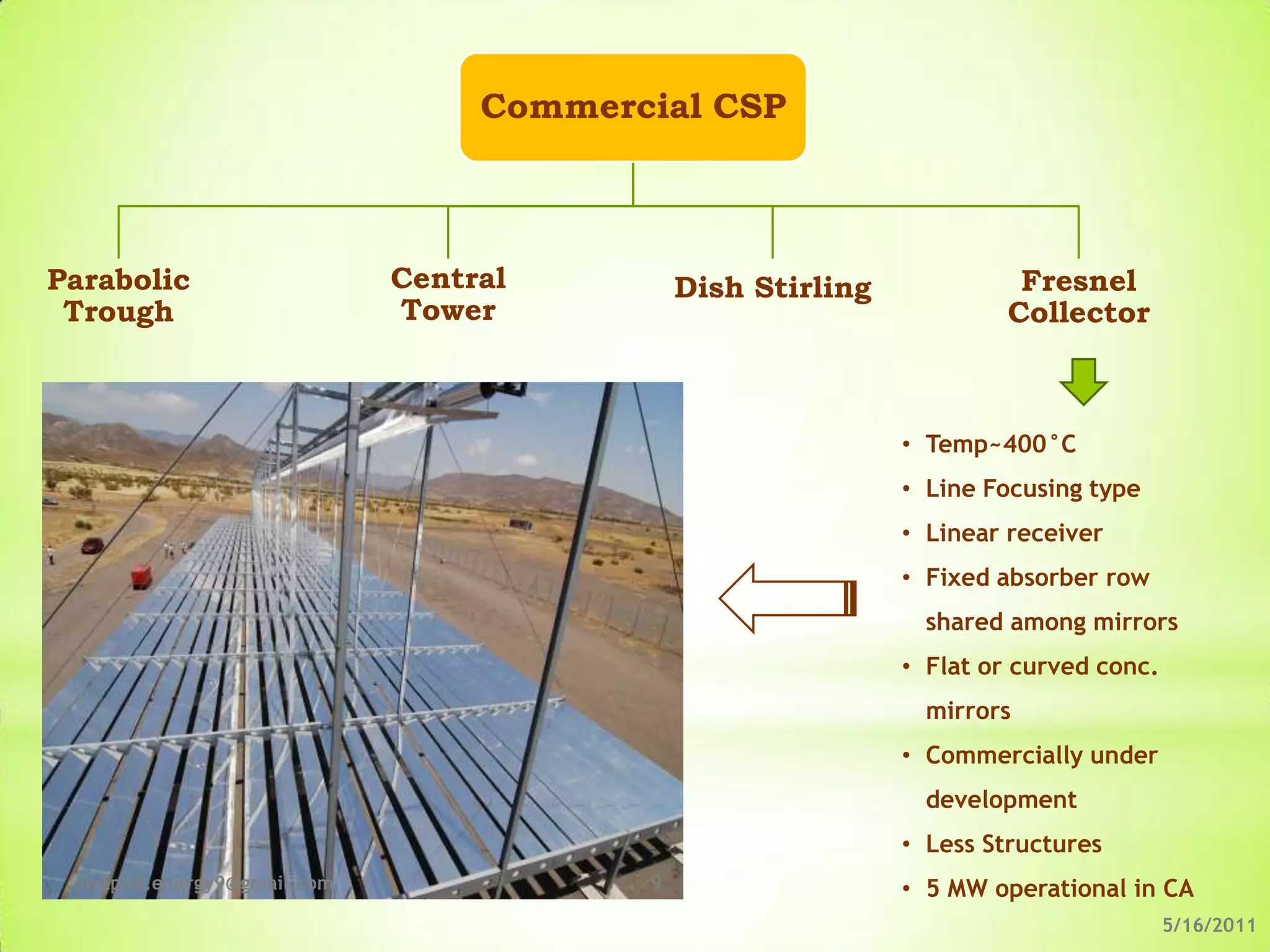
                                                             • Temp~400°C
                                                             • Line Focusing type
                                                             • Linear receiver
                                                             • Fixed absorber row
                                                               shared among mirrors
                                                             • Flat or curved conc.
                                                               mirrors
                                                             • Commercially under
                                                               development
                                                             • Less Structures
 swapnil.energy9@gmail.com               9                   • 5 MW operational in CA
                                                                                      5/16/2011
CSP Power - Brief
     Good DNI range ≥ 5-6 kWh/sq.m/day
     Capital Cost: $ 4-8 Million / MW (Increases with Heat Storage)
     Land Required: ~ 6-10 acres / MW
     Generation Potential: 25-35 MW / sq.km
     Units Generated: 1.81 Million Units / year (Increases with Heat Storage)
     Capacity Factor: 20 – 25% (Can be increased to 40% using Heat storage)
     COGN: $ 0.10 - 0.20 / kWh
     Lifespan: ~ 40 years, PPA’s are generally for 20-25 years
     Pay back Period: 5-12 years (Depends on the Tariff, subsidies, incentives)
     Installation Period: ~ 2-3 years (Capacity dependent)
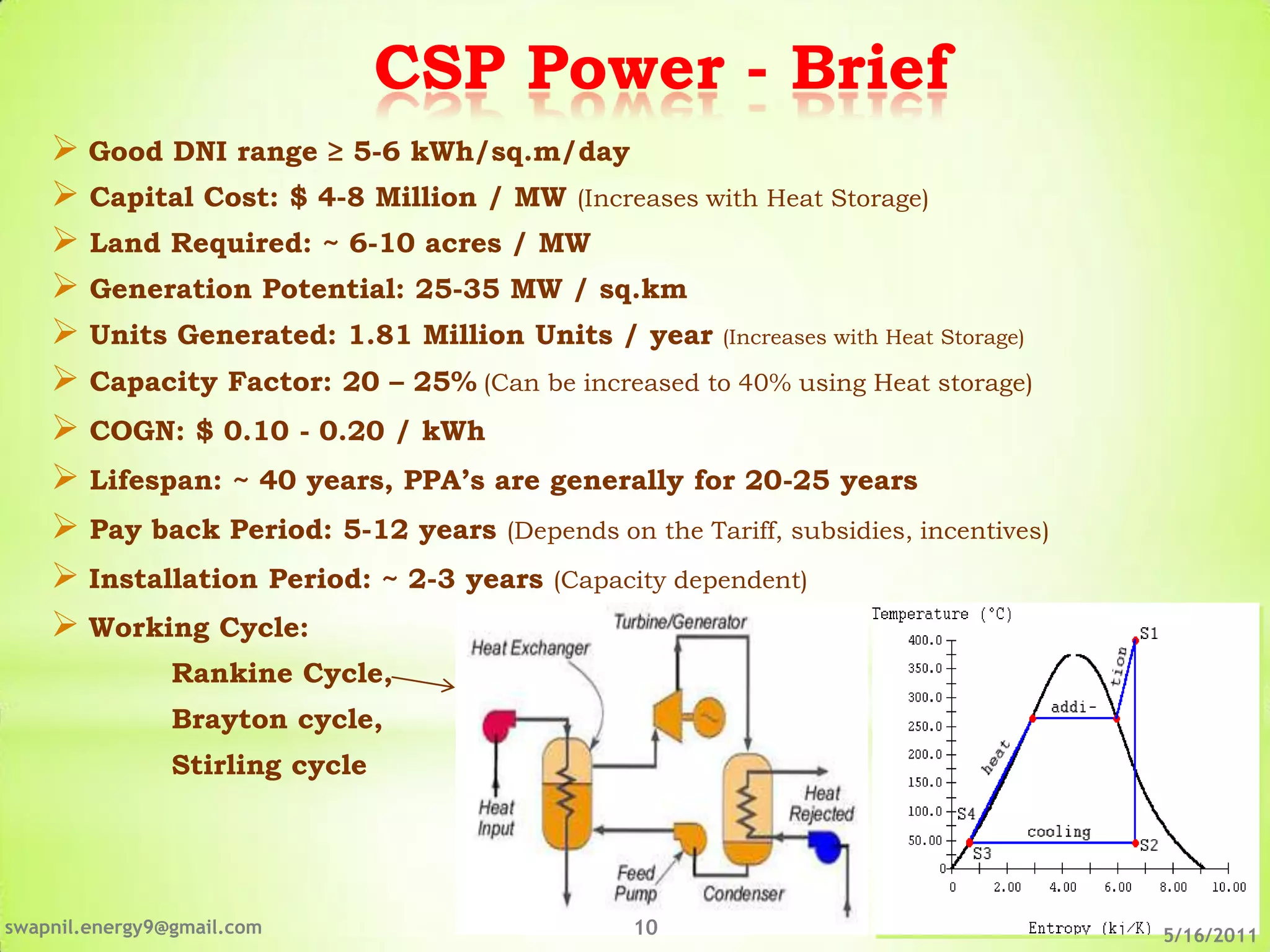
     Working Cycle:
                Rankine Cycle,
                Brayton cycle,
                Stirling cycle


swapnil.energy9@gmail.com                       10                                 5/16/2011
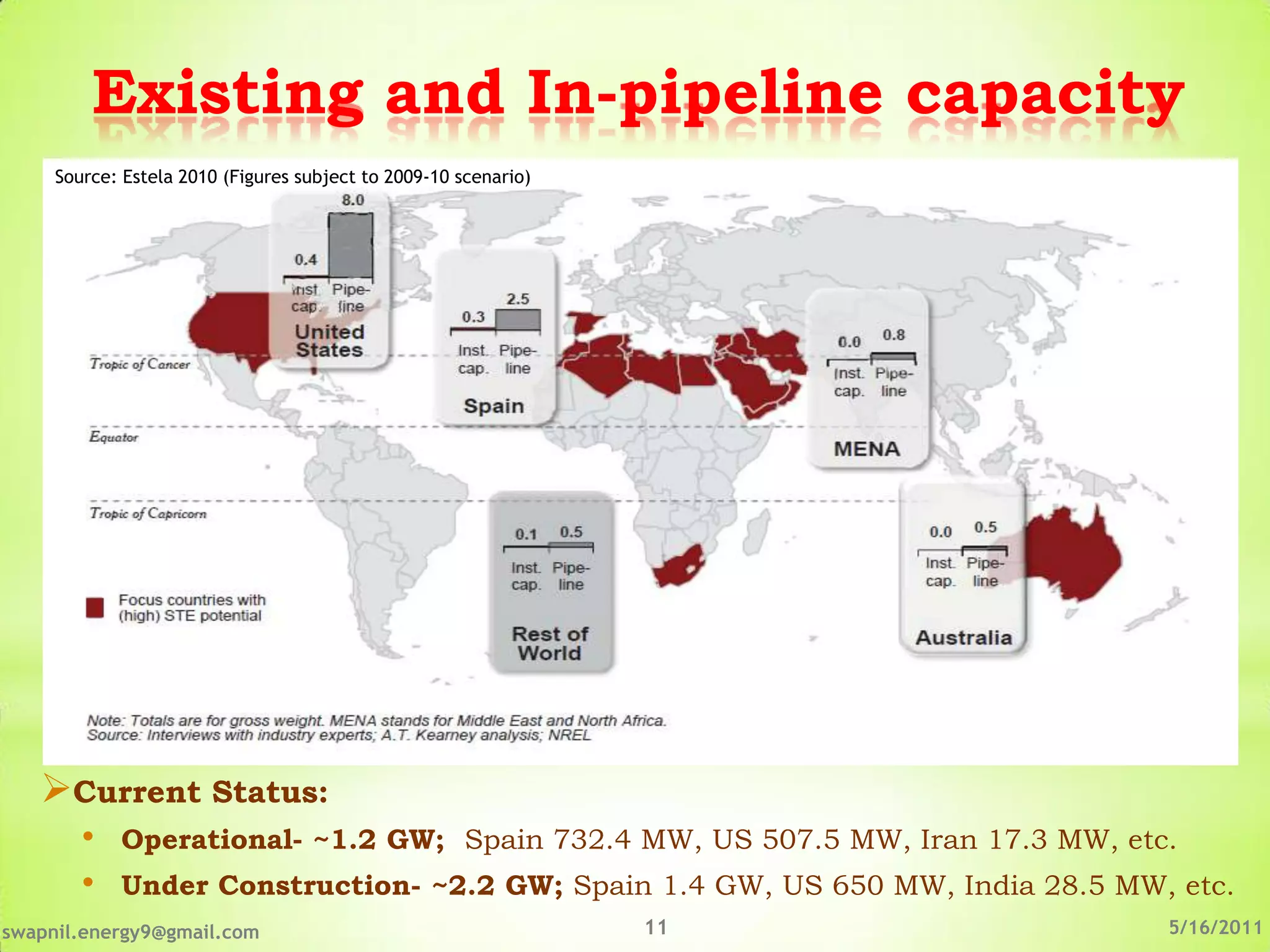
Existing and In-pipeline capacity
     Source: Estela 2010 (Figures subject to 2009-10 scenario)


   Current Status:
        •   Operational- ~1.2 GW; Spain 732.4 MW, US 507.5 MW, Iran 17.3 MW, etc.
        •   Under Construction- ~2.2 GW; Spain 1.4 GW, US 650 MW, India 28.5 MW, etc.
swapnil.energy9@gmail.com                                        11             5/16/2011
Commercialized Project Analysis

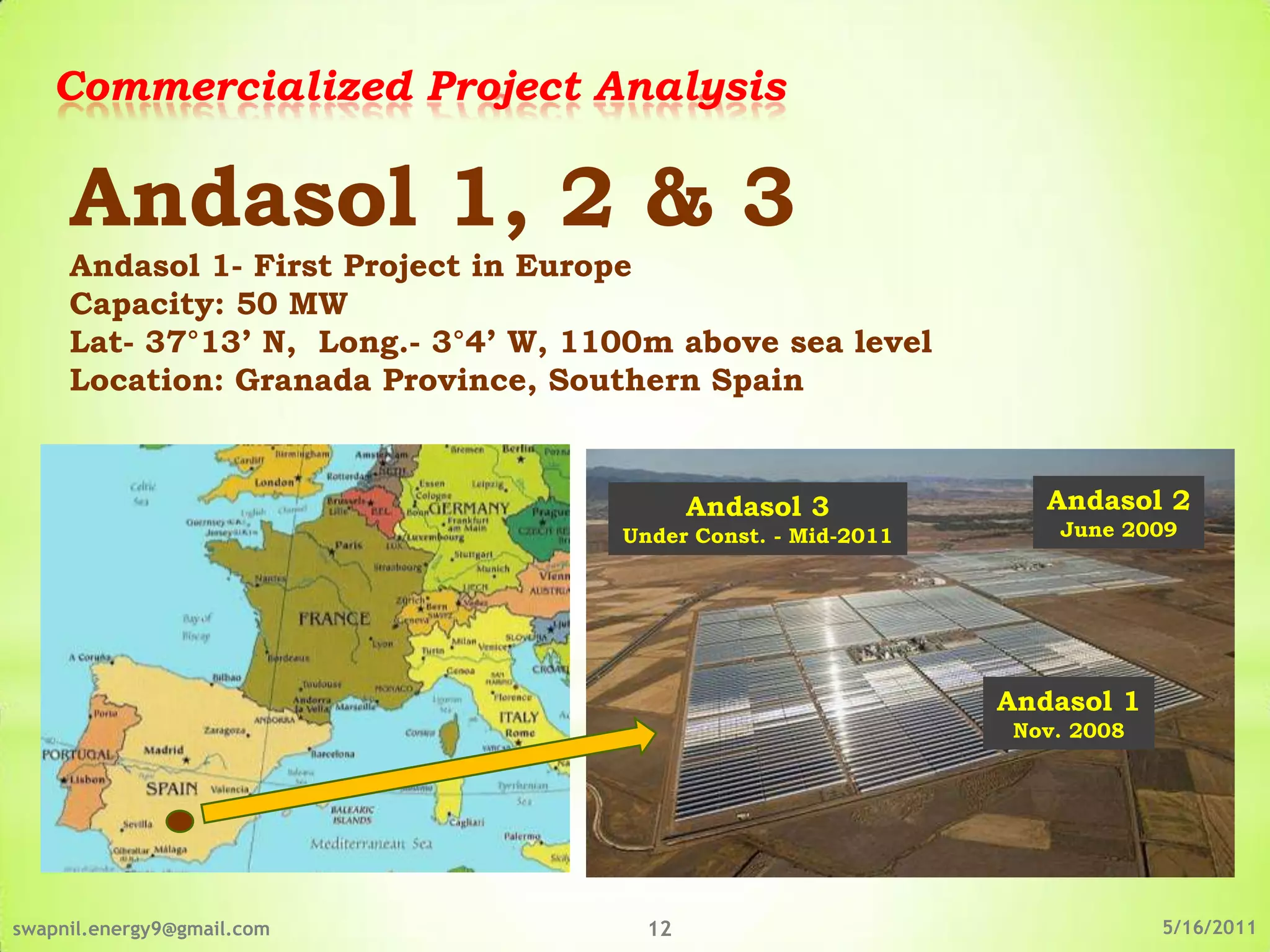
     Andasol 1, 2 & 3
     Andasol 1- First Project in Europe
     Capacity: 50 MW
     Lat- 37°13’ N, Long.- 3°4’ W, 1100m above sea level
     Location: Granada Province, Southern Spain


                                            Andasol 3             Andasol 2
                                     Under Const. - Mid-2011       June 2009


                                                               Andasol 1
                                                                Nov. 2008


swapnil.energy9@gmail.com              12                                   5/16/2011
Andasol 1- Specifications
       Annual DNI: 2,136 kWh / sq.m. A
       Technology Used: Parabolic Trough – Skal-ET 150
       Land Utilization: ~ 195 Hectares (9.6 Acres/MW)
       Construction Period: July 2006 – October 2008
       Estimated Lifespan: 40 years
       Entire Efficiency: ~28% peak, ~ 15% annual avg.
       Capacity Factor: 20%
       Units Generated: upto 180 GWh / Year
       Uses Heat storage and Wet Cooling systems
       Developers:
                  ACS Group (75%) Solar Millennium (25%)
swapnil.energy9@gmail.com                    13            5/16/2011
Major Component- Specifications
      Solar Field:
            Area: 510,120 m2
            209,664 mirrors – 580, 500 sq.m.
            ~ 90 km receiver pipes (Schott Solar & Solel Solar)
            Field η = ~ 70% peak, 50% annual avg.
            Sustains wind speed of 13.6 m/s

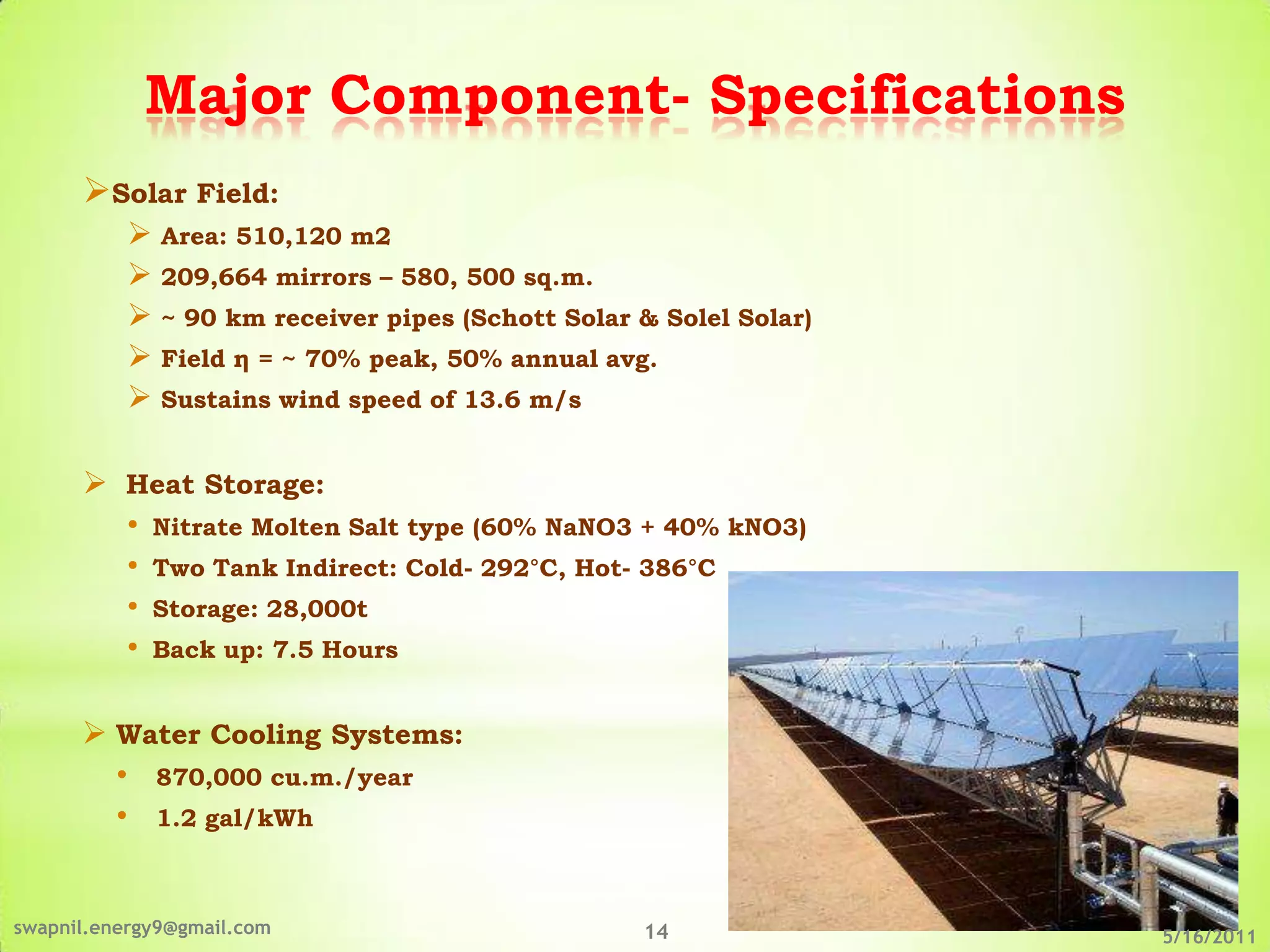
       Heat Storage:
        • Nitrate Molten Salt type (60% NaNO3 + 40% kNO3)
        • Two Tank Indirect: Cold- 292°C, Hot- 386°C
        • Storage: 28,000t
        • Back up: 7.5 Hours

       Water Cooling Systems:
        • 870,000 cu.m./year
        • 1.2 gal/kWh


swapnil.energy9@gmail.com                         14               5/16/2011
Working


swapnil.energy9@gmail.com   15   5/16/2011
Key Points

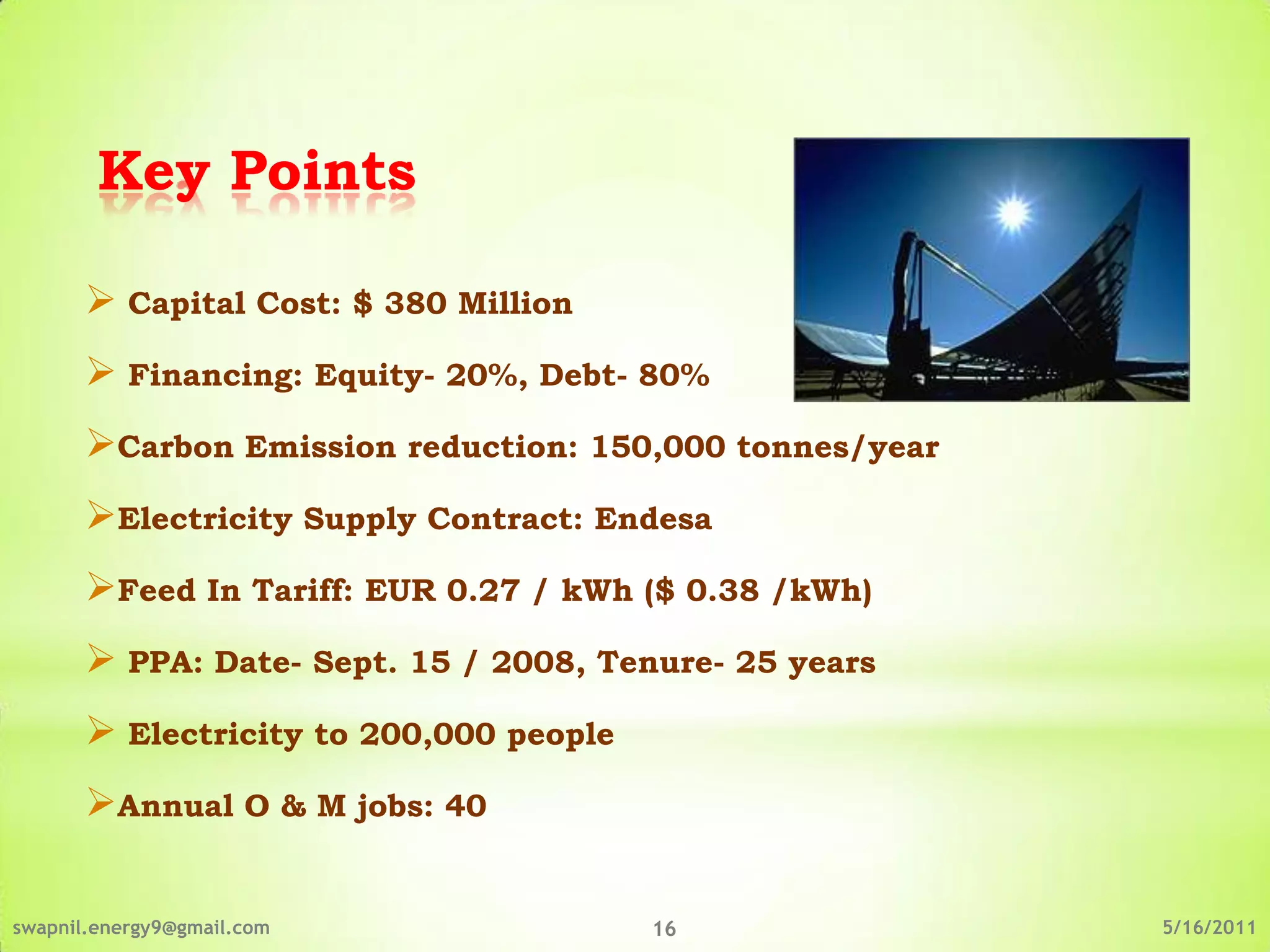
       Capital Cost: $ 380 Million
       Financing: Equity- 20%, Debt- 80%
      Carbon Emission reduction: 150,000 tonnes/year
      Electricity Supply Contract: Endesa
      Feed In Tariff: EUR 0.27 / kWh ($ 0.38 /kWh)
       PPA: Date- Sept. 15 / 2008, Tenure- 25 years
       Electricity to 200,000 people
      Annual O & M jobs: 40

swapnil.energy9@gmail.com               16              5/16/2011
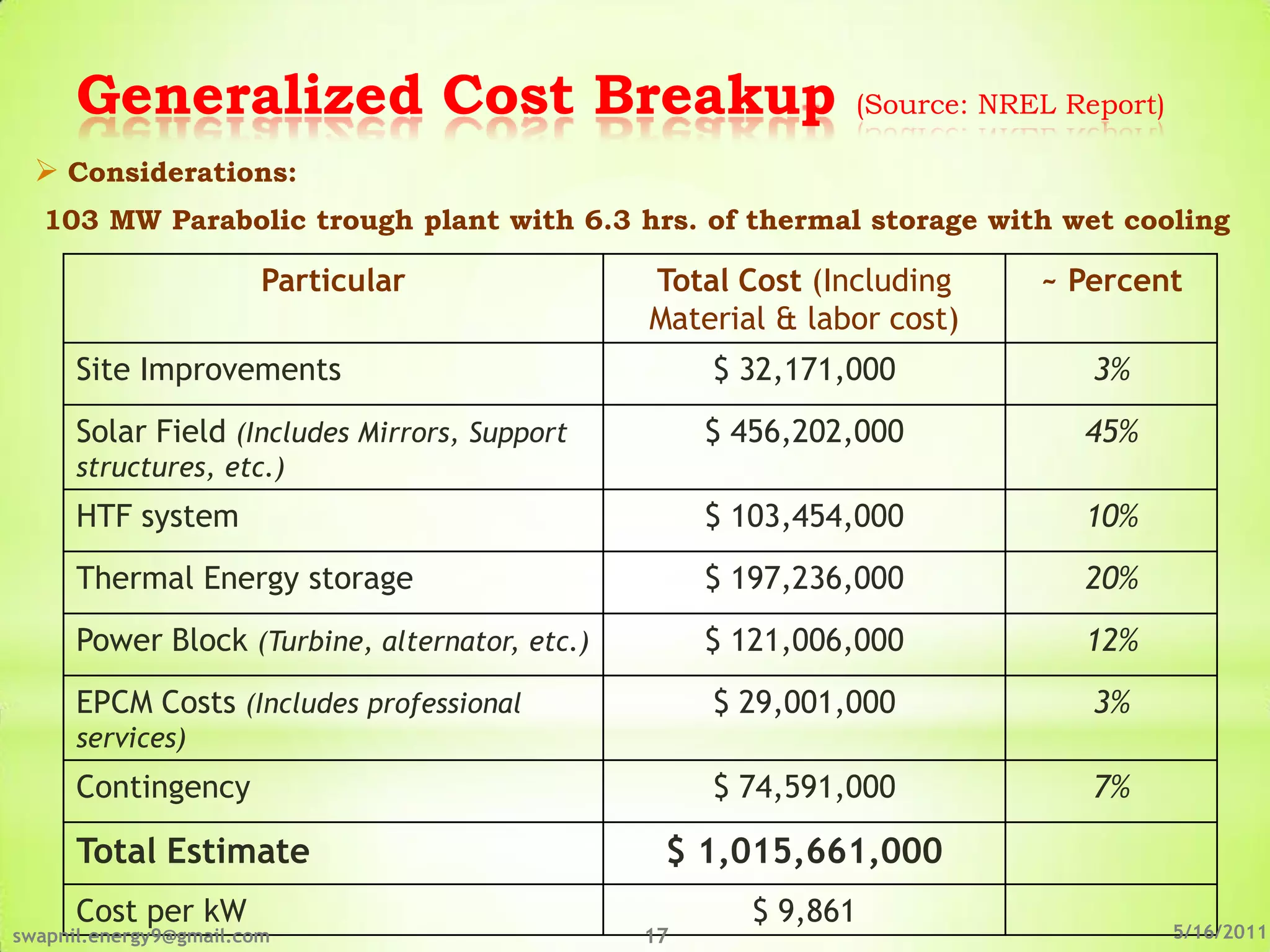
Generalized Cost Breakup                                (Source: NREL Report)

   Considerations:
  103 MW Parabolic trough plant with 6.3 hrs. of thermal storage with wet cooling

                        Particular              Total Cost (Including     ~ Percent
                                                Material & labor cost)
      Site Improvements                              $ 32,171,000             3%
      Solar Field (Includes Mirrors, Support         $ 456,202,000           45%
      structures, etc.)
      HTF system                                     $ 103,454,000           10%
      Thermal Energy storage                         $ 197,236,000           20%
      Power Block (Turbine, alternator, etc.)        $ 121,006,000           12%
      EPCM Costs (Includes professional              $ 29,001,000             3%
      services)
      Contingency                                    $ 74,591,000             7%

      Total Estimate                             $ 1,015,661,000
      Cost per kW                                       $ 9,861
swapnil.energy9@gmail.com                       17                                    5/16/2011
Challenges & Alternatives
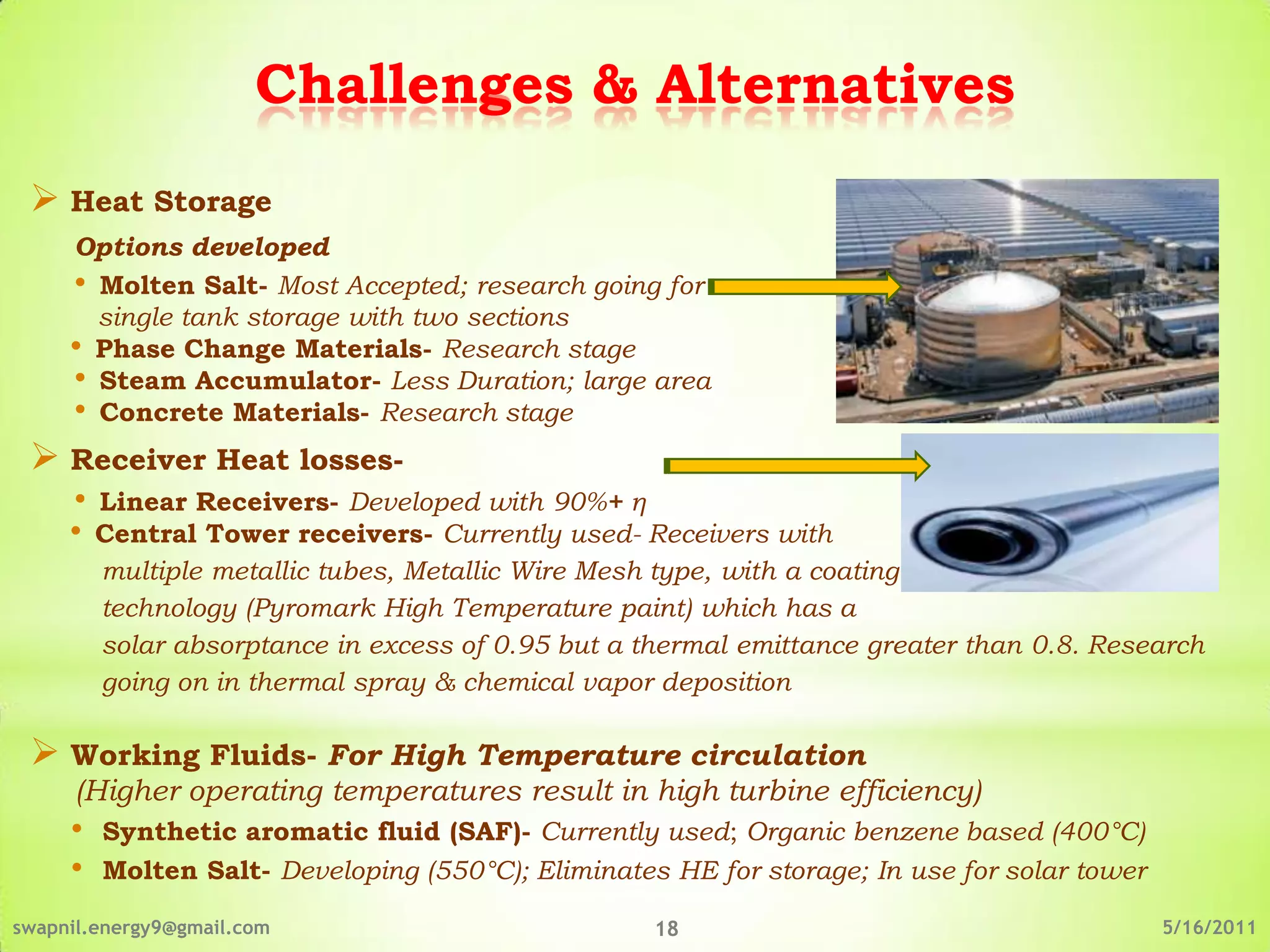
  Heat Storage
     Options developed
     • Molten Salt- Most Accepted; research going for
       single tank storage with two sections
     • Phase Change Materials- Research stage
     • Steam Accumulator- Less Duration; large area
     • Concrete Materials- Research stage
  Receiver Heat losses-
     • Linear Receivers- Developed with 90%+ η
     • Central Tower receivers- Currently used- Receivers with
         multiple metallic tubes, Metallic Wire Mesh type, with a coating
         technology (Pyromark High Temperature paint) which has a
         solar absorptance in excess of 0.95 but a thermal emittance greater than 0.8. Research
         going on in thermal spray & chemical vapor deposition

  Working Fluids- For High Temperature circulation
      (Higher operating temperatures result in high turbine efficiency)
     •   Synthetic aromatic fluid (SAF)- Currently used; Organic benzene based (400°C)
     •   Molten Salt- Developing (550°C); Eliminates HE for storage; In use for solar tower

swapnil.energy9@gmail.com                           18                                        5/16/2011
Challenges & Alternatives
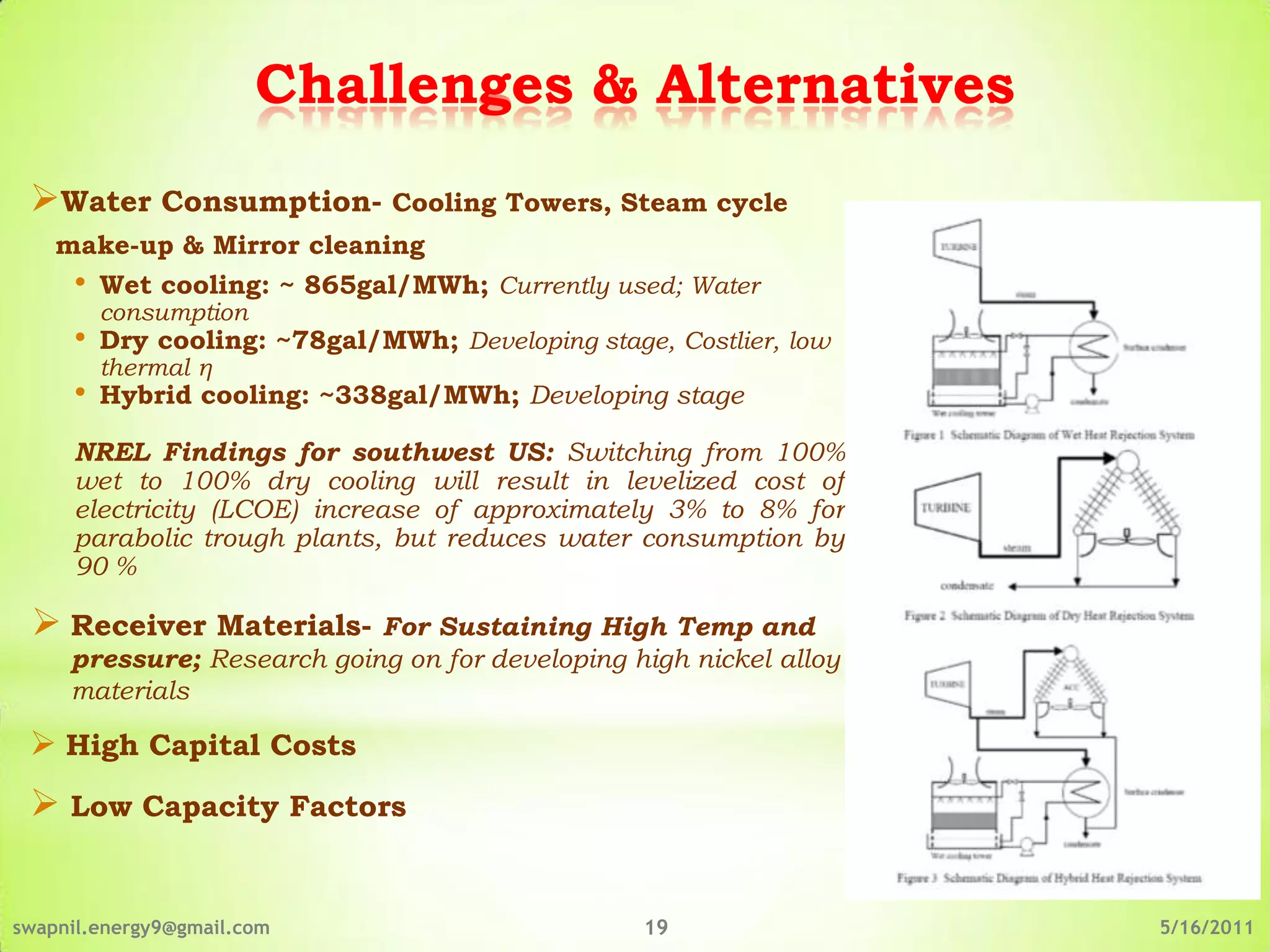
 Water Consumption- Cooling Towers, Steam cycle
    make-up & Mirror cleaning
     •   Wet cooling: ~ 865gal/MWh; Currently used; Water
         consumption
     •   Dry cooling: ~78gal/MWh; Developing stage, Costlier, low
         thermal η
     •   Hybrid cooling: ~338gal/MWh; Developing stage

     NREL Findings for southwest US: Switching from 100%
     wet to 100% dry cooling will result in levelized cost of
     electricity (LCOE) increase of approximately 3% to 8% for
     parabolic trough plants, but reduces water consumption by
     90 %

  Receiver Materials- For Sustaining High Temp and
     pressure; Research going on for developing high nickel alloy
     materials

  High Capital Costs
  Low Capacity Factors


swapnil.energy9@gmail.com                         19                5/16/2011
Advantages over Competitive
         Technologies (Eg. PV & Wind)

        Heat Storage option – Electricity Supply after Sunset
        Process Heat Generation
        Hybrid Option
        Good for High temperature regions
        Predictable and reliable power (less variable)
        Water desalination along with electricity generation (Adv. In Middle east & N. Africa)

      Other Benefits:
        Carbon   Emission Reduction- CDM benefits Each square meter of CSP can avoid
         annual emissions of 200 to 300 kilograms (kg) of carbon dioxide, depending on its
         configuration.
        No Fuel or its transportation cost - Substitutes Fossil Fuel use
        Energy Security
       High share of local contents
        Employment Generation
swapnil.energy9@gmail.com                         20                                     5/16/2011
Feasible
                                 Applications


      Utility / Commercial
                                                          Domestic/small Scale
               scale
       Electricity Generation
                                                         Hot Water collectors
         • Stand alone
                                                         Solar HVAC
         • Grid projects
                                                         Solar steam Cooking
         • Hybrid projects
                                                         Solar Ovens/cookers
       Industrial Process
                                                         Solar Food dryers
          Heat
         • Boiling
         • Melting
         • Sterilizing
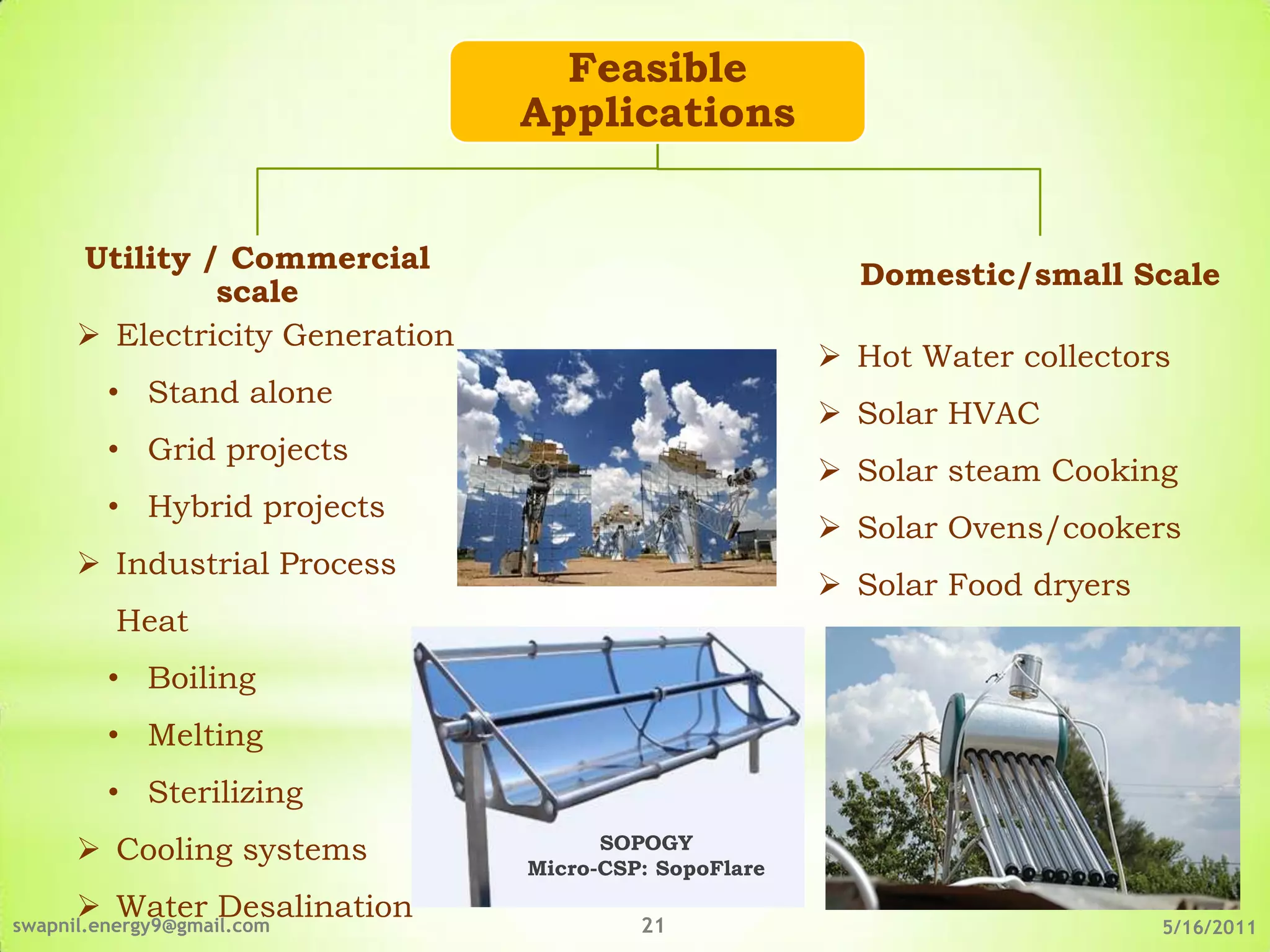
       Cooling systems                SOPOGY
                                 Micro-CSP: SopoFlare
       Water Desalination
swapnil.energy9@gmail.com                 21                                  5/16/2011
Development Measures
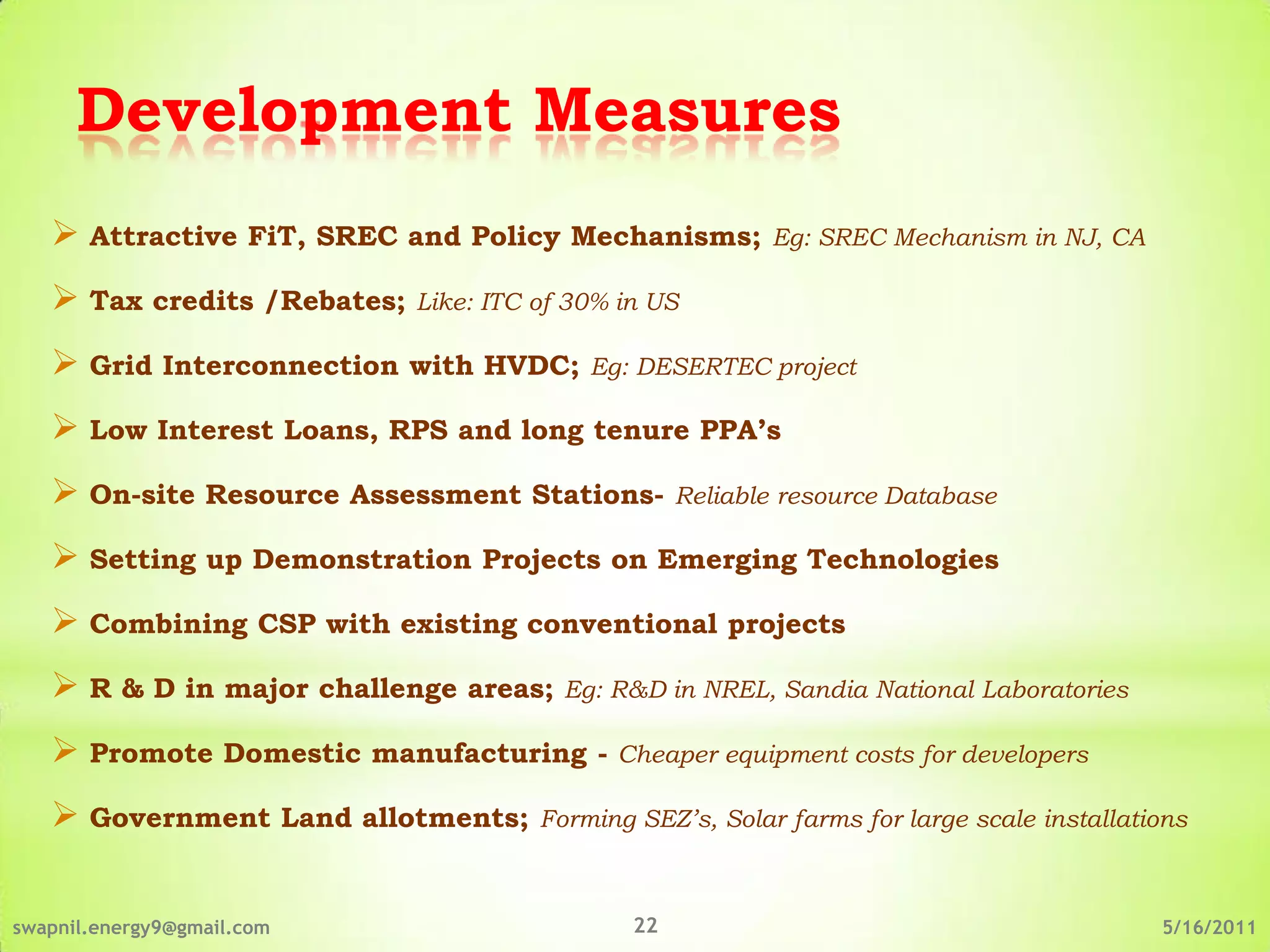
    Attractive FiT, SREC and Policy Mechanisms; Eg: SREC Mechanism in NJ, CA
    Tax credits /Rebates; Like: ITC of 30% in US
    Grid Interconnection with HVDC; Eg: DESERTEC project
    Low Interest Loans, RPS and long tenure PPA’s
    On-site Resource Assessment Stations- Reliable resource Database
    Setting up Demonstration Projects on Emerging Technologies
    Combining CSP with existing conventional projects
    R & D in major challenge areas; Eg: R&D in NREL, Sandia National Laboratories
    Promote Domestic manufacturing - Cheaper equipment costs for developers
    Government Land allotments; Forming SEZ’s, Solar farms for large scale installations

swapnil.energy9@gmail.com                      22                                      5/16/2011
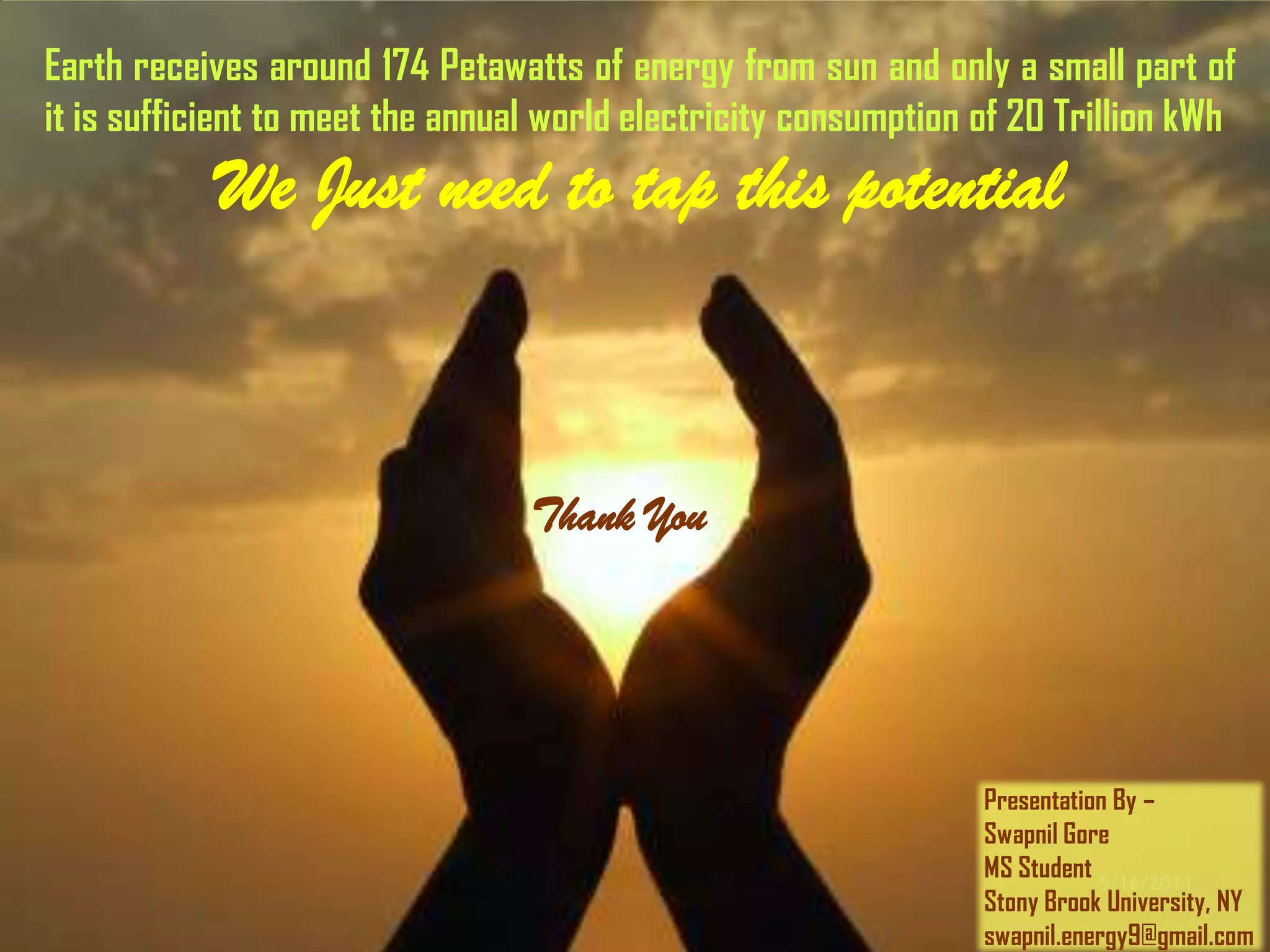
Earth receives around 174 Petawatts of energy from sun and only a small part of
it is sufficient to meet the annual world electricity consumption of 20 Trillion kWh
            We Just need to tap this potential
                 Thank You
                                  Thank You


                                                                  Presentation By –
                                                                  Swapnil Gore
                                                                  MS Student 5/16/2011
                                                                  Stony Brook University, NY
                                                                  swapnil.energy9@gmail.com
Concentrated Solar Power Technologies (CSP)

  • 1.
    Concentrating Solar Power Technologies Presentation By – Swapnil Gore MS Student 5/16/2011 1 Stony Brook University, NY swapnil.energy9@gmail.com
  • 2.
    Overview  Principle: Sunlight – Heat – Electricity Sunlight is concentrated, using mirrors or directly, on to receivers heating the circulating fluid which further generates steam &/or electricity.  Solar Radiation Components: Direct, Diffuse & Global  CSP uses- Direct Normal Irradiance (DNI)  Measuring Instrument: Pyrheliometer swapnil.energy9@gmail.com 2 5/16/2011
  • 3.
    Solar Power Potential  Globally: swapnil.energy9@gmail.com 3 5/16/2011
  • 4.
     US: NREL analysis-‘If only best suited sites are selected, CSP can generate about 26,400,000 GWh/year’ (It is many times more than total US consumption of 3,741,000 GWh) swapnil.energy9@gmail.com 4 5/16/2011
  • 5.
    Concentrating Solar Technologies Low Temperature Medium Temperature – Line High Temperature- (<100°C) Focusing (≈ 400 C) Point Focusing (>400°C) Flat Plate Collectors Parabolic Central Tower Trough Solar Chimney Fresnel Collectors Parabolic Dish Solar Pond swapnil.energy9@gmail.com 5 5/16/2011
  • 6.
    Commercial CSP Parabolic Central Dish Stirling Fresnel Trough Tower Collector • Temp~400°C • Line Focusing • Linear Receiver tube • Water consuming • Conc.: Parabolic Mirrors • Heat Storage feasible • Most Commercialized • Good for Hybrid option • Requires flat land • Good receiver η but low turbine η swapnil.energy9@gmail.com 6 5/16/2011
  • 7.
    Commercial CSP Parabolic Central Dish Stirling Fresnel Trough Tower Collector • Temp~600-800°C • Point Focusing • Flat Conc. Mirrors • Commercially proven • Central Receiver • Water consuming • Heat Storage capability • Feasible on Non Flat sites • Good performance for large capacity & temperatures • Low receiver η but good turbine η swapnil.energy9@gmail.com 7 5/16/2011
  • 8.
    Commercial CSP Parabolic Central Dish Stirling Fresnel Trough Tower Collector • Temp~700-800°C • Point Focusing • Uses Dish concentrator • Stirling Engine • Generally 25 kW units • High Efficiency ~ 30% • Dry cooling • No water requirement • Heat storage difficult • Commercially under development • Dual Axis Tracking swapnil.energy9@gmail.com 8 5/16/2011
  • 9.
    Commercial CSP Parabolic Central Dish Stirling Fresnel Trough Tower Collector • Temp~400°C • Line Focusing type • Linear receiver • Fixed absorber row shared among mirrors • Flat or curved conc. mirrors • Commercially under development • Less Structures swapnil.energy9@gmail.com 9 • 5 MW operational in CA 5/16/2011
  • 10.
    CSP Power -Brief  Good DNI range ≥ 5-6 kWh/sq.m/day  Capital Cost: $ 4-8 Million / MW (Increases with Heat Storage)  Land Required: ~ 6-10 acres / MW  Generation Potential: 25-35 MW / sq.km  Units Generated: 1.81 Million Units / year (Increases with Heat Storage)  Capacity Factor: 20 – 25% (Can be increased to 40% using Heat storage)  COGN: $ 0.10 - 0.20 / kWh  Lifespan: ~ 40 years, PPA’s are generally for 20-25 years  Pay back Period: 5-12 years (Depends on the Tariff, subsidies, incentives)  Installation Period: ~ 2-3 years (Capacity dependent)  Working Cycle: Rankine Cycle, Brayton cycle, Stirling cycle swapnil.energy9@gmail.com 10 5/16/2011
  • 11.
    Existing and In-pipelinecapacity Source: Estela 2010 (Figures subject to 2009-10 scenario) Current Status: • Operational- ~1.2 GW; Spain 732.4 MW, US 507.5 MW, Iran 17.3 MW, etc. • Under Construction- ~2.2 GW; Spain 1.4 GW, US 650 MW, India 28.5 MW, etc. swapnil.energy9@gmail.com 11 5/16/2011
  • 12.
    Commercialized Project Analysis Andasol 1, 2 & 3 Andasol 1- First Project in Europe Capacity: 50 MW Lat- 37°13’ N, Long.- 3°4’ W, 1100m above sea level Location: Granada Province, Southern Spain Andasol 3 Andasol 2 Under Const. - Mid-2011 June 2009 Andasol 1 Nov. 2008 swapnil.energy9@gmail.com 12 5/16/2011
  • 13.
    Andasol 1- Specifications  Annual DNI: 2,136 kWh / sq.m. A  Technology Used: Parabolic Trough – Skal-ET 150  Land Utilization: ~ 195 Hectares (9.6 Acres/MW)  Construction Period: July 2006 – October 2008  Estimated Lifespan: 40 years  Entire Efficiency: ~28% peak, ~ 15% annual avg.  Capacity Factor: 20%  Units Generated: upto 180 GWh / Year  Uses Heat storage and Wet Cooling systems  Developers: ACS Group (75%) Solar Millennium (25%) swapnil.energy9@gmail.com 13 5/16/2011
  • 14.
    Major Component- Specifications Solar Field:  Area: 510,120 m2  209,664 mirrors – 580, 500 sq.m.  ~ 90 km receiver pipes (Schott Solar & Solel Solar)  Field η = ~ 70% peak, 50% annual avg.  Sustains wind speed of 13.6 m/s  Heat Storage: • Nitrate Molten Salt type (60% NaNO3 + 40% kNO3) • Two Tank Indirect: Cold- 292°C, Hot- 386°C • Storage: 28,000t • Back up: 7.5 Hours  Water Cooling Systems: • 870,000 cu.m./year • 1.2 gal/kWh swapnil.energy9@gmail.com 14 5/16/2011
  • 15.
  • 16.
    Key Points  Capital Cost: $ 380 Million  Financing: Equity- 20%, Debt- 80% Carbon Emission reduction: 150,000 tonnes/year Electricity Supply Contract: Endesa Feed In Tariff: EUR 0.27 / kWh ($ 0.38 /kWh)  PPA: Date- Sept. 15 / 2008, Tenure- 25 years  Electricity to 200,000 people Annual O & M jobs: 40 swapnil.energy9@gmail.com 16 5/16/2011
  • 17.
    Generalized Cost Breakup (Source: NREL Report)  Considerations: 103 MW Parabolic trough plant with 6.3 hrs. of thermal storage with wet cooling Particular Total Cost (Including ~ Percent Material & labor cost) Site Improvements $ 32,171,000 3% Solar Field (Includes Mirrors, Support $ 456,202,000 45% structures, etc.) HTF system $ 103,454,000 10% Thermal Energy storage $ 197,236,000 20% Power Block (Turbine, alternator, etc.) $ 121,006,000 12% EPCM Costs (Includes professional $ 29,001,000 3% services) Contingency $ 74,591,000 7% Total Estimate $ 1,015,661,000 Cost per kW $ 9,861 swapnil.energy9@gmail.com 17 5/16/2011
  • 18.
    Challenges & Alternatives  Heat Storage Options developed • Molten Salt- Most Accepted; research going for single tank storage with two sections • Phase Change Materials- Research stage • Steam Accumulator- Less Duration; large area • Concrete Materials- Research stage  Receiver Heat losses- • Linear Receivers- Developed with 90%+ η • Central Tower receivers- Currently used- Receivers with multiple metallic tubes, Metallic Wire Mesh type, with a coating technology (Pyromark High Temperature paint) which has a solar absorptance in excess of 0.95 but a thermal emittance greater than 0.8. Research going on in thermal spray & chemical vapor deposition  Working Fluids- For High Temperature circulation (Higher operating temperatures result in high turbine efficiency) • Synthetic aromatic fluid (SAF)- Currently used; Organic benzene based (400°C) • Molten Salt- Developing (550°C); Eliminates HE for storage; In use for solar tower swapnil.energy9@gmail.com 18 5/16/2011
  • 19.
    Challenges & Alternatives Water Consumption- Cooling Towers, Steam cycle make-up & Mirror cleaning • Wet cooling: ~ 865gal/MWh; Currently used; Water consumption • Dry cooling: ~78gal/MWh; Developing stage, Costlier, low thermal η • Hybrid cooling: ~338gal/MWh; Developing stage NREL Findings for southwest US: Switching from 100% wet to 100% dry cooling will result in levelized cost of electricity (LCOE) increase of approximately 3% to 8% for parabolic trough plants, but reduces water consumption by 90 %  Receiver Materials- For Sustaining High Temp and pressure; Research going on for developing high nickel alloy materials  High Capital Costs  Low Capacity Factors swapnil.energy9@gmail.com 19 5/16/2011
  • 20.
    Advantages over Competitive Technologies (Eg. PV & Wind)  Heat Storage option – Electricity Supply after Sunset  Process Heat Generation  Hybrid Option  Good for High temperature regions  Predictable and reliable power (less variable)  Water desalination along with electricity generation (Adv. In Middle east & N. Africa) Other Benefits:  Carbon Emission Reduction- CDM benefits Each square meter of CSP can avoid annual emissions of 200 to 300 kilograms (kg) of carbon dioxide, depending on its configuration.  No Fuel or its transportation cost - Substitutes Fossil Fuel use  Energy Security High share of local contents  Employment Generation swapnil.energy9@gmail.com 20 5/16/2011
  • 21.
    Feasible Applications Utility / Commercial Domestic/small Scale scale  Electricity Generation  Hot Water collectors • Stand alone  Solar HVAC • Grid projects  Solar steam Cooking • Hybrid projects  Solar Ovens/cookers  Industrial Process  Solar Food dryers Heat • Boiling • Melting • Sterilizing  Cooling systems SOPOGY Micro-CSP: SopoFlare  Water Desalination swapnil.energy9@gmail.com 21 5/16/2011
  • 22.
    Development Measures  Attractive FiT, SREC and Policy Mechanisms; Eg: SREC Mechanism in NJ, CA  Tax credits /Rebates; Like: ITC of 30% in US  Grid Interconnection with HVDC; Eg: DESERTEC project  Low Interest Loans, RPS and long tenure PPA’s  On-site Resource Assessment Stations- Reliable resource Database  Setting up Demonstration Projects on Emerging Technologies  Combining CSP with existing conventional projects  R & D in major challenge areas; Eg: R&D in NREL, Sandia National Laboratories  Promote Domestic manufacturing - Cheaper equipment costs for developers  Government Land allotments; Forming SEZ’s, Solar farms for large scale installations swapnil.energy9@gmail.com 22 5/16/2011
  • 23.
    Earth receives around174 Petawatts of energy from sun and only a small part of it is sufficient to meet the annual world electricity consumption of 20 Trillion kWh We Just need to tap this potential Thank You Thank You Presentation By – Swapnil Gore MS Student 5/16/2011 Stony Brook University, NY swapnil.energy9@gmail.com