Thermoelectric Power generator
From
Vikram
Introduction
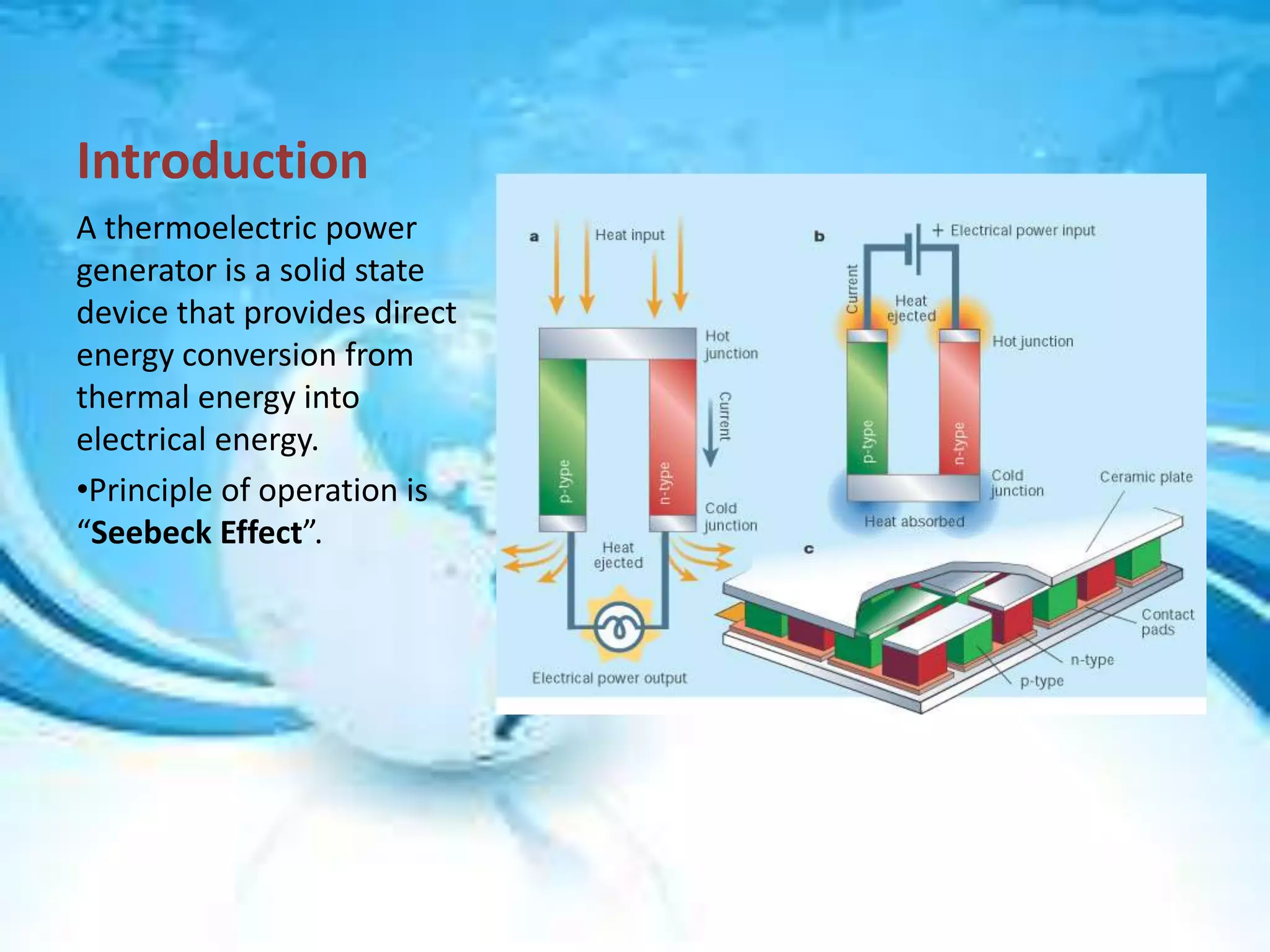
A thermoelectric power
generator is a solid state
device that provides direct
energy conversion from
thermal energy into
electrical energy.
•Principle of operation is
“Seebeck Effect”.
Seebeck Effect
• Thermoelectric power generation is based on a
phenomenon called “Seebeck effect” discovered by
Thomas Seebeck in 1821.
• When a temperature difference is established
between the hot and cold junctions of two
dissimilar materials (metals or semiconductors) a
voltage is generated, i.e., Seebeck voltage.
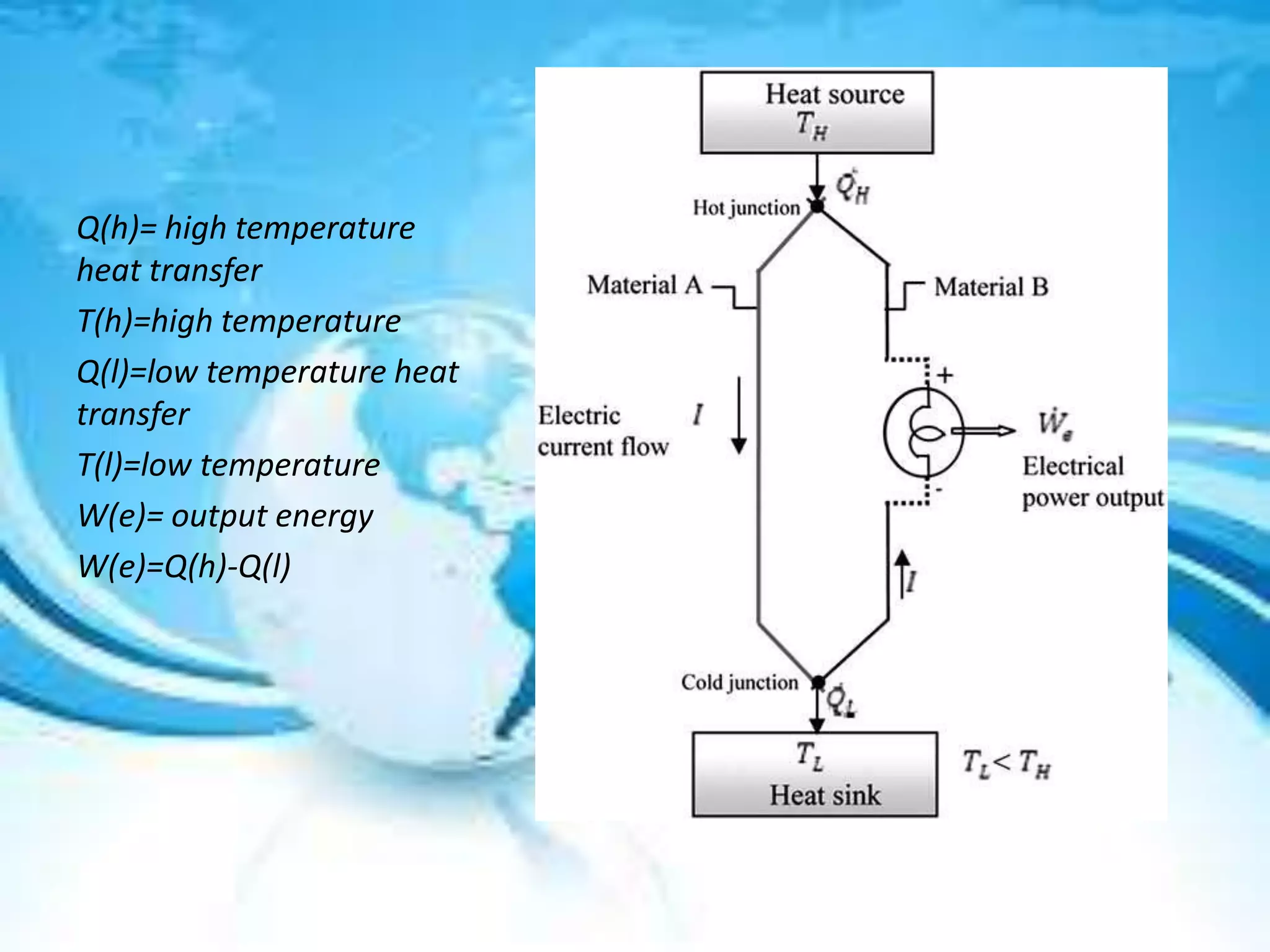
Q(h)= high temperature
heat transfer
T(h)=high temperature
Q(l)=low temperature heat
transfer
T(l)=low temperature
W(e)= output energy
W(e)=Q(h)-Q(l)
Specification
•Sizes of conventional
thermoelectric devices vary
from 3 mm2 by 4 mm thick to
75 mm2 by 5 mm thick.
•50 mm in length.
•Height of modules vary from
1mm to 5mm.
•Modules contain 3 to 127
thermocouples.
•There are multistage
thermoelectric modules of
height 20 mm.
• Below is a 3 stage module.

•

Schematic diagram showing components and
arrangement of a typical single-stage
thermoelectric power generator.
Performance of Thermoelectric Power
Generator
Performance of thermoelectric materials
can be expressed as:

• Z= a^(2)/kr
where,
Z is thermoelectric material
figure-of-merit
a is Seebeck coefficient
k is the total thermal
conductivity
R is the electric resistivity

• ZT = a T / kR
where,
T=T(h)+T(l)/2
• Carnot efficiency
n = 1- T(l)/T(h)
Conversion efficiency as
a function of temperature
and module material
figure-of-merit.

With the increase in the
value of T(h) conversion
efficiency increases.

But with the increase in
the value of Z has an
opposite effect on the
conversion efficiency.
Materials Used
• Ceramic plates usually made from alumina.
• Semiconductor thermoelements usually SiGe.
• The hot and cold plates are usually connected
using highly conductive material like copper.
• Foe Power Generators these are further
categorized as :
Conventional and Novel
Conventional Material
• Alloys based on Bismuth (Bi) in combinations
with Antimony (An), Tellurium (Te) or
Selenium (Se) are referred to as low
temperature materials and can be used at
temperatures up to around 450K.
• The intermediate temperature range - up to
around 850K is the regime of materials based
on alloys of Lead (Pb)
• Thermoelements employed at the highest
temperatures are fabricated from SiGe alloys
and operate up to 1300K.
• Although these materials provide a limited
efficiency.
• These are a cornerstone in practical and
commercial application.
New or Novel Materials
• Promising candidate to fill the temperature
range in the ZT spectrum between those
based on Bi2Te3 and PbTe is the
semiconductor compound ß-Zn4Sb3.
• Possesses an exceptionally low thermal
conductivity and exhibits a maximum ZT of 1.3
at a temperature of 670K.
• Apart from this a thin thermo electric
generator film made from semiconductors are
also synthesized.
• Their primary focus is not only on figure of
merit (Z) but to improve thermal contact.
Stirling Engine
•A Stirling engine is a heat
engine operating by cyclic
compression and
expansion of air or other
gas, the working fluid, at
different temperature
levels such that there is a
net conversion
of heat energy to
mechanical work.
•Noted for its high
efficiency compared to
steam engines.
Automotive thermoelectric generator
• An automotive thermoelectric
generator (ATEG) is a device that
converts waste heat in an internal combustion
engine (IC) into electricity.
• The thermoelectric materials are made up of
p-type and n-type semiconductors, while the
heat exchangers are metal plates with
high thermal conductivity.
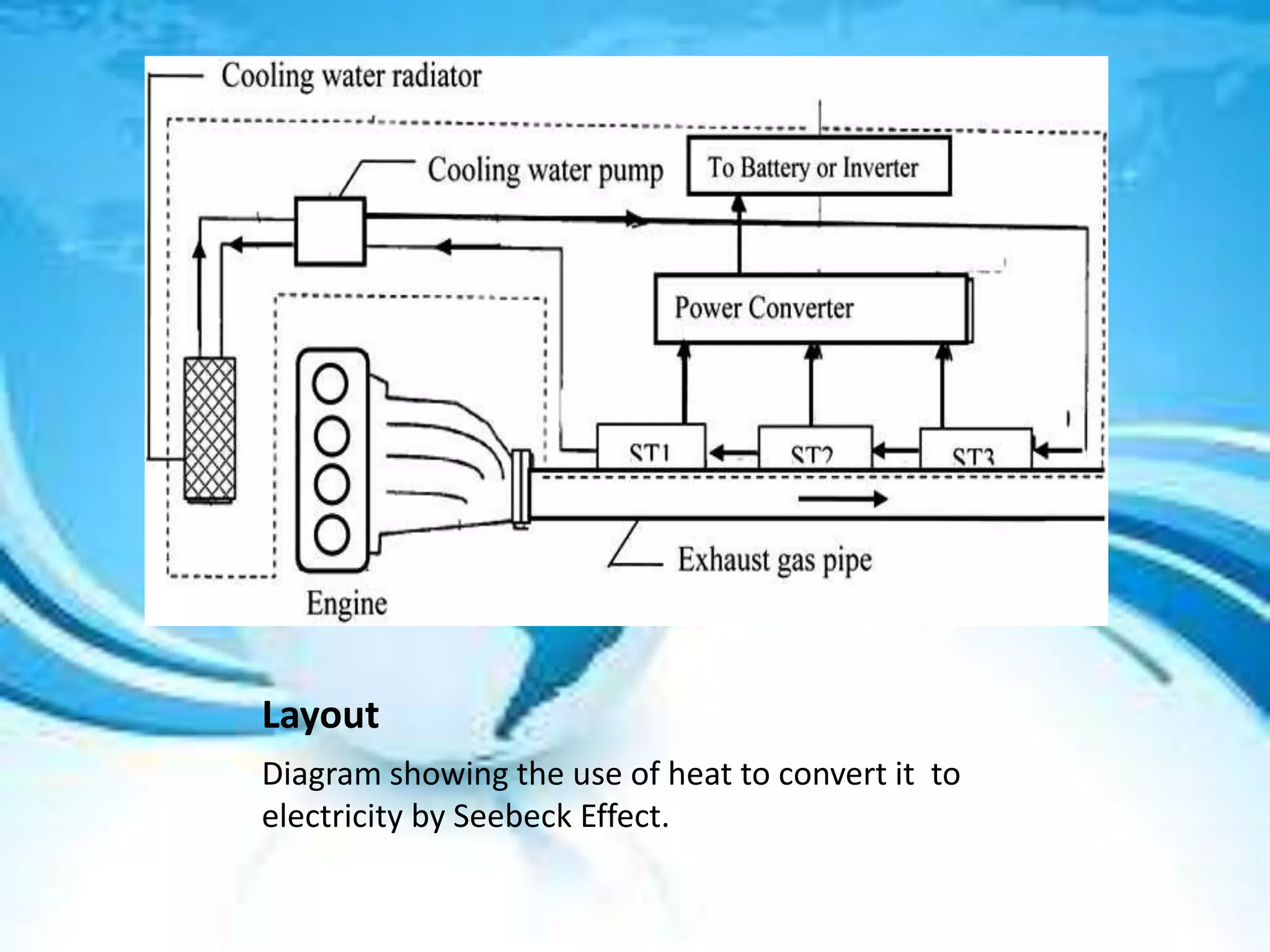
Layout
Diagram showing the use of heat to convert it to
electricity by Seebeck Effect.
Industrial Waste Heat Applications
• Most of the recent research activities on applications
of thermoelectric power generation have been
directed towards utilisation of industrial waste heat.
• This can revolutionize the energy crisis as well as the
environmental effects.
Photograph of a
thermoelectric power
generator produced
power for cathode
protection of the well
and gas line, which
used the temperature
difference between
hot and cold legs of
glycol natural gas
dehydrator cycle.
THANK YOU

Thermoelectric power generator

  • 1.
  • 2.
    Introduction A thermoelectric power generatoris a solid state device that provides direct energy conversion from thermal energy into electrical energy. •Principle of operation is “Seebeck Effect”.
  • 3.
    Seebeck Effect • Thermoelectricpower generation is based on a phenomenon called “Seebeck effect” discovered by Thomas Seebeck in 1821. • When a temperature difference is established between the hot and cold junctions of two dissimilar materials (metals or semiconductors) a voltage is generated, i.e., Seebeck voltage.
  • 4.
    Q(h)= high temperature heattransfer T(h)=high temperature Q(l)=low temperature heat transfer T(l)=low temperature W(e)= output energy W(e)=Q(h)-Q(l)
  • 5.
    Specification •Sizes of conventional thermoelectricdevices vary from 3 mm2 by 4 mm thick to 75 mm2 by 5 mm thick. •50 mm in length. •Height of modules vary from 1mm to 5mm. •Modules contain 3 to 127 thermocouples. •There are multistage thermoelectric modules of height 20 mm. • Below is a 3 stage module. • Schematic diagram showing components and arrangement of a typical single-stage thermoelectric power generator.
  • 6.
    Performance of ThermoelectricPower Generator Performance of thermoelectric materials can be expressed as: • Z= a^(2)/kr where, Z is thermoelectric material figure-of-merit a is Seebeck coefficient k is the total thermal conductivity R is the electric resistivity • ZT = a T / kR where, T=T(h)+T(l)/2 • Carnot efficiency n = 1- T(l)/T(h)
  • 7.
    Conversion efficiency as afunction of temperature and module material figure-of-merit. With the increase in the value of T(h) conversion efficiency increases. But with the increase in the value of Z has an opposite effect on the conversion efficiency.
  • 8.
    Materials Used • Ceramicplates usually made from alumina. • Semiconductor thermoelements usually SiGe. • The hot and cold plates are usually connected using highly conductive material like copper. • Foe Power Generators these are further categorized as : Conventional and Novel
  • 9.
    Conventional Material • Alloysbased on Bismuth (Bi) in combinations with Antimony (An), Tellurium (Te) or Selenium (Se) are referred to as low temperature materials and can be used at temperatures up to around 450K. • The intermediate temperature range - up to around 850K is the regime of materials based on alloys of Lead (Pb)
  • 10.
    • Thermoelements employedat the highest temperatures are fabricated from SiGe alloys and operate up to 1300K. • Although these materials provide a limited efficiency. • These are a cornerstone in practical and commercial application.
  • 11.
    New or NovelMaterials • Promising candidate to fill the temperature range in the ZT spectrum between those based on Bi2Te3 and PbTe is the semiconductor compound ß-Zn4Sb3. • Possesses an exceptionally low thermal conductivity and exhibits a maximum ZT of 1.3 at a temperature of 670K.
  • 12.
    • Apart fromthis a thin thermo electric generator film made from semiconductors are also synthesized. • Their primary focus is not only on figure of merit (Z) but to improve thermal contact.
  • 13.
    Stirling Engine •A Stirlingengine is a heat engine operating by cyclic compression and expansion of air or other gas, the working fluid, at different temperature levels such that there is a net conversion of heat energy to mechanical work. •Noted for its high efficiency compared to steam engines.
  • 14.
    Automotive thermoelectric generator •An automotive thermoelectric generator (ATEG) is a device that converts waste heat in an internal combustion engine (IC) into electricity. • The thermoelectric materials are made up of p-type and n-type semiconductors, while the heat exchangers are metal plates with high thermal conductivity.
  • 15.
    Layout Diagram showing theuse of heat to convert it to electricity by Seebeck Effect.
  • 16.
    Industrial Waste HeatApplications • Most of the recent research activities on applications of thermoelectric power generation have been directed towards utilisation of industrial waste heat. • This can revolutionize the energy crisis as well as the environmental effects.
  • 17.
    Photograph of a thermoelectricpower generator produced power for cathode protection of the well and gas line, which used the temperature difference between hot and cold legs of glycol natural gas dehydrator cycle.
  • 18.