OUTLINE OF THE PRESENTATION
1. Introduction
2. Mud evaluation criteria for HPHT wells
3. Mud treatment
4. Mud cooling
5. Swab and Surge - ECD Management
6. Hydraulics
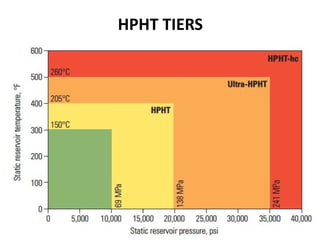
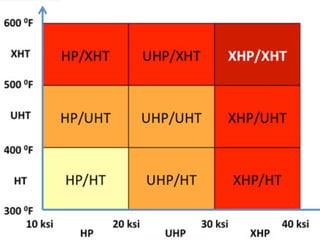
HPHT TIERS
 As HPHT drilling operations are expensive and risky,
an accurate knowledge of drilling fluid behavior
under actual conditions is required to maximize
operational efficiency and to minimize cost and
drilling fluids related risks.
 Hence, a thorough understanding of the Drilling
Fluids is very important and essential as the Drilling
Fluids are the very core of the drilling process.
WHY UNDERSTANDING DRILLING FLUIDS IS
ESSENTIAL?
1. Best well productivity at lowest drawdown.
2. Best well integrity and longest structural lifetime.
3. Lowest well construction cost.
4. Lowest environmental impact and liability
exposure.
5. Best reservoir information capture.
THE MAIN OBJECTIVES OF DRILLING FLUID ARE
MUD EVALUATION CRITERIA
COMMONLY USED MUD TYPES IN HPHT WELLS:
1. Invert emulsion fluids - SOBM
2. Cesium Formate brine based drilling fluids
3. HPHT WBM
The drilling fluid chosen must offer a host of functionalities:
1. Ability to maintain the integrity of weak rocks.
2. Ability to minimize fluid loss into permeable rocks.
3. Ability to provide stable well control
4. Ability to efficiently transfer hydraulic power.
5. Ability to move cuttings to the surface
6. Provide steel/steel and steel/rock lubricity
7. Provide protection against all forms of corrosion.
8. Allow formation evaluation.
9. Pose little or no hazard to rig personnel.
10. Have little or no adverse effect on the environment.
11. Have little or no adverse effect on elastomers.
MUD EVALUATION CRITERIA
INVERT EMULSION FLUIDS
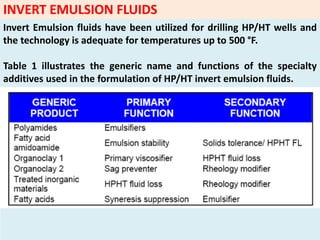
Invert Emulsion fluids have been utilized for drilling HP/HT wells and
the technology is adequate for temperatures up to 500 °F.
Table 1 illustrates the generic name and functions of the specialty
additives used in the formulation of HP/HT invert emulsion fluids.
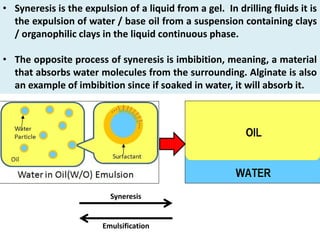
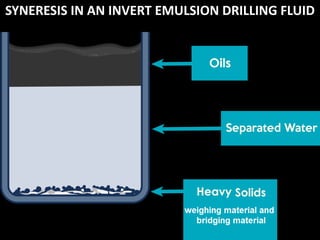
• Syneresis is the expulsion of a liquid from a gel. In drilling fluids it is
the expulsion of water / base oil from a suspension containing clays
/ organophilic clays in the liquid continuous phase.
• The opposite process of syneresis is imbibition, meaning, a material
that absorbs water molecules from the surrounding. Alginate is also
an example of imbibition since if soaked in water, it will absorb it.
Syneresis
Emulsification
SYNERESIS IN AN INVERT EMULSION DRILLING FLUID
ADVANTAGES:
1. Minimal formation damage.
2. Maintenance of additive properties at high temperatures.
3. Elimination of barite and its sagging problems.
4. Reduced hydraulic flow resistance.
5. Lower ECDs.
6. Better kick detection and well control.
7. Faster flow‐checks.
8. Low potential for differential sticking.
9. Reduced torque and drag.
10. Inhibition of hydrate formation.
11. Very low corrosion rates.
12. Compatibility with elastomers.
13. Lower swab and surge pressures.
14. Better power transmission to motors and bits.
15. Low gas solubility
CESIUM FORMATE BRINES BASED DRILLING FLUIDS
 Mud treatment or solids control is the process of
controlling the buildup of undesirable solids in a mud
system.
 Rheological and Filtration properties can become difficult
to control when the concentration of drilled solids (low‐
gravity solids) becomes excessive.
 Penetration rates and bit life decrease and hole problems
increase with a high concentration of drill solids.
MUD TREATMENT
 Solids‐control equipment on a drilling operation should
be operated like a processing plant.
 In an ideal situation, all drill solids are removed from a
drilling fluid.
 Under typical drilling conditions, low‐gravity solids
should be maintained below 6 percent by volume.
MUD TREATMENT
SOURCES AND SIZES OF SOLIDS
 The two primary sources of solids (particles) are
chemical additives and drilled solids.
 Most formation solids can be removed by
mechanical means at the surface.
 The particle size of drilled solids incorporated into
drilling fluid can range from 1 to 250 microns (1
micron equals 1/25,400 of an inch or 1/1,000 of a
millimeter.
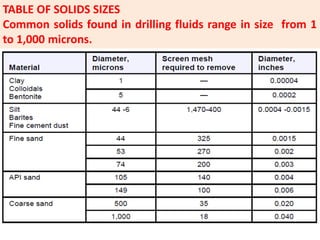
TABLE OF SOLIDS SIZES
Common solids found in drilling fluids range in size from 1
to 1,000 microns.
MUD TREATMENT - SOLIDS CONTROL
Mechanical solids‐removal equipment
Equipment that removes solids mechanically can be grouped
into two major classifications:
 Screen devices
 Centrifugal separation devices
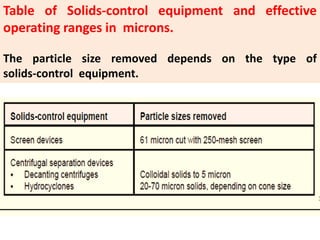
Table of Solids‐control equipment and effective
operating ranges in microns.
The particle size removed depends on the type of
solids‐control equipment.
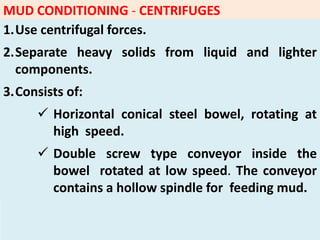
MUD CONDITIONING - CENTRIFUGES
1.Use centrifugal forces.
2.Separate heavy solids from liquid and lighter
components.
3.Consists of:
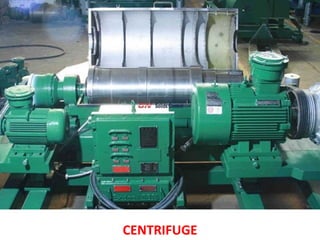
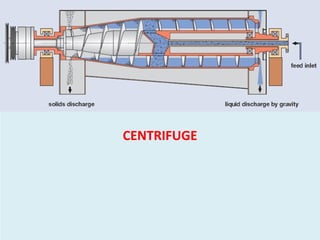
 Horizontal conical steel bowel, rotating at
high speed.
 Double screw type conveyor inside the
bowel rotated at low speed. The conveyor
contains a hollow spindle for feeding mud.
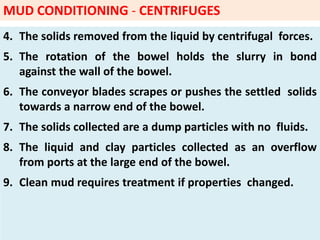
4. The solids removed from the liquid by centrifugal forces.
5. The rotation of the bowel holds the slurry in bond
against the wall of the bowel.
6. The conveyor blades scrapes or pushes the settled solids
towards a narrow end of the bowel.
7. The solids collected are a dump particles with no fluids.
8. The liquid and clay particles collected as an overflow
from ports at the large end of the bowel.
9. Clean mud requires treatment if properties changed.
MUD CONDITIONING - CENTRIFUGES
CENTRIFUGE
CENTRIFUGE
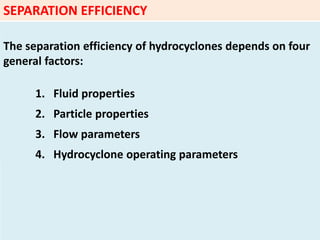
SEPARATION EFFICIENCY
The separation efficiency of hydrocyclones depends on four
general factors:
1. Fluid properties
2. Particle properties
3. Flow parameters
4. Hydrocyclone operating parameters
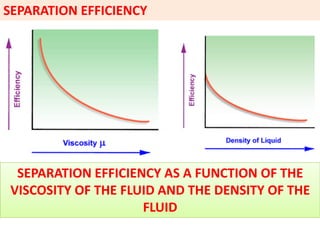
SEPARATION EFFICIENCY
SEPARATION EFFICIENCY AS A FUNCTION OF THE
VISCOSITY OF THE FLUID AND THE DENSITY OF THE
FLUID
SEPARATION EFFICIENCY AS A FUNCTION OF THE
VISCOSITY OF THE FLUID AND THE DENSITY OF THE
FLUID
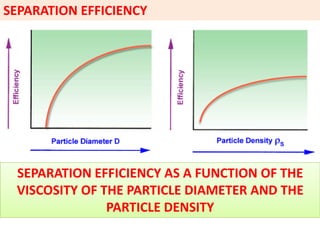
SEPARATION EFFICIENCY
SEPARATION EFFICIENCY AS A FUNCTION OF THE
VISCOSITY OF THE PARTICLE DIAMETER AND THE
PARTICLE DENSITY
SEPARATION EFFICIENCY AS A FUNCTION OF THE
VISCOSITY OF THE PARTICLE DIAMETER AND THE
PARTICLE DENSITY
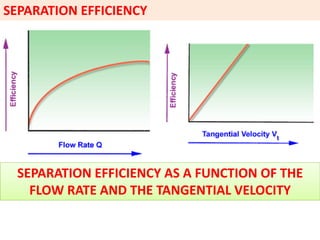
SEPARATION EFFICIENCY
SEPARATION EFFICIENCY AS A FUNCTION OF THE
FLOW RATE AND THE TANGENTIAL VELOCITY
SEPARATION EFFICIENCY AS A FUNCTION OF THE
FLOW RATE AND THE TANGENTIAL VELOCITY
DILUTION:
Dilution, or the addition of base fluid to a mud system, serves
to:
 Reduce concentration of solids left by mechanical solids
removal equipment
 Replenish liquids lost when using mechanical solids
control equipment
Dilution can generate excessive volumes. It is not a first choice
for solids control. But dilution is needed all the same.
MUD TREATMENT
MUD COOLING
 Drilling Fluid Temperature Control System DFTCS :
Commonly known as the Mud Cooler.
 Mud Cooler system is used to reduce the temperature of
drilling fluid returned to the surface.
 In HTHP wells the temperature of the drilling fluid must
be strictly controlled to keep its properties within the
specified parameters for that particular well.
If the temperature of the drilling fluid is allowed to increase
then a variety of problems can occur such as:
 Reduction in viscosity.
 Formation breakdown.
 Unstable filter‐cake.
 Lost of circulation.
 Packing off.
 Degradation of chemicals except weighting material.
 Stuck pipe.
 Evaporation of the oil and water phases.
MUD COOLING
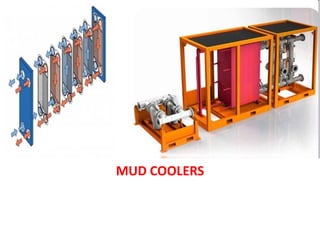
MUD COOLERS
1. Maintains drilling fluid efficiency.
2. Reduce need for continuous replenishmentt of mud
conditioning additives
3. Extend life of elastomer seals on BOP, LWD/MWD
tools, riser, shaker, centrifuges and pumps.
4. Increases accuracy of downhole measurement
devices.
5. Reduces mud‐related downhole problems.
6. Eliminate noxious oil‐based mud surface emissions.
7. Improves safety of HPHT drilling operation.
8. Improves the ambience for the comfort of the
personnel.
MUD COOLING BENEFITS
1. The effects of pressure and temperature on mud weight must be
considered in the drilling of HPHT wells.
2. Unfortunately, due to the changes of downhole temperature and
pressure profile it is impossible even to maintain a constant
hydrostatic pressure.
3. The hydrostatic overbalance varies within a certain range(pump
rate and the mud properties).
4. Non‐aqueous and water‐based fluids used for drilling HPHT wells
up to 500°F (260°C).
5. HPHT approaching temperature 600°F (316°C) use fluids with
higher temperature stability.
ECD, SWAB AND SURGE
 The combination of the relatively high viscosity mud, deep wells
and small annular clearances leads to higher than normal friction
pressure during mud circulation.
 Mud hydrostatic pressure and friction pressure then combine to
give the equivalent circulating density (ECD)
 This can cause increase in ECD.
 The high annular pressure losses can then lead to a high ECD value,
higher than the fracture gradient equivalent mud weight of the
formation. This can lead to mud loss and all the problems
associated with mud loss.
 It should always be borne in mind that the mud weight window, i.e.
the window between the fracture gradient and the pore pressure is
always very small in HPHT wells.
EQUIVALENT CIRCULATING DENSITY
SWABBING & SURGING
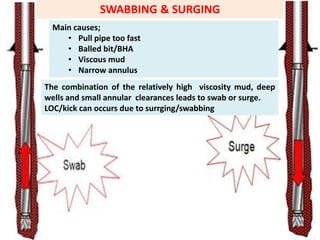
Main causes;
• Pull pipe too fast
• Balled bit/BHA
• Viscous mud
• Narrow annulus
The combination of the relatively high viscosity mud, deep
wells and small annular clearances leads to swab or surge.
LOC/kick can occurs due to surrging/swabbing
 Using Cesium Formate Brine based drilling fluid (an aqueous
formulation of solids‐free mud (up to SG 2.30) can help in the
drilling of HPHT wells:
 Reduced hydraulic flow resistance, ECDs, swab and surge
pressures, gas solvency, potential for differential sticking,
torque and drag, corrosion
 Minimal formation damage
 Maintenance of additive properties at high temperatures
 No solids except bridging materials and polymers for filtration
control and rheology modification. The main weighing
material is Cesium Formate, which is present as a dissolved
solid.
CESIUM FORMATE BRINE BASED DRILLING FLUIDS
AND THE ECD MANAGEMENT
HPHT problems:
 High loading of barite in conventional mud creates high
frictional pressure losses during circulation, leading to
unacceptably high equivalent circulating densities.
 HPHT breaks down the solid carrying capacity (yield point)
causing both dynamic and static barite sag and severely
increasing the risk of loss of well control.
 An influx of hydrocarbon gas into designed oil bas mud may
destabilize the formulation and cause rheological problems.
HYDRAULICS
The main objective of any hydraulics design is to minimize the risk of a
well control incident (fluid loss, kicks).
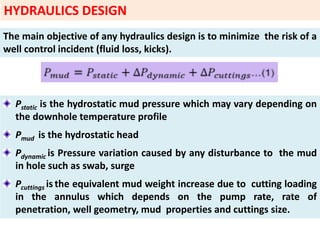
Pstatic is the hydrostatic mud pressure which may vary depending on
the downhole temperature profile
Pmud is the hydrostatic head
Pdynamic is Pressure variation caused by any disturbance to the mud
in hole such as swab, surge
Pcuttings is the equivalent mud weight increase due to cutting loading
in the annulus which depends on the pump rate, rate of
penetration, well geometry, mud properties and cuttings size.
HYDRAULICS DESIGN
Calculating mud density:
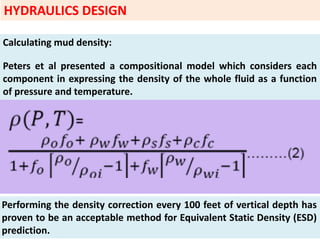
Peters et al presented a compositional model which considers each
component in expressing the density of the whole fluid as a function
of pressure and temperature.
Performing the density correction every 100 feet of vertical depth has
proven to be an acceptable method for Equivalent Static Density (ESD)
prediction.
HYDRAULICS DESIGN
Viscometer:
 Ron Bland et al (2006) set out to develop a new
viscometer(Chandler 7600 or XHPHT viscometer) suitable for
HP/HT drilling.
 Criteria for the new HP/HT viscometer included:
 Working pressure up to 40,000 psig and Working temperature
up to 600°F
 Capable of accurate measurements in fluids containing
ferromagnetic material.
 Anticipate any fluid problems at anticipated down hole
pressure and temperature or even extreme conditions, a fluid
can be tested at higher temperatures and pressures
HYDRAULICS DESIGN
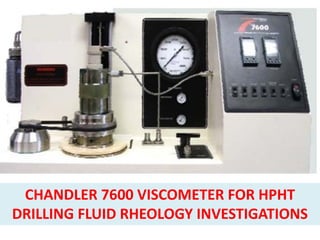
CHANDLER 7600 VISCOMETER FOR HPHT
DRILLING FLUID RHEOLOGY INVESTIGATIONS
 The hydraulics program used in the HPHT sections can generate the
following information:
 Pump pressure and bit hydraulics.
 Hydrostatic pressure Pstatic at a given downhole temperature
profile.
 The dynamic pressure(s) as described including an individual
dynamic pressure or any combination of the dynamic pressures
such as surge and swab, pressure required to break gels and
inertial pressure.
 Surface mud weight versus temperature chart.
 Thermal expansion of mud in the hole.
 Effects of the various parameters on bottom hole mud pressure
or ECD.
HYDRAULICS DESIGN
So with this we come to the end of
the first part of our presentation.
Before we move on the second
part, we can have a short question
& answer session on some of the
topics presented in this part.
REFERENCES
1. http://www.flowprocess.com/mud_cooling_system.html
2. SPE‐103731‐MS,HPHT drilling fluid challenges
3. SPE 155320 Offshore Drilling & Well Testing Of A HPHT Gas Well: A
Case Study.
4. The DRILLING FLUID TEMPERATURE CONTROL SYSTEM† (DFTCS†)
from M‐I SWACO, a Schlumberger company, Schlumberger
company website.
5. SPE‐150737‐MS,Advances in mud design and challenges in HPHT
wells.
6. IPTC 16466, Drilling and completing HPHT wells difficulties with the
aid of cesium brine formate a performance review.
We now move on to the second
part of this presentation on
HPHT Drilling Fluids. We
will be seeing some of the
important aspects of the
Chemistry of Drilling Fluids
for HPHT Applications
The Chemistry of
Drilling Fluids for
HPHT
Applications
HTHP WELLS WILL MAKE SPECIAL DEMANDS ON THE
DRILLING FLUID.
 Temperature will alter the chemistry of the components
of the drilling fluid.
 High Pressure will induce its own problems
 HTHP wells are generally: BHST > 300° F (150 °C)
 Mud density needed >16.0 ppg (1.92 sg)
 Therefore, muds must be able to function under these
exacting conditions.
MECHANISM OF THERMAL DEGRADATION
THERMAL EFFECTS
 When putting so much energy into a chemical
substance, a portion of the structure breaks off or
changes form.
 The following are the most common chemical changes:
 Oxygen – promotes Oxidation
 Water – promotes Hydrolysis
HYDROLYSIS
 A chemical reaction in which a compound reacts with
water, causing decomposition and production of two or
more other compounds
 An example of hydrolysis ---- the conversion of starch to
glucose.
MECHANISM OF THERMAL DEGRADATION
CONTAMINATION
HTHP wells often face contamination problems
Acid gas (H2S & CO2). These gases create their own problems.
Higher mud weights are used in HPHT wells [1.90 - 2.30] - the
weighing material may be contaminated - for instance, silt is
always present in barite.
Longer trip times (no circulation for extended times). The
drilling fluid is exposed to high BHST for long periods of time.
Drilled solids are also a major contaminant affecting the
rheology of the drilling fluid in conditions of high
temperature.
FLOCCULATION OR DISPERSION?
 Exposure of the drilling fluid to High temperatures can cause:
 Flocculation
 Dispersion
 Flocculation or Dispersion? What will occur? This will depend on:
 The mud type
 The contaminants
 The effects of high temperature
 The duration of exposure to high temperature,
 The sensitivity of the chemicals used in the mud
formulation
 The treatment pattern and
 Solids control
FLOCCULATION OR DISPERSION?
An increased quantity of clay platelets is observed as they tend
to split from the aggregated stacks.
Drop in pH due to reaction of hydroxyl ions. Increased surface
area and the drop in pH will increase flocculation.
Down hole conditions results in:
 Increased demand for alkali as the hydroxyl ion is
consumed in chemical reactions at the elevated
temperatures leading to a drop in the pH.
 Increased demand for deflocculants.
 Failure to replenish the deflocculants or the failure of
the deflocculants can lead to severe flocculation or
gelation.
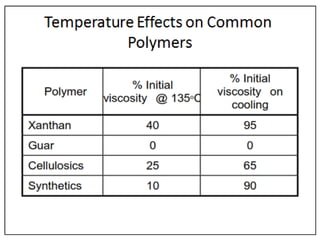
HT POLYMER MUDS
Most polymer systems are maintained with:
 Low solids content
 Clay inhibition
This will extend temperature stability
The Polymers of the polymer mud system are Susceptible to
degradation by:
 Cleavage of the polymer chain
 Possible chemical modification of the attached groups
Hydrolysis & Oxidation controlled by:
 Maintaining the pH between 9.5 - 10.5
 Using Oxygen scavengers
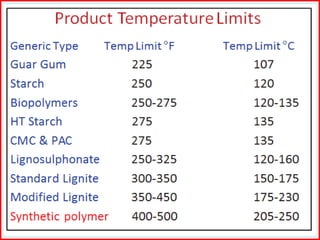
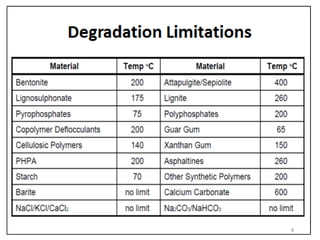
EXTENDING TEMPERATURE LIMITS
 The temperature limitations of the chemicals used in the formulation of
the HPHT drilling fluid can be extended by a few pertinent steps.
 pH 9.5 - 10 to be maintained. This helps in extending the temperature
limits.
 Oxygen scavenging can increase the temperature limit by 25 deg F
 Formulating in brine - this can extend the temperature limit by 50 deg F
and brine acts as a powerful antioxidant and has less solids. Therefore,
we have lesser flocculation problems.
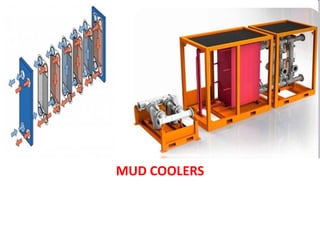
 And last but definitely not the least - use of a mud cololer. Mud coolers
bring down the temperatures to which the drilling fluid and its
components are subjected to. Depending on the mud cooler, the
temperature of the drilling fluid can be brought down by nearly 15 to
30 deg C [58 to 86 deg F]
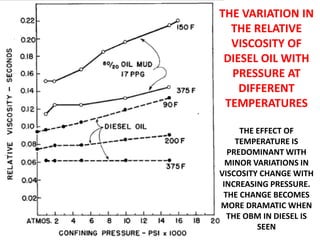
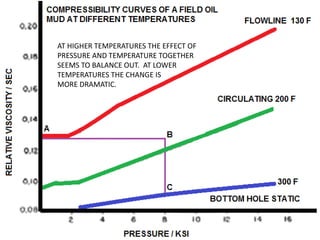
THE VARIATION IN
THE RELATIVE
VISCOSITY OF
DIESEL OIL WITH
PRESSURE AT
DIFFERENT
TEMPERATURES
THE EFFECT OF
TEMPERATURE IS
PREDOMINANT WITH
MINOR VARIATIONS IN
VISCOSITY CHANGE WITH
INCREASING PRESSURE.
THE CHANGE BECOMES
MORE DRAMATIC WHEN
THE OBM IN DIESEL IS
SEEN
AT HIGHER TEMPERATURES THE EFFECT OF
PRESSURE AND TEMPERATURE TOGETHER
SEEMS TO BALANCE OUT. AT LOWER
TEMPERATURES THE CHANGE IS
MORE DRAMATIC.
MUD COOLERS
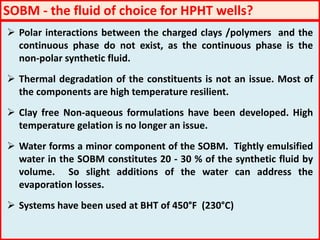
SOBM - the fluid of choice for HPHT wells?
 Polar interactions between the charged clays /polymers and the
continuous phase do not exist, as the continuous phase is the
non-polar synthetic fluid.
 Thermal degradation of the constituents is not an issue. Most of
the components are high temperature resilient.
 Clay free Non-aqueous formulations have been developed. High
temperature gelation is no longer an issue.
 Water forms a minor component of the SOBM. Tightly emulsified
water in the SOBM constitutes 20 - 30 % of the synthetic fluid by
volume. So slight additions of the water can address the
evaporation losses.
 Systems have been used at BHT of 450°F (230°C)
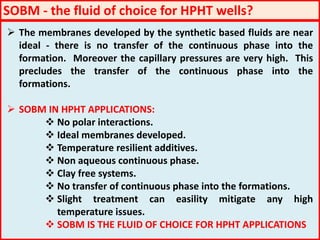
 The membranes developed by the synthetic based fluids are near
ideal - there is no transfer of the continuous phase into the
formation. Moreover the capillary pressures are very high. This
precludes the transfer of the continuous phase into the
formations.
 SOBM IN HPHT APPLICATIONS:
 No polar interactions.
 Ideal membranes developed.
 Temperature resilient additives.
 Non aqueous continuous phase.
 Clay free systems.
 No transfer of continuous phase into the formations.
 Slight treatment can easility mitigate any high
temperature issues.
 SOBM IS THE FLUID OF CHOICE FOR HPHT APPLICATIONS
SOBM - the fluid of choice for HPHT wells?
WHAT HAPPENS WHEN IT GETS TOO HOT?
The following are the drilling
fluid properties that will be
affected due to the high
temperatures the mud is
exposed to:
1. Density
2. Viscosity
3. Filtrate Control
4. Alkalinity
5. Methylene Blue Test (MBT)
6. Flash Point
The properties affected are interlinked
with each other. For instance, high
filtration losses will dehydrate the mud
and lead to higher viscosities. Loss in
alkalinity will increase the gelation. So
the effect of temperature on one mud
property invariably affects the others
too.
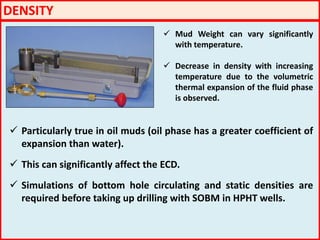
DENSITY
 Mud Weight can vary significantly
with temperature.
 Decrease in density with increasing
temperature due to the volumetric
thermal expansion of the fluid phase
is observed.
 Particularly true in oil muds (oil phase has a greater coefficient of
expansion than water).
 This can significantly affect the ECD.
 Simulations of bottom hole circulating and static densities are
required before taking up drilling with SOBM in HPHT wells.
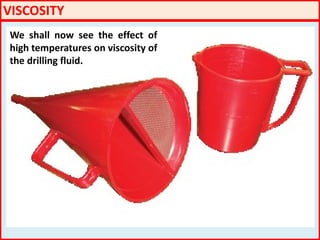
VISCOSITY
We shall now see the effect of
high temperatures on viscosity of
the drilling fluid.
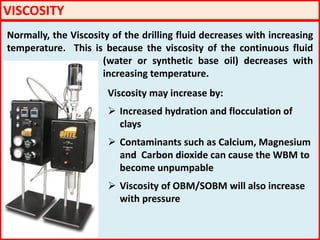
VISCOSITY
Normally, the Viscosity of the drilling fluid decreases with increasing
temperature. This is because the viscosity of the continuous fluid
(water or synthetic base oil) decreases with
increasing temperature.
Viscosity may increase by:
 Increased hydration and flocculation of
clays
 Contaminants such as Calcium, Magnesium
and Carbon dioxide can cause the WBM to
become unpumpable
 Viscosity of OBM/SOBM will also increase
with pressure
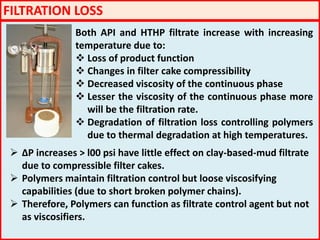
FILTRATION LOSS
Both API and HTHP filtrate increase with increasing
temperature due to:
 Loss of product function
 Changes in filter cake compressibility
 Decreased viscosity of the continuous phase
 Lesser the viscosity of the continuous phase more
will be the filtration rate.
 Degradation of filtration loss controlling polymers
due to thermal degradation at high temperatures.
 ΔP increases > l00 psi have little effect on clay-based-mud filtrate
due to compressible filter cakes.
 Polymers maintain filtration control but loose viscosifying
capabilities (due to short broken polymer chains).
 Therefore, Polymers can function as filtrate control agent but not
as viscosifiers.
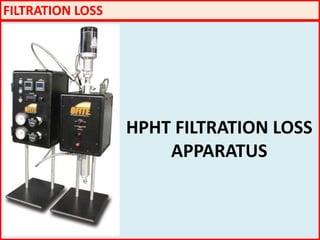
FILTRATION LOSS
HPHT FILTRATION LOSS
APPARATUS
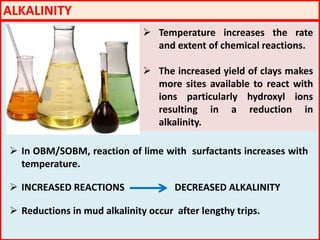
ALKALINITY
 Temperature increases the rate
and extent of chemical reactions.
 The increased yield of clays makes
more sites available to react with
ions particularly hydroxyl ions
resulting in a reduction in
alkalinity.
 In OBM/SOBM, reaction of lime with surfactants increases with
temperature.
 INCREASED REACTIONS DECREASED ALKALINITY
 Reductions in mud alkalinity occur after lengthy trips.
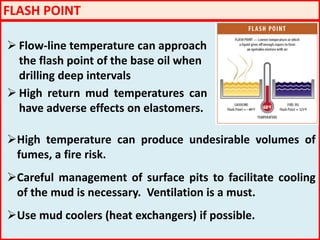
FLASH POINT
 Flow-line temperature can approach
the flash point of the base oil when
drilling deep intervals
 High return mud temperatures can
have adverse effects on elastomers.
High temperature can produce undesirable volumes of
fumes, a fire risk.
Careful management of surface pits to facilitate cooling
of the mud is necessary. Ventilation is a must.
Use mud coolers (heat exchangers) if possible.
THE SYMPTOMS OF HIGH TEMPERATURE
 Typical symptoms are:
 High viscosity and gel strengths
 Increased fluid loss
 Decreased alkalinity
 These are manifested as the following:
 Difficulty in breaking circulation
 Difficulty running tools to bottom
 Difficulty in degassing circulated mud
 The first indications seen in bottoms up samples after trips (so
bottoms up mud should be tested).
 Long trip times in HTHP wells. The mud is exposed to near BHT for
long periods.
REMEDIAL ACTIONS TO COUNTER THE EFFECT OF
HIGH TEMPERATURE AND HIGH PRESSURE
 For Increased Rheology and Gels -- add water (or base oil in
SOBM) to compensate for:
 Increased surface area of clays
 Increased downhole filtration and
 Surface evaporation
 Muds at high temperature get dehydrated rapidly.
 Reduce the LGS content. This is generally very helpful. Reducing
the LG solids can help in the:
 Control of the viscosity of the drilling fluid
 Improve product performance
 Improve flow properties
 Add deflocculants - If Bottoms Up samples indicate flocculation
tendency.
 Substitute the existing product with one better suited to the BHT.
 Care must be exercised when increasing product concentration.
 Chemicals will take up free water and this can negate any
beneficial effects of deflocculation.
 Adjust pH-maintenance of adequate alkalinity will:
 Decrease flocculation of clays,
 Ensure that deflocculants function effectively and
 Minimise hydrolysis of polymers.
 Most WBM with a pH in the range 9.0 - 9.5 should be
targeted.
INCREASED FILTRATE (API AND HPHT FILTRATION
LOSS TESTS)
 Add HT filtrate reducer.
 More thermally stable product should be used.
 Expensive option (of HPHT filtration loss control additives) usually
proves more cost effective.
It is generally more costly to do
a thing cheaply
SOBM
To combat increased viscosity and gels regular additions of base oil
are necessary.
Increased filtrate and surface evaporation reduces total oil content
of mud.
If not replaced, system will lose base oil rapidly and the
performance of the synthetic mud will deteriorate.
Add Oil Wetting Agents
 If all solids are oil wet, the inter-particle reactions are
reduced.
 This results in reductions in viscosity and gel strengths.
 However care must be taken to avoid over treatment as
this can reduce suspension characteristics to levels that
will promote inefficient hole cleaning and barite
settlement.
INCREASED HTHP FILTRATION LOSS
 Add sufficient lime to restore a good excess (2 -3 lb/bbl)
 If not effective, increase levels of emulsifiers
 Add dry powder filtrate reducer - e.g.
Amine lignite,
Soltex,
Gilsonite
 Prior to the addition of these types of products, their
compatibility with the producing formation must be
established.
MUD SELECTION
 Prior to drilling an HTHP interval, contingencies must be
in place to ensure that the potential fluid problems,
common on HTHP wells, can be anticipated and
corrected.
 Selection will depend on factors other than just BHT
such as:
1. Location of the well
2. Remoteness
3. Environment sensitivity
4. Use of an oil mud may be restricted
5. The anticipated formations and contaminants are
important factors.
6. Highly dispersed water based muds are not appropriate
to drill:
Reactive shales
Formations where CO2 is predicted
Formations where brine flows are predicted
7. CO2 will have negative effects on WBM that do not
contain lime.
8. WBM treated with lime can be particularly difficult to
stabilize at high temperatures. The mud can become
umpumpable at times.
BARITE SAG
 Barite sag is not a static phenomenon but a dynamic one.
 Prevention of barite sag is a major challenge on high angle
HTHP wells.
 At angles >30° deviation, the formulation must be tested
for barite sag potential.
 Risk is minimized by testing and by the use of the most
appropriate blend of viscosifiers.
 Optimising low-end rheology is a very effective tool in
controlling barite sagging.
 Continuous circulation at low circulation rates should be
particularly avoided.
SOLIDS REMOVAL EQUIPMENT
 Drilled solids are the major contaminants of any mud system.
 The adverse effects are amplified by:
Large quantities of weighting agents
Contamination effects from Carbon dioxide and
Calcium from the formations or shoe tract drilling.
 Effective solids removal is essential. This can be achieved by:
Primary separation by fine shaker screens
Use more number of shale shakers if required
Hydrocyclones
Centrifuges
Maintain a record of the solids control efficiency
MUD ENGINEERS IN HPHT WELLS
 Mud engineers employed on HTHP wells should be
familiar with:
Mud system program for the HPHT wells
Engineering techniques
Contingencies
 The Mud Engineers should be:
Competency assessed and
Approved for HTHP work
When using WBM, the mud engineer must know:
 The techniques required to treat the effects of all
possible contaminants and thermal gelation effects
 The use of hot rolling ovens and Fann 70 rheometer
 H2S detection, analysis and treatment
 CO2 detection, analysis and treatment
 The formulation and placement procedures for barite
plugs
 General lost circulation techniques and those specific
to induced fractures
 PρT studies on the drilling fluid in use
WHEN USING SOBM, THE MUD ENGINEER MUST
KNOW:
 The behavior of the SOBM at downhole temperature and
pressure conditions
 Simulating the downhole temperature and pressure
conditions and the response of the mud to these
downhole conditions.
 Predicting the effect of high temperature and pressure on
the overall behavior of the mud, most importantly on the:
Density
Viscosity and flow behavior
Rheology
 Barite sag
 Methods of analyzing barite sag
 Techniques of preventing barite sag
 Particle size distribution techniques and implementation
 Familiarity with use of WARP barite
 Solubility of Hydrocarbons in the base fluid of the SOBM at downhole
temperature and pressure conditions. Simulation and prediction of these
effects is desirable
 Hole cleaning
 ECD Management
 Swab and Surge pressures - calculation and remediation
 Effective Pit Management
 Kick Control in Synthetic muds.
 H2S handling and mitigation of the effects of H2S
 Volume management and reporting
 PρT studies on the drilling fluid.
QA/QC PROGRAMS FOR HPHT DRILLING FLUIDS
 QA/QC Program must be established for Barite and Bentonite
(when applicable). Use only Wyoming grade Bentonite.
 Chemicals added can have disastrous effects on a high solids
water based mud if their effect is not known before hand and
not studied before adding into the mud.
 Pilot testing is of utmost importance
 Check the temperature limitations of the chemicals before
adding them into the system.
 Do not use chemicals of unproven heritage. Use properly
tested and verified chemicals.
 The entire mud package must be thoroughly screened for
HPHT applications before use.
 The effect of contaminants must be carefully studied.
OPERATIONAL CONSIDERATIONS
 WBM bottoms up after a trip must be observed. The mud
engineer must particularly see:
 If the mud return on bottoms up is extremely viscous.
 If there are signs of Clay hydration.
 In addition, if a loss of the effect of the deflocculant is
observed.
 If environmental constraints allow, dump highly viscous mud that
returns after the bottoms up (in case of WBM only)
 If allowed into the circulating system, it will damage properties
(Increased MBT, Viscosity & Gels)
 Frequent additions of base fluid (water or oil) is good
 Loss of base fluid occurs due to:
 Downhole filtration.
 Surface evaporation resulting from high flowline
temperatures.
 Downhole filtration rates should be preferably monitored
with a dynamic filtration loss apparatus. This would give
the results close to what is happening in the well.
 Capillary flow studies of the base fluid (in case of synthetic
systems) can be carried out to determine the flow of the
base fluid into the pore openings. Generally the extremely
high capillary pressures preclude the entry of the synthetic
fluid into the pore spaces of the formation
OPERATIONAL TIPS
1. When in HTHP intervals, any additions to the mud
system should normally be made when circulating but
not while drilling.
2. Close monitoring of mud levels for losses or gains is
essential while drilling.
3. Fingerprinting the system is a must.
4. Even closely controlled addition of fluid to the active
pit can cause confusion and doubt.
5. When running a dispersed water based mud, it is vital
that the low gravity solids content be kept under
control.
6. It is the tendency among mud engineers to control increasing gel
strengths with chemical thinners, thus allowing solids to increase
to a point where the mud becomes unmanageable.
7. The availability of a hot rolling oven and/or a Fann 70 rheometer
at the rig site will allow "look ahead" viscosities and gels to be
run.
8. The reaction of the current mud to anticipated temperatures can
be studied and treatments made.
9. Particularly in WBM, be sure to monitor closely for H2S which
may come from the formation or from the breakdown of mud
products.
10. Suitable treatment products must be on hand at the rig site to
render H2S harmless to rig personnel and equipment.
THANK YOU VERY MUCH

DRILLING FLUIDS FOR THE HPHT ENVIRONMENT

  • 2.
    OUTLINE OF THEPRESENTATION 1. Introduction 2. Mud evaluation criteria for HPHT wells 3. Mud treatment 4. Mud cooling 5. Swab and Surge - ECD Management 6. Hydraulics
  • 3.
  • 5.
     As HPHTdrilling operations are expensive and risky, an accurate knowledge of drilling fluid behavior under actual conditions is required to maximize operational efficiency and to minimize cost and drilling fluids related risks.  Hence, a thorough understanding of the Drilling Fluids is very important and essential as the Drilling Fluids are the very core of the drilling process. WHY UNDERSTANDING DRILLING FLUIDS IS ESSENTIAL?
  • 6.
    1. Best wellproductivity at lowest drawdown. 2. Best well integrity and longest structural lifetime. 3. Lowest well construction cost. 4. Lowest environmental impact and liability exposure. 5. Best reservoir information capture. THE MAIN OBJECTIVES OF DRILLING FLUID ARE
  • 7.
    MUD EVALUATION CRITERIA COMMONLYUSED MUD TYPES IN HPHT WELLS: 1. Invert emulsion fluids - SOBM 2. Cesium Formate brine based drilling fluids 3. HPHT WBM
  • 8.
    The drilling fluidchosen must offer a host of functionalities: 1. Ability to maintain the integrity of weak rocks. 2. Ability to minimize fluid loss into permeable rocks. 3. Ability to provide stable well control 4. Ability to efficiently transfer hydraulic power. 5. Ability to move cuttings to the surface 6. Provide steel/steel and steel/rock lubricity 7. Provide protection against all forms of corrosion. 8. Allow formation evaluation. 9. Pose little or no hazard to rig personnel. 10. Have little or no adverse effect on the environment. 11. Have little or no adverse effect on elastomers. MUD EVALUATION CRITERIA
  • 9.
    INVERT EMULSION FLUIDS InvertEmulsion fluids have been utilized for drilling HP/HT wells and the technology is adequate for temperatures up to 500 °F. Table 1 illustrates the generic name and functions of the specialty additives used in the formulation of HP/HT invert emulsion fluids.
  • 11.
    • Syneresis isthe expulsion of a liquid from a gel. In drilling fluids it is the expulsion of water / base oil from a suspension containing clays / organophilic clays in the liquid continuous phase. • The opposite process of syneresis is imbibition, meaning, a material that absorbs water molecules from the surrounding. Alginate is also an example of imbibition since if soaked in water, it will absorb it. Syneresis Emulsification
  • 12.
    SYNERESIS IN ANINVERT EMULSION DRILLING FLUID
  • 13.
    ADVANTAGES: 1. Minimal formationdamage. 2. Maintenance of additive properties at high temperatures. 3. Elimination of barite and its sagging problems. 4. Reduced hydraulic flow resistance. 5. Lower ECDs. 6. Better kick detection and well control. 7. Faster flow‐checks. 8. Low potential for differential sticking. 9. Reduced torque and drag. 10. Inhibition of hydrate formation. 11. Very low corrosion rates. 12. Compatibility with elastomers. 13. Lower swab and surge pressures. 14. Better power transmission to motors and bits. 15. Low gas solubility CESIUM FORMATE BRINES BASED DRILLING FLUIDS
  • 14.
     Mud treatmentor solids control is the process of controlling the buildup of undesirable solids in a mud system.  Rheological and Filtration properties can become difficult to control when the concentration of drilled solids (low‐ gravity solids) becomes excessive.  Penetration rates and bit life decrease and hole problems increase with a high concentration of drill solids. MUD TREATMENT
  • 15.
     Solids‐control equipmenton a drilling operation should be operated like a processing plant.  In an ideal situation, all drill solids are removed from a drilling fluid.  Under typical drilling conditions, low‐gravity solids should be maintained below 6 percent by volume. MUD TREATMENT
  • 16.
    SOURCES AND SIZESOF SOLIDS  The two primary sources of solids (particles) are chemical additives and drilled solids.  Most formation solids can be removed by mechanical means at the surface.  The particle size of drilled solids incorporated into drilling fluid can range from 1 to 250 microns (1 micron equals 1/25,400 of an inch or 1/1,000 of a millimeter.
  • 17.
    TABLE OF SOLIDSSIZES Common solids found in drilling fluids range in size from 1 to 1,000 microns.
  • 18.
    MUD TREATMENT -SOLIDS CONTROL Mechanical solids‐removal equipment Equipment that removes solids mechanically can be grouped into two major classifications:  Screen devices  Centrifugal separation devices
  • 19.
    Table of Solids‐controlequipment and effective operating ranges in microns. The particle size removed depends on the type of solids‐control equipment.
  • 20.
    MUD CONDITIONING -CENTRIFUGES 1.Use centrifugal forces. 2.Separate heavy solids from liquid and lighter components. 3.Consists of:  Horizontal conical steel bowel, rotating at high speed.  Double screw type conveyor inside the bowel rotated at low speed. The conveyor contains a hollow spindle for feeding mud.
  • 21.
    4. The solidsremoved from the liquid by centrifugal forces. 5. The rotation of the bowel holds the slurry in bond against the wall of the bowel. 6. The conveyor blades scrapes or pushes the settled solids towards a narrow end of the bowel. 7. The solids collected are a dump particles with no fluids. 8. The liquid and clay particles collected as an overflow from ports at the large end of the bowel. 9. Clean mud requires treatment if properties changed. MUD CONDITIONING - CENTRIFUGES
  • 22.
  • 23.
  • 24.
    SEPARATION EFFICIENCY The separationefficiency of hydrocyclones depends on four general factors: 1. Fluid properties 2. Particle properties 3. Flow parameters 4. Hydrocyclone operating parameters
  • 25.
    SEPARATION EFFICIENCY SEPARATION EFFICIENCYAS A FUNCTION OF THE VISCOSITY OF THE FLUID AND THE DENSITY OF THE FLUID SEPARATION EFFICIENCY AS A FUNCTION OF THE VISCOSITY OF THE FLUID AND THE DENSITY OF THE FLUID
  • 26.
    SEPARATION EFFICIENCY SEPARATION EFFICIENCYAS A FUNCTION OF THE VISCOSITY OF THE PARTICLE DIAMETER AND THE PARTICLE DENSITY SEPARATION EFFICIENCY AS A FUNCTION OF THE VISCOSITY OF THE PARTICLE DIAMETER AND THE PARTICLE DENSITY
  • 27.
    SEPARATION EFFICIENCY SEPARATION EFFICIENCYAS A FUNCTION OF THE FLOW RATE AND THE TANGENTIAL VELOCITY SEPARATION EFFICIENCY AS A FUNCTION OF THE FLOW RATE AND THE TANGENTIAL VELOCITY
  • 28.
    DILUTION: Dilution, or theaddition of base fluid to a mud system, serves to:  Reduce concentration of solids left by mechanical solids removal equipment  Replenish liquids lost when using mechanical solids control equipment Dilution can generate excessive volumes. It is not a first choice for solids control. But dilution is needed all the same. MUD TREATMENT
  • 29.
    MUD COOLING  DrillingFluid Temperature Control System DFTCS : Commonly known as the Mud Cooler.  Mud Cooler system is used to reduce the temperature of drilling fluid returned to the surface.  In HTHP wells the temperature of the drilling fluid must be strictly controlled to keep its properties within the specified parameters for that particular well.
  • 30.
    If the temperatureof the drilling fluid is allowed to increase then a variety of problems can occur such as:  Reduction in viscosity.  Formation breakdown.  Unstable filter‐cake.  Lost of circulation.  Packing off.  Degradation of chemicals except weighting material.  Stuck pipe.  Evaporation of the oil and water phases. MUD COOLING
  • 31.
  • 32.
    1. Maintains drillingfluid efficiency. 2. Reduce need for continuous replenishmentt of mud conditioning additives 3. Extend life of elastomer seals on BOP, LWD/MWD tools, riser, shaker, centrifuges and pumps. 4. Increases accuracy of downhole measurement devices. 5. Reduces mud‐related downhole problems. 6. Eliminate noxious oil‐based mud surface emissions. 7. Improves safety of HPHT drilling operation. 8. Improves the ambience for the comfort of the personnel. MUD COOLING BENEFITS
  • 33.
    1. The effectsof pressure and temperature on mud weight must be considered in the drilling of HPHT wells. 2. Unfortunately, due to the changes of downhole temperature and pressure profile it is impossible even to maintain a constant hydrostatic pressure. 3. The hydrostatic overbalance varies within a certain range(pump rate and the mud properties). 4. Non‐aqueous and water‐based fluids used for drilling HPHT wells up to 500°F (260°C). 5. HPHT approaching temperature 600°F (316°C) use fluids with higher temperature stability. ECD, SWAB AND SURGE
  • 34.
     The combinationof the relatively high viscosity mud, deep wells and small annular clearances leads to higher than normal friction pressure during mud circulation.  Mud hydrostatic pressure and friction pressure then combine to give the equivalent circulating density (ECD)  This can cause increase in ECD.  The high annular pressure losses can then lead to a high ECD value, higher than the fracture gradient equivalent mud weight of the formation. This can lead to mud loss and all the problems associated with mud loss.  It should always be borne in mind that the mud weight window, i.e. the window between the fracture gradient and the pore pressure is always very small in HPHT wells. EQUIVALENT CIRCULATING DENSITY
  • 35.
    SWABBING & SURGING Maincauses; • Pull pipe too fast • Balled bit/BHA • Viscous mud • Narrow annulus The combination of the relatively high viscosity mud, deep wells and small annular clearances leads to swab or surge. LOC/kick can occurs due to surrging/swabbing
  • 36.
     Using CesiumFormate Brine based drilling fluid (an aqueous formulation of solids‐free mud (up to SG 2.30) can help in the drilling of HPHT wells:  Reduced hydraulic flow resistance, ECDs, swab and surge pressures, gas solvency, potential for differential sticking, torque and drag, corrosion  Minimal formation damage  Maintenance of additive properties at high temperatures  No solids except bridging materials and polymers for filtration control and rheology modification. The main weighing material is Cesium Formate, which is present as a dissolved solid. CESIUM FORMATE BRINE BASED DRILLING FLUIDS AND THE ECD MANAGEMENT
  • 37.
    HPHT problems:  Highloading of barite in conventional mud creates high frictional pressure losses during circulation, leading to unacceptably high equivalent circulating densities.  HPHT breaks down the solid carrying capacity (yield point) causing both dynamic and static barite sag and severely increasing the risk of loss of well control.  An influx of hydrocarbon gas into designed oil bas mud may destabilize the formulation and cause rheological problems. HYDRAULICS
  • 38.
    The main objectiveof any hydraulics design is to minimize the risk of a well control incident (fluid loss, kicks). Pstatic is the hydrostatic mud pressure which may vary depending on the downhole temperature profile Pmud is the hydrostatic head Pdynamic is Pressure variation caused by any disturbance to the mud in hole such as swab, surge Pcuttings is the equivalent mud weight increase due to cutting loading in the annulus which depends on the pump rate, rate of penetration, well geometry, mud properties and cuttings size. HYDRAULICS DESIGN
  • 39.
    Calculating mud density: Peterset al presented a compositional model which considers each component in expressing the density of the whole fluid as a function of pressure and temperature. Performing the density correction every 100 feet of vertical depth has proven to be an acceptable method for Equivalent Static Density (ESD) prediction. HYDRAULICS DESIGN
  • 40.
    Viscometer:  Ron Blandet al (2006) set out to develop a new viscometer(Chandler 7600 or XHPHT viscometer) suitable for HP/HT drilling.  Criteria for the new HP/HT viscometer included:  Working pressure up to 40,000 psig and Working temperature up to 600°F  Capable of accurate measurements in fluids containing ferromagnetic material.  Anticipate any fluid problems at anticipated down hole pressure and temperature or even extreme conditions, a fluid can be tested at higher temperatures and pressures HYDRAULICS DESIGN
  • 41.
    CHANDLER 7600 VISCOMETERFOR HPHT DRILLING FLUID RHEOLOGY INVESTIGATIONS
  • 42.
     The hydraulicsprogram used in the HPHT sections can generate the following information:  Pump pressure and bit hydraulics.  Hydrostatic pressure Pstatic at a given downhole temperature profile.  The dynamic pressure(s) as described including an individual dynamic pressure or any combination of the dynamic pressures such as surge and swab, pressure required to break gels and inertial pressure.  Surface mud weight versus temperature chart.  Thermal expansion of mud in the hole.  Effects of the various parameters on bottom hole mud pressure or ECD. HYDRAULICS DESIGN
  • 43.
    So with thiswe come to the end of the first part of our presentation. Before we move on the second part, we can have a short question & answer session on some of the topics presented in this part.
  • 44.
    REFERENCES 1. http://www.flowprocess.com/mud_cooling_system.html 2. SPE‐103731‐MS,HPHTdrilling fluid challenges 3. SPE 155320 Offshore Drilling & Well Testing Of A HPHT Gas Well: A Case Study. 4. The DRILLING FLUID TEMPERATURE CONTROL SYSTEM† (DFTCS†) from M‐I SWACO, a Schlumberger company, Schlumberger company website. 5. SPE‐150737‐MS,Advances in mud design and challenges in HPHT wells. 6. IPTC 16466, Drilling and completing HPHT wells difficulties with the aid of cesium brine formate a performance review.
  • 45.
    We now moveon to the second part of this presentation on HPHT Drilling Fluids. We will be seeing some of the important aspects of the Chemistry of Drilling Fluids for HPHT Applications
  • 46.
    The Chemistry of DrillingFluids for HPHT Applications
  • 47.
    HTHP WELLS WILLMAKE SPECIAL DEMANDS ON THE DRILLING FLUID.  Temperature will alter the chemistry of the components of the drilling fluid.  High Pressure will induce its own problems  HTHP wells are generally: BHST > 300° F (150 °C)  Mud density needed >16.0 ppg (1.92 sg)  Therefore, muds must be able to function under these exacting conditions.
  • 48.
    MECHANISM OF THERMALDEGRADATION THERMAL EFFECTS  When putting so much energy into a chemical substance, a portion of the structure breaks off or changes form.  The following are the most common chemical changes:  Oxygen – promotes Oxidation  Water – promotes Hydrolysis
  • 49.
    HYDROLYSIS  A chemicalreaction in which a compound reacts with water, causing decomposition and production of two or more other compounds  An example of hydrolysis ---- the conversion of starch to glucose. MECHANISM OF THERMAL DEGRADATION
  • 50.
    CONTAMINATION HTHP wells oftenface contamination problems Acid gas (H2S & CO2). These gases create their own problems. Higher mud weights are used in HPHT wells [1.90 - 2.30] - the weighing material may be contaminated - for instance, silt is always present in barite. Longer trip times (no circulation for extended times). The drilling fluid is exposed to high BHST for long periods of time. Drilled solids are also a major contaminant affecting the rheology of the drilling fluid in conditions of high temperature.
  • 51.
    FLOCCULATION OR DISPERSION? Exposure of the drilling fluid to High temperatures can cause:  Flocculation  Dispersion  Flocculation or Dispersion? What will occur? This will depend on:  The mud type  The contaminants  The effects of high temperature  The duration of exposure to high temperature,  The sensitivity of the chemicals used in the mud formulation  The treatment pattern and  Solids control
  • 52.
    FLOCCULATION OR DISPERSION? Anincreased quantity of clay platelets is observed as they tend to split from the aggregated stacks. Drop in pH due to reaction of hydroxyl ions. Increased surface area and the drop in pH will increase flocculation. Down hole conditions results in:  Increased demand for alkali as the hydroxyl ion is consumed in chemical reactions at the elevated temperatures leading to a drop in the pH.  Increased demand for deflocculants.  Failure to replenish the deflocculants or the failure of the deflocculants can lead to severe flocculation or gelation.
  • 53.
    HT POLYMER MUDS Mostpolymer systems are maintained with:  Low solids content  Clay inhibition This will extend temperature stability The Polymers of the polymer mud system are Susceptible to degradation by:  Cleavage of the polymer chain  Possible chemical modification of the attached groups Hydrolysis & Oxidation controlled by:  Maintaining the pH between 9.5 - 10.5  Using Oxygen scavengers
  • 55.
    EXTENDING TEMPERATURE LIMITS The temperature limitations of the chemicals used in the formulation of the HPHT drilling fluid can be extended by a few pertinent steps.  pH 9.5 - 10 to be maintained. This helps in extending the temperature limits.  Oxygen scavenging can increase the temperature limit by 25 deg F  Formulating in brine - this can extend the temperature limit by 50 deg F and brine acts as a powerful antioxidant and has less solids. Therefore, we have lesser flocculation problems.  And last but definitely not the least - use of a mud cololer. Mud coolers bring down the temperatures to which the drilling fluid and its components are subjected to. Depending on the mud cooler, the temperature of the drilling fluid can be brought down by nearly 15 to 30 deg C [58 to 86 deg F]
  • 58.
    THE VARIATION IN THERELATIVE VISCOSITY OF DIESEL OIL WITH PRESSURE AT DIFFERENT TEMPERATURES THE EFFECT OF TEMPERATURE IS PREDOMINANT WITH MINOR VARIATIONS IN VISCOSITY CHANGE WITH INCREASING PRESSURE. THE CHANGE BECOMES MORE DRAMATIC WHEN THE OBM IN DIESEL IS SEEN
  • 59.
    AT HIGHER TEMPERATURESTHE EFFECT OF PRESSURE AND TEMPERATURE TOGETHER SEEMS TO BALANCE OUT. AT LOWER TEMPERATURES THE CHANGE IS MORE DRAMATIC.
  • 60.
  • 61.
    SOBM - thefluid of choice for HPHT wells?  Polar interactions between the charged clays /polymers and the continuous phase do not exist, as the continuous phase is the non-polar synthetic fluid.  Thermal degradation of the constituents is not an issue. Most of the components are high temperature resilient.  Clay free Non-aqueous formulations have been developed. High temperature gelation is no longer an issue.  Water forms a minor component of the SOBM. Tightly emulsified water in the SOBM constitutes 20 - 30 % of the synthetic fluid by volume. So slight additions of the water can address the evaporation losses.  Systems have been used at BHT of 450°F (230°C)
  • 62.
     The membranesdeveloped by the synthetic based fluids are near ideal - there is no transfer of the continuous phase into the formation. Moreover the capillary pressures are very high. This precludes the transfer of the continuous phase into the formations.  SOBM IN HPHT APPLICATIONS:  No polar interactions.  Ideal membranes developed.  Temperature resilient additives.  Non aqueous continuous phase.  Clay free systems.  No transfer of continuous phase into the formations.  Slight treatment can easility mitigate any high temperature issues.  SOBM IS THE FLUID OF CHOICE FOR HPHT APPLICATIONS SOBM - the fluid of choice for HPHT wells?
  • 63.
    WHAT HAPPENS WHENIT GETS TOO HOT? The following are the drilling fluid properties that will be affected due to the high temperatures the mud is exposed to: 1. Density 2. Viscosity 3. Filtrate Control 4. Alkalinity 5. Methylene Blue Test (MBT) 6. Flash Point The properties affected are interlinked with each other. For instance, high filtration losses will dehydrate the mud and lead to higher viscosities. Loss in alkalinity will increase the gelation. So the effect of temperature on one mud property invariably affects the others too.
  • 64.
    DENSITY  Mud Weightcan vary significantly with temperature.  Decrease in density with increasing temperature due to the volumetric thermal expansion of the fluid phase is observed.  Particularly true in oil muds (oil phase has a greater coefficient of expansion than water).  This can significantly affect the ECD.  Simulations of bottom hole circulating and static densities are required before taking up drilling with SOBM in HPHT wells.
  • 65.
    VISCOSITY We shall nowsee the effect of high temperatures on viscosity of the drilling fluid.
  • 66.
    VISCOSITY Normally, the Viscosityof the drilling fluid decreases with increasing temperature. This is because the viscosity of the continuous fluid (water or synthetic base oil) decreases with increasing temperature. Viscosity may increase by:  Increased hydration and flocculation of clays  Contaminants such as Calcium, Magnesium and Carbon dioxide can cause the WBM to become unpumpable  Viscosity of OBM/SOBM will also increase with pressure
  • 67.
    FILTRATION LOSS Both APIand HTHP filtrate increase with increasing temperature due to:  Loss of product function  Changes in filter cake compressibility  Decreased viscosity of the continuous phase  Lesser the viscosity of the continuous phase more will be the filtration rate.  Degradation of filtration loss controlling polymers due to thermal degradation at high temperatures.  ΔP increases > l00 psi have little effect on clay-based-mud filtrate due to compressible filter cakes.  Polymers maintain filtration control but loose viscosifying capabilities (due to short broken polymer chains).  Therefore, Polymers can function as filtrate control agent but not as viscosifiers.
  • 68.
  • 69.
    ALKALINITY  Temperature increasesthe rate and extent of chemical reactions.  The increased yield of clays makes more sites available to react with ions particularly hydroxyl ions resulting in a reduction in alkalinity.  In OBM/SOBM, reaction of lime with surfactants increases with temperature.  INCREASED REACTIONS DECREASED ALKALINITY  Reductions in mud alkalinity occur after lengthy trips.
  • 70.
    FLASH POINT  Flow-linetemperature can approach the flash point of the base oil when drilling deep intervals  High return mud temperatures can have adverse effects on elastomers. High temperature can produce undesirable volumes of fumes, a fire risk. Careful management of surface pits to facilitate cooling of the mud is necessary. Ventilation is a must. Use mud coolers (heat exchangers) if possible.
  • 71.
    THE SYMPTOMS OFHIGH TEMPERATURE  Typical symptoms are:  High viscosity and gel strengths  Increased fluid loss  Decreased alkalinity  These are manifested as the following:  Difficulty in breaking circulation  Difficulty running tools to bottom  Difficulty in degassing circulated mud  The first indications seen in bottoms up samples after trips (so bottoms up mud should be tested).  Long trip times in HTHP wells. The mud is exposed to near BHT for long periods.
  • 72.
    REMEDIAL ACTIONS TOCOUNTER THE EFFECT OF HIGH TEMPERATURE AND HIGH PRESSURE  For Increased Rheology and Gels -- add water (or base oil in SOBM) to compensate for:  Increased surface area of clays  Increased downhole filtration and  Surface evaporation  Muds at high temperature get dehydrated rapidly.  Reduce the LGS content. This is generally very helpful. Reducing the LG solids can help in the:  Control of the viscosity of the drilling fluid  Improve product performance  Improve flow properties
  • 73.
     Add deflocculants- If Bottoms Up samples indicate flocculation tendency.  Substitute the existing product with one better suited to the BHT.  Care must be exercised when increasing product concentration.  Chemicals will take up free water and this can negate any beneficial effects of deflocculation.  Adjust pH-maintenance of adequate alkalinity will:  Decrease flocculation of clays,  Ensure that deflocculants function effectively and  Minimise hydrolysis of polymers.  Most WBM with a pH in the range 9.0 - 9.5 should be targeted.
  • 74.
    INCREASED FILTRATE (APIAND HPHT FILTRATION LOSS TESTS)  Add HT filtrate reducer.  More thermally stable product should be used.  Expensive option (of HPHT filtration loss control additives) usually proves more cost effective. It is generally more costly to do a thing cheaply
  • 75.
    SOBM To combat increasedviscosity and gels regular additions of base oil are necessary. Increased filtrate and surface evaporation reduces total oil content of mud. If not replaced, system will lose base oil rapidly and the performance of the synthetic mud will deteriorate. Add Oil Wetting Agents  If all solids are oil wet, the inter-particle reactions are reduced.  This results in reductions in viscosity and gel strengths.  However care must be taken to avoid over treatment as this can reduce suspension characteristics to levels that will promote inefficient hole cleaning and barite settlement.
  • 76.
    INCREASED HTHP FILTRATIONLOSS  Add sufficient lime to restore a good excess (2 -3 lb/bbl)  If not effective, increase levels of emulsifiers  Add dry powder filtrate reducer - e.g. Amine lignite, Soltex, Gilsonite  Prior to the addition of these types of products, their compatibility with the producing formation must be established.
  • 77.
    MUD SELECTION  Priorto drilling an HTHP interval, contingencies must be in place to ensure that the potential fluid problems, common on HTHP wells, can be anticipated and corrected.  Selection will depend on factors other than just BHT such as: 1. Location of the well 2. Remoteness 3. Environment sensitivity 4. Use of an oil mud may be restricted 5. The anticipated formations and contaminants are important factors.
  • 78.
    6. Highly dispersedwater based muds are not appropriate to drill: Reactive shales Formations where CO2 is predicted Formations where brine flows are predicted 7. CO2 will have negative effects on WBM that do not contain lime. 8. WBM treated with lime can be particularly difficult to stabilize at high temperatures. The mud can become umpumpable at times.
  • 79.
    BARITE SAG  Baritesag is not a static phenomenon but a dynamic one.  Prevention of barite sag is a major challenge on high angle HTHP wells.  At angles >30° deviation, the formulation must be tested for barite sag potential.  Risk is minimized by testing and by the use of the most appropriate blend of viscosifiers.  Optimising low-end rheology is a very effective tool in controlling barite sagging.  Continuous circulation at low circulation rates should be particularly avoided.
  • 80.
    SOLIDS REMOVAL EQUIPMENT Drilled solids are the major contaminants of any mud system.  The adverse effects are amplified by: Large quantities of weighting agents Contamination effects from Carbon dioxide and Calcium from the formations or shoe tract drilling.  Effective solids removal is essential. This can be achieved by: Primary separation by fine shaker screens Use more number of shale shakers if required Hydrocyclones Centrifuges Maintain a record of the solids control efficiency
  • 81.
    MUD ENGINEERS INHPHT WELLS  Mud engineers employed on HTHP wells should be familiar with: Mud system program for the HPHT wells Engineering techniques Contingencies  The Mud Engineers should be: Competency assessed and Approved for HTHP work
  • 82.
    When using WBM,the mud engineer must know:  The techniques required to treat the effects of all possible contaminants and thermal gelation effects  The use of hot rolling ovens and Fann 70 rheometer  H2S detection, analysis and treatment  CO2 detection, analysis and treatment  The formulation and placement procedures for barite plugs  General lost circulation techniques and those specific to induced fractures  PρT studies on the drilling fluid in use
  • 83.
    WHEN USING SOBM,THE MUD ENGINEER MUST KNOW:  The behavior of the SOBM at downhole temperature and pressure conditions  Simulating the downhole temperature and pressure conditions and the response of the mud to these downhole conditions.  Predicting the effect of high temperature and pressure on the overall behavior of the mud, most importantly on the: Density Viscosity and flow behavior Rheology
  • 84.
     Barite sag Methods of analyzing barite sag  Techniques of preventing barite sag  Particle size distribution techniques and implementation  Familiarity with use of WARP barite  Solubility of Hydrocarbons in the base fluid of the SOBM at downhole temperature and pressure conditions. Simulation and prediction of these effects is desirable  Hole cleaning  ECD Management  Swab and Surge pressures - calculation and remediation  Effective Pit Management  Kick Control in Synthetic muds.  H2S handling and mitigation of the effects of H2S  Volume management and reporting  PρT studies on the drilling fluid.
  • 85.
    QA/QC PROGRAMS FORHPHT DRILLING FLUIDS  QA/QC Program must be established for Barite and Bentonite (when applicable). Use only Wyoming grade Bentonite.  Chemicals added can have disastrous effects on a high solids water based mud if their effect is not known before hand and not studied before adding into the mud.  Pilot testing is of utmost importance  Check the temperature limitations of the chemicals before adding them into the system.  Do not use chemicals of unproven heritage. Use properly tested and verified chemicals.  The entire mud package must be thoroughly screened for HPHT applications before use.  The effect of contaminants must be carefully studied.
  • 86.
    OPERATIONAL CONSIDERATIONS  WBMbottoms up after a trip must be observed. The mud engineer must particularly see:  If the mud return on bottoms up is extremely viscous.  If there are signs of Clay hydration.  In addition, if a loss of the effect of the deflocculant is observed.  If environmental constraints allow, dump highly viscous mud that returns after the bottoms up (in case of WBM only)  If allowed into the circulating system, it will damage properties (Increased MBT, Viscosity & Gels)  Frequent additions of base fluid (water or oil) is good
  • 87.
     Loss ofbase fluid occurs due to:  Downhole filtration.  Surface evaporation resulting from high flowline temperatures.  Downhole filtration rates should be preferably monitored with a dynamic filtration loss apparatus. This would give the results close to what is happening in the well.  Capillary flow studies of the base fluid (in case of synthetic systems) can be carried out to determine the flow of the base fluid into the pore openings. Generally the extremely high capillary pressures preclude the entry of the synthetic fluid into the pore spaces of the formation
  • 88.
    OPERATIONAL TIPS 1. Whenin HTHP intervals, any additions to the mud system should normally be made when circulating but not while drilling. 2. Close monitoring of mud levels for losses or gains is essential while drilling. 3. Fingerprinting the system is a must. 4. Even closely controlled addition of fluid to the active pit can cause confusion and doubt. 5. When running a dispersed water based mud, it is vital that the low gravity solids content be kept under control.
  • 89.
    6. It isthe tendency among mud engineers to control increasing gel strengths with chemical thinners, thus allowing solids to increase to a point where the mud becomes unmanageable. 7. The availability of a hot rolling oven and/or a Fann 70 rheometer at the rig site will allow "look ahead" viscosities and gels to be run. 8. The reaction of the current mud to anticipated temperatures can be studied and treatments made. 9. Particularly in WBM, be sure to monitor closely for H2S which may come from the formation or from the breakdown of mud products. 10. Suitable treatment products must be on hand at the rig site to render H2S harmless to rig personnel and equipment.
  • 90.