Shared Leadership
A new leadership approach
Michael Makowski
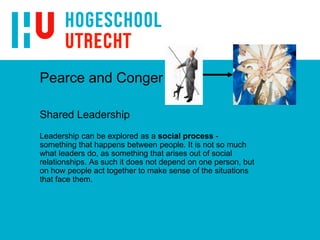
Shared Leadership
Leadership can be explored as a social process -
something that happens between people. It is not so much
what leaders do, as something that arises out of social
relationships. As such it does not depend on one person, but
on how people act together to make sense of the situations
that face them.
Pearce and Conger
Leadership
Leadership has been described as the process of
social influence in which one person can enlist the aid
and support of others in the accomplishment of a
common task.
Leadership is about leaders and followers.
Pearce and Conger
Shared Leadership
Leaderhip:
- focus on individuals taking decisions and
aligning the organization to follow decisions in
order to reach strategic goals
- group processes and teamwork
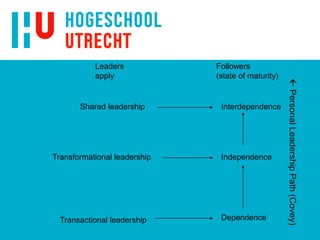
About the followers:
Transactional leadership is effective in the case of
dependent followers.
Transformative Leadership needs independent
followers and independent followers won’t accept
transactional leadership.
Only followers with a consciousness of inter-
dependency will be able to apply shared leadership.
PersonalLeadershipPath(Covey)
Dependence
Independence
Interdependence
Followers
(state of maturity)
Transactional leadership
Transformational leadership
Shared leadership
Leaders
apply
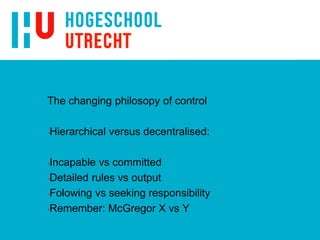
The changing philosopy of control
•Hierarchical versus decentralised:
•Incapable vs committed
•Detailed rules vs output
•Folowing vs seeking responsibility
•Remember: McGregor X vs Y
Personal capacities en knowledge of the
persons involved
highlow
Space to take leadership tasks
over
high
Shared
leadership
Directive
leadership
Leadership
struggle /
competition
Leadership
vacuum
Leadership space
Part 2
Shared Leadership and generative
collaboration
Steve Jobs
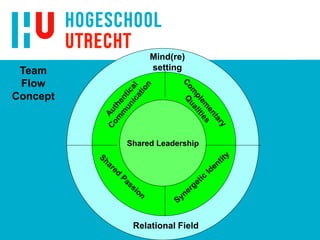
Shared Leadership
Mind(re)
setting
Relational Field
Team
Flow
Concept
University of Applied Sciences
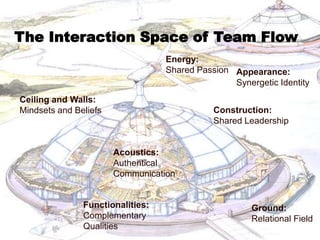
Ground:
Relational Field
Ceiling and Walls:
Mindsets and Beliefs
The Interaction Space of Team Flow
Energy:
Shared Passion
Acoustics:
Authentical
Communication
Functionalities:
Complementary
Qualities
Construction:
Shared Leadership
Appearance:
Synergetic Identity
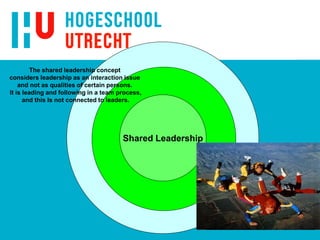
Shared Leadership
The shared leadership concept
considers leadership as an interaction issue
and not as qualities of certain persons.
It is leading and following in a team process,
and this Is not connected to leaders.
Shared leadership and generative
collaboration
 There is a difference between effective
collaboration (collaboration 1.0) and
generative collaboration (collaboration 2.0)
 Shared leadership seems to be a suitable
‘style of leadership’ for collaboration 2.0
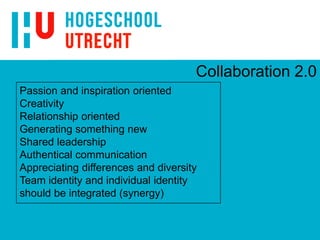
Collaboration 2.0
Passion and inspiration oriented
Creativity
Relationship oriented
Generating something new
Shared leadership
Authentical communication
Appreciating differences and diversity
Team identity and individual identity
should be integrated (synergy)
Shared leadership
Questions?

Presentatie shared leadership

  • 1.
    Shared Leadership A newleadership approach Michael Makowski
  • 2.
    Shared Leadership Leadership canbe explored as a social process - something that happens between people. It is not so much what leaders do, as something that arises out of social relationships. As such it does not depend on one person, but on how people act together to make sense of the situations that face them. Pearce and Conger
  • 3.
    Leadership Leadership has beendescribed as the process of social influence in which one person can enlist the aid and support of others in the accomplishment of a common task. Leadership is about leaders and followers.
  • 4.
    Pearce and Conger SharedLeadership Leaderhip: - focus on individuals taking decisions and aligning the organization to follow decisions in order to reach strategic goals - group processes and teamwork
  • 5.
    About the followers: Transactionalleadership is effective in the case of dependent followers. Transformative Leadership needs independent followers and independent followers won’t accept transactional leadership. Only followers with a consciousness of inter- dependency will be able to apply shared leadership.
  • 6.
  • 7.
    The changing philosopyof control •Hierarchical versus decentralised: •Incapable vs committed •Detailed rules vs output •Folowing vs seeking responsibility •Remember: McGregor X vs Y
  • 8.
    Personal capacities enknowledge of the persons involved highlow Space to take leadership tasks over high Shared leadership Directive leadership Leadership struggle / competition Leadership vacuum Leadership space
  • 9.
    Part 2 Shared Leadershipand generative collaboration Steve Jobs
  • 10.
  • 11.
    University of AppliedSciences Ground: Relational Field Ceiling and Walls: Mindsets and Beliefs The Interaction Space of Team Flow Energy: Shared Passion Acoustics: Authentical Communication Functionalities: Complementary Qualities Construction: Shared Leadership Appearance: Synergetic Identity
  • 12.
    Shared Leadership The sharedleadership concept considers leadership as an interaction issue and not as qualities of certain persons. It is leading and following in a team process, and this Is not connected to leaders.
  • 13.
    Shared leadership andgenerative collaboration  There is a difference between effective collaboration (collaboration 1.0) and generative collaboration (collaboration 2.0)  Shared leadership seems to be a suitable ‘style of leadership’ for collaboration 2.0
  • 14.
    Collaboration 2.0 Passion andinspiration oriented Creativity Relationship oriented Generating something new Shared leadership Authentical communication Appreciating differences and diversity Team identity and individual identity should be integrated (synergy)
  • 15.