Using Action Learning to Develop Shared Leadership Skills Skipton Leonard –  Co-Chair Michael Marquardt  Cynthia McCauley & Patricia O’Connor Craig Pearce –  Co-chair, Discussant Arthur Freedman  Jay Conger & Susan Elaine Murphy
Leadership in Flux 35-40% of leaders fail in the 1 st  18 months of promotion or appointment Rate of failure is increasing – turnover rate  for CEO’s doubled from 1999-2004 1996-2006 – CEO turnover for performance increased 318% 1996-2006 – CEO tenure decreased from 9.5 to 7.8 years
Leadership Challenges Rate of technology change – disruptive technologies flattening of hierarchies – made possible by improvements in technology More fluid and complex lines of authority and organizational structure – erosion of positional authority Globalization Threats to environment and security
Vertical/Hierarchical (top-down) leadership  -  Traditional leadership models have focused on leader  follower influence  In contemporary organizational situations Emphasis on personal knowledge and skill Team structures Focus increasingly upon mutual or shared influence between Formal leaders and team members Team members Lateral/Shared   Leadership   –   Mutual influence among team members is becoming much prominent in contemporary organizations  Changes in Leader/Follower  Relationships
Shared Leadership Meets Action Research Craig L. Pearce
What is Shared Leadership? “ We define shared leadership as a dynamic, interactive influence process among individuals in groups for which the objective is to lead one another to the achievement of group or organizational goals or both. The key distinction between shared leadership and traditional models of leadership is that the influence process involves more than just downward influence on subordinates by an appointed or elected leader.”  Pearce, C.L. & Conger, J. A. (2003). Shared Leadership.   Sage Publications.
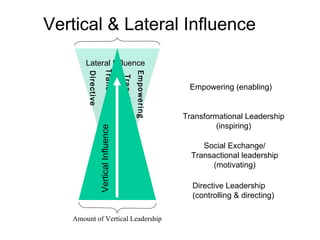
Vertical Influence Vertical & Lateral Influence Directive Transactional Transformational Empowering Lateral Influence Directive Leadership (controlling & directing) Social Exchange/ Transactional leadership (motivating) Transformational Leadership (inspiring) Empowering (enabling) Amount of Vertical Leadership Vertical Influence
Our Initial Research Evidence Pearce (1997) Shared leadership an important predictor of change management team effectiveness.  Dissertation-University of Maryland. Pearce & Sims (2002) Shared leadership a better predictor of change management team effectiveness than vertical leadership.  Group Dynamics . Pearce, Yoo & Alavi (2004) Shared leadership a better predictor of virtual team outcomes than vertical leadership.  Non-profit Leadership. Ensley, Hmieleski & Pearce (2006) Controlling for CEO leadership, shared leadership among top management team an important predictor of firm performance.  Leadership Quarterly.
Action Research and Shared Leadership How do we develop shared leadership? What are the fine-grained dynamics of shared leadership? How can shared leadership facilitate action learning? What are the limits and liabilities of both shared leadership and action learning?
Shared/Collaborative Leadership Collective Leadership   (Raelin, 2006) It is not a leap of faith to view leadership as something that an entire community does together. In such a setting, everyone is challenged to learn; no one needs to stand by in a dependent capacity. Accordingly, organizational members willingly seek feedback, openly discuss errors, experiment optimistically with new behaviors, reflect mutually on their operating assumptions, and demonstrably support one another.
Shared Leadership Skills When to lead and when to follow,  When to be directive and when to encourage collaboration and consensus,  How to use intrinsic and well as extrinsic motivators to keep people engaged,  How to engage people’s idealism and desire for personal development and growth to develop inspiring visions and passion,  How to empower subordinates and use and develop their ability to self-manage and self-lead, and  How to develop a mind-set for learning throughout the organization.
Leadership Development Strategies Individual Development Plan (IDP) 360-degree feedback + IDP Traditional Leadership Programs – (Instructor provides knowledge) Experiential Leadership Programs – (instructor facilitates knowledge transfer from training curriculum) Coaching/Mentoring Action Learning – Working on a real problem with a coach that requires shared leadership 
Using Questions to Develop Shared Leadership Michael J. Marquardt World Institute for Action Learning George Washington University
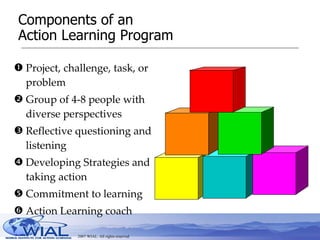
Components of an  Action Learning Program Project, challenge, task, or problem Group of 4-8 people with diverse perspectives Reflective questioning and listening Developing Strategies and taking action  Commitment to learning Action Learning coach
Elements of action learning that build shared leadership Complex, urgent problem/challenges that require multiple perspectives and shared ideas Group size that enables all to participate and to learn Focus on questions and reflective inquiry that emphasizes listening and building on others’ ideas  Development of systemic, holistic action steps and strategies
Development of Shared Leadership Competencies via the Learning Coach At commencement of each session, each group member’s leadership skill is identified and listed Coach informs the group that each competency will be reflected upon during and after the session Commitment to help each other develop leadership competencies Competencies are built when the following elements are in place: Important to the person Opportunity to practice Immediate, extensive and positive feedback Ability to reflect and determine for self
Questions from the Coach for Developing Leadership Competencies Questions during Session What listed leadership competencies have been demonstrated thus far? What is the impact of that on the progress of the group? Have any opportunities been missed?  Questions after session Directed to the individual How do you think you did on your competency (OK/not OK)? What could you have improved? Directed to others  How did this person do in his/her competency? What did he/she do well? Impact of what he/she did? Directed to entire group What have we learned about this competency? How can we apply to our work environment?
How questions from members and coach builds shared leadership Group problem-solving Everyone is engaged in solving the problem Different perspectives are valued All are expected to assume leadership and to share as appropriate Group cohesiveness Questions build cohesiveness, trust, caring, and respect for the other person Questions enable the other person to be able to help and to be seen as valuable
Developing Shared Leadership Practices Through Action Learning Projects Cindy McCauley and Patricia O’Connor Academy of Management August, 2007
Leadership Beliefs and Practices Beliefs Creating direction, alignment, and commitment (i.e., leadership) for dealing with complex organizational problems requires senior managers with diverse expertise and perspectives  collaborating as peers . New leadership practices are needed for effective leadership in a peer context. New Leadership Practices Working as a leadership team without a formal leader. Working with multiple stakeholders as partners. Shared sense-making of complex issues. Collective learning through experimentation. Center for Creative Leadership
Action Learning Leadership Projects (ALLP) Teams of senior managers. Given broad strategic issues within which teams shaped a more focused project. No experts on the team (including sponsors). Encouraged to take action. Encouraged to experiment with more collaborative/shared leadership practices. Center for Creative Leadership
What capabilities do ALLP teams develop to support shared leadership practices? Engaging across boundaries (e.g., dialogue skills, discovering underlying assumptions, valuing differences). Understanding the organization as an interdependent system. Leveraging diverse personal networks. Diagnosing and addressing sensitive organizational issues. Effective teamwork. Center for Creative Leadership
Can ALLP teams generate direction, alignment, and commitment for solutions that address a complex organizational issue? Organization #1:  Six months after project completion, nine projects lead to changes or further actions in the organization, six projects had little impact in the organization, and the jury was still out on five projects. Some differentiators: Top-level support for the project Linked to an existing strategic initiative Team’s ability to navigate the organizational system Team’s enthusiasm for the project Degree of focus on a specific solution/intervention Center for Creative Leadership
Can ALLP teams generate direction, alignment, and commitment for solutions that address a complex organizational issue? Organization #2:  One year after project completion: Eight of the eleven projects reported that their recommendations were fully or partially implemented. Team members’ perceptions of why project deliverables were adopted: Senior-level support Involvement of key players Quality of the deliverable Innovativeness of the recommendations System was ready Directly addressed a strategic goal Center for Creative Leadership
Action Learning and Organization Development & Change Academy of Management August 7, 2007  Philadelphia  Arthur M. Freedman, Ph.D. >>> World Institute for Action Learning <<< >>> Freedman, Leonard, & Marquardt <<< >>> NTL Institute <<<
Action Learning (AL)  can stand alone  as a powerful intervention that can satisfy multiple organizational needs. Synergy can be achieved by integrating AL  with  Leadership Development (LD)  and Organization Development & Change (OD&C)  programs. My focus today is on the integration of AL with OD&C
Organization Development & Change Organization Development & Change [OD&C] is a system-wide application and transfer of behavioral science knowledge to the planed development, improvement, and reinforcement of the strategies, structures, [technologies,] and processes that lead to organizational effectiveness. Cummings, T. G., & Worley, C. G. (2005).  Organization development & change, 8th edition . Mason, OH: Thomson/South-Western.
Action Learning Action Learning [AL] is a team process that enables members to:  (1)  effectively and efficiently deal with critical, urgent  organizational issues  [problems, opportunities, and dilemmas] with innovative strategies;  (2)  develop teams that continuously learn and improve their capacities to perform and adapt; and  (3)  capture, transfer, and apply valuable, practical knowledge at the individual, team, intergroup, organizational, and community levels. Marquardt, M. J. (2004).  Optimizing the power of action learning: Solving problems and building leaders in real time . Palo Alto, CA: Davies-Black.
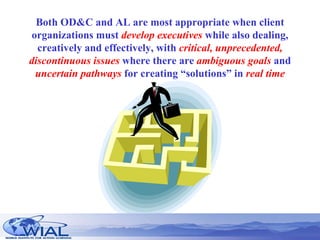
Both OD&C and AL are most appropriate when client organizations must  develop executives  while also dealing, creatively and effectively, with  critical, unprecedented, discontinuous issues  where there are  ambiguous goals  and  uncertain pathways  for creating “solutions” in  real time
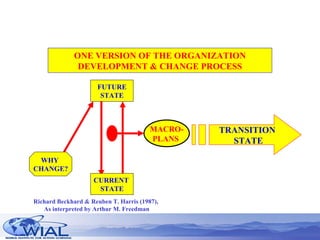
Richard Beckhard & Reuben T. Harris (1987),  As interpreted by Arthur M. Freedman FUTURE STATE TRANSITION  STATE MACRO- PLANS   WHY  CHANGE? CURRENT  STATE ONE VERSION OF THE ORGANIZATION DEVELOPMENT & CHANGE PROCESS
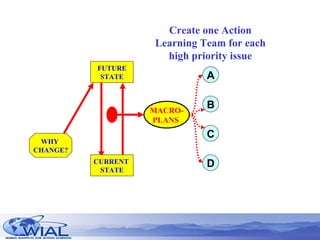
FUTURE STATE MACRO- PLANS   WHY  CHANGE? CURRENT  STATE A C B D Create one Action Learning Team for each high priority issue
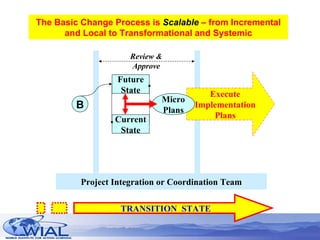
B Future State Current State Review & Approve Execute Implementation Plans TRANSITION  STATE Project Integration or Coordination Team Micro Plans The Basic Change Process is  Scalable  – from Incremental and Local to Transformational and Systemic
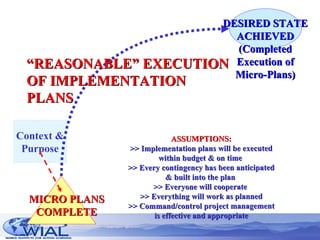
Context & Purpose MICRO PLANS COMPLETE DESIRED STATE ACHIEVED (Completed Execution of Micro-Plans) ASSUMPTIONS: >> Implementation plans will be executed within budget & on time  >> Every contingency has been anticipated & built into the plan  >> Everyone will cooperate  >> Everything will work as planned >> Command/control project management is effective and appropriate “ REASONABLE” EXECUTION OF IMPLEMENTATION PLANS
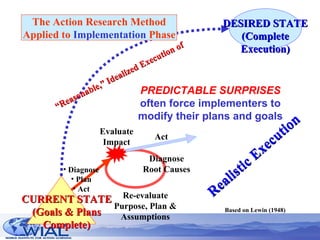
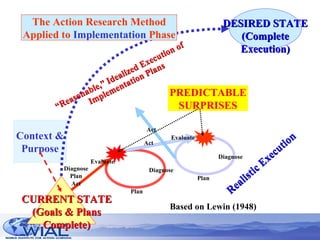
Realistic Execution Based on Lewin (1948) Re-evaluate Purpose, Plan & Assumptions Diagnose Plan Act CURRENT STATE (Goals & Plans Complete) “ Reasonable,” Idealized Execution of DESIRED STATE (Complete Execution) The Action Research Method Applied to  Implementation  Phase Evaluate Impact Diagnose Root Causes PREDICTABLE SURPRISES   often force implementers to modify their plans and goals Act
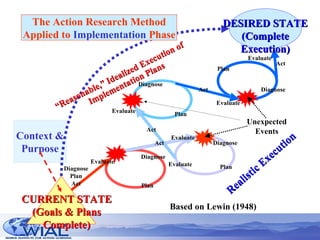
PREDICTABLE SURPRISES Realistic Execution Based on Lewin (1948) Context & Purpose Diagnose Act Evaluate Plan Plan Evaluate Act Diagnose Diagnose Plan Act CURRENT STATE (Goals & Plans Complete) “ Reasonable,” Idealized Execution of Implementation Plans DESIRED STATE (Complete Execution) The Action Research Method Applied to  Implementation  Phase
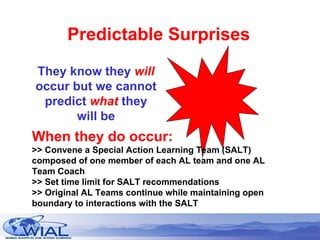
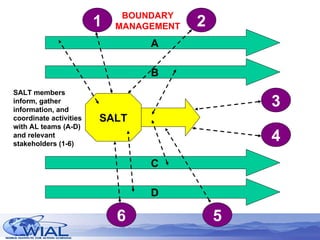
Predictable Surprises They know they  will  occur but we cannot predict  what  they will be When they do occur: >> Convene a Special Action Learning Team (SALT) composed of one member of each AL team and one AL Team Coach >> Set time limit for SALT recommendations >> Original AL Teams continue while maintaining open boundary to interactions with the SALT
AN EXAMPLE OF SHARED LEADERSHIP Particularly in uncertain, ambiguous conditions and situations, command/control project leaders are unlikely to have sufficient information, capacity, and adequate competencies to recognize emergent predictable surprises and deal with them in a timely, effective manner. Organizational change projects are likely to fail when such flawed assumptions prevail. An alternative assumption is that people who are closest to the emergence of predictable surprises are often best prepared to deal with them. This requires legitimacy for  whoever   recognizes a need is entitled to take an active leadership role, regardless of their status.
A B C D SALT 1 2 5 3 6 4 SALT members inform, gather information, and coordinate activities with AL teams (A-D) and relevant stakeholders (1-6) BOUNDARY MANAGEMENT
Unexpected Events Realistic Execution Based on Lewin (1948) Context & Purpose Diagnose Act Evaluate Plan Plan Evaluate Evaluate Act Evaluate Plan Evaluate Diagnose Diagnose Act Act Diagnose Plan Evaluate Diagnose Plan Act CURRENT STATE (Goals & Plans Complete) “ Reasonable,” Idealized Execution of Implementation Plans DESIRED STATE (Complete Execution) The Action Research Method Applied to  Implementation  Phase
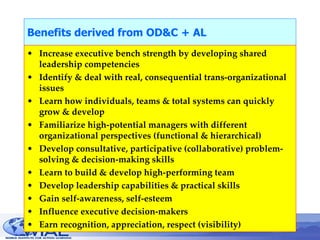
Benefits derived from OD&C + AL Increase executive bench strength by developing shared leadership competencies Identify & deal with real, consequential trans-organizational issues Learn how individuals, teams & total systems can quickly grow & develop Familiarize high-potential managers with different organizational perspectives (functional & hierarchical) Develop consultative, participative (collaborative) problem-solving & decision-making skills Learn to build & develop high-performing team Develop leadership capabilities & practical skills Gain self-awareness, self-esteem Influence executive decision-makers Earn recognition, appreciation, respect (visibility)
Building Rigor Into Developing  Shared Leadership: Design Features  for Action Learning Approaches Jay Conger and Susan Murphy  Kravis Leadership Institute  Claremont McKenna College  Academy of Management Meetings  August 7, 2007
Is Action Learning the Right Vehicle for Learning Shared Leadership? The Positives: Team-based designs/rewards Strong collective identity Peers Complex enterprise issues Facilitated experiences High stakes, recognition rewards
Is Action Learning the Right Vehicle for Learning Shared Leadership? The Dilemmas: Peers Project recommendations trump    the process  One-time event Little or no follow-up Existing organizational architecture    and attitudes towards leadership
Critical Design Features: Project and sponsor selection Projects that are multidisciplinary Sponsors who model a degree of SL  and who are not experts Participant selection No subject experts Multiple levels instead of peers Moderate needs for personalized power
Critical Design Features: Group process Explicit norms a la IDEO ‘deep dive’ Highly skilled facilitators who also instruct Task and demand transitions identified  Multiple reflection windows/daily feedback and debriefing on team SL process Content learning  (beyond project knowledge) Training in shared leadership and influence tactics In-company role models sharing their SL experiences
Critical Design Features: Deliverables  (beyond project recommendations) Pre- and post-360 assessments of the participants’ capability at SL Detailed diagnosis of the SL process by  facilitators and participants along with measurement  Follow-up 360 assessment six and twelve months out Coaching Requirement to instruct their own staff and  facilitate one shared leadership team
Questions and Discussant Craig Pearce

Shared leadership skills

  • 1.
    Using Action Learningto Develop Shared Leadership Skills Skipton Leonard – Co-Chair Michael Marquardt Cynthia McCauley & Patricia O’Connor Craig Pearce – Co-chair, Discussant Arthur Freedman Jay Conger & Susan Elaine Murphy
  • 2.
    Leadership in Flux35-40% of leaders fail in the 1 st 18 months of promotion or appointment Rate of failure is increasing – turnover rate for CEO’s doubled from 1999-2004 1996-2006 – CEO turnover for performance increased 318% 1996-2006 – CEO tenure decreased from 9.5 to 7.8 years
  • 3.
    Leadership Challenges Rateof technology change – disruptive technologies flattening of hierarchies – made possible by improvements in technology More fluid and complex lines of authority and organizational structure – erosion of positional authority Globalization Threats to environment and security
  • 4.
    Vertical/Hierarchical (top-down) leadership - Traditional leadership models have focused on leader  follower influence In contemporary organizational situations Emphasis on personal knowledge and skill Team structures Focus increasingly upon mutual or shared influence between Formal leaders and team members Team members Lateral/Shared Leadership – Mutual influence among team members is becoming much prominent in contemporary organizations Changes in Leader/Follower Relationships
  • 5.
    Shared Leadership MeetsAction Research Craig L. Pearce
  • 6.
    What is SharedLeadership? “ We define shared leadership as a dynamic, interactive influence process among individuals in groups for which the objective is to lead one another to the achievement of group or organizational goals or both. The key distinction between shared leadership and traditional models of leadership is that the influence process involves more than just downward influence on subordinates by an appointed or elected leader.” Pearce, C.L. & Conger, J. A. (2003). Shared Leadership. Sage Publications.
  • 7.
    Vertical Influence Vertical& Lateral Influence Directive Transactional Transformational Empowering Lateral Influence Directive Leadership (controlling & directing) Social Exchange/ Transactional leadership (motivating) Transformational Leadership (inspiring) Empowering (enabling) Amount of Vertical Leadership Vertical Influence
  • 8.
    Our Initial ResearchEvidence Pearce (1997) Shared leadership an important predictor of change management team effectiveness. Dissertation-University of Maryland. Pearce & Sims (2002) Shared leadership a better predictor of change management team effectiveness than vertical leadership. Group Dynamics . Pearce, Yoo & Alavi (2004) Shared leadership a better predictor of virtual team outcomes than vertical leadership. Non-profit Leadership. Ensley, Hmieleski & Pearce (2006) Controlling for CEO leadership, shared leadership among top management team an important predictor of firm performance. Leadership Quarterly.
  • 9.
    Action Research andShared Leadership How do we develop shared leadership? What are the fine-grained dynamics of shared leadership? How can shared leadership facilitate action learning? What are the limits and liabilities of both shared leadership and action learning?
  • 10.
    Shared/Collaborative Leadership CollectiveLeadership (Raelin, 2006) It is not a leap of faith to view leadership as something that an entire community does together. In such a setting, everyone is challenged to learn; no one needs to stand by in a dependent capacity. Accordingly, organizational members willingly seek feedback, openly discuss errors, experiment optimistically with new behaviors, reflect mutually on their operating assumptions, and demonstrably support one another.
  • 11.
    Shared Leadership SkillsWhen to lead and when to follow, When to be directive and when to encourage collaboration and consensus, How to use intrinsic and well as extrinsic motivators to keep people engaged, How to engage people’s idealism and desire for personal development and growth to develop inspiring visions and passion, How to empower subordinates and use and develop their ability to self-manage and self-lead, and How to develop a mind-set for learning throughout the organization.
  • 12.
    Leadership Development StrategiesIndividual Development Plan (IDP) 360-degree feedback + IDP Traditional Leadership Programs – (Instructor provides knowledge) Experiential Leadership Programs – (instructor facilitates knowledge transfer from training curriculum) Coaching/Mentoring Action Learning – Working on a real problem with a coach that requires shared leadership 
  • 13.
    Using Questions toDevelop Shared Leadership Michael J. Marquardt World Institute for Action Learning George Washington University
  • 14.
    Components of an Action Learning Program Project, challenge, task, or problem Group of 4-8 people with diverse perspectives Reflective questioning and listening Developing Strategies and taking action Commitment to learning Action Learning coach
  • 15.
    Elements of actionlearning that build shared leadership Complex, urgent problem/challenges that require multiple perspectives and shared ideas Group size that enables all to participate and to learn Focus on questions and reflective inquiry that emphasizes listening and building on others’ ideas Development of systemic, holistic action steps and strategies
  • 16.
    Development of SharedLeadership Competencies via the Learning Coach At commencement of each session, each group member’s leadership skill is identified and listed Coach informs the group that each competency will be reflected upon during and after the session Commitment to help each other develop leadership competencies Competencies are built when the following elements are in place: Important to the person Opportunity to practice Immediate, extensive and positive feedback Ability to reflect and determine for self
  • 17.
    Questions from theCoach for Developing Leadership Competencies Questions during Session What listed leadership competencies have been demonstrated thus far? What is the impact of that on the progress of the group? Have any opportunities been missed? Questions after session Directed to the individual How do you think you did on your competency (OK/not OK)? What could you have improved? Directed to others How did this person do in his/her competency? What did he/she do well? Impact of what he/she did? Directed to entire group What have we learned about this competency? How can we apply to our work environment?
  • 18.
    How questions frommembers and coach builds shared leadership Group problem-solving Everyone is engaged in solving the problem Different perspectives are valued All are expected to assume leadership and to share as appropriate Group cohesiveness Questions build cohesiveness, trust, caring, and respect for the other person Questions enable the other person to be able to help and to be seen as valuable
  • 19.
    Developing Shared LeadershipPractices Through Action Learning Projects Cindy McCauley and Patricia O’Connor Academy of Management August, 2007
  • 20.
    Leadership Beliefs andPractices Beliefs Creating direction, alignment, and commitment (i.e., leadership) for dealing with complex organizational problems requires senior managers with diverse expertise and perspectives collaborating as peers . New leadership practices are needed for effective leadership in a peer context. New Leadership Practices Working as a leadership team without a formal leader. Working with multiple stakeholders as partners. Shared sense-making of complex issues. Collective learning through experimentation. Center for Creative Leadership
  • 21.
    Action Learning LeadershipProjects (ALLP) Teams of senior managers. Given broad strategic issues within which teams shaped a more focused project. No experts on the team (including sponsors). Encouraged to take action. Encouraged to experiment with more collaborative/shared leadership practices. Center for Creative Leadership
  • 22.
    What capabilities doALLP teams develop to support shared leadership practices? Engaging across boundaries (e.g., dialogue skills, discovering underlying assumptions, valuing differences). Understanding the organization as an interdependent system. Leveraging diverse personal networks. Diagnosing and addressing sensitive organizational issues. Effective teamwork. Center for Creative Leadership
  • 23.
    Can ALLP teamsgenerate direction, alignment, and commitment for solutions that address a complex organizational issue? Organization #1: Six months after project completion, nine projects lead to changes or further actions in the organization, six projects had little impact in the organization, and the jury was still out on five projects. Some differentiators: Top-level support for the project Linked to an existing strategic initiative Team’s ability to navigate the organizational system Team’s enthusiasm for the project Degree of focus on a specific solution/intervention Center for Creative Leadership
  • 24.
    Can ALLP teamsgenerate direction, alignment, and commitment for solutions that address a complex organizational issue? Organization #2: One year after project completion: Eight of the eleven projects reported that their recommendations were fully or partially implemented. Team members’ perceptions of why project deliverables were adopted: Senior-level support Involvement of key players Quality of the deliverable Innovativeness of the recommendations System was ready Directly addressed a strategic goal Center for Creative Leadership
  • 25.
    Action Learning andOrganization Development & Change Academy of Management August 7, 2007 Philadelphia Arthur M. Freedman, Ph.D. >>> World Institute for Action Learning <<< >>> Freedman, Leonard, & Marquardt <<< >>> NTL Institute <<<
  • 26.
    Action Learning (AL) can stand alone as a powerful intervention that can satisfy multiple organizational needs. Synergy can be achieved by integrating AL with Leadership Development (LD) and Organization Development & Change (OD&C) programs. My focus today is on the integration of AL with OD&C
  • 27.
    Organization Development &Change Organization Development & Change [OD&C] is a system-wide application and transfer of behavioral science knowledge to the planed development, improvement, and reinforcement of the strategies, structures, [technologies,] and processes that lead to organizational effectiveness. Cummings, T. G., & Worley, C. G. (2005). Organization development & change, 8th edition . Mason, OH: Thomson/South-Western.
  • 28.
    Action Learning ActionLearning [AL] is a team process that enables members to: (1) effectively and efficiently deal with critical, urgent organizational issues [problems, opportunities, and dilemmas] with innovative strategies; (2) develop teams that continuously learn and improve their capacities to perform and adapt; and (3) capture, transfer, and apply valuable, practical knowledge at the individual, team, intergroup, organizational, and community levels. Marquardt, M. J. (2004). Optimizing the power of action learning: Solving problems and building leaders in real time . Palo Alto, CA: Davies-Black.
  • 29.
    Both OD&C andAL are most appropriate when client organizations must develop executives while also dealing, creatively and effectively, with critical, unprecedented, discontinuous issues where there are ambiguous goals and uncertain pathways for creating “solutions” in real time
  • 30.
    Richard Beckhard &Reuben T. Harris (1987), As interpreted by Arthur M. Freedman FUTURE STATE TRANSITION STATE MACRO- PLANS WHY CHANGE? CURRENT STATE ONE VERSION OF THE ORGANIZATION DEVELOPMENT & CHANGE PROCESS
  • 31.
    FUTURE STATE MACRO-PLANS WHY CHANGE? CURRENT STATE A C B D Create one Action Learning Team for each high priority issue
  • 32.
    B Future StateCurrent State Review & Approve Execute Implementation Plans TRANSITION STATE Project Integration or Coordination Team Micro Plans The Basic Change Process is Scalable – from Incremental and Local to Transformational and Systemic
  • 33.
    Context & PurposeMICRO PLANS COMPLETE DESIRED STATE ACHIEVED (Completed Execution of Micro-Plans) ASSUMPTIONS: >> Implementation plans will be executed within budget & on time >> Every contingency has been anticipated & built into the plan >> Everyone will cooperate >> Everything will work as planned >> Command/control project management is effective and appropriate “ REASONABLE” EXECUTION OF IMPLEMENTATION PLANS
  • 34.
    Realistic Execution Basedon Lewin (1948) Re-evaluate Purpose, Plan & Assumptions Diagnose Plan Act CURRENT STATE (Goals & Plans Complete) “ Reasonable,” Idealized Execution of DESIRED STATE (Complete Execution) The Action Research Method Applied to Implementation Phase Evaluate Impact Diagnose Root Causes PREDICTABLE SURPRISES often force implementers to modify their plans and goals Act
  • 35.
    PREDICTABLE SURPRISES RealisticExecution Based on Lewin (1948) Context & Purpose Diagnose Act Evaluate Plan Plan Evaluate Act Diagnose Diagnose Plan Act CURRENT STATE (Goals & Plans Complete) “ Reasonable,” Idealized Execution of Implementation Plans DESIRED STATE (Complete Execution) The Action Research Method Applied to Implementation Phase
  • 36.
    Predictable Surprises Theyknow they will occur but we cannot predict what they will be When they do occur: >> Convene a Special Action Learning Team (SALT) composed of one member of each AL team and one AL Team Coach >> Set time limit for SALT recommendations >> Original AL Teams continue while maintaining open boundary to interactions with the SALT
  • 37.
    AN EXAMPLE OFSHARED LEADERSHIP Particularly in uncertain, ambiguous conditions and situations, command/control project leaders are unlikely to have sufficient information, capacity, and adequate competencies to recognize emergent predictable surprises and deal with them in a timely, effective manner. Organizational change projects are likely to fail when such flawed assumptions prevail. An alternative assumption is that people who are closest to the emergence of predictable surprises are often best prepared to deal with them. This requires legitimacy for whoever recognizes a need is entitled to take an active leadership role, regardless of their status.
  • 38.
    A B CD SALT 1 2 5 3 6 4 SALT members inform, gather information, and coordinate activities with AL teams (A-D) and relevant stakeholders (1-6) BOUNDARY MANAGEMENT
  • 39.
    Unexpected Events RealisticExecution Based on Lewin (1948) Context & Purpose Diagnose Act Evaluate Plan Plan Evaluate Evaluate Act Evaluate Plan Evaluate Diagnose Diagnose Act Act Diagnose Plan Evaluate Diagnose Plan Act CURRENT STATE (Goals & Plans Complete) “ Reasonable,” Idealized Execution of Implementation Plans DESIRED STATE (Complete Execution) The Action Research Method Applied to Implementation Phase
  • 40.
    Benefits derived fromOD&C + AL Increase executive bench strength by developing shared leadership competencies Identify & deal with real, consequential trans-organizational issues Learn how individuals, teams & total systems can quickly grow & develop Familiarize high-potential managers with different organizational perspectives (functional & hierarchical) Develop consultative, participative (collaborative) problem-solving & decision-making skills Learn to build & develop high-performing team Develop leadership capabilities & practical skills Gain self-awareness, self-esteem Influence executive decision-makers Earn recognition, appreciation, respect (visibility)
  • 41.
    Building Rigor IntoDeveloping Shared Leadership: Design Features for Action Learning Approaches Jay Conger and Susan Murphy Kravis Leadership Institute Claremont McKenna College Academy of Management Meetings August 7, 2007
  • 42.
    Is Action Learningthe Right Vehicle for Learning Shared Leadership? The Positives: Team-based designs/rewards Strong collective identity Peers Complex enterprise issues Facilitated experiences High stakes, recognition rewards
  • 43.
    Is Action Learningthe Right Vehicle for Learning Shared Leadership? The Dilemmas: Peers Project recommendations trump the process One-time event Little or no follow-up Existing organizational architecture and attitudes towards leadership
  • 44.
    Critical Design Features:Project and sponsor selection Projects that are multidisciplinary Sponsors who model a degree of SL and who are not experts Participant selection No subject experts Multiple levels instead of peers Moderate needs for personalized power
  • 45.
    Critical Design Features:Group process Explicit norms a la IDEO ‘deep dive’ Highly skilled facilitators who also instruct Task and demand transitions identified Multiple reflection windows/daily feedback and debriefing on team SL process Content learning (beyond project knowledge) Training in shared leadership and influence tactics In-company role models sharing their SL experiences
  • 46.
    Critical Design Features:Deliverables (beyond project recommendations) Pre- and post-360 assessments of the participants’ capability at SL Detailed diagnosis of the SL process by facilitators and participants along with measurement Follow-up 360 assessment six and twelve months out Coaching Requirement to instruct their own staff and facilitate one shared leadership team
  • 47.