Shared Leadership
          Doing More with More


         Elissa Perry • Think. Do. Repeat.

www.thinkdorepeat.com•415.902.3709•elissa@thinkdorepeat.com
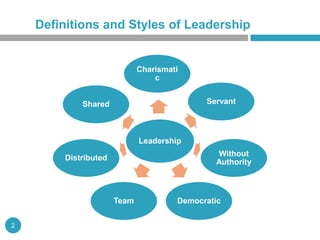
Definitions and Styles of Leadership


                             Charismati
                                 c


            Shared                          Servant


                             Leadership
                                               Without
        Distributed
                                              Authority


                      Team            Democratic


2
Definitions

Intelligence
   The ability to create something, solve a challenge
   or address an issue that is of value across
   communities and groups of people (based on the
   definition of Intelligence from Howard Gardner’s
   Frames of Mind).

Leadership
   The practice of developing and exercising
   intelligence in self and developing and supporting
   the intelligence of others.
Shared Leadership
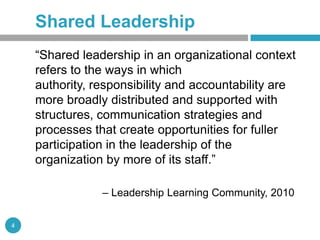
    “Shared leadership in an organizational context
    refers to the ways in which
    authority, responsibility and accountability are
    more broadly distributed and supported with
    structures, communication strategies and
    processes that create opportunities for fuller
    participation in the leadership of the
    organization by more of its staff.”

                – Leadership Learning Community, 2010

4
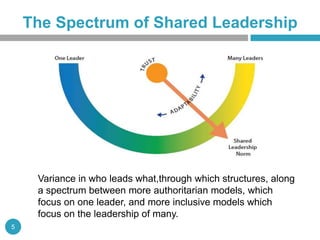
The Spectrum of Shared Leadership


     Variance in who leads what,through which structures, along
     a spectrum between more authoritarian models, which
     focus on one leader, and more inclusive models which
     focus on the leadership of many.
5
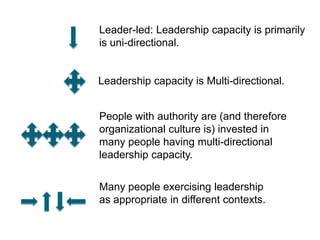
Leader-led: Leadership capacity is primarily
is uni-directional.


Leadership capacity is Multi-directional.


People with authority are (and therefore
organizational culture is) invested in
many people having multi-directional
leadership capacity.


Many people exercising leadership
as appropriate in different contexts.
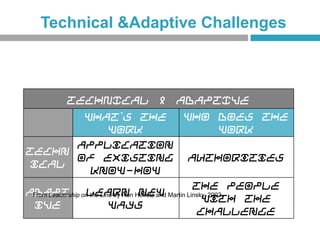
Technical &Adaptive Challenges


            TECHNICAL & ADAPTIVE
                 What’s the           Who Does the
                         Work               Work
                Application
Techn
                of existing Authorities
ical
                   know-how
                                       The people
Adapt onLearn Heifetz and Martin Linsky, 2002.
                  the Line by Ron new
 From Leadership
                                        with the
  ive                    ways
                                       challenge
Organizational Readiness

     Explicit commitment by senior leadership to change
     Up front investment of time to educate and plan
     Fundamental management practices in place
     Focus on engagement and accountability and
      learning
     Identification of and agreement on shared values


8
Points of Entry

     Transformation in mindset and role – working
      with individuals
     Organizational restructuring – breaking out of
      what’s been
     Attention to communication and decision-
      making – paying attention to the how
     Attention to organizational culture and
      relationships – paying attention to the what

9
What It Has Looked Like
      2 years, workshops, peer
       exchanges, conferences for 2 staff from 27
       organizations – Strengthening Organizations
       to Mobilize California
      8 Month Intensive with Core Team of 8 staff
       and consultants, Workshops, Team
       coaching, Peer coaching – County
       Collaborative
      5 Month Series with 4 Workshops, Team
       Coaching and Peer Coaching with 2 staff from
       13 organizations – Regional Management
       Assistance Organization “Partnership in
10
       Action” Series
The Bevy of Benefits
      Benefits include:
        Working environment aligned with values
        Lower stress and risk of burnout
        More empowered, engaged, responsive and responsible staff
        Improved decision-making, especially re: adaptive challenges
        Deeper leadership bench
        More and sometimes better ideas
        More and more diverse external representation and greater
         community connection and relevance
        Greater impact
      Challenges include:
        Significant time and possibly financial commitment
        Stepping back and stepping up
        Quite clumsyin the beginning
11
Questions to Consider
      What are other successful ways to develop and
       sustain shared leadership systems and processes?
      How can shared leadership be extended beyond staff
       to the board and to allies?
      Howdoesshared leadership within one organization
       support and enhance networks and movement
       building?
      What are the implications for philanthropy and
       supporting shared leadership in an among
       organizations and movements?

12
Resources
 Doing More with More – Nonprofit Quarterly, Summer
  2011
   http://thinkdorepeat.wordpress.com/
 Structuring Leadership – Building Movement
  Project, 2011
   http://www.buildingmovement.org/news/entry/277
 Shared Leadership Presentation – Leadership Learning
  Community, 2010
   http://www.slideshare.net/leadershipera/shared-
    leadership-session-alliance-for-nonprofit-management

                  Elissa Perry •Think. Do. Repeat.
  www.thinkdorepeat.com•415.902.3709 •elissa@thinkdorepeat.com

Shared Leadership Webinar

  • 1.
    Shared Leadership Doing More with More Elissa Perry • Think. Do. Repeat. www.thinkdorepeat.com•415.902.3709•elissa@thinkdorepeat.com
  • 2.
    Definitions and Stylesof Leadership Charismati c Shared Servant Leadership Without Distributed Authority Team Democratic 2
  • 3.
    Definitions Intelligence The ability to create something, solve a challenge or address an issue that is of value across communities and groups of people (based on the definition of Intelligence from Howard Gardner’s Frames of Mind). Leadership The practice of developing and exercising intelligence in self and developing and supporting the intelligence of others.
  • 4.
    Shared Leadership “Shared leadership in an organizational context refers to the ways in which authority, responsibility and accountability are more broadly distributed and supported with structures, communication strategies and processes that create opportunities for fuller participation in the leadership of the organization by more of its staff.” – Leadership Learning Community, 2010 4
  • 5.
    The Spectrum ofShared Leadership Variance in who leads what,through which structures, along a spectrum between more authoritarian models, which focus on one leader, and more inclusive models which focus on the leadership of many. 5
  • 6.
    Leader-led: Leadership capacityis primarily is uni-directional. Leadership capacity is Multi-directional. People with authority are (and therefore organizational culture is) invested in many people having multi-directional leadership capacity. Many people exercising leadership as appropriate in different contexts.
  • 7.
    Technical &Adaptive Challenges TECHNICAL & ADAPTIVE What’s the Who Does the Work Work Application Techn of existing Authorities ical know-how The people Adapt onLearn Heifetz and Martin Linsky, 2002. the Line by Ron new From Leadership with the ive ways challenge
  • 8.
    Organizational Readiness  Explicit commitment by senior leadership to change  Up front investment of time to educate and plan  Fundamental management practices in place  Focus on engagement and accountability and learning  Identification of and agreement on shared values 8
  • 9.
    Points of Entry  Transformation in mindset and role – working with individuals  Organizational restructuring – breaking out of what’s been  Attention to communication and decision- making – paying attention to the how  Attention to organizational culture and relationships – paying attention to the what 9
  • 10.
    What It HasLooked Like  2 years, workshops, peer exchanges, conferences for 2 staff from 27 organizations – Strengthening Organizations to Mobilize California  8 Month Intensive with Core Team of 8 staff and consultants, Workshops, Team coaching, Peer coaching – County Collaborative  5 Month Series with 4 Workshops, Team Coaching and Peer Coaching with 2 staff from 13 organizations – Regional Management Assistance Organization “Partnership in 10 Action” Series
  • 11.
    The Bevy ofBenefits  Benefits include:  Working environment aligned with values  Lower stress and risk of burnout  More empowered, engaged, responsive and responsible staff  Improved decision-making, especially re: adaptive challenges  Deeper leadership bench  More and sometimes better ideas  More and more diverse external representation and greater community connection and relevance  Greater impact  Challenges include:  Significant time and possibly financial commitment  Stepping back and stepping up  Quite clumsyin the beginning 11
  • 12.
    Questions to Consider  What are other successful ways to develop and sustain shared leadership systems and processes?  How can shared leadership be extended beyond staff to the board and to allies?  Howdoesshared leadership within one organization support and enhance networks and movement building?  What are the implications for philanthropy and supporting shared leadership in an among organizations and movements? 12
  • 13.
    Resources  Doing Morewith More – Nonprofit Quarterly, Summer 2011  http://thinkdorepeat.wordpress.com/  Structuring Leadership – Building Movement Project, 2011  http://www.buildingmovement.org/news/entry/277  Shared Leadership Presentation – Leadership Learning Community, 2010  http://www.slideshare.net/leadershipera/shared- leadership-session-alliance-for-nonprofit-management Elissa Perry •Think. Do. Repeat. www.thinkdorepeat.com•415.902.3709 •elissa@thinkdorepeat.com

Editor's Notes

  • #2 Shared Leadership is:- deeper diffusion of authority and responsibility into the organization. the capacity that organizations need to solve the complex or “adaptive” problems they face today.Shared leadership looks like:Developing staff as leaders at all levels of the organizationIncrease in staff involvement in decision making Clear and effective accountability structuresIntentionally creating the structure and culture needed to share leadershipWhat’s possible: -Doing more effective work -Greater impact-Higher staff engagement-Less burnout-Better prepared for successionIn leadership theory we hear: “learning organizations”, “open book management”, “leaderful organizations”, etc.Joseph Raelin – a leaderful organization is one that “intentionally creates the structure and culture needed to share leadership among staff, board, volunteers, and other stakeholders.” Leslie R. Crutchfield and Heather McLeod Grant, Forces for Good, “effective organizations share leadership across staff, board members, and external networks.”
  • #4 Other DefinitionsMary McCleod Bethune – The Capacity to Respond to a Given Situation
  • #6 Shared leadership is a stanceShared leadership – multiple people must have capacity to lead from organizational/network perspective.Building Movement Project:Shared leadership describes a model in which the top level of executive leadership is shared internally by two or more people (for example, a co-directorship). Distributed leadership is a model in which there is one person in the executive role, but decision-making is consistently and methodically pushed down to other levels in the organization (for example, strong program directors).Organizations that exhibit shared leadership have:Adaptability within the Spectrum:Different tactics and tools for different scenarios, and the ability to know what to use and whenAn orientation toward shared leadershipStaff willing to see the big picture and an invitation for staff to assume greater responsibility and influenceA culture of trust First step takes a leap of faith. Will I be punished for taking risks? Will my staff follow through? What happens if I fail at something?Aligning values, clarifying accountability, explicitly supporting experimentation, and clear communication.
  • #9 Explicit commitment by senior leadership to change“champion” supportUp front investment of time to educate and plan Most likely reduces efficiencies in the short term; long term focus on continuous improvementFundamental management practices are in placeBasics around supervision, effective communication and decision making, clear strategy, sound financial management systems, and ongoing planning mechanismsEngagement and accountability Explicit leadership responsibilities and trainingsI almost always include values when doing shared leadership work. We started with identifying values and strengths in the St. Louis series. The values piece was a part of creating the shared vision for the organizational culture they wanted to have. I will insert a slide that refers to values and we can talk about it.
  • #10 Places that a consulting engagement can enter from as well as places where organizations are also originating in their thinking about and approach to shared leadership.A transformation in mindset and role – creating a culture of engagement and accountability, building own leadership skills, and bringing them to the staff. Helping staff look at their organizations holistically.Organizational restructuring – co-director models, expanding management or leadership teams, redefining staff positions and roles, developing shared metrics of success for teamsChanges in communication and in decision making processes – shifts in management, communication and decision making need to be revisited. Introduction of peer coaching and crucial conversationsintentional strategy for how decisions will be made, as well as flexibility and acceptance of emerging priorities (if you ask people for their help and ideas and don’t use them, you will loose supporters)Changing organizational culture and relationships – Focus on organization shared values, developing mutual respect, trust, and accountability through intensive and deliberative processes.
  • #11 Refer to availability of article for the first example. Go into detail for the Partnership in Action (3rd) example.
  • #12 Challenges were not insurmountable. Just took time and attention.