What is
Leadership?
• Leadershipis the ability to guide a group
toward the achievement of goals.
• Leaders can be formally recognized by the
organization, or individuals can emerge as
informal leaders within work groups
because they have some characteristic that
the group members value.
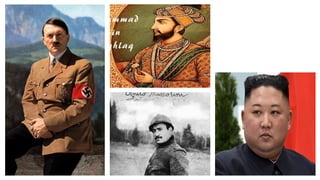
• Destructive leadershipbehavior is the systematic and repeated
behavior by a leader, supervisor, or manager that violates legitimate
interest of the organization by undermining and/or sabotaging the
organization’s goals, tasks, resources, and effectiveness and/or the
motivation, well-being, or job satisfaction of his/her subordinates
Leader versus
Manager or
Supervisor
•The terms “manager” and “supervisor” are job titles. They
imply the tasks or duties of the person who holds the title.
They describe what is to be done.
• Leadership deals with how these tasks or duties are
carried out with respect to members of the work group.
• “Leader” refers to a social-psychological aspect of the role
of supervisor or manager.
• What makes the job of manager or role of leader different
from many other work “behaviors” is the fact that
supervisors must depend on subordinates and leaders must
depend on followers to execute their plans.
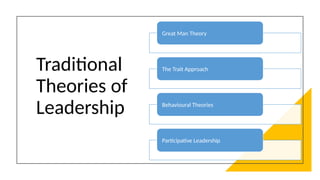
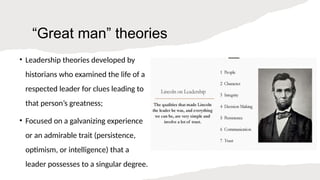
“Great man” theories
•Leadership theories developed by
historians who examined the life of a
respected leader for clues leading to
that person’s greatness;
• Focused on a galvanizing experience
or an admirable trait (persistence,
optimism, or intelligence) that a
leader possesses to a singular degree.
11.
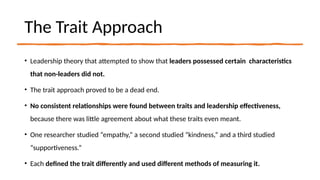
The Trait Approach
•Leadership theory that attempted to show that leaders possessed certain characteristics
that non-leaders did not.
• The trait approach proved to be a dead end.
• No consistent relationships were found between traits and leadership effectiveness,
because there was little agreement about what these traits even meant.
• One researcher studied “empathy,” a second studied “kindness,” and a third studied
“supportiveness.”
• Each defined the trait differently and used different methods of measuring it.
12.
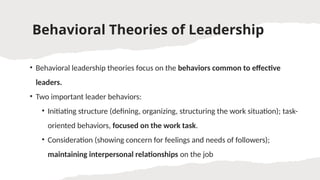
Behavioral Theories ofLeadership
• Behavioral leadership theories focus on the behaviors common to effective
leaders.
• Two important leader behaviors:
• Initiating structure (defining, organizing, structuring the work situation); task-
oriented behaviors, focused on the work task.
• Consideration (showing concern for feelings and needs of followers);
maintaining interpersonal relationships on the job
13.
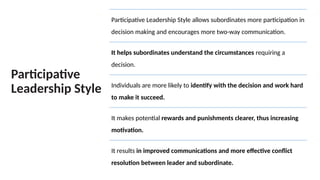
Participative
Leadership Style
Participative LeadershipStyle allows subordinates more participation in
decision making and encourages more two-way communication.
It helps subordinates understand the circumstances requiring a
decision.
Individuals are more likely to identify with the decision and work hard
to make it succeed.
It makes potential rewards and punishments clearer, thus increasing
motivation.
It results in improved communications and more effective conflict
resolution between leader and subordinate.
Leader–Member Exchange (LMX)
•This theory proposes that leaders adopt different behaviors with individual subordinates; the
particular behavior pattern of the leader develops over time and depends to a large extent on the
quality of the leader–subordinate relationship.
• In-group members: People who have high-quality relationships with their leader and high chances
of negotiating their work roles.
• Out-group members: People who have low-quality relationships with their leader and little chances
of negotiating their work roles.
16.
Life cycle ofa leader–follower relationship:
• The task of the leader is to drive the relationship from a tentative first-stage relationship to a
deeper, more meaningful one.
• It begins tentatively and then either evolves into a more trusting and committed relationship or
remains fixed at the initial stage
• The subordinates who experience the evolved relationship become in-group members, whereas
those who remain stuck at the first phase become out-group members.
17.
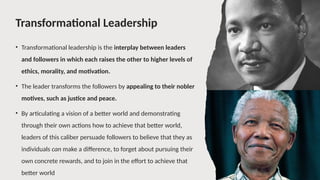
Transformational Leadership
• Transformationalleadership is the interplay between leaders
and followers in which each raises the other to higher levels of
ethics, morality, and motivation.
• The leader transforms the followers by appealing to their nobler
motives, such as justice and peace.
• By articulating a vision of a better world and demonstrating
through their own actions how to achieve that better world,
leaders of this caliber persuade followers to believe that they as
individuals can make a difference, to forget about pursuing their
own concrete rewards, and to join in the effort to achieve that
better world
18.
Transformational Leadership
Transformational
leaders typically
useone of four
general strategies.
Idealized influence. Leaders display conviction, emphasize trust, take
stands on difficult issues, emphasize the importance of commitment and
purpose, and are aware of the ethical consequences of their decisions.
Inspirational motivation. Leaders articulate an appealing vision of the
future, challenge followers with high standards, talk optimistically with
enthusiasm, and provide encouragement and meaning for what needs to
be done.
19.
Transformational Leadership
Transformational
leaders typically
useone of four
general strategies.
Intellectual stimulation. Leaders question old assumptions, values, and
beliefs; stimulate new ways of doing things; and encourage expression of
ideas and reasons.
Individualized consideration. Leaders deal with others as individuals;
consider individual needs, abilities, and aspirations; listen attentively; and
advise, coach, and teach.
20.
Authentic
Leadership
• Authentic leadershipis one leadership style that
emphasizes transparency, genuineness and
honesty.
• Authentic leaders build genuine relationships
with their employees by inspiring trust and
fostering a positive work environment.
• Authentic leadership involves a long-term focus
on organizational goals, with the ability to
inspire people to succeed.
21.
Components of AuthenticLeadership
Self-awareness: Authentic leaders assess their own weaknesses, strengths and values in order to be
more authentic with team members. Practicing self-awareness may also include self-reflection,
asking for feedback and awareness of employees' feelings. Self-awareness shows employees that
their leader is capable of processing their own perspective while considering others.
Fair and balanced processing: When making decisions, authentic leaders consider both supporting
and opposing opinions. This type of processing encourages employees to share their opinions and
experiences while avoiding potential conflicts. Fair and balanced processing shows that each
employee is valued and that the leader is willing to listen.
22.
Components
of Authentic
Leadership
Relational transparency:Authentic leaders are
transparent in their workplace relationships and they
remain honest when sharing their own thoughts and
feelings. This may include offering constructive
feedback to team members when necessary, as well
as admitting when they're in the wrong. By doing so,
an authentic leader leads by example and fosters
transparency among the team and organization.
23.
Components of AuthenticLeadership
Long-term focus: Rather than simply focusing on short-term goals, leaders can motivate
employees to strive for goals that may take more time, hard work and patience. This
quality is important because it keeps teams on track to succeed in the long term.
Mission-driven: they put the goals of the company or their team's mission in front of
their own self-interest. Mission-driven leaders want their teams to succeed for the sake
of accomplishing goals rather than to earn more power.
24.
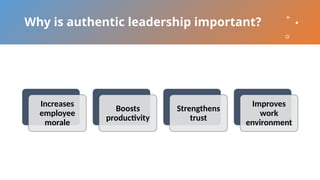
Why is authenticleadership important?
Increases
employee
morale
Boosts
productivity
Strengthens
trust
Improves
work
environment
• Leaders helpfollowers interpret events. This means identifying threats
and opportunities, as well as helping people understand complex
problems and environments.
• Leaders help build and maintain consensus about objectives,
priorities, and strategies.
• Leaders increase efficacy (individual and group) and commitment to
tasks and objectives, particularly in the face of obstacles.
• Leaders foster trust, respect, and cooperation among group members.
30.
• Leaders fosteridentification with the group or organization.
• Leaders help coordinate the activities of group members.
• Leaders facilitate learning and innovation among group members.
• Leaders promote and defend their group and organization and obtain
necessary resources for their group.
• Leaders help group members develop skills and prepare them for
leadership responsibilities.
• Leaders promote social justice, as well as ethical and moral behavior.