



Team Flow –  The Magic of Collaboration Inspired by The Rolling Stones University of Applied Sciences Michael Makowski
Personal Introduction Born in Berlin, Germany MSc Business Administration Jobs in consultancy, training and research Since 1987 working and living in The Netherlands Since 2000 lecturer/ communication trainer and  researcher at the Hogeschool Utrecht University of Applied Sciences
University of Applied Sciences Inspired by The Rolling Stones? University of Applied Sciences
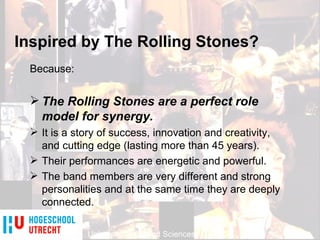
University of Applied Sciences Inspired by The Rolling Stones? University of Applied Sciences Because: The Rolling Stones are a perfect role model for synergy. It is a story of success, innovation and creativity, and cutting edge (lasting more than 45 years). Their performances are energetic and powerful. The band members are very different and strong personalities and at the same time they are deeply connected.
University of Applied Sciences Let’s ask Keith Richards http :// team-flow-group.blogspot.com /
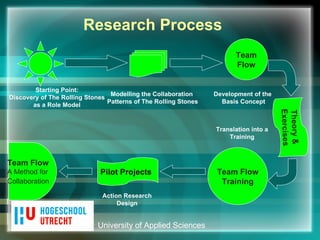
University of Applied Sciences Research Process Starting Point: Discovery of The Rolling Stones as a Role Model Modelling the Collaboration  Patterns of The Rolling Stones Team Flow Development of the  Basis Concept Theory & Exercises Translation into a Training Team Flow Training Action Research Design Pilot Projects Team Flow A Method for Collaboration
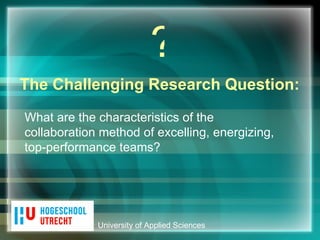
University of Applied Sciences The Challenging Research Question: What are the characteristics of the collaboration method of excelling, energizing, top-performance teams?   ?
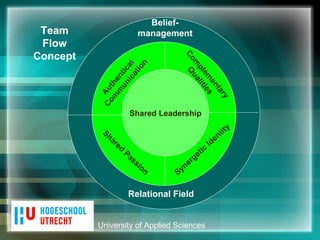
University of Applied Sciences Shared Leadership Authentical  Communication Complementary Qualities Shared Passion Synergetic Identity Belief- management Relational Field Team Flow Concept
University of Applied Sciences The Interaction Space of Team Flow
University of Applied Sciences Ground: Relational Field Ceiling and Walls: Mindsets and Beliefs The Interaction Space of Team Flow Energy: Shared Passion Acoustics: Authentical Communication Functionalities: Complementary Qualities Construction: Shared Leadership Appearance: Synergetic Identity
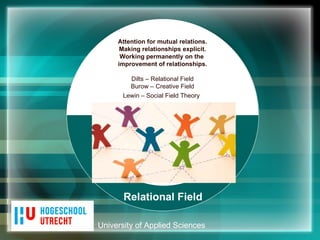
University of Applied Sciences Attention for mutual relations. Making relationships explicit. Working permanently on the  improvement of relationships. Dilts – Relational Field Burow – Creative Field Lewin – Social Field Theory   Relational Field
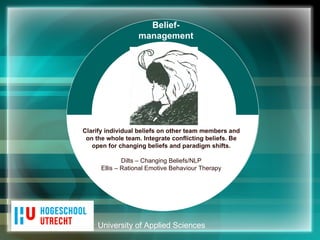
University of Applied Sciences Belief- management Clarify individual beliefs on other team members and on the whole team. Integrate conflicting beliefs. Be open for changing beliefs and paradigm shifts. Dilts – Changing Beliefs/NLP Ellis – Rational Emotive Behaviour Therapy
University of Applied Sciences Shared Leadership Authentical  Communication Complementary Qualities Shared Passion Synergetic Identity Communicating from your heart: you say what you think and feel at the moment you are connected with your ‘Self’.  This is different from egocentric communication. Korzybski  - The Map is not the Territory Watzlawick  -  Social Constructivism Scharmer et al. - Presencing, Theory U
University of Applied Sciences Shared Leadership Complementary Qualities Shared Passion Synergetic Identity We know that  heterogeneous teams are more productive than  homogeneous teams. It’s not enough to know and to accept this. You need to appreciate diversity and experience the interdependency in your team.   Belbin – Team Role Theory Ofman – Core Qualities
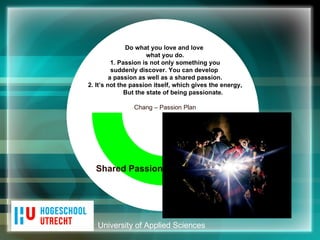
University of Applied Sciences Shared Leadership Shared Passion Synergetic Identity Do what you love and love  what you do. 1. Passion is not only something you suddenly discover. You can develop  a passion as well as a shared passion. 2. It’s not the passion itself, which gives the energy, But the state of being passionate. Chang – Passion Plan
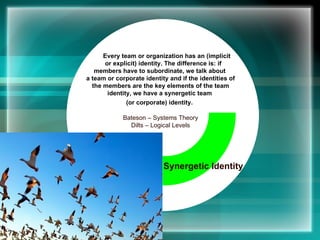
Shared Leadership Shared Passion Synergetic Identity Every team or organization has an (implicit  or explicit) identity. The difference is: if members have to subordinate, we talk about  a team or corporate identity and if the identities of the members are the key elements of the team identity, we have a synergetic team  (or corporate) identity.   Bateson – Systems Theory Dilts – Logical Levels
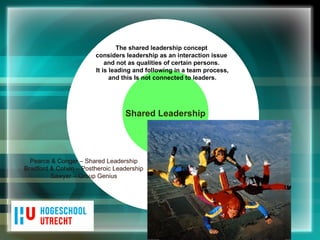
Shared Leadership Pearce & Conger – Shared Leadership Bradford & Cohen – Postheroic Leadership Sawyer – Group Genius The shared leadership concept  considers leadership as an interaction issue  and not as qualities of certain persons.  It is leading and following in a team process, and this Is not connected to leaders.
University of Applied Sciences Experience in Training To much thinking or analyzing keep you out of  team flow. People know the difference between being and not being in team flow. It’s possible to bring a team into a state of team flow. You can create conditions to stimulate team flow, you can’t create team flow. Only if you are fully immersed in the process you can experience team flow. The most important cues to recognize team flow are:  Soft and relaxed faces, laughter/humour, involvement, enthusiasm, openness,  mutual support, mutual appreciation, a natural way of changing roles.
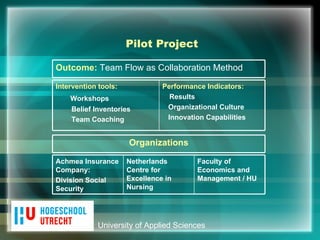
University of Applied Sciences Pilot Project Organizations Achmea Insurance Company: Division Social Security Netherlands Centre for Excellence in Nursing Faculty of Economics and Management / HU Intervention tools: Workshops Belief Inventories Team Coaching Performance Indicators: Results  Organizational Culture Innovation Capabilities Outcome:  Team Flow as   Collaboration Method
University of Applied Sciences Any Questions ? ? ? ? ?
University of Applied Sciences Want to keep in touch?  Join the Team Flow Group  (Google). Contact me. E-mail:  [email_address] Want to watch this presentation again?  http :// www.slideshare.net / mmakowski Thank You!

Teamflow – The Magic Of Collaboration Web Version

  • 1.
    Team Flow – The Magic of Collaboration Inspired by The Rolling Stones University of Applied Sciences Michael Makowski
  • 2.
    Personal Introduction Bornin Berlin, Germany MSc Business Administration Jobs in consultancy, training and research Since 1987 working and living in The Netherlands Since 2000 lecturer/ communication trainer and researcher at the Hogeschool Utrecht University of Applied Sciences
  • 3.
    University of AppliedSciences Inspired by The Rolling Stones? University of Applied Sciences
  • 4.
    University of AppliedSciences Inspired by The Rolling Stones? University of Applied Sciences Because: The Rolling Stones are a perfect role model for synergy. It is a story of success, innovation and creativity, and cutting edge (lasting more than 45 years). Their performances are energetic and powerful. The band members are very different and strong personalities and at the same time they are deeply connected.
  • 5.
    University of AppliedSciences Let’s ask Keith Richards http :// team-flow-group.blogspot.com /
  • 6.
    University of AppliedSciences Research Process Starting Point: Discovery of The Rolling Stones as a Role Model Modelling the Collaboration Patterns of The Rolling Stones Team Flow Development of the Basis Concept Theory & Exercises Translation into a Training Team Flow Training Action Research Design Pilot Projects Team Flow A Method for Collaboration
  • 7.
    University of AppliedSciences The Challenging Research Question: What are the characteristics of the collaboration method of excelling, energizing, top-performance teams? ?
  • 8.
    University of AppliedSciences Shared Leadership Authentical Communication Complementary Qualities Shared Passion Synergetic Identity Belief- management Relational Field Team Flow Concept
  • 9.
    University of AppliedSciences The Interaction Space of Team Flow
  • 10.
    University of AppliedSciences Ground: Relational Field Ceiling and Walls: Mindsets and Beliefs The Interaction Space of Team Flow Energy: Shared Passion Acoustics: Authentical Communication Functionalities: Complementary Qualities Construction: Shared Leadership Appearance: Synergetic Identity
  • 11.
    University of AppliedSciences Attention for mutual relations. Making relationships explicit. Working permanently on the improvement of relationships. Dilts – Relational Field Burow – Creative Field Lewin – Social Field Theory Relational Field
  • 12.
    University of AppliedSciences Belief- management Clarify individual beliefs on other team members and on the whole team. Integrate conflicting beliefs. Be open for changing beliefs and paradigm shifts. Dilts – Changing Beliefs/NLP Ellis – Rational Emotive Behaviour Therapy
  • 13.
    University of AppliedSciences Shared Leadership Authentical Communication Complementary Qualities Shared Passion Synergetic Identity Communicating from your heart: you say what you think and feel at the moment you are connected with your ‘Self’. This is different from egocentric communication. Korzybski - The Map is not the Territory Watzlawick - Social Constructivism Scharmer et al. - Presencing, Theory U
  • 14.
    University of AppliedSciences Shared Leadership Complementary Qualities Shared Passion Synergetic Identity We know that heterogeneous teams are more productive than homogeneous teams. It’s not enough to know and to accept this. You need to appreciate diversity and experience the interdependency in your team. Belbin – Team Role Theory Ofman – Core Qualities
  • 15.
    University of AppliedSciences Shared Leadership Shared Passion Synergetic Identity Do what you love and love what you do. 1. Passion is not only something you suddenly discover. You can develop a passion as well as a shared passion. 2. It’s not the passion itself, which gives the energy, But the state of being passionate. Chang – Passion Plan
  • 16.
    Shared Leadership SharedPassion Synergetic Identity Every team or organization has an (implicit or explicit) identity. The difference is: if members have to subordinate, we talk about a team or corporate identity and if the identities of the members are the key elements of the team identity, we have a synergetic team (or corporate) identity. Bateson – Systems Theory Dilts – Logical Levels
  • 17.
    Shared Leadership Pearce& Conger – Shared Leadership Bradford & Cohen – Postheroic Leadership Sawyer – Group Genius The shared leadership concept considers leadership as an interaction issue and not as qualities of certain persons. It is leading and following in a team process, and this Is not connected to leaders.
  • 18.
    University of AppliedSciences Experience in Training To much thinking or analyzing keep you out of team flow. People know the difference between being and not being in team flow. It’s possible to bring a team into a state of team flow. You can create conditions to stimulate team flow, you can’t create team flow. Only if you are fully immersed in the process you can experience team flow. The most important cues to recognize team flow are: Soft and relaxed faces, laughter/humour, involvement, enthusiasm, openness, mutual support, mutual appreciation, a natural way of changing roles.
  • 19.
    University of AppliedSciences Pilot Project Organizations Achmea Insurance Company: Division Social Security Netherlands Centre for Excellence in Nursing Faculty of Economics and Management / HU Intervention tools: Workshops Belief Inventories Team Coaching Performance Indicators: Results Organizational Culture Innovation Capabilities Outcome: Team Flow as Collaboration Method
  • 20.
    University of AppliedSciences Any Questions ? ? ? ? ?
  • 21.
    University of AppliedSciences Want to keep in touch? Join the Team Flow Group (Google). Contact me. E-mail: [email_address] Want to watch this presentation again? http :// www.slideshare.net / mmakowski Thank You!