UNDERSTANDING OF
LEADERSHIP
1
Synopsis
2 Evolution of Leadership
3 Components of Leadership
4 Functions of Leadership
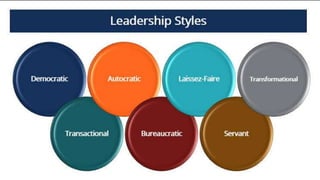
5 Types of Leadership Style
6 Basic Principles and necessary condition of leadership
7 Significance and Role of Leaders
8 Power, Authority, Status and relationship with leadership
9 Challenges of Leadership
DEFINITIONS
Leadership is a dynamic process that involves inspiring and influencing others
to achieve a shared vision or goal.
• Leadership is about one individual influencing a group of others to accomplish
common goals.
DEFINITIONS
• According to C.I. Bernard – ‘Leadership is the quality of behaviour of the individuals whereby they
guide people or their activities in organized efforts’.
• According to Bernard Keys and Thomas – ‘Leadership is the process of influencing and supporting
others to work enthusiastically towards achieving objectives’.
• Keith Davis, “Leadership is the process of encouraging and helping others to work enthusiastically
towards their objectives. Leadership must extract cooperation and willingness of the individuals and
groups to attain the organisational objectives.”
• George R. Terry, “Leadership is a relationship in which one person influences others to work together
willingly on related tasks to attain what the leader desires.”
• Koontz and O’Donnell, “Leadership is the process of influencing people so that they will strive
willingly towards the achievement of group goals.”
• Alford and Beattey, “Leadership is the ability to secure desirable actions from a group of followers
voluntarily without the use of coercion.”
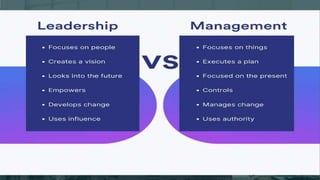
LEADERSIP & MANAGEMENT
Leadership is the ability of an individual to influence, motivate, and
enable others to contribute to the organization's success.

Management is responsible for controlling an organization, a group, or
a set of entities to achieve a particular objective.
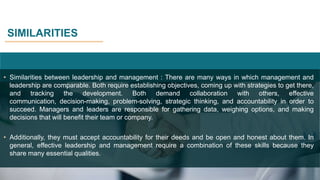
SIMILARITIES
• Similarities between leadership and management : There are many ways in which management and
leadership are comparable. Both require establishing objectives, coming up with strategies to get there,
and tracking the development. Both demand collaboration with others, effective
communication, decision-making, problem-solving, strategic thinking, and accountability in order to
succeed. Managers and leaders are responsible for gathering data, weighing options, and making
decisions that will benefit their team or company.
• Additionally, they must accept accountability for their deeds and be open and honest about them. In
general, effective leadership and management require a combination of these skills because they
share many essential qualities.
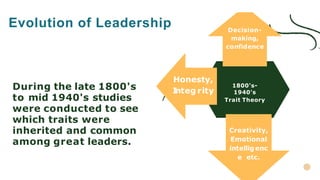
1800's-
1940's
Trait Theory
Creativity,
Emotional
intellig enc
e etc.
Decision-
making,
confidence
Honesty,
I
nteg rity
During the late 1800's
to mid 1940's studies
were conducted to see
which traits were
inherited and common
among great leaders.
Evolution of Leadership
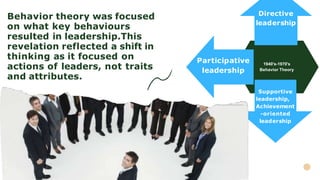
1940's-1970's
Behavior Theory
Supportive
leadership,
Achievement
-oriented
leadership
Directive
leadership
Participative
leadership
Behavior theory was focused
on what key behaviours
resulted in leadership.This
revelation reflected a shift in
thinking as it focused on
actions of leaders, not traits
and attributes.
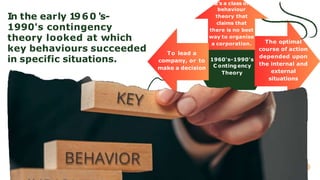
1960's-1990's
C onting ency
Theory
The optimal
course of action
depended upon
the internal and
external
situations
It's a class of
behaviour
theory that
claims that
there is no best
way to organise
a corporation.
To lead a
company, or to
make a decision
In the early 1960 's-
1990's contingency
theory looked at which
key behaviours succeeded
in specific situations.
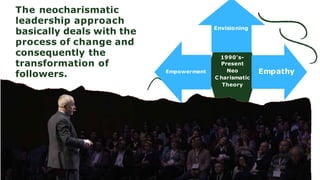
1990's-
Present
Neo
C harismatic
Theory
Empathy
Envisioning
Empowerment
The neocharismatic
leadership approach
basically deals with the
process of change and
consequently the
transformation of
followers.
Component of Leadership
1. Influence: The power to impact or convince others to adopt a specific course
of action or mindset.
Example: A manager's positive influence is evident when they inspire team
members to enthusiastically embrace a new project, fostering a collaborative
and productive work environment.
2. Followers: Individuals who willingly align themselves with a leader and are
swayed by their decisions and guidance.
Example: In a corporate setting, employees act as followers, seeking direction,
guidance, and leadership from their CEO to achieve organizational goals.
Component of Leadership
3. Goal: The intended outcome or objective that a leader and their followers
collaboratively strive to attain.
Example: A team leader may establish a goal to increase sales by 15% within the
next quarter, providing clear direction for the team to concentrate their efforts
and resources.*
4. Purpose of Action: The rationale behind a leader's decisions and actions,
highlighting the intended impact on the organization or followers.
Example: A CEO's purpose of action might be to enhance sustainability practices
within the company, demonstrating a commitment to social responsibility and
long-term success.
Component of Leadership
5. Consent: Securing approval or agreement from followers before implementing
significant decisions or changes.
Example: A leader seeking consent might involve team members in the decision-
making process for a major project, ensuring their input and support before
finalizing plans.
6.Ethics: The moral principles and values guiding a leader's behavior and
decision-making, considering the impact on followers and the broader
community.
Example: An ethical leader ensures fair treatment of employees, upholding
principles of honesty and integrity even in challenging situations.
Functions of Leadership
1. Setting goals
2. Organising
3. Uses power properly
4. Leader manages the time well
5. Take initiatives
6. Cooperation among employees
Continue…..
7. Motivation and direction
8. Liaison between workers and management
9. Policy making
10. Supervision and control
Kotter (1990), identified some categories of the functions of leadership. These are :
 1. Establishing Direction:
 a) Create a vision
 b) Clarify big picture
 c) Set strategies
 2. Aligning People:
 a) Communicate goals
 b) Seek commitment
 c) Build teams and coalitions
 3. Motivating and Inspiring:
 a) Inspire and energise
 b) Empower followers
 c) Satisfy unmet needs.
 10. Supervision and Control.
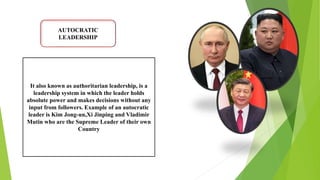
AUTOCRATIC
LEADERSHIP
It also known as authoritarian leadership, is a
leadership system in which the leader holds
absolute power and makes decisions without any
input from followers. Example of an autocratic
leader is Kim Jong-un,Xi Jinping and Vladimir
Mutin who are the Supreme Leader of their own
Country
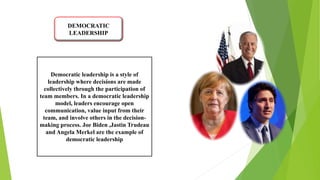
DEMOCRATIC
LEADERSHIP
Democratic leadership is a style of
leadership where decisions are made
collectively through the participation of
team members. In a democratic leadership
model, leaders encourage open
communication, value input from their
team, and involve others in the decision-
making process. Joe Biden ,Jastin Trudeau
and Angela Merkel are the example of
democratic leadership
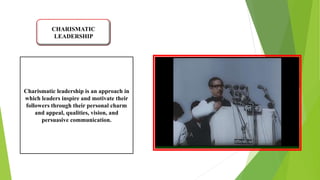
CHARISMATIC
LEADERSHIP
Charismatic leadership is an approach in
which leaders inspire and motivate their
followers through their personal charm
and appeal, qualities, vision, and
persuasive communication.
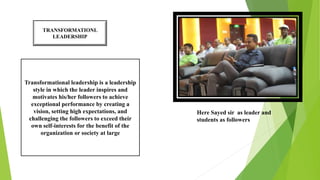
TRANSFORMATIONL
LEADERSHIP
Transformational leadership is a leadership
style in which the leader inspires and
motivates his/her followers to achieve
exceptional performance by creating a
vision, setting high expectations, and
challenging the followers to exceed their
own self-interests for the benefit of the
organization or society at large
Here Sayed sir as leader and
students as followers
TRANSACTIONL
LEADERSHIP
Transactional leadership is an
approach that focuses on the exchange
relationship between leaders and
followers . For any good performance,
the leader provides rewards (such as
bonuses, improved salaries,
promotions, and recognition.For
example the manager and the staf
relationship.
LAISSEZ-FAIRE
LEADERSHIP
Laissez-faire leadership, sometimes
referred to as delegative leadership,
is a leadership style in which the
leader has a hands-off approach,
minimal involvement and allows
followers to make decisions. laissez-
faire leaders provide little guidance
or supervision to their followers,
allowing them significant autonomy
and freedom to make decisions and
perform tasks. An example of laissez-
faire leadership might involve a
manager giving team members the
autonomy to set their own goals,
SITUATIONAL
LEADERSHIP
Situational leadership is a flexible
leadership style that adapts to the
specific needs and capabilities of
individual followers or groups
(Hersey at. el, 2013). Situational
leadership style emphasises the
leader's ability to assess the situation
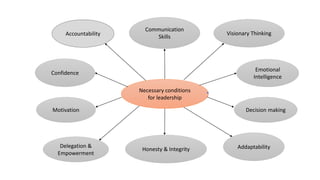
Necessary conditions
for leadership
Accountability
Communication
Skills
Visionary Thinking
Emotional
Intelligence
Decision making
Addaptability
Honesty & Integrity
Delegation &
Empowerment
Motivation
Confidence
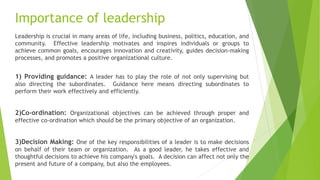
Importance of leadership
Leadership is crucial in many areas of life, including business, politics, education, and
community. Effective leadership motivates and inspires individuals or groups to
achieve common goals, encourages innovation and creativity, guides decision-making
processes, and promotes a positive organizational culture.
1) Providing guidance: A leader has to play the role of not only supervising but
also directing the subordinates. Guidance here means directing subordinates to
perform their work effectively and efficiently.
2)Co-ordination: Organizational objectives can be achieved through proper and
effective co-ordination which should be the primary objective of an organization.
3)Decision Making: One of the key responsibilities of a leader is to make decisions
on behalf of their team or organization. As a good leader, he takes effective and
thoughtful decisions to achieve his company's goals. A decision can affect not only the
present and future of a company, but also the employees.
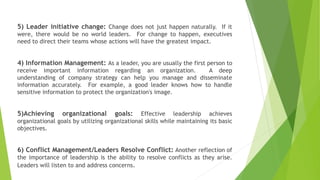
5) Leader initiative change: Change does not just happen naturally. If it
were, there would be no world leaders. For change to happen, executives
need to direct their teams whose actions will have the greatest impact.
4) Information Management: As a leader, you are usually the first person to
receive important information regarding an organization. A deep
understanding of company strategy can help you manage and disseminate
information accurately. For example, a good leader knows how to handle
sensitive information to protect the organization's image.
5)Achieving organizational goals: Effective leadership achieves
organizational goals by utilizing organizational skills while maintaining its basic
objectives.
6) Conflict Management/Leaders Resolve Conflict: Another reflection of
the importance of leadership is the ability to resolve conflicts as they arise.
Leaders will listen to and address concerns.
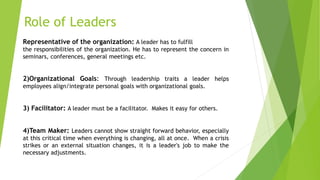
Role of Leaders
Representative of the organization: A leader has to fulfill
the responsibilities of the organization. He has to represent the concern in
seminars, conferences, general meetings etc.
2)Organizational Goals: Through leadership traits a leader helps
employees align/integrate personal goals with organizational goals.
3) Facilitator: A leader must be a facilitator. Makes it easy for others.
4)Team Maker: Leaders cannot show straight forward behavior, especially
at this critical time when everything is changing, all at once. When a crisis
strikes or an external situation changes, it is a leader's job to make the
necessary adjustments.
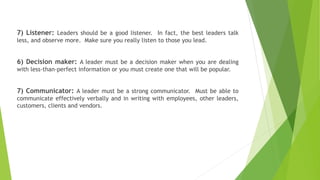
7) Listener: Leaders should be a good listener. In fact, the best leaders talk
less, and observe more. Make sure you really listen to those you lead.
6) Decision maker: A leader must be a decision maker when you are dealing
with less-than-perfect information or you must create one that will be popular.
7) Communicator: A leader must be a strong communicator. Must be able to
communicate effectively verbally and in writing with employees, other leaders,
customers, clients and vendors.
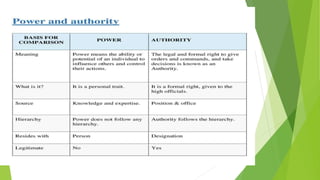
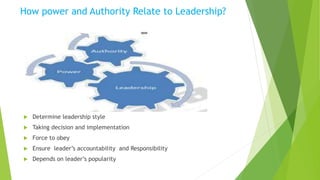
How power and Authority Relate to Leadership?
 Determine leadership style
 Taking decision and implementation
 Force to obey
 Ensure leader’s accountability and Responsibility
 Depends on leader’s popularity
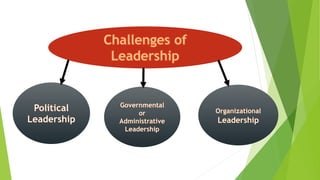
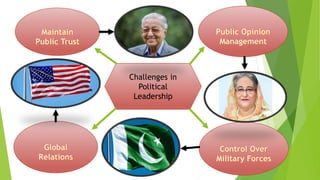
Challenges in
Political
Leadership
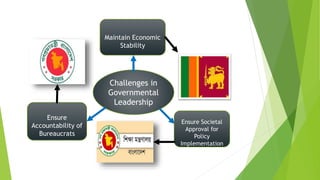
Challenges in
Governmental
Leadership
Maintain Economic
Stability
Ensure Societal
Approval for
Policy
Implementation
Ensure
Accountability of
Bureaucrats
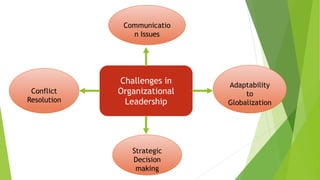
Challenges in
Organizational
Leadership
Communicatio
n Issues
Adaptability
to
Globalization
Strategic
Decision
making
Conflict
Resolution
THANK YOU

Introduction to leadership study .pptx

  • 1.
  • 2.
    1 Synopsis 2 Evolution ofLeadership 3 Components of Leadership 4 Functions of Leadership 5 Types of Leadership Style 6 Basic Principles and necessary condition of leadership 7 Significance and Role of Leaders 8 Power, Authority, Status and relationship with leadership 9 Challenges of Leadership
  • 3.
    DEFINITIONS Leadership is adynamic process that involves inspiring and influencing others to achieve a shared vision or goal. • Leadership is about one individual influencing a group of others to accomplish common goals.
  • 4.
    DEFINITIONS • According toC.I. Bernard – ‘Leadership is the quality of behaviour of the individuals whereby they guide people or their activities in organized efforts’. • According to Bernard Keys and Thomas – ‘Leadership is the process of influencing and supporting others to work enthusiastically towards achieving objectives’. • Keith Davis, “Leadership is the process of encouraging and helping others to work enthusiastically towards their objectives. Leadership must extract cooperation and willingness of the individuals and groups to attain the organisational objectives.” • George R. Terry, “Leadership is a relationship in which one person influences others to work together willingly on related tasks to attain what the leader desires.” • Koontz and O’Donnell, “Leadership is the process of influencing people so that they will strive willingly towards the achievement of group goals.” • Alford and Beattey, “Leadership is the ability to secure desirable actions from a group of followers voluntarily without the use of coercion.”
  • 5.
    LEADERSIP & MANAGEMENT Leadershipis the ability of an individual to influence, motivate, and enable others to contribute to the organization's success. Management is responsible for controlling an organization, a group, or a set of entities to achieve a particular objective.
  • 7.
    SIMILARITIES • Similarities betweenleadership and management : There are many ways in which management and leadership are comparable. Both require establishing objectives, coming up with strategies to get there, and tracking the development. Both demand collaboration with others, effective communication, decision-making, problem-solving, strategic thinking, and accountability in order to succeed. Managers and leaders are responsible for gathering data, weighing options, and making decisions that will benefit their team or company. • Additionally, they must accept accountability for their deeds and be open and honest about them. In general, effective leadership and management require a combination of these skills because they share many essential qualities.
  • 8.
    1800's- 1940's Trait Theory Creativity, Emotional intellig enc eetc. Decision- making, confidence Honesty, I nteg rity During the late 1800's to mid 1940's studies were conducted to see which traits were inherited and common among great leaders. Evolution of Leadership
  • 9.
    1940's-1970's Behavior Theory Supportive leadership, Achievement -oriented leadership Directive leadership Participative leadership Behavior theorywas focused on what key behaviours resulted in leadership.This revelation reflected a shift in thinking as it focused on actions of leaders, not traits and attributes.
  • 10.
    1960's-1990's C onting ency Theory Theoptimal course of action depended upon the internal and external situations It's a class of behaviour theory that claims that there is no best way to organise a corporation. To lead a company, or to make a decision In the early 1960 's- 1990's contingency theory looked at which key behaviours succeeded in specific situations.
  • 11.
    1990's- Present Neo C harismatic Theory Empathy Envisioning Empowerment The neocharismatic leadershipapproach basically deals with the process of change and consequently the transformation of followers.
  • 12.
    Component of Leadership 1.Influence: The power to impact or convince others to adopt a specific course of action or mindset. Example: A manager's positive influence is evident when they inspire team members to enthusiastically embrace a new project, fostering a collaborative and productive work environment. 2. Followers: Individuals who willingly align themselves with a leader and are swayed by their decisions and guidance. Example: In a corporate setting, employees act as followers, seeking direction, guidance, and leadership from their CEO to achieve organizational goals.
  • 13.
    Component of Leadership 3.Goal: The intended outcome or objective that a leader and their followers collaboratively strive to attain. Example: A team leader may establish a goal to increase sales by 15% within the next quarter, providing clear direction for the team to concentrate their efforts and resources.* 4. Purpose of Action: The rationale behind a leader's decisions and actions, highlighting the intended impact on the organization or followers. Example: A CEO's purpose of action might be to enhance sustainability practices within the company, demonstrating a commitment to social responsibility and long-term success.
  • 14.
    Component of Leadership 5.Consent: Securing approval or agreement from followers before implementing significant decisions or changes. Example: A leader seeking consent might involve team members in the decision- making process for a major project, ensuring their input and support before finalizing plans. 6.Ethics: The moral principles and values guiding a leader's behavior and decision-making, considering the impact on followers and the broader community. Example: An ethical leader ensures fair treatment of employees, upholding principles of honesty and integrity even in challenging situations.
  • 15.
    Functions of Leadership 1.Setting goals 2. Organising 3. Uses power properly 4. Leader manages the time well 5. Take initiatives 6. Cooperation among employees
  • 16.
    Continue….. 7. Motivation anddirection 8. Liaison between workers and management 9. Policy making 10. Supervision and control
  • 17.
    Kotter (1990), identifiedsome categories of the functions of leadership. These are :  1. Establishing Direction:  a) Create a vision  b) Clarify big picture  c) Set strategies  2. Aligning People:  a) Communicate goals  b) Seek commitment  c) Build teams and coalitions  3. Motivating and Inspiring:  a) Inspire and energise  b) Empower followers  c) Satisfy unmet needs.  10. Supervision and Control.
  • 19.
    AUTOCRATIC LEADERSHIP It also knownas authoritarian leadership, is a leadership system in which the leader holds absolute power and makes decisions without any input from followers. Example of an autocratic leader is Kim Jong-un,Xi Jinping and Vladimir Mutin who are the Supreme Leader of their own Country
  • 20.
    DEMOCRATIC LEADERSHIP Democratic leadership isa style of leadership where decisions are made collectively through the participation of team members. In a democratic leadership model, leaders encourage open communication, value input from their team, and involve others in the decision- making process. Joe Biden ,Jastin Trudeau and Angela Merkel are the example of democratic leadership
  • 21.
    CHARISMATIC LEADERSHIP Charismatic leadership isan approach in which leaders inspire and motivate their followers through their personal charm and appeal, qualities, vision, and persuasive communication.
  • 22.
    TRANSFORMATIONL LEADERSHIP Transformational leadership isa leadership style in which the leader inspires and motivates his/her followers to achieve exceptional performance by creating a vision, setting high expectations, and challenging the followers to exceed their own self-interests for the benefit of the organization or society at large Here Sayed sir as leader and students as followers
  • 23.
    TRANSACTIONL LEADERSHIP Transactional leadership isan approach that focuses on the exchange relationship between leaders and followers . For any good performance, the leader provides rewards (such as bonuses, improved salaries, promotions, and recognition.For example the manager and the staf relationship.
  • 24.
    LAISSEZ-FAIRE LEADERSHIP Laissez-faire leadership, sometimes referredto as delegative leadership, is a leadership style in which the leader has a hands-off approach, minimal involvement and allows followers to make decisions. laissez- faire leaders provide little guidance or supervision to their followers, allowing them significant autonomy and freedom to make decisions and perform tasks. An example of laissez- faire leadership might involve a manager giving team members the autonomy to set their own goals, SITUATIONAL LEADERSHIP Situational leadership is a flexible leadership style that adapts to the specific needs and capabilities of individual followers or groups (Hersey at. el, 2013). Situational leadership style emphasises the leader's ability to assess the situation
  • 25.
    Necessary conditions for leadership Accountability Communication Skills VisionaryThinking Emotional Intelligence Decision making Addaptability Honesty & Integrity Delegation & Empowerment Motivation Confidence
  • 26.
    Importance of leadership Leadershipis crucial in many areas of life, including business, politics, education, and community. Effective leadership motivates and inspires individuals or groups to achieve common goals, encourages innovation and creativity, guides decision-making processes, and promotes a positive organizational culture. 1) Providing guidance: A leader has to play the role of not only supervising but also directing the subordinates. Guidance here means directing subordinates to perform their work effectively and efficiently. 2)Co-ordination: Organizational objectives can be achieved through proper and effective co-ordination which should be the primary objective of an organization. 3)Decision Making: One of the key responsibilities of a leader is to make decisions on behalf of their team or organization. As a good leader, he takes effective and thoughtful decisions to achieve his company's goals. A decision can affect not only the present and future of a company, but also the employees.
  • 27.
    5) Leader initiativechange: Change does not just happen naturally. If it were, there would be no world leaders. For change to happen, executives need to direct their teams whose actions will have the greatest impact. 4) Information Management: As a leader, you are usually the first person to receive important information regarding an organization. A deep understanding of company strategy can help you manage and disseminate information accurately. For example, a good leader knows how to handle sensitive information to protect the organization's image. 5)Achieving organizational goals: Effective leadership achieves organizational goals by utilizing organizational skills while maintaining its basic objectives. 6) Conflict Management/Leaders Resolve Conflict: Another reflection of the importance of leadership is the ability to resolve conflicts as they arise. Leaders will listen to and address concerns.
  • 28.
    Role of Leaders Representativeof the organization: A leader has to fulfill the responsibilities of the organization. He has to represent the concern in seminars, conferences, general meetings etc. 2)Organizational Goals: Through leadership traits a leader helps employees align/integrate personal goals with organizational goals. 3) Facilitator: A leader must be a facilitator. Makes it easy for others. 4)Team Maker: Leaders cannot show straight forward behavior, especially at this critical time when everything is changing, all at once. When a crisis strikes or an external situation changes, it is a leader's job to make the necessary adjustments.
  • 29.
    7) Listener: Leadersshould be a good listener. In fact, the best leaders talk less, and observe more. Make sure you really listen to those you lead. 6) Decision maker: A leader must be a decision maker when you are dealing with less-than-perfect information or you must create one that will be popular. 7) Communicator: A leader must be a strong communicator. Must be able to communicate effectively verbally and in writing with employees, other leaders, customers, clients and vendors.
  • 31.
    How power andAuthority Relate to Leadership?  Determine leadership style  Taking decision and implementation  Force to obey  Ensure leader’s accountability and Responsibility  Depends on leader’s popularity
  • 33.
  • 34.
    Challenges in Governmental Leadership Maintain Economic Stability EnsureSocietal Approval for Policy Implementation Ensure Accountability of Bureaucrats
  • 35.
  • 36.