Present Progressive Tense,
Comparisons & Demonstrative
Adjectives
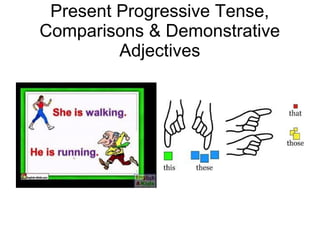
Present Progressive Tense
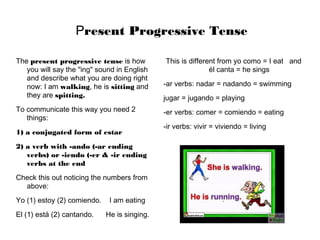
The present progressive tense is how
you will say the "ing" sound in English
and describe what you are doing right
now: I am walking, he is sitting and
they are spitting.
To communicate this way you need 2
things:
1) a conjugated form of estar
2) a verb with -ando (-ar ending
verbs) or -iendo (-er & -ir ending
verbs at the end
Check this out noticing the numbers from
above:
Yo (1) estoy (2) comiendo. I am eating
El (1) está (2) cantando. He is singing.
This is different from yo como = I eat and
él canta = he sings
-ar verbs: nadar = nadando = swimming
jugar = jugando = playing
-er verbs: comer = comiendo = eating
-ir verbs: vivir = viviendo = living
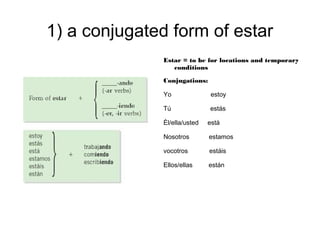
1) a conjugated form of estar
Estar = to be for locations and temporary
conditions
Conjugations:
Yo estoy
Tú estás
Èl/ella/usted está
Nosotros estamos
vocotros estáis
Ellos/ellas están
Comparaciones de igualdad
(equality)
Use these ridiculous comparisons to help
you understand comparisons in Spanish
for Writing 2A
Tan/tanto/a/os/as = as or, as many Como=
as much/as many
Ejemplos:
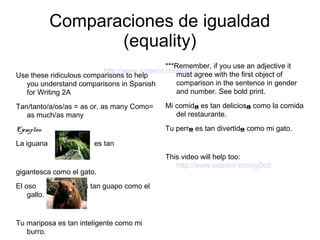
La iguana es tan
gigantesca como el gato.
El oso es tan guapo como el
gallo.
Tu mariposa es tan inteligente como mi
burro.
***Remember, if you use an adjective it
must agree with the first object of
comparison in the sentence in gender
and number. See bold print.
Mi comida es tan deliciosa como la comida
del restaurante.
Tu perro es tan divertido como mi gato.
This video will help too:
http://www.screenr.com/gDo8
Comparaciones de desigualdad
(inequality)
Comparaciones de desigualdad
(inequality)
Que= that peor= worse mejor= better más
= more
Ejemplos:
Este pájaro es
menos alto que el papagallo.
El pez
es más inteligente que su jirafa.
***Remember, if you use an adjective it
must agree with the first object of
comparison in the sentence in gender
and number. See bold print.
Mi comida es más deliciosa que la comida
del restaurante.
Tu perro es menos divertido que mi gato.
This video will help too:
http://www.screenr.com/gDo8
Demonstrative Adjectives ~
This & These
Close To You/Speaker ~ You Can
Touch It
este (this masculine) = this
esta (this feminine) = this
estos (these) = these
estas (these feminine) = these
Examples:
Me gusta esta serpiente. (Snake is
feminine so it must be esta.)
Me gustan estas serpientes. (Snakes are
feminine and plural so it must be estas.)
http://channel.nationalgeographic.com/wild/episodes
/snake-underworld/
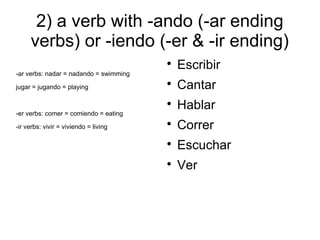
2) a verb with -ando (-ar ending
verbs) or -iendo (-er & -ir ending)
-ar verbs: nadar = nadando = swimming
jugar = jugando = playing
-er verbs: comer = comiendo = eating
-ir verbs: vivir = viviendo = living

Escribir

Cantar

Hablar

Correr

Escuchar

Ver
Demonstrative Adjectives ~
That & Those
Farther From You/Speaker ~ Over
There
ese (that masculine) = that
esa (that feminine) = that
esos (thosemasculine) = those
esas (those feminine) = those
Les gustan esas vacas.
Me gusta esa vaca.
http://dealbreaker.com/2011/09/could-moodys-
saying-bofa-is-not-too-big-to-fail-make-bofa-not-
too-big-to-fail/cows-curious/
Demonstrative Adjectives ~
That & Those (Over Yonder)
Farthest From You/Speaker ~ WAY
Over There
aquel (that masculine) = that
aquella (that feminine) = that
aquellas (those feminine) = those
aquellos (those masculine) = those
Yo prefiero aquella vaca.
Aquella vaca
http://commons.wikimedia.org/wiki/File:Cows_and_calf.JPG
Demonstrative Adjectives ~
That & Those (Over Yonder)
Farthest From You/Speaker ~ WAY
Over There
aquel (that masculine) = that
aquella (that feminine) = that
aquellas (those feminine) = those
aquellos (those masculine) = those
Yo prefiero aquella vaca.
Aquella vaca
http://commons.wikimedia.org/wiki/File:Cows_and_calf.JPG

Present Progressive Tense, Comparisons & Demonstrative Adjectives

  • 1.
    Present Progressive Tense, Comparisons& Demonstrative Adjectives
  • 2.
    Present Progressive Tense Thepresent progressive tense is how you will say the "ing" sound in English and describe what you are doing right now: I am walking, he is sitting and they are spitting. To communicate this way you need 2 things: 1) a conjugated form of estar 2) a verb with -ando (-ar ending verbs) or -iendo (-er & -ir ending verbs at the end Check this out noticing the numbers from above: Yo (1) estoy (2) comiendo. I am eating El (1) está (2) cantando. He is singing. This is different from yo como = I eat and él canta = he sings -ar verbs: nadar = nadando = swimming jugar = jugando = playing -er verbs: comer = comiendo = eating -ir verbs: vivir = viviendo = living
  • 3.
    1) a conjugatedform of estar Estar = to be for locations and temporary conditions Conjugations: Yo estoy Tú estás Èl/ella/usted está Nosotros estamos vocotros estáis Ellos/ellas están
  • 4.
    Comparaciones de igualdad (equality) Usethese ridiculous comparisons to help you understand comparisons in Spanish for Writing 2A Tan/tanto/a/os/as = as or, as many Como= as much/as many Ejemplos: La iguana es tan gigantesca como el gato. El oso es tan guapo como el gallo. Tu mariposa es tan inteligente como mi burro. ***Remember, if you use an adjective it must agree with the first object of comparison in the sentence in gender and number. See bold print. Mi comida es tan deliciosa como la comida del restaurante. Tu perro es tan divertido como mi gato. This video will help too: http://www.screenr.com/gDo8 http://www.screenr.com/gDo8
  • 5.
    Comparaciones de desigualdad (inequality) Comparacionesde desigualdad (inequality) Que= that peor= worse mejor= better más = more Ejemplos: Este pájaro es menos alto que el papagallo. El pez es más inteligente que su jirafa. ***Remember, if you use an adjective it must agree with the first object of comparison in the sentence in gender and number. See bold print. Mi comida es más deliciosa que la comida del restaurante. Tu perro es menos divertido que mi gato. This video will help too: http://www.screenr.com/gDo8
  • 6.
    Demonstrative Adjectives ~ This& These Close To You/Speaker ~ You Can Touch It este (this masculine) = this esta (this feminine) = this estos (these) = these estas (these feminine) = these Examples: Me gusta esta serpiente. (Snake is feminine so it must be esta.) Me gustan estas serpientes. (Snakes are feminine and plural so it must be estas.) http://channel.nationalgeographic.com/wild/episodes /snake-underworld/
  • 7.
    2) a verbwith -ando (-ar ending verbs) or -iendo (-er & -ir ending) -ar verbs: nadar = nadando = swimming jugar = jugando = playing -er verbs: comer = comiendo = eating -ir verbs: vivir = viviendo = living  Escribir  Cantar  Hablar  Correr  Escuchar  Ver
  • 8.
    Demonstrative Adjectives ~ That& Those Farther From You/Speaker ~ Over There ese (that masculine) = that esa (that feminine) = that esos (thosemasculine) = those esas (those feminine) = those Les gustan esas vacas. Me gusta esa vaca. http://dealbreaker.com/2011/09/could-moodys- saying-bofa-is-not-too-big-to-fail-make-bofa-not- too-big-to-fail/cows-curious/
  • 9.
    Demonstrative Adjectives ~ That& Those (Over Yonder) Farthest From You/Speaker ~ WAY Over There aquel (that masculine) = that aquella (that feminine) = that aquellas (those feminine) = those aquellos (those masculine) = those Yo prefiero aquella vaca. Aquella vaca http://commons.wikimedia.org/wiki/File:Cows_and_calf.JPG
  • 10.
    Demonstrative Adjectives ~ That& Those (Over Yonder) Farthest From You/Speaker ~ WAY Over There aquel (that masculine) = that aquella (that feminine) = that aquellas (those feminine) = those aquellos (those masculine) = those Yo prefiero aquella vaca. Aquella vaca http://commons.wikimedia.org/wiki/File:Cows_and_calf.JPG