The Use of Adjectives
Making
Descriptions
This looks
a little...
What is an adjective?
Classes of Adjectives
Coordinate adjectives
These are small groups of adjectives used to
describe some attributes of the same noun or
subject. They are separated by a comma to avoid
confusing the adjectives as singular modifier and
not a coordinate pair.
Examples
She wore a blue and white blouse
yesterday.
It was a dark, gloomy and
thunderous afternoon in
Boracay.
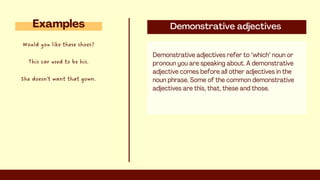
Demonstrative adjectives
Demonstrative adjectives refer to "which" noun or
pronoun you are speaking about. A demonstrative
adjective comes before all other adjectives in the
noun phrase. Some of the common demonstrative
adjectives are this, that, these and those.
Examples
Would you like these shoes?
This car used to be his.
She doesn't want that gown.
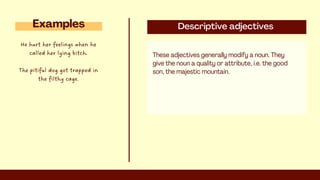
Descriptive adjectives
These adjectives generally modify a noun. They
give the noun a quality or attribute, i.e. the good
son, the majestic mountain.
Examples
He hurt her feelings when he
called her lying bitch.
The pitiful dog got trapped in
the filthy cage.
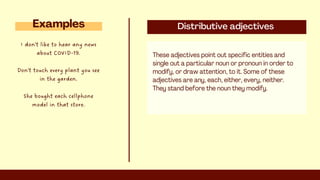
Distributive adjectives
These adjectives point out specific entities and
single out a particular noun or pronoun in order to
modify, or draw attention, to it. Some of these
adjectives are any, each, either, every, neither.
They stand before the noun they modify.
Examples
I don't like to hear any news
about COVID-19.
Don't touch every plant you see
in the garden.
She bought each cellphone
model in that store.
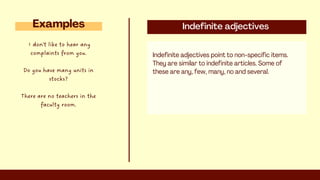
Indefinite adjectives
Indefinite adjectives point to non-specific items.
They are similar to indefinite articles. Some of
these are any, few, many, no and several.
Examples
I don't like to hear any
complaints from you.
Do you have many units in
stocks?
There are no teachers in the
faculty room.
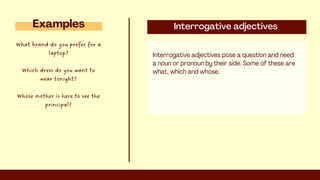
Interrogative adjectives
Interrogative adjectives pose a question and need
a noun or pronoun by their side. Some of these are
what, which and whose.
Examples
What brand do you prefer for a
laptop?
Which dress do you want to
wear tonight?
Whose mother is here to see the
principal?
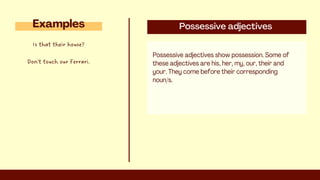
Possessive adjectives
Possessive adjectives show possession. Some of
these adjectives are his, her, my, our, their and
your. They come before their corresponding
noun/s.
Examples
Is that their house?
Don't touch our Ferrari.
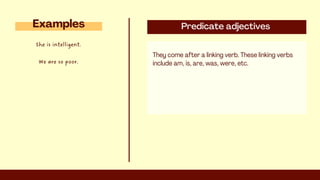
Predicate adjectives
They come after a linking verb. These linking verbs
include am, is, are, was, were, etc.
Examples
She is intelligent.
We are so poor.
Proper adjectives
These adjectives are capitalized adjectives derived
from proper nouns.
Examples
I love Korean cuisine.
Singaporean English is different
from conventional English.
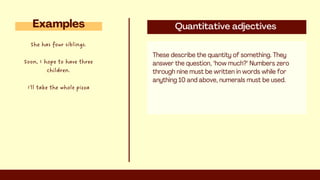
Quantitative adjectives
These describe the quantity of something. They
answer the question, "how much?" Numbers zero
through nine must be written in words while for
anything 10 and above, numerals must be used.
Examples
She has four siblings.
Soon, I hope to have three
children.
I'll take the whole pizza
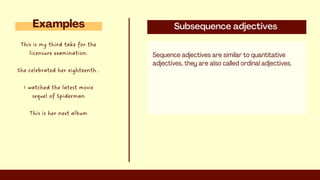
Subsequence adjectives
Sequence adjectives are similar to quantitative
adjectives, they are also called ordinal adjectives.
Examples
This is my third take for the
licensure examination.
She celebrated her eighteenth .
I watched the latest movie
sequel of Spiderman
This is her next album
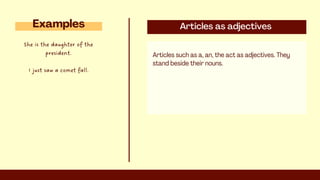
Articles as adjectives
Articles such as a, an, the act as adjectives. They
stand beside their nouns.
Examples
She is the daughter of the
president.
I just saw a comet fall.
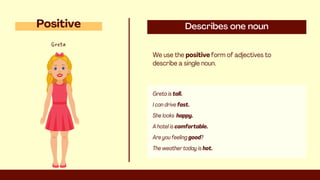
Describes one noun
We use the positive form of adjectives to
describe a single noun.
Positive
A hotel is comfortable.
Are you feeling good?
The weather today is hot.
Greta is tall.
I can drive fast.
She looks happy.
Greta
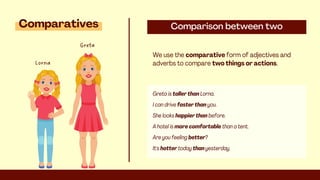
Comparison between two
We use the comparative form of adjectives and
adverbs to compare two things or actions.
Comparatives
A hotel is more comfortable than a tent.
Are you feeling better?
It's hotter today than yesterday.
Greta is taller than Lorna.
I can drive faster than you.
She looks happier than before.
Greta
Lorna
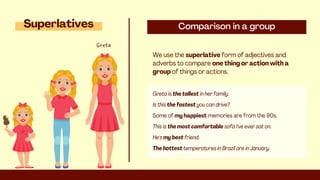
Comparison in a group
We use the superlative form of adjectives and
adverbs to compare one thing or action with a
group of things or actions.
This is the most comfortable sofa I've ever sat on.
He's my best friend.
The hottest temperatures in Brazil are in January.
Greta is the tallest in her family.
Is this the fastest you can drive?
Some of my happiest memories are from the 90s.
Greta
Superlatives
to make comparisons
Other types of clauses
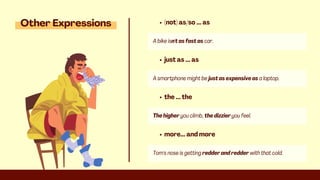
A bike isn't as fast as car.
(not) as/so ... as
A smartphone might be just as expensive as a laptop.
just as ... as
The higher you climb, the dizzier you feel.
the ... the
Tom's nose is getting redder and redder with that cold.
more... and more
Other Expressions
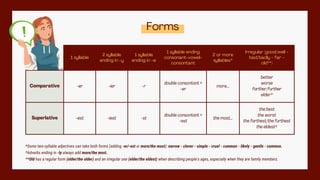
1 syllable
2 syllable
ending in -y
1 syllable
ending in -e
1 syllable ending
consonant-vowel-
consontant
2 or more
syllables*
Irregular (good/well -
bad/badly - far -
old**)
Comparative -er -ier -r
double consontant +
-er
more...
better
worse
farther/further
elder*
Superlative -est -iest -st
double consontant +
-est
the most...
the best
the worst
the farthest/the furthest
the eldest*
Forms
**Old has a regular form (older/the older) and an irregular one (elder/the eldest) when describing people's ages, especially when they are family members.
*Some two-syllable adjectives can take both forms (adding -er/-est or more/the most): narrow - clever - simple - cruel - common - likely - gentle - common.
*Adverbs ending in -ly always add more/the most.
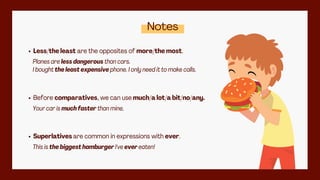
Notes
Less/the least are the opposites of more/the most.
Planes are less dangerous than cars.
I bought the least expensive phone. I only need it to make calls.
Superlatives are common in expressions with ever.
This is the biggest hamburger I've ever eaten!
Before comparatives, we can use much/a lot/a bit/no/any.
Your car is much faster than mine.
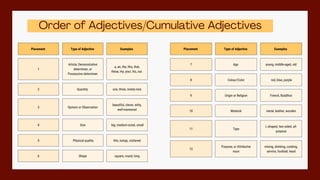
Order of Adjectives/Cumulative Adjectives
The order of adjectives refers to the specific sequence in which
multiple adjectives are placed before a noun in English. When you
describe something using more than one adjective, these adjectives
follow a fixed order to ensure the sentence sounds natural and
clear.
Cumulative adjectives are adjectives that work together to build a
description without needing commas between them. They are not
interchangeable, and their order follows a particular hierarchy.
Placement Type of Adjective Examples
1
Article, Demonstrative
determiner, or
Possessive determiner
a, an, the, this, that,
these, my, your, his, our.
2 Quantity one, three, ninety-nine
3 Opinion or Observation
beautiful, clever, witty,
well-mannered
4 Size big, medium-sized, small
5 Physical quality thin, lumpy, cluttered
6 Shape square, round, long
Order of Adjectives/Cumulative Adjectives
Placement Type of Adjective Examples
7 Age young, middle-aged, old
8 Colour/Color red, blue, purple
9 Origin or Religion French, Buddhist
10 Material metal, leather, wooden
11 Type
L-shaped, two-sided, all-
purpose
12
Purpose, or Attributive
noun
mixing, drinking, cooking,
service, football, head
Order of Adjectives/Cumulative Adjectives
"A beautiful small
round old red Italian
wooden dining table."
Example: ORDER
A (article)
Beautiful (opinion)
Small (size)
Round (shape)
Old (age)
Red (color)
Italian (origin)
Wooden (material)
Dining (purpose)
Order of Adjectives/Cumulative Adjectives
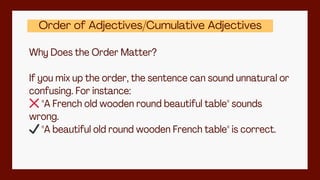
Why Does the Order Matter?
If you mix up the order, the sentence can sound unnatural or
confusing. For instance:
❌"A French old wooden round beautiful table" sounds
wrong.
✔️"A beautiful old round wooden French table" is correct.
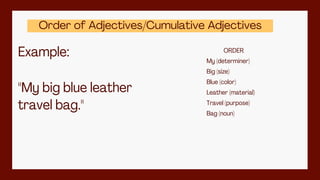
Order of Adjectives/Cumulative Adjectives
"My big blue leather
travel bag."
Example: ORDER
My (determiner)
Big (size)
Blue (color)
Leather (material)
Travel (purpose)
Bag (noun)
Happy
learning!

STRUCTURE OF ENGLISH. Midterm adjective

  • 1.
    The Use ofAdjectives Making Descriptions This looks a little...
  • 4.
    What is anadjective?
  • 6.
  • 7.
    Coordinate adjectives These aresmall groups of adjectives used to describe some attributes of the same noun or subject. They are separated by a comma to avoid confusing the adjectives as singular modifier and not a coordinate pair. Examples She wore a blue and white blouse yesterday. It was a dark, gloomy and thunderous afternoon in Boracay.
  • 8.
    Demonstrative adjectives Demonstrative adjectivesrefer to "which" noun or pronoun you are speaking about. A demonstrative adjective comes before all other adjectives in the noun phrase. Some of the common demonstrative adjectives are this, that, these and those. Examples Would you like these shoes? This car used to be his. She doesn't want that gown.
  • 9.
    Descriptive adjectives These adjectivesgenerally modify a noun. They give the noun a quality or attribute, i.e. the good son, the majestic mountain. Examples He hurt her feelings when he called her lying bitch. The pitiful dog got trapped in the filthy cage.
  • 10.
    Distributive adjectives These adjectivespoint out specific entities and single out a particular noun or pronoun in order to modify, or draw attention, to it. Some of these adjectives are any, each, either, every, neither. They stand before the noun they modify. Examples I don't like to hear any news about COVID-19. Don't touch every plant you see in the garden. She bought each cellphone model in that store.
  • 11.
    Indefinite adjectives Indefinite adjectivespoint to non-specific items. They are similar to indefinite articles. Some of these are any, few, many, no and several. Examples I don't like to hear any complaints from you. Do you have many units in stocks? There are no teachers in the faculty room.
  • 12.
    Interrogative adjectives Interrogative adjectivespose a question and need a noun or pronoun by their side. Some of these are what, which and whose. Examples What brand do you prefer for a laptop? Which dress do you want to wear tonight? Whose mother is here to see the principal?
  • 13.
    Possessive adjectives Possessive adjectivesshow possession. Some of these adjectives are his, her, my, our, their and your. They come before their corresponding noun/s. Examples Is that their house? Don't touch our Ferrari.
  • 14.
    Predicate adjectives They comeafter a linking verb. These linking verbs include am, is, are, was, were, etc. Examples She is intelligent. We are so poor.
  • 15.
    Proper adjectives These adjectivesare capitalized adjectives derived from proper nouns. Examples I love Korean cuisine. Singaporean English is different from conventional English.
  • 16.
    Quantitative adjectives These describethe quantity of something. They answer the question, "how much?" Numbers zero through nine must be written in words while for anything 10 and above, numerals must be used. Examples She has four siblings. Soon, I hope to have three children. I'll take the whole pizza
  • 17.
    Subsequence adjectives Sequence adjectivesare similar to quantitative adjectives, they are also called ordinal adjectives. Examples This is my third take for the licensure examination. She celebrated her eighteenth . I watched the latest movie sequel of Spiderman This is her next album
  • 18.
    Articles as adjectives Articlessuch as a, an, the act as adjectives. They stand beside their nouns. Examples She is the daughter of the president. I just saw a comet fall.
  • 19.
    Describes one noun Weuse the positive form of adjectives to describe a single noun. Positive A hotel is comfortable. Are you feeling good? The weather today is hot. Greta is tall. I can drive fast. She looks happy. Greta
  • 20.
    Comparison between two Weuse the comparative form of adjectives and adverbs to compare two things or actions. Comparatives A hotel is more comfortable than a tent. Are you feeling better? It's hotter today than yesterday. Greta is taller than Lorna. I can drive faster than you. She looks happier than before. Greta Lorna
  • 21.
    Comparison in agroup We use the superlative form of adjectives and adverbs to compare one thing or action with a group of things or actions. This is the most comfortable sofa I've ever sat on. He's my best friend. The hottest temperatures in Brazil are in January. Greta is the tallest in her family. Is this the fastest you can drive? Some of my happiest memories are from the 90s. Greta Superlatives
  • 22.
    to make comparisons Othertypes of clauses
  • 23.
    A bike isn'tas fast as car. (not) as/so ... as A smartphone might be just as expensive as a laptop. just as ... as The higher you climb, the dizzier you feel. the ... the Tom's nose is getting redder and redder with that cold. more... and more Other Expressions
  • 24.
    1 syllable 2 syllable endingin -y 1 syllable ending in -e 1 syllable ending consonant-vowel- consontant 2 or more syllables* Irregular (good/well - bad/badly - far - old**) Comparative -er -ier -r double consontant + -er more... better worse farther/further elder* Superlative -est -iest -st double consontant + -est the most... the best the worst the farthest/the furthest the eldest* Forms **Old has a regular form (older/the older) and an irregular one (elder/the eldest) when describing people's ages, especially when they are family members. *Some two-syllable adjectives can take both forms (adding -er/-est or more/the most): narrow - clever - simple - cruel - common - likely - gentle - common. *Adverbs ending in -ly always add more/the most.
  • 25.
    Notes Less/the least arethe opposites of more/the most. Planes are less dangerous than cars. I bought the least expensive phone. I only need it to make calls. Superlatives are common in expressions with ever. This is the biggest hamburger I've ever eaten! Before comparatives, we can use much/a lot/a bit/no/any. Your car is much faster than mine.
  • 26.
    Order of Adjectives/CumulativeAdjectives The order of adjectives refers to the specific sequence in which multiple adjectives are placed before a noun in English. When you describe something using more than one adjective, these adjectives follow a fixed order to ensure the sentence sounds natural and clear. Cumulative adjectives are adjectives that work together to build a description without needing commas between them. They are not interchangeable, and their order follows a particular hierarchy.
  • 27.
    Placement Type ofAdjective Examples 1 Article, Demonstrative determiner, or Possessive determiner a, an, the, this, that, these, my, your, his, our. 2 Quantity one, three, ninety-nine 3 Opinion or Observation beautiful, clever, witty, well-mannered 4 Size big, medium-sized, small 5 Physical quality thin, lumpy, cluttered 6 Shape square, round, long Order of Adjectives/Cumulative Adjectives Placement Type of Adjective Examples 7 Age young, middle-aged, old 8 Colour/Color red, blue, purple 9 Origin or Religion French, Buddhist 10 Material metal, leather, wooden 11 Type L-shaped, two-sided, all- purpose 12 Purpose, or Attributive noun mixing, drinking, cooking, service, football, head
  • 28.
    Order of Adjectives/CumulativeAdjectives "A beautiful small round old red Italian wooden dining table." Example: ORDER A (article) Beautiful (opinion) Small (size) Round (shape) Old (age) Red (color) Italian (origin) Wooden (material) Dining (purpose)
  • 29.
    Order of Adjectives/CumulativeAdjectives Why Does the Order Matter? If you mix up the order, the sentence can sound unnatural or confusing. For instance: ❌"A French old wooden round beautiful table" sounds wrong. ✔️"A beautiful old round wooden French table" is correct.
  • 30.
    Order of Adjectives/CumulativeAdjectives "My big blue leather travel bag." Example: ORDER My (determiner) Big (size) Blue (color) Leather (material) Travel (purpose) Bag (noun)
  • 31.