Proyecto Final
Spanish 1 Ends Friday, May 31st
All Work in Units 1 - 8 is due by midnight on Friday,
May 31st
Final Project & Exam are due by midnight on Friday,
May 31st
Checking Your Grades
You can check your grades by reviewing your Grades tab on the left hand side of the screen.
 Click the Grades button on the left of the screen
 Pay special attention to scores with a - or a 0. This means you have not completed the assignment and
you should do so ASAP.
 Incomplete work and 0s hurt your grade. :(
 Progress Reports come out every two weeks.
 The grading Period ends January 11th
 Call me with specific questions about your grade at (252) 256-7082
Grade Calculations ~ Las calulaciones
de notas
Assignments in this course are broken down into the
following percentages:
• Participation (GS Unit, eLinguafolio, RLCs) 10%
• Speaking and Listening Assignments 15%
• Reading and Writing Assignments 15%
• Vocabulary Quizzes 15%
• Cultural activities 10%
• Summative Projects 15%
Final Grade Calculations
The total course grade (block courses) is calculated
as follows:
Units 1-8 & Getting Started Unit 80%
Final Project & Exam 20%
¿Preguntas? ~ Questions
1. Date and time of class
2. Teacher/facilitator name
3. What is your biggest goal pertaining to the specific content covered
in this RLC?
4. At least one question that you still have about what was discussed
in the RLC
5. Thorough and detailed copy of your notes (can be submitted as
picture if handwritten, linked to a Google Doc or uploaded as Word doc or
PDF). These notes are the bulk of your grade and should reflect your
active note-taking throughout the entire hour.
Gracias.
Part 1: Usando el español
Imagine a scenario based in Costa Rica. You might be
an exchange student, or a Costa Rican high school
student, or a tourist to Costa Rica.
You will develop a written project in Spanish describing
your experiences in Costa Rica. You should include
material learned from all units (basic conversation,
school, housing, family, hobbies, food, shopping
experiences, and community). This project should
demonstrate the concepts and vocabulary that you
were taught in this course. Please reference the
Summary of Course Content provided in this section for
this purpose. You will use the web 2.0 tool to house this
written portion.
Tools for the Proyecto Final
Possible tools to use:
• Animation (Powtoon, Wideo, etc.)
• Authorstream (www.authorstream.com )
• Brainshark (www.brainshark.com )
• Digital Story (www.voicethread.com)
• Digital Book (www.wobook.com or www.storybird.com)
• Interactive Poster (www.glogster.com or www.padlet.com)
• Prezi (www.prezi.com)
• Screencast (www.screencast-o-matic.com)
Video - **If file is too large to upload to Moodle, you may have to
upload to third party site (such as YouTube, SchoolTube, Vimeo,
etc.) and then copy and paste the link/URL of your saved work on
their site in the submission box.
Other (please message your teacher of your proposal ahead of
time for verification/approval)
Part 1: Usando el español
Then, record yourself speaking in Spanish (at least two
paragraphs) about how your school, apartment, family,
hobbies, food, shopping experiences, and community in
Costa Rica compared to those in the United States.
(**Please note that this is NOT the same as what you
wrote in the previous bullet, but a different prompt with a
different response, which is verbal. You are not simply
reading what you wrote on the screen. The written
portion is the description, the recording is the
comparision.**) If the web 2.0 tool you chose allows for
an audio component, you can include this recording with
the written portion on the tool. If not, you may upload a
separate MP3 or wav file with your comparison.
Part 2: In English:
 What differences have you seen between the
Spanish language and your native language? What
did you find interesting and exciting about the
Spanish culture?
 What do you hope to learn if you continue to study
the Spanish language?
 We have learned elements of a language in a
different teaching/learning style than you may be
used to. Talk about your experience with learning
Spanish in an online class. What did you like about
the course? What did you not like and/or what
could be improved?
Part 2: In English:
 What things did you do that helped you learn
Spanish in this course? What things can you do to
improve your own Spanish learning in the future?
 What things did your professor do to help you with
your learning? Was there anything that your
professor didn't do, but would have helped you?
Part 2 Directions
This presentation needs to be well thought out and planned.
You are to be as creative as you'd like with your "product", as
long as you answer the prompts thoroughly/with great detail.
Please review carefully the Tips for a Great Final Project
provided in this section.
Please make sure that you have included written, audio, and
visual aspects to your project.
You should make your project visually appealing by using
photos or clipart for illustrations. But, please note that unless
the images are yours, you must cite the sources. (FYI -
"Google Images" is NOT a source, but a search engine.
Please see below for help citing images.)
Procedure For Citing Images
Be certain to cite the image in its original context.
Include all of the following steps whenever possible to cite your image
properly:
1) Image creator's last name, first name, if available, or page author's name if
available, followed by a period and a space
2) Title of photo followed by a period, in quotation marks. If no title, describe
briefly within quotation marks.
3) Descriptive word (photo, map, cartoon, drawing, etc,) followed by a period
and a space
4) Website title in italics, followed by a space
5) Website publication date in DD Mo. YYYY format followed by a period and
a space
6) Date image was viewed in DD Mo. YYYY format followed by a space
7) Web address in angle brackets, followed by a period
Example:
Suzuki, Lea. "Mick Jaggar." Photo. SFGate.com 14 Nov. 2005. 14 Nov. 2005
<http://www.sfgate.com>.
Part 3: Leer & Escuchar
• This section is a typical listing comprehension quiz
(Escuchar) and a Reading Comprehension Activity
(Leer) Quiz just longer.
• Make sure you have sorted out all of your audio file
playback issues before you start this quiz.
8) If you insist on using Mozilla Firefox you must
disable the popups. Click Tools/Firefox button, click
Options, click Content and uncheck the Popup
Blocker box.
9) Make sure the volume is turned up on the speakers.
:)
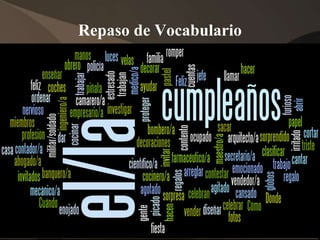
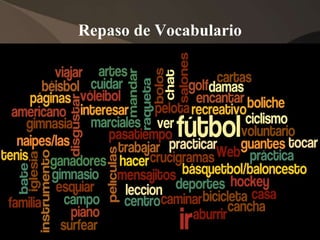
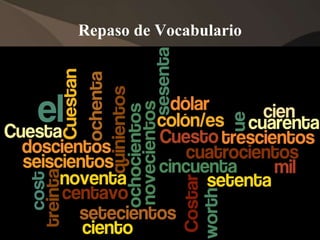
Repaso de Vocabulario
Hay = There is or there are
 Remember that hay can mean there is or there are.
So if you are saying there is or there are in your head
in English, you will need Hay in Spanish.
 Don't say hay es.
 Examples:
 En Costa Rica hay bosques lluvios y volcanes.
 En Carolina del Norte no hay volcanes.

Hablar = to talk
Comer = to eat
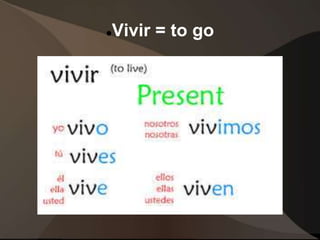
Vivir = to go
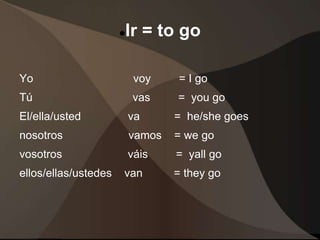
Ir = to go
Yo voy = I go
Tú vas = you go
El/ella/usted va = he/she goes
nosotros vamos = we go
vosotros váis = yall go
ellos/ellas/ustedes van = they go
Ir + a + infinitive= Going to..…
 In your sentences you need an “a”
between voy/va and the place you are
going to or the verb. Always use “a” after
ir when going to a place or going to do
something. The “a” = to in English.
 Example:
 Yo voy a la biblioteca.
 Vamos a comer los tacos.
Ir + a + infinitive=
Going to do something
Yo voy a escuchar música = I am going to listen
to music
 Tú vas a cantar = You are going to sing
 Ella va a escribir = She is going to write
 Nosotros vamos a comer = We are going to eat
 Ustedes van a cantar = They are going to sing
Ir + a + infinitive = Going to..…
 We are going to memorize?
 They are going to speak?
 I am going to watch a
 movie?
 She is going to clean the
 house?
 They are going to read?
 He is going to pay attention?
 You are going to ?
 Y’all are going to play the
 guitar?
 Ver una película = to watch a
movie
 Patintar = to skate
 Hablar = to speak
 Tocar la guitarra = to play the
guitar
 Cocinar = to cook
 Limpiar la casa = to clean the
house
 Beber = to drink
 Leer = to read
 Memorizar = to memorize
 Prestar atención = to pay
attention
 Vivir = to live
Adjectives Describing Food
 el pan (tostado)
 los huevos
 la fruta
 el tocino
 el cereal
 el yogur
 la comida
 el sándwich de jamón y
queso
delicioso/a
sabroso/a
Rico/a
Favorito/a
Sano/a
La comida es sana.
Las pizzas son deliciosas.
El delado es delicioso.
Los huevos son sabrosos.
Gustar = to like
Gustar = to like
Poder + Another Verb
Examples:
Yo puedo estudiar. = I can
study.
Tú puedes correr. = You can
run.
Ella puede practicar las artes
marciales. = She can practice
martial arts.
Nosotros podemos memorizar el
vocabulario. = We can
memorize the vocab.
Ellos pueden jugar el fútbol. =
They can play soccer.
Uncongated Verb
Deber with Other Verbs
Examples:
Yo debo surfear. = I should surf.
Tú debes correr. = You should run.
Ella debe practicar las artes marciales.
= She should practice martial arts.
Nosotros debemos memorizar el
vocabulario. = We should memorize
the vocab.
Ellos deben jugar el fútbol. = They
should play soccer.
Notice how the second verb is
unconjugated. (It has an r at the
end.)

Proyecto Final

  • 1.
  • 2.
    Spanish 1 EndsFriday, May 31st All Work in Units 1 - 8 is due by midnight on Friday, May 31st Final Project & Exam are due by midnight on Friday, May 31st
  • 3.
    Checking Your Grades CheckingYour Grades You can check your grades by reviewing your Grades tab on the left hand side of the screen.  Click the Grades button on the left of the screen  Pay special attention to scores with a - or a 0. This means you have not completed the assignment and you should do so ASAP.  Incomplete work and 0s hurt your grade. :(  Progress Reports come out every two weeks.  The grading Period ends January 11th  Call me with specific questions about your grade at (252) 256-7082
  • 4.
    Grade Calculations ~Las calulaciones de notas Assignments in this course are broken down into the following percentages: • Participation (GS Unit, eLinguafolio, RLCs) 10% • Speaking and Listening Assignments 15% • Reading and Writing Assignments 15% • Vocabulary Quizzes 15% • Cultural activities 10% • Summative Projects 15%
  • 5.
    Final Grade Calculations Thetotal course grade (block courses) is calculated as follows: Units 1-8 & Getting Started Unit 80% Final Project & Exam 20%
  • 6.
    ¿Preguntas? ~ Questions 1.Date and time of class 2. Teacher/facilitator name 3. What is your biggest goal pertaining to the specific content covered in this RLC? 4. At least one question that you still have about what was discussed in the RLC 5. Thorough and detailed copy of your notes (can be submitted as picture if handwritten, linked to a Google Doc or uploaded as Word doc or PDF). These notes are the bulk of your grade and should reflect your active note-taking throughout the entire hour. Gracias.
  • 7.
    Part 1: Usandoel español Imagine a scenario based in Costa Rica. You might be an exchange student, or a Costa Rican high school student, or a tourist to Costa Rica. You will develop a written project in Spanish describing your experiences in Costa Rica. You should include material learned from all units (basic conversation, school, housing, family, hobbies, food, shopping experiences, and community). This project should demonstrate the concepts and vocabulary that you were taught in this course. Please reference the Summary of Course Content provided in this section for this purpose. You will use the web 2.0 tool to house this written portion.
  • 8.
    Tools for theProyecto Final Possible tools to use: • Animation (Powtoon, Wideo, etc.) • Authorstream (www.authorstream.com ) • Brainshark (www.brainshark.com ) • Digital Story (www.voicethread.com) • Digital Book (www.wobook.com or www.storybird.com) • Interactive Poster (www.glogster.com or www.padlet.com) • Prezi (www.prezi.com) • Screencast (www.screencast-o-matic.com) Video - **If file is too large to upload to Moodle, you may have to upload to third party site (such as YouTube, SchoolTube, Vimeo, etc.) and then copy and paste the link/URL of your saved work on their site in the submission box. Other (please message your teacher of your proposal ahead of time for verification/approval)
  • 9.
    Part 1: Usandoel español Then, record yourself speaking in Spanish (at least two paragraphs) about how your school, apartment, family, hobbies, food, shopping experiences, and community in Costa Rica compared to those in the United States. (**Please note that this is NOT the same as what you wrote in the previous bullet, but a different prompt with a different response, which is verbal. You are not simply reading what you wrote on the screen. The written portion is the description, the recording is the comparision.**) If the web 2.0 tool you chose allows for an audio component, you can include this recording with the written portion on the tool. If not, you may upload a separate MP3 or wav file with your comparison.
  • 10.
    Part 2: InEnglish:  What differences have you seen between the Spanish language and your native language? What did you find interesting and exciting about the Spanish culture?  What do you hope to learn if you continue to study the Spanish language?  We have learned elements of a language in a different teaching/learning style than you may be used to. Talk about your experience with learning Spanish in an online class. What did you like about the course? What did you not like and/or what could be improved?
  • 11.
    Part 2: InEnglish:  What things did you do that helped you learn Spanish in this course? What things can you do to improve your own Spanish learning in the future?  What things did your professor do to help you with your learning? Was there anything that your professor didn't do, but would have helped you?
  • 12.
    Part 2 Directions Thispresentation needs to be well thought out and planned. You are to be as creative as you'd like with your "product", as long as you answer the prompts thoroughly/with great detail. Please review carefully the Tips for a Great Final Project provided in this section. Please make sure that you have included written, audio, and visual aspects to your project. You should make your project visually appealing by using photos or clipart for illustrations. But, please note that unless the images are yours, you must cite the sources. (FYI - "Google Images" is NOT a source, but a search engine. Please see below for help citing images.)
  • 13.
    Procedure For CitingImages Be certain to cite the image in its original context. Include all of the following steps whenever possible to cite your image properly: 1) Image creator's last name, first name, if available, or page author's name if available, followed by a period and a space 2) Title of photo followed by a period, in quotation marks. If no title, describe briefly within quotation marks. 3) Descriptive word (photo, map, cartoon, drawing, etc,) followed by a period and a space 4) Website title in italics, followed by a space 5) Website publication date in DD Mo. YYYY format followed by a period and a space 6) Date image was viewed in DD Mo. YYYY format followed by a space 7) Web address in angle brackets, followed by a period Example: Suzuki, Lea. "Mick Jaggar." Photo. SFGate.com 14 Nov. 2005. 14 Nov. 2005 <http://www.sfgate.com>.
  • 14.
    Part 3: Leer& Escuchar • This section is a typical listing comprehension quiz (Escuchar) and a Reading Comprehension Activity (Leer) Quiz just longer. • Make sure you have sorted out all of your audio file playback issues before you start this quiz. 8) If you insist on using Mozilla Firefox you must disable the popups. Click Tools/Firefox button, click Options, click Content and uncheck the Popup Blocker box. 9) Make sure the volume is turned up on the speakers. :)
  • 15.
  • 16.
  • 18.
  • 19.
  • 20.
  • 21.
  • 22.
  • 23.
  • 24.
  • 25.
  • 26.
  • 27.
  • 28.
  • 29.
  • 30.
  • 31.
  • 32.
  • 33.
  • 34.
  • 35.
    Hay = Thereis or there are  Remember that hay can mean there is or there are. So if you are saying there is or there are in your head in English, you will need Hay in Spanish.  Don't say hay es.  Examples:  En Costa Rica hay bosques lluvios y volcanes.  En Carolina del Norte no hay volcanes. 
  • 36.
  • 37.
  • 38.
  • 39.
    Ir = togo Yo voy = I go Tú vas = you go El/ella/usted va = he/she goes nosotros vamos = we go vosotros váis = yall go ellos/ellas/ustedes van = they go
  • 40.
    Ir + a+ infinitive= Going to..…  In your sentences you need an “a” between voy/va and the place you are going to or the verb. Always use “a” after ir when going to a place or going to do something. The “a” = to in English.  Example:  Yo voy a la biblioteca.  Vamos a comer los tacos.
  • 41.
    Ir + a+ infinitive= Going to do something Yo voy a escuchar música = I am going to listen to music  Tú vas a cantar = You are going to sing  Ella va a escribir = She is going to write  Nosotros vamos a comer = We are going to eat  Ustedes van a cantar = They are going to sing
  • 42.
    Ir + a+ infinitive = Going to..…  We are going to memorize?  They are going to speak?  I am going to watch a  movie?  She is going to clean the  house?  They are going to read?  He is going to pay attention?  You are going to ?  Y’all are going to play the  guitar?  Ver una película = to watch a movie  Patintar = to skate  Hablar = to speak  Tocar la guitarra = to play the guitar  Cocinar = to cook  Limpiar la casa = to clean the house  Beber = to drink  Leer = to read  Memorizar = to memorize  Prestar atención = to pay attention  Vivir = to live
  • 43.
    Adjectives Describing Food el pan (tostado)  los huevos  la fruta  el tocino  el cereal  el yogur  la comida  el sándwich de jamón y queso delicioso/a sabroso/a Rico/a Favorito/a Sano/a La comida es sana. Las pizzas son deliciosas. El delado es delicioso. Los huevos son sabrosos.
  • 44.
  • 45.
  • 46.
    Poder + AnotherVerb Examples: Yo puedo estudiar. = I can study. Tú puedes correr. = You can run. Ella puede practicar las artes marciales. = She can practice martial arts. Nosotros podemos memorizar el vocabulario. = We can memorize the vocab. Ellos pueden jugar el fútbol. = They can play soccer. Uncongated Verb
  • 47.
    Deber with OtherVerbs Examples: Yo debo surfear. = I should surf. Tú debes correr. = You should run. Ella debe practicar las artes marciales. = She should practice martial arts. Nosotros debemos memorizar el vocabulario. = We should memorize the vocab. Ellos deben jugar el fútbol. = They should play soccer. Notice how the second verb is unconjugated. (It has an r at the end.)