La Historia de Cuba
From the Spanish
American War in 1898 to
Fidel Castro
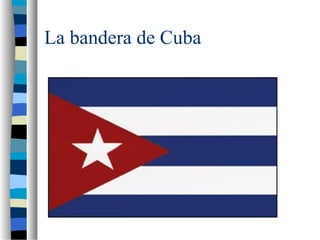
La bandera de Cuba
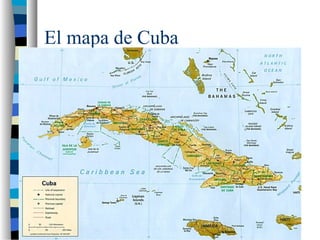
El mapa de Cuba
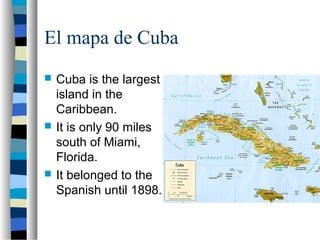
El mapa de Cuba
 Cuba is the largest
island in the
Caribbean.
 It is only 90 miles
south of Miami,
Florida.
 It belonged to the
Spanish until 1898.
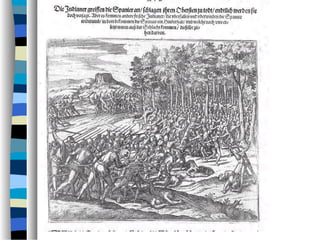
Cubanos nativos
 The original
inhabitants of Cuba
suffered the same
fate as the rest of
the indigenous
Caribbean Indian:
they were killed of
by, slavery, small
pox and war by the
Spanish settlers.
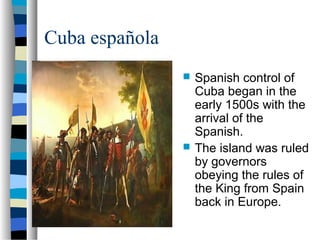
Cuba española
 Spanish control of
Cuba began in the
early 1500s with the
arrival of the
Spanish.
 The island was ruled
by governors
obeying the rules of
the King from Spain
back in Europe.
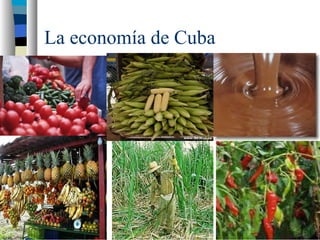
La economía de Cuba
La economía de Cuba
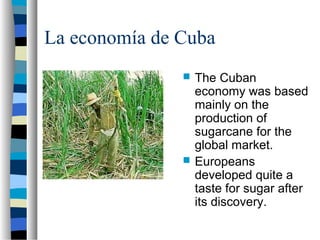
 The Cuban
economy was based
mainly on the
production of
sugarcane for the
global market.
 Europeans
developed quite a
taste for sugar after
its discovery.
El negocio de esclavos
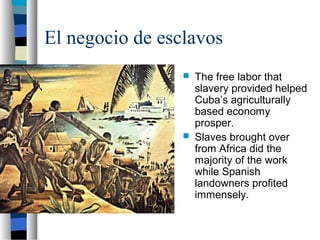
 The free labor that
slavery provided helped
Cuba’s agriculturally
based economy
prosper.
 Slaves brought over
from Africa did the
majority of the work
while Spanish
landowners profited
immensely.
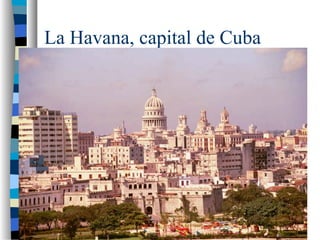
La Havana, capital de Cuba
La Havana, Capital de Cuba
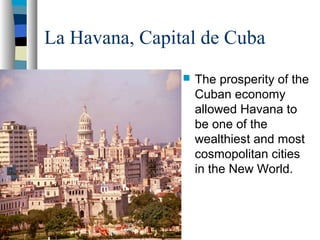
 The prosperity of the
Cuban economy
allowed Havana to
be one of the
wealthiest and most
cosmopolitan cities
in the New World.
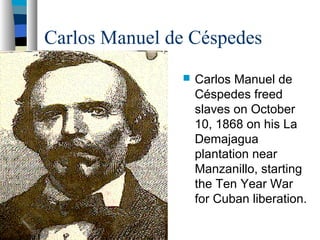
Carlos Manuel de Céspedes
 Carlos Manuel de
Céspedes freed
slaves on October
10, 1868 on his La
Demajagua
plantation near
Manzanillo, starting
the Ten Year War
for Cuban liberation.
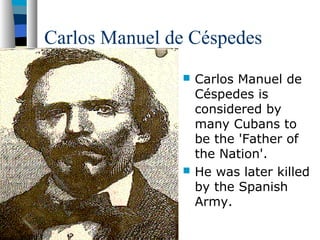
Carlos Manuel de Céspedes
 Carlos Manuel de
Céspedes is
considered by
many Cubans to
be the 'Father of
the Nation'.
 He was later killed
by the Spanish
Army.
Diez años de guerra
 The 10 years of Civil War was
eventually crushed by the Spanish
army, but the causes for the
insurrection did not go away.
 Inequality, poverty, racism, and lack of
opportunity for slaves was still rampant
in Cuba.
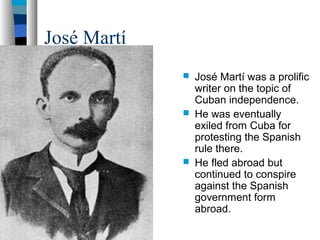
José Martí
 José Martí was a prolific
writer on the topic of
Cuban independence.
 He was eventually
exiled from Cuba for
protesting the Spanish
rule there.
 He fled abroad but
continued to conspire
against the Spanish
government form
abroad.
José Martí
 Martí returned to Cuba to fight in a second
war for political independence form Spain in
1895.
 José Martí would later die in the initial
conflicts of the Cuban-Spanish War for
Independence in 1895.
 It was not until 1898, after three years of
fighting, that the United States would declare
war on Spain.
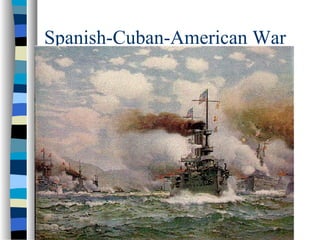
Spanish-Cuban-American War
 You probably don’t recognize that War,
but that is how the Cubans call it.
 The Cubans had been struggling for
years against the Spanish rule.
 You see the bias in the name of the
Spanish-American War. Up until now
you may not even have known that
Cubans fought in this war.
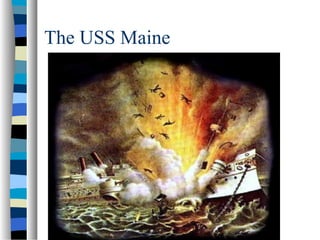
The USS Maine
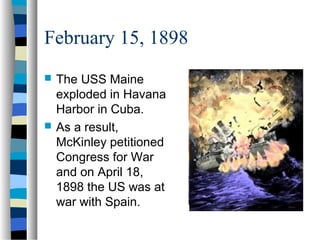
February 15, 1898
 The USS Maine
exploded in Havana
Harbor in Cuba.
 As a result,
McKinley petitioned
Congress for War
and on April 18,
1898 the US was at
war with Spain.
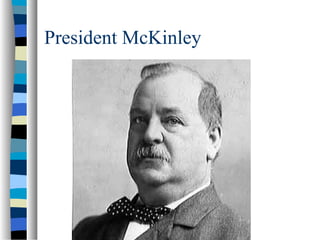
President McKinley
The Teller Amendment
 On April 18,1898 an amendment to the U.S.
declaration of war against Spain which
proclaimed that the United States would not
establish permanent control over Cuba. It
stated that the United States "hereby
disclaims any disposition of intention to
exercise sovereignty, jurisdiction, or control
over said island except for pacification
thereof, and asserts its determination, when
that is accomplished, to leave the
government and control of the island to its
people."
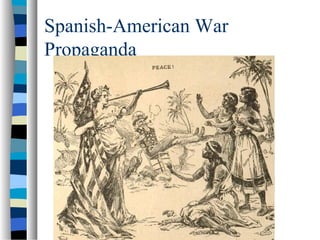
Spanish-American War
Propaganda
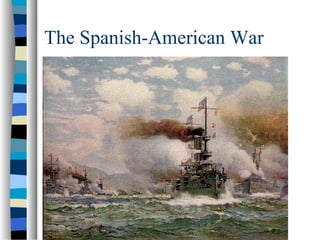
The Spanish-American War
 The Spanish-American War lasted 3
months.
 American Secretary of State John Hay
referred to it as “a splendid little war”.
 Not a single Cuban was allowed to be
present present at the surrender
negotiations between the Spanish and
American officials.
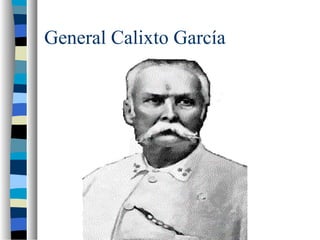
General Calixto García
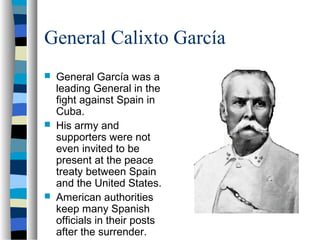
 General García was a
leading General in the
fight against Spain in
Cuba.
 His army and
supporters were not
even invited to be
present at the peace
treaty between Spain
and the United States.
 American authorities
keep many Spanish
officials in their posts
after the surrender.
Después de la guerra
 García wrote to the General of the US forces
at the end of the war: “I have not been
honored with a single word from yourself
informing me about the negotiations for
peace or the terms of the capitulation by the
Spaniards ... when the question arises of
appointing authorities in Santiago de
Cuba….I cannot see but with the deepest
regret that such authorities are not elected by
the Cuban people, but are the same ones
selected by the Queen of Spain.”
Ocupación militar
 After the War, American troops maintained a
military presence in Cuba.
 Also after the war, American businesses
began to pour into the country.
 United Fruit Company bought 1,900,000
acres at 20 cents an acre.
 Timber companies moved in to harvest the
10,000,000 acres of virgin forest in Cuba.
 American tobacco companies and steel
companies also moved onto the island to
exploit Cuba’s wealth of natural resources.
The Platt Amendment
 Platt Amendment of February 1901
allowed the United States "the right to
intervene for the preservation of Cuban
independence, the maintenance of a
government adequate for the protection
of life, property, and individual liberty..."
The Platt Amendment was finally
abrogated on May 29, 1934.
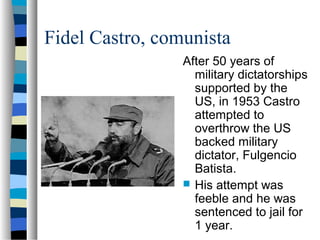
Fidel Castro, comunista
After 50 years of
military dictatorships
supported by the
US, in 1953 Castro
attempted to
overthrow the US
backed military
dictator, Fulgencio
Batista.
 His attempt was
feeble and he was
sentenced to jail for
1 year.
Cuban Revolutionary War
 Castro was released from jail and fled to
Mexico to begin preparations for a military
takeover of Batista.
 In Mexico he gathered together many Cuban
exiles to fight for his cause.
 There he met Ernesto “Che” Guevara, a
young communist who despised US political
involvement in Cuban politics.
 In 1956, Castro and 81 supporters returned
to Cuba on a boat called the Granma and
began a gorilla insurgency against Batista
from the mountains of the Sierra Maestra in
western Cuba.
Cuban Revolutionary War
 20,000 people had been killed in the
liberation war. As he entered Havana
on 8 January, 32-year-old Castro
reportedly ordered 50,000 rifles and
machine guns to be imported to defend
the Revolution.
Reforma agraria
 After Castro seized power, many
wealthy Cuban landowners lost their
land as Castro expropriated (stole) I
tand turned into state farms.
 The US owned United Fruit Company
lost much of theirt land and was turned
over to small farmers.
 In total, 1,000,000 acres were
redistributed to the poor.
Los resueltos del gobierno
comunista
 On 2 January 1959, the government
announced that 50-60% of casino profits
would be directed to welfare programs. The
first of a series of land reforms was enacted
on 17 May.
 The Cuban government offered to discuss
compensation for US-owned farms and
mineral properties. The US Secretary of State
declined the offer.
Castro y los Estados Unidos
 Ever since his rise to power in 1959,
Cuban Premier Fidel Castro struggled
to survive America's efforts to
"encourage" his political demise”
 When Castro came to power, the U.S.
stopped buying Cuban sugar and
refused to supply its former trading
partner with much needed oil and other
trade.
The Bay of Pigs
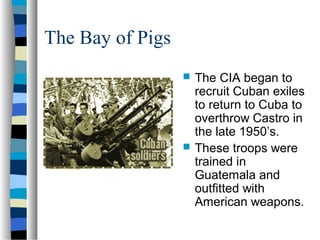
 The CIA began to
recruit Cuban exiles
to return to Cuba to
overthrow Castro in
the late 1950’s.
 These troops were
trained in
Guatemala and
outfitted with
American weapons.
Invasión cubana
 On April 17, 1961, the US supported
troops attempted to invade Cuba.
 The invasion was crushed by Castro’s
military.
 There is little proof the public would
have supported Castro’s removal from
power.
La bahía be chanchos
 Cuban air force pilots managed to destroy
ships just off the beach that were to supply
the invaders with needed ammunition and
communication equipment. Cut off from this
lifeline and running short on bullets, the exile
brigade struggled in vain for a few days
before almost all of its members were killed
or captured.
 When the shooting was over, 114 members
of the brigade were dead and 1,189 had
become Castro's prisoners.
La crisis nuclear de Cuba
 Fueled by concerns that the U.S. had
some nuclear missiles based a mere
150 miles from its boarders, in Turkey,
the Soviet leadership grew increasingly
desperate to somehow tip the balance
of power in its favor.
El crisis nuclear de Cuba
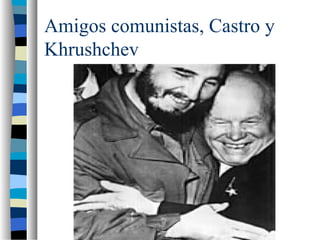
 The Soviet Union offered Castro new
trade opportunities, to ease the effects
of U.S. sanctions, and a promise of
protection from U.S. hostilities. The
cozy alliance which ensued between
Castro and Khrushchev laid the ground
for what culminated in a Soviet missile
base in Cuba and ended in the Cuban
missile crisis.
Amigos comunistas, Castro y
Khrushchev
El crisis nuclear de Cuba
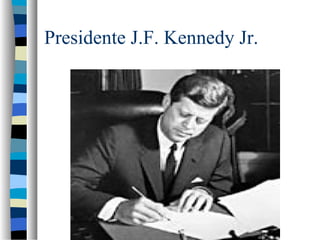
 On October 22, 1962, after reviewing newly
acquired intelligence, President John F.
Kennedy informed the world that the Soviet
Union was building secret missile bases in
Cuba, a mere 90 miles off the shores of
Florida. After weighing such options as an
armed invasion of Cuba and air strikes
against the missiles, Kennedy decided on a
less dangerous response.
Presidente J.F. Kennedy Jr.
El crisis nuclear de Cuba
 In addition to demanding that Russian
Premier Nikita S. Khrushchev remove all the
missile bases and their deadly contents,
Kennedy ordered a naval quarantine
(blockade) of Cuba in order to prevent
Russian ships from bringing additional
missiles and construction materials to the
island.
 In response to the American naval blockade,
Premier Khrushchev authorized his Soviet
field commanders in Cuba to launch their
tactical nuclear weapons if invaded by U.S.
forces.
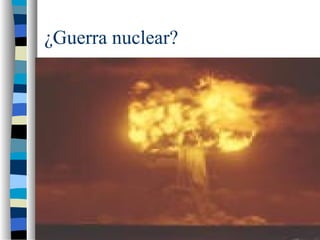
¿Guerra nuclear?
El crisis nuclear de Cuba
 Deadlocked in this manner, the two leaders of
the world's greatest nuclear superpowers
stared each other down for seven days - until
Khrushchev blinked. On October 28, thinking
better of prolonging his challenge to the
United States, the Russian Premier conceded
to President Kennedy's demands by ordering
all Soviet supply ships away from Cuban
waters and agreeing to remove the missiles
from Cuba's mainland..
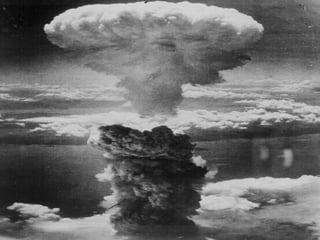
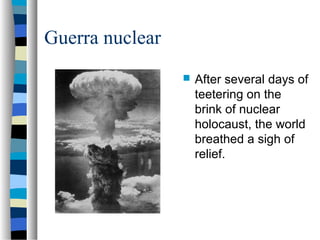
Guerra nuclear
 After several days of
teetering on the
brink of nuclear
holocaust, the world
breathed a sigh of
relief.
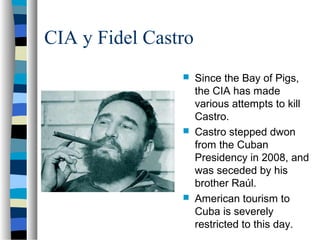
CIA y Fidel Castro
 Since the Bay of Pigs,
the CIA has made
various attempts to kill
Castro.
 Castro stepped dwon
from the Cuban
Presidency in 2008, and
was seceded by his
brother Raúl.
 American tourism to
Cuba is severely
restricted to this day.

La historia de cuba

  • 1.
    La Historia deCuba From the Spanish American War in 1898 to Fidel Castro
  • 2.
  • 3.
  • 4.
    El mapa deCuba  Cuba is the largest island in the Caribbean.  It is only 90 miles south of Miami, Florida.  It belonged to the Spanish until 1898.
  • 6.
    Cubanos nativos  Theoriginal inhabitants of Cuba suffered the same fate as the rest of the indigenous Caribbean Indian: they were killed of by, slavery, small pox and war by the Spanish settlers.
  • 7.
    Cuba española  Spanishcontrol of Cuba began in the early 1500s with the arrival of the Spanish.  The island was ruled by governors obeying the rules of the King from Spain back in Europe.
  • 8.
  • 9.
    La economía deCuba  The Cuban economy was based mainly on the production of sugarcane for the global market.  Europeans developed quite a taste for sugar after its discovery.
  • 10.
    El negocio deesclavos  The free labor that slavery provided helped Cuba’s agriculturally based economy prosper.  Slaves brought over from Africa did the majority of the work while Spanish landowners profited immensely.
  • 11.
  • 12.
    La Havana, Capitalde Cuba  The prosperity of the Cuban economy allowed Havana to be one of the wealthiest and most cosmopolitan cities in the New World.
  • 13.
    Carlos Manuel deCéspedes  Carlos Manuel de Céspedes freed slaves on October 10, 1868 on his La Demajagua plantation near Manzanillo, starting the Ten Year War for Cuban liberation.
  • 14.
    Carlos Manuel deCéspedes  Carlos Manuel de Céspedes is considered by many Cubans to be the 'Father of the Nation'.  He was later killed by the Spanish Army.
  • 15.
    Diez años deguerra  The 10 years of Civil War was eventually crushed by the Spanish army, but the causes for the insurrection did not go away.  Inequality, poverty, racism, and lack of opportunity for slaves was still rampant in Cuba.
  • 16.
    José Martí  JoséMartí was a prolific writer on the topic of Cuban independence.  He was eventually exiled from Cuba for protesting the Spanish rule there.  He fled abroad but continued to conspire against the Spanish government form abroad.
  • 17.
    José Martí  Martíreturned to Cuba to fight in a second war for political independence form Spain in 1895.  José Martí would later die in the initial conflicts of the Cuban-Spanish War for Independence in 1895.  It was not until 1898, after three years of fighting, that the United States would declare war on Spain.
  • 18.
  • 19.
    Spanish-Cuban-American War  Youprobably don’t recognize that War, but that is how the Cubans call it.  The Cubans had been struggling for years against the Spanish rule.  You see the bias in the name of the Spanish-American War. Up until now you may not even have known that Cubans fought in this war.
  • 20.
  • 21.
    February 15, 1898 The USS Maine exploded in Havana Harbor in Cuba.  As a result, McKinley petitioned Congress for War and on April 18, 1898 the US was at war with Spain.
  • 22.
  • 23.
    The Teller Amendment On April 18,1898 an amendment to the U.S. declaration of war against Spain which proclaimed that the United States would not establish permanent control over Cuba. It stated that the United States "hereby disclaims any disposition of intention to exercise sovereignty, jurisdiction, or control over said island except for pacification thereof, and asserts its determination, when that is accomplished, to leave the government and control of the island to its people."
  • 24.
  • 25.
  • 26.
    The Spanish-American War The Spanish-American War lasted 3 months.  American Secretary of State John Hay referred to it as “a splendid little war”.  Not a single Cuban was allowed to be present present at the surrender negotiations between the Spanish and American officials.
  • 27.
  • 28.
    General Calixto García General García was a leading General in the fight against Spain in Cuba.  His army and supporters were not even invited to be present at the peace treaty between Spain and the United States.  American authorities keep many Spanish officials in their posts after the surrender.
  • 29.
    Después de laguerra  García wrote to the General of the US forces at the end of the war: “I have not been honored with a single word from yourself informing me about the negotiations for peace or the terms of the capitulation by the Spaniards ... when the question arises of appointing authorities in Santiago de Cuba….I cannot see but with the deepest regret that such authorities are not elected by the Cuban people, but are the same ones selected by the Queen of Spain.”
  • 30.
    Ocupación militar  Afterthe War, American troops maintained a military presence in Cuba.  Also after the war, American businesses began to pour into the country.  United Fruit Company bought 1,900,000 acres at 20 cents an acre.  Timber companies moved in to harvest the 10,000,000 acres of virgin forest in Cuba.  American tobacco companies and steel companies also moved onto the island to exploit Cuba’s wealth of natural resources.
  • 31.
    The Platt Amendment Platt Amendment of February 1901 allowed the United States "the right to intervene for the preservation of Cuban independence, the maintenance of a government adequate for the protection of life, property, and individual liberty..." The Platt Amendment was finally abrogated on May 29, 1934.
  • 32.
    Fidel Castro, comunista After50 years of military dictatorships supported by the US, in 1953 Castro attempted to overthrow the US backed military dictator, Fulgencio Batista.  His attempt was feeble and he was sentenced to jail for 1 year.
  • 33.
    Cuban Revolutionary War Castro was released from jail and fled to Mexico to begin preparations for a military takeover of Batista.  In Mexico he gathered together many Cuban exiles to fight for his cause.  There he met Ernesto “Che” Guevara, a young communist who despised US political involvement in Cuban politics.  In 1956, Castro and 81 supporters returned to Cuba on a boat called the Granma and began a gorilla insurgency against Batista from the mountains of the Sierra Maestra in western Cuba.
  • 34.
    Cuban Revolutionary War 20,000 people had been killed in the liberation war. As he entered Havana on 8 January, 32-year-old Castro reportedly ordered 50,000 rifles and machine guns to be imported to defend the Revolution.
  • 35.
    Reforma agraria  AfterCastro seized power, many wealthy Cuban landowners lost their land as Castro expropriated (stole) I tand turned into state farms.  The US owned United Fruit Company lost much of theirt land and was turned over to small farmers.  In total, 1,000,000 acres were redistributed to the poor.
  • 36.
    Los resueltos delgobierno comunista  On 2 January 1959, the government announced that 50-60% of casino profits would be directed to welfare programs. The first of a series of land reforms was enacted on 17 May.  The Cuban government offered to discuss compensation for US-owned farms and mineral properties. The US Secretary of State declined the offer.
  • 37.
    Castro y losEstados Unidos  Ever since his rise to power in 1959, Cuban Premier Fidel Castro struggled to survive America's efforts to "encourage" his political demise”  When Castro came to power, the U.S. stopped buying Cuban sugar and refused to supply its former trading partner with much needed oil and other trade.
  • 38.
    The Bay ofPigs  The CIA began to recruit Cuban exiles to return to Cuba to overthrow Castro in the late 1950’s.  These troops were trained in Guatemala and outfitted with American weapons.
  • 39.
    Invasión cubana  OnApril 17, 1961, the US supported troops attempted to invade Cuba.  The invasion was crushed by Castro’s military.  There is little proof the public would have supported Castro’s removal from power.
  • 40.
    La bahía bechanchos  Cuban air force pilots managed to destroy ships just off the beach that were to supply the invaders with needed ammunition and communication equipment. Cut off from this lifeline and running short on bullets, the exile brigade struggled in vain for a few days before almost all of its members were killed or captured.  When the shooting was over, 114 members of the brigade were dead and 1,189 had become Castro's prisoners.
  • 41.
    La crisis nuclearde Cuba  Fueled by concerns that the U.S. had some nuclear missiles based a mere 150 miles from its boarders, in Turkey, the Soviet leadership grew increasingly desperate to somehow tip the balance of power in its favor.
  • 42.
    El crisis nuclearde Cuba  The Soviet Union offered Castro new trade opportunities, to ease the effects of U.S. sanctions, and a promise of protection from U.S. hostilities. The cozy alliance which ensued between Castro and Khrushchev laid the ground for what culminated in a Soviet missile base in Cuba and ended in the Cuban missile crisis.
  • 43.
  • 44.
    El crisis nuclearde Cuba  On October 22, 1962, after reviewing newly acquired intelligence, President John F. Kennedy informed the world that the Soviet Union was building secret missile bases in Cuba, a mere 90 miles off the shores of Florida. After weighing such options as an armed invasion of Cuba and air strikes against the missiles, Kennedy decided on a less dangerous response.
  • 45.
  • 46.
    El crisis nuclearde Cuba  In addition to demanding that Russian Premier Nikita S. Khrushchev remove all the missile bases and their deadly contents, Kennedy ordered a naval quarantine (blockade) of Cuba in order to prevent Russian ships from bringing additional missiles and construction materials to the island.  In response to the American naval blockade, Premier Khrushchev authorized his Soviet field commanders in Cuba to launch their tactical nuclear weapons if invaded by U.S. forces.
  • 47.
  • 48.
    El crisis nuclearde Cuba  Deadlocked in this manner, the two leaders of the world's greatest nuclear superpowers stared each other down for seven days - until Khrushchev blinked. On October 28, thinking better of prolonging his challenge to the United States, the Russian Premier conceded to President Kennedy's demands by ordering all Soviet supply ships away from Cuban waters and agreeing to remove the missiles from Cuba's mainland..
  • 50.
    Guerra nuclear  Afterseveral days of teetering on the brink of nuclear holocaust, the world breathed a sigh of relief.
  • 51.
    CIA y FidelCastro  Since the Bay of Pigs, the CIA has made various attempts to kill Castro.  Castro stepped dwon from the Cuban Presidency in 2008, and was seceded by his brother Raúl.  American tourism to Cuba is severely restricted to this day.