ADJECTIVE + NOUN 
Adjetive :An adjective is a word such as `big', `small ', or ` that describes a 
person or thing, or gives extra information about them. Adjectives usually come 
before nouns or after link verbs. 
Nouns: A noun is a word such as `car', `bag ', or `Anne' which is used to refer to a 
person or thing 
Example : 
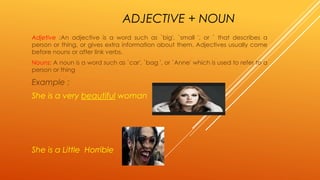
She is a very beautiful woman 
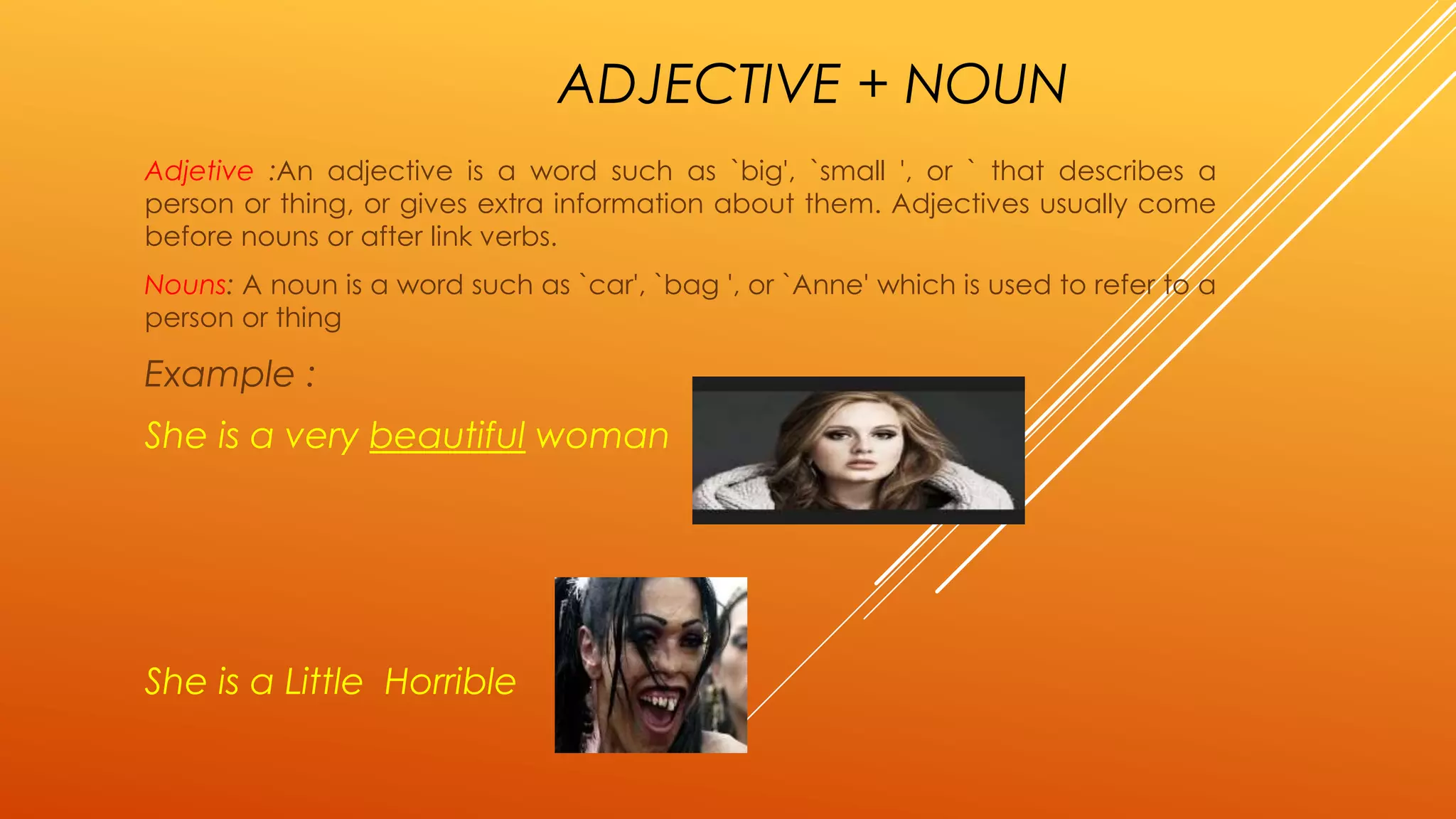
She is a Little Horrible
The adjective 
 La posición del adjetivo en inglés varía según su función. 
 a.) Atributo (atributivos). Se colocan como norma general 
delante del nombre al que califican 
 An interesting book / Un libro interesante 
 A tall girl / Una chica alta 
 b.) Predicado (predicativos), se colocan detrás del verbo. 
 This house is beautiful / Esta casa es bonita
ESCRIBE LAS PALABRAS EN EL ORDEN CORRECTO 
MAN UGLY AN 
AN UGLY MAN 
1. 1.American an she’s girl 
2. expensive holiday an it’s 
3. sad you are why? 
2. 4. are beautiful girl you a 
5. an job interesting it’s 
6. handsome is husband my 
7. Spanish you are? 
8. very I’m hungry 
She is an american girl 
It’s an expensive holiday 
why are you sad ? 
you are a beatuful girl 
It´s an interesting job 
My husband is handsome 
Are you Spanish ? 
I´m very hungry
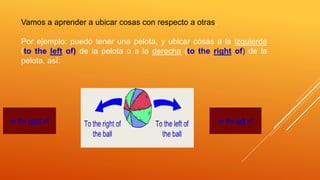
Vamos a aprender a ubicar cosas con respecto a otras. 
Por ejemplo: puedo tener una pelota, y ubicar cosas a la izquierda 
(to the left of) de la pelota o a la derecha (to the right of) de la 
pelota, así: 
to the right of to the left of
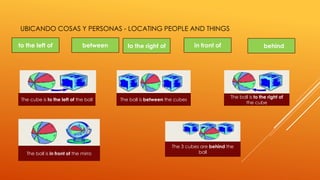
UBICANDO COSAS Y PERSONAS - LOCATING PEOPLE AND THINGS 
to the left of between to the right of in front of behind 
The ball is in front of the mirro 
The ball is to the right of 
the cube 
The cube is to the left of the ball The ball is between the cubes 
The 3 cubes are behind the 
ball
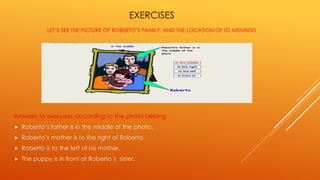
EXERCISES 
LET’S SEE THE PICTURE OF ROBERTO’S FAMILY: AND THE LOCATION OF ITS MEMBERS 
Answers to exercises according to the photo belong 
 Roberto’s father is in the middle of the photo. 
 Roberto’s mother is to the right of Roberto. 
 Roberto is to the left of his mother. 
 The puppy is in front of Roberto´s sister.
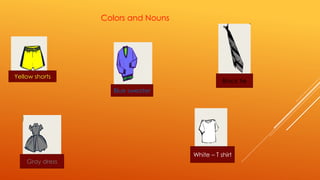
Colors and Nouns 
a 
Yellow shorts 
Blue sweater 
Black tie 
White – T shirt 
Gray dress
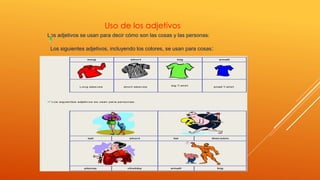
Uso de los adjetivos 
Los adjetivos se usan para decir cómo son las cosas y las personas: 
Los siguientes adjetivos, incluyendo los colores, se usan para cosas:
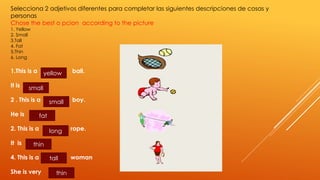
Selecciona 2 adjetivos diferentes para completar las siguientes descripciones de cosas y 
personas 
Chose the best o pcion according to the picture 
1. Yellow 
2. Small 
3.Tall 
4. Fat 
5.Thin 
6. Long 
1.This is a ball. 
It is 
2 . This is a boy. 
He is 
2. This is a rope. 
It is 
4. This is a woman 
She is very 
yellow 
small 
small 
fat 
long 
thin 
tall 
thin
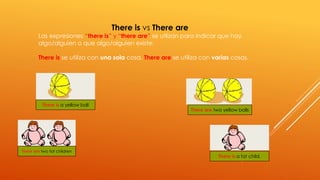
There is vs There are 
Las expresiones “there is” y “there are” se utlizan para indicar que hay 
algo/alguien o que algo/alguien existe: 
There is se utiliza con una sola cosa. There are se utiliza con varias cosas. 
There are two yellow balls 
There is a fat child. 
There is a yellow ball 
There are two fat children
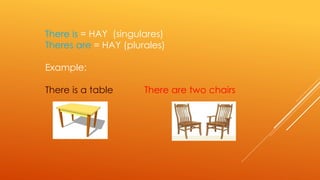
There is = HAY (singulares) 
Theres are = HAY (plurales) 
Example: 
There is a table There are two chairs
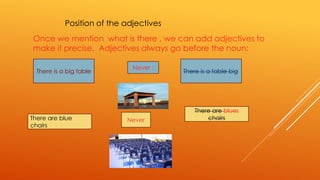
Position of the adjectives 
Once we mention what is there , we can add adjectives to 
make it precise. Adjectives always go before the noun: 
. Never : 
There is a big table 
There is a table big 
There are blue 
chairs 
Never 
There are blues 
chairs
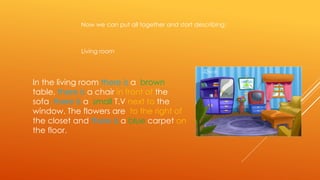
Now we can put all together and start describing: 
Living room 
In the living room there is a brown 
table, there is a chair in front of the 
sofa, there is a small T.V next to the 
window. The flowers are to the right of 
the closet and there is a blue carpet on 
the floor.
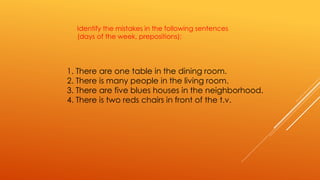
Identify the mistakes in the following sentences 
(days of the week, prepositions): 
1. There are one table in the dining room. 
2. There is many people in the living room. 
3. There are five blues houses in the neighborhood. 
4. There is two reds chairs in front of the t.v.
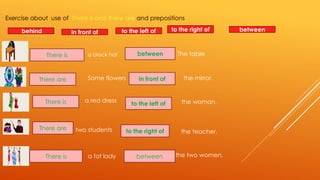
Exercise about use of There is and there are and prepositions 
i 
behind in front of to the left of to the right of between 
There is between 
a black hat The table 
the mirror. 
There are in front of 
a red dress the woman. 
There is to the left of 
two students to the right of 
the teacher. 
a fat lady the two women. 
between 
There are 
There is 
Some flowers
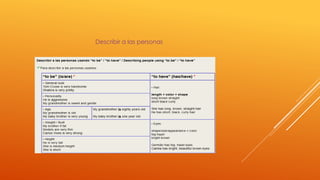
Objetivos 
Continuar con las descripciones, con énfasis en 
el aspecto físico de las personas. Usar “to be” / 
“to have” para hablar del aspecto físico de las 
personas 
Utilizar estructuras de comparación entre las 
personas, sea de tipo físico (tall, slim ) o de 
personalidad (nice, mean ). 
UNIDAD # 9
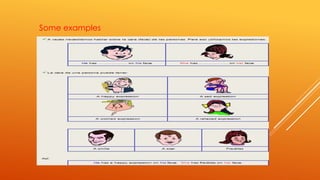
Some examples
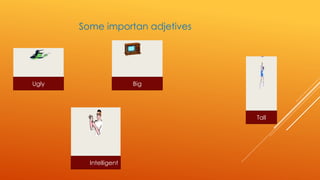
Some importan adjetives 
Ugly Big 
Tall 
Intelligent
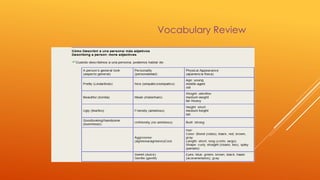
Vocabulary Review
Describir a las personas
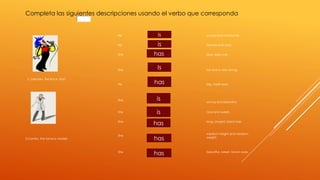
Completa las siguientes descripciones usando el verbo que corresponda 
2. Germán, the Rock- Star! 
is 
He young and handsome. 
is 
He friendly and cool. 
has 
She blue, spiky hair . 
Is 
She tall and a very strong. 
has 
He big, hazel eyes. 
3.Camila, the famous model! 
She 
young and beautiful. 
is 
is 
has 
She nice and sweet. 
She long, straight, black hair. 
She 
medium height and medium 
weight. 
has 
has 
She beautiful, sweet, brown eyes.
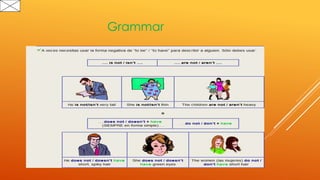
Grammar
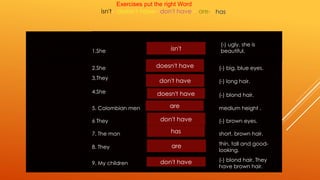
1.She 
(-) ugly, she is 
beautiful. 
2.She (-) big, blue eyes. 
3.They 
(-) long hair. 
4.She 
(-) blond hair. 
5. Colombian men medium height . 
6 They (-) brown eyes. 
7. The man short, brown hair. 
8. They 
thin, tall and good-looking. 
9. My children 
(-) blond hair. They 
have brown hair. 
Exercises put the right Word . 
isn't- doesn't have- don't have - are-isn't 
doesn't have 
don't have 
doesn't have 
are 
don't have 
has 
are 
don't have 
has
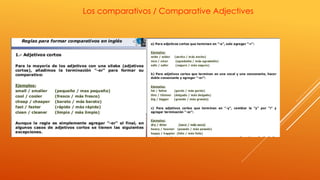
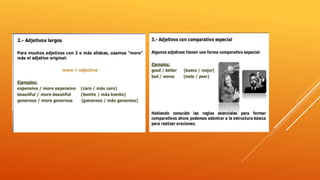
Los comparativos / Comparative Adjectives
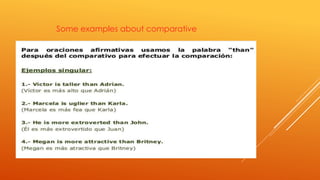
Some examples about comparative
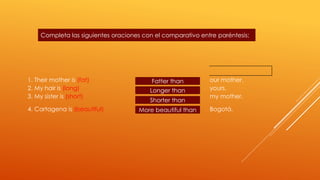
Completa las siguientes oraciones con el comparativo entre paréntesis: 
1. Their mother is (fat) Fatter than 
our mother. 
2. My hair is (long) yours. 
3. My sister is (short) my mother. 
Longer than 
Shorter than 
4. Cartagena is (beautiful) Bogotá. 
More beautiful than
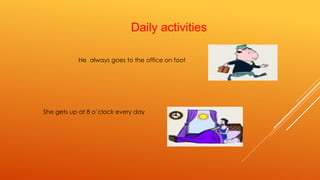
Daily activities 
He always goes to the office on foot 
She gets up at 8 o´clock every day
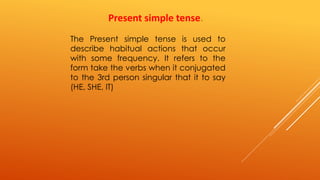
Present simple tense. 
The Present simple tense is used to 
describe habitual actions that occur 
with some frequency. It refers to the 
form take the verbs when it conjugated 
to the 3rd person singular that it to say 
(HE, SHE, IT)
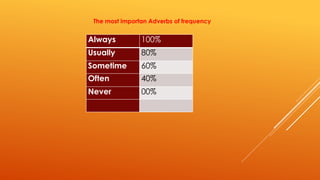
The most importan Adverbs of frequency 
Always 100% 
Usually 80% 
Sometime 60% 
Often 40% 
Never 00%
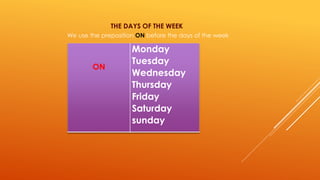
THE DAYS OF THE WEEK 
We use the preposition ON before the days of the week 
ON 
Monday 
Tuesday 
Wednesday 
Thursday 
Friday 
Saturday 
sunday
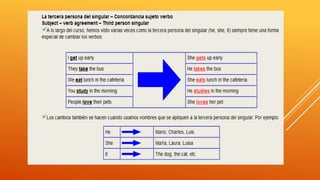
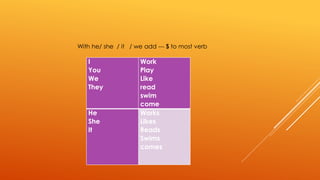
With he/ she / it / we add --- S to most verb 
I 
You 
We 
They 
Work 
Play 
Like 
read 
swim 
come 
He 
She 
It 
Works 
Likes 
Reads 
Swims 
comes
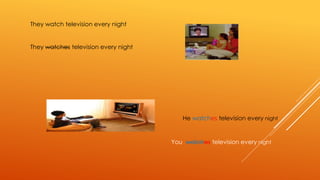
They watch television every night 
They watches television every night 
He watches television every night 
You watches television every night
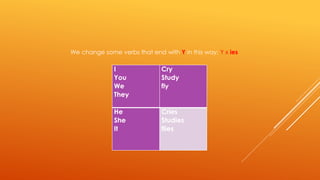
We change some verbs that end with Y in this way: Y x ies 
I 
You 
We 
They 
Cry 
Study 
fly 
He 
She 
It 
Cries 
Studies 
flies
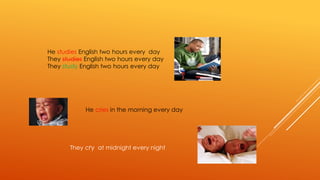
He studies English two hours every day 
They studies English two hours every day 
They study English two hours every day 
He cries in the morning every day 
They cry at midnight every night
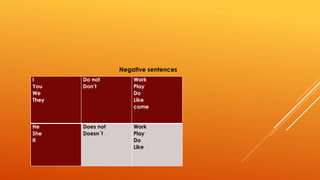
Negative sentences 
I 
You 
We 
They 
Do not 
Don’t 
Work 
Play 
Do 
Like 
come 
He 
She 
It 
Does not 
Doesn´t 
Work 
Play 
Do 
Like
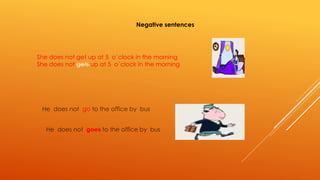
Negative sentences 
She does not get up at 5 o´clock in the morning 
She does not gets up at 5 o´clock in the morning 
He does not go to the office by bus 
He does not goes to the office by bus
Uso de verbo MUST 
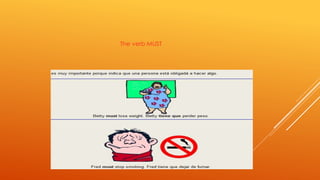
El verbo 'must' expresa una prohibición u obligación fuerte así como cierta 
certeza: I must go. She must be crazy. En español significa debo, debo de. 
I must - debo / debo de 
Affirmative 
•I must go to the library. 
Debo ir a la biblioteca. 
•You must stay here until I come back. 
Debes quedarte aquí hasta que yo vuelva. 
•We must be at the airport at three o'clock. 
Debemos estar en el aeropuerto a las tres. 
•Everybody must wear a uniform. 
Todos deben usar uniforme. 
•You must be joking! 
¡Deben de estar bromeando! 
•Julia must be in Paris by now. 
Julia ya debe de estar en París. 
•It must be noon already. 
Ya debe de ser mediodía.
Negative 
•You must not talk to strangers. 
No debes hablar con extraños. 
•We mustn't make noise. 
No debemos hacer ruido. 
•Mr. Williams must not smoke. 
El señor Williams no debe fumar. 
Interrogative 
•Must we do everything today? 
¿Debemos hacer todo hoy? 
•Must you go so soon? 
¿Debes irte tan pronto?
The verb MUST
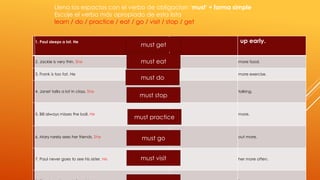
Llena los espacios con el verbo de obligacion ‘must’ + forma simple 
Escoje el verbo más apropiado de esta lista 
learn / do / practice / eat / go / visit / stop / get 
1. Paul sleeps a lot. He up early. 
must get 
must eat 
2. Jackie is very thin. She more food. 
3. Frank is too fat. He more exercise. 
must do 
4. Janet talks a lot in class. She talking. 
must stop 
5. Bill always misses the ball. He more. 
must practice 
6. Mary rarely sees her friends. She out more. 
must go 
must visit 
7. Paul never goes to see his sister. He her more often. 
8. Tim doesn’t speak Spanish. He it.
Review Exercises. Units 11 – 14.
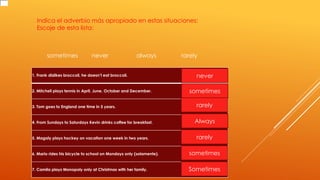
Indica el adverbio más apropiado en estas situaciones: 
Escoje de esta lista: 
sometimes never always rarely 
1. Frank dislikes broccoli, he doesn’t eat broccoli. 
2. Mitchell plays tennis in April, June, October and December. 
3. Tom goes to England one time in 5 years. 
4. From Sundays to Saturdays Kevin drinks coffee for breakfast. 
5. Magaly plays hockey on vacation one week in two years. 
6. Mario rides his bicycle to school on Mondays only (solamente). 
7. Camila plays Monopoly only at Christmas with her family. 
never 
sometimes 
rarely 
Always 
rarely 
sometimes 
Sometimes

Apoyo web conference ingles 0

  • 1.
    ADJECTIVE + NOUN Adjetive :An adjective is a word such as `big', `small ', or ` that describes a person or thing, or gives extra information about them. Adjectives usually come before nouns or after link verbs. Nouns: A noun is a word such as `car', `bag ', or `Anne' which is used to refer to a person or thing Example : She is a very beautiful woman She is a Little Horrible
  • 2.
    The adjective La posición del adjetivo en inglés varía según su función.  a.) Atributo (atributivos). Se colocan como norma general delante del nombre al que califican  An interesting book / Un libro interesante  A tall girl / Una chica alta  b.) Predicado (predicativos), se colocan detrás del verbo.  This house is beautiful / Esta casa es bonita
  • 3.
    ESCRIBE LAS PALABRASEN EL ORDEN CORRECTO MAN UGLY AN AN UGLY MAN 1. 1.American an she’s girl 2. expensive holiday an it’s 3. sad you are why? 2. 4. are beautiful girl you a 5. an job interesting it’s 6. handsome is husband my 7. Spanish you are? 8. very I’m hungry She is an american girl It’s an expensive holiday why are you sad ? you are a beatuful girl It´s an interesting job My husband is handsome Are you Spanish ? I´m very hungry
  • 4.
    Vamos a aprendera ubicar cosas con respecto a otras. Por ejemplo: puedo tener una pelota, y ubicar cosas a la izquierda (to the left of) de la pelota o a la derecha (to the right of) de la pelota, así: to the right of to the left of
  • 5.
    UBICANDO COSAS YPERSONAS - LOCATING PEOPLE AND THINGS to the left of between to the right of in front of behind The ball is in front of the mirro The ball is to the right of the cube The cube is to the left of the ball The ball is between the cubes The 3 cubes are behind the ball
  • 6.
    EXERCISES LET’S SEETHE PICTURE OF ROBERTO’S FAMILY: AND THE LOCATION OF ITS MEMBERS Answers to exercises according to the photo belong  Roberto’s father is in the middle of the photo.  Roberto’s mother is to the right of Roberto.  Roberto is to the left of his mother.  The puppy is in front of Roberto´s sister.
  • 7.
    Colors and Nouns a Yellow shorts Blue sweater Black tie White – T shirt Gray dress
  • 8.
    Uso de losadjetivos Los adjetivos se usan para decir cómo son las cosas y las personas: Los siguientes adjetivos, incluyendo los colores, se usan para cosas:
  • 9.
    Selecciona 2 adjetivosdiferentes para completar las siguientes descripciones de cosas y personas Chose the best o pcion according to the picture 1. Yellow 2. Small 3.Tall 4. Fat 5.Thin 6. Long 1.This is a ball. It is 2 . This is a boy. He is 2. This is a rope. It is 4. This is a woman She is very yellow small small fat long thin tall thin
  • 10.
    There is vsThere are Las expresiones “there is” y “there are” se utlizan para indicar que hay algo/alguien o que algo/alguien existe: There is se utiliza con una sola cosa. There are se utiliza con varias cosas. There are two yellow balls There is a fat child. There is a yellow ball There are two fat children
  • 11.
    There is =HAY (singulares) Theres are = HAY (plurales) Example: There is a table There are two chairs
  • 12.
    Position of theadjectives Once we mention what is there , we can add adjectives to make it precise. Adjectives always go before the noun: . Never : There is a big table There is a table big There are blue chairs Never There are blues chairs
  • 13.
    Now we canput all together and start describing: Living room In the living room there is a brown table, there is a chair in front of the sofa, there is a small T.V next to the window. The flowers are to the right of the closet and there is a blue carpet on the floor.
  • 14.
    Identify the mistakesin the following sentences (days of the week, prepositions): 1. There are one table in the dining room. 2. There is many people in the living room. 3. There are five blues houses in the neighborhood. 4. There is two reds chairs in front of the t.v.
  • 15.
    Exercise about useof There is and there are and prepositions i behind in front of to the left of to the right of between There is between a black hat The table the mirror. There are in front of a red dress the woman. There is to the left of two students to the right of the teacher. a fat lady the two women. between There are There is Some flowers
  • 16.
    Objetivos Continuar conlas descripciones, con énfasis en el aspecto físico de las personas. Usar “to be” / “to have” para hablar del aspecto físico de las personas Utilizar estructuras de comparación entre las personas, sea de tipo físico (tall, slim ) o de personalidad (nice, mean ). UNIDAD # 9
  • 17.
  • 18.
    Some importan adjetives Ugly Big Tall Intelligent
  • 19.
  • 20.
  • 21.
    Completa las siguientesdescripciones usando el verbo que corresponda 2. Germán, the Rock- Star! is He young and handsome. is He friendly and cool. has She blue, spiky hair . Is She tall and a very strong. has He big, hazel eyes. 3.Camila, the famous model! She young and beautiful. is is has She nice and sweet. She long, straight, black hair. She medium height and medium weight. has has She beautiful, sweet, brown eyes.
  • 22.
  • 23.
    1.She (-) ugly,she is beautiful. 2.She (-) big, blue eyes. 3.They (-) long hair. 4.She (-) blond hair. 5. Colombian men medium height . 6 They (-) brown eyes. 7. The man short, brown hair. 8. They thin, tall and good-looking. 9. My children (-) blond hair. They have brown hair. Exercises put the right Word . isn't- doesn't have- don't have - are-isn't doesn't have don't have doesn't have are don't have has are don't have has
  • 24.
    Los comparativos /Comparative Adjectives
  • 26.
  • 27.
    Completa las siguientesoraciones con el comparativo entre paréntesis: 1. Their mother is (fat) Fatter than our mother. 2. My hair is (long) yours. 3. My sister is (short) my mother. Longer than Shorter than 4. Cartagena is (beautiful) Bogotá. More beautiful than
  • 28.
    Daily activities Healways goes to the office on foot She gets up at 8 o´clock every day
  • 29.
    Present simple tense. The Present simple tense is used to describe habitual actions that occur with some frequency. It refers to the form take the verbs when it conjugated to the 3rd person singular that it to say (HE, SHE, IT)
  • 31.
    The most importanAdverbs of frequency Always 100% Usually 80% Sometime 60% Often 40% Never 00%
  • 32.
    THE DAYS OFTHE WEEK We use the preposition ON before the days of the week ON Monday Tuesday Wednesday Thursday Friday Saturday sunday
  • 33.
    With he/ she/ it / we add --- S to most verb I You We They Work Play Like read swim come He She It Works Likes Reads Swims comes
  • 34.
    They watch televisionevery night They watches television every night He watches television every night You watches television every night
  • 35.
    We change someverbs that end with Y in this way: Y x ies I You We They Cry Study fly He She It Cries Studies flies
  • 36.
    He studies Englishtwo hours every day They studies English two hours every day They study English two hours every day He cries in the morning every day They cry at midnight every night
  • 37.
    Negative sentences I You We They Do not Don’t Work Play Do Like come He She It Does not Doesn´t Work Play Do Like
  • 38.
    Negative sentences Shedoes not get up at 5 o´clock in the morning She does not gets up at 5 o´clock in the morning He does not go to the office by bus He does not goes to the office by bus
  • 39.
    Uso de verboMUST El verbo 'must' expresa una prohibición u obligación fuerte así como cierta certeza: I must go. She must be crazy. En español significa debo, debo de. I must - debo / debo de Affirmative •I must go to the library. Debo ir a la biblioteca. •You must stay here until I come back. Debes quedarte aquí hasta que yo vuelva. •We must be at the airport at three o'clock. Debemos estar en el aeropuerto a las tres. •Everybody must wear a uniform. Todos deben usar uniforme. •You must be joking! ¡Deben de estar bromeando! •Julia must be in Paris by now. Julia ya debe de estar en París. •It must be noon already. Ya debe de ser mediodía.
  • 40.
    Negative •You mustnot talk to strangers. No debes hablar con extraños. •We mustn't make noise. No debemos hacer ruido. •Mr. Williams must not smoke. El señor Williams no debe fumar. Interrogative •Must we do everything today? ¿Debemos hacer todo hoy? •Must you go so soon? ¿Debes irte tan pronto?
  • 41.
  • 42.
    Llena los espacioscon el verbo de obligacion ‘must’ + forma simple Escoje el verbo más apropiado de esta lista learn / do / practice / eat / go / visit / stop / get 1. Paul sleeps a lot. He up early. must get must eat 2. Jackie is very thin. She more food. 3. Frank is too fat. He more exercise. must do 4. Janet talks a lot in class. She talking. must stop 5. Bill always misses the ball. He more. must practice 6. Mary rarely sees her friends. She out more. must go must visit 7. Paul never goes to see his sister. He her more often. 8. Tim doesn’t speak Spanish. He it.
  • 43.
  • 44.
    Indica el adverbiomás apropiado en estas situaciones: Escoje de esta lista: sometimes never always rarely 1. Frank dislikes broccoli, he doesn’t eat broccoli. 2. Mitchell plays tennis in April, June, October and December. 3. Tom goes to England one time in 5 years. 4. From Sundays to Saturdays Kevin drinks coffee for breakfast. 5. Magaly plays hockey on vacation one week in two years. 6. Mario rides his bicycle to school on Mondays only (solamente). 7. Camila plays Monopoly only at Christmas with her family. never sometimes rarely Always rarely sometimes Sometimes