Unidad 6: La Comida
Vocabulario Nuevo, Time, Tener Expressions,
Stem Changing Verbs, Deber, & Poder
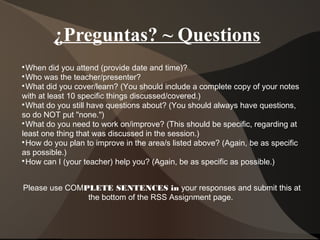
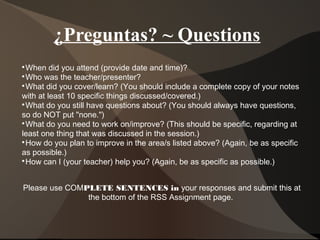
¿Preguntas? ~ Questions

When did you attend (provide date and time)?

Who was the teacher/presenter?

What did you cover/learn? (You should include a complete copy of your notes
with at least 10 specific things discussed/covered.)

What do you still have questions about? (You should always have questions,
so do NOT put "none.")

What do you need to work on/improve? (This should be specific, regarding at
least one thing that was discussed in the session.)

How do you plan to improve in the area/s listed above? (Again, be as specific
as possible.)

How can I (your teacher) help you? (Again, be as specific as possible.)
Please use COMPLETE SENTENCES in your responses and submit this at
the bottom of the RSS Assignment page.
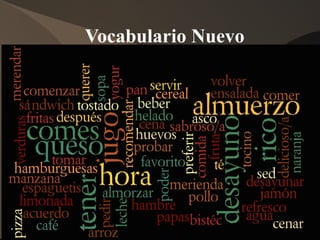
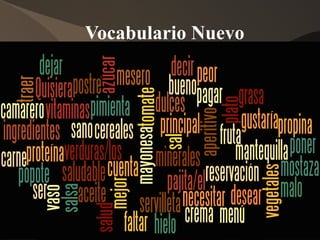
Vocabulario Nuevo
Vocabulario Nuevo
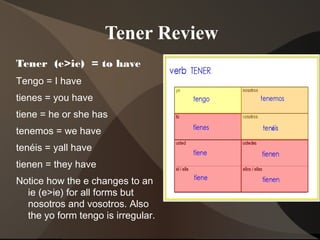
Tener Review
Tener (e>ie) = to have
Tengo = I have
tienes = you have
tiene = he or she has
tenemos = we have
tenéis = yall have
tienen = they have
Notice how the e changes to an
ie (e>ie) for all forms but
nosotros and vosotros. Also
the yo form tengo is irregular.
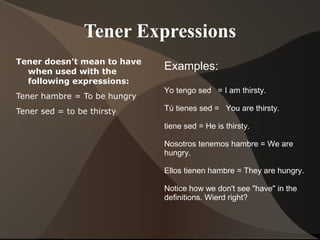
Tener Expressions
Tener doesn't mean to have
when used with the
following expressions:
Tener hambre = To be hungry
Tener sed = to be thirsty
Examples:
Yo tengo sed = I am thirsty.
Tú tienes sed = You are thirsty.
tiene sed = He is thirsty.
Nosotros tenemos hambre = We are
hungry.
Ellos tienen hambre = They are hungry.
Notice how we don't see "have" in the
definitions. Wierd right?
Telling Time
To say it is __________
o'clock say son las or es
la.
Examples:
Son las dos. =It's 2 o'clock.
Es la una y media. = It's 1:
30.
To say at a time in
Spanish use a la or a las.
Examples:
Yo voy al parque a la una y
veinte. (I go to the park at
1:20.)
Nosotros desayunamos a las
siete. (We eat breakfast at
7:00.
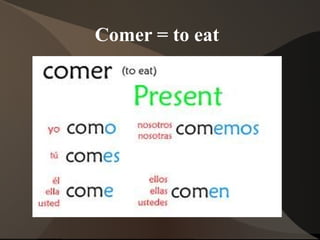
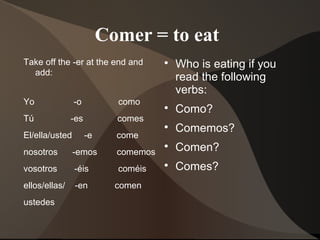
Comer = to eat
Comer = to eat
Take off the -er at the end and
add:
Yo -o como
Tú -es comes
El/ella/usted -e come
nosotros -emos comemos
vosotros -éis coméis
ellos/ellas/ -en comen
ustedes

Who is eating if you
read the following
verbs:

Como?

Comemos?

Comen?

Comes?
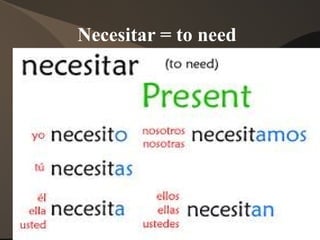
Necesitar = to need
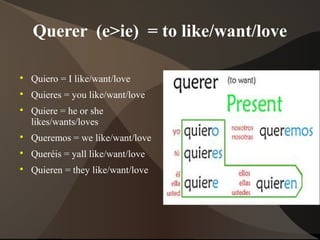
Querer (e>ie) = to like/want/love

Quiero = I like/want/love

Quieres = you like/want/love

Quiere = he or she
likes/wants/loves

Queremos = we like/want/love

Queréis = yall like/want/love

Quieren = they like/want/love
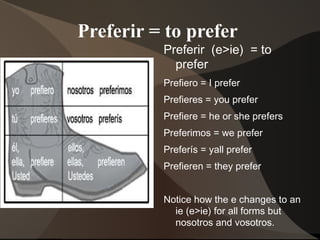
Preferir = to prefer
Preferir (e>ie) = to
prefer
Prefiero = I prefer
Prefieres = you prefer
Prefiere = he or she prefers
Preferimos = we prefer
Preferís = yall prefer
Prefieren = they prefer
Notice how the e changes to an
ie (e>ie) for all forms but
nosotros and vosotros.
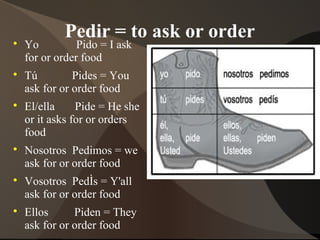
Pedir = to ask or order
Yo Pido = I ask
for or order food

Tú Pides = You
ask for or order food

El/ella Pide = He she
or it asks for or orders
food

Nosotros Pedimos = we
ask for or order food

Vosotros PedÌs = Y'all
ask for or order food

Ellos Piden = They
ask for or order food
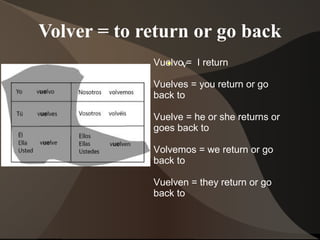
Volver = to return or go back
 vVuelvo = I return
Vuelves = you return or go
back to
Vuelve = he or she returns or
goes back to
Volvemos = we return or go
back to
Vuelven = they return or go
back to
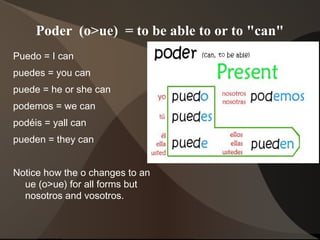
Poder (o>ue) = to be able to or to "can"
Puedo = I can
puedes = you can
puede = he or she can
podemos = we can
podéis = yall can
pueden = they can
Notice how the o changes to an
ue (o>ue) for all forms but
nosotros and vosotros.
Poder + Another Verb
Examples:
Yo puedo estudiar. = I can
study.
Tú puedes correr. = You can
run.
Ella puede practicar las artes
marciales. = She can
practice martial arts.
Nosotros podemos memorizar
el vocabulario. = We can
memorize the vocab.
Ellos pueden jugar el fútbol. =
They can play soccer.
Uncongated Verb
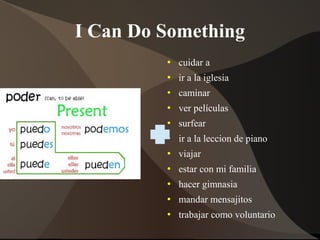
I Can Do Something
 cuidar a
 ir a la iglesia
 caminar
 ver películas
 surfear
 ir a la leccion de piano
 viajar
 estar con mi familia
 hacer gimnasia
 mandar mensajitos
 trabajar como voluntario
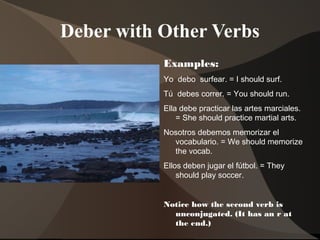
Deber with Other Verbs
Examples:
Yo debo surfear. = I should surf.
Tú debes correr. = You should run.
Ella debe practicar las artes marciales.
= She should practice martial arts.
Nosotros debemos memorizar el
vocabulario. = We should memorize
the vocab.
Ellos deben jugar el fútbol. = They
should play soccer.
Notice how the second verb is
unconjugated. (It has an r at
the end.)
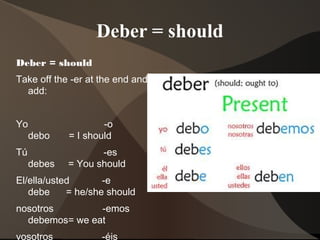
Deber = should
Deber = should
Take off the -er at the end and
add:
Yo -o
debo = I should
Tú -es
debes = You should
El/ella/usted -e
debe = he/she should
nosotros -emos
debemos= we eat
vosotros -éis
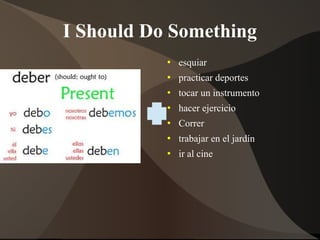
I Should Do Something
 esquiar
 practicar deportes
 tocar un instrumento
 hacer ejercicio
 Correr
 trabajar en el jardín
 ir al cine
¿Preguntas? ~ Questions

When did you attend (provide date and time)?

Who was the teacher/presenter?

What did you cover/learn? (You should include a complete copy of your notes
with at least 10 specific things discussed/covered.)

What do you still have questions about? (You should always have questions,
so do NOT put "none.")

What do you need to work on/improve? (This should be specific, regarding at
least one thing that was discussed in the session.)

How do you plan to improve in the area/s listed above? (Again, be as specific
as possible.)

How can I (your teacher) help you? (Again, be as specific as possible.)
Please use COMPLETE SENTENCES in your responses and submit this at
the bottom of the RSS Assignment page.
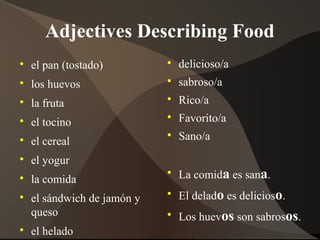
Adjectives Describing Food

el pan (tostado)

los huevos

la fruta

el tocino

el cereal

el yogur

la comida

el sándwich de jamón y
queso

el helado

delicioso/a

sabroso/a

Rico/a

Favorito/a

Sano/a

La comida es sana.

El delado es delicioso.

Los huevos son sabrosos.
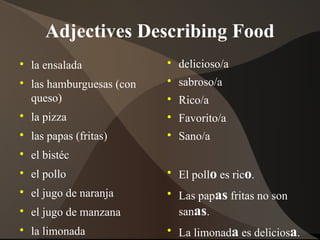
Adjectives Describing Food

la ensalada

las hamburguesas (con
queso)

la pizza

las papas (fritas)

el bistéc

el pollo

el jugo de naranja

el jugo de manzana

la limonada

delicioso/a

sabroso/a

Rico/a

Favorito/a

Sano/a

El pollo es rico.

Las papas fritas no son
sanas.

La limonada es deliciosa.
¿Preguntas? ~ Questions

When did you attend (provide date and time)?

Who was the teacher/presenter?

What did you cover/learn? (You should include a complete copy of your notes
with at least 10 specific things discussed/covered.)

What do you still have questions about? (You should always have questions,
so do NOT put "none.")

What do you need to work on/improve? (This should be specific, regarding at
least one thing that was discussed in the session.)

How do you plan to improve in the area/s listed above? (Again, be as specific
as possible.)

How can I (your teacher) help you? (Again, be as specific as possible.)
Please use COMPLETE SENTENCES in your responses and submit this at
the bottom of the RSS Assignment page.

Unidad 6 ~ la comida

  • 1.
    Unidad 6: LaComida Vocabulario Nuevo, Time, Tener Expressions, Stem Changing Verbs, Deber, & Poder
  • 2.
    ¿Preguntas? ~ Questions  Whendid you attend (provide date and time)?  Who was the teacher/presenter?  What did you cover/learn? (You should include a complete copy of your notes with at least 10 specific things discussed/covered.)  What do you still have questions about? (You should always have questions, so do NOT put "none.")  What do you need to work on/improve? (This should be specific, regarding at least one thing that was discussed in the session.)  How do you plan to improve in the area/s listed above? (Again, be as specific as possible.)  How can I (your teacher) help you? (Again, be as specific as possible.) Please use COMPLETE SENTENCES in your responses and submit this at the bottom of the RSS Assignment page.
  • 3.
  • 4.
  • 5.
    Tener Review Tener (e>ie)= to have Tengo = I have tienes = you have tiene = he or she has tenemos = we have tenéis = yall have tienen = they have Notice how the e changes to an ie (e>ie) for all forms but nosotros and vosotros. Also the yo form tengo is irregular.
  • 6.
    Tener Expressions Tener doesn'tmean to have when used with the following expressions: Tener hambre = To be hungry Tener sed = to be thirsty Examples: Yo tengo sed = I am thirsty. Tú tienes sed = You are thirsty. tiene sed = He is thirsty. Nosotros tenemos hambre = We are hungry. Ellos tienen hambre = They are hungry. Notice how we don't see "have" in the definitions. Wierd right?
  • 7.
    Telling Time To sayit is __________ o'clock say son las or es la. Examples: Son las dos. =It's 2 o'clock. Es la una y media. = It's 1: 30. To say at a time in Spanish use a la or a las. Examples: Yo voy al parque a la una y veinte. (I go to the park at 1:20.) Nosotros desayunamos a las siete. (We eat breakfast at 7:00.
  • 8.
  • 9.
    Comer = toeat Take off the -er at the end and add: Yo -o como Tú -es comes El/ella/usted -e come nosotros -emos comemos vosotros -éis coméis ellos/ellas/ -en comen ustedes  Who is eating if you read the following verbs:  Como?  Comemos?  Comen?  Comes?
  • 10.
  • 11.
    Querer (e>ie) =to like/want/love  Quiero = I like/want/love  Quieres = you like/want/love  Quiere = he or she likes/wants/loves  Queremos = we like/want/love  Queréis = yall like/want/love  Quieren = they like/want/love
  • 12.
    Preferir = toprefer Preferir (e>ie) = to prefer Prefiero = I prefer Prefieres = you prefer Prefiere = he or she prefers Preferimos = we prefer Preferís = yall prefer Prefieren = they prefer Notice how the e changes to an ie (e>ie) for all forms but nosotros and vosotros.
  • 13.
    Pedir = toask or order Yo Pido = I ask for or order food  Tú Pides = You ask for or order food  El/ella Pide = He she or it asks for or orders food  Nosotros Pedimos = we ask for or order food  Vosotros PedÌs = Y'all ask for or order food  Ellos Piden = They ask for or order food
  • 14.
    Volver = toreturn or go back  vVuelvo = I return Vuelves = you return or go back to Vuelve = he or she returns or goes back to Volvemos = we return or go back to Vuelven = they return or go back to
  • 15.
    Poder (o>ue) =to be able to or to "can" Puedo = I can puedes = you can puede = he or she can podemos = we can podéis = yall can pueden = they can Notice how the o changes to an ue (o>ue) for all forms but nosotros and vosotros.
  • 16.
    Poder + AnotherVerb Examples: Yo puedo estudiar. = I can study. Tú puedes correr. = You can run. Ella puede practicar las artes marciales. = She can practice martial arts. Nosotros podemos memorizar el vocabulario. = We can memorize the vocab. Ellos pueden jugar el fútbol. = They can play soccer. Uncongated Verb
  • 17.
    I Can DoSomething  cuidar a  ir a la iglesia  caminar  ver películas  surfear  ir a la leccion de piano  viajar  estar con mi familia  hacer gimnasia  mandar mensajitos  trabajar como voluntario
  • 18.
    Deber with OtherVerbs Examples: Yo debo surfear. = I should surf. Tú debes correr. = You should run. Ella debe practicar las artes marciales. = She should practice martial arts. Nosotros debemos memorizar el vocabulario. = We should memorize the vocab. Ellos deben jugar el fútbol. = They should play soccer. Notice how the second verb is unconjugated. (It has an r at the end.)
  • 19.
    Deber = should Deber= should Take off the -er at the end and add: Yo -o debo = I should Tú -es debes = You should El/ella/usted -e debe = he/she should nosotros -emos debemos= we eat vosotros -éis
  • 20.
    I Should DoSomething  esquiar  practicar deportes  tocar un instrumento  hacer ejercicio  Correr  trabajar en el jardín  ir al cine
  • 21.
    ¿Preguntas? ~ Questions  Whendid you attend (provide date and time)?  Who was the teacher/presenter?  What did you cover/learn? (You should include a complete copy of your notes with at least 10 specific things discussed/covered.)  What do you still have questions about? (You should always have questions, so do NOT put "none.")  What do you need to work on/improve? (This should be specific, regarding at least one thing that was discussed in the session.)  How do you plan to improve in the area/s listed above? (Again, be as specific as possible.)  How can I (your teacher) help you? (Again, be as specific as possible.) Please use COMPLETE SENTENCES in your responses and submit this at the bottom of the RSS Assignment page.
  • 22.
    Adjectives Describing Food  elpan (tostado)  los huevos  la fruta  el tocino  el cereal  el yogur  la comida  el sándwich de jamón y queso  el helado  delicioso/a  sabroso/a  Rico/a  Favorito/a  Sano/a  La comida es sana.  El delado es delicioso.  Los huevos son sabrosos.
  • 23.
    Adjectives Describing Food  laensalada  las hamburguesas (con queso)  la pizza  las papas (fritas)  el bistéc  el pollo  el jugo de naranja  el jugo de manzana  la limonada  delicioso/a  sabroso/a  Rico/a  Favorito/a  Sano/a  El pollo es rico.  Las papas fritas no son sanas.  La limonada es deliciosa.
  • 24.
    ¿Preguntas? ~ Questions  Whendid you attend (provide date and time)?  Who was the teacher/presenter?  What did you cover/learn? (You should include a complete copy of your notes with at least 10 specific things discussed/covered.)  What do you still have questions about? (You should always have questions, so do NOT put "none.")  What do you need to work on/improve? (This should be specific, regarding at least one thing that was discussed in the session.)  How do you plan to improve in the area/s listed above? (Again, be as specific as possible.)  How can I (your teacher) help you? (Again, be as specific as possible.) Please use COMPLETE SENTENCES in your responses and submit this at the bottom of the RSS Assignment page.