Warm up
• What are you doing this
weekend?
• What are you going to do when
you finish school?
• Where will you live when you are
30 years old?
Future forms
Predictions, Decisions, Plans
PREDICTIONS
GOING TO
Predictions based on evidence.
We can see the future in the
present. We see things coming.
There is present evidence.
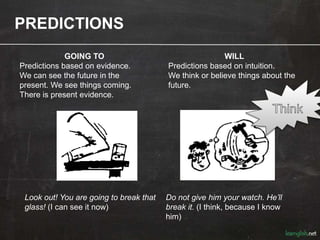
Look out! You are going to break that
glass! (I can see it now)
WILL
Predictions based on intuition.
We think or believe things about the
future.
Do not give him your watch. He’ll
break it. (I think, because I know
him)
DECISIONS
GOING TO
Decisions are already made
when we speak.
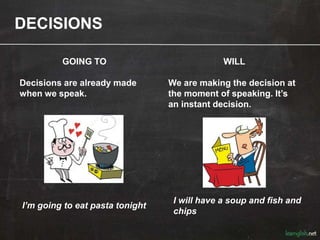
I’m going to eat pasta tonight
WILL
We are making the decision at
the moment of speaking. It’s
an instant decision.
I will have a soup and fish and
chips
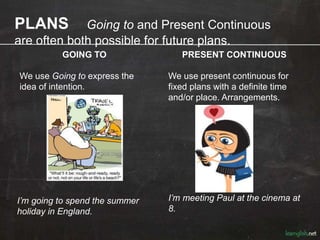
PLANS Going to and Present Continuous
are often both possible for future plans.
GOING TO
We use Going to express the
idea of intention.
I’m going to spend the summer
holiday in England.
PRESENT CONTINUOUS
We use present continuous for
fixed plans with a definite time
and/or place. Arrangements.
I’m meeting Paul at the cinema at
8.
DECISIONS
Choose the best form.
That shirt is dirty! Oh, yes. I am going to / will wash it.
Oh, yes. I’ll wash it.
PLANS
In three of these sentences, the present progressive is
possible. Which three?
1. Jack is going to arrive at 4.00.
2. I'm going to learn Spanish one of these days.
3. I'm going to fly to Glasgow tomorrow.
4. Alan's going to tell me about his problems.
5. We're going to spend next week in Ireland.
6. Are you going to answer those letters?
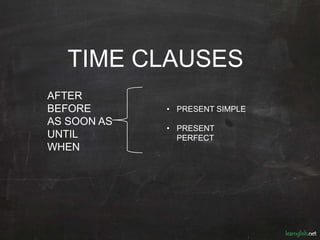
TIME CLAUSES
AFTER
BEFORE
AS SOON AS
UNTIL
WHEN
• PRESENT SIMPLE
• PRESENT
PERFECT
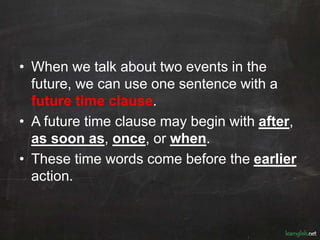
• When we talk about two events in the
future, we can use one sentence with a
future time clause.
• A future time clause may begin with after,
as soon as, once, or when.
• These time words come before the earlier
action.
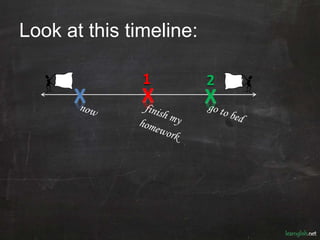
Look at this timeline:
X X X
2past future
1
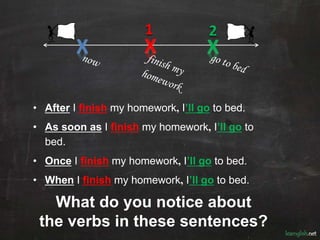
X X X
2past future
1
• After I finish my homework, I’ll go to bed.
• As soon as I finish my homework, I’ll go to
bed.
• Once I finish my homework, I’ll go to bed.
• When I finish my homework, I’ll go to bed.
What do you notice about
the verbs in these sentences?
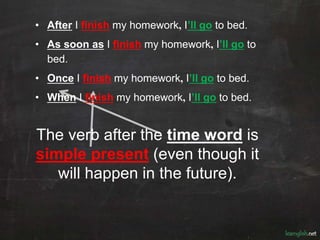
• After I finish my homework, I’ll go to bed.
• As soon as I finish my homework, I’ll go to
bed.
• Once I finish my homework, I’ll go to bed.
• When I finish my homework, I’ll go to bed.
The verb after the time word is
simple present (even though it
will happen in the future).
X X X
2past future
1
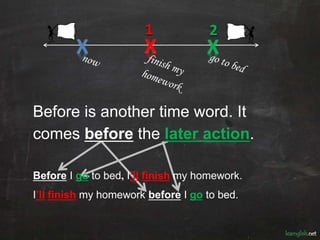
Before is another time word. It
comes before the later action.
Before I go to bed, I’ll finish my homework.
I’ll finish my homework before I go to bed.
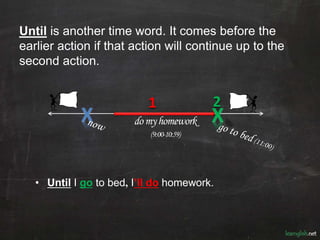
Until is another time word. It comes before the
earlier action if that action will continue up to the
second action.
X Xdomyhomework
(9:00-10:59)
1 2past future
• Until I go to bed, I’ll do homework.
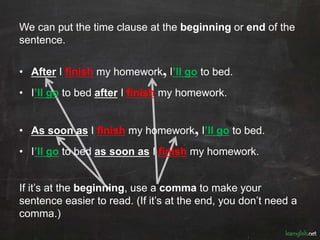
We can put the time clause at the beginning or end of the
sentence.
• After I finish my homework, I’ll go to bed.
• I’ll go to bed after I finish my homework.
• As soon as I finish my homework, I’ll go to bed.
• I’ll go to bed as soon as I finish my homework.
If it’s at the beginning, use a comma to make your
sentence easier to read. (If it’s at the end, you don’t need a
comma.)
In any of these sentences, you can use present
perfect after the time word.
It emphasizes that the action will be completed.
• Once I have finished my homework, I’ll go to
bed.
• I’ll go to bed when I have finished my
homework.
(This is less common than simple present.)
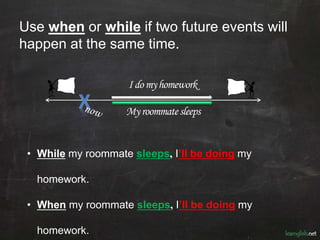
Use when or while if two future events will
happen at the same time.
• While my roommate sleeps, I’ll be doing my
homework.
• When my roommate sleeps, I’ll be doing my
homework.
X
Idomyhomeworkpast future
Myroommatesleeps
X
Idomyhomeworkpast future
Myroommatesleeps
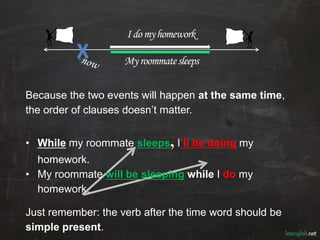
Because the two events will happen at the same time,
the order of clauses doesn’t matter.
• While my roommate sleeps, I’ll be doing my
homework.
• My roommate will be sleeping while I do my
homework.
Just remember: the verb after the time word should be
simple present.
Got it? Awesome!
• Please do exercises 2.1, 2.2, 2.3, and 2.4
(pages 79-82).
• We’ll check them in class Thursday and go
over any questions you have.
Thanks!
FUTURE CONTINUOUS/
FUTURE PERFECT
CAN YOU SEE THE
DIFFERENCE?
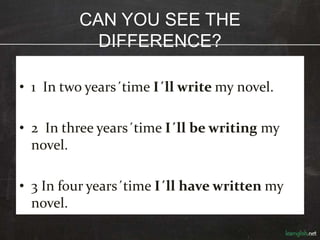
• 1 In two years´time I´ll write my novel.
• 2 In three years´time I´ll be writing my
novel.
• 3 In four years´time I´ll have written my
novel.
CAN YOU SEE THE
DIFFERENCE?
• In two years´time I´ll
write my novel.
CAN YOU SEE THE DIFFERENCE?
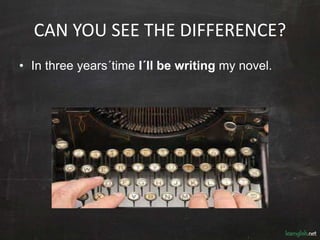
• In three years´time I´ll be writing my novel.
CAN YOU SEE THE
DIFFERENCE?
• In four years´time I´ll have written my novel.
FUTURE CONTINUOUS
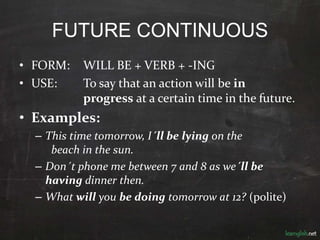
• FORM: WILL BE + VERB + -ING
• USE: To say that an action will be in
progress at a certain time in the future.
• Examples:
– This time tomorrow, I´ll be lying on the
beach in the sun.
– Don´t phone me between 7 and 8 as we´ll be
having dinner then.
– What will you be doing tomorrow at 12? (polite)
FUTURE CONTINUOUS
• The future continuous can also be used as an
alternative to the present continuous to talk about
things which are already planned or decided.
• E.g.: I´ll be going to the gym tomorrow afternoon.
FUTURE PERFECT
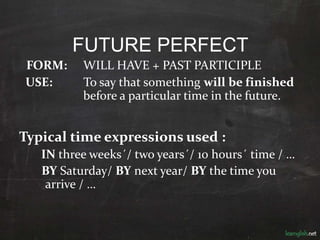
FORM: WILL HAVE + PAST PARTICIPLE
USE: To say that something will be finished
before a particular time in the future.
Typical time expressions used :
IN three weeks´/ two years´/ 10 hours´ time / …
BY Saturday/ BY next year/ BY the time you
arrive / …
FUTURE PERFECT
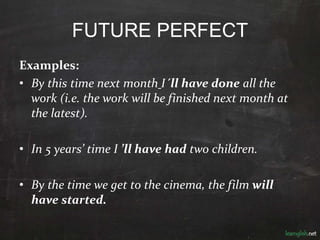
Examples:
• By this time next month I´ll have done all the
work (i.e. the work will be finished next month at
the latest).
• In 5 years’ time I ’ll have had two children.
• By the time we get to the cinema, the film will
have started.

Future forms

  • 1.
    Warm up • Whatare you doing this weekend? • What are you going to do when you finish school? • Where will you live when you are 30 years old?
  • 2.
  • 3.
    PREDICTIONS GOING TO Predictions basedon evidence. We can see the future in the present. We see things coming. There is present evidence. Look out! You are going to break that glass! (I can see it now) WILL Predictions based on intuition. We think or believe things about the future. Do not give him your watch. He’ll break it. (I think, because I know him)
  • 4.
    DECISIONS GOING TO Decisions arealready made when we speak. I’m going to eat pasta tonight WILL We are making the decision at the moment of speaking. It’s an instant decision. I will have a soup and fish and chips
  • 5.
    PLANS Going toand Present Continuous are often both possible for future plans. GOING TO We use Going to express the idea of intention. I’m going to spend the summer holiday in England. PRESENT CONTINUOUS We use present continuous for fixed plans with a definite time and/or place. Arrangements. I’m meeting Paul at the cinema at 8.
  • 6.
    DECISIONS Choose the bestform. That shirt is dirty! Oh, yes. I am going to / will wash it. Oh, yes. I’ll wash it.
  • 7.
    PLANS In three ofthese sentences, the present progressive is possible. Which three? 1. Jack is going to arrive at 4.00. 2. I'm going to learn Spanish one of these days. 3. I'm going to fly to Glasgow tomorrow. 4. Alan's going to tell me about his problems. 5. We're going to spend next week in Ireland. 6. Are you going to answer those letters?
  • 8.
    TIME CLAUSES AFTER BEFORE AS SOONAS UNTIL WHEN • PRESENT SIMPLE • PRESENT PERFECT
  • 9.
    • When wetalk about two events in the future, we can use one sentence with a future time clause. • A future time clause may begin with after, as soon as, once, or when. • These time words come before the earlier action.
  • 10.
    Look at thistimeline: X X X 2past future 1
  • 11.
    X X X 2pastfuture 1 • After I finish my homework, I’ll go to bed. • As soon as I finish my homework, I’ll go to bed. • Once I finish my homework, I’ll go to bed. • When I finish my homework, I’ll go to bed. What do you notice about the verbs in these sentences?
  • 12.
    • After Ifinish my homework, I’ll go to bed. • As soon as I finish my homework, I’ll go to bed. • Once I finish my homework, I’ll go to bed. • When I finish my homework, I’ll go to bed. The verb after the time word is simple present (even though it will happen in the future).
  • 13.
    X X X 2pastfuture 1 Before is another time word. It comes before the later action. Before I go to bed, I’ll finish my homework. I’ll finish my homework before I go to bed.
  • 14.
    Until is anothertime word. It comes before the earlier action if that action will continue up to the second action. X Xdomyhomework (9:00-10:59) 1 2past future • Until I go to bed, I’ll do homework.
  • 15.
    We can putthe time clause at the beginning or end of the sentence. • After I finish my homework, I’ll go to bed. • I’ll go to bed after I finish my homework. • As soon as I finish my homework, I’ll go to bed. • I’ll go to bed as soon as I finish my homework. If it’s at the beginning, use a comma to make your sentence easier to read. (If it’s at the end, you don’t need a comma.)
  • 16.
    In any ofthese sentences, you can use present perfect after the time word. It emphasizes that the action will be completed. • Once I have finished my homework, I’ll go to bed. • I’ll go to bed when I have finished my homework. (This is less common than simple present.)
  • 17.
    Use when orwhile if two future events will happen at the same time. • While my roommate sleeps, I’ll be doing my homework. • When my roommate sleeps, I’ll be doing my homework. X Idomyhomeworkpast future Myroommatesleeps
  • 18.
    X Idomyhomeworkpast future Myroommatesleeps Because thetwo events will happen at the same time, the order of clauses doesn’t matter. • While my roommate sleeps, I’ll be doing my homework. • My roommate will be sleeping while I do my homework. Just remember: the verb after the time word should be simple present.
  • 19.
    Got it? Awesome! •Please do exercises 2.1, 2.2, 2.3, and 2.4 (pages 79-82). • We’ll check them in class Thursday and go over any questions you have. Thanks!
  • 21.
  • 22.
    CAN YOU SEETHE DIFFERENCE? • 1 In two years´time I´ll write my novel. • 2 In three years´time I´ll be writing my novel. • 3 In four years´time I´ll have written my novel.
  • 23.
    CAN YOU SEETHE DIFFERENCE? • In two years´time I´ll write my novel.
  • 24.
    CAN YOU SEETHE DIFFERENCE? • In three years´time I´ll be writing my novel.
  • 25.
    CAN YOU SEETHE DIFFERENCE? • In four years´time I´ll have written my novel.
  • 26.
    FUTURE CONTINUOUS • FORM:WILL BE + VERB + -ING • USE: To say that an action will be in progress at a certain time in the future. • Examples: – This time tomorrow, I´ll be lying on the beach in the sun. – Don´t phone me between 7 and 8 as we´ll be having dinner then. – What will you be doing tomorrow at 12? (polite)
  • 27.
    FUTURE CONTINUOUS • Thefuture continuous can also be used as an alternative to the present continuous to talk about things which are already planned or decided. • E.g.: I´ll be going to the gym tomorrow afternoon.
  • 28.
    FUTURE PERFECT FORM: WILLHAVE + PAST PARTICIPLE USE: To say that something will be finished before a particular time in the future. Typical time expressions used : IN three weeks´/ two years´/ 10 hours´ time / … BY Saturday/ BY next year/ BY the time you arrive / …
  • 29.
    FUTURE PERFECT Examples: • Bythis time next month I´ll have done all the work (i.e. the work will be finished next month at the latest). • In 5 years’ time I ’ll have had two children. • By the time we get to the cinema, the film will have started.