PRESENT PERFECT
TENSE
( P.P.T.)
Prepared by: Junaid Iqbal
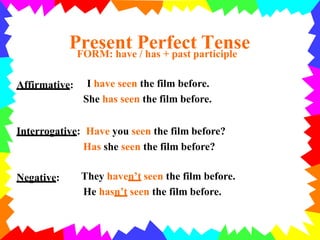
Present Perfect Tense
FORM: have / has + past participle
Affirmative: I have seen the film before.
She has seen the film before.
Interrogative: Have you seen the film before?
Has she seen the film before?
Negative: They haven’t seen the film before.
He hasn’t seen the film before.
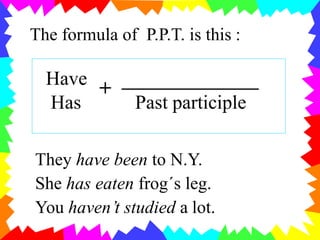
The formula of P.P.T. is this :
Have
+
Has Past participle
They have been to N.Y.
She has eaten frog´s leg.
You haven’t studied a lot.
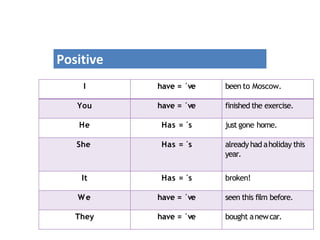
I have = ´ve been to Moscow.
You have = ´ve finished the exercise.
He Has = ´s just gone home.
She Has = ´s already had aholiday this
year.
It Has = ´s broken!
We have = ´ve seen this film before.
They have = ´ve bought anewcar.
Positive
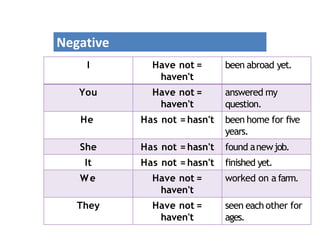
I Have not =
haven't
been abroad yet.
You Have not =
haven't
answered my
question.
He Has not = hasn't been home for five
years.
She Has not = hasn't found anewjob.
It Has not = hasn't finished yet.
We Have not =
haven't
worked on a farm.
They Have not =
haven't
seen each other for
ages.
Negative
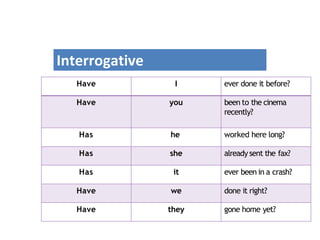
Have I ever done it before?
Have you been to the cinema
recently?
Has he worked here long?
Has she already sent the fax?
Has it ever been in a crash?
Have we done it right?
Have they gone home yet?
Interrogative
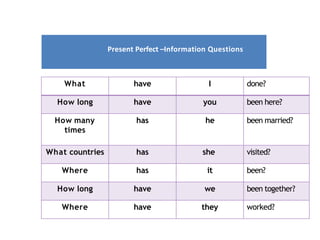
What have I done?
How long have you been here?
How many
times
has he been married?
What countries has she visited?
Where has it been?
How long have we been together?
Where have they worked?
Present Perfect –Information Questions
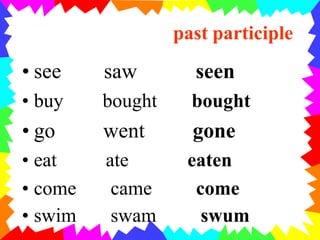
past participle
• see saw seen
• buy bought bought
• go went gone
• eat ate eaten
• come came come
• swim swam swum
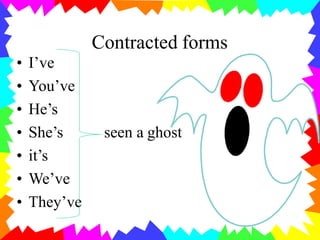
Contracted forms
seen a ghost
• I’ve
• You’ve
• He’s
• She’s
• it’s
• We’ve
• They’ve
Interrogative form
• You have traveled to Japan twice. (aff)
• Have you traveled to Japan
twice?
(interrogative)
Have you traveled to Japan
twice?
• Yes, I have.
• No, I haven’t.
Negative form
• I have visited the Taj Mahal.
• I have .... visited the Taj Mahal.
• I have NOT visited the Taj Mahal.
• I haven’t seen you for weeks !
• He hasn’t arrived home.
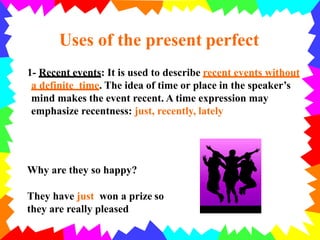
1- Recent events: It is used to describe recent events without
a definite time. The idea of time or place in the speaker’s
mind makes the event recent. A time expression may
emphasize recentness: just, recently, lately
Uses of the present perfect
Why are they so happy?
They have just won a prize so
they are really pleased
JUST
I have just finished my exercise.
He has just had lunch.
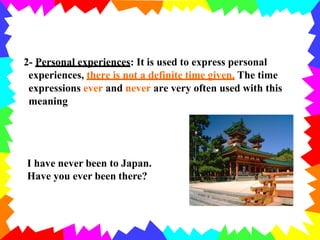
2- Personal experiences: It is used to express personal
experiences, there is not a definite time given. The time
expressions ever and never are very often used with this
meaning
I have never been to Japan.
Have you ever been there?
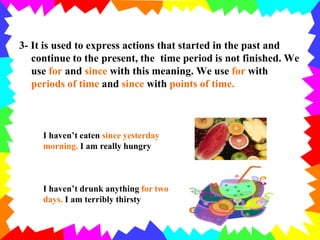
3- It is used to express actions that started in the past and
continue to the present, the time period is not finished. We
use for and since with this meaning. We use for with
periods of time and since with points of time.
I haven’t eaten since yesterday
morning. I am really hungry
I haven’t drunk anything for two
days. I am terribly thirsty
Indefinite time
• We use PPT to indicate an action that
happened in the past but we don’t know
exactly when. ( indefinitive time ). The verb
in Portuguese is in the past .
• Eg.:
•
•
He has bought a car. ( When ? )
They have been to Europe. ( When ? )
Indefinite Time
I have been to New York.
( When ?? )
She has eaten frog´s leg.
( When ?? )
An action started in the past
• We use PPT to indicate an action that began
in the past and continues up to the present.
(the verb in Portuguese is in the present).
• Eg.:
•
•
I’ve lived in Limeira for three years.
She has studied English since January.
• I have worked here since last year.
( How long? )
• She has played tennis for 10 years.
( How long? )
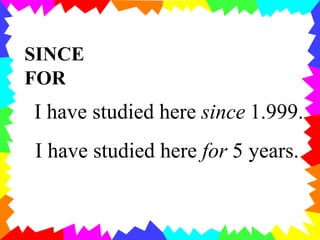
SINCE
FOR
I have studied here since 1.999.
I have studied here for 5 years.
PRESENT PERFECT + for, since
Using the present perfect, we can define a
period of time before now by considering its
starting point, with since + a point in time.
Since + a point in time:
since this morning, since last week,
since yesterday,since I was a child,
since Wednesday, since 2 o'clock.
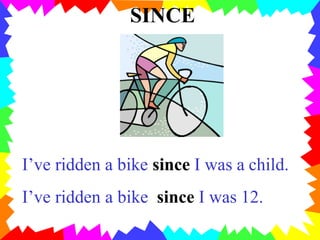
SINCE
I’ve ridden a bike since I was a child.
I’ve ridden a bike since I was 12.
Using the present perfect, we can
define a period of time before
now by considering its duration,
with for + a period of time.
For + a period of time:
for six years, for a week, for a
month, for hours, for two hours.
FOR
They’ve been married for 1 year.
They’ve dated for 3 years.
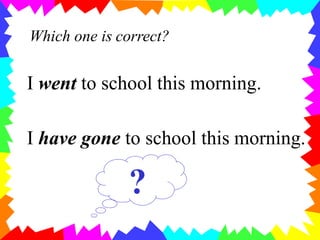
I went to school this morning.
Which one is correct?
I have gone to school this morning.
?
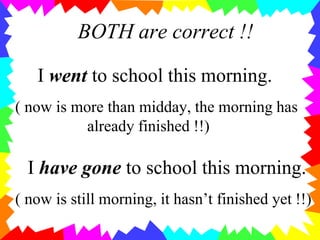
BOTH are correct !!
I went to school this morning.
( now is more than midday, the morning has
already finished !!)
I have gone to school this morning.
( now is still morning, it hasn’t finished yet !!)
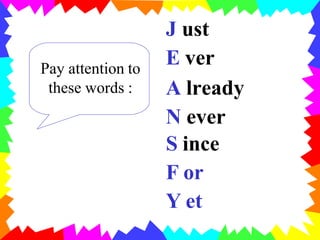
J ust
E ver
A lready
N ever
S ince
F or
Y et
Pay attention to
these words :
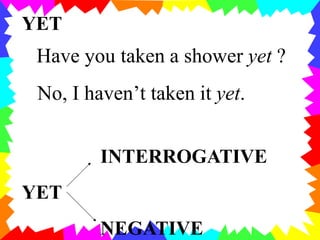
YET
Have you taken a shower yet ?
No, I haven’t taken it yet.
INTERROGATIVE
YET
NEGATIVE
YET
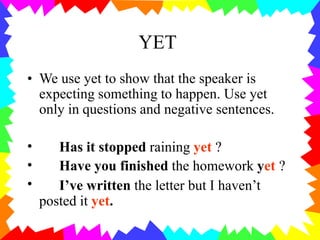
• We use yet to show that the speaker is
expecting something to happen. Use yet
only in questions and negative sentences.
•
•
•
Has it stopped raining yet ?
Have you finished the homework yet ?
I’ve written the letter but I haven’t
posted it yet.
ALREADY
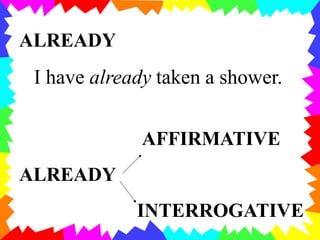
I have already taken a shower.
AFFIRMATIVE
ALREADY
INTERROGATIVE
ALREADY
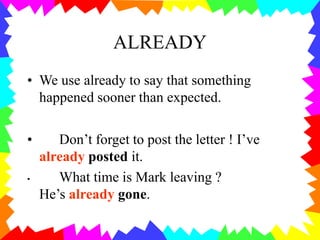
• We use already to say that something
happened sooner than expected.
• Don’t forget to post the letter ! I’ve
already posted it.
• What time is Mark leaving ?
He’s already gone.
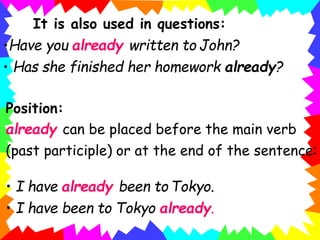
It is also used in questions:
•Have you already written to John?
• Has she finished her homework already?
Position:
already can be placed before the main verb
(past participle) or at the end of the sentence:
• I have already been to Tokyo.
• I have been to Tokyo already.
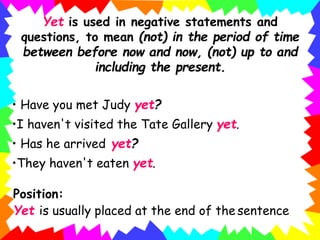
Yet is used in negative statements and
questions, to mean (not) in the period of time
between before now and now, (not) up to and
including the present.
• Have you met Judy yet?
•I haven't visited the Tate Gallery yet.
• Has he arrived yet?
•They haven't eaten yet.
Position:
Yet is usually placed at the end of the sentence
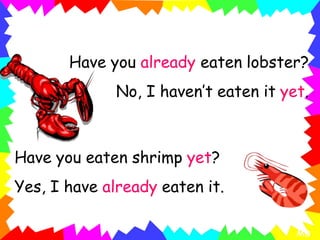
Have you already eaten lobster?
No, I haven’t eaten it yet.
Have you eaten shrimp yet?
Yes, I have already eaten it.
MD
EVER
NEVER
Have you ever ridden a horse?
I have never ridden a horse.
EVER AND NEVER
• Have you ever studied German? No, I’ve
never studied German.
• Has she ever been to the USA ? No, she
has never been to the USA
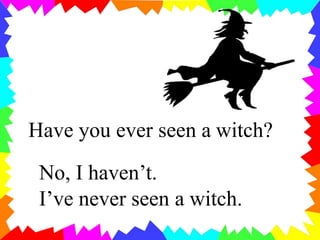
Have you ever seen a witch?
No, I haven’t.
I’ve never seen a witch.
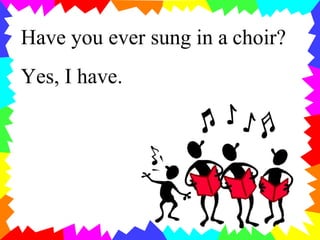
Have you ever sung in a choir?
Yes, I have.
The adverbs ever and never express the idea
of an unidentified time before now
Have you ever visited Berlin?
'Ever' is used
a. in questions.
Have you ever been to England?
Has she ever met the Prime Minister?
b. in negative questions
Haven't they ever been to Europe?
Haven't you ever eaten Chinese food?
c.and in negative statements using the
pattern nothing.......ever, nobody.......ever
Nobody has ever said that to me before.
Nothing like this has ever happened to us.
d.'Ever' is also used with 'The first time....
It's the first time (that) I've ever eaten snails.
This is the first time I've ever been to England.
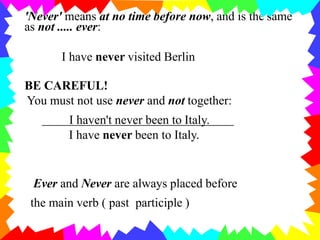
'Never' means at no time before now, and is the same
as not ..... ever:
I have never visited Berlin
BE CAREFUL!
You must not use never and not together:
I haven't never been to Italy.
I have never been to Italy.
Ever and Never are always placed before
the main verb ( past participle )
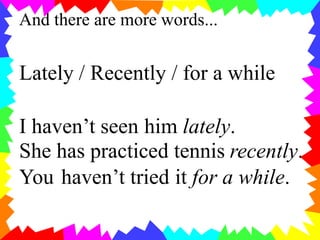
And there are more words...
Lately / Recently / for a while
I haven’t seen him lately.
She has practiced tennis recently.
You haven’t tried it for a while.
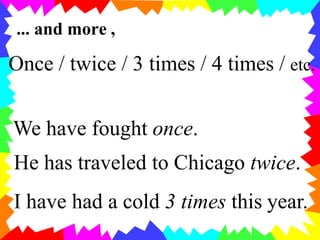
... and more ,
Once / twice / 3 times / 4 times / etc.
We have fought once.
He has traveled to Chicago twice.
I have had a cold 3 times this year.
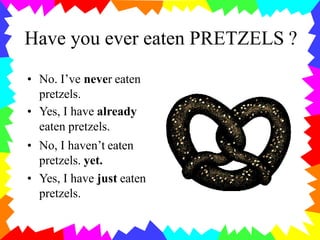
Have you ever eaten PRETZELS ?
• No. I’ve never eaten
pretzels.
• Yes, I have already
eaten pretzels.
• No, I haven’t eaten
pretzels. yet.
• Yes, I have just eaten
pretzels.
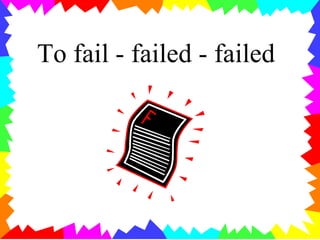
To fail - failed - failed
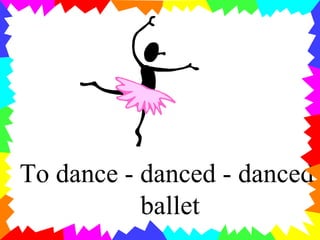
To dance - danced - danced
ballet
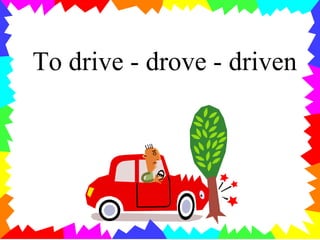
To drive - drove - driven
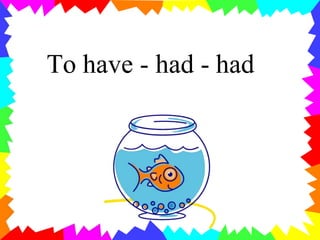
To have - had - had
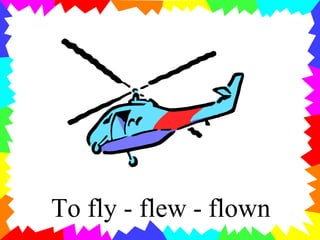
To fly - flew - flown
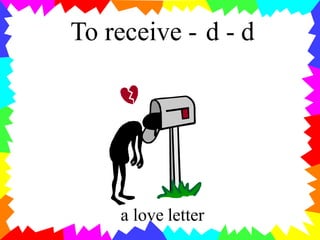
To receive - d - d
a love letter
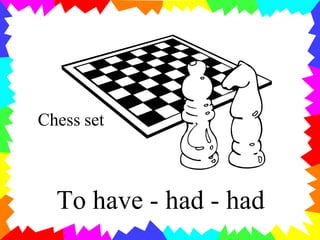
Chess set
To have - had - had
wallet
To find - found - found
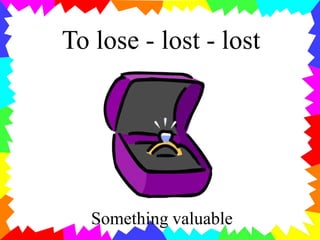
To lose - lost - lost
Something valuable
Let’s practice
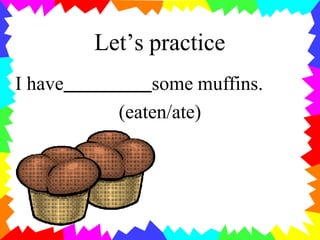
• I have some muffins.
(eaten/ate)
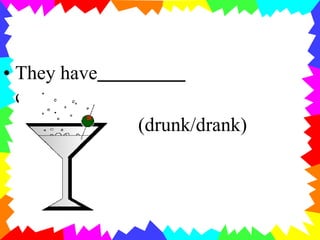
• They have
cocktail.
(drunk/drank)
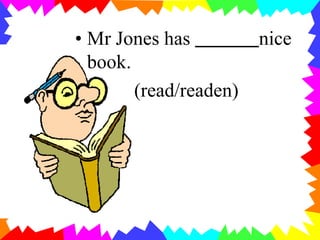
• Mr Jones has nice
book.
(read/readen)
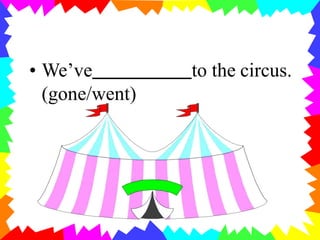
• We’ve to the circus.
(gone/went)
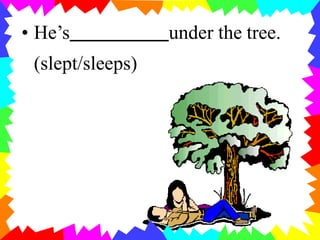
• He’s under the tree.
(slept/sleeps)
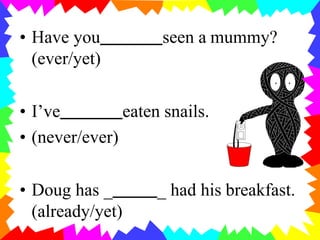
• Have you seen a mummy?
(ever/yet)
• I’ve eaten snails.
• (never/ever)
• Doug has _ _ had his breakfast.
(already/yet)
• Have you finished your work ?
(already/yet)
• Have you called Susan?
(already/yet)
• Jack has gone to work. (just/yet)
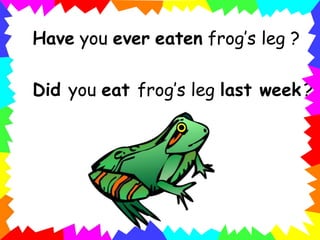
Have you ever eaten frog’s leg ?
Did you eat frog’s leg last week ?
Have you ever visited New York ?
Did you visit New York last year ?
Let’s Practice
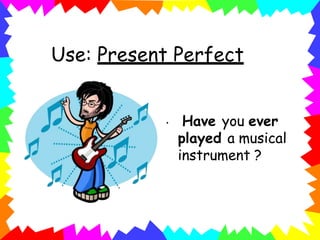
Use: Present Perfect
• Have you ever
played a musical
instrument ?
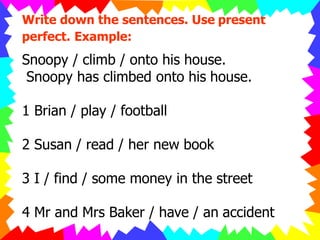
Write down the sentences. Use present
perfect. Example:
Snoopy / climb / onto his house.
Snoopy has climbed onto his house.
1 Brian / play / football
2 Susan / read / her new book
3 I / find / some money in the street
4 Mr and Mrs Baker / have / an accident
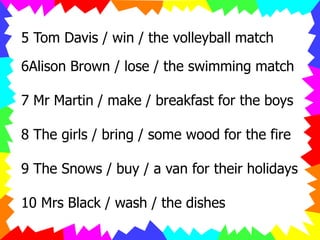
5 Tom Davis / win / the volleyball match
6Alison Brown / lose / the swimming match
7 Mr Martin / make / breakfast for the boys
8 The girls / bring / some wood for the fire
9 The Snows / buy / a van for their holidays
10 Mrs Black / wash / the dishes
SIMPLE PAST
OR
PRESENT PERFECT
? ? ? ? ? ? ? ?
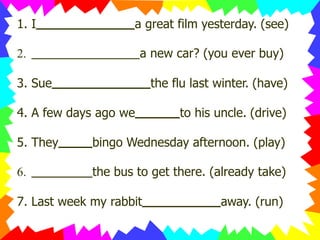
1. I a great film yesterday. (see)
2. a new car? (you ever buy)
3. Sue the flu last winter. (have)
4. A few days ago we to his uncle. (drive)
5. They bingo Wednesday afternoon. (play)
6. the bus to get there. (already take)
7. Last week my rabbit away. (run)
EXERCISES P.P.T.
SINCE - FOR
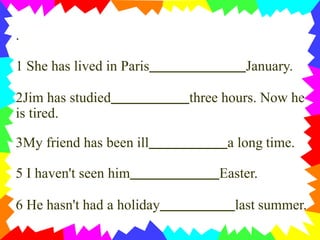
.
1 She has lived in Paris January.
2Jim has studied three hours. Now he
is tired.
3My friend has been ill a long time.
5 I haven't seen him Easter.
6 He hasn't had a holiday last summer.
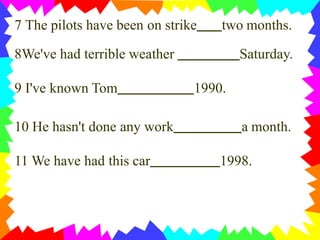
7 The pilots have been on strike two months.
8We've had terrible weather Saturday.
9 I've known Tom 1990.
10 He hasn't done any work a month.
11 We have had this car 1998.

presentperfecttense-200610130757 (1).pdf

  • 1.
  • 2.
    Present Perfect Tense FORM:have / has + past participle Affirmative: I have seen the film before. She has seen the film before. Interrogative: Have you seen the film before? Has she seen the film before? Negative: They haven’t seen the film before. He hasn’t seen the film before.
  • 3.
    The formula ofP.P.T. is this : Have + Has Past participle They have been to N.Y. She has eaten frog´s leg. You haven’t studied a lot.
  • 4.
    I have =´ve been to Moscow. You have = ´ve finished the exercise. He Has = ´s just gone home. She Has = ´s already had aholiday this year. It Has = ´s broken! We have = ´ve seen this film before. They have = ´ve bought anewcar. Positive
  • 5.
    I Have not= haven't been abroad yet. You Have not = haven't answered my question. He Has not = hasn't been home for five years. She Has not = hasn't found anewjob. It Has not = hasn't finished yet. We Have not = haven't worked on a farm. They Have not = haven't seen each other for ages. Negative
  • 6.
    Have I everdone it before? Have you been to the cinema recently? Has he worked here long? Has she already sent the fax? Has it ever been in a crash? Have we done it right? Have they gone home yet? Interrogative
  • 7.
    What have Idone? How long have you been here? How many times has he been married? What countries has she visited? Where has it been? How long have we been together? Where have they worked? Present Perfect –Information Questions
  • 8.
    past participle • seesaw seen • buy bought bought • go went gone • eat ate eaten • come came come • swim swam swum
  • 9.
    Contracted forms seen aghost • I’ve • You’ve • He’s • She’s • it’s • We’ve • They’ve
  • 10.
    Interrogative form • Youhave traveled to Japan twice. (aff) • Have you traveled to Japan twice? (interrogative)
  • 11.
    Have you traveledto Japan twice? • Yes, I have. • No, I haven’t.
  • 12.
    Negative form • Ihave visited the Taj Mahal. • I have .... visited the Taj Mahal. • I have NOT visited the Taj Mahal. • I haven’t seen you for weeks ! • He hasn’t arrived home.
  • 13.
    1- Recent events:It is used to describe recent events without a definite time. The idea of time or place in the speaker’s mind makes the event recent. A time expression may emphasize recentness: just, recently, lately Uses of the present perfect Why are they so happy? They have just won a prize so they are really pleased
  • 14.
    JUST I have justfinished my exercise. He has just had lunch.
  • 15.
    2- Personal experiences:It is used to express personal experiences, there is not a definite time given. The time expressions ever and never are very often used with this meaning I have never been to Japan. Have you ever been there?
  • 16.
    3- It isused to express actions that started in the past and continue to the present, the time period is not finished. We use for and since with this meaning. We use for with periods of time and since with points of time. I haven’t eaten since yesterday morning. I am really hungry I haven’t drunk anything for two days. I am terribly thirsty
  • 17.
    Indefinite time • Weuse PPT to indicate an action that happened in the past but we don’t know exactly when. ( indefinitive time ). The verb in Portuguese is in the past . • Eg.: • • He has bought a car. ( When ? ) They have been to Europe. ( When ? )
  • 18.
    Indefinite Time I havebeen to New York. ( When ?? ) She has eaten frog´s leg. ( When ?? )
  • 19.
    An action startedin the past • We use PPT to indicate an action that began in the past and continues up to the present. (the verb in Portuguese is in the present). • Eg.: • • I’ve lived in Limeira for three years. She has studied English since January.
  • 20.
    • I haveworked here since last year. ( How long? ) • She has played tennis for 10 years. ( How long? )
  • 21.
    SINCE FOR I have studiedhere since 1.999. I have studied here for 5 years.
  • 22.
    PRESENT PERFECT +for, since Using the present perfect, we can define a period of time before now by considering its starting point, with since + a point in time. Since + a point in time: since this morning, since last week, since yesterday,since I was a child, since Wednesday, since 2 o'clock.
  • 23.
    SINCE I’ve ridden abike since I was a child. I’ve ridden a bike since I was 12.
  • 24.
    Using the presentperfect, we can define a period of time before now by considering its duration, with for + a period of time. For + a period of time: for six years, for a week, for a month, for hours, for two hours.
  • 25.
    FOR They’ve been marriedfor 1 year. They’ve dated for 3 years.
  • 26.
    I went toschool this morning. Which one is correct? I have gone to school this morning. ?
  • 27.
    BOTH are correct!! I went to school this morning. ( now is more than midday, the morning has already finished !!) I have gone to school this morning. ( now is still morning, it hasn’t finished yet !!)
  • 28.
    J ust E ver Already N ever S ince F or Y et Pay attention to these words :
  • 29.
    YET Have you takena shower yet ? No, I haven’t taken it yet. INTERROGATIVE YET NEGATIVE
  • 30.
    YET • We useyet to show that the speaker is expecting something to happen. Use yet only in questions and negative sentences. • • • Has it stopped raining yet ? Have you finished the homework yet ? I’ve written the letter but I haven’t posted it yet.
  • 31.
    ALREADY I have alreadytaken a shower. AFFIRMATIVE ALREADY INTERROGATIVE
  • 32.
    ALREADY • We usealready to say that something happened sooner than expected. • Don’t forget to post the letter ! I’ve already posted it. • What time is Mark leaving ? He’s already gone.
  • 33.
    It is alsoused in questions: •Have you already written to John? • Has she finished her homework already? Position: already can be placed before the main verb (past participle) or at the end of the sentence: • I have already been to Tokyo. • I have been to Tokyo already.
  • 34.
    Yet is usedin negative statements and questions, to mean (not) in the period of time between before now and now, (not) up to and including the present. • Have you met Judy yet? •I haven't visited the Tate Gallery yet. • Has he arrived yet? •They haven't eaten yet. Position: Yet is usually placed at the end of the sentence
  • 35.
    Have you alreadyeaten lobster? No, I haven’t eaten it yet. Have you eaten shrimp yet? Yes, I have already eaten it. MD
  • 36.
    EVER NEVER Have you everridden a horse? I have never ridden a horse.
  • 37.
    EVER AND NEVER •Have you ever studied German? No, I’ve never studied German. • Has she ever been to the USA ? No, she has never been to the USA
  • 38.
    Have you everseen a witch? No, I haven’t. I’ve never seen a witch.
  • 39.
    Have you eversung in a choir? Yes, I have.
  • 40.
    The adverbs everand never express the idea of an unidentified time before now Have you ever visited Berlin? 'Ever' is used a. in questions. Have you ever been to England? Has she ever met the Prime Minister?
  • 41.
    b. in negativequestions Haven't they ever been to Europe? Haven't you ever eaten Chinese food? c.and in negative statements using the pattern nothing.......ever, nobody.......ever Nobody has ever said that to me before. Nothing like this has ever happened to us. d.'Ever' is also used with 'The first time.... It's the first time (that) I've ever eaten snails. This is the first time I've ever been to England.
  • 42.
    'Never' means atno time before now, and is the same as not ..... ever: I have never visited Berlin BE CAREFUL! You must not use never and not together: I haven't never been to Italy. I have never been to Italy. Ever and Never are always placed before the main verb ( past participle )
  • 43.
    And there aremore words... Lately / Recently / for a while I haven’t seen him lately. She has practiced tennis recently. You haven’t tried it for a while.
  • 44.
    ... and more, Once / twice / 3 times / 4 times / etc. We have fought once. He has traveled to Chicago twice. I have had a cold 3 times this year.
  • 45.
    Have you evereaten PRETZELS ? • No. I’ve never eaten pretzels. • Yes, I have already eaten pretzels. • No, I haven’t eaten pretzels. yet. • Yes, I have just eaten pretzels.
  • 47.
    To fail -failed - failed
  • 48.
    To dance -danced - danced ballet
  • 49.
    To drive -drove - driven
  • 50.
    To have -had - had
  • 51.
    To fly -flew - flown
  • 52.
    To receive -d - d a love letter
  • 53.
    Chess set To have- had - had
  • 54.
    wallet To find -found - found
  • 55.
    To lose -lost - lost Something valuable
  • 56.
    Let’s practice • Ihave some muffins. (eaten/ate)
  • 57.
  • 58.
    • Mr Joneshas nice book. (read/readen)
  • 59.
    • We’ve tothe circus. (gone/went)
  • 60.
    • He’s underthe tree. (slept/sleeps)
  • 61.
    • Have youseen a mummy? (ever/yet) • I’ve eaten snails. • (never/ever) • Doug has _ _ had his breakfast. (already/yet)
  • 62.
    • Have youfinished your work ? (already/yet) • Have you called Susan? (already/yet) • Jack has gone to work. (just/yet)
  • 63.
    Have you evereaten frog’s leg ? Did you eat frog’s leg last week ?
  • 64.
    Have you evervisited New York ? Did you visit New York last year ?
  • 65.
  • 66.
    Use: Present Perfect •Have you ever played a musical instrument ?
  • 67.
    Write down thesentences. Use present perfect. Example: Snoopy / climb / onto his house. Snoopy has climbed onto his house. 1 Brian / play / football 2 Susan / read / her new book 3 I / find / some money in the street 4 Mr and Mrs Baker / have / an accident
  • 68.
    5 Tom Davis/ win / the volleyball match 6Alison Brown / lose / the swimming match 7 Mr Martin / make / breakfast for the boys 8 The girls / bring / some wood for the fire 9 The Snows / buy / a van for their holidays 10 Mrs Black / wash / the dishes
  • 69.
  • 70.
    1. I agreat film yesterday. (see) 2. a new car? (you ever buy) 3. Sue the flu last winter. (have) 4. A few days ago we to his uncle. (drive) 5. They bingo Wednesday afternoon. (play) 6. the bus to get there. (already take) 7. Last week my rabbit away. (run)
  • 71.
  • 72.
    . 1 She haslived in Paris January. 2Jim has studied three hours. Now he is tired. 3My friend has been ill a long time. 5 I haven't seen him Easter. 6 He hasn't had a holiday last summer.
  • 73.
    7 The pilotshave been on strike two months. 8We've had terrible weather Saturday. 9 I've known Tom 1990. 10 He hasn't done any work a month. 11 We have had this car 1998.