By Professor : Dra. María Elena Villafuerte Castro
UNIVERSIDAD NACIONAL JOSÉ
FAUSTTINO SÁNCHEZ CARRIÓN
INGLÉS III
IV - CICLO
The Present
Perfect
Tense
Facultad de Derecho y Ciencias Políticas
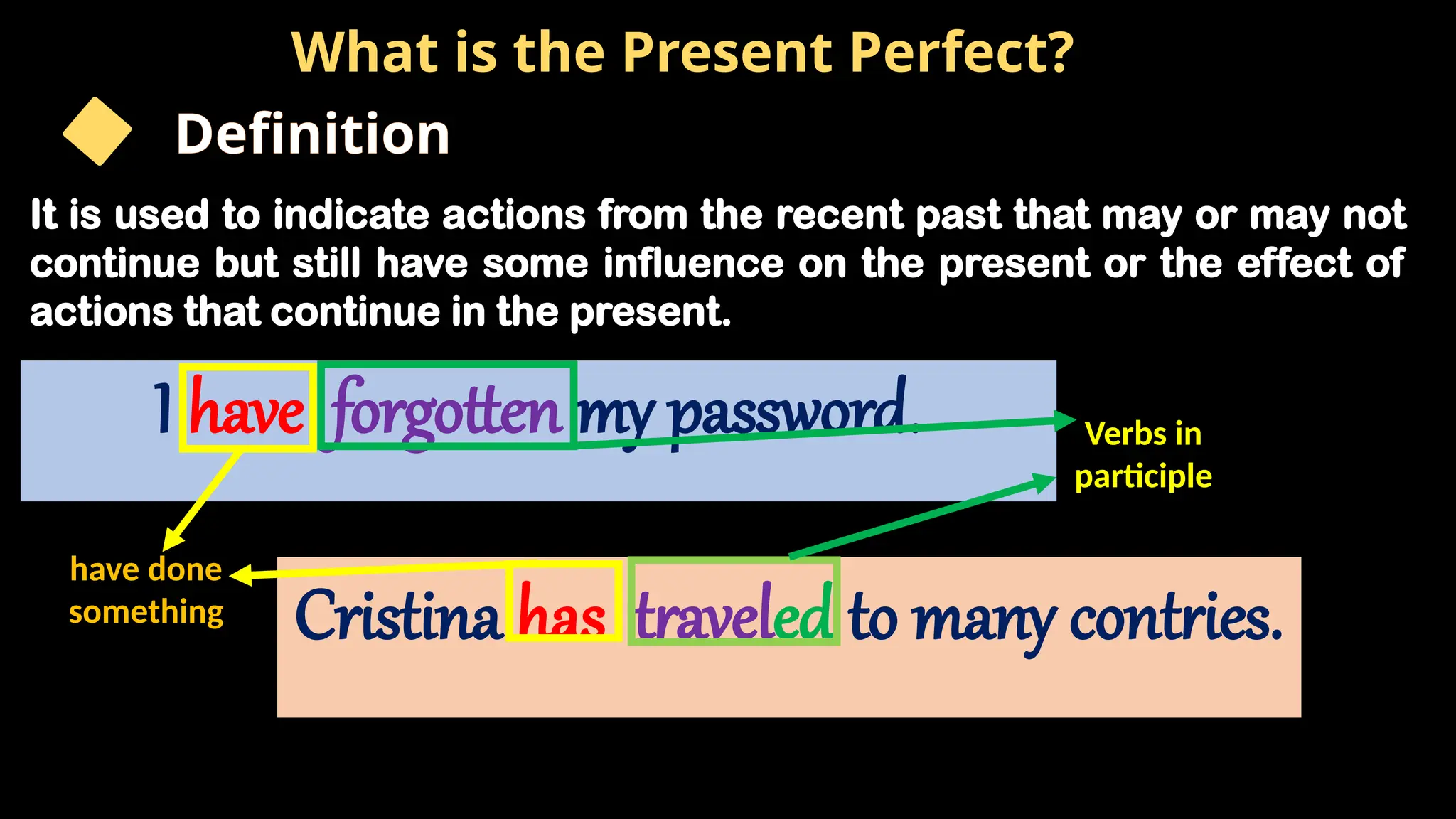
It is used to indicate actions from the recent past that may or may not
continue but still have some influence on the present or the effect of
actions that continue in the present.
I have forgotten my password.
Cristina has traveled to many contries.
Verbs in
participle
have done
something
Definition
What is the Present Perfect?
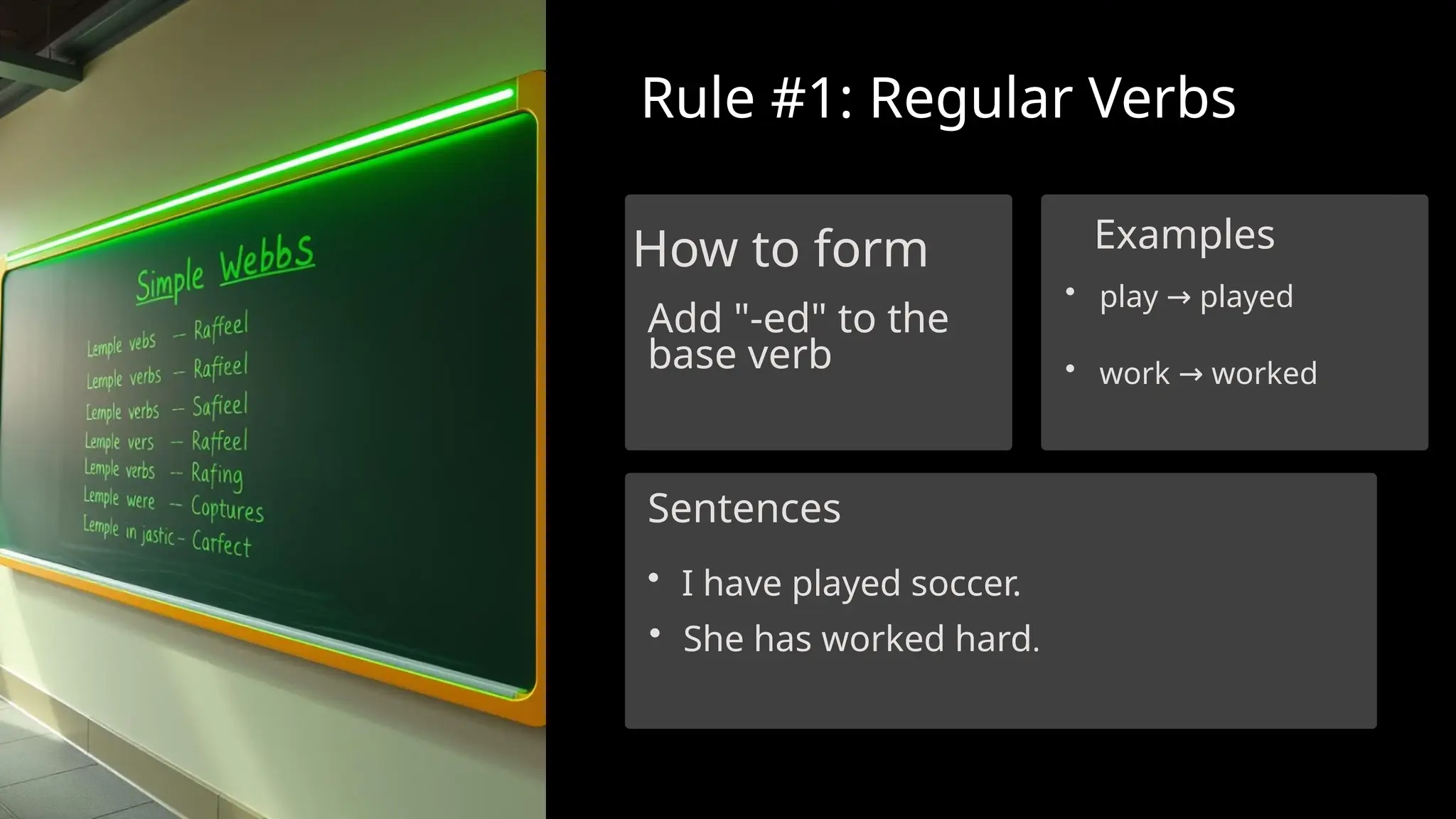
Rule #1: Regular Verbs
How to form
Add "-ed" to the
base verb
Examples
• play played
→
• work worked
→
Sentences
• I have played soccer.
• She has worked hard.
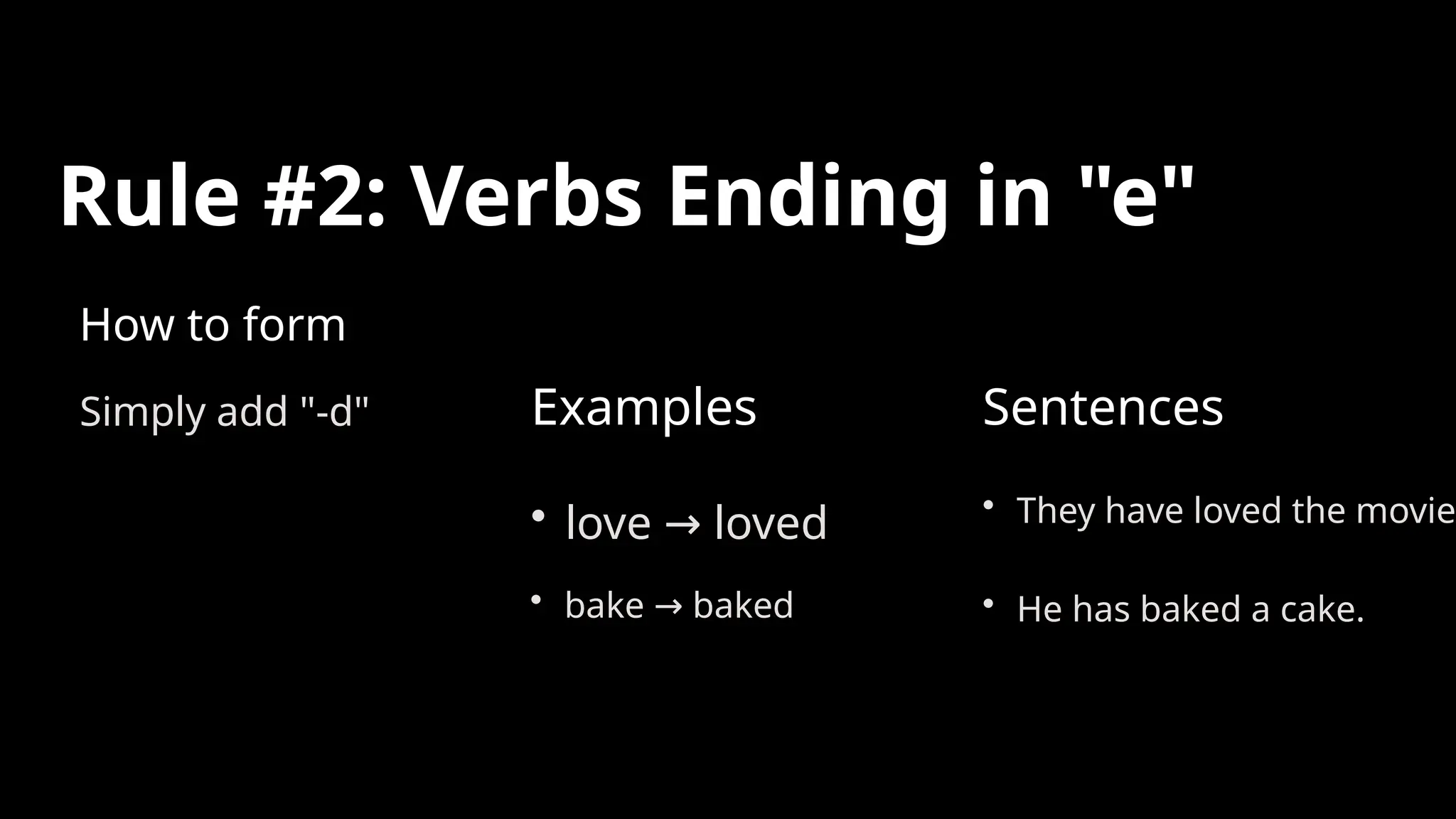
Rule #2: Verbs Ending in "e"
How to form
Simply add "-d" Examples
• love loved
→
• bake baked
→
Sentences
• They have loved the movie.
• He has baked a cake.
Rule #3: Verbs Ending
in "y"
Before Y: Consonant?
Change "y" to "i" and add "-ed"
Examples
• study studied
→
• cry cried
→
Sentences
• She has studied English.
• The baby has cried.
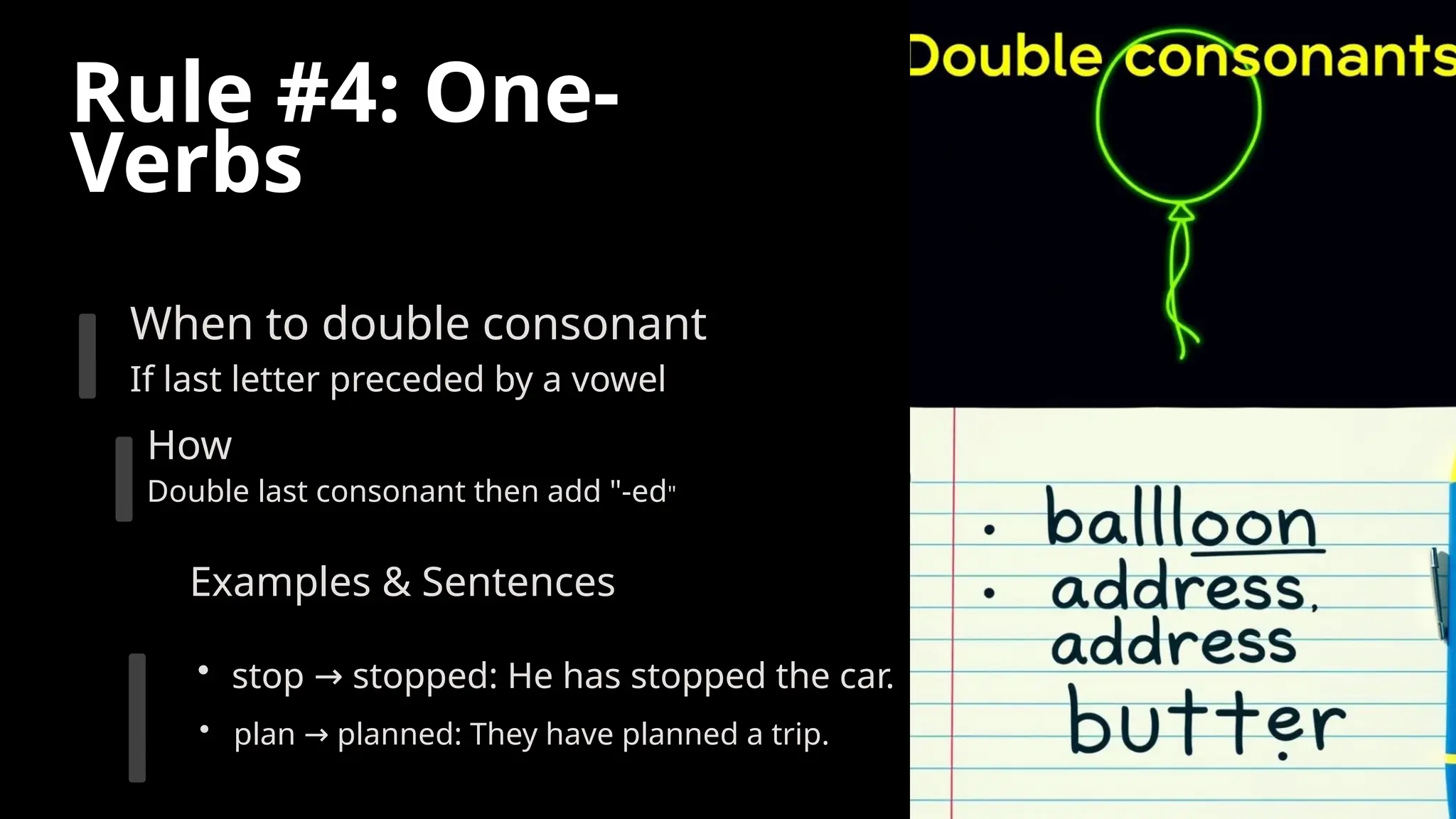
Rule #4: One-
Verbs
When to double consonant
If last letter preceded by a vowel
How
Double last consonant then add "-ed"
Examples & Sentences
• stop stopped: He has stopped the car.
→
• plan planned: They have planned a trip.
→
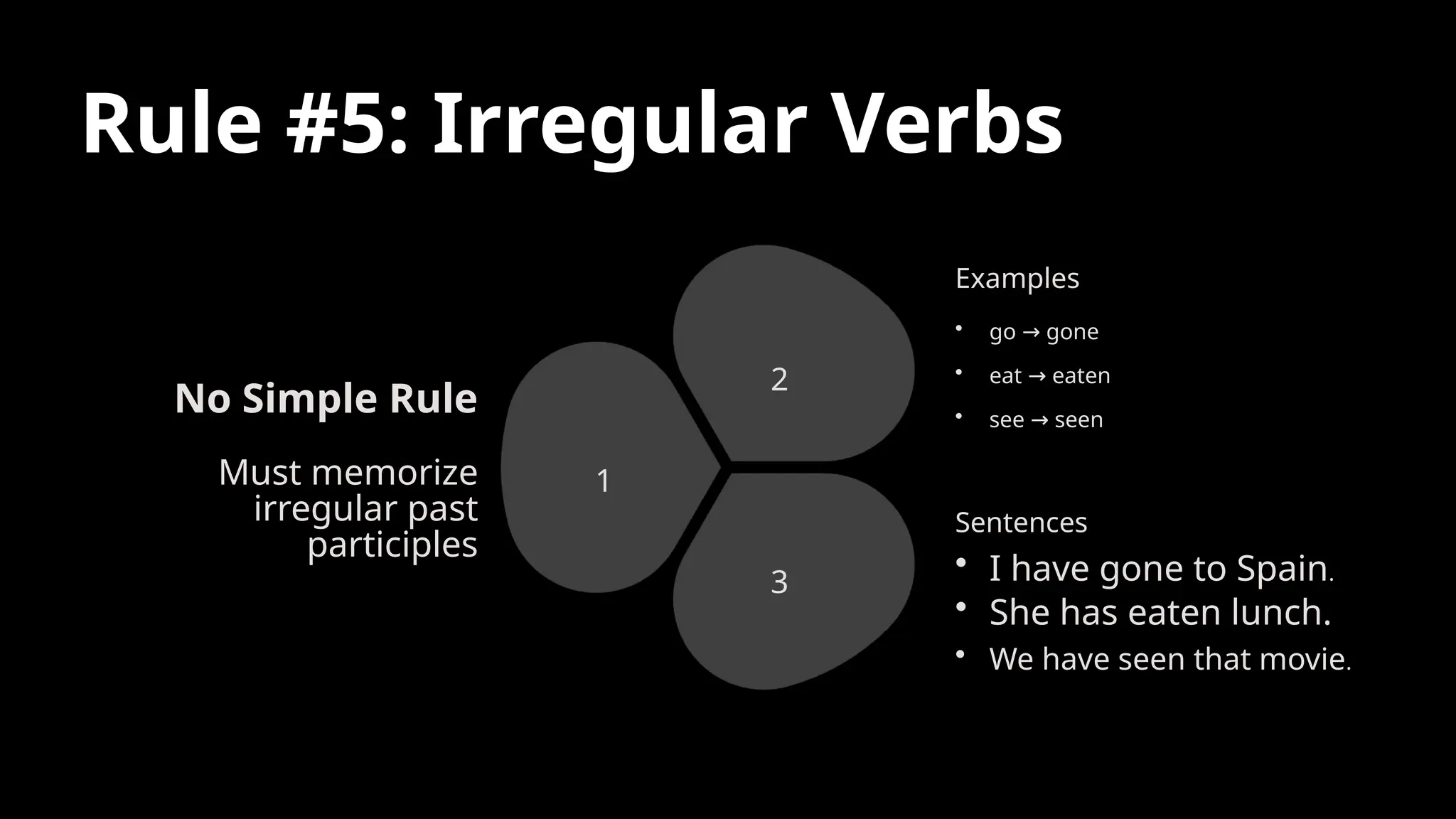
Rule #5: Irregular Verbs
No Simple Rule
Must memorize
irregular past
participles
1
Examples
• go gone
→
• eat eaten
→
• see seen
→
2
Sentences
• I have gone to Spain.
• She has eaten lunch.
• We have seen that movie.
3
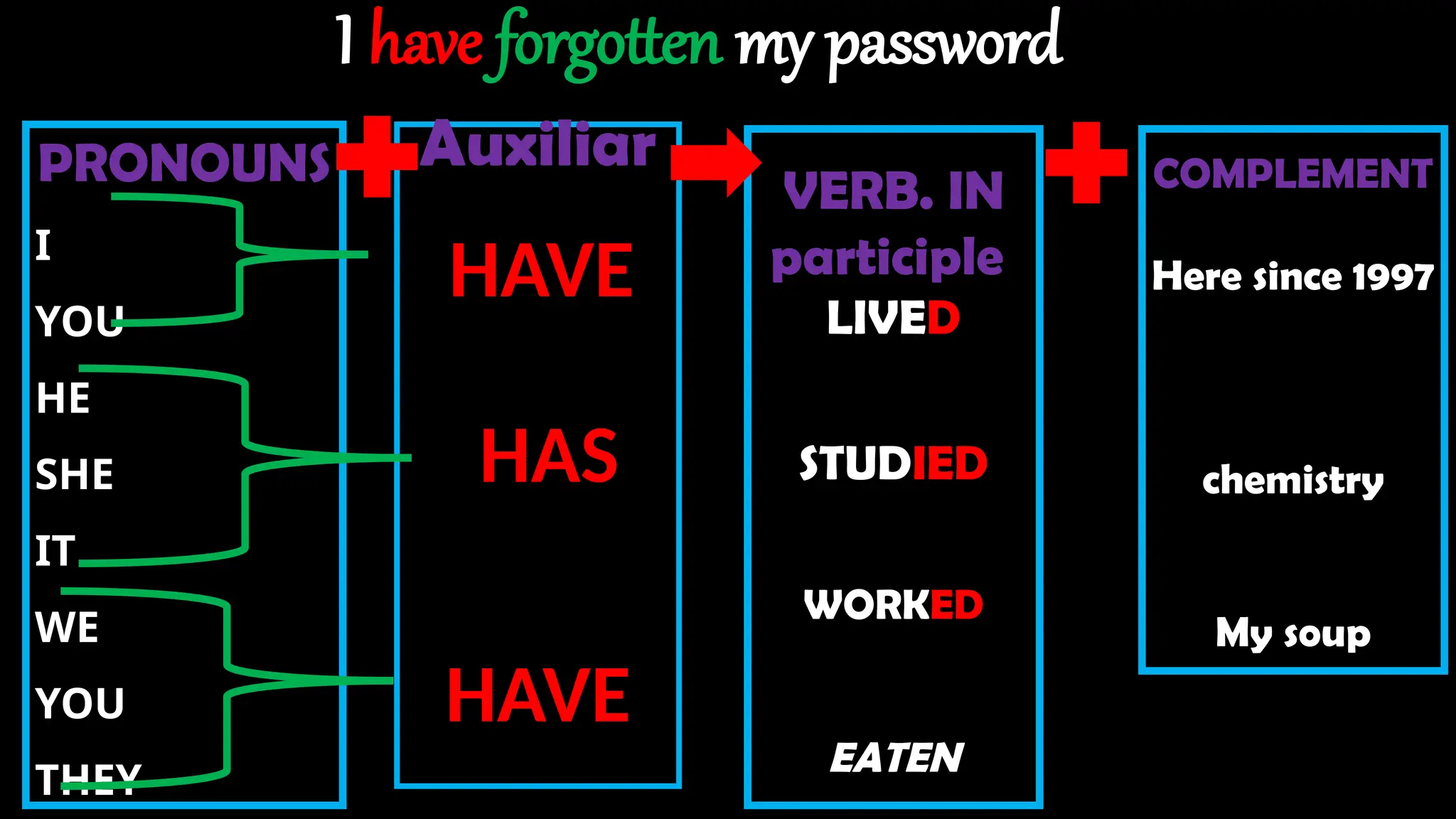
PRONOUNS
I
YOU
HE
SHE
IT
WE
YOU
THEY
Auxiliar
VERB. IN
participle
LIVED
STUDIED
WORKED
EATEN
COMPLEMENT
Here since 1997
chemistry
My soup
HAVE
HAS
HAVE
I have forgotten my password
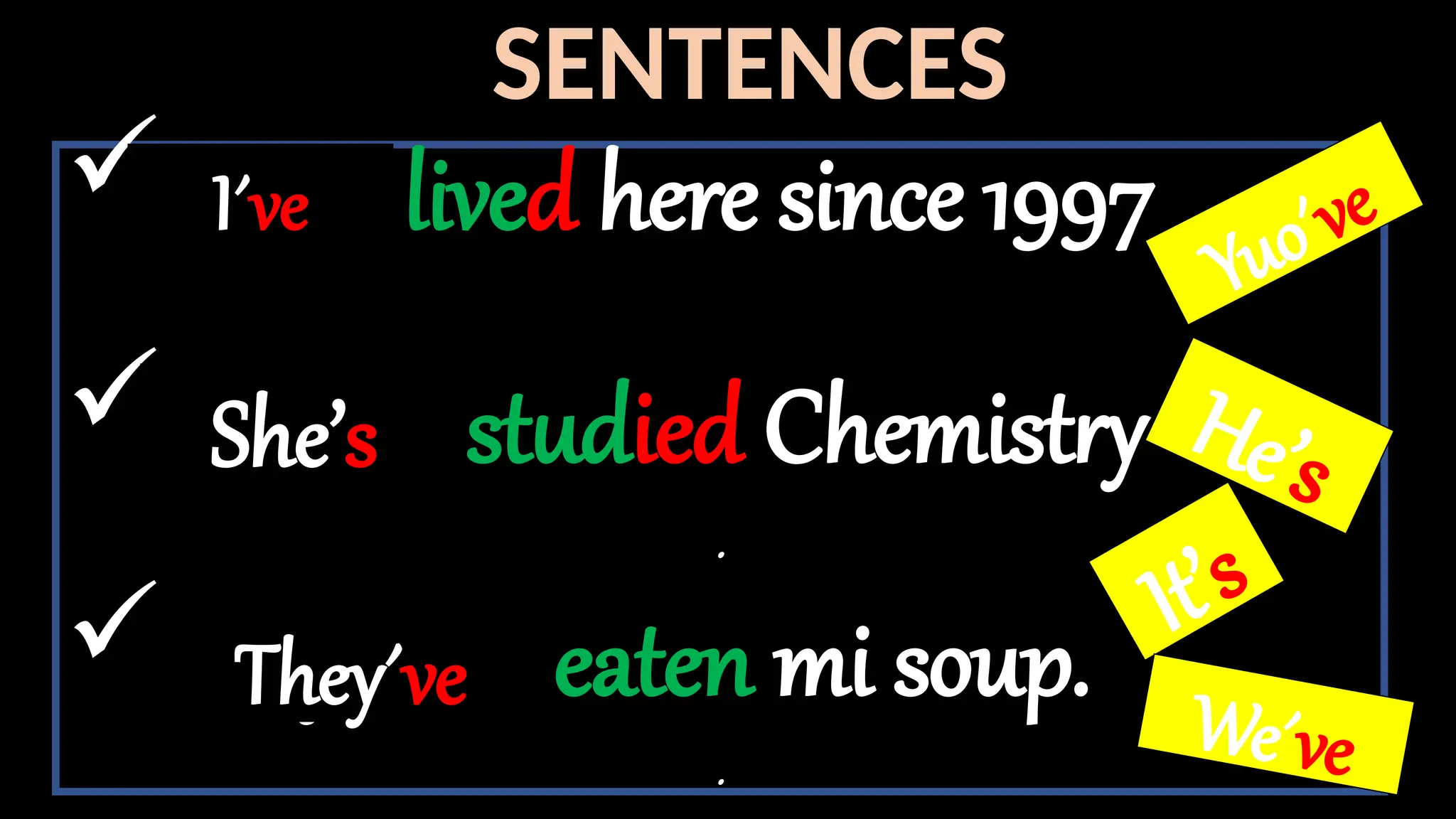
SENTENCES
I have lived here since 1997
She has studied Chemistry
.
They have eaten mi soup.
.
I´ve
She’s
They´ve
Yuo´ve
He’s
It’s
We´ve
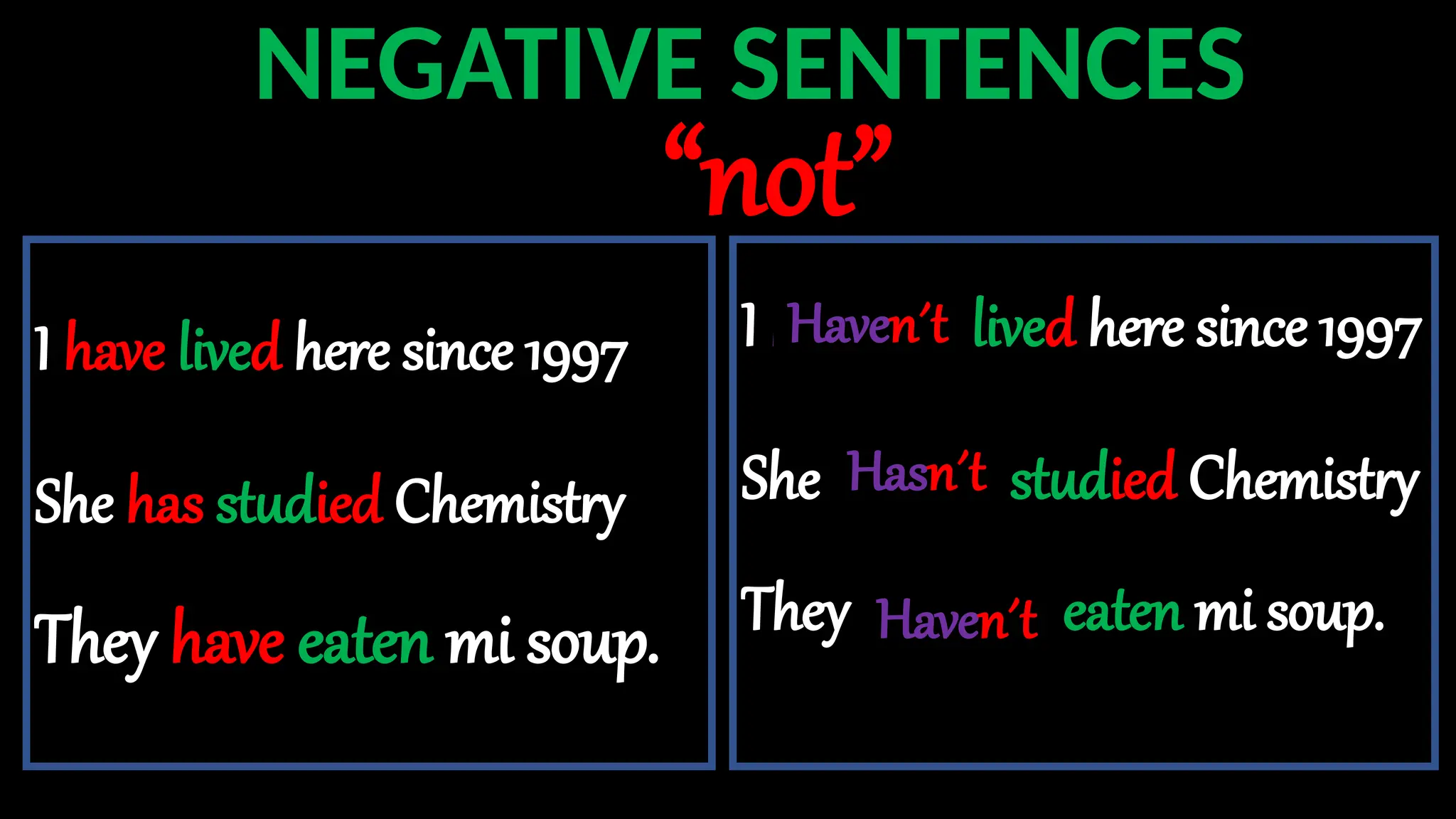
NEGATIVE SENTENCES
I have lived here since 1997
She has studied Chemistry
They have eaten mi soup.
“not”
I have not lived here since 1997
She has not studied Chemistry
They have not eaten mi soup.
Haven´t
Hasn´t
Haven´t
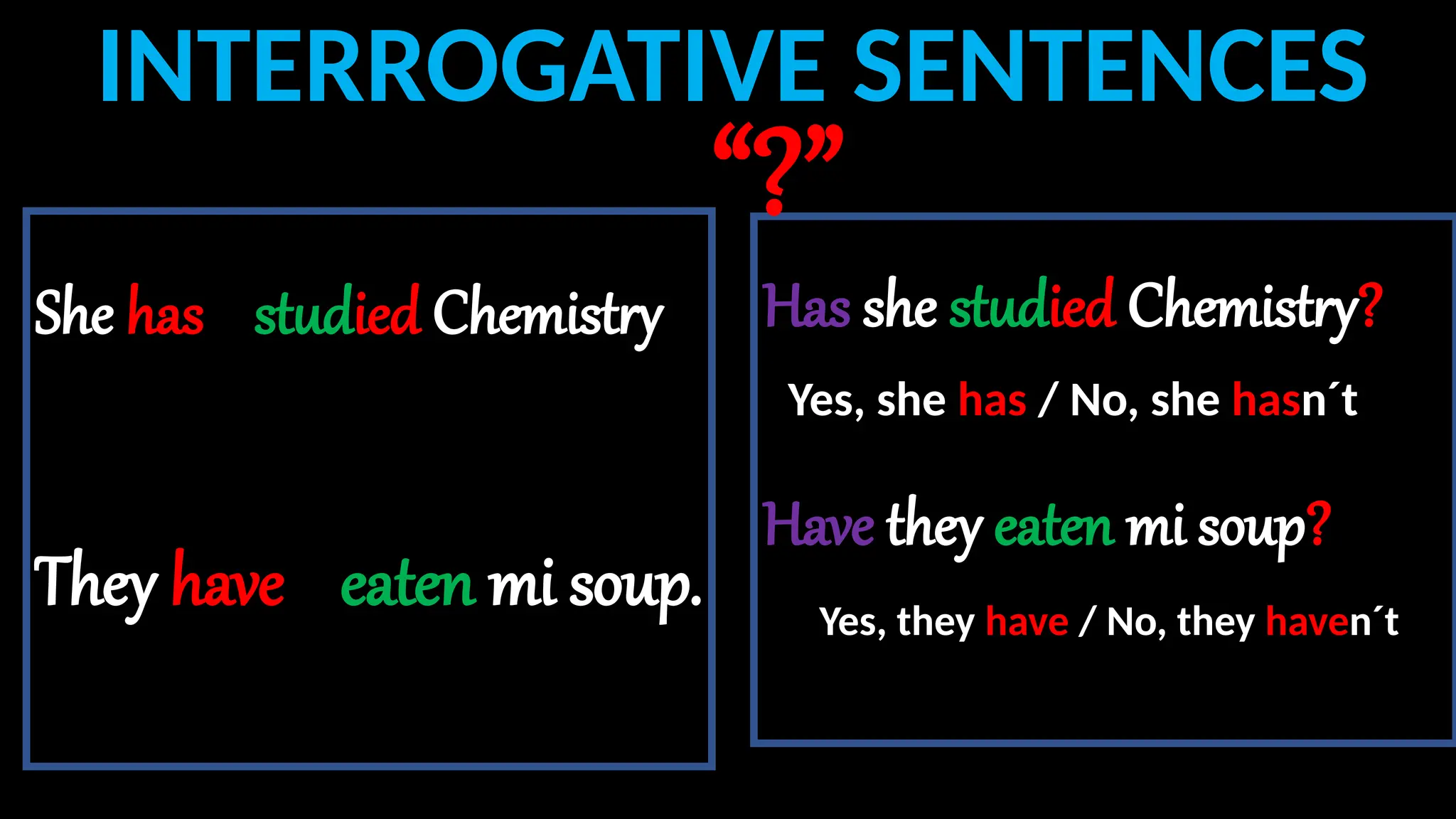
Has she studied Chemistry?
Have they eaten mi soup?
INTERROGATIVE SENTENCES
She has studied Chemistry
They have eaten mi soup.
“?”
Yes, she has / No, she hasn´t
Yes, they have / No, they haven´t
USES OF PRESENT PERFECT
My boss has decided fire me.
Cristina has traveled a lot.
We use it to talk about recent past actions of which we are
only interested in their results or the effect they produce in
the present.
I have finished my homework.
ACHIEVEMENT:
EXPERIENCE:
#1
USES OF PRESENT PERFECT
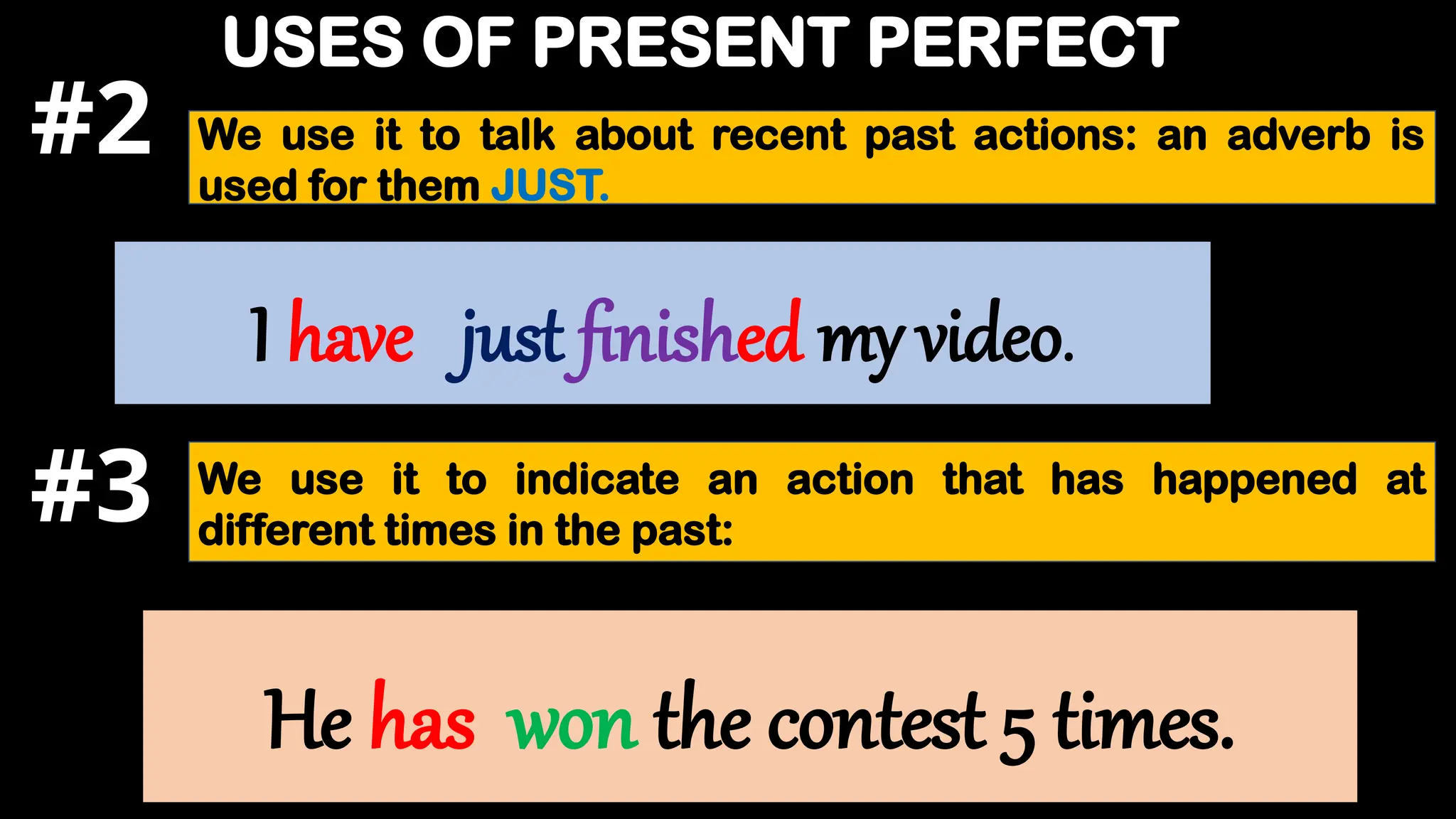
He has won the contest 5 times.
We use it to talk about recent past actions: an adverb is
used for them JUST.
I have just finished my video.
We use it to indicate an action that has happened at
different times in the past:
#2
#3
USES OF PRESENT PERFECT
Ana has written 2 books this year.
We use it to talk about past actions that happened in a
period of time not yet concluded:
“today” “this week” “this month” “this year”
I have already eaten 4 desserts today.
#4
USES OF PRESENT PERFECT
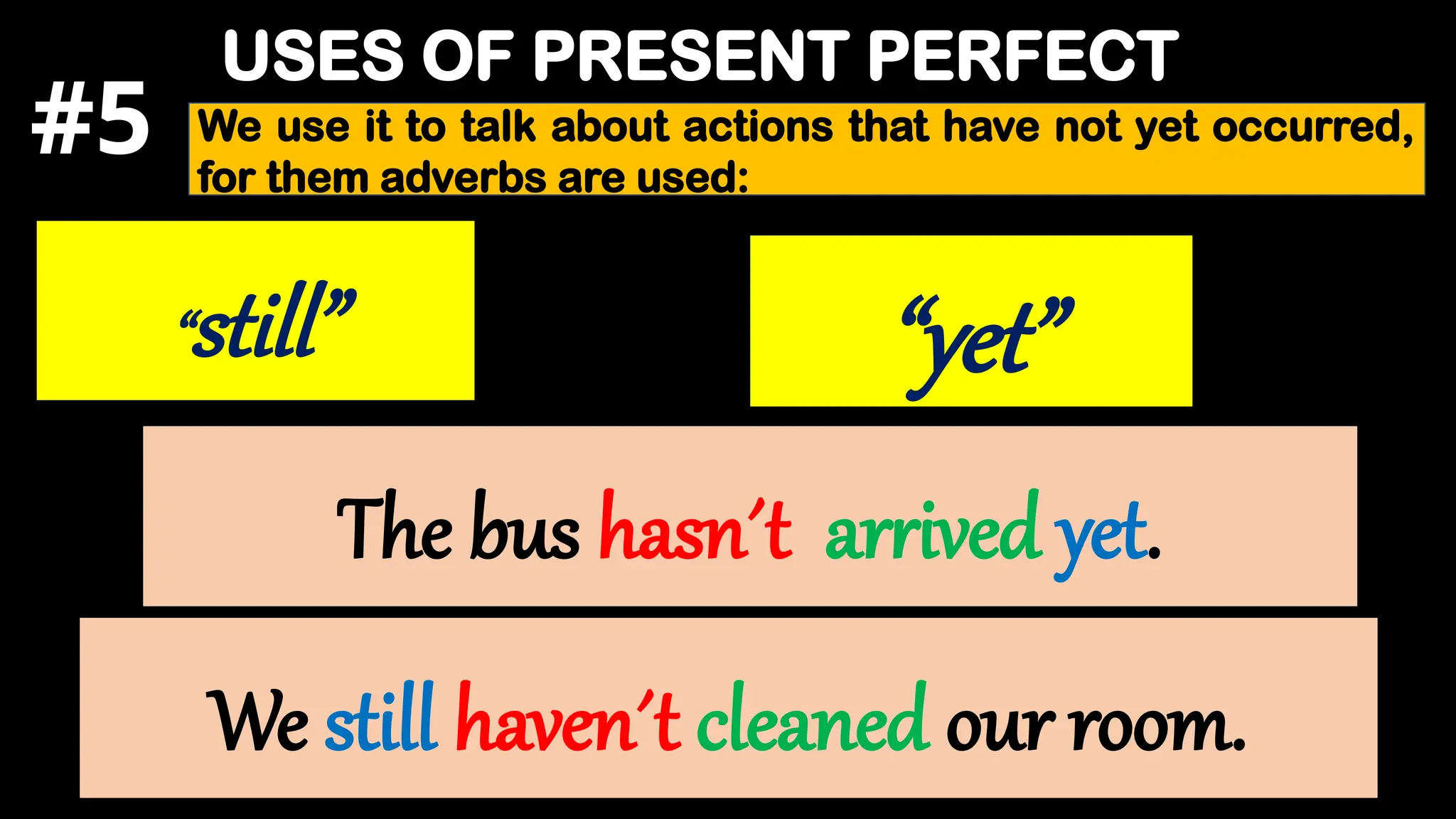
The bus hasn´t arrived yet.
We use it to talk about actions that have not yet occurred,
for them adverbs are used:
“still” “yet”
We still haven´t cleaned our room.
#5
USES OF PRESENT PERFECT
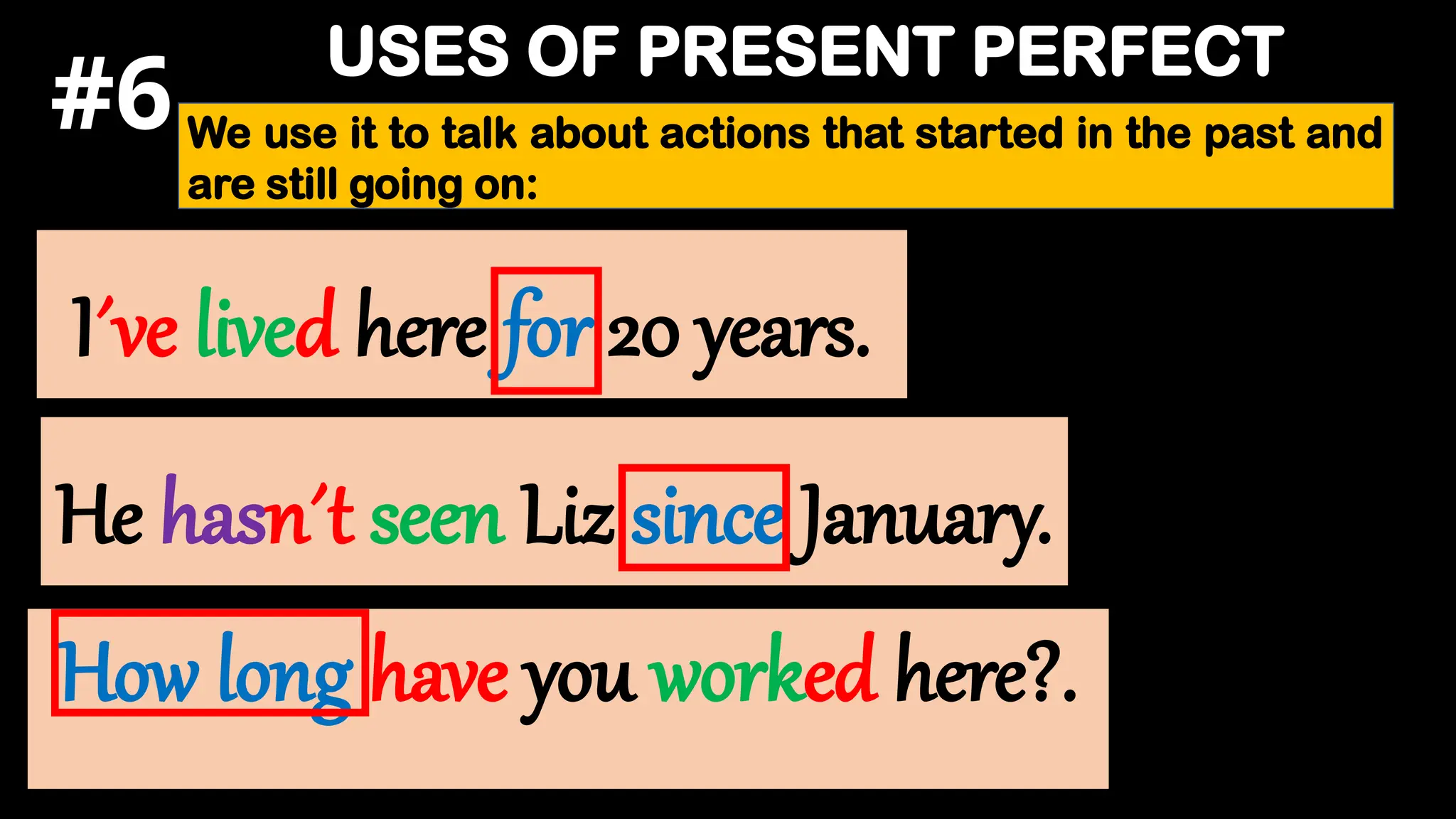
I´ve lived here for 20 years.
We use it to talk about actions that started in the past and
are still going on:
How long have you worked here?.
He hasn´t seen Liz since January.
#6
USES OF PRESENT PERFECT
I have worked here yesterday.
In PRESENT PERFECT expressions it does not matter when the
actions occurred.
at 4 pm.
last year.
I worked here yesterday.
USES OF PRESENT PERFECT
have you finished here yet?
In the PRESENT PERFECT we use non-specific adverbs of time
such as:
never
Have you ever flown an airplane.
always lately
since for ever
yet
(todavía)
(ya) ?
still
(todavía)
already
(ya) +
(ya) ?
have you already finished?
just
(acabar de)
Practice Makes
Perfect!
Present Perfect: Irregular Verbs
Many Present Perfect tense verbs are
irregular. Study the grammar reference chart
below. Below are 64 commonly used Present
Perfect irregular verbs in English. For example:
“I swim in a swimming pool every week.”
“I have swum in the Pacific Ocean.”
With your team, choose a number, then write a
sentence on the board using your group's chosen
verb.

PRESENT PERFECT TENSE.pptx 2025 Lima per

  • 1.
    By Professor :Dra. María Elena Villafuerte Castro UNIVERSIDAD NACIONAL JOSÉ FAUSTTINO SÁNCHEZ CARRIÓN INGLÉS III IV - CICLO The Present Perfect Tense Facultad de Derecho y Ciencias Políticas
  • 3.
    It is usedto indicate actions from the recent past that may or may not continue but still have some influence on the present or the effect of actions that continue in the present. I have forgotten my password. Cristina has traveled to many contries. Verbs in participle have done something Definition What is the Present Perfect?
  • 4.
    Rule #1: RegularVerbs How to form Add "-ed" to the base verb Examples • play played → • work worked → Sentences • I have played soccer. • She has worked hard.
  • 5.
    Rule #2: VerbsEnding in "e" How to form Simply add "-d" Examples • love loved → • bake baked → Sentences • They have loved the movie. • He has baked a cake.
  • 6.
    Rule #3: VerbsEnding in "y" Before Y: Consonant? Change "y" to "i" and add "-ed" Examples • study studied → • cry cried → Sentences • She has studied English. • The baby has cried.
  • 7.
    Rule #4: One- Verbs Whento double consonant If last letter preceded by a vowel How Double last consonant then add "-ed" Examples & Sentences • stop stopped: He has stopped the car. → • plan planned: They have planned a trip. →
  • 8.
    Rule #5: IrregularVerbs No Simple Rule Must memorize irregular past participles 1 Examples • go gone → • eat eaten → • see seen → 2 Sentences • I have gone to Spain. • She has eaten lunch. • We have seen that movie. 3
  • 9.
  • 10.
    SENTENCES I have livedhere since 1997 She has studied Chemistry . They have eaten mi soup. . I´ve She’s They´ve Yuo´ve He’s It’s We´ve
  • 11.
    NEGATIVE SENTENCES I havelived here since 1997 She has studied Chemistry They have eaten mi soup. “not” I have not lived here since 1997 She has not studied Chemistry They have not eaten mi soup. Haven´t Hasn´t Haven´t
  • 12.
    Has she studiedChemistry? Have they eaten mi soup? INTERROGATIVE SENTENCES She has studied Chemistry They have eaten mi soup. “?” Yes, she has / No, she hasn´t Yes, they have / No, they haven´t
  • 13.
    USES OF PRESENTPERFECT My boss has decided fire me. Cristina has traveled a lot. We use it to talk about recent past actions of which we are only interested in their results or the effect they produce in the present. I have finished my homework. ACHIEVEMENT: EXPERIENCE: #1
  • 14.
    USES OF PRESENTPERFECT He has won the contest 5 times. We use it to talk about recent past actions: an adverb is used for them JUST. I have just finished my video. We use it to indicate an action that has happened at different times in the past: #2 #3
  • 15.
    USES OF PRESENTPERFECT Ana has written 2 books this year. We use it to talk about past actions that happened in a period of time not yet concluded: “today” “this week” “this month” “this year” I have already eaten 4 desserts today. #4
  • 16.
    USES OF PRESENTPERFECT The bus hasn´t arrived yet. We use it to talk about actions that have not yet occurred, for them adverbs are used: “still” “yet” We still haven´t cleaned our room. #5
  • 17.
    USES OF PRESENTPERFECT I´ve lived here for 20 years. We use it to talk about actions that started in the past and are still going on: How long have you worked here?. He hasn´t seen Liz since January. #6
  • 18.
    USES OF PRESENTPERFECT I have worked here yesterday. In PRESENT PERFECT expressions it does not matter when the actions occurred. at 4 pm. last year. I worked here yesterday.
  • 19.
    USES OF PRESENTPERFECT have you finished here yet? In the PRESENT PERFECT we use non-specific adverbs of time such as: never Have you ever flown an airplane. always lately since for ever yet (todavía) (ya) ? still (todavía) already (ya) + (ya) ? have you already finished? just (acabar de)
  • 20.
    Practice Makes Perfect! Present Perfect:Irregular Verbs Many Present Perfect tense verbs are irregular. Study the grammar reference chart below. Below are 64 commonly used Present Perfect irregular verbs in English. For example: “I swim in a swimming pool every week.” “I have swum in the Pacific Ocean.” With your team, choose a number, then write a sentence on the board using your group's chosen verb.